
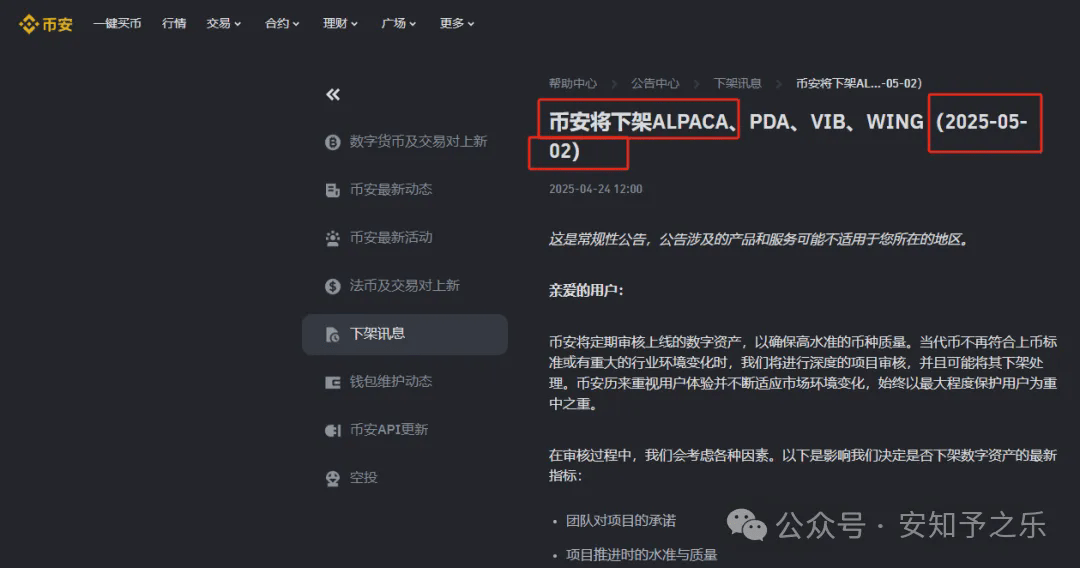
On April 24, 2025, Alpaca Finance (ALPACA) unfortunately made it to Binance's delisting list and instantly became a hot topic. According to the usual pattern, coins that are delisted typically drop 50% first, then slowly decline over the next few days, and finally struggle with a few rebounds, squeezing out the last bit of value. But this time, ALPACA has taken an unusual path.
After Binance issued the announcement, ALPACA dropped less than 20% within ten minutes, far below everyone's expectations. Suddenly, many 'smart people' sensed an opportunity: it only dropped this much? There are still contracts to play? So why wait? Hurry up and short it, take some profits with small positions; at worst, stop-loss and run!
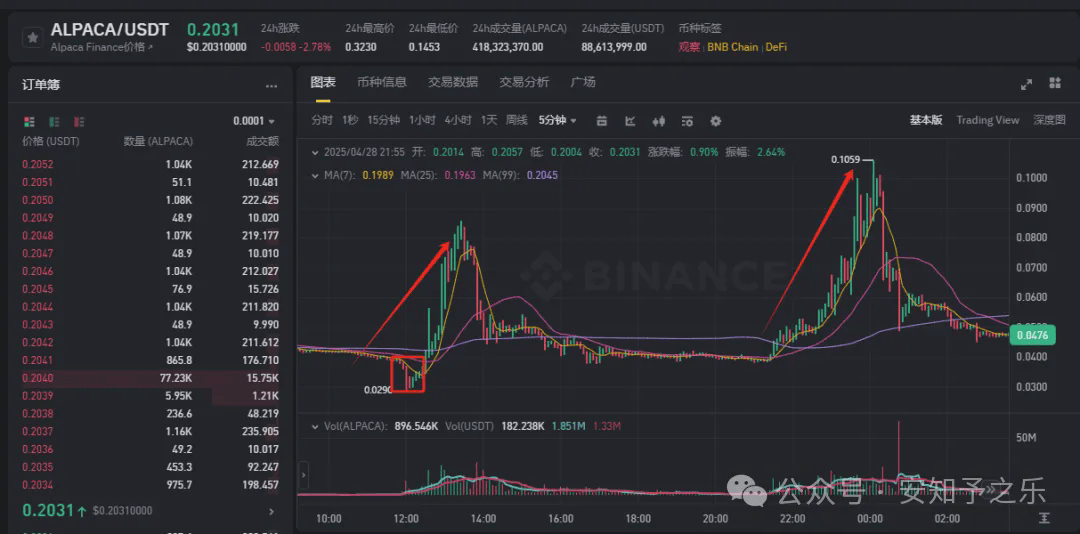
However, the market's trend gave those shorting a hard slap. Starting from 12:10 PM that day, ALPACA's price suddenly rebounded, rising more than 100% within an hour, followed by significant fluctuations; the long and short battle of retail investors became the main force's feast. That day, shorts lost $4.4609 million, and longs lost $1.6522 million.
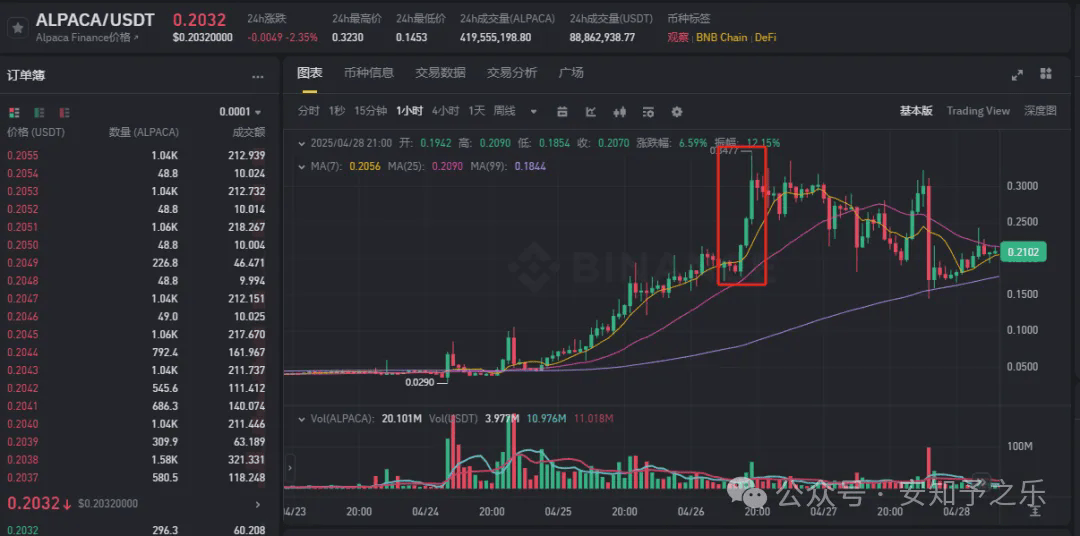
Even crazier, in the following days, the amount of liquidations soared like a rocket! On April 25, shorts faced a liquidation of $13.3249 million, and longs $2.2671 million; on April 26, shorts again liquidated $13.1199 million, and longs $1.8753 million (in a certain 4-hour period, the liquidation amount even exceeded Bitcoin's volatility!); by April 27, shorts liquidated $5.0061 million, and longs also liquidated $2.6325 million.
Bybit became the hardest-hit area for this round of liquidations; major exchanges quickly shortened the ALPACA funding rate settlement period from 8 hours to 1 hour, with rates plummeting to -2%. Shorts were 'cut' every hour, without a moment's respite.
Was this wave of 'Delisting Carnival' a market failure or a carefully orchestrated scheme by the main force and the project team? This article will take you deep into the reasons behind the dramatic rise and fall of ALPACA, revealing the project team's controversial operations and exploring the profound impact of this turmoil on retail investors and the market.
The driving force behind the abnormal trend: main force operations and retail investor misjudgments.
ALPACA's abnormal performance mainly stems from the catalytic effect of Binance's delisting announcement and the precise manipulation by the main funds. Usually, a delisting announcement will cause the coin price to be halved first, and after everyone has dumped their chips, they will either hike the price wildly or crash it; many people's first reaction is: 'Dropped 20%? After the announcement, it's so hard, why not short it!'
However, if you pay attention to ALPACA's market cap, you will find it's not large, and the circulating supply is relatively easy to control. The main force first accumulates chips, then uses contract leverage to push the price up, and shorts are naturally 'slaughtered.' Next, they replicate this process, with retail investors making the wrong judgments of shorting when prices rise and chasing longs when they fall, becoming the perfect script for the main force's harvesting.
The project team's bad operations: the threat of increasing issuance and the collapse of trust.
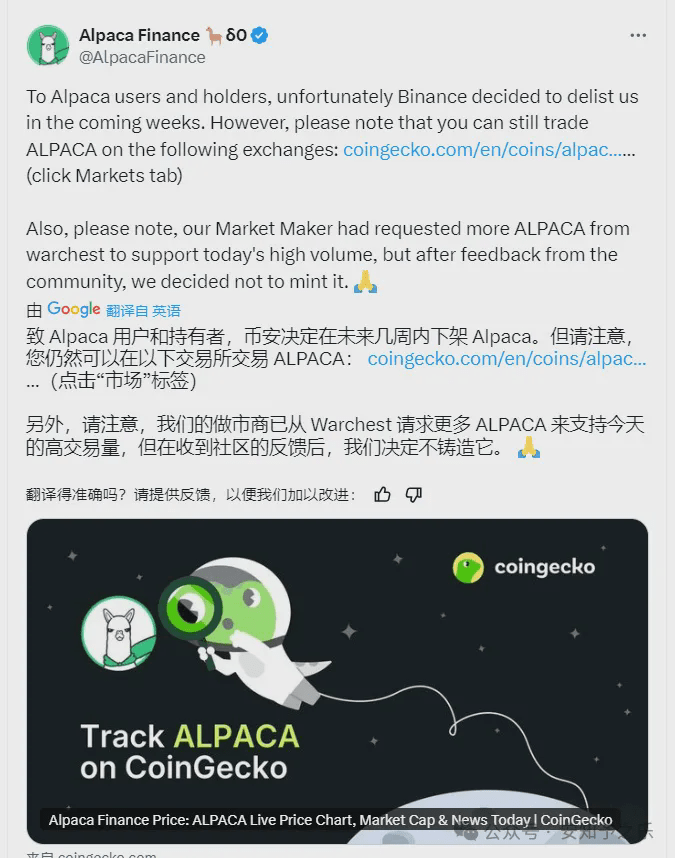
On the 25th, ALPACA soared by 400%, and the project team suddenly executed a 'sneaky operation'—preparing to increase the issuance of tokens. My guess is that the project team may have already dumped their tokens at low prices; now, taking advantage of the market frenzy, they threw out the threat of increased issuance, creating panic to guide retail investors to sell, providing an opportunity for the main force to accumulate at low prices. Sure enough, the news of increased issuance triggered a brief market correction, causing retail investors to panic sell.
However, the project team quickly tweeted to announce that they 'listened to community opinions and decided not to increase issuance,' but that tweet was deleted shortly after, leaving a hollow trust vacuum.
What does deleting tweets mean? This is clearly playing with retail investors; how many chips have they quietly taken back! In this wave of operations, the price's 'strong rebound' indicates that the main force had already accumulated enough chips, taking the opportunity to push up the price and harvest again.
ALPACA's funding rate trick is simply the main force's 'secret weapon' for cutting retail investors' money!
What is the funding rate? Simply put, in the contract market, both sides of longs and shorts have to pay some fees regularly to balance positions. For example, when there are more shorts than longs, the shorts have to pay the longs. But ALPACA took this to extremes, shortening the settlement period from 8 hours to 1 hour, and the rate soared to -2%. Shorts are 'cut' every hour; who can stand that?
How were they cut? On April 24, Binance announced the delisting of ALPACA, resulting in a 20% drop. Retail investors saw this news and rushed to short, and shorts accounted for 75% instantly. Then, the main force directly pulled the price, doubling it within an hour; shorts not only faced liquidation but also had to pay extremely high fees. For example, if you made a $100,000 short, you’d need to pay $2,000 every hour; by the end of the day, that's $48,000—who can stand that? The main force was even harsher, directly pushing the price up with spot buying, resulting in double losses for shorts due to liquidation and high fees.
This fee design is clearly a trap for retail investors, settling every hour, giving them no time to react; the -2% fee is like a knife cutting flesh. The main force uses this method to leave shorts with nothing, while they profit immensely. And the exchange shortening the settlement period like this seems to be in collusion with the main force. This wave of ALPACA truly used shorts as a 'meat grinder,' and retail investors' money was 'cleaned out' just like that.
This operation is practically a textbook on how to manipulate retail investors, a history of their blood and tears.
You see the price skyrocketing after delisting, some ask why it surged wildly after the delisting; what logic is behind this? Let’s see how He Yi replied.

This wave of operations was like a meticulously choreographed show; the main force was the director, and retail investors were merely actors following a script, at their mercy. This time, the shell-buying teacher not only made back losses but earned a fortune. This operation completely trampled over retail investors, solidifying the operator's status in the doge community. In the future, those projects facing delisting will likely have the backing capital worshipping them as gods.
This 'grand drama' is also nearing its end.
ALPACA's contract will be delisted the day after tomorrow, on the 30th, and by then this 'performance' will basically come to an end.
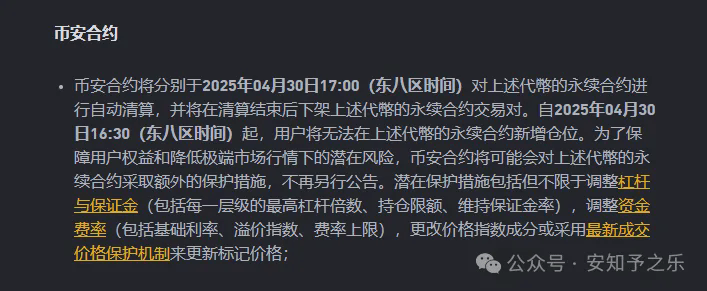
Friends holding spot positions, whether you entered at a low or were trapped at a high, now is the time to take action. Once this performance ends, the price is likely to return to its original state. In short—these past few days have been like a dream, playing with ALPACA, starting price was 0.038, after a few operations, now looking back, it’s still 0.038, but the difference is my USDT is gone.
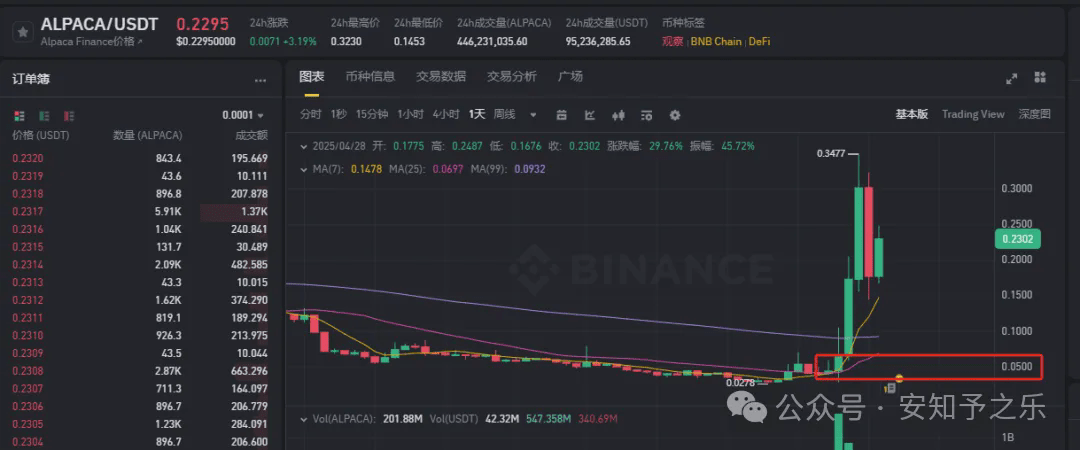
Those who made money quietly exit, while those who lost can only lick their wounds. In a few days, once new hotspots emerge, this story will be completely forgotten.
ALPACA's 'Delisting Carnival' leaves everyone not just with the blood and tears of retail investors, but also the stark reality of the market: low market cap tokens are too easily manipulated, and high-leverage contracts are practically a graveyard for retail investors. If the project team is not transparent, trust will ultimately collapse.
Finally, a piece of advice for everyone, ALPACA is a lesson this time. In the future, when encountering delisted coins, don't rush to short, and don't blindly chase longs; sharpen your eyes and see through the main force's tricks. If ALPACA wants to turn around, it must honestly disclose its economic model and stop playing tricks with issuance and deletions. Otherwise, this 'alpaca' may completely cool off in the DeFi race. As for retail investors, let's be cautious and not become the 'leeks' of the main force again!