
#plasma
plasma
24.9M views
332,957 Discussing
Hot
Latest

{spot}(XPLUSDT)
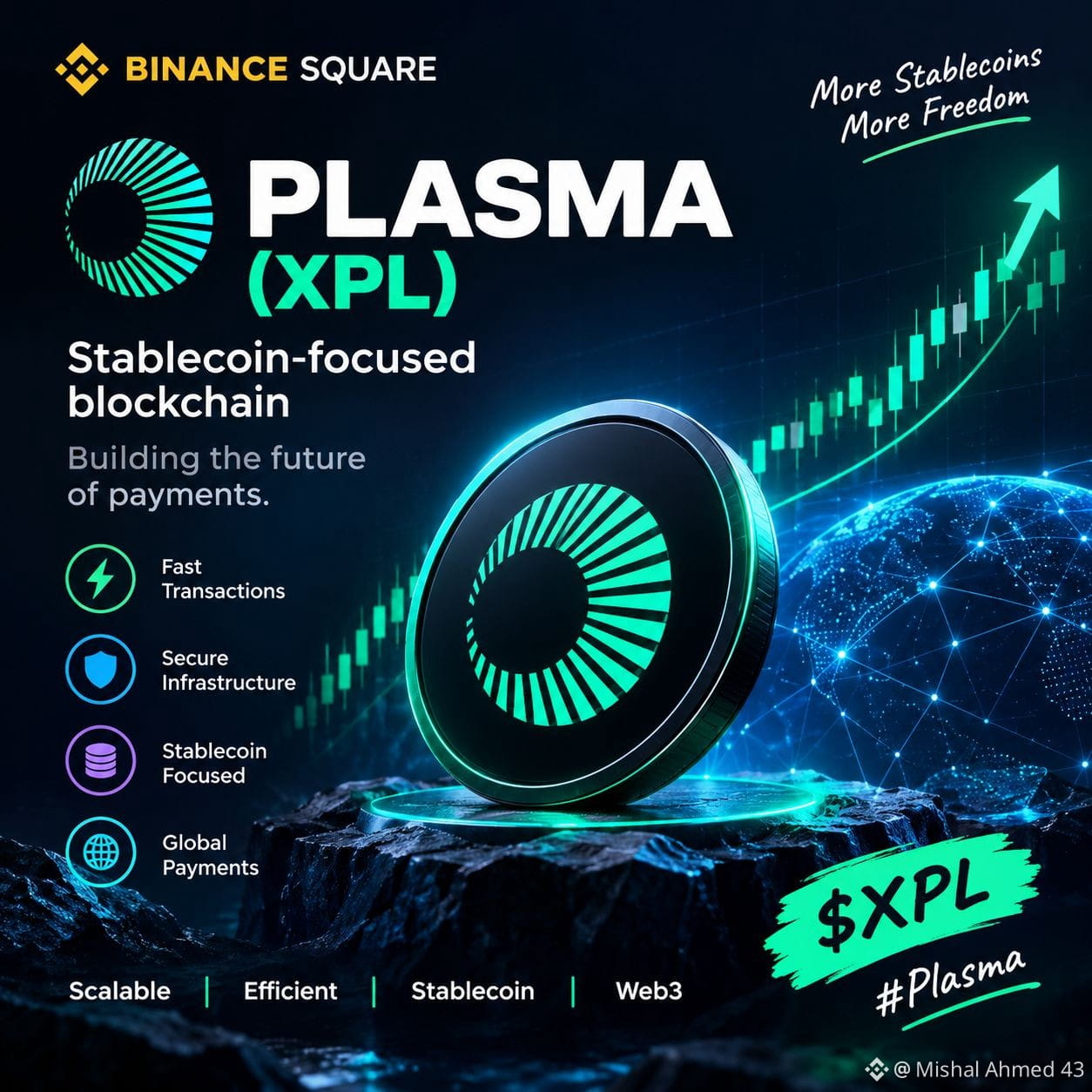
@Plasma plasma is building a new standard for fast, efficient, and stablecoin-focused blockchain infrastructure. I’m excited to follow the growth of @Plasma and see how $XPL develops as the ecosystem expands. The vision around scalable payments and stablecoins makes Plasma a project worth watching.
#Plasma @Plasma $XPL #Plasma
@Plasma plasma is building a new standard for fast, efficient, and stablecoin-focused blockchain infrastructure. I’m excited to follow the growth of @Plasma and see how $XPL develops as the ecosystem expands. The vision around scalable payments and stablecoins makes Plasma a project worth watching.
#Plasma @Plasma $XPL #Plasma
#Plasma @Plasma $XPL #Plasma
1
150

·
--
Bullish
Plasma boosts its Platinum card by adding a Priority Pass lounge access feature amid news of new partnerships. Plasma’s XPL token price rose after the Plasma One Platinum card now includes Priority Pass lounge access. Strategic media partnerships and the possibility of integrating Sol Labs also contributed to this recent surge.
#Plasma #SolanaLabs
$XPL
{spot}(XPLUSDT)
Plasma boosts its Platinum card by adding a Priority Pass lounge access feature amid news of new partnerships. Plasma’s XPL token price rose after the Plasma One Platinum card now includes Priority Pass lounge access. Strategic media partnerships and the possibility of integrating Sol Labs also contributed to this recent surge.
#Plasma #SolanaLabs
$XPL
#Plasma #SolanaLabs
$XPL
1
48

·
--
Bullish
The broader market has no momentum, but it moves first: Plasma, this stablecoin chain, rose more than 10% today
Today the overall market has little excitement—BTC is down slightly by 0.91%, and ETH is basically going nowhere. But on the gainers list, a few coins are showing up and moving with more energy than anyone else. The most eye-catching is XPL—Plasma—which is up 10.06% in the last 24 hours. Its price is back around $0.10, and trading volume is about $16 million. On a leaderboard where most coins are seeing shrinking volume, this amount really stands out. #BTC
Plasma isn’t a typical public chain. Its positioning is a base-layer setup specifically for stablecoins and micro-payments, with ties to Tether and Bitfinex. When it launched in 2025, it made a big splash thanks to an airdrop. As for who exactly is pushing this rally, I haven’t seen any particularly clear news on that yet. It feels more like after the market steadied, money turned around to pick up these chains with real narratives. It’s one thing to be up, but whether it’s worth chasing depends on whether it can actually build real stablecoin usage. #Plasma
Looking at it in comparison is even more interesting. In the top ranks of the gainers list, ATOM (Cosmos) is up 8.55%, with trading volume around $4.4 million. PROM (Prometeus) is up 6.41%, and its volume is actually around $15.6 million. One focuses on cross-chain interoperability, and one does the data-matching business. They’re both old tracks, but each has its own story. When the broader market goes sideways, it’s often these mid- and small-cap names that start moving first. That kind of structure, in previous market cycles, has often been a signal of capital quietly probing from lower levels.
A pull-up can draw a pretty candlestick chart, but only when they cluster together can you write a real story. What’s truly worth paying attention to isn’t how much it rose in a single day—it’s whether a group of people is genuinely doing the work. Like little Ma Ge’s rowdy pack of dogs: under all the commotion, the crowd’s energy is there, and it can’t be hidden.
🐶 Let’s check out Ma Ge’s little dogs ✨🚀
#马斯克爱小狗 #我爱小狗 #小狗狗
{web3_wallet_create}(10xcf91b70017eabde82c9671e30e5502d312ea6eb2)
The broader market has no momentum, but it moves first: Plasma, this stablecoin chain, rose more than 10% today
Today the overall market has little excitement—BTC is down slightly by 0.91%, and ETH is basically going nowhere. But on the gainers list, a few coins are showing up and moving with more energy than anyone else. The most eye-catching is XPL—Plasma—which is up 10.06% in the last 24 hours. Its price is back around $0.10, and trading volume is about $16 million. On a leaderboard where most coins are seeing shrinking volume, this amount really stands out. #BTC
Plasma isn’t a typical public chain. Its positioning is a base-layer setup specifically for stablecoins and micro-payments, with ties to Tether and Bitfinex. When it launched in 2025, it made a big splash thanks to an airdrop. As for who exactly is pushing this rally, I haven’t seen any particularly clear news on that yet. It feels more like after the market steadied, money turned around to pick up these chains with real narratives. It’s one thing to be up, but whether it’s worth chasing depends on whether it can actually build real stablecoin usage. #Plasma
Looking at it in comparison is even more interesting. In the top ranks of the gainers list, ATOM (Cosmos) is up 8.55%, with trading volume around $4.4 million. PROM (Prometeus) is up 6.41%, and its volume is actually around $15.6 million. One focuses on cross-chain interoperability, and one does the data-matching business. They’re both old tracks, but each has its own story. When the broader market goes sideways, it’s often these mid- and small-cap names that start moving first. That kind of structure, in previous market cycles, has often been a signal of capital quietly probing from lower levels.
A pull-up can draw a pretty candlestick chart, but only when they cluster together can you write a real story. What’s truly worth paying attention to isn’t how much it rose in a single day—it’s whether a group of people is genuinely doing the work. Like little Ma Ge’s rowdy pack of dogs: under all the commotion, the crowd’s energy is there, and it can’t be hidden.
🐶 Let’s check out Ma Ge’s little dogs ✨🚀
#马斯克爱小狗 #我爱小狗 #小狗狗
Today the overall market has little excitement—BTC is down slightly by 0.91%, and ETH is basically going nowhere. But on the gainers list, a few coins are showing up and moving with more energy than anyone else. The most eye-catching is XPL—Plasma—which is up 10.06% in the last 24 hours. Its price is back around $0.10, and trading volume is about $16 million. On a leaderboard where most coins are seeing shrinking volume, this amount really stands out. #BTC
Plasma isn’t a typical public chain. Its positioning is a base-layer setup specifically for stablecoins and micro-payments, with ties to Tether and Bitfinex. When it launched in 2025, it made a big splash thanks to an airdrop. As for who exactly is pushing this rally, I haven’t seen any particularly clear news on that yet. It feels more like after the market steadied, money turned around to pick up these chains with real narratives. It’s one thing to be up, but whether it’s worth chasing depends on whether it can actually build real stablecoin usage. #Plasma
Looking at it in comparison is even more interesting. In the top ranks of the gainers list, ATOM (Cosmos) is up 8.55%, with trading volume around $4.4 million. PROM (Prometeus) is up 6.41%, and its volume is actually around $15.6 million. One focuses on cross-chain interoperability, and one does the data-matching business. They’re both old tracks, but each has its own story. When the broader market goes sideways, it’s often these mid- and small-cap names that start moving first. That kind of structure, in previous market cycles, has often been a signal of capital quietly probing from lower levels.
A pull-up can draw a pretty candlestick chart, but only when they cluster together can you write a real story. What’s truly worth paying attention to isn’t how much it rose in a single day—it’s whether a group of people is genuinely doing the work. Like little Ma Ge’s rowdy pack of dogs: under all the commotion, the crowd’s energy is there, and it can’t be hidden.
🐶 Let’s check out Ma Ge’s little dogs ✨🚀
#马斯克爱小狗 #我爱小狗 #小狗狗
2
527

·
--
Payments are blowing up—this month, $XPL isn’t doing nothingFirst, the conclusion: this payment track isn’t just empty talk this year—the product is actually getting deployed. Stablecoin market caps have been steadily piling up, but what’s missing is an on-ramp that can truly be transferred, spent, and won’t have your fee layer eat away at your value. Plasma is aimed exactly at this. 💸
A few things that have been more tangible this month. Circle has put native USDC and EURC on-chain—regulated dollars and euros no longer need to be routed through a wrapped detour. Plasma One’s Visa card is still in the works; global card payments, yield, and rewards are bundled together. To get access to better tiers, you need to lock \u003cc-11/\u003e in—meaning real people are actually locking the coins off the board. Travel spending can get up to a 20% cashback—at least it’s not just issuing announcements. ✈️
Payments are blowing up—this month, $XPL isn’t doing nothing
First, the conclusion: this payment track isn’t just empty talk this year—the product is actually getting deployed. Stablecoin market caps have been steadily piling up, but what’s missing is an on-ramp that can truly be transferred, spent, and won’t have your fee layer eat away at your value. Plasma is aimed exactly at this. 💸
A few things that have been more tangible this month. Circle has put native USDC and EURC on-chain—regulated dollars and euros no longer need to be routed through a wrapped detour. Plasma One’s Visa card is still in the works; global card payments, yield, and rewards are bundled together. To get access to better tiers, you need to lock \u003cc-11/\u003e in—meaning real people are actually locking the coins off the board. Travel spending can get up to a 20% cashback—at least it’s not just issuing announcements. ✈️
A few things that have been more tangible this month. Circle has put native USDC and EURC on-chain—regulated dollars and euros no longer need to be routed through a wrapped detour. Plasma One’s Visa card is still in the works; global card payments, yield, and rewards are bundled together. To get access to better tiers, you need to lock \u003cc-11/\u003e in—meaning real people are actually locking the coins off the board. Travel spending can get up to a 20% cashback—at least it’s not just issuing announcements. ✈️
270

·
--
Verified
🔶 $XPL (Plasma) — Current State
Plasma positions itself as an L1 blockchain built for stablecoins (zero-fee USDT transfers), but the past year has been turbulent:
📉 Price: after a hyped launch in September 2025 (peak of $1.67), the token has dropped over 80%, now trading roughly in the $0.09–0.31 range depending on the period.
⚠️ Key risk — September 25, 2026: ~1.81B XPL held by team and investors unlocks (roughly 65% of current circulating supply), plus an ecosystem tranche on the same day. Combined, that's nearly 19% of max supply released in a single day — a classic overhang risk the market will need to absorb.
🏦 Bullish factors:
Plasma One neobank launch (Visa card, cashback) drove a +27% rally in June Circle deployed native USDC/EURC on the network Validator staking (starting ~5% annual inflation) and a pBTC bridge are expected to go live in 2026
🔴 Bearish factors:
A Plasma One card hack (~$1.1M) crashed the token roughly 49% in August Real network throughput is well below the claimed 1,000 TPS target Heavy competition with Tron for the stablecoin-payments niche
Bottom line: XPL is a bet on whether real stablecoin-payment adoption can outpace speculative hype before upcoming unlocks dilute the price. The September unlock will be a key test.
#Plasma #stablecoin #Binance
🔶 $XPL (Plasma) — Current State
Plasma positions itself as an L1 blockchain built for stablecoins (zero-fee USDT transfers), but the past year has been turbulent:
📉 Price: after a hyped launch in September 2025 (peak of $1.67), the token has dropped over 80%, now trading roughly in the $0.09–0.31 range depending on the period.
⚠️ Key risk — September 25, 2026: ~1.81B XPL held by team and investors unlocks (roughly 65% of current circulating supply), plus an ecosystem tranche on the same day. Combined, that's nearly 19% of max supply released in a single day — a classic overhang risk the market will need to absorb.
🏦 Bullish factors:
Plasma One neobank launch (Visa card, cashback) drove a +27% rally in June Circle deployed native USDC/EURC on the network Validator staking (starting ~5% annual inflation) and a pBTC bridge are expected to go live in 2026
🔴 Bearish factors:
A Plasma One card hack (~$1.1M) crashed the token roughly 49% in August Real network throughput is well below the claimed 1,000 TPS target Heavy competition with Tron for the stablecoin-payments niche
Bottom line: XPL is a bet on whether real stablecoin-payment adoption can outpace speculative hype before upcoming unlocks dilute the price. The September unlock will be a key test.
#Plasma #stablecoin #Binance
Plasma positions itself as an L1 blockchain built for stablecoins (zero-fee USDT transfers), but the past year has been turbulent:
📉 Price: after a hyped launch in September 2025 (peak of $1.67), the token has dropped over 80%, now trading roughly in the $0.09–0.31 range depending on the period.
⚠️ Key risk — September 25, 2026: ~1.81B XPL held by team and investors unlocks (roughly 65% of current circulating supply), plus an ecosystem tranche on the same day. Combined, that's nearly 19% of max supply released in a single day — a classic overhang risk the market will need to absorb.
🏦 Bullish factors:
Plasma One neobank launch (Visa card, cashback) drove a +27% rally in June Circle deployed native USDC/EURC on the network Validator staking (starting ~5% annual inflation) and a pBTC bridge are expected to go live in 2026
🔴 Bearish factors:
A Plasma One card hack (~$1.1M) crashed the token roughly 49% in August Real network throughput is well below the claimed 1,000 TPS target Heavy competition with Tron for the stablecoin-payments niche
Bottom line: XPL is a bet on whether real stablecoin-payment adoption can outpace speculative hype before upcoming unlocks dilute the price. The September unlock will be a key test.
#Plasma #stablecoin #Binance
1
189

·
--
Bullish
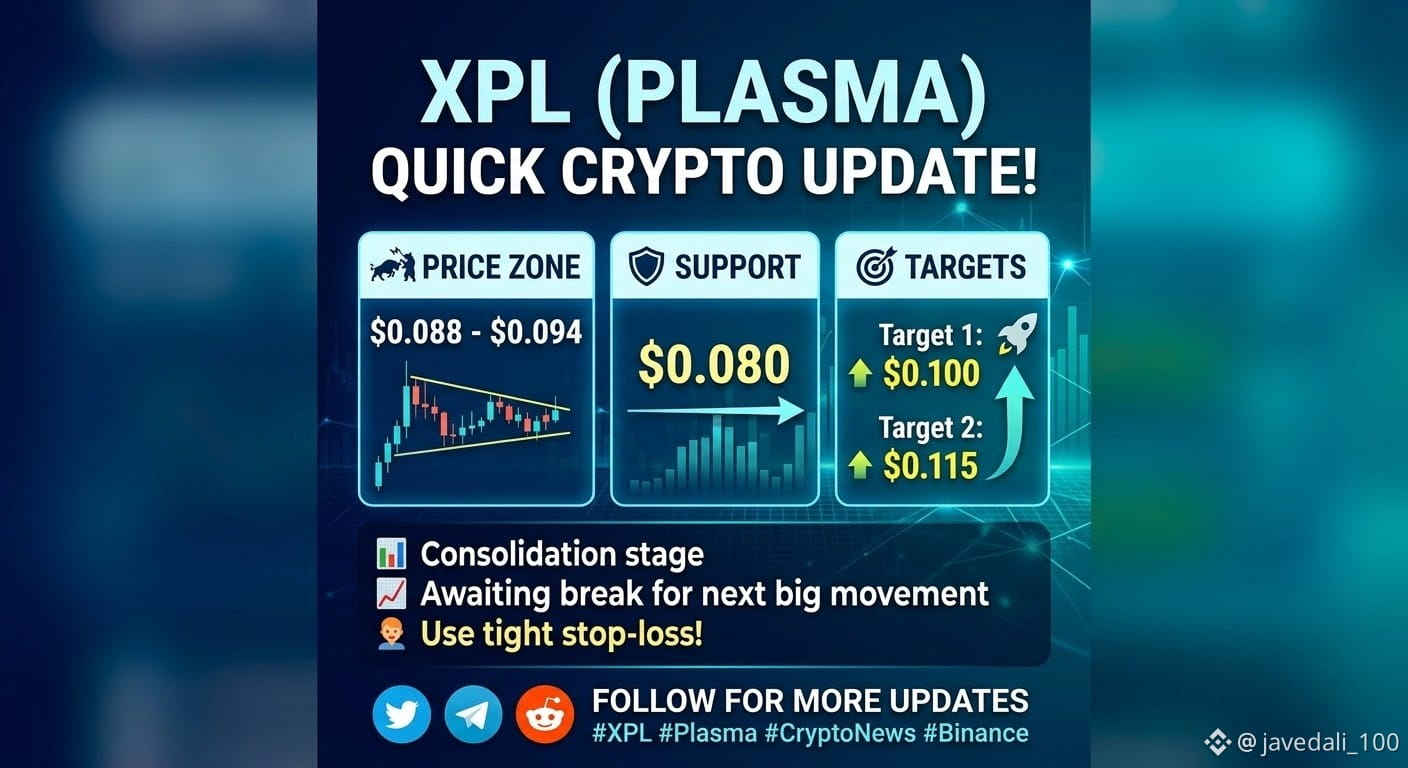
$XPL (Plasma) Quick Update! 🔥
📍 Price Zone: $0.088 - $0.094
🛡️ Support: $0.080
🎯 Targets: $0.100 | $0.115
Short-term consolidation stage main hai. Next big movement ke liye $0.10 ka level break hona zaruri hai. Tight stop-loss ke saath trade karein! 📊🚀
#XPL #Plasma #CryptoNews #TradingSignals
{spot}(XPLUSDT)
$XPL (Plasma) Quick Update! 🔥
📍 Price Zone: $0.088 - $0.094
🛡️ Support: $0.080
🎯 Targets: $0.100 | $0.115
Short-term consolidation stage main hai. Next big movement ke liye $0.10 ka level break hona zaruri hai. Tight stop-loss ke saath trade karein! 📊🚀
#XPL #Plasma #CryptoNews #TradingSignals
📍 Price Zone: $0.088 - $0.094
🛡️ Support: $0.080
🎯 Targets: $0.100 | $0.115
Short-term consolidation stage main hai. Next big movement ke liye $0.10 ka level break hona zaruri hai. Tight stop-loss ke saath trade karein! 📊🚀
#XPL #Plasma #CryptoNews #TradingSignals
29

·
--
Only 22 days left until the September 26th XPL unlock, and the current price is $0.18.
This unlock event is about to become the market focus—large amounts of tokens are about to enter circulation, and the risk of downward price pressure should not be overlooked. As a core token of the Plasma ecosystem, XPL’s unlock schedule, the distribution among early holders, and the current community holding concentration are all key signals worth closely monitoring.
The crucial question is: how large will the sell pressure be after the unlock? Is market liquidity sufficient to absorb it? It’s recommended to watch on-chain data and changes in trading volume, and to manage your positions and control risk in advance.
#加密货币 #Plasma
Only 22 days left until the September 26th XPL unlock, and the current price is $0.18.
This unlock event is about to become the market focus—large amounts of tokens are about to enter circulation, and the risk of downward price pressure should not be overlooked. As a core token of the Plasma ecosystem, XPL’s unlock schedule, the distribution among early holders, and the current community holding concentration are all key signals worth closely monitoring.
The crucial question is: how large will the sell pressure be after the unlock? Is market liquidity sufficient to absorb it? It’s recommended to watch on-chain data and changes in trading volume, and to manage your positions and control risk in advance.
#加密货币 #Plasma
This unlock event is about to become the market focus—large amounts of tokens are about to enter circulation, and the risk of downward price pressure should not be overlooked. As a core token of the Plasma ecosystem, XPL’s unlock schedule, the distribution among early holders, and the current community holding concentration are all key signals worth closely monitoring.
The crucial question is: how large will the sell pressure be after the unlock? Is market liquidity sufficient to absorb it? It’s recommended to watch on-chain data and changes in trading volume, and to manage your positions and control risk in advance.
#加密货币 #Plasma
70

·
--
Plasma ($XPL) Gains Momentum with Active Community and Strong Volume
Plasma ($XPL) is trending with a 3.55% 24h gain and $28M in volume. The community is buzzing, driving interest and engagement. $XPL's active development and recent updates are fueling the momentum. Traders should keep an eye on this mid-cap gem as it continues to gain traction. ⚡👀
Follow for more crypto setups.
#DeGenYuv #Plasma
Plasma ($XPL ) Gains Momentum with Active Community and Strong Volume
Plasma ($XPL ) is trending with a 3.55% 24h gain and $28M in volume. The community is buzzing, driving interest and engagement. $XPL 's active development and recent updates are fueling the momentum. Traders should keep an eye on this mid-cap gem as it continues to gain traction. ⚡👀
Follow for more crypto setups.
#DeGenYuv #Plasma
Plasma ($XPL ) is trending with a 3.55% 24h gain and $28M in volume. The community is buzzing, driving interest and engagement. $XPL 's active development and recent updates are fueling the momentum. Traders should keep an eye on this mid-cap gem as it continues to gain traction. ⚡👀
Follow for more crypto setups.
#DeGenYuv #Plasma
20
·
--
Plasma ($XPL) Gains Momentum with Solid 24h Volumes
Plasma ($XPL) is climbing the ranks with a solid 3.64% 24h gain and $28M in volume. 📈 The community is buzzing, driven by recent updates and strong on-chain activity. $XPL’s unique Layer 2 scaling solution is attracting attention from traders and developers alike. With a market cap of $86.77M, $XPL is positioning itself as a key player in the ecosystem. Keep an eye on this one as it continues to build momentum. 👀
Follow for daily crypto updates.
#DeGenYuv #Plasma
Plasma ($XPL ) Gains Momentum with Solid 24h Volumes
Plasma ($XPL ) is climbing the ranks with a solid 3.64% 24h gain and $28M in volume. 📈 The community is buzzing, driven by recent updates and strong on-chain activity. $XPL ’s unique Layer 2 scaling solution is attracting attention from traders and developers alike. With a market cap of $86.77M, $XPL is positioning itself as a key player in the ecosystem. Keep an eye on this one as it continues to build momentum. 👀
Follow for daily crypto updates.
#DeGenYuv #Plasma
Plasma ($XPL ) is climbing the ranks with a solid 3.64% 24h gain and $28M in volume. 📈 The community is buzzing, driven by recent updates and strong on-chain activity. $XPL ’s unique Layer 2 scaling solution is attracting attention from traders and developers alike. With a market cap of $86.77M, $XPL is positioning itself as a key player in the ecosystem. Keep an eye on this one as it continues to build momentum. 👀
Follow for daily crypto updates.
#DeGenYuv #Plasma

43

·
--
Bullish
السلام عليكم
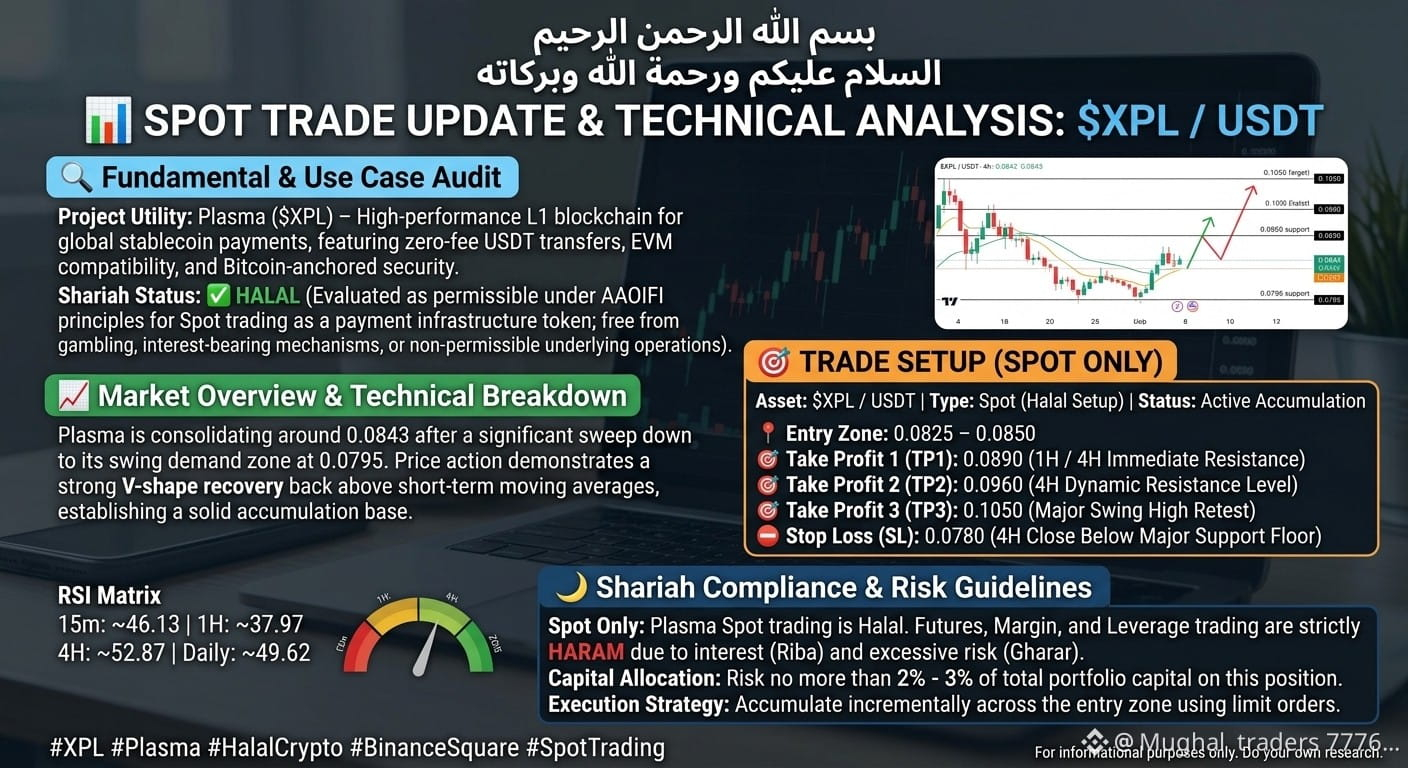
📊 SPOT TRADE UPDATE & TECHNICAL ANALYSIS: $XPL / USDT
🔍 Fundamental & Use Case Audit
Project Utility: Plasma ($XPL) is a high-performance Layer-1 blockchain engineered specifically for global stablecoin payments, featuring zero-fee USDT transfers, EVM compatibility, and Bitcoin-anchored security.
Shariah Status: HALAL (Evaluated as permissible under AAOIFI principles for Spot trading as a payment infrastructure token; free from gambling, interest-bearing mechanisms, or non-permissible underlying operations).
📈 Market Overview & Technical Breakdown
Plasma is consolidating around 0.0843 after a significant sweep down to its swing demand zone at 0.0795. Price action demonstrates a strong V-shape recovery back above short-term moving averages, establishing a solid accumulation base.
15m & 1H Charts: The 15m chart shows price rising toward the upper MA(99) resistance with RSI at ~46.13, while the 1H chart shows price rebounding off the 0.0795 wick low with 1H RSI cool at ~37.97.
4H & Daily Charts: 4H RSI sits neutral at ~52.87, and Daily RSI is stable at ~49.62, confirming healthy momentum recovery with room for an extended upward swing toward higher resistance levels.
RSI Matrix: 15m: ~46.13 | 1H: ~37.97 | 4H: ~52.87 | Daily: ~49.62.
🎯 TRADE SETUP (SPOT ONLY)
Asset: $XPL / USDT | Type: Spot (Halal Setup) | Status: Active Accumulation
📍 Entry Zone: 0.0825 – 0.0850
🎯 Take Profit 1 (TP1): 0.0890 (1H / 4H Immediate Resistance)
🎯 Take Profit 2 (TP2): 0.0960 (4H Dynamic Resistance Level)
🎯 Take Profit 3 (TP3): 0.1050 (Major Swing High Retest)
⛔ Stop Loss (SL): 0.0780 (4H Close Below Major Support Floor)
🌙 Shariah Compliance & Risk Guidelines
Spot Only: Plasma Spot trading is Halal. Futures, Margin, and Leverage trading are strictly HARAM due to interest and excessive risk.
Capital Allocation: Risk no more than 2% - 3% of total portfolio capital on this position.
Execution Strategy: Accumulate incrementally across the entry zone using limit orders.
{spot}(XPLUSDT)
#XPL #Plasma #HalalCrypto #SpotTrading
السلام عليكم
📊 SPOT TRADE UPDATE & TECHNICAL ANALYSIS: $XPL / USDT
🔍 Fundamental & Use Case Audit
Project Utility: Plasma ($XPL) is a high-performance Layer-1 blockchain engineered specifically for global stablecoin payments, featuring zero-fee USDT transfers, EVM compatibility, and Bitcoin-anchored security.
Shariah Status: HALAL (Evaluated as permissible under AAOIFI principles for Spot trading as a payment infrastructure token; free from gambling, interest-bearing mechanisms, or non-permissible underlying operations).
📈 Market Overview & Technical Breakdown
Plasma is consolidating around 0.0843 after a significant sweep down to its swing demand zone at 0.0795. Price action demonstrates a strong V-shape recovery back above short-term moving averages, establishing a solid accumulation base.
15m & 1H Charts: The 15m chart shows price rising toward the upper MA(99) resistance with RSI at ~46.13, while the 1H chart shows price rebounding off the 0.0795 wick low with 1H RSI cool at ~37.97.
4H & Daily Charts: 4H RSI sits neutral at ~52.87, and Daily RSI is stable at ~49.62, confirming healthy momentum recovery with room for an extended upward swing toward higher resistance levels.
RSI Matrix: 15m: ~46.13 | 1H: ~37.97 | 4H: ~52.87 | Daily: ~49.62.
🎯 TRADE SETUP (SPOT ONLY)
Asset: $XPL / USDT | Type: Spot (Halal Setup) | Status: Active Accumulation
📍 Entry Zone: 0.0825 – 0.0850
🎯 Take Profit 1 (TP1): 0.0890 (1H / 4H Immediate Resistance)
🎯 Take Profit 2 (TP2): 0.0960 (4H Dynamic Resistance Level)
🎯 Take Profit 3 (TP3): 0.1050 (Major Swing High Retest)
⛔ Stop Loss (SL): 0.0780 (4H Close Below Major Support Floor)
🌙 Shariah Compliance & Risk Guidelines
Spot Only: Plasma Spot trading is Halal. Futures, Margin, and Leverage trading are strictly HARAM due to interest and excessive risk.
Capital Allocation: Risk no more than 2% - 3% of total portfolio capital on this position.
Execution Strategy: Accumulate incrementally across the entry zone using limit orders.
#XPL #Plasma #HalalCrypto #SpotTrading
📊 SPOT TRADE UPDATE & TECHNICAL ANALYSIS: $XPL / USDT
🔍 Fundamental & Use Case Audit
Project Utility: Plasma ($XPL) is a high-performance Layer-1 blockchain engineered specifically for global stablecoin payments, featuring zero-fee USDT transfers, EVM compatibility, and Bitcoin-anchored security.
Shariah Status: HALAL (Evaluated as permissible under AAOIFI principles for Spot trading as a payment infrastructure token; free from gambling, interest-bearing mechanisms, or non-permissible underlying operations).
📈 Market Overview & Technical Breakdown
Plasma is consolidating around 0.0843 after a significant sweep down to its swing demand zone at 0.0795. Price action demonstrates a strong V-shape recovery back above short-term moving averages, establishing a solid accumulation base.
15m & 1H Charts: The 15m chart shows price rising toward the upper MA(99) resistance with RSI at ~46.13, while the 1H chart shows price rebounding off the 0.0795 wick low with 1H RSI cool at ~37.97.
4H & Daily Charts: 4H RSI sits neutral at ~52.87, and Daily RSI is stable at ~49.62, confirming healthy momentum recovery with room for an extended upward swing toward higher resistance levels.
RSI Matrix: 15m: ~46.13 | 1H: ~37.97 | 4H: ~52.87 | Daily: ~49.62.
🎯 TRADE SETUP (SPOT ONLY)
Asset: $XPL / USDT | Type: Spot (Halal Setup) | Status: Active Accumulation
📍 Entry Zone: 0.0825 – 0.0850
🎯 Take Profit 1 (TP1): 0.0890 (1H / 4H Immediate Resistance)
🎯 Take Profit 2 (TP2): 0.0960 (4H Dynamic Resistance Level)
🎯 Take Profit 3 (TP3): 0.1050 (Major Swing High Retest)
⛔ Stop Loss (SL): 0.0780 (4H Close Below Major Support Floor)
🌙 Shariah Compliance & Risk Guidelines
Spot Only: Plasma Spot trading is Halal. Futures, Margin, and Leverage trading are strictly HARAM due to interest and excessive risk.
Capital Allocation: Risk no more than 2% - 3% of total portfolio capital on this position.
Execution Strategy: Accumulate incrementally across the entry zone using limit orders.
#XPL #Plasma #HalalCrypto #SpotTrading
105

·
--
Plasma Trends in Crypto Market: What Investors Need to KnowPlasma has appeared as a trending topic in the crypto market over the past 24 hours according to CoinGecko data. This development may be linked to increased social media engagement and search activity around the project. Plasma is known as a layer-2 scaling solution built on the Ethereum blockchain, aiming to boost transaction speed and lower fees. Such an approach can be attractive for high‑volume financial applications and gaming platforms.
CoinGecko’s trending list typically highlights assets with rising short‑term volume and social signals. Plasma’s inclusion suggests a noticeable uptick in its trading activity. Market data indicate that Plasma’s 24‑hour trading volume has risen by roughly 20 % in the last day, reflecting growing buyer interest. No specific price target is given, and forward‑looking predictions should be avoided; only the observed volume movement is reported.
Market participants should monitor Plasma’s technical roadmap and ecosystem partnerships to assess its long‑term value. The project’s open‑source repositories show two core protocol updates in the past month, targeting faster finalization of rollup transactions. Furthermore, Plasma’s token allocation model assigns 15 % of total supply to an ecosystem development fund, 10 % to early investors, and 5 % to team incentives, as stated on its website; an independent audit firm completed a security review of the contracts within the last three months.
Compared with major crypto assets, Plasma’s movements often correlate with the broader market sentiment of Bitcoin ($BTC) and Ethereum ($ETH). In a risk‑on environment, altcoin rallies can contribute to Plasma’s observed gains. Additionally, contract security and audit reports are key credibility factors. Since detailed audit information and team details are presently limited, investors are encouraged to conduct their own research (DYOR).
In summary, Plasma’s short‑term trend reflects current interest, but its lasting success will depend on the underlying technology, roadmap progress, and ecosystem support. Market actors should follow recent developments and balance exposure with sound risk‑management practices.
#Plasma #Trending #Binance
Sources: CoinGecko
This news digest was compiled with AI assistance; it is not financial advice. Always do your own research (DYOR).
Plasma Trends in Crypto Market: What Investors Need to Know
Plasma has appeared as a trending topic in the crypto market over the past 24 hours according to CoinGecko data. This development may be linked to increased social media engagement and search activity around the project. Plasma is known as a layer-2 scaling solution built on the Ethereum blockchain, aiming to boost transaction speed and lower fees. Such an approach can be attractive for high‑volume financial applications and gaming platforms.
CoinGecko’s trending list typically highlights assets with rising short‑term volume and social signals. Plasma’s inclusion suggests a noticeable uptick in its trading activity. Market data indicate that Plasma’s 24‑hour trading volume has risen by roughly 20 % in the last day, reflecting growing buyer interest. No specific price target is given, and forward‑looking predictions should be avoided; only the observed volume movement is reported.
Market participants should monitor Plasma’s technical roadmap and ecosystem partnerships to assess its long‑term value. The project’s open‑source repositories show two core protocol updates in the past month, targeting faster finalization of rollup transactions. Furthermore, Plasma’s token allocation model assigns 15 % of total supply to an ecosystem development fund, 10 % to early investors, and 5 % to team incentives, as stated on its website; an independent audit firm completed a security review of the contracts within the last three months.
Compared with major crypto assets, Plasma’s movements often correlate with the broader market sentiment of Bitcoin ($BTC ) and Ethereum ($ETH ). In a risk‑on environment, altcoin rallies can contribute to Plasma’s observed gains. Additionally, contract security and audit reports are key credibility factors. Since detailed audit information and team details are presently limited, investors are encouraged to conduct their own research (DYOR).
In summary, Plasma’s short‑term trend reflects current interest, but its lasting success will depend on the underlying technology, roadmap progress, and ecosystem support. Market actors should follow recent developments and balance exposure with sound risk‑management practices.
#Plasma #Trending #Binance
Sources: CoinGecko
This news digest was compiled with AI assistance; it is not financial advice. Always do your own research (DYOR).
CoinGecko’s trending list typically highlights assets with rising short‑term volume and social signals. Plasma’s inclusion suggests a noticeable uptick in its trading activity. Market data indicate that Plasma’s 24‑hour trading volume has risen by roughly 20 % in the last day, reflecting growing buyer interest. No specific price target is given, and forward‑looking predictions should be avoided; only the observed volume movement is reported.
Market participants should monitor Plasma’s technical roadmap and ecosystem partnerships to assess its long‑term value. The project’s open‑source repositories show two core protocol updates in the past month, targeting faster finalization of rollup transactions. Furthermore, Plasma’s token allocation model assigns 15 % of total supply to an ecosystem development fund, 10 % to early investors, and 5 % to team incentives, as stated on its website; an independent audit firm completed a security review of the contracts within the last three months.
Compared with major crypto assets, Plasma’s movements often correlate with the broader market sentiment of Bitcoin ($BTC ) and Ethereum ($ETH ). In a risk‑on environment, altcoin rallies can contribute to Plasma’s observed gains. Additionally, contract security and audit reports are key credibility factors. Since detailed audit information and team details are presently limited, investors are encouraged to conduct their own research (DYOR).
In summary, Plasma’s short‑term trend reflects current interest, but its lasting success will depend on the underlying technology, roadmap progress, and ecosystem support. Market actors should follow recent developments and balance exposure with sound risk‑management practices.
#Plasma #Trending #Binance
Sources: CoinGecko
This news digest was compiled with AI assistance; it is not financial advice. Always do your own research (DYOR).
67


·
--
Bullish
Verified
Circle’s CCTP protocol is now available on the Plasma network 🚀
This step opens the door to natively transfer USDC and EURC between chains, without the need for external bridges or complex integrations.
Smoother, faster, and more secure liquidity between Plasma and the other networks supported by Circle.
@Plasma
#marouan47 #Plasma #crc
$CRCL $XPL
{future}(XPLUSDT)
{future}(CRCLUSDT)
Circle’s CCTP protocol is now available on the Plasma network 🚀
This step opens the door to natively transfer USDC and EURC between chains, without the need for external bridges or complex integrations.
Smoother, faster, and more secure liquidity between Plasma and the other networks supported by Circle.
@Plasma
#marouan47 #Plasma #crc
$CRCL $XPL
This step opens the door to natively transfer USDC and EURC between chains, without the need for external bridges or complex integrations.
Smoother, faster, and more secure liquidity between Plasma and the other networks supported by Circle.
@Plasma
#marouan47 #Plasma #crc
$CRCL $XPL

2
675
·
--
Plasma Is Trending in the Crypto Market: Details and ImpactsPlasma, it seems, has become a trending topic in the crypto market within the last 24 hours according to CoinGecko data. This situation can be associated with increased social media engagement related to the project and a rise in search volume. Plasma is known as a layer-2 scaling solution built on the Ethereum blockchain, aiming to increase transaction speed and reduce fees. This technical approach may be appealing especially for financial applications and gaming platforms that require high transaction volume.
Plasma Is Trending in the Crypto Market: Details and Impacts
Plasma, it seems, has become a trending topic in the crypto market within the last 24 hours according to CoinGecko data. This situation can be associated with increased social media engagement related to the project and a rise in search volume. Plasma is known as a layer-2 scaling solution built on the Ethereum blockchain, aiming to increase transaction speed and reduce fees. This technical approach may be appealing especially for financial applications and gaming platforms that require high transaction volume.
59

·
--
💧 XPL Has a Supply Event Today — But There's a Bigger Story
Plasma is scheduled to unlock approximately 88.89M XPL today, valued around $8.91M.
The tokens are allocated toward ecosystem and growth, according to recent unlock data.
That's important because not every unlock has the same market impact.
Tokens sent to ecosystem development may behave differently from tokens going directly to early investors or contributors.
So the trader's job isn't simply to count tokens.
It's to understand:
Who receives them?
Why are they being released?
How quickly could they reach the market?
That's where tokenomics becomes useful.
$XPL
#Plasma #XPL #Layer1 #Stablecoins #Crypto
💧 XPL Has a Supply Event Today — But There's a Bigger Story
Plasma is scheduled to unlock approximately 88.89M XPL today, valued around $8.91M.
The tokens are allocated toward ecosystem and growth, according to recent unlock data.
That's important because not every unlock has the same market impact.
Tokens sent to ecosystem development may behave differently from tokens going directly to early investors or contributors.
So the trader's job isn't simply to count tokens.
It's to understand:
Who receives them?
Why are they being released?
How quickly could they reach the market?
That's where tokenomics becomes useful.
$XPL
#Plasma #XPL #Layer1 #Stablecoins #Crypto
Plasma is scheduled to unlock approximately 88.89M XPL today, valued around $8.91M.
The tokens are allocated toward ecosystem and growth, according to recent unlock data.
That's important because not every unlock has the same market impact.
Tokens sent to ecosystem development may behave differently from tokens going directly to early investors or contributors.
So the trader's job isn't simply to count tokens.
It's to understand:
Who receives them?
Why are they being released?
How quickly could they reach the market?
That's where tokenomics becomes useful.
$XPL
#Plasma #XPL #Layer1 #Stablecoins #Crypto

147

#plasma 🔥 Plasma (XPL) Outperforms the Market — Up 28%+ in a Week
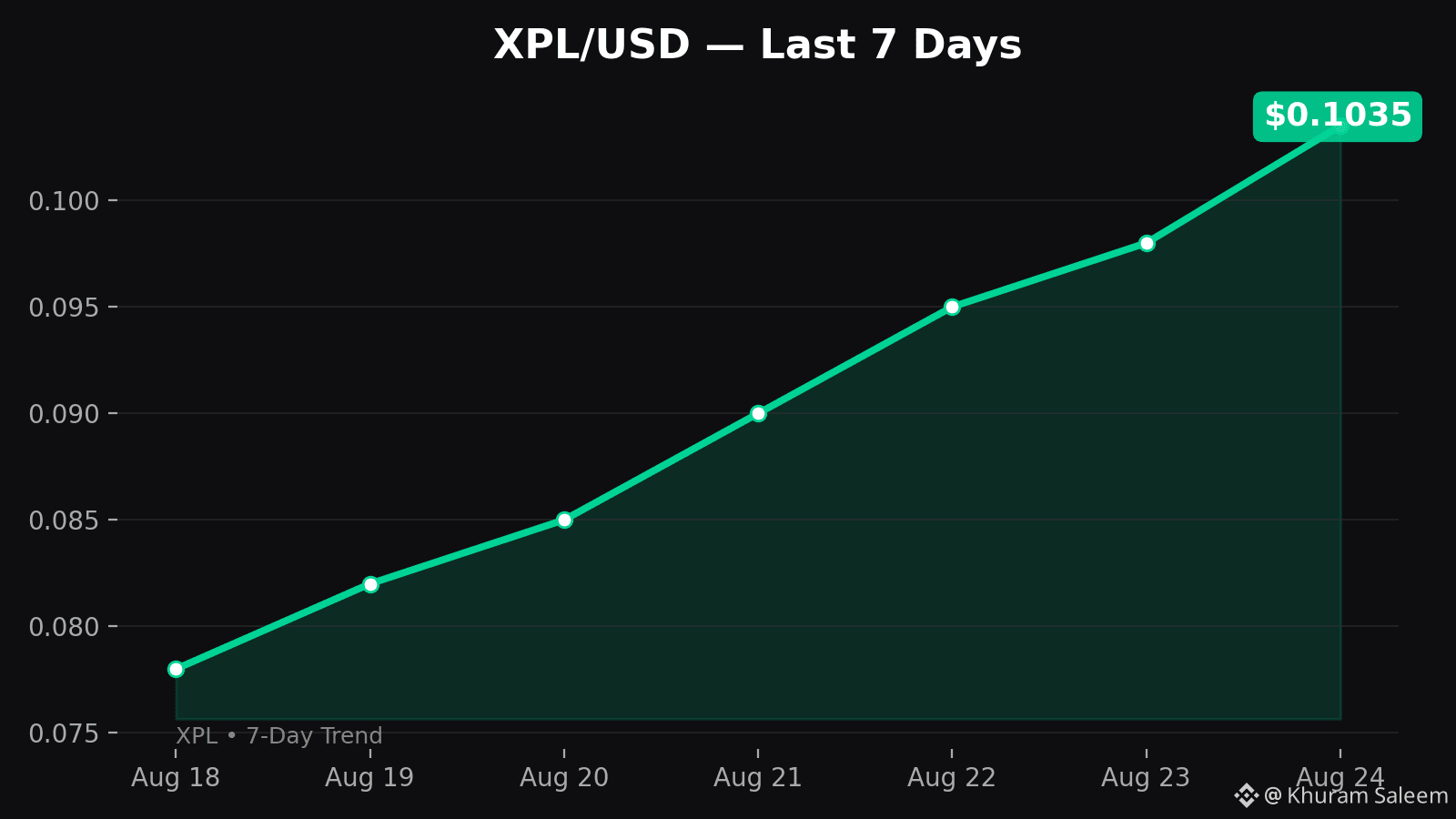
XPL is trading around $0.10, up nearly 29% over the past 7 days — outpacing the broader crypto market's 19% weekly gain. Plasma is the L1 chain built for zero-fee USDT transfers, backed by Tether.
📊 Key stats:
• Market cap: ~$265M–$286M
• Circulating supply: ~2.69B XPL
• 24h volume: $140M+
🔍 What's driving it:
Growing traction of Plasma's stablecoin-payment infrastructure and Bitcoin bridge is fueling renewed interest after a rough post-launch drawdown (XPL is still ~93% below its Sept 2025 ATH of $1.68).
⚠️ Watch for: A scheduled token unlock on Aug 25 (88.89M XPL, ~$8.7M) could add short-term sell pressure. Volatility remains high — this is still an early-stage token.
Not financial advice — always DYOR. 🔶
#XPL #Plasma #WriteToEarn #BinanceSquare #CryptoAnalysis
{future}(XPLUSDT)
#BitcoinOpenInterestFallsToTwoMonthLow #BitcoinRises23.6%Weekly #AIHardwareStocksFallPreMarketAAOIDown11.66%
#plasma 🔥 Plasma (XPL) Outperforms the Market — Up 28%+ in a Week
XPL is trading around $0.10, up nearly 29% over the past 7 days — outpacing the broader crypto market's 19% weekly gain. Plasma is the L1 chain built for zero-fee USDT transfers, backed by Tether.
📊 Key stats:
• Market cap: ~$265M–$286M
• Circulating supply: ~2.69B XPL
• 24h volume: $140M+
🔍 What's driving it:
Growing traction of Plasma's stablecoin-payment infrastructure and Bitcoin bridge is fueling renewed interest after a rough post-launch drawdown (XPL is still ~93% below its Sept 2025 ATH of $1.68).
⚠️ Watch for: A scheduled token unlock on Aug 25 (88.89M XPL, ~$8.7M) could add short-term sell pressure. Volatility remains high — this is still an early-stage token.
Not financial advice — always DYOR. 🔶
#XPL #Plasma #WriteToEarn #BinanceSquare #CryptoAnalysis
#BitcoinOpenInterestFallsToTwoMonthLow #BitcoinRises23.6%Weekly #AIHardwareStocksFallPreMarketAAOIDown11.66%
XPL is trading around $0.10, up nearly 29% over the past 7 days — outpacing the broader crypto market's 19% weekly gain. Plasma is the L1 chain built for zero-fee USDT transfers, backed by Tether.
📊 Key stats:
• Market cap: ~$265M–$286M
• Circulating supply: ~2.69B XPL
• 24h volume: $140M+
🔍 What's driving it:
Growing traction of Plasma's stablecoin-payment infrastructure and Bitcoin bridge is fueling renewed interest after a rough post-launch drawdown (XPL is still ~93% below its Sept 2025 ATH of $1.68).
⚠️ Watch for: A scheduled token unlock on Aug 25 (88.89M XPL, ~$8.7M) could add short-term sell pressure. Volatility remains high — this is still an early-stage token.
Not financial advice — always DYOR. 🔶
#XPL #Plasma #WriteToEarn #BinanceSquare #CryptoAnalysis
#BitcoinOpenInterestFallsToTwoMonthLow #BitcoinRises23.6%Weekly #AIHardwareStocksFallPreMarketAAOIDown11.66%
84

·
--
Have you evaluated the potential of Plasma $XPL ?
{future}(XPLUSDT)
This Layer 1 is designed specifically for global payments with stablecoins, offering transfers of $USDT with no fees and EVM compatibility.
In a macro environment where capital efficiency and stable liquidity are priorities, its infrastructure aims to capture institutional volume. However, I warn: competition in L1 payment solutions is fierce, and real adoption must surpass the initial speculation#CTRARK #Plasma
Have you evaluated the potential of Plasma $XPL ?
This Layer 1 is designed specifically for global payments with stablecoins, offering transfers of $USDT with no fees and EVM compatibility.
In a macro environment where capital efficiency and stable liquidity are priorities, its infrastructure aims to capture institutional volume. However, I warn: competition in L1 payment solutions is fierce, and real adoption must surpass the initial speculation#CTRARK #Plasma
This Layer 1 is designed specifically for global payments with stablecoins, offering transfers of $USDT with no fees and EVM compatibility.
In a macro environment where capital efficiency and stable liquidity are priorities, its infrastructure aims to capture institutional volume. However, I warn: competition in L1 payment solutions is fierce, and real adoption must surpass the initial speculation#CTRARK #Plasma
1
185

·
--
The overall performance of the Plasma ecosystem associated with $XPL in recent times has been quite impressive, with positive trends across multiple dimensions.
First, the on-chain card payment transaction volume has reached an all-time high, directly reflecting steadily growing real user demand and that the progress of deployed applications has far exceeded market expectations.
Second, overall user activity continues to rise, with more and more capital and users flowing into the ecosystem. Both new user retention and repeat purchases by existing users have performed exceptionally well.
Meanwhile, Plasma has also been expanding its partner network recently. More top organizations in the industry are joining the ecosystem, further strengthening the project’s fundamentals.
What’s even more worth looking forward to is that the project still has a number of new features that have not yet been unlocked. In the future, there should be enough catalytic events to keep driving market momentum.
At present, overall market sentiment has clearly shifted toward optimism. With multiple favorable factors stacking up, the price of $XPL may be poised for further upside.
#Plasma #cryptocurrency
The overall performance of the Plasma ecosystem associated with $XPL in recent times has been quite impressive, with positive trends across multiple dimensions.
First, the on-chain card payment transaction volume has reached an all-time high, directly reflecting steadily growing real user demand and that the progress of deployed applications has far exceeded market expectations.
Second, overall user activity continues to rise, with more and more capital and users flowing into the ecosystem. Both new user retention and repeat purchases by existing users have performed exceptionally well.
Meanwhile, Plasma has also been expanding its partner network recently. More top organizations in the industry are joining the ecosystem, further strengthening the project’s fundamentals.
What’s even more worth looking forward to is that the project still has a number of new features that have not yet been unlocked. In the future, there should be enough catalytic events to keep driving market momentum.
At present, overall market sentiment has clearly shifted toward optimism. With multiple favorable factors stacking up, the price of $XPL may be poised for further upside.
#Plasma #cryptocurrency
First, the on-chain card payment transaction volume has reached an all-time high, directly reflecting steadily growing real user demand and that the progress of deployed applications has far exceeded market expectations.
Second, overall user activity continues to rise, with more and more capital and users flowing into the ecosystem. Both new user retention and repeat purchases by existing users have performed exceptionally well.
Meanwhile, Plasma has also been expanding its partner network recently. More top organizations in the industry are joining the ecosystem, further strengthening the project’s fundamentals.
What’s even more worth looking forward to is that the project still has a number of new features that have not yet been unlocked. In the future, there should be enough catalytic events to keep driving market momentum.
At present, overall market sentiment has clearly shifted toward optimism. With multiple favorable factors stacking up, the price of $XPL may be poised for further upside.
#Plasma #cryptocurrency
12

·
--
In recent times, the overall market environment for $XPL has been moving in a positive direction. Multiple favorable factors are jointly pushing prices upward.
First, Plasma’s on-chain card payment transaction volume has reached a historic high. More and more users are starting to use it for daily payments, fully demonstrating the project’s execution capability and the growth in user demand.
Second, in the near term, platform user activity has clearly increased. Whether it’s new user growth or returning rate among existing users, the performance is solid, and network effects are gradually becoming apparent.
At the same time, the project team continues to expand its partner network, steadily enlarging its ecosystem footprint, further enhancing the project’s overall value and market influence.
More worth noting is that Plasma is about to unlock a brand-new feature. The market has high expectations for the new functionality, and investor sentiment continues to heat up.
Overall, judging from both fundamentals and market sentiment, $XPL has entered a promising development window, and its subsequent performance is definitely worth ongoing attention.
#Plasma #支付创新 #区块链落地
In recent times, the overall market environment for $XPL has been moving in a positive direction. Multiple favorable factors are jointly pushing prices upward.
First, Plasma’s on-chain card payment transaction volume has reached a historic high. More and more users are starting to use it for daily payments, fully demonstrating the project’s execution capability and the growth in user demand.
Second, in the near term, platform user activity has clearly increased. Whether it’s new user growth or returning rate among existing users, the performance is solid, and network effects are gradually becoming apparent.
At the same time, the project team continues to expand its partner network, steadily enlarging its ecosystem footprint, further enhancing the project’s overall value and market influence.
More worth noting is that Plasma is about to unlock a brand-new feature. The market has high expectations for the new functionality, and investor sentiment continues to heat up.
Overall, judging from both fundamentals and market sentiment, $XPL has entered a promising development window, and its subsequent performance is definitely worth ongoing attention.
#Plasma #支付创新 #区块链落地
First, Plasma’s on-chain card payment transaction volume has reached a historic high. More and more users are starting to use it for daily payments, fully demonstrating the project’s execution capability and the growth in user demand.
Second, in the near term, platform user activity has clearly increased. Whether it’s new user growth or returning rate among existing users, the performance is solid, and network effects are gradually becoming apparent.
At the same time, the project team continues to expand its partner network, steadily enlarging its ecosystem footprint, further enhancing the project’s overall value and market influence.
More worth noting is that Plasma is about to unlock a brand-new feature. The market has high expectations for the new functionality, and investor sentiment continues to heat up.
Overall, judging from both fundamentals and market sentiment, $XPL has entered a promising development window, and its subsequent performance is definitely worth ongoing attention.
#Plasma #支付创新 #区块链落地
51

·
--
In the recent period, the Plasma ecosystem where $XPL is located has seen multiple positive catalysts, and market sentiment continues to heat up.
From a fundamentals perspective, the transaction volume of Plasma entity card payments has reached a historic high, directly reflecting the growth in real user demand. At the same time, overall platform user activity has clearly increased, the partnership ecosystem is also expanding continuously, and the project team is about to unlock new features, further opening up room for growth expectations.
Currently, the price of $XPL is $0.09826, with a 24-hour trading volume of $235 million and a market cap of approximately $264 million. Against the backdrop of an overall favorable recent market environment, multiple positive signals in the fundamentals are expected to further drive prices upward.
$XPL #Plasma #Cryptocurrency
In the recent period, the Plasma ecosystem where $XPL is located has seen multiple positive catalysts, and market sentiment continues to heat up.
From a fundamentals perspective, the transaction volume of Plasma entity card payments has reached a historic high, directly reflecting the growth in real user demand. At the same time, overall platform user activity has clearly increased, the partnership ecosystem is also expanding continuously, and the project team is about to unlock new features, further opening up room for growth expectations.
Currently, the price of $XPL is $0.09826, with a 24-hour trading volume of $235 million and a market cap of approximately $264 million. Against the backdrop of an overall favorable recent market environment, multiple positive signals in the fundamentals are expected to further drive prices upward.
$XPL #Plasma #Cryptocurrency
From a fundamentals perspective, the transaction volume of Plasma entity card payments has reached a historic high, directly reflecting the growth in real user demand. At the same time, overall platform user activity has clearly increased, the partnership ecosystem is also expanding continuously, and the project team is about to unlock new features, further opening up room for growth expectations.
Currently, the price of $XPL is $0.09826, with a 24-hour trading volume of $235 million and a market cap of approximately $264 million. Against the backdrop of an overall favorable recent market environment, multiple positive signals in the fundamentals are expected to further drive prices upward.
$XPL #Plasma #Cryptocurrency
35

·
--
🚀 XPL | PLASMA — THE STABLECOIN BLOCKCHAIN
Plasma ($XPL ) is building a blockchain focused on fast, scalable stablecoin payments and digital finance.
⚡ Fast & Scalable — Designed for high-throughput transactions.
💵 Stablecoin Focus — Built around efficient digital-dollar payments.
🌐 Global Infrastructure — Designed for borderless value transfer.
🔗 Plasma Ecosystem — Expanding across payments, DeFi, and on-chain applications.
📊 XPL is a project to watch as the stablecoin economy continues to evolve.
Do your own research. Stay informed. 🚀
#XPL #Plasma #Web3
{spot}(XPLUSDT)
🚀 XPL | PLASMA — THE STABLECOIN BLOCKCHAIN
Plasma ($XPL ) is building a blockchain focused on fast, scalable stablecoin payments and digital finance.
⚡ Fast & Scalable — Designed for high-throughput transactions.
💵 Stablecoin Focus — Built around efficient digital-dollar payments.
🌐 Global Infrastructure — Designed for borderless value transfer.
🔗 Plasma Ecosystem — Expanding across payments, DeFi, and on-chain applications.
📊 XPL is a project to watch as the stablecoin economy continues to evolve.
Do your own research. Stay informed. 🚀
#XPL #Plasma #Web3
Plasma ($XPL ) is building a blockchain focused on fast, scalable stablecoin payments and digital finance.
⚡ Fast & Scalable — Designed for high-throughput transactions.
💵 Stablecoin Focus — Built around efficient digital-dollar payments.
🌐 Global Infrastructure — Designed for borderless value transfer.
🔗 Plasma Ecosystem — Expanding across payments, DeFi, and on-chain applications.
📊 XPL is a project to watch as the stablecoin economy continues to evolve.
Do your own research. Stay informed. 🚀
#XPL #Plasma #Web3
1
69
Log in to explore more content
Join global crypto users on Binance Square
⚡️ Get latest and useful information about crypto.
💬 Trusted by the world’s largest crypto exchange.
👍 Discover real insights from verified creators.
Email / Phone number
Trending Topics
1
#AnthropicCEOCallsForAISlowdown
75,056 views
1,084 Discussing
2
#BitcoinThirdSingleBlockReorgInFourWeeks
6,683 views
247 Discussing
3
#EthereumFallsBelow$2500
533 views
43 Discussing
4
#BitcoinDropsToIntradayLow$76367
226 views
7 Discussing
5
#WhiteHouseRejectsAISlowdownCalls
0 views
2 Discussing
6
#UKMayExemptTokenizedGoldFromFundRules
0 views
0 Discussing
7
#BitcoinSpotETFsRecord$463MNetOutflowLastWeek
8 views
2 Discussing
8
#LSKSurgesOver515%In24Hours
6,508 views
164 Discussing
9
#ClarityActLawIn2026OddsRiseTo30%
3,919 views
84 Discussing
10
#KoreaCryptoTaxDelayPetitionMeetsReviewThreshold
937 views
51 Discussing