

#usdtvenezuela
usdtvenezuela
84,736 views
194 Discussing
Hot
Latest

·
--
BPAY and Binance: how to buy USDT with electronic dollars📊 BPAY and Binance: how to buy USDT with electronic dollars
USDT P2P trading in Venezuela does not stop, and every week new funding and payment methods appear. This video lays out a specific workflow: using BPAY as a bridge from a Banco de Venezuela account to buy USDT on Binance with electronic dollars. At PitbullChain we break it down and add the real-world context on exchange rate, liquidity, and risks.
📈 Video summary
The content is a practical, step-by-step guide to buy USDT on Binance’s P2P market using BPAY as a payment method linked to an account from the Banco de Venezuela. It explains how to prepare the user, verify the payment method, filter ads by amount and counterparty reputation, and complete the order with electronic dollars. It also reviews good security practices: do not release the payment without confirming the deposit, review the ad terms, and use the platform’s chat. The approach is operational: get the user ready for their first purchase without making costly mistakes.
BPAY and Binance: how to buy USDT with electronic dollars
📊 BPAY and Binance: how to buy USDT with electronic dollars
USDT P2P trading in Venezuela does not stop, and every week new funding and payment methods appear. This video lays out a specific workflow: using BPAY as a bridge from a Banco de Venezuela account to buy USDT on Binance with electronic dollars. At PitbullChain we break it down and add the real-world context on exchange rate, liquidity, and risks.
📈 Video summary
The content is a practical, step-by-step guide to buy USDT on Binance’s P2P market using BPAY as a payment method linked to an account from the Banco de Venezuela. It explains how to prepare the user, verify the payment method, filter ads by amount and counterparty reputation, and complete the order with electronic dollars. It also reviews good security practices: do not release the payment without confirming the deposit, review the ad terms, and use the platform’s chat. The approach is operational: get the user ready for their first purchase without making costly mistakes.
USDT P2P trading in Venezuela does not stop, and every week new funding and payment methods appear. This video lays out a specific workflow: using BPAY as a bridge from a Banco de Venezuela account to buy USDT on Binance with electronic dollars. At PitbullChain we break it down and add the real-world context on exchange rate, liquidity, and risks.
📈 Video summary
The content is a practical, step-by-step guide to buy USDT on Binance’s P2P market using BPAY as a payment method linked to an account from the Banco de Venezuela. It explains how to prepare the user, verify the payment method, filter ads by amount and counterparty reputation, and complete the order with electronic dollars. It also reviews good security practices: do not release the payment without confirming the deposit, review the ad terms, and use the platform’s chat. The approach is operational: get the user ready for their first purchase without making costly mistakes.
15
·
--
Article
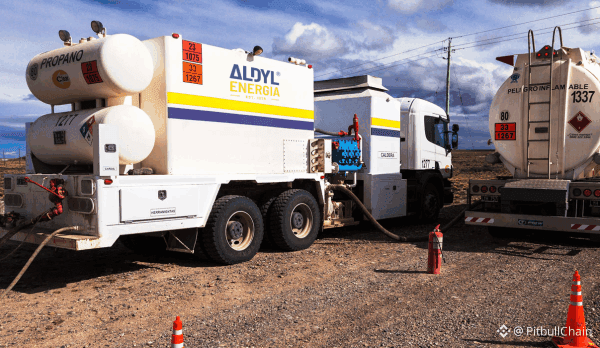
Aldyl revives 13 wells in Uverito: Does this move the dollar and the P2P of USDT?The Venezuelan east once again sounded like a drill. Argentine energy company Aldyl Energía installed a Drillmec HH-102 hydraulic rig at the Uverito Field, in the Orinoco Oil Belt, and kicked off with the restart of well UV 208, which had been shut down since 2014. The company estimates roughly 100 net barrels per day at the start, but the real interest isn’t that well: it’s what comes next.
The company has set its sights on a portfolio of 13 wells, with which it expects to average 1,100 barrels per day during 2026. This isn’t a boom, not even close. But it’s a sign that Latin America’s private capital continues to bet on rehabilitating old fields rather than opening new ones—a cheaper and faster move.
Aldyl revives 13 wells in Uverito: Does this move the dollar and the P2P of USDT?
The Venezuelan east once again sounded like a drill. Argentine energy company Aldyl Energía installed a Drillmec HH-102 hydraulic rig at the Uverito Field, in the Orinoco Oil Belt, and kicked off with the restart of well UV 208, which had been shut down since 2014. The company estimates roughly 100 net barrels per day at the start, but the real interest isn’t that well: it’s what comes next.
The company has set its sights on a portfolio of 13 wells, with which it expects to average 1,100 barrels per day during 2026. This isn’t a boom, not even close. But it’s a sign that Latin America’s private capital continues to bet on rehabilitating old fields rather than opening new ones—a cheaper and faster move.
The company has set its sights on a portfolio of 13 wells, with which it expects to average 1,100 barrels per day during 2026. This isn’t a boom, not even close. But it’s a sign that Latin America’s private capital continues to bet on rehabilitating old fields rather than opening new ones—a cheaper and faster move.
18
·
--
Article
USDT P2P gap exceeds 15% vs BCV: Alert for bank spreadsLive P2P Radar Capture: 13/8/2026, 9:30:14 p. m.
USDT/VES reference Bs. 887.12
Buy USDT Bs. 887.12
USDT Sale Bs. 865.26
BCV Bs. 766.86
Premium vs BCV 15.68%
P2P Spread 2.53%
Observed offers 207
Check current data on P2P Radar
Venezuela’s financial ecosystem continues its rapid evolution in mid-August 2026. In a context where exchange platforms and new digital payment tools gain ground, the P2P (Peer-to-Peer) market immediately reflects the tensions and opportunities of the local economy. Currently, the dynamics between supply and demand for stablecoins has generated a significant divergence from official indicators, requiring users to exercise greater caution and analysis before executing their transactions.
USDT P2P gap exceeds 15% vs BCV: Alert for bank spreads
Live P2P Radar Capture: 13/8/2026, 9:30:14 p. m.
USDT/VES reference Bs. 887.12
Buy USDT Bs. 887.12
USDT Sale Bs. 865.26
BCV Bs. 766.86
Premium vs BCV 15.68%
P2P Spread 2.53%
Observed offers 207
Check current data on P2P Radar
Venezuela’s financial ecosystem continues its rapid evolution in mid-August 2026. In a context where exchange platforms and new digital payment tools gain ground, the P2P (Peer-to-Peer) market immediately reflects the tensions and opportunities of the local economy. Currently, the dynamics between supply and demand for stablecoins has generated a significant divergence from official indicators, requiring users to exercise greater caution and analysis before executing their transactions.
USDT/VES reference Bs. 887.12
Buy USDT Bs. 887.12
USDT Sale Bs. 865.26
BCV Bs. 766.86
Premium vs BCV 15.68%
P2P Spread 2.53%
Observed offers 207
Check current data on P2P Radar
Venezuela’s financial ecosystem continues its rapid evolution in mid-August 2026. In a context where exchange platforms and new digital payment tools gain ground, the P2P (Peer-to-Peer) market immediately reflects the tensions and opportunities of the local economy. Currently, the dynamics between supply and demand for stablecoins has generated a significant divergence from official indicators, requiring users to exercise greater caution and analysis before executing their transactions.
·
--
Article
USDT P2P registers a 14% gap vs BCV with high liquidity Live P2P Radar Capture: 15/8/2026, 7:30:13 p. m.
USDT/VES reference Bs. 880.14
Buy USDT Bs. 880.14
USDT Sale Bs. 852.47
BCV Bs. 771.07
Premium vs BCV 14.14%
P2P Spread 3.25%
Observed offers 218
Verify current data on P2P Radar
The crypto asset market in Venezuela continues to show the strong dependence of users on stablecoins as a hedging and daily transaction mechanism. According to the most recent data processed by market monitors, the Tether (USDT) price in the peer-to-peer (P2P) ecosystem stands at 880.13 VES for the purchase, marking a significant distance from the official rate set by the Central Bank of Venezuela (BCV), which is at 771.07 VES.
USDT P2P registers a 14% gap vs BCV with high liquidity
Live P2P Radar Capture: 15/8/2026, 7:30:13 p. m.
USDT/VES reference Bs. 880.14
Buy USDT Bs. 880.14
USDT Sale Bs. 852.47
BCV Bs. 771.07
Premium vs BCV 14.14%
P2P Spread 3.25%
Observed offers 218
Verify current data on P2P Radar
The crypto asset market in Venezuela continues to show the strong dependence of users on stablecoins as a hedging and daily transaction mechanism. According to the most recent data processed by market monitors, the Tether (USDT) price in the peer-to-peer (P2P) ecosystem stands at 880.13 VES for the purchase, marking a significant distance from the official rate set by the Central Bank of Venezuela (BCV), which is at 771.07 VES.
USDT/VES reference Bs. 880.14
Buy USDT Bs. 880.14
USDT Sale Bs. 852.47
BCV Bs. 771.07
Premium vs BCV 14.14%
P2P Spread 3.25%
Observed offers 218
Verify current data on P2P Radar
The crypto asset market in Venezuela continues to show the strong dependence of users on stablecoins as a hedging and daily transaction mechanism. According to the most recent data processed by market monitors, the Tether (USDT) price in the peer-to-peer (P2P) ecosystem stands at 880.13 VES for the purchase, marking a significant distance from the official rate set by the Central Bank of Venezuela (BCV), which is at 771.07 VES.
4
·
--
Article
USDT P2P gap and BCV dollar nearly reach 18% in August 2026 Live P2P Radar Capture: 16/8/2026, 1:00:15 a.m.
USDT/VES reference Bs. 908.56
Buy USDT Bs. 908.56
Sell USDT Bs. 835.72
BCV Bs. 771.07
Premium vs BCV 17.83%
P2P Spread 8.72%
Observed offers 185
Verify current data on P2P Radar
The cryptocurrency market in Venezuela is going through a period of structural readjustment during the third quarter of 2026. As the national economy experiences new monetary policies, Venezuelans continue to consolidate Tether (USDT) stablecoin as their main store of value and medium of exchange. However, this level of mass adoption has brought with it a phenomenon that requires the attention of every operator: the significant widening of the exchange-rate gap between the P2P market and the official rate of the Central Bank of Venezuela (BCV).
USDT P2P gap and BCV dollar nearly reach 18% in August 2026
Live P2P Radar Capture: 16/8/2026, 1:00:15 a.m.
USDT/VES reference Bs. 908.56
Buy USDT Bs. 908.56
Sell USDT Bs. 835.72
BCV Bs. 771.07
Premium vs BCV 17.83%
P2P Spread 8.72%
Observed offers 185
Verify current data on P2P Radar
The cryptocurrency market in Venezuela is going through a period of structural readjustment during the third quarter of 2026. As the national economy experiences new monetary policies, Venezuelans continue to consolidate Tether (USDT) stablecoin as their main store of value and medium of exchange. However, this level of mass adoption has brought with it a phenomenon that requires the attention of every operator: the significant widening of the exchange-rate gap between the P2P market and the official rate of the Central Bank of Venezuela (BCV).
USDT/VES reference Bs. 908.56
Buy USDT Bs. 908.56
Sell USDT Bs. 835.72
BCV Bs. 771.07
Premium vs BCV 17.83%
P2P Spread 8.72%
Observed offers 185
Verify current data on P2P Radar
The cryptocurrency market in Venezuela is going through a period of structural readjustment during the third quarter of 2026. As the national economy experiences new monetary policies, Venezuelans continue to consolidate Tether (USDT) stablecoin as their main store of value and medium of exchange. However, this level of mass adoption has brought with it a phenomenon that requires the attention of every operator: the significant widening of the exchange-rate gap between the P2P market and the official rate of the Central Bank of Venezuela (BCV).
10
·
--
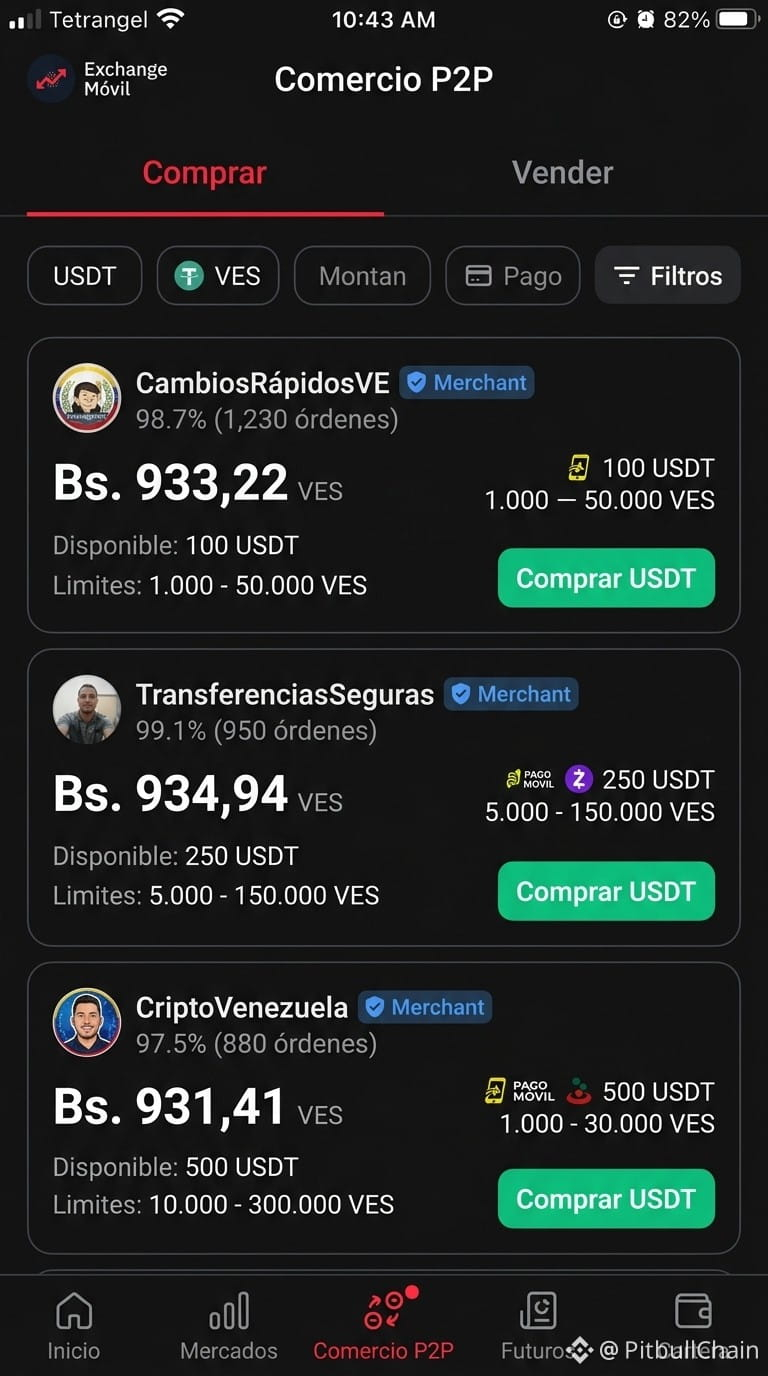
Article
USDT vs BCV dollar spread exceeds 19% in the P2P market Live P2P Radar Capture: 24/8/2026, 8:00:13 a. m.
USDT/VES reference Bs. 934.97
Buy USDT Bs. 934.97
Buy USDT Bs. 880.51
BCV Bs. 784.66
Premium vs BCV 19.16%
P2P spread 6.19%
Observed offers 219
Verify current data in P2P Radar
Venezuela's financial ecosystem continues its evolution toward accelerated digitalization, and the P2P (peer-to-peer) market is consolidating as the main barometer of the real economy. For August 24, 2026, the data extracted from the main exchange platforms reveals a scenario of high volatility and sustained demand: the USDT vs. the official exchange rate from Venezuela's Central Bank (BCV) has surpassed the 19% threshold, marking a milestone in the country's currency dynamics.
USDT vs BCV dollar spread exceeds 19% in the P2P market
Live P2P Radar Capture: 24/8/2026, 8:00:13 a. m.
USDT/VES reference Bs. 934.97
Buy USDT Bs. 934.97
Buy USDT Bs. 880.51
BCV Bs. 784.66
Premium vs BCV 19.16%
P2P spread 6.19%
Observed offers 219
Verify current data in P2P Radar
Venezuela's financial ecosystem continues its evolution toward accelerated digitalization, and the P2P (peer-to-peer) market is consolidating as the main barometer of the real economy. For August 24, 2026, the data extracted from the main exchange platforms reveals a scenario of high volatility and sustained demand: the USDT vs. the official exchange rate from Venezuela's Central Bank (BCV) has surpassed the 19% threshold, marking a milestone in the country's currency dynamics.
USDT/VES reference Bs. 934.97
Buy USDT Bs. 934.97
Buy USDT Bs. 880.51
BCV Bs. 784.66
Premium vs BCV 19.16%
P2P spread 6.19%
Observed offers 219
Verify current data in P2P Radar
Venezuela's financial ecosystem continues its evolution toward accelerated digitalization, and the P2P (peer-to-peer) market is consolidating as the main barometer of the real economy. For August 24, 2026, the data extracted from the main exchange platforms reveals a scenario of high volatility and sustained demand: the USDT vs. the official exchange rate from Venezuela's Central Bank (BCV) has surpassed the 19% threshold, marking a milestone in the country's currency dynamics.
14
·
--

Article
Delcy orders new web unblock: does anything change for P2P and USDT?Once again the same formula: a brief statement, disseminated via social media, ordering the "immediate unblocking" of a set of platforms and web portals, with no list, no figures, and no schedule. Acting President Delcy Rodríguez gave the order this Friday, September 25, after receiving reports on the second round of dialogue between the ruling party and representatives of the opposition, according to the text published by the Communications Minister, Miguel Ángel Pérez Pirela.
The announcement builds on one from September 17, when Conatel talked about a "formal restoration of access" to national and international digital platforms and media. In practice, the pattern repeats: first the political gesture, then the technical verification. And in Venezuela, that verification almost always ends up being carried out by civil society before the State.
Delcy orders new web unblock: does anything change for P2P and USDT?
Once again the same formula: a brief statement, disseminated via social media, ordering the "immediate unblocking" of a set of platforms and web portals, with no list, no figures, and no schedule. Acting President Delcy Rodríguez gave the order this Friday, September 25, after receiving reports on the second round of dialogue between the ruling party and representatives of the opposition, according to the text published by the Communications Minister, Miguel Ángel Pérez Pirela.
The announcement builds on one from September 17, when Conatel talked about a "formal restoration of access" to national and international digital platforms and media. In practice, the pattern repeats: first the political gesture, then the technical verification. And in Venezuela, that verification almost always ends up being carried out by civil society before the State.
The announcement builds on one from September 17, when Conatel talked about a "formal restoration of access" to national and international digital platforms and media. In practice, the pattern repeats: first the political gesture, then the technical verification. And in Venezuela, that verification almost always ends up being carried out by civil society before the State.
73
·
--
Article
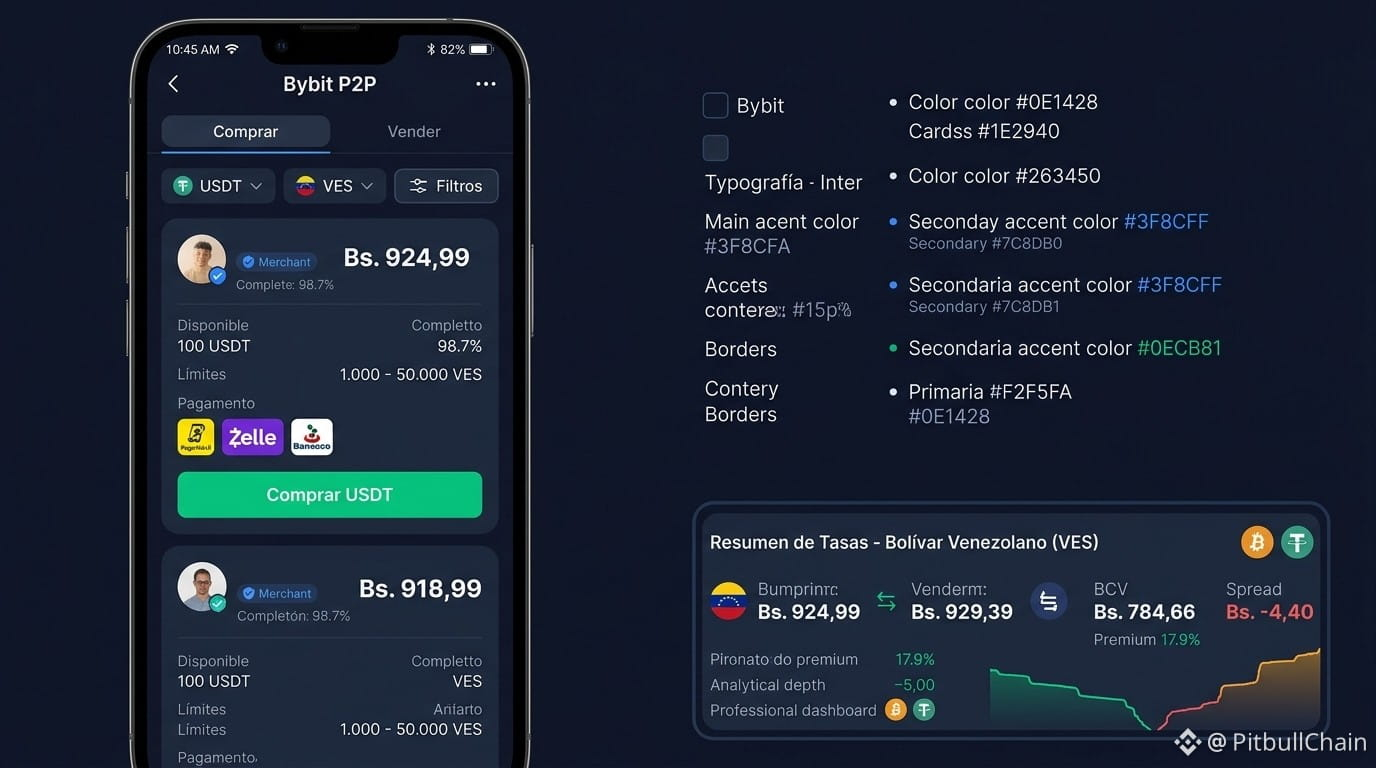
The USDT P2P gap exceeds 19% compared to the BCV rate in Venezuela Live P2P Radar Capture: 24/8/2026, 10:00:13 p. m.
USDT/VES reference Bs. 935.05
Buy USDT Bs. 935.05
Buy USDT Bs. 902.59
BCV Bs. 784.66
Premium vs BCV 19.17%
P2P Spread 3.60%
Observed offers 228
Check current data on Radar P2P
The stablecoin market in Venezuela shows a notable increase in its exchange premium. According to live data collected by PitbullChain monitoring tools, the reference USDT P2P rate reached Bs. 935.05 per unit, while the official exchange rate published by the Central Bank of Venezuela (BCV) remains at Bs. 784.66 per US dollar. This discrepancy establishes an exchange-rate gap of 19.17% between the crypto peer-to-peer market and the official quotation.
The USDT P2P gap exceeds 19% compared to the BCV rate in Venezuela
Live P2P Radar Capture: 24/8/2026, 10:00:13 p. m.
USDT/VES reference Bs. 935.05
Buy USDT Bs. 935.05
Buy USDT Bs. 902.59
BCV Bs. 784.66
Premium vs BCV 19.17%
P2P Spread 3.60%
Observed offers 228
Check current data on Radar P2P
The stablecoin market in Venezuela shows a notable increase in its exchange premium. According to live data collected by PitbullChain monitoring tools, the reference USDT P2P rate reached Bs. 935.05 per unit, while the official exchange rate published by the Central Bank of Venezuela (BCV) remains at Bs. 784.66 per US dollar. This discrepancy establishes an exchange-rate gap of 19.17% between the crypto peer-to-peer market and the official quotation.
USDT/VES reference Bs. 935.05
Buy USDT Bs. 935.05
Buy USDT Bs. 902.59
BCV Bs. 784.66
Premium vs BCV 19.17%
P2P Spread 3.60%
Observed offers 228
Check current data on Radar P2P
The stablecoin market in Venezuela shows a notable increase in its exchange premium. According to live data collected by PitbullChain monitoring tools, the reference USDT P2P rate reached Bs. 935.05 per unit, while the official exchange rate published by the Central Bank of Venezuela (BCV) remains at Bs. 784.66 per US dollar. This discrepancy establishes an exchange-rate gap of 19.17% between the crypto peer-to-peer market and the official quotation.
38
·
--
Article
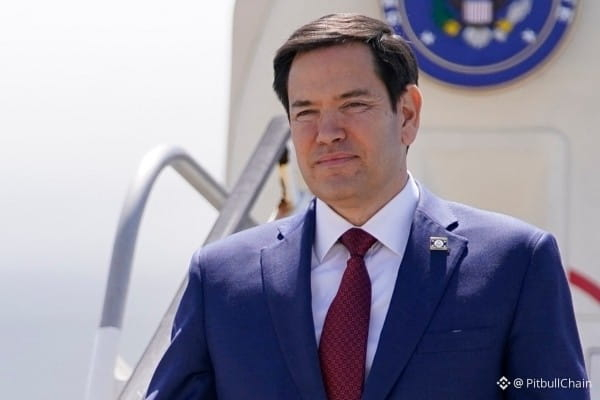
Rubio, Trump and Rodríguez: reconstruction with USDT on the radarMarco Rubio’s press conference left a headline that few expected and another that almost no one highlighted. The U.S. secretary of state confirmed that Donald Trump and Delcy Rodríguez discussed elections, yes, but the real weight of the agenda was on how to lift an economy that, according to their own words, would end up in the hands of any elected government as a social and economic catastrophe.
Translated into the language of the Venezuelan market: the discussion is not about who sits in Miraflores, but about what remains of the financial system when that happens. And that’s where the local crypto community has a lot to read between the lines.
Rubio, Trump and Rodríguez: reconstruction with USDT on the radar
Marco Rubio’s press conference left a headline that few expected and another that almost no one highlighted. The U.S. secretary of state confirmed that Donald Trump and Delcy Rodríguez discussed elections, yes, but the real weight of the agenda was on how to lift an economy that, according to their own words, would end up in the hands of any elected government as a social and economic catastrophe.
Translated into the language of the Venezuelan market: the discussion is not about who sits in Miraflores, but about what remains of the financial system when that happens. And that’s where the local crypto community has a lot to read between the lines.
Translated into the language of the Venezuelan market: the discussion is not about who sits in Miraflores, but about what remains of the financial system when that happens. And that’s where the local crypto community has a lot to read between the lines.
27
·
--
Article
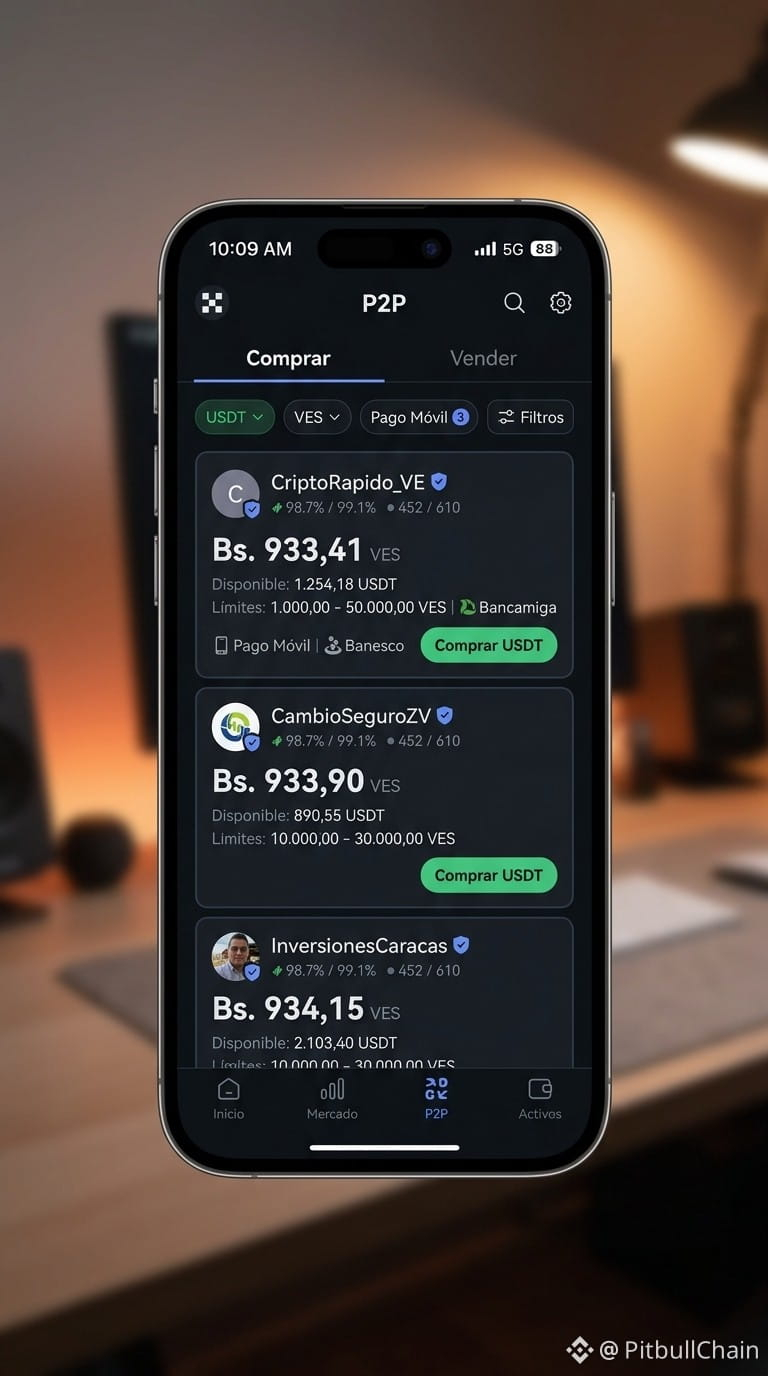
Gap between USDT P2P and BCV dollar reaches 19.6% in the Venezuelan marketLive P2P Radar Capture: 25/8/2026, 4:00:14 p. m.
USDT/VES reference Bs. 938.96
Buy USDT Bs. 938.96
USDT sale USDT Bs. 932.71
BCV Bs. 785.07
Premium vs BCV 19.6%
P2P spread 0.67%
Offers observed 241
Verify current data on P2P Radar
Venezuela’s stablecoin market shows a new widening in its currency exchange spreads. According to the quantitative records compiled by P2P monitoring tools, the USDT purchase rate versus the bolívar stood at 938.96 VES, while the reference exchange rate published by the Central Bank of Venezuela (BCV) closed the day at 785.06 VES. This discrepancy consolidates a 19.60% currency premium between the peer-to-peer market and the official rate.
Gap between USDT P2P and BCV dollar reaches 19.6% in the Venezuelan market
Live P2P Radar Capture: 25/8/2026, 4:00:14 p. m.
USDT/VES reference Bs. 938.96
Buy USDT Bs. 938.96
USDT sale USDT Bs. 932.71
BCV Bs. 785.07
Premium vs BCV 19.6%
P2P spread 0.67%
Offers observed 241
Verify current data on P2P Radar
Venezuela’s stablecoin market shows a new widening in its currency exchange spreads. According to the quantitative records compiled by P2P monitoring tools, the USDT purchase rate versus the bolívar stood at 938.96 VES, while the reference exchange rate published by the Central Bank of Venezuela (BCV) closed the day at 785.06 VES. This discrepancy consolidates a 19.60% currency premium between the peer-to-peer market and the official rate.
USDT/VES reference Bs. 938.96
Buy USDT Bs. 938.96
USDT sale USDT Bs. 932.71
BCV Bs. 785.07
Premium vs BCV 19.6%
P2P spread 0.67%
Offers observed 241
Verify current data on P2P Radar
Venezuela’s stablecoin market shows a new widening in its currency exchange spreads. According to the quantitative records compiled by P2P monitoring tools, the USDT purchase rate versus the bolívar stood at 938.96 VES, while the reference exchange rate published by the Central Bank of Venezuela (BCV) closed the day at 785.06 VES. This discrepancy consolidates a 19.60% currency premium between the peer-to-peer market and the official rate.
11
·
--

Article
Mendoza and the lack of banking: reading from the P2P and USDT in VenezuelaLorenzo Mendoza, CEO of Empresas Polar, resurfaced with a message that, on paper, sounds like a business roadmap, but in practice describes the same problem that led thousands of Venezuelans to seek refuge in digital dollars: without capital, projects don’t get off the ground. He said this during the presentation of the «1.000 Empresas» program, an initiative by Polar itself to train, support, and finance entrepreneurial ventures with a national vocation.
📊 A diagnosis the P2P knows by heart
Mendoza and the lack of banking: reading from the P2P and USDT in Venezuela
Lorenzo Mendoza, CEO of Empresas Polar, resurfaced with a message that, on paper, sounds like a business roadmap, but in practice describes the same problem that led thousands of Venezuelans to seek refuge in digital dollars: without capital, projects don’t get off the ground. He said this during the presentation of the «1.000 Empresas» program, an initiative by Polar itself to train, support, and finance entrepreneurial ventures with a national vocation.
📊 A diagnosis the P2P knows by heart
📊 A diagnosis the P2P knows by heart
1
16
·
--

Article
Venezuelan gold to New York: what changes for the dollar, USDT, and P2P📊 A seven-year unblocking that’s being cooked in silence
After nearly a decade of legal and diplomatic disputes, Venezuela’s gold reserves stored in the vaults of the Bank of England would have a different fate: the Federal Reserve Bank of New York. The information, published by the Financial Times and replicated by local media, points to an amount close to $4.0 billion and to an understanding between the government led by Delcy Rodríguez and the Washington-backed opposition.
Venezuelan gold to New York: what changes for the dollar, USDT, and P2P
📊 A seven-year unblocking that’s being cooked in silence
After nearly a decade of legal and diplomatic disputes, Venezuela’s gold reserves stored in the vaults of the Bank of England would have a different fate: the Federal Reserve Bank of New York. The information, published by the Financial Times and replicated by local media, points to an amount close to $4.0 billion and to an understanding between the government led by Delcy Rodríguez and the Washington-backed opposition.
After nearly a decade of legal and diplomatic disputes, Venezuela’s gold reserves stored in the vaults of the Bank of England would have a different fate: the Federal Reserve Bank of New York. The information, published by the Financial Times and replicated by local media, points to an amount close to $4.0 billion and to an understanding between the government led by Delcy Rodríguez and the Washington-backed opposition.
81
·
--
Crypto cards in Vzla: how to use them to spend USDT today## Crypto cards in Vzla: how to use them to spend USDT today
**Date:** Monday, August 31, 2026 · **Live P2P Radar data:** buy Bs. 942.39 · sell Bs. 924.59 · BCV Bs. N/A · premium N/A%
P2P starts the week with a buy rate of Bs. 942.39 and a sell rate of Bs. 924.59, leaving a spread of Bs. 17.80, while the BCV rate is not available. In this scenario, crypto cards gain ground as a tool to avoid giving away margin in every expense.
### Crypto cards: daily analysis
For the P2P merchant, the cards linked to USDT (like those from other platforms, other platforms, or similar ones) make it possible to convert digital balance into direct purchasing power, without going through P2P. Today, with a spread of 17.80 bolívares, using the card for expenses in bolívares avoids the implicit loss of selling at sale (924.59) and buying back at purchase (942.39). These cards usually operate on the Visa/Mastercard network, with a loading fee that ranges from 1% to 3%, and a currency conversion that may apply the official exchange rate or a parallel one, depending on the issuer. Monthly limits vary: free versions typically cap loading at $1,000-$2,000, while premium ones reach $10,000 or more. It’s key to check whether the card allows payments in bolívares directly (with automatic conversion) or only in dollars, and whether there are ATM withdrawal costs (typically $2-$3 per operation). For the merchant, the most practical approach is to use these cards for small, operational expenses, keeping P2P for accumulating USDT or selling large amounts, where the spread makes sense. Today, with the BCV not publishing a rate, crypto cards are a refuge against exchange-rate uncertainty, but always reviewing the exchange rate applied by each processing bank.
Crypto cards in Vzla: how to use them to spend USDT today
## Crypto cards in Vzla: how to use them to spend USDT today
**Date:** Monday, August 31, 2026 · **Live P2P Radar data:** buy Bs. 942.39 · sell Bs. 924.59 · BCV Bs. N/A · premium N/A%
P2P starts the week with a buy rate of Bs. 942.39 and a sell rate of Bs. 924.59, leaving a spread of Bs. 17.80, while the BCV rate is not available. In this scenario, crypto cards gain ground as a tool to avoid giving away margin in every expense.
### Crypto cards: daily analysis
For the P2P merchant, the cards linked to USDT (like those from other platforms, other platforms, or similar ones) make it possible to convert digital balance into direct purchasing power, without going through P2P. Today, with a spread of 17.80 bolívares, using the card for expenses in bolívares avoids the implicit loss of selling at sale (924.59) and buying back at purchase (942.39). These cards usually operate on the Visa/Mastercard network, with a loading fee that ranges from 1% to 3%, and a currency conversion that may apply the official exchange rate or a parallel one, depending on the issuer. Monthly limits vary: free versions typically cap loading at $1,000-$2,000, while premium ones reach $10,000 or more. It’s key to check whether the card allows payments in bolívares directly (with automatic conversion) or only in dollars, and whether there are ATM withdrawal costs (typically $2-$3 per operation). For the merchant, the most practical approach is to use these cards for small, operational expenses, keeping P2P for accumulating USDT or selling large amounts, where the spread makes sense. Today, with the BCV not publishing a rate, crypto cards are a refuge against exchange-rate uncertainty, but always reviewing the exchange rate applied by each processing bank.
**Date:** Monday, August 31, 2026 · **Live P2P Radar data:** buy Bs. 942.39 · sell Bs. 924.59 · BCV Bs. N/A · premium N/A%
P2P starts the week with a buy rate of Bs. 942.39 and a sell rate of Bs. 924.59, leaving a spread of Bs. 17.80, while the BCV rate is not available. In this scenario, crypto cards gain ground as a tool to avoid giving away margin in every expense.
### Crypto cards: daily analysis
For the P2P merchant, the cards linked to USDT (like those from other platforms, other platforms, or similar ones) make it possible to convert digital balance into direct purchasing power, without going through P2P. Today, with a spread of 17.80 bolívares, using the card for expenses in bolívares avoids the implicit loss of selling at sale (924.59) and buying back at purchase (942.39). These cards usually operate on the Visa/Mastercard network, with a loading fee that ranges from 1% to 3%, and a currency conversion that may apply the official exchange rate or a parallel one, depending on the issuer. Monthly limits vary: free versions typically cap loading at $1,000-$2,000, while premium ones reach $10,000 or more. It’s key to check whether the card allows payments in bolívares directly (with automatic conversion) or only in dollars, and whether there are ATM withdrawal costs (typically $2-$3 per operation). For the merchant, the most practical approach is to use these cards for small, operational expenses, keeping P2P for accumulating USDT or selling large amounts, where the spread makes sense. Today, with the BCV not publishing a rate, crypto cards are a refuge against exchange-rate uncertainty, but always reviewing the exchange rate applied by each processing bank.
20
·
--
Article
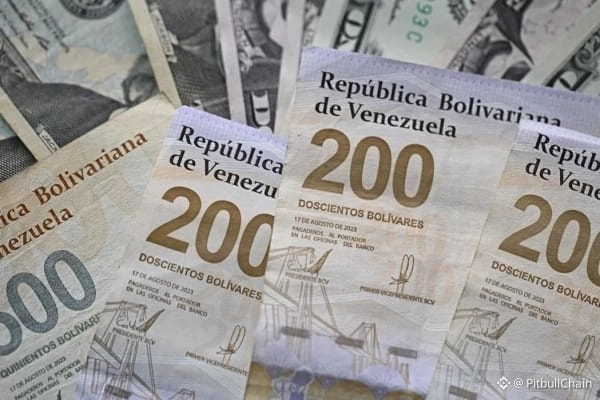
Wage adjustment in sight: what it means for the dollar, P2P, and your USDTThe conversation about a possible wage increase in Venezuela has returned to the center of the economic debate. Economist and university professor Jesús Palacios Chacín noted that there is a reasonable chance that an adjustment in salaries will take shape in the coming months, although he cautioned that any decision runs up against a structural obstacle: the enormous weight of labor liabilities carried by current legislation.
For anyone operating in the P2P market—swapping dollars for bolívares or keeping their savings in USDT—the announcement is not an anecdotal detail. An increase in minimum income moves the needle on consumption, the exchange rate, and above all, on the decisions people make to protect their purchasing power. Here we break down the issue with a close-up look at the Venezuelan crypto market.
Wage adjustment in sight: what it means for the dollar, P2P, and your USDT
The conversation about a possible wage increase in Venezuela has returned to the center of the economic debate. Economist and university professor Jesús Palacios Chacín noted that there is a reasonable chance that an adjustment in salaries will take shape in the coming months, although he cautioned that any decision runs up against a structural obstacle: the enormous weight of labor liabilities carried by current legislation.
For anyone operating in the P2P market—swapping dollars for bolívares or keeping their savings in USDT—the announcement is not an anecdotal detail. An increase in minimum income moves the needle on consumption, the exchange rate, and above all, on the decisions people make to protect their purchasing power. Here we break down the issue with a close-up look at the Venezuelan crypto market.
For anyone operating in the P2P market—swapping dollars for bolívares or keeping their savings in USDT—the announcement is not an anecdotal detail. An increase in minimum income moves the needle on consumption, the exchange rate, and above all, on the decisions people make to protect their purchasing power. Here we break down the issue with a close-up look at the Venezuelan crypto market.
8
·
--
Article
USDT P2P: 14.29% premium over BCV and 73.68% buy-side imbalance Live P2P Radar Screenshot: 13/9/2026, 2:00:13 p. m.
USDT/VES reference Bs. 962.58
Buy USDT Bs. 962.58
USDT Sale Bs. 936.70
BCV Bs. 842.21
Premium vs BCV 14.29%
P2P Spread 2.76%
Offers observed 222
Verify current data on P2P Radar
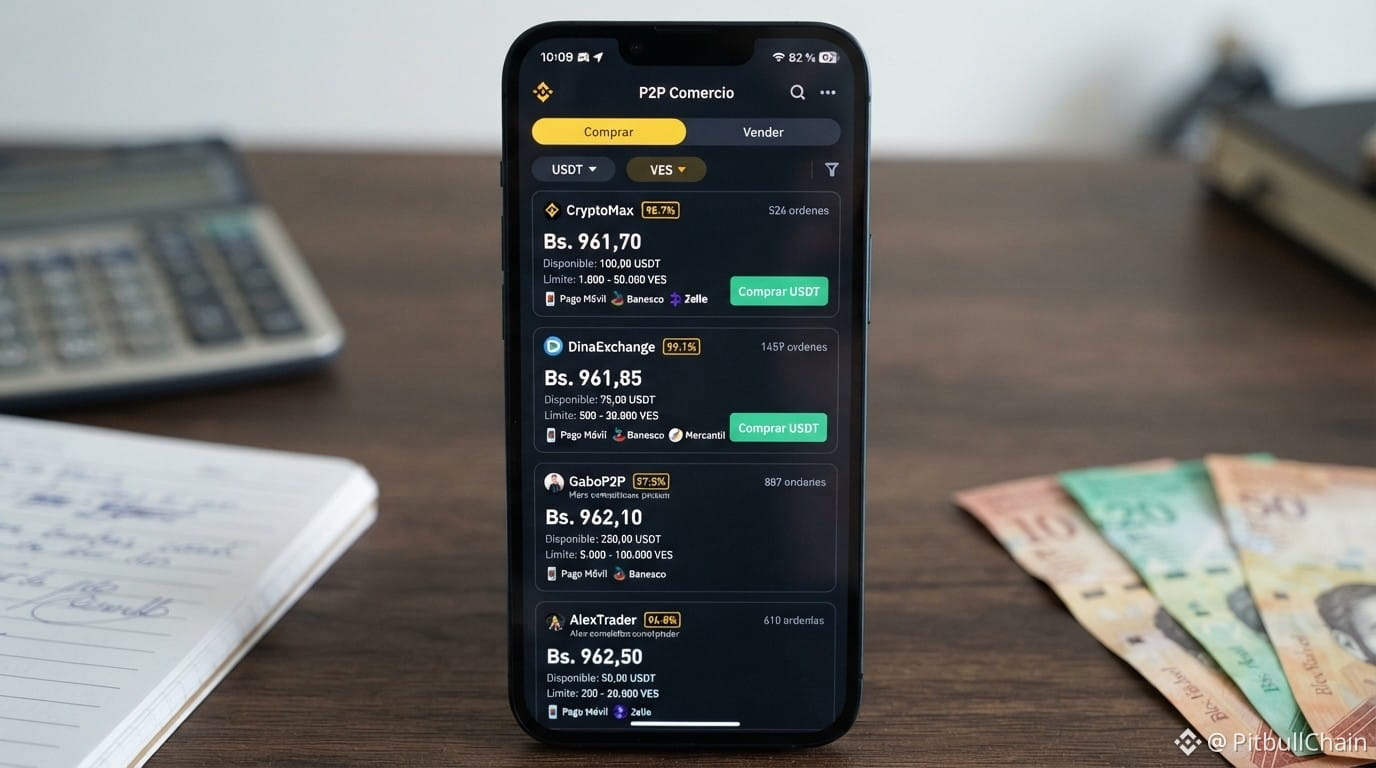
**The P2P USDT market in Venezuela closed the session of September 13, 2026 with a reference purchase price of Bs. 962.58 per USDT**, compared to Bs. 842.21 from the BCV official rate. This difference corresponds to a premium of 14.29%. The spread between the aggregator’s purchase reference and its sell reference is Bs. 25.87, or 2.76%. And the order book shows 423,015.18 USDT on the buy side versus 64,096.14 USDT on the sell side: a net imbalance of 73.68%.
USDT P2P: 14.29% premium over BCV and 73.68% buy-side imbalance
Live P2P Radar Screenshot: 13/9/2026, 2:00:13 p. m.
USDT/VES reference Bs. 962.58
Buy USDT Bs. 962.58
USDT Sale Bs. 936.70
BCV Bs. 842.21
Premium vs BCV 14.29%
P2P Spread 2.76%
Offers observed 222
Verify current data on P2P Radar
**The P2P USDT market in Venezuela closed the session of September 13, 2026 with a reference purchase price of Bs. 962.58 per USDT**, compared to Bs. 842.21 from the BCV official rate. This difference corresponds to a premium of 14.29%. The spread between the aggregator’s purchase reference and its sell reference is Bs. 25.87, or 2.76%. And the order book shows 423,015.18 USDT on the buy side versus 64,096.14 USDT on the sell side: a net imbalance of 73.68%.
USDT/VES reference Bs. 962.58
Buy USDT Bs. 962.58
USDT Sale Bs. 936.70
BCV Bs. 842.21
Premium vs BCV 14.29%
P2P Spread 2.76%
Offers observed 222
Verify current data on P2P Radar
**The P2P USDT market in Venezuela closed the session of September 13, 2026 with a reference purchase price of Bs. 962.58 per USDT**, compared to Bs. 842.21 from the BCV official rate. This difference corresponds to a premium of 14.29%. The spread between the aggregator’s purchase reference and its sell reference is Bs. 25.87, or 2.76%. And the order book shows 423,015.18 USDT on the buy side versus 64,096.14 USDT on the sell side: a net imbalance of 73.68%.
21
·
--
Article
USDT/VES: 4.15% in the official rate and 0.27% in the real order book Live P2P Radar Capture: 13/9/2026, 12:00:13 a. m.
USDT/VES reference Bs. 971.47
Buy USDT Bs. 971.47
Sell USDT Bs. 932.71
BCV Bs. 842.21
Premium vs BCV 15.35%
P2P Spread 4.16%
Observed offers 195
Verify current data in P2P Radar
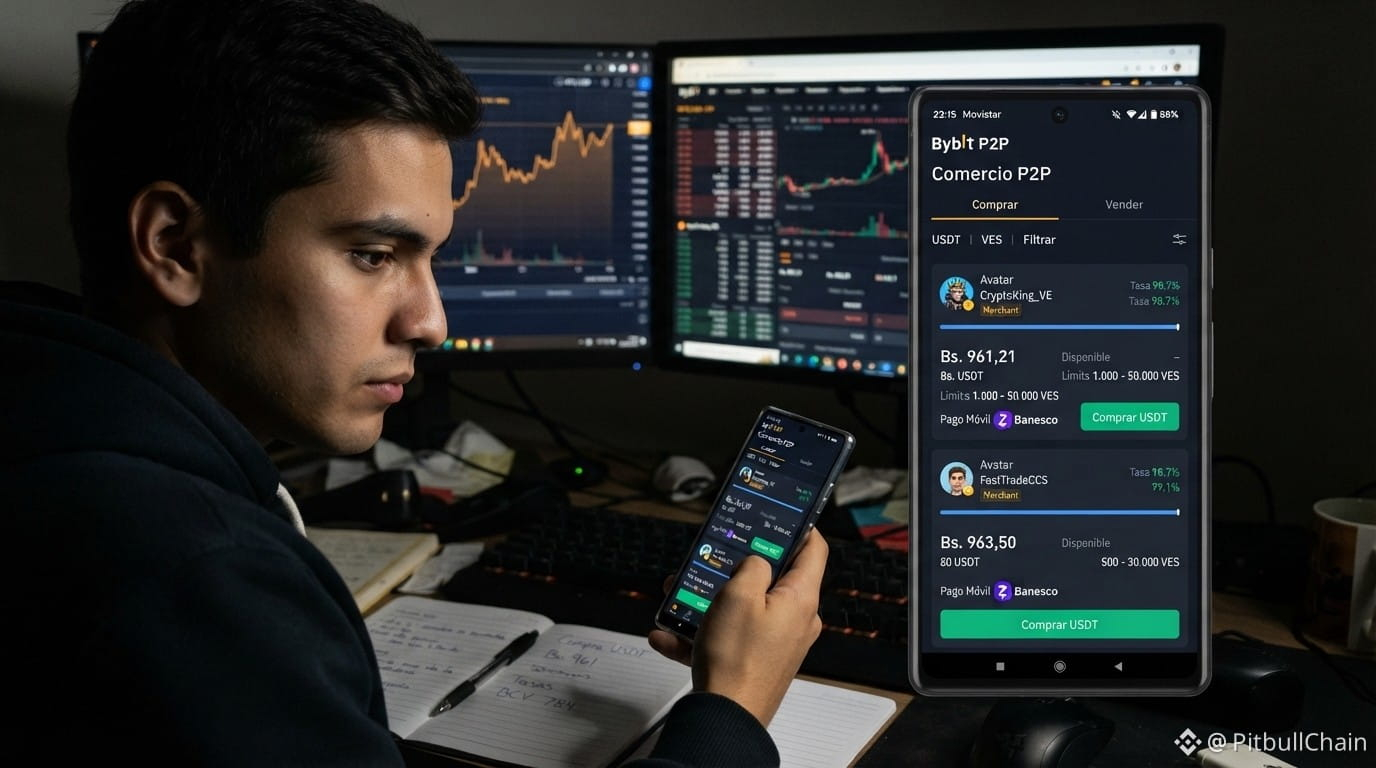
**Starting data:** on September 13, 2026, at 04:00 UTC (00:00 in Venezuela), P2P Radar published the USDT/VES pair with buy at ₮971.47 and sell at ₮932.71. This pair yields a spread of ₮38.76, equivalent to 4.15%. Sixteen seconds earlier, the aggregated order book from Binance and other platforms showed best ask at ₮960.79 and best bid at ₮958.20: a difference of ₮2.59, 0.27%.
USDT/VES: 4.15% in the official rate and 0.27% in the real order book
Live P2P Radar Capture: 13/9/2026, 12:00:13 a. m.
USDT/VES reference Bs. 971.47
Buy USDT Bs. 971.47
Sell USDT Bs. 932.71
BCV Bs. 842.21
Premium vs BCV 15.35%
P2P Spread 4.16%
Observed offers 195
Verify current data in P2P Radar
**Starting data:** on September 13, 2026, at 04:00 UTC (00:00 in Venezuela), P2P Radar published the USDT/VES pair with buy at ₮971.47 and sell at ₮932.71. This pair yields a spread of ₮38.76, equivalent to 4.15%. Sixteen seconds earlier, the aggregated order book from Binance and other platforms showed best ask at ₮960.79 and best bid at ₮958.20: a difference of ₮2.59, 0.27%.
USDT/VES reference Bs. 971.47
Buy USDT Bs. 971.47
Sell USDT Bs. 932.71
BCV Bs. 842.21
Premium vs BCV 15.35%
P2P Spread 4.16%
Observed offers 195
Verify current data in P2P Radar
**Starting data:** on September 13, 2026, at 04:00 UTC (00:00 in Venezuela), P2P Radar published the USDT/VES pair with buy at ₮971.47 and sell at ₮932.71. This pair yields a spread of ₮38.76, equivalent to 4.15%. Sixteen seconds earlier, the aggregated order book from Binance and other platforms showed best ask at ₮960.79 and best bid at ₮958.20: a difference of ₮2.59, 0.27%.
19
·
--

Article
Venezuelan coffee rises 10%: how much does it move USDT and P2P?The production of Venezuelan coffee grew by about 10%, and exports of the category are said to have made a three-digit jump during 2025, with the United States as a prominent destination. The announcement was made by the acting president, Delcy Rodríguez, who insisted that domestic grain has a market abroad and that industrialization supports that momentum. Up to that point, the news is agricultural. But at PitbullChain we read it with a different lens: that of the FX market, P2P, and those who buy and sell USDT every day.
Venezuelan coffee rises 10%: how much does it move USDT and P2P?
The production of Venezuelan coffee grew by about 10%, and exports of the category are said to have made a three-digit jump during 2025, with the United States as a prominent destination. The announcement was made by the acting president, Delcy Rodríguez, who insisted that domestic grain has a market abroad and that industrialization supports that momentum. Up to that point, the news is agricultural. But at PitbullChain we read it with a different lens: that of the FX market, P2P, and those who buy and sell USDT every day.
57
·
--

Article
USDT P2P at 972.76 Bs vs order book at 961.19 Bs: the spreadLive P2P Radar Capture: 10/9/2026, 4:00:17 p. m.
USDT/VES reference Bs. 972.76
Buy USDT Bs. 972.76
Sell USDT Bs. 940.27
BCV Bs. 827.74
Premium vs BCV 17.52%
P2P Spread 3.46%
Observed offers 232
Verify current data in Radar P2P
**Captured data:** September 10, 2026, 20:00 UTC (16:00 in Venezuela). The Radar P2P reference rate and the aggregated order book correspond to the same minute window, allowing both readings to be compared without time noise.
## Key figures at a glance
USDT P2P at 972.76 Bs vs order book at 961.19 Bs: the spread
Live P2P Radar Capture: 10/9/2026, 4:00:17 p. m.
USDT/VES reference Bs. 972.76
Buy USDT Bs. 972.76
Sell USDT Bs. 940.27
BCV Bs. 827.74
Premium vs BCV 17.52%
P2P Spread 3.46%
Observed offers 232
Verify current data in Radar P2P
**Captured data:** September 10, 2026, 20:00 UTC (16:00 in Venezuela). The Radar P2P reference rate and the aggregated order book correspond to the same minute window, allowing both readings to be compared without time noise.
## Key figures at a glance
USDT/VES reference Bs. 972.76
Buy USDT Bs. 972.76
Sell USDT Bs. 940.27
BCV Bs. 827.74
Premium vs BCV 17.52%
P2P Spread 3.46%
Observed offers 232
Verify current data in Radar P2P
**Captured data:** September 10, 2026, 20:00 UTC (16:00 in Venezuela). The Radar P2P reference rate and the aggregated order book correspond to the same minute window, allowing both readings to be compared without time noise.
## Key figures at a glance
13
·
--
Article
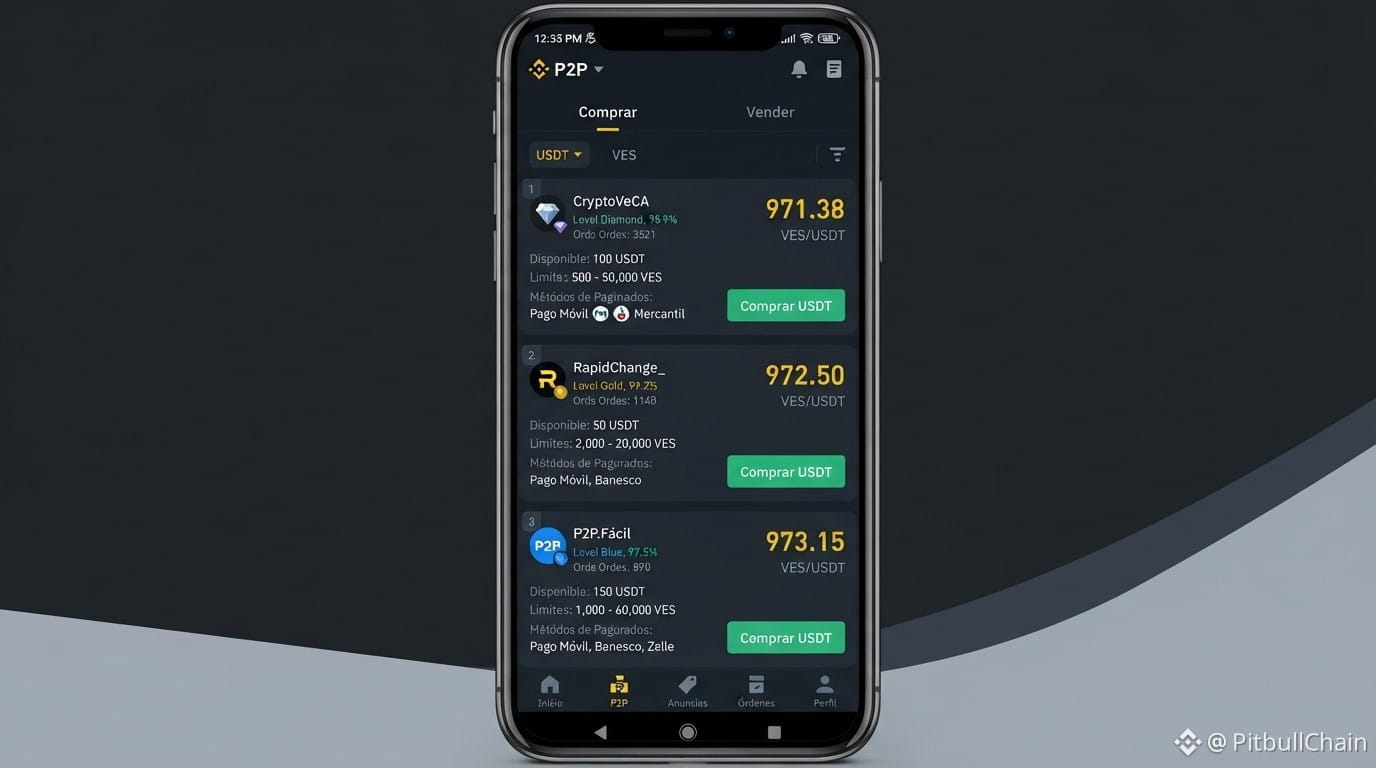
USDT P2P premium vs BCV hits 19.4% and opens liquidity gapsThe changing dynamics in Venezuela’s digital ecosystem once again reflect tensions between supply and demand. Real-time market records from the peer-to-peer (P2P) exchange place the USDT buy price at 972.38 VES and the sell price at 945.47 VES, setting a currency premium of 19.36% versus the reference rate of the Central Bank of Venezuela (BCV), fixed at 814.69 VES. At the same time, the average spread in the overall market widens to 2.85% (26.91 bolivars per unit), triggering operational caution alerts among frequent operators. Currency gap: USDT trades with a 19.36% premium over the BCV The behavior of stable digital assets continues to move away from official channels. While the parallel reference dollar averages 969.06 VES (with buy levels at 970.78 VES and sell at 967.34 VES), USDT on P2P platforms trades at a marked markup versus the official banking exchange rate. In direct conversion terms: Sale of 100 USDT: At the direct sell rate of 945.47 VES, a user receives approximately 94,546.56 VES. Conversion of 1,000,000 VES: At the average buy price of 972.38 VES, a buyer obtains close to 1,057.68 USDT. This 19.36% gap is not an isolated anomaly, but the reflection of structural friction in accessing foreign currency at the official rate within the traditional financial system, channeling transactional flow toward stablecoins for value preservation and commercial payments. Order book and depth: Strong buyer imbalance The microstructure analysis extracted from the combined order books (Binance and other platforms) reveals a pronounced asymmetry in the market. The volume of recorded buy orders reaches 371,374.96 USDT distributed across 34 main offers, compared with a sell volume of just 104,287.79 USDT across 29 orders. This situation results in a depth imbalance of 56.15% in favor of demand. In other words, there is more than three times the capital in bolivars trying to absorb USDT than the sellers are willing to liquidate immediately at the first price levels. PitbullChain’s risk traffic light places the market in yellow status (69/100, Moderate caution). While bank availability (95/100) and overall liquidity (95/100) are optimal, the spread metric (20/100) and sell-side depth (45/100) point to mixed conditions where users should intensify price comparison before executing high-volume transactions. Behavior by banking entity and spread dispersion Liquidity and margins are not distributed evenly across the national banking system. Each payment method shows specific friction levels and price differentials: Banesco: Concentrates 14.5% of analyzed liquidity with 18 active listings. It presents an average buy price of 971.63 VES and a sell price of 964.84 VES, with a competitive spread of 0.70% (6.78 VES) and a health score of 83 points. Bank of Venezuela: Accounts for 12.9% of the volume with 16 listings. Offers one of the tightest spreads in the institutional market at 0.41% (3.93 VES), buying at 971.26 VES and selling at 967.33 VES. Pago Móvil: Accounts for 17.7% of liquidity with 22 active listings. Its average buy is 972.00 VES and sell is 963.12 VES, widening the spread to 0.92% (8.88 VES). Bancamiga: Maintains a 3.2% share with 4 offers, recording buys at 971.75 VES and sells at 968.00 VES, with a narrow spread of 0.39%. Mercantil and PagoMovil (pure listings): Show listings concentrated almost exclusively on the buy side (971.58 VES and 971.57 VES respectively), reflecting a temporary shortage of direct selling counterparties on those channels. The aggregated category of other alternative methods absorbs 21% of the registered listings, though with a wider spread of 1.26% (12.06 VES). Operational impact: Key considerations for users and businesses in Venezuela The dynamism of USDT in the country is supported by massive daily adoption. Industry reports indicate that Venezuela transacts tens of millions of dollars per day through P2P channels, consolidating stablecoins as the main informal settlement mechanism and exchange-rate hedge. To navigate the current situation of an expanded spread and high premium, operators should consider the following technical recommendations: Filter by specific payment method: Using order books from entities with a smaller differential (such as Banesco or Bank of Venezuela) reduces slippage costs compared with generic Pago Móvil options. Monitor book rotation: The 56.15% buy-side imbalance suggests that sell orders at favorable prices are absorbed quickly; placing orders as a taker during high-volatility moments may be more costly than setting limit orders (maker). Strict profile verification: With 243 active global offers detected in monitoring, it is essential to verify the merchant’s completion rate (greater than 98%), minimum/maximum limits, and consistency of bank account ownership. The interaction between the BCV rate and P2P will continue to set the pace of Venezuela’s financial pulse, requiring continuous data reading and operational prudence.
USDT P2P premium vs BCV hits 19.4% and opens liquidity gaps
The changing dynamics in Venezuela’s digital ecosystem once again reflect tensions between supply and demand. Real-time market records from the peer-to-peer (P2P) exchange place the USDT buy price at 972.38 VES and the sell price at 945.47 VES, setting a currency premium of 19.36% versus the reference rate of the Central Bank of Venezuela (BCV), fixed at 814.69 VES. At the same time, the average spread in the overall market widens to 2.85% (26.91 bolivars per unit), triggering operational caution alerts among frequent operators. Currency gap: USDT trades with a 19.36% premium over the BCV The behavior of stable digital assets continues to move away from official channels. While the parallel reference dollar averages 969.06 VES (with buy levels at 970.78 VES and sell at 967.34 VES), USDT on P2P platforms trades at a marked markup versus the official banking exchange rate. In direct conversion terms: Sale of 100 USDT: At the direct sell rate of 945.47 VES, a user receives approximately 94,546.56 VES. Conversion of 1,000,000 VES: At the average buy price of 972.38 VES, a buyer obtains close to 1,057.68 USDT. This 19.36% gap is not an isolated anomaly, but the reflection of structural friction in accessing foreign currency at the official rate within the traditional financial system, channeling transactional flow toward stablecoins for value preservation and commercial payments. Order book and depth: Strong buyer imbalance The microstructure analysis extracted from the combined order books (Binance and other platforms) reveals a pronounced asymmetry in the market. The volume of recorded buy orders reaches 371,374.96 USDT distributed across 34 main offers, compared with a sell volume of just 104,287.79 USDT across 29 orders. This situation results in a depth imbalance of 56.15% in favor of demand. In other words, there is more than three times the capital in bolivars trying to absorb USDT than the sellers are willing to liquidate immediately at the first price levels. PitbullChain’s risk traffic light places the market in yellow status (69/100, Moderate caution). While bank availability (95/100) and overall liquidity (95/100) are optimal, the spread metric (20/100) and sell-side depth (45/100) point to mixed conditions where users should intensify price comparison before executing high-volume transactions. Behavior by banking entity and spread dispersion Liquidity and margins are not distributed evenly across the national banking system. Each payment method shows specific friction levels and price differentials: Banesco: Concentrates 14.5% of analyzed liquidity with 18 active listings. It presents an average buy price of 971.63 VES and a sell price of 964.84 VES, with a competitive spread of 0.70% (6.78 VES) and a health score of 83 points. Bank of Venezuela: Accounts for 12.9% of the volume with 16 listings. Offers one of the tightest spreads in the institutional market at 0.41% (3.93 VES), buying at 971.26 VES and selling at 967.33 VES. Pago Móvil: Accounts for 17.7% of liquidity with 22 active listings. Its average buy is 972.00 VES and sell is 963.12 VES, widening the spread to 0.92% (8.88 VES). Bancamiga: Maintains a 3.2% share with 4 offers, recording buys at 971.75 VES and sells at 968.00 VES, with a narrow spread of 0.39%. Mercantil and PagoMovil (pure listings): Show listings concentrated almost exclusively on the buy side (971.58 VES and 971.57 VES respectively), reflecting a temporary shortage of direct selling counterparties on those channels. The aggregated category of other alternative methods absorbs 21% of the registered listings, though with a wider spread of 1.26% (12.06 VES). Operational impact: Key considerations for users and businesses in Venezuela The dynamism of USDT in the country is supported by massive daily adoption. Industry reports indicate that Venezuela transacts tens of millions of dollars per day through P2P channels, consolidating stablecoins as the main informal settlement mechanism and exchange-rate hedge. To navigate the current situation of an expanded spread and high premium, operators should consider the following technical recommendations: Filter by specific payment method: Using order books from entities with a smaller differential (such as Banesco or Bank of Venezuela) reduces slippage costs compared with generic Pago Móvil options. Monitor book rotation: The 56.15% buy-side imbalance suggests that sell orders at favorable prices are absorbed quickly; placing orders as a taker during high-volatility moments may be more costly than setting limit orders (maker). Strict profile verification: With 243 active global offers detected in monitoring, it is essential to verify the merchant’s completion rate (greater than 98%), minimum/maximum limits, and consistency of bank account ownership. The interaction between the BCV rate and P2P will continue to set the pace of Venezuela’s financial pulse, requiring continuous data reading and operational prudence.
20
·
--
Article
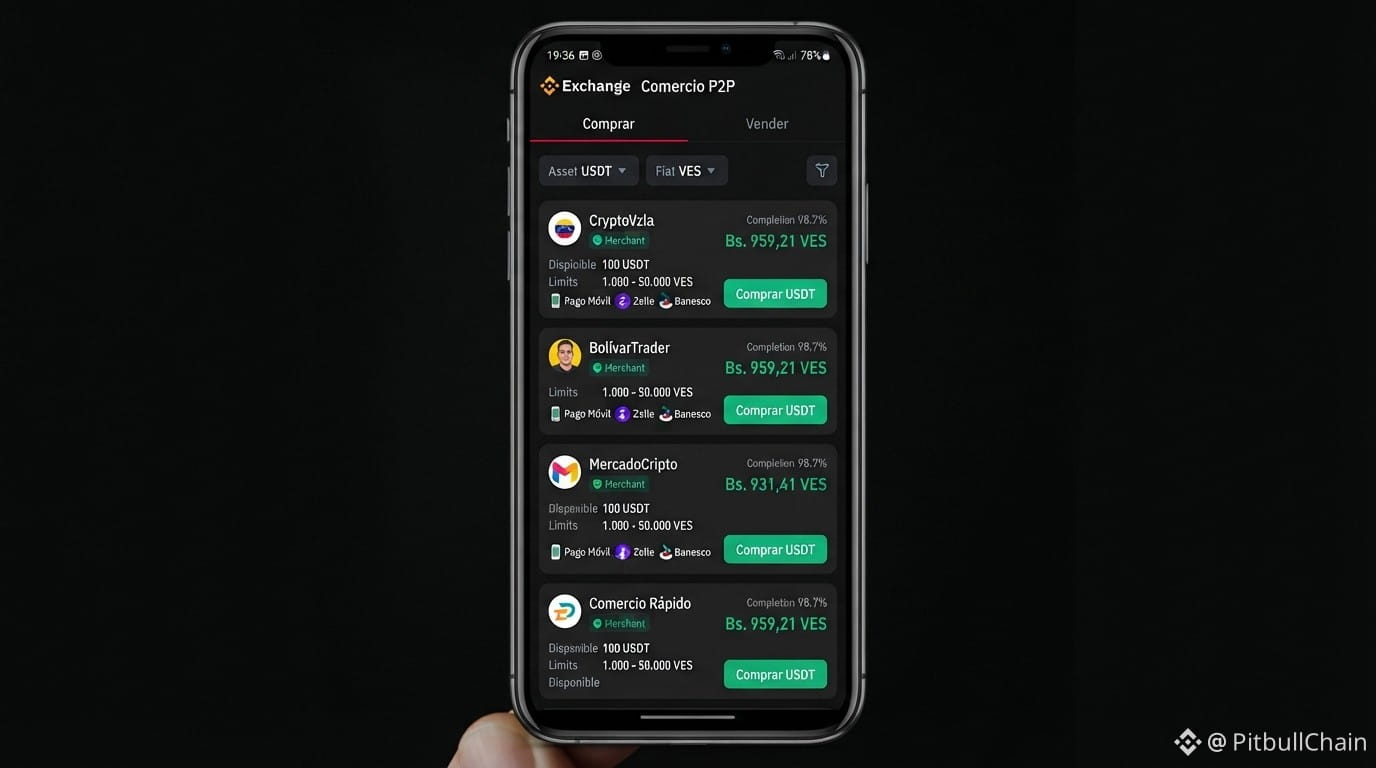
USDT P2P in Venezuela: 3.65% spread and 18.54% gap with BCVThe early hours of September 5, 2026 (Venezuela time) delivered a clear reading for those operating digital assets in bolivars: the USDT P2P market widened the gap between buy and sell prices again. PitbullChain’s Radar P2P snapshot recorded that buying USDT cost an average of Bs. 964.64, while selling it paid Bs. 930.65. In other words, a spread of Bs. 33.99, equivalent to 3.65%. That percentage triggered a yellow signal on the market traffic light, with a score of 69 out of 100. The main factor was the elevated spread, while liquidity continued to show health across several banks and exchanges. The USDT P2P price versus the official dollar The official dollar published by the BCV at the time of the snapshot was Bs. 813.74 per unit. Consequently, buying USDT via P2P represented a difference of Bs. 150.90 versus the official exchange rate, equivalent to a premium of 18.54%. This number measures the extra cost in bolivars borne by a user when acquiring decentralized USDT compared to the dollar set by the issuing authority. This gap is not a new phenomenon in Venezuela, but the data for September 6 confirms that demand for USDT remains firm. According to an estimate by Ecoanalítica published by BeInCrypto, the country transacts around USD 44 million daily through Binance P2P alone. Order book liquidity: strong visible demand, but with imbalance The consolidated order book compiled by PitbullChain at 02:00 UTC showed 94 active notices across Binance, other platforms and other platforms. The midpoint between the best prices was Bs. 950.66, with a range of Bs. 943.33 to buy USDT and Bs. 958.00 to sell it; in that interval, the spread between sides was 1.53%, below the weighted average. Most notable was the aggregate volume on each side of the book: visible demand (1,147,577 USDT) far exceeded visible supply (127,715 USDT). The imbalance between buyers and sellers reached 79.97%, suggesting greater pressure to acquire USDT. However, depth was not distributed evenly: on the demand side there were pronounced blocks of up to 529,480 USDT posted by a single notice on other platforms, while sell listings appeared more fragmented. For the retail trader, this imbalance means always rechecking the minimum and maximum limits of each listing, since large blocks are usually reserved for amounts above 50,000 USDT. Banks and payment methods: who concentrates the activity The analysis of the data by institution shows that Pago Móvil and Banesco account for the largest number of listings within the measured ecosystem, with 20.3% and 18.8% of liquidity respectively. They are followed by the “Other method” group (17.2%) and Banco de Venezuela (13.3%). Among banks present across multiple exchanges, the lowest average spreads were found at BANK (0.51%), Banco de Venezuela (0.53%) and Mercantil (0.52%). Banesco posted a spread of 0.96%, and Pago Móvil, 1.04%, reflecting a wider operating margin for the trader arbitraging between both. In contrast, Bancamiga and BNC Banco Nacional showed fewer active notices and, in some cases, a lack of representative buy prices during the sample. This does not mean operations do not exist, only that the visibility of offers was insufficient to calculate a symmetrical spread. It is important to remember that these averages do not include additional bank fees, since the P2P system is quoted net of transfer charges. Even so, the 3.65% spread in the Radar P2P average already incorporates part of the friction generated by the available payment methods. Market signals and practical criteria for the operator PitbullChain’s traffic light assigned a score of 69 points, in yellow status. Key metrics include: Overall liquidity: 95/100, sufficient across several banks. Bank availability: 95/100, with at least six relevant institutions active. Volatility: 80/100, which recommends closing deals quickly when the price matches your expectations. Order book depth: 45/100, with a notable imbalance between both sides. Spread: 20/100, the main warning at the moment. The platform’s recommended actions are straightforward: compare prices across exchanges, verify the bank and the counterparty’s reputation before trading, and define amount limits. None of these suggestions constitute a buy or sell instruction, but rather a guide to reduce operational risks. To understand the scale of this market, a TRM Labs report cited USDT as one of the factors that propelled Venezuela up the global crypto adoption ranking in the first quarter of 2026. That use is concentrated precisely in P2P exchange with bolivars, which is why monitoring spreads and depth is now an unavoidable tool for anyone or any business exposed to Venezuela’s digital economy. In short, the midnight snapshot of September 6 shows a market with enough liquidity across banks and exchanges to execute trades, but with an average friction of 3.65% that is worth monitoring. Comparing prices across the three platforms and reviewing the banking method remain the best filter for reducing costs.
USDT P2P in Venezuela: 3.65% spread and 18.54% gap with BCV
The early hours of September 5, 2026 (Venezuela time) delivered a clear reading for those operating digital assets in bolivars: the USDT P2P market widened the gap between buy and sell prices again. PitbullChain’s Radar P2P snapshot recorded that buying USDT cost an average of Bs. 964.64, while selling it paid Bs. 930.65. In other words, a spread of Bs. 33.99, equivalent to 3.65%. That percentage triggered a yellow signal on the market traffic light, with a score of 69 out of 100. The main factor was the elevated spread, while liquidity continued to show health across several banks and exchanges. The USDT P2P price versus the official dollar The official dollar published by the BCV at the time of the snapshot was Bs. 813.74 per unit. Consequently, buying USDT via P2P represented a difference of Bs. 150.90 versus the official exchange rate, equivalent to a premium of 18.54%. This number measures the extra cost in bolivars borne by a user when acquiring decentralized USDT compared to the dollar set by the issuing authority. This gap is not a new phenomenon in Venezuela, but the data for September 6 confirms that demand for USDT remains firm. According to an estimate by Ecoanalítica published by BeInCrypto, the country transacts around USD 44 million daily through Binance P2P alone. Order book liquidity: strong visible demand, but with imbalance The consolidated order book compiled by PitbullChain at 02:00 UTC showed 94 active notices across Binance, other platforms and other platforms. The midpoint between the best prices was Bs. 950.66, with a range of Bs. 943.33 to buy USDT and Bs. 958.00 to sell it; in that interval, the spread between sides was 1.53%, below the weighted average. Most notable was the aggregate volume on each side of the book: visible demand (1,147,577 USDT) far exceeded visible supply (127,715 USDT). The imbalance between buyers and sellers reached 79.97%, suggesting greater pressure to acquire USDT. However, depth was not distributed evenly: on the demand side there were pronounced blocks of up to 529,480 USDT posted by a single notice on other platforms, while sell listings appeared more fragmented. For the retail trader, this imbalance means always rechecking the minimum and maximum limits of each listing, since large blocks are usually reserved for amounts above 50,000 USDT. Banks and payment methods: who concentrates the activity The analysis of the data by institution shows that Pago Móvil and Banesco account for the largest number of listings within the measured ecosystem, with 20.3% and 18.8% of liquidity respectively. They are followed by the “Other method” group (17.2%) and Banco de Venezuela (13.3%). Among banks present across multiple exchanges, the lowest average spreads were found at BANK (0.51%), Banco de Venezuela (0.53%) and Mercantil (0.52%). Banesco posted a spread of 0.96%, and Pago Móvil, 1.04%, reflecting a wider operating margin for the trader arbitraging between both. In contrast, Bancamiga and BNC Banco Nacional showed fewer active notices and, in some cases, a lack of representative buy prices during the sample. This does not mean operations do not exist, only that the visibility of offers was insufficient to calculate a symmetrical spread. It is important to remember that these averages do not include additional bank fees, since the P2P system is quoted net of transfer charges. Even so, the 3.65% spread in the Radar P2P average already incorporates part of the friction generated by the available payment methods. Market signals and practical criteria for the operator PitbullChain’s traffic light assigned a score of 69 points, in yellow status. Key metrics include: Overall liquidity: 95/100, sufficient across several banks. Bank availability: 95/100, with at least six relevant institutions active. Volatility: 80/100, which recommends closing deals quickly when the price matches your expectations. Order book depth: 45/100, with a notable imbalance between both sides. Spread: 20/100, the main warning at the moment. The platform’s recommended actions are straightforward: compare prices across exchanges, verify the bank and the counterparty’s reputation before trading, and define amount limits. None of these suggestions constitute a buy or sell instruction, but rather a guide to reduce operational risks. To understand the scale of this market, a TRM Labs report cited USDT as one of the factors that propelled Venezuela up the global crypto adoption ranking in the first quarter of 2026. That use is concentrated precisely in P2P exchange with bolivars, which is why monitoring spreads and depth is now an unavoidable tool for anyone or any business exposed to Venezuela’s digital economy. In short, the midnight snapshot of September 6 shows a market with enough liquidity across banks and exchanges to execute trades, but with an average friction of 3.65% that is worth monitoring. Comparing prices across the three platforms and reviewing the banking method remain the best filter for reducing costs.
267
Log in to explore more content
Join global crypto users on Binance Square
⚡️ Get latest and useful information about crypto.
💬 Trusted by the world’s largest crypto exchange.
👍 Discover real insights from verified creators.
Email / Phone number
Trending Topics
1
#IMFApproves$139MDisbursementToElSalvador
0 views
0 Discussing
2
#AnthropicTargetsIPOAsSoonAsMidNovember
0 views
0 Discussing
3
#EtherGains70.9%InQ3
184,658 views
1,228 Discussing
4
#TreasuryLetsStatesFileStablecoinCertificationsEarly
12,430 views
94 Discussing
5
#US10YearYieldNears5.3%
163,634 views
1,193 Discussing
6
#DollarIndexHitsHighestSinceMay2025
50,028 views
659 Discussing
7
#USWeeklyJoblessClaimsFallTo197000
39,527 views
529 Discussing
8
#BitcoinETFsTake$6.34BillionInQ3
10,687 views
77 Discussing
9
#KoreaProposesTokenizingStocksAndBonds
77,304 views
847 Discussing
10
#MetaMaskExitsLidoValidatorsAfterSecurityIncident
177,334 views
1,577 Discussing