

#metamaskexitslidovalidatorsaftersecurityincident
metamaskexitslidovalidatorsaftersecurityincident
235,173 views
1,589 Discussing
Hot
Latest

·
--
Picture this: you park your assets in what feels like the safest infrastructure in DeFi, only to find out that operational risk never actually goes away. Most stakers chase yield while assuming top-tier protocols are entirely bulletproof, forgetting that infrastructure layers carry counterparty vulnerabilities that can surface overnight.
Last week, Consensys made the quiet call to migrate its staking infrastructure away from certain $LDO validators following a security breach involving an operator's signing keys. It immediately brings back memories of the classic validator compromise playbook we have seen across major proof-of-stake ecosystems, where individual node exposure threatens broader protocol health. While native staking on $ETH is designed to punish bad actors through slashing, custodial and pooled setups constantly have to balance decentralization against operator competence.
When you look at liquid staking alternatives versus direct validator operations across networks like $NEAR or Cosmos, the lesson remains identical. Single-point failures at the node operator tier force institutional aggregators to react aggressively, because a single compromised key risks cascading penalties and total user trust erosion.
How do you evaluate validator counterparty risk when choosing where to stake your assets?
#MetaMaskExitsLidoValidatorsAfterSecurityIncident #EtherGains70
Picture this: you park your assets in what feels like the safest infrastructure in DeFi, only to find out that operational risk never actually goes away. Most stakers chase yield while assuming top-tier protocols are entirely bulletproof, forgetting that infrastructure layers carry counterparty vulnerabilities that can surface overnight.
Last week, Consensys made the quiet call to migrate its staking infrastructure away from certain $LDO validators following a security breach involving an operator's signing keys. It immediately brings back memories of the classic validator compromise playbook we have seen across major proof-of-stake ecosystems, where individual node exposure threatens broader protocol health. While native staking on $ETH is designed to punish bad actors through slashing, custodial and pooled setups constantly have to balance decentralization against operator competence.
When you look at liquid staking alternatives versus direct validator operations across networks like $NEAR or Cosmos, the lesson remains identical. Single-point failures at the node operator tier force institutional aggregators to react aggressively, because a single compromised key risks cascading penalties and total user trust erosion.
How do you evaluate validator counterparty risk when choosing where to stake your assets?
#MetaMaskExitsLidoValidatorsAfterSecurityIncident #EtherGains70
Last week, Consensys made the quiet call to migrate its staking infrastructure away from certain $LDO validators following a security breach involving an operator's signing keys. It immediately brings back memories of the classic validator compromise playbook we have seen across major proof-of-stake ecosystems, where individual node exposure threatens broader protocol health. While native staking on $ETH is designed to punish bad actors through slashing, custodial and pooled setups constantly have to balance decentralization against operator competence.
When you look at liquid staking alternatives versus direct validator operations across networks like $NEAR or Cosmos, the lesson remains identical. Single-point failures at the node operator tier force institutional aggregators to react aggressively, because a single compromised key risks cascading penalties and total user trust erosion.
How do you evaluate validator counterparty risk when choosing where to stake your assets?
#MetaMaskExitsLidoValidatorsAfterSecurityIncident #EtherGains70

158

#MetaMaskExitsLidoValidatorsAfterSecurityIncident MetaMask has exited its Lido validator operations following a security incident, highlighting renewed concerns around validator infrastructure, staking security and operational risk across the Ethereum ecosystem. 🔐⛓️
#MetaMaskSecurityUpdate #LidoValidatorExit #EthereumStakingRisk #CryptoSecurityNews
l $ETH
{spot}(ETHUSDT)
| $LDO
{spot}(LDOUSDT)
| $BTC
{spot}(BTCUSDT)
#MetaMaskExitsLidoValidatorsAfterSecurityIncident MetaMask has exited its Lido validator operations following a security incident, highlighting renewed concerns around validator infrastructure, staking security and operational risk across the Ethereum ecosystem. 🔐⛓️
#MetaMaskSecurityUpdate #LidoValidatorExit #EthereumStakingRisk #CryptoSecurityNews
l $ETH
| $LDO
| $BTC
#MetaMaskSecurityUpdate #LidoValidatorExit #EthereumStakingRisk #CryptoSecurityNews
l $ETH
| $LDO
| $BTC
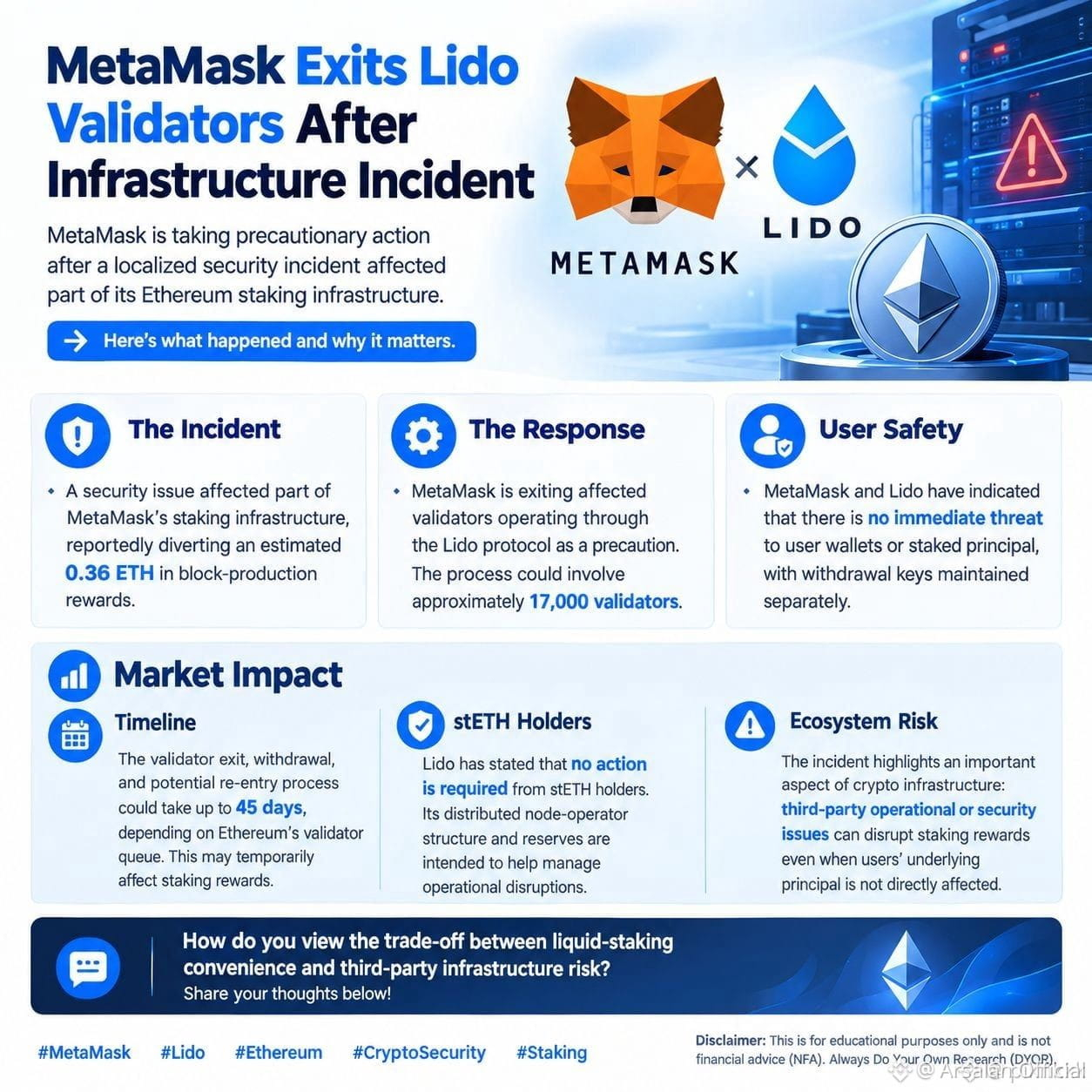
1
75

🚨 SHOCKING
MetaMask Is Pulling Ethereum Validators From Lido
A security incident affecting part of MetaMask’s infrastructure has triggered precautionary exits from its Lido validators. MetaMask says there is no immediate threat to wallets, while the investigation continues.
$ETH $LDO
#metamaskexitslidovalidatorsaftersecurityincident
🚨 SHOCKING
MetaMask Is Pulling Ethereum Validators From Lido
A security incident affecting part of MetaMask’s infrastructure has triggered precautionary exits from its Lido validators. MetaMask says there is no immediate threat to wallets, while the investigation continues.
$ETH $LDO
#metamaskexitslidovalidatorsaftersecurityincident
MetaMask Is Pulling Ethereum Validators From Lido
A security incident affecting part of MetaMask’s infrastructure has triggered precautionary exits from its Lido validators. MetaMask says there is no immediate threat to wallets, while the investigation continues.
$ETH $LDO
#metamaskexitslidovalidatorsaftersecurityincident
2
2.8k

·
--
Bullish
#metamaskexitslidovalidatorsaftersecurityincident \
🛡️ Security First: MetaMask Steps Back from Lido Validators Following Recent Incident 🛡️
The Ethereum liquid staking ecosystem is under close watch following a major infrastructure update. MetaMask has initiated a full exit of its operated Ethereum ($ETH) validators from the Lido Finance protocol as a precautionary measure following an infrastructure security incident.
While MetaMask and Lido have assured the public that no immediate risk or loss to user wallets has been identified, the event is causing a ripple effect across Ethereum’s validator queue and DeFi liquidity dynamics.
Infrastructure Containment & Complete Exit Timeline ⏳
MetaMask confirmed it is remediating an infrastructure breach and actively exiting affected node infrastructure to mitigate operational and network risks. Lido reported that all MetaMask-operated validators are scheduled to complete their exits by October 7.
Ethereum Exit Queue Spikes to 9-Month High 📈
With roughly 17,000 validators—holding over 500,000 $ETH—entering the exit process, Ethereum’s validator exit queue has surged to its highest level in nine months.
🔍 What This Means for DeFi & Liquid Staking
Client Diversity & Infrastructure Resilience: The rapid response highlights the necessity of non-custodial node segregation. By proactively offloading compromised validators, total risk is contained before slashing or pool-wide damage can occur.
Impact on Liquid Staking Tokens ($stETH): Despite the mass validator exits, Lido’s underlying smart contracts and $stETH peg remain stable, proving that liquid staking pools can digest high validator turnover without systemic failure.
Short-Term Liquidity Tensions: The 45-day cycle to re-deposit or redistribute the unwound ETH means stakers should expect minor fluctuations in yield until new validator sets are fully onboarded.
💬 What’s your takeaway? Drop your thoughts below! 👇
#TreasuryLetsStatesFileStablecoinCertificationsEarly #US10YearYieldNears5.3%
#metamaskexitslidovalidatorsaftersecurityincident \
🛡️ Security First: MetaMask Steps Back from Lido Validators Following Recent Incident 🛡️
The Ethereum liquid staking ecosystem is under close watch following a major infrastructure update. MetaMask has initiated a full exit of its operated Ethereum ($ETH) validators from the Lido Finance protocol as a precautionary measure following an infrastructure security incident.
While MetaMask and Lido have assured the public that no immediate risk or loss to user wallets has been identified, the event is causing a ripple effect across Ethereum’s validator queue and DeFi liquidity dynamics.
Infrastructure Containment & Complete Exit Timeline ⏳
MetaMask confirmed it is remediating an infrastructure breach and actively exiting affected node infrastructure to mitigate operational and network risks. Lido reported that all MetaMask-operated validators are scheduled to complete their exits by October 7.
Ethereum Exit Queue Spikes to 9-Month High 📈
With roughly 17,000 validators—holding over 500,000 $ETH—entering the exit process, Ethereum’s validator exit queue has surged to its highest level in nine months.
🔍 What This Means for DeFi & Liquid Staking
Client Diversity & Infrastructure Resilience: The rapid response highlights the necessity of non-custodial node segregation. By proactively offloading compromised validators, total risk is contained before slashing or pool-wide damage can occur.
Impact on Liquid Staking Tokens ($stETH): Despite the mass validator exits, Lido’s underlying smart contracts and $stETH peg remain stable, proving that liquid staking pools can digest high validator turnover without systemic failure.
Short-Term Liquidity Tensions: The 45-day cycle to re-deposit or redistribute the unwound ETH means stakers should expect minor fluctuations in yield until new validator sets are fully onboarded.
💬 What’s your takeaway? Drop your thoughts below! 👇
#TreasuryLetsStatesFileStablecoinCertificationsEarly #US10YearYieldNears5.3%
🛡️ Security First: MetaMask Steps Back from Lido Validators Following Recent Incident 🛡️
The Ethereum liquid staking ecosystem is under close watch following a major infrastructure update. MetaMask has initiated a full exit of its operated Ethereum ($ETH) validators from the Lido Finance protocol as a precautionary measure following an infrastructure security incident.
While MetaMask and Lido have assured the public that no immediate risk or loss to user wallets has been identified, the event is causing a ripple effect across Ethereum’s validator queue and DeFi liquidity dynamics.
Infrastructure Containment & Complete Exit Timeline ⏳
MetaMask confirmed it is remediating an infrastructure breach and actively exiting affected node infrastructure to mitigate operational and network risks. Lido reported that all MetaMask-operated validators are scheduled to complete their exits by October 7.
Ethereum Exit Queue Spikes to 9-Month High 📈
With roughly 17,000 validators—holding over 500,000 $ETH—entering the exit process, Ethereum’s validator exit queue has surged to its highest level in nine months.
🔍 What This Means for DeFi & Liquid Staking
Client Diversity & Infrastructure Resilience: The rapid response highlights the necessity of non-custodial node segregation. By proactively offloading compromised validators, total risk is contained before slashing or pool-wide damage can occur.
Impact on Liquid Staking Tokens ($stETH): Despite the mass validator exits, Lido’s underlying smart contracts and $stETH peg remain stable, proving that liquid staking pools can digest high validator turnover without systemic failure.
Short-Term Liquidity Tensions: The 45-day cycle to re-deposit or redistribute the unwound ETH means stakers should expect minor fluctuations in yield until new validator sets are fully onboarded.
💬 What’s your takeaway? Drop your thoughts below! 👇
#TreasuryLetsStatesFileStablecoinCertificationsEarly #US10YearYieldNears5.3%

5
5.1k

·
--
#metamaskexitslidovalidatorsaftersecurityincident
🚨 MetaMask is exiting its Lido validators after a security incident.
MetaMask says the investigation involves external partners, while no immediate threat to wallets has been detected. The affected validators are part of a non-custodial staking service and don’t control withdrawal keys.
Lido says the final validators are expected to exit by October 7, 2026, with the full withdrawal and re-entry cycle taking roughly 45 days because of Ethereum’s entry queues.
⚠️ The main risks are foregone staking rewards and possible downtime penalties if validators are taken offline.
For stETH holders, no action is required.
The ETH will gradually return through the withdrawal process, while traders watch the potential impact on $LDO and $ETH.
{spot}(LDOUSDT)
| $ETH
{spot}(ETHUSDT)
#MetaMask #Lido #SecurityAlert #Ethereum #crypto
#metamaskexitslidovalidatorsaftersecurityincident
🚨 MetaMask is exiting its Lido validators after a security incident.
MetaMask says the investigation involves external partners, while no immediate threat to wallets has been detected. The affected validators are part of a non-custodial staking service and don’t control withdrawal keys.
Lido says the final validators are expected to exit by October 7, 2026, with the full withdrawal and re-entry cycle taking roughly 45 days because of Ethereum’s entry queues.
⚠️ The main risks are foregone staking rewards and possible downtime penalties if validators are taken offline.
For stETH holders, no action is required.
The ETH will gradually return through the withdrawal process, while traders watch the potential impact on $LDO and $ETH .
| $ETH
#MetaMask #Lido #SecurityAlert #Ethereum #crypto
🚨 MetaMask is exiting its Lido validators after a security incident.
MetaMask says the investigation involves external partners, while no immediate threat to wallets has been detected. The affected validators are part of a non-custodial staking service and don’t control withdrawal keys.
Lido says the final validators are expected to exit by October 7, 2026, with the full withdrawal and re-entry cycle taking roughly 45 days because of Ethereum’s entry queues.
⚠️ The main risks are foregone staking rewards and possible downtime penalties if validators are taken offline.
For stETH holders, no action is required.
The ETH will gradually return through the withdrawal process, while traders watch the potential impact on $LDO and $ETH .
| $ETH
#MetaMask #Lido #SecurityAlert #Ethereum #crypto
2
246

·
--
Bullish
#MetaMaskExitsLidoValidatorsAfterSecurityIncident
MetaMask is proactively exiting affected Ethereum validators operated through Lido after a security incident hit part of its infrastructure. MetaMask says there is currently no immediate threat to its wallets.
🎯 WHY TRADERS SHOULD CARE:
This puts ETH staking + LDO + crypto-security risk directly on the radar. Lido says affected exits may take time and could mean missed staking rewards.
📊 TRADING WATCH:
• ETH spot volume
• LDO price + volume
• ETH OI + Funding
• stETH liquidity
• Further security updates
🔥 10X THINKING: Don’t panic-trade the headline. Watch ETH/LDO price reaction + volume confirmation as the investigation develops.
$LITEB $BTC $ETH
{future}(ETHUSDT)
{future}(BTCUSDT)
{spot}(LITEBUSDT)
#MetaMaskExitsLidoValidatorsAfterSecurityIncident
MetaMask is proactively exiting affected Ethereum validators operated through Lido after a security incident hit part of its infrastructure. MetaMask says there is currently no immediate threat to its wallets.
🎯 WHY TRADERS SHOULD CARE:
This puts ETH staking + LDO + crypto-security risk directly on the radar. Lido says affected exits may take time and could mean missed staking rewards.
📊 TRADING WATCH:
• ETH spot volume
• LDO price + volume
• ETH OI + Funding
• stETH liquidity
• Further security updates
🔥 10X THINKING: Don’t panic-trade the headline. Watch ETH/LDO price reaction + volume confirmation as the investigation develops.
$LITEB $BTC $ETH
MetaMask is proactively exiting affected Ethereum validators operated through Lido after a security incident hit part of its infrastructure. MetaMask says there is currently no immediate threat to its wallets.
🎯 WHY TRADERS SHOULD CARE:
This puts ETH staking + LDO + crypto-security risk directly on the radar. Lido says affected exits may take time and could mean missed staking rewards.
📊 TRADING WATCH:
• ETH spot volume
• LDO price + volume
• ETH OI + Funding
• stETH liquidity
• Further security updates
🔥 10X THINKING: Don’t panic-trade the headline. Watch ETH/LDO price reaction + volume confirmation as the investigation develops.
$LITEB $BTC $ETH

60

·
--
🚨 MetaMask’s Lido Validator Exit 👇
Who Benefits and Who Could Be Affected?🔥
MetaMask stepping away from Lido validators following a security incident could have different effects across the market.
🔹 MetaMask: Reduces its exposure to potential security risks.
🔹 Lido: Could see some impact if a significant amount of validator capacity leaves.
🔹 ETH stakers: May face changes in staking performance or operational risk.
🔹 Other validators: Could benefit from the reduced share of MetaMask’s validator operations.
The overall impact will depend on how many validators are actually exiting and what caused the security incident.
#MetaMaskExitsLidoValidatorsAfterSecurityIncident
🚨 MetaMask’s Lido Validator Exit 👇
Who Benefits and Who Could Be Affected?🔥
MetaMask stepping away from Lido validators following a security incident could have different effects across the market.
🔹 MetaMask: Reduces its exposure to potential security risks.
🔹 Lido: Could see some impact if a significant amount of validator capacity leaves.
🔹 ETH stakers: May face changes in staking performance or operational risk.
🔹 Other validators: Could benefit from the reduced share of MetaMask’s validator operations.
The overall impact will depend on how many validators are actually exiting and what caused the security incident.
#MetaMaskExitsLidoValidatorsAfterSecurityIncident
Who Benefits and Who Could Be Affected?🔥
MetaMask stepping away from Lido validators following a security incident could have different effects across the market.
🔹 MetaMask: Reduces its exposure to potential security risks.
🔹 Lido: Could see some impact if a significant amount of validator capacity leaves.
🔹 ETH stakers: May face changes in staking performance or operational risk.
🔹 Other validators: Could benefit from the reduced share of MetaMask’s validator operations.
The overall impact will depend on how many validators are actually exiting and what caused the security incident.
#MetaMaskExitsLidoValidatorsAfterSecurityIncident
1
52

#metamaskexitslidovalidatorsaftersecurityincident
🦬 MetaMask Pulls Lido Validators After Security Incident
MetaMask has begun exiting affected Ethereum validators from Lido after an infrastructure security incident. The move is precautionary, and MetaMask says there is no immediate threat to its wallets.
On-chain research indicates roughly 17,000 validators holding over 565,000 ETH were being exited, while about 0.36 ETH in block tips was reportedly diverted. No validators had been slashed in the latest data.
Lido expects the affected validators to exit by October 7, while the full withdrawal/re-staking cycle could take up to 45 days.
📊 Market impact: The incident is more of a security and operational-risk signal than an immediate threat to $ETH fundamentals, but traders should watch ETH/LDO sentiment and further disclosures closely.
Security risk remains the key narrative. 🔐
#MetaMask #Lido #Ethereum #ETH #CryptoNews #CryptoSecurity #DeFi #Binance
{spot}(ETHUSDT)
#metamaskexitslidovalidatorsaftersecurityincident
🦬 MetaMask Pulls Lido Validators After Security Incident
MetaMask has begun exiting affected Ethereum validators from Lido after an infrastructure security incident. The move is precautionary, and MetaMask says there is no immediate threat to its wallets.
On-chain research indicates roughly 17,000 validators holding over 565,000 ETH were being exited, while about 0.36 ETH in block tips was reportedly diverted. No validators had been slashed in the latest data.
Lido expects the affected validators to exit by October 7, while the full withdrawal/re-staking cycle could take up to 45 days.
📊 Market impact: The incident is more of a security and operational-risk signal than an immediate threat to $ETH fundamentals, but traders should watch ETH/LDO sentiment and further disclosures closely.
Security risk remains the key narrative. 🔐
#MetaMask #Lido #Ethereum #ETH #CryptoNews #CryptoSecurity #DeFi #Binance
🦬 MetaMask Pulls Lido Validators After Security Incident
MetaMask has begun exiting affected Ethereum validators from Lido after an infrastructure security incident. The move is precautionary, and MetaMask says there is no immediate threat to its wallets.
On-chain research indicates roughly 17,000 validators holding over 565,000 ETH were being exited, while about 0.36 ETH in block tips was reportedly diverted. No validators had been slashed in the latest data.
Lido expects the affected validators to exit by October 7, while the full withdrawal/re-staking cycle could take up to 45 days.
📊 Market impact: The incident is more of a security and operational-risk signal than an immediate threat to $ETH fundamentals, but traders should watch ETH/LDO sentiment and further disclosures closely.
Security risk remains the key narrative. 🔐
#MetaMask #Lido #Ethereum #ETH #CryptoNews #CryptoSecurity #DeFi #Binance
AngelOfCrypto_-:
nice
2
4
7.6k

·
--
Bullish
$AIA $XAUT Infrastructure Compromise: MetaMask reported an ongoing security incident affecting part of its internal infrastructure. The specific nature of the breach has not been fully detailed.
No Immediate Threat to Wallets: MetaMask has clarified that there is no immediate threat to user wallets, and client withdrawal keys remain outside of its direct control.
Timeline for Validator Exits: The process of pulling the affected validators out of the Lido protocol started recently and is expected to be fully completed by October 7, 2026. #MetaMaskExitsLidoValidatorsAfterSecurityIncident Infrastructure Compromise: MetaMask reported an ongoing security incident affecting part of its internal infrastructure. The specific nature of the breach has not been fully detailed.
No Immediate Threat to Wallets: MetaMask has clarified that there is no immediate threat to user wallets, and client withdrawal keys remain outside of its direct control.
Timeline for Validator Exits: The process of pulling the affected validators out of the Lido protocol started recently and is expected to be fully completed by October 7, 2026.
$AIA $XAUT Infrastructure Compromise: MetaMask reported an ongoing security incident affecting part of its internal infrastructure. The specific nature of the breach has not been fully detailed.
No Immediate Threat to Wallets: MetaMask has clarified that there is no immediate threat to user wallets, and client withdrawal keys remain outside of its direct control.
Timeline for Validator Exits: The process of pulling the affected validators out of the Lido protocol started recently and is expected to be fully completed by October 7, 2026. #MetaMaskExitsLidoValidatorsAfterSecurityIncident Infrastructure Compromise: MetaMask reported an ongoing security incident affecting part of its internal infrastructure. The specific nature of the breach has not been fully detailed.
No Immediate Threat to Wallets: MetaMask has clarified that there is no immediate threat to user wallets, and client withdrawal keys remain outside of its direct control.
Timeline for Validator Exits: The process of pulling the affected validators out of the Lido protocol started recently and is expected to be fully completed by October 7, 2026.
No Immediate Threat to Wallets: MetaMask has clarified that there is no immediate threat to user wallets, and client withdrawal keys remain outside of its direct control.
Timeline for Validator Exits: The process of pulling the affected validators out of the Lido protocol started recently and is expected to be fully completed by October 7, 2026. #MetaMaskExitsLidoValidatorsAfterSecurityIncident Infrastructure Compromise: MetaMask reported an ongoing security incident affecting part of its internal infrastructure. The specific nature of the breach has not been fully detailed.
No Immediate Threat to Wallets: MetaMask has clarified that there is no immediate threat to user wallets, and client withdrawal keys remain outside of its direct control.
Timeline for Validator Exits: The process of pulling the affected validators out of the Lido protocol started recently and is expected to be fully completed by October 7, 2026.
1
488

·
--
Bullish
#MetaMaskExitsLidoValidatorsAfterSecurityIncident
MetaMask Is Pulling 17,000 Validators Off Ethereum and the Reason Involves Money Going to the Wrong Wallet 🔐😂
September 30. MetaMask Staking, the business formerly called Consensys Staking, disclosed an infrastructure security incident and started exiting affected Ethereum validators as a precaution. The official line is calm, no immediate threat to wallets identified. The scale most coverage left out is not calm at all, researcher Kaden estimated the exits cover roughly 17,000 validators holding around 523,000 ETH. That is not a small cleanup, that is half a million ETH quietly stepping off the field at once. 💎
Here is the detail worth actually sitting with 🧠
Kaden also flagged that 18 of 19 MetaMask validators receiving block payments were sending those earnings to an unexpected wallet. Neither MetaMask nor Lido has confirmed that specific claim, and neither has reported any slashing despite it. Something clearly went wrong with where rewards were landing, but the full story of how is still sitting with outside security advisors. 😂
The honest mechanics of the cleanup 🎯
Lido confirmed the exits began Wednesday with the final validators expected out by October 7, though the complete exit, withdrawal, and re-entry cycle back into the protocol could take up to 45 days. Affected validators forfeit rewards during that window, and going offline mid-exit risks downtime penalties on top of it. stETH holders and MetaMask wallet users need take no action. Aave's founder said its own markets are running normally throughout. 💡
The honest takeaway 🚀
Wallets stayed safe. Rewards did not, and nobody has fully explained why yet.
$ETH
{spot}(ETHUSDT)
#MetaMaskExitsLidoValidatorsAfterSecurityIncident
MetaMask Is Pulling 17,000 Validators Off Ethereum and the Reason Involves Money Going to the Wrong Wallet 🔐😂
September 30. MetaMask Staking, the business formerly called Consensys Staking, disclosed an infrastructure security incident and started exiting affected Ethereum validators as a precaution. The official line is calm, no immediate threat to wallets identified. The scale most coverage left out is not calm at all, researcher Kaden estimated the exits cover roughly 17,000 validators holding around 523,000 ETH. That is not a small cleanup, that is half a million ETH quietly stepping off the field at once. 💎
Here is the detail worth actually sitting with 🧠
Kaden also flagged that 18 of 19 MetaMask validators receiving block payments were sending those earnings to an unexpected wallet. Neither MetaMask nor Lido has confirmed that specific claim, and neither has reported any slashing despite it. Something clearly went wrong with where rewards were landing, but the full story of how is still sitting with outside security advisors. 😂
The honest mechanics of the cleanup 🎯
Lido confirmed the exits began Wednesday with the final validators expected out by October 7, though the complete exit, withdrawal, and re-entry cycle back into the protocol could take up to 45 days. Affected validators forfeit rewards during that window, and going offline mid-exit risks downtime penalties on top of it. stETH holders and MetaMask wallet users need take no action. Aave's founder said its own markets are running normally throughout. 💡
The honest takeaway 🚀
Wallets stayed safe. Rewards did not, and nobody has fully explained why yet.
$ETH
MetaMask Is Pulling 17,000 Validators Off Ethereum and the Reason Involves Money Going to the Wrong Wallet 🔐😂
September 30. MetaMask Staking, the business formerly called Consensys Staking, disclosed an infrastructure security incident and started exiting affected Ethereum validators as a precaution. The official line is calm, no immediate threat to wallets identified. The scale most coverage left out is not calm at all, researcher Kaden estimated the exits cover roughly 17,000 validators holding around 523,000 ETH. That is not a small cleanup, that is half a million ETH quietly stepping off the field at once. 💎
Here is the detail worth actually sitting with 🧠
Kaden also flagged that 18 of 19 MetaMask validators receiving block payments were sending those earnings to an unexpected wallet. Neither MetaMask nor Lido has confirmed that specific claim, and neither has reported any slashing despite it. Something clearly went wrong with where rewards were landing, but the full story of how is still sitting with outside security advisors. 😂
The honest mechanics of the cleanup 🎯
Lido confirmed the exits began Wednesday with the final validators expected out by October 7, though the complete exit, withdrawal, and re-entry cycle back into the protocol could take up to 45 days. Affected validators forfeit rewards during that window, and going offline mid-exit risks downtime penalties on top of it. stETH holders and MetaMask wallet users need take no action. Aave's founder said its own markets are running normally throughout. 💡
The honest takeaway 🚀
Wallets stayed safe. Rewards did not, and nobody has fully explained why yet.
$ETH

114

·
--
Bullish
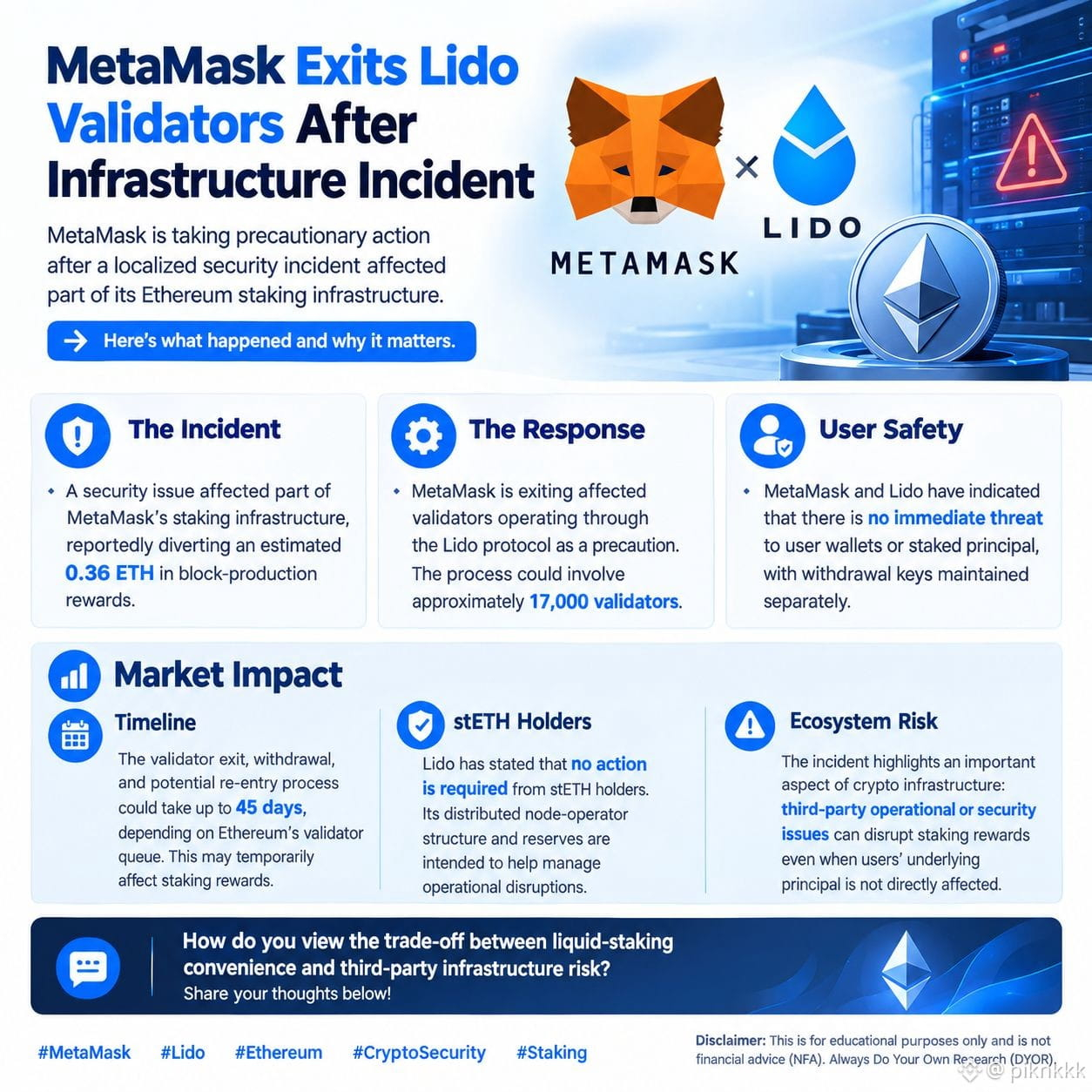
#metamaskexitslidovalidatorsaftersecurityincident MetaMask Exits Lido Validators After Infrastructure Incident
MetaMask is proactively withdrawing affected Ethereum validators from its non-custodial staking operations following a localized infrastructure security incident. Here is the breakdown. 👇
🔹The Incident A security issue affected part of MetaMask’s staking infrastructure, diverting an estimated 0.36 ETH in block-production rewards.
🔹 The Response As a precaution, MetaMask is exiting affected validators on the Lido protocol, potentially involving ~17,000 validators.
🔹 User Safety Both MetaMask and Lido confirm **no immediate threat to user wallets or staked principal as withdrawal keys remain separate and secure.
📊 Market Impact
⏳ Timeline The exit, withdrawal, and re-entry cycle may take up to 45 days due to Ethereum’s validator queue, causing temporary missed rewards.
🛡️ stETH Holders Lido states no action is required. Its diverse node-operator set and reserve funds are designed to absorb such disruptions.
Ecosystem This highlights operational risks in crypto infrastructure, where third-party vulnerabilities can cause yield disruption without direct fund loss.
💬 How do you view the trade-off between liquid staking convenience and third-party operational risks? Share your thoughts below!
#MetaMask #Lido #Ethereum #CryptoSecurity #Staking
This is for educational purposes only. Not Financial Advice (NFA). Always Do Your Own Research (DYOR).'
$STX $JASMY $DUSK
{future}(DUSKUSDT)
{future}(JASMYUSDT)
{future}(STXUSDT)
#metamaskexitslidovalidatorsaftersecurityincident MetaMask Exits Lido Validators After Infrastructure Incident
MetaMask is proactively withdrawing affected Ethereum validators from its non-custodial staking operations following a localized infrastructure security incident. Here is the breakdown. 👇
🔹The Incident A security issue affected part of MetaMask’s staking infrastructure, diverting an estimated 0.36 ETH in block-production rewards.
🔹 The Response As a precaution, MetaMask is exiting affected validators on the Lido protocol, potentially involving ~17,000 validators.
🔹 User Safety Both MetaMask and Lido confirm **no immediate threat to user wallets or staked principal as withdrawal keys remain separate and secure.
📊 Market Impact
⏳ Timeline The exit, withdrawal, and re-entry cycle may take up to 45 days due to Ethereum’s validator queue, causing temporary missed rewards.
🛡️ stETH Holders Lido states no action is required. Its diverse node-operator set and reserve funds are designed to absorb such disruptions.
Ecosystem This highlights operational risks in crypto infrastructure, where third-party vulnerabilities can cause yield disruption without direct fund loss.
💬 How do you view the trade-off between liquid staking convenience and third-party operational risks? Share your thoughts below!
#MetaMask #Lido #Ethereum #CryptoSecurity #Staking
This is for educational purposes only. Not Financial Advice (NFA). Always Do Your Own Research (DYOR).'
$STX $JASMY $DUSK
MetaMask is proactively withdrawing affected Ethereum validators from its non-custodial staking operations following a localized infrastructure security incident. Here is the breakdown. 👇
🔹The Incident A security issue affected part of MetaMask’s staking infrastructure, diverting an estimated 0.36 ETH in block-production rewards.
🔹 The Response As a precaution, MetaMask is exiting affected validators on the Lido protocol, potentially involving ~17,000 validators.
🔹 User Safety Both MetaMask and Lido confirm **no immediate threat to user wallets or staked principal as withdrawal keys remain separate and secure.
📊 Market Impact
⏳ Timeline The exit, withdrawal, and re-entry cycle may take up to 45 days due to Ethereum’s validator queue, causing temporary missed rewards.
🛡️ stETH Holders Lido states no action is required. Its diverse node-operator set and reserve funds are designed to absorb such disruptions.
Ecosystem This highlights operational risks in crypto infrastructure, where third-party vulnerabilities can cause yield disruption without direct fund loss.
💬 How do you view the trade-off between liquid staking convenience and third-party operational risks? Share your thoughts below!
#MetaMask #Lido #Ethereum #CryptoSecurity #Staking
This is for educational purposes only. Not Financial Advice (NFA). Always Do Your Own Research (DYOR).'
$STX $JASMY $DUSK
81
🦊 META MASK MADE ONE THING VERY CLEAR
Security incident? YES.
Immediate wallet threat? NO identified threat so far.
The affected validators are being exited as a precaution, while the investigation continues.
That distinction could matter massively for $ETH sentiment. 📊
#metamaskexitslidovalidatorsaftersecurityincident
🦊 META MASK MADE ONE THING VERY CLEAR
Security incident? YES.
Immediate wallet threat? NO identified threat so far.
The affected validators are being exited as a precaution, while the investigation continues.
That distinction could matter massively for $ETH sentiment. 📊
#metamaskexitslidovalidatorsaftersecurityincident
Security incident? YES.
Immediate wallet threat? NO identified threat so far.
The affected validators are being exited as a precaution, while the investigation continues.
That distinction could matter massively for $ETH sentiment. 📊
#metamaskexitslidovalidatorsaftersecurityincident
15
💥 THE HIDDEN COST OF THE METAMASK INCIDENT
The biggest impact may not be stolen ETH — it could be missed staking rewards and possible downtime penalties during the precautionary exits.
No panic. No leverage.
Just watch the facts, the validator exits and $ETH. 👀📊
#metamaskexitslidovalidatorsaftersecurityincident
💥 THE HIDDEN COST OF THE METAMASK INCIDENT
The biggest impact may not be stolen ETH — it could be missed staking rewards and possible downtime penalties during the precautionary exits.
No panic. No leverage.
Just watch the facts, the validator exits and $ETH. 👀📊
#metamaskexitslidovalidatorsaftersecurityincident
The biggest impact may not be stolen ETH — it could be missed staking rewards and possible downtime penalties during the precautionary exits.
No panic. No leverage.
Just watch the facts, the validator exits and $ETH. 👀📊
#metamaskexitslidovalidatorsaftersecurityincident
15
⚠️ THE 7-DAY DEADLINE HIDES A 45-DAY STORY
MetaMask’s affected validators are expected to exit by Oct. 7.
But the complete exit → withdrawal → re-entry cycle could take up to ~45 days because of Ethereum’s validator queue.
$ETH suddenly has a major staking-security story to watch. 🔥
#metamaskexitslidovalidatorsaftersecurityincident
⚠️ THE 7-DAY DEADLINE HIDES A 45-DAY STORY
MetaMask’s affected validators are expected to exit by Oct. 7.
But the complete exit → withdrawal → re-entry cycle could take up to ~45 days because of Ethereum’s validator queue.
$ETH suddenly has a major staking-security story to watch. 🔥
#metamaskexitslidovalidatorsaftersecurityincident
MetaMask’s affected validators are expected to exit by Oct. 7.
But the complete exit → withdrawal → re-entry cycle could take up to ~45 days because of Ethereum’s validator queue.
$ETH suddenly has a major staking-security story to watch. 🔥
#metamaskexitslidovalidatorsaftersecurityincident
8
🚨 ETH STAKING JUST GOT A SECURITY SHOCK
MetaMask is pulling affected Ethereum validators from Lido after an infrastructure security incident.
😳 The surprising part: MetaMask says no immediate threat to wallets has been identified.
$ETH traders are watching every move now. 👀
#metamaskexitslidovalidatorsaftersecurityincident
🚨 ETH STAKING JUST GOT A SECURITY SHOCK
MetaMask is pulling affected Ethereum validators from Lido after an infrastructure security incident.
😳 The surprising part: MetaMask says no immediate threat to wallets has been identified.
$ETH traders are watching every move now. 👀
#metamaskexitslidovalidatorsaftersecurityincident
MetaMask is pulling affected Ethereum validators from Lido after an infrastructure security incident.
😳 The surprising part: MetaMask says no immediate threat to wallets has been identified.
$ETH traders are watching every move now. 👀
#metamaskexitslidovalidatorsaftersecurityincident
11
🚨 META MASK JUST PULLED THE BRAKE ON ETH STAKING
MetaMask is exiting affected Ethereum validators after a security incident hit part of its infrastructure. The surprise? 🔥 The company says there’s no immediate threat to MetaMask wallets.
⏳ Lido expects the affected validators to exit by Oct. 7, while the full exit/withdrawal/re-entry cycle could take up to ~45 days.
👀 $ETH is now the coin to watch closely.
#metamaskexitslidovalidatorsaftersecurityincident
🚨 META MASK JUST PULLED THE BRAKE ON ETH STAKING
MetaMask is exiting affected Ethereum validators after a security incident hit part of its infrastructure. The surprise? 🔥 The company says there’s no immediate threat to MetaMask wallets.
⏳ Lido expects the affected validators to exit by Oct. 7, while the full exit/withdrawal/re-entry cycle could take up to ~45 days.
👀 $ETH is now the coin to watch closely.
#metamaskexitslidovalidatorsaftersecurityincident
MetaMask is exiting affected Ethereum validators after a security incident hit part of its infrastructure. The surprise? 🔥 The company says there’s no immediate threat to MetaMask wallets.
⏳ Lido expects the affected validators to exit by Oct. 7, while the full exit/withdrawal/re-entry cycle could take up to ~45 days.
👀 $ETH is now the coin to watch closely.
#metamaskexitslidovalidatorsaftersecurityincident
19

·
--
Bullish
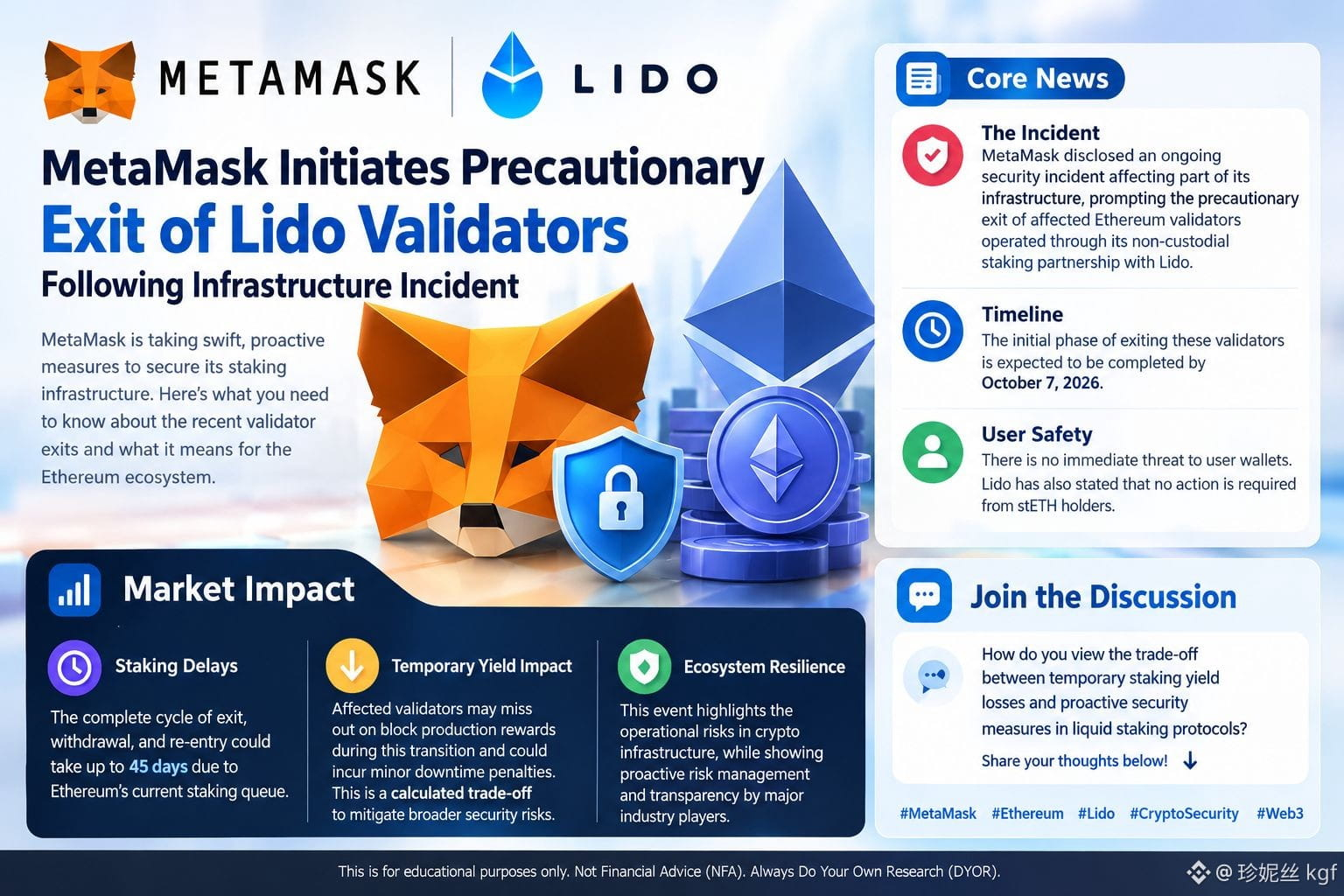
#metamaskexitslidovalidatorsaftersecurityincident 🔍 MetaMask Initiates Precautionary Exit of Lido Validators Following Infrastructure Incident
MetaMask is taking swift, proactive measures to secure its staking infrastructure. Here’s what you need to know about the recent validator exits and what it means for the Ethereum ecosystem. 🧵👇
📰 Core News
• 🛡️ The Incident MetaMask disclosed an ongoing security incident affecting part of its infrastructure, prompting the precautionary exit of affected Ethereum validators operated through its non-custodial staking partnership with Lido.
• ⏱️ Timeline The initial phase of exiting these validators is expected to be completed by October 7, 2026.
• 💼 User Safety MetaMask has confirmed there is no immediate threat to user wallets. Lido has also stated that no action is required from stETH holders.
📊 Market Impact
• ⏳ Staking Delays The complete cycle of exit, withdrawal, and re-entry could take up to 45 days due to Ethereum’s current staking queue.
• 📉 Temporary Yield Impact Affected validators may miss out on block production rewards during this transition and could incur minor downtime penalties. This is a calculated operational trade-off to mitigate broader security risks.
• 🏗️ Ecosystem Resilience This event highlights the operational risks inherent in crypto infrastructure, while simultaneously demonstrating proactive risk management and transparency by major industry players.
💬 Join the Discussion
How do you view the trade-off between temporary staking yield losses and proactive security measures in liquid staking protocols? Share your thoughts below! 👇
#MetaMask #Ethereum #Lido #CryptoSecurity #Web3
This is for educational purposes only. Not Financial Advice (NFA). Always Do Your Own Research (DYOR).
$STX $JASMY $DUSK
{future}(DUSKUSDT)
{future}(JASMYUSDT)
{future}(STXUSDT)
#metamaskexitslidovalidatorsaftersecurityincident 🔍 MetaMask Initiates Precautionary Exit of Lido Validators Following Infrastructure Incident
MetaMask is taking swift, proactive measures to secure its staking infrastructure. Here’s what you need to know about the recent validator exits and what it means for the Ethereum ecosystem. 🧵👇
📰 Core News
• 🛡️ The Incident MetaMask disclosed an ongoing security incident affecting part of its infrastructure, prompting the precautionary exit of affected Ethereum validators operated through its non-custodial staking partnership with Lido.
• ⏱️ Timeline The initial phase of exiting these validators is expected to be completed by October 7, 2026.
• 💼 User Safety MetaMask has confirmed there is no immediate threat to user wallets. Lido has also stated that no action is required from stETH holders.
📊 Market Impact
• ⏳ Staking Delays The complete cycle of exit, withdrawal, and re-entry could take up to 45 days due to Ethereum’s current staking queue.
• 📉 Temporary Yield Impact Affected validators may miss out on block production rewards during this transition and could incur minor downtime penalties. This is a calculated operational trade-off to mitigate broader security risks.
• 🏗️ Ecosystem Resilience This event highlights the operational risks inherent in crypto infrastructure, while simultaneously demonstrating proactive risk management and transparency by major industry players.
💬 Join the Discussion
How do you view the trade-off between temporary staking yield losses and proactive security measures in liquid staking protocols? Share your thoughts below! 👇
#MetaMask #Ethereum #Lido #CryptoSecurity #Web3
This is for educational purposes only. Not Financial Advice (NFA). Always Do Your Own Research (DYOR).
$STX $JASMY $DUSK
MetaMask is taking swift, proactive measures to secure its staking infrastructure. Here’s what you need to know about the recent validator exits and what it means for the Ethereum ecosystem. 🧵👇
📰 Core News
• 🛡️ The Incident MetaMask disclosed an ongoing security incident affecting part of its infrastructure, prompting the precautionary exit of affected Ethereum validators operated through its non-custodial staking partnership with Lido.
• ⏱️ Timeline The initial phase of exiting these validators is expected to be completed by October 7, 2026.
• 💼 User Safety MetaMask has confirmed there is no immediate threat to user wallets. Lido has also stated that no action is required from stETH holders.
📊 Market Impact
• ⏳ Staking Delays The complete cycle of exit, withdrawal, and re-entry could take up to 45 days due to Ethereum’s current staking queue.
• 📉 Temporary Yield Impact Affected validators may miss out on block production rewards during this transition and could incur minor downtime penalties. This is a calculated operational trade-off to mitigate broader security risks.
• 🏗️ Ecosystem Resilience This event highlights the operational risks inherent in crypto infrastructure, while simultaneously demonstrating proactive risk management and transparency by major industry players.
💬 Join the Discussion
How do you view the trade-off between temporary staking yield losses and proactive security measures in liquid staking protocols? Share your thoughts below! 👇
#MetaMask #Ethereum #Lido #CryptoSecurity #Web3
This is for educational purposes only. Not Financial Advice (NFA). Always Do Your Own Research (DYOR).
$STX $JASMY $DUSK
Safer:
@BiBi Verificar este contenido con datos
1
2
11.9k

·
--
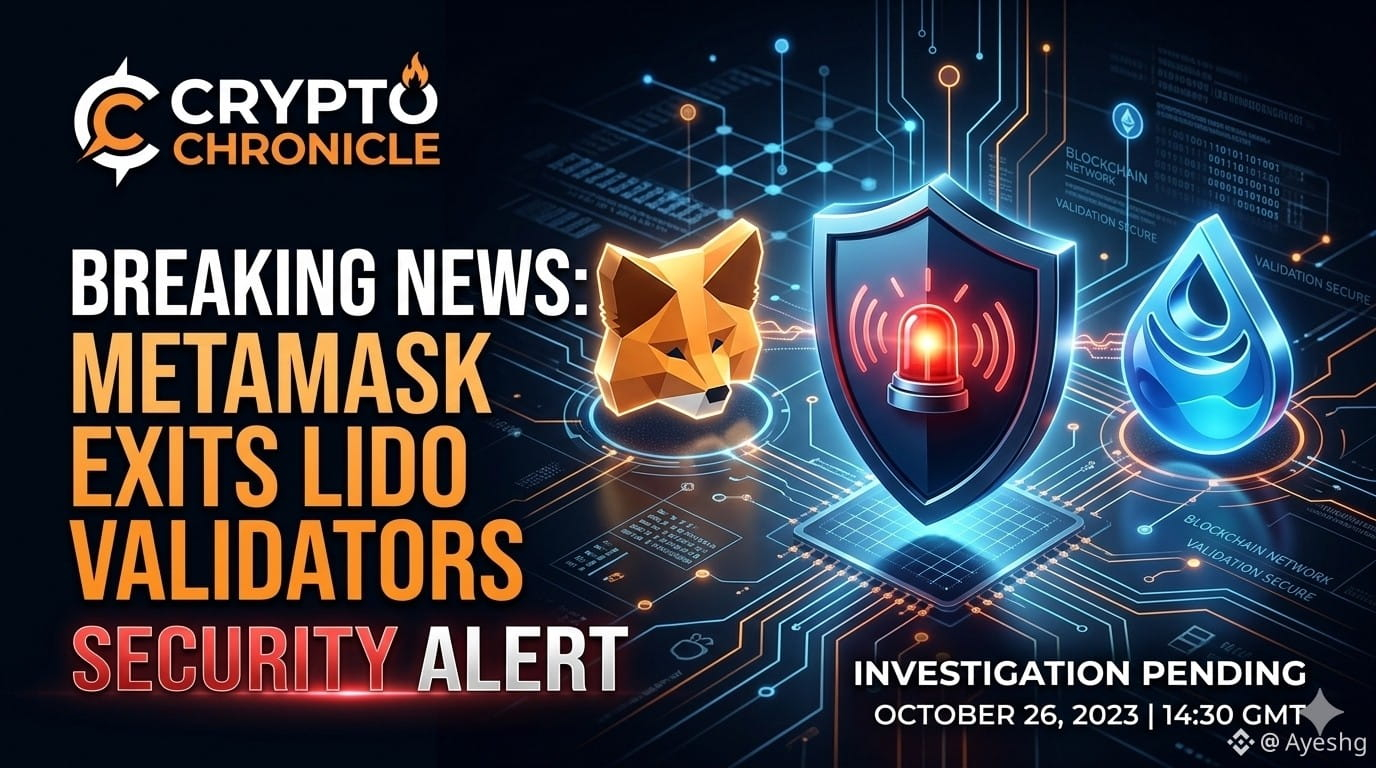
#metamaskexitslidovalidatorsaftersecurityincident 🚨 BREAKING: METAMASK EXITS LIDO VALIDATORS AFTER SECURITY INCIDENT
MetaMask is responding to a security incident affecting part of its infrastructure and has begun proactively exiting affected Ethereum validators operated through its non-custodial staking service.
🛡️ WHAT METAMASK SAYS
• 🔍 Investigation is ongoing with external partners and security advisors
• ✅ MetaMask says it has identified no immediate threat to user wallets
• 🚪 Affected validators are being exited as a precaution
• 🔐 MetaMask says its staking operation is non-custodial and it does not manage clients’ withdrawal keys
MetaMask announced the incident on September 30, 2026.
🏦 LIDO IMPACT
Lido is coordinating the validator exits. Reporting indicates the final affected validators are expected to exit by approximately October 7, while the complete withdrawal and potential re-entry process could take around 45 days because of Ethereum’s validator queues.
💰 WHAT DOES THIS MEAN FOR stETH?
Lido says stETH holders do not need to take action because of the validator exits.
The main potential impact is on staking operations: exiting validators can mean foregone staking rewards, while validators taken offline can also face potential performance-related penalties.
⚠️ IMPORTANT
This is currently a precautionary security response, not evidence that MetaMask user wallets or stETH itself have been compromised.
The incident investigation is still developing, so the full technical details of what happened have not yet been publicly disclosed.
👀 WATCHING NEXT
The market will be watching:
• MetaMask’s investigation updates
• Lido validator exits
• ETH staking flows
• $LDO and market reaction
What do you think — is this mainly a temporary infrastructure issue, or could it have a longer-term impact on Ethereum staking sentiment? 👇
#MetaMask #Lido #Ethereum #SecurityAlert #CryptoNews #Staking
💎 $ETH
🔵 $LDO
🪙 $stETH
#metamaskexitslidovalidatorsaftersecurityincident 🚨 BREAKING: METAMASK EXITS LIDO VALIDATORS AFTER SECURITY INCIDENT
MetaMask is responding to a security incident affecting part of its infrastructure and has begun proactively exiting affected Ethereum validators operated through its non-custodial staking service.
🛡️ WHAT METAMASK SAYS
• 🔍 Investigation is ongoing with external partners and security advisors
• ✅ MetaMask says it has identified no immediate threat to user wallets
• 🚪 Affected validators are being exited as a precaution
• 🔐 MetaMask says its staking operation is non-custodial and it does not manage clients’ withdrawal keys
MetaMask announced the incident on September 30, 2026.
🏦 LIDO IMPACT
Lido is coordinating the validator exits. Reporting indicates the final affected validators are expected to exit by approximately October 7, while the complete withdrawal and potential re-entry process could take around 45 days because of Ethereum’s validator queues.
💰 WHAT DOES THIS MEAN FOR stETH?
Lido says stETH holders do not need to take action because of the validator exits.
The main potential impact is on staking operations: exiting validators can mean foregone staking rewards, while validators taken offline can also face potential performance-related penalties.
⚠️ IMPORTANT
This is currently a precautionary security response, not evidence that MetaMask user wallets or stETH itself have been compromised.
The incident investigation is still developing, so the full technical details of what happened have not yet been publicly disclosed.
👀 WATCHING NEXT
The market will be watching:
• MetaMask’s investigation updates
• Lido validator exits
• ETH staking flows
• $LDO and market reaction
What do you think — is this mainly a temporary infrastructure issue, or could it have a longer-term impact on Ethereum staking sentiment? 👇
#MetaMask #Lido #Ethereum #SecurityAlert #CryptoNews #Staking
💎 $ETH
🔵 $LDO
🪙 $stETH
MetaMask is responding to a security incident affecting part of its infrastructure and has begun proactively exiting affected Ethereum validators operated through its non-custodial staking service.
🛡️ WHAT METAMASK SAYS
• 🔍 Investigation is ongoing with external partners and security advisors
• ✅ MetaMask says it has identified no immediate threat to user wallets
• 🚪 Affected validators are being exited as a precaution
• 🔐 MetaMask says its staking operation is non-custodial and it does not manage clients’ withdrawal keys
MetaMask announced the incident on September 30, 2026.
🏦 LIDO IMPACT
Lido is coordinating the validator exits. Reporting indicates the final affected validators are expected to exit by approximately October 7, while the complete withdrawal and potential re-entry process could take around 45 days because of Ethereum’s validator queues.
💰 WHAT DOES THIS MEAN FOR stETH?
Lido says stETH holders do not need to take action because of the validator exits.
The main potential impact is on staking operations: exiting validators can mean foregone staking rewards, while validators taken offline can also face potential performance-related penalties.
⚠️ IMPORTANT
This is currently a precautionary security response, not evidence that MetaMask user wallets or stETH itself have been compromised.
The incident investigation is still developing, so the full technical details of what happened have not yet been publicly disclosed.
👀 WATCHING NEXT
The market will be watching:
• MetaMask’s investigation updates
• Lido validator exits
• ETH staking flows
• $LDO and market reaction
What do you think — is this mainly a temporary infrastructure issue, or could it have a longer-term impact on Ethereum staking sentiment? 👇
#MetaMask #Lido #Ethereum #SecurityAlert #CryptoNews #Staking
💎 $ETH
🔵 $LDO
🪙 $stETH
1
3
7.1k

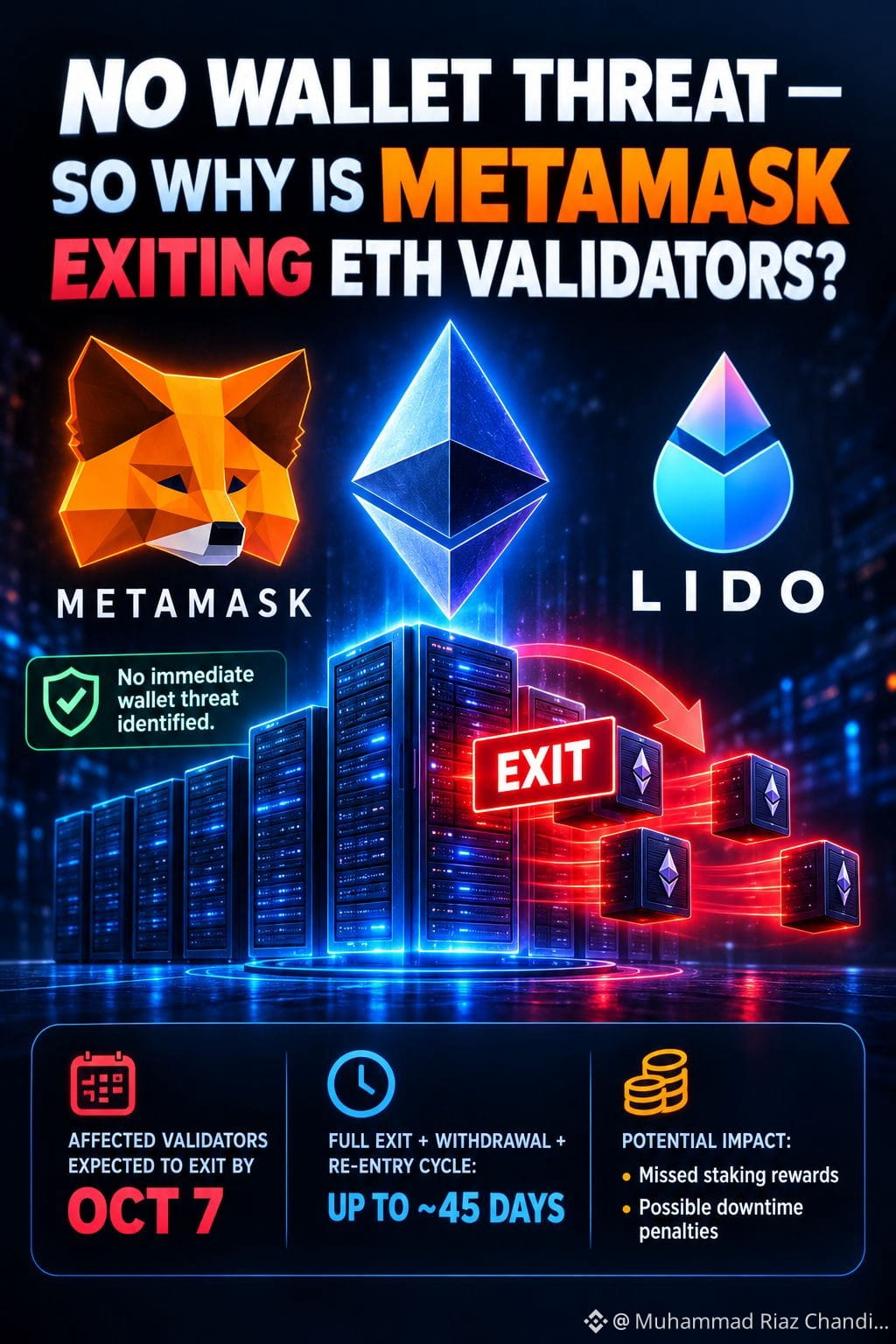
#MetaMaskExitsLidoValidatorsAfterSecurityIncident 🚨 MetaMask Is Exiting Ethereum Validators — But This Isn’t a Wallet Attack
MetaMask has begun proactively exiting a group of Ethereum validators tied to its non-custodial staking infrastructure following a security incident affecting part of its backend.
The important detail: MetaMask says there’s currently no identified threat to user wallets.
Still, $ETH traders have another timeline to watch 👀
According to Lido, the affected validators are expected to exit by October 7, while the full process — exit, withdrawal, and re-entry — could take up to ~45 days.
That could mean:
• Missed staking rewards
• Potential inactivity/exit-related penalties
• Temporary validator downtime
For now, this looks like an infrastructure-level issue rather than a direct wallet-security event.
But the bigger question is whether the investigation ends there — or whether it triggers broader caution around Ethereum staking infrastructure and DeFi.
$ETH: isolated incident or early warning for the staking ecosystem? 👀
$LDO
{spot}(ETHUSDT)
{spot}(LDOUSDT)
#MetaMaskExitsLidoValidatorsAfterSecurityIncident 🚨 MetaMask Is Exiting Ethereum Validators — But This Isn’t a Wallet Attack
MetaMask has begun proactively exiting a group of Ethereum validators tied to its non-custodial staking infrastructure following a security incident affecting part of its backend.
The important detail: MetaMask says there’s currently no identified threat to user wallets.
Still, $ETH traders have another timeline to watch 👀
According to Lido, the affected validators are expected to exit by October 7, while the full process — exit, withdrawal, and re-entry — could take up to ~45 days.
That could mean:
• Missed staking rewards
• Potential inactivity/exit-related penalties
• Temporary validator downtime
For now, this looks like an infrastructure-level issue rather than a direct wallet-security event.
But the bigger question is whether the investigation ends there — or whether it triggers broader caution around Ethereum staking infrastructure and DeFi.
$ETH: isolated incident or early warning for the staking ecosystem? 👀
$LDO
MetaMask has begun proactively exiting a group of Ethereum validators tied to its non-custodial staking infrastructure following a security incident affecting part of its backend.
The important detail: MetaMask says there’s currently no identified threat to user wallets.
Still, $ETH traders have another timeline to watch 👀
According to Lido, the affected validators are expected to exit by October 7, while the full process — exit, withdrawal, and re-entry — could take up to ~45 days.
That could mean:
• Missed staking rewards
• Potential inactivity/exit-related penalties
• Temporary validator downtime
For now, this looks like an infrastructure-level issue rather than a direct wallet-security event.
But the bigger question is whether the investigation ends there — or whether it triggers broader caution around Ethereum staking infrastructure and DeFi.
$ETH: isolated incident or early warning for the staking ecosystem? 👀
$LDO
1
69

·
--
#MetaMaskExitsLidoValidatorsAfterSecurityIncident
Latest MetaMask–Lido update
MetaMask is still investigating an infrastructure security incident. It has not disclosed exactly what was compromised or how the incident occurred.
MetaMask says it has found no immediate threat to MetaMask wallets and is proactively exiting affected validators as a precaution.
Lido expects the affected MetaMask validators to finish exiting by October 7, 2026.
The latest reporting estimates roughly 523,000 ETH is associated with the validators being exited. An Ethereum security researcher reportedly estimated only about 0.36 ETH in rewards was diverted, although the full incident details remain undisclosed.
stETH holders do not currently need to take action. The exited ETH will gradually go through withdrawal and re-entry, potentially taking around 45 days because of Ethereum's entry queue.
Aave's founder has said its markets are operating normally while the situation is monitored.
Binance market note
Impact so far: 🟡 Caution, not confirmed systemic damage.
The key thing to watch now is what MetaMask reveals about the actual compromise. If it turns out to be limited to staking infrastructure with no withdrawal-key compromise, the impact could remain mainly operational. If additional systems or validator keys were affected, market concern could increase.
For LDO/ETH: monitor validator exits, stETH liquidity and any further security disclosure rather than assuming the incident means Lido itself has been compromised.
#MetaMaskExitsLidoValidatorsAfterSecurityIncident
Latest MetaMask–Lido update
MetaMask is still investigating an infrastructure security incident. It has not disclosed exactly what was compromised or how the incident occurred.
MetaMask says it has found no immediate threat to MetaMask wallets and is proactively exiting affected validators as a precaution.
Lido expects the affected MetaMask validators to finish exiting by October 7, 2026.
The latest reporting estimates roughly 523,000 ETH is associated with the validators being exited. An Ethereum security researcher reportedly estimated only about 0.36 ETH in rewards was diverted, although the full incident details remain undisclosed.
stETH holders do not currently need to take action. The exited ETH will gradually go through withdrawal and re-entry, potentially taking around 45 days because of Ethereum's entry queue.
Aave's founder has said its markets are operating normally while the situation is monitored.
Binance market note
Impact so far: 🟡 Caution, not confirmed systemic damage.
The key thing to watch now is what MetaMask reveals about the actual compromise. If it turns out to be limited to staking infrastructure with no withdrawal-key compromise, the impact could remain mainly operational. If additional systems or validator keys were affected, market concern could increase.
For LDO/ETH: monitor validator exits, stETH liquidity and any further security disclosure rather than assuming the incident means Lido itself has been compromised.
Latest MetaMask–Lido update
MetaMask is still investigating an infrastructure security incident. It has not disclosed exactly what was compromised or how the incident occurred.
MetaMask says it has found no immediate threat to MetaMask wallets and is proactively exiting affected validators as a precaution.
Lido expects the affected MetaMask validators to finish exiting by October 7, 2026.
The latest reporting estimates roughly 523,000 ETH is associated with the validators being exited. An Ethereum security researcher reportedly estimated only about 0.36 ETH in rewards was diverted, although the full incident details remain undisclosed.
stETH holders do not currently need to take action. The exited ETH will gradually go through withdrawal and re-entry, potentially taking around 45 days because of Ethereum's entry queue.
Aave's founder has said its markets are operating normally while the situation is monitored.
Binance market note
Impact so far: 🟡 Caution, not confirmed systemic damage.
The key thing to watch now is what MetaMask reveals about the actual compromise. If it turns out to be limited to staking infrastructure with no withdrawal-key compromise, the impact could remain mainly operational. If additional systems or validator keys were affected, market concern could increase.
For LDO/ETH: monitor validator exits, stETH liquidity and any further security disclosure rather than assuming the incident means Lido itself has been compromised.
98
Log in to explore more content
Join global crypto users on Binance Square
⚡️ Get latest and useful information about crypto.
💬 Trusted by the world’s largest crypto exchange.
👍 Discover real insights from verified creators.
Email / Phone number
Trending Topics
1
#SECHaltsCryptoETFReviewsAmidFundingLapse
1,857 views
98 Discussing
2
#ZcashETFPostsFirstWeeklyOutflow$93.6M
55,250 views
166 Discussing
3
#GreekPoliceBustCryptoScamRingArrest17
161,327 views
1,134 Discussing
4
#BitcoinRejectedAt$87K
155,738 views
215 Discussing
5
#FedOctoberRateHikeOddsFallTo17%
195,543 views
1,327 Discussing
6
#NvidiaHitsRecordHighUp2.4%
139,698 views
940 Discussing
7
#CanaryFilesAmendedS1ForPEPEETF
34,951 views
640 Discussing
8
#BitcoinParesGainsAfterRallyTo$86.5K
55,595 views
171 Discussing
9
#CerebrasSinksNearly20%OnReportNvidiaToPowerOpenAI
145,965 views
1,275 Discussing
10
#SECProposesCryptoCustodyRules
200,191 views
1,575 Discussing