
#newton
newton
113,290 views
1,314 Discussing
Hot
Latest

·
--
Partly True
Article
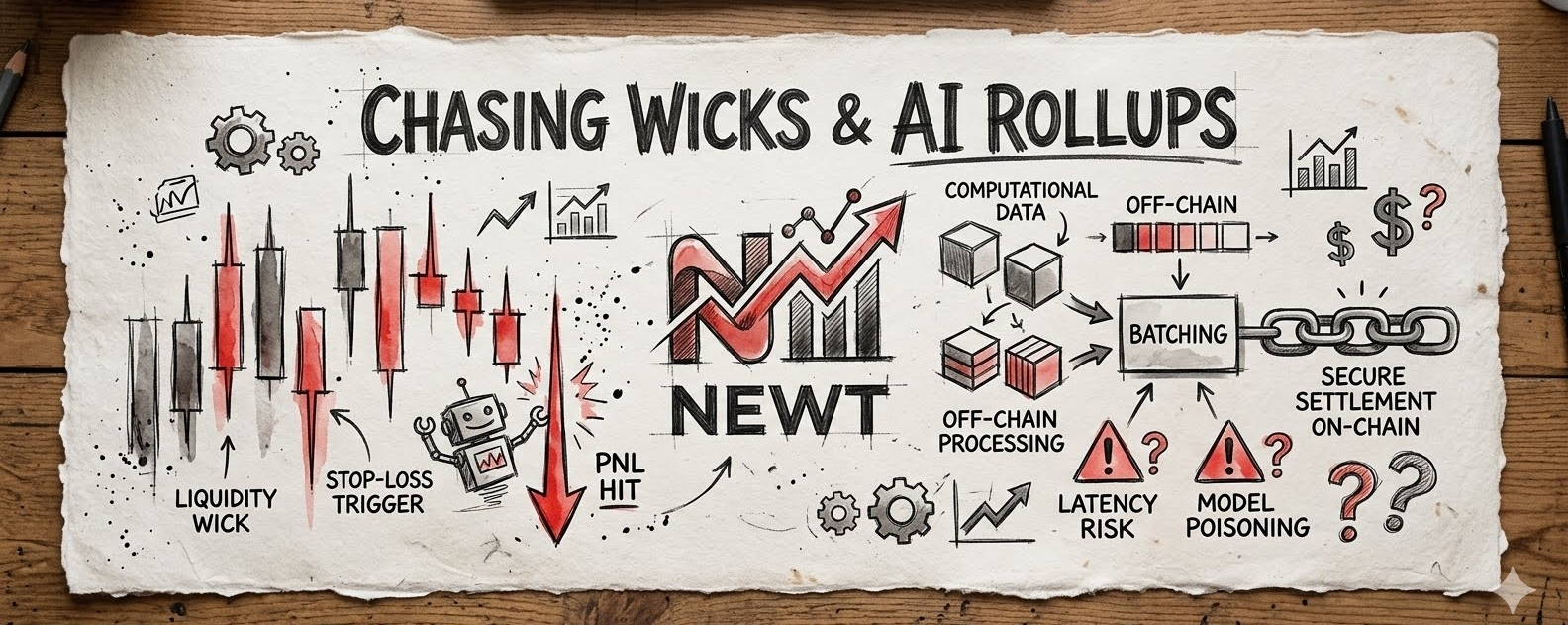
Chasing Wicks and AI Rollups: Why I’m Keeping My Hype in Check for Newton Protocol ($NEWT)I spent the morning digging into the documentation for the Newton Protocol ($NEWT ). I needed a distraction because my actual PNL this week took a massive hit from a stupid trading mistake. I left a trailing stop too tight on an unoptimized market-making bot, and my position got completely wiped out during a sudden, aggressive wick. It’s brutal out there right now, which is precisely why the concept of a secure rollup specifically built for AI-driven strategies and automated trading caught my eye. The team is trying to build a decentralized marketplace where machine learning and AI devs can easily monetize their quantitative models. Honestly, it sounds exactly like what the market needs, but I’m forced to keep my hype firmly in check until we see actual mainnet execution.
The underlying architecture relies on complex off-chain processing to handle high-frequency computational data streams before batching and settling them securely on-chain. This is pretty standard rollup stuff on paper, but they claim it is highly optimized specifically for machine learning execution. In theory, this framework eliminates manual execution risks by relying purely on programmatic conditional smart contract statements. Furthermore, the developer marketplace creates a neat, self-sustaining ecosystem for quant devs who want to rent out their algorithmic strategies. Furthermore, the seamless integration of these systems creates a cyclical environment where devs publish models, automated systems deploy them, and the rollup processes the transactions smoothly.
But let’s be real for a second—I see two massive, glaring red flags that make me incredibly nervous to deploy any serious capital here. First, there is the fundamental latency issue that plagues all rollup designs. Rollups inherently batch transactions, which introduces unavoidable millisecond delays. In highly volatile execution environments, that minor latency means instant death by slippage. Predatory MEV bots lurking on monolithic base layers will absolutely front-run these complex AI strategies before they settle. Second, the decentralized marketplace opens up a terrifying attack vector for model poisoning. A malicious developer could easily upload an algorithmic model that backtests beautifully during historical simulation but contains hidden triggers or backdoors. These triggers could be designed to intentionally drain user liquidity and redirect funds during a specific, engineered market anomaly.
In conclusion, Newton Protocol presents a super unique and attractive conceptual framework for decentralized financial intelligence. Furthermore, the network offers a clear infrastructure for automation and developer monetization. However, until they definitively solve execution lag and find a way to mitigate algorithmic security risks, I'm sticking to safe, broad plays rather than risking my remaining portfolio on unproven rollups.
@NewtonProtocol #newton
Chasing Wicks and AI Rollups: Why I’m Keeping My Hype in Check for Newton Protocol ($NEWT)
I spent the morning digging into the documentation for the Newton Protocol ($NEWT ). I needed a distraction because my actual PNL this week took a massive hit from a stupid trading mistake. I left a trailing stop too tight on an unoptimized market-making bot, and my position got completely wiped out during a sudden, aggressive wick. It’s brutal out there right now, which is precisely why the concept of a secure rollup specifically built for AI-driven strategies and automated trading caught my eye. The team is trying to build a decentralized marketplace where machine learning and AI devs can easily monetize their quantitative models. Honestly, it sounds exactly like what the market needs, but I’m forced to keep my hype firmly in check until we see actual mainnet execution.
The underlying architecture relies on complex off-chain processing to handle high-frequency computational data streams before batching and settling them securely on-chain. This is pretty standard rollup stuff on paper, but they claim it is highly optimized specifically for machine learning execution. In theory, this framework eliminates manual execution risks by relying purely on programmatic conditional smart contract statements. Furthermore, the developer marketplace creates a neat, self-sustaining ecosystem for quant devs who want to rent out their algorithmic strategies. Furthermore, the seamless integration of these systems creates a cyclical environment where devs publish models, automated systems deploy them, and the rollup processes the transactions smoothly.
But let’s be real for a second—I see two massive, glaring red flags that make me incredibly nervous to deploy any serious capital here. First, there is the fundamental latency issue that plagues all rollup designs. Rollups inherently batch transactions, which introduces unavoidable millisecond delays. In highly volatile execution environments, that minor latency means instant death by slippage. Predatory MEV bots lurking on monolithic base layers will absolutely front-run these complex AI strategies before they settle. Second, the decentralized marketplace opens up a terrifying attack vector for model poisoning. A malicious developer could easily upload an algorithmic model that backtests beautifully during historical simulation but contains hidden triggers or backdoors. These triggers could be designed to intentionally drain user liquidity and redirect funds during a specific, engineered market anomaly.
In conclusion, Newton Protocol presents a super unique and attractive conceptual framework for decentralized financial intelligence. Furthermore, the network offers a clear infrastructure for automation and developer monetization. However, until they definitively solve execution lag and find a way to mitigate algorithmic security risks, I'm sticking to safe, broad plays rather than risking my remaining portfolio on unproven rollups.
@NewtonProtocol #newton
The underlying architecture relies on complex off-chain processing to handle high-frequency computational data streams before batching and settling them securely on-chain. This is pretty standard rollup stuff on paper, but they claim it is highly optimized specifically for machine learning execution. In theory, this framework eliminates manual execution risks by relying purely on programmatic conditional smart contract statements. Furthermore, the developer marketplace creates a neat, self-sustaining ecosystem for quant devs who want to rent out their algorithmic strategies. Furthermore, the seamless integration of these systems creates a cyclical environment where devs publish models, automated systems deploy them, and the rollup processes the transactions smoothly.
But let’s be real for a second—I see two massive, glaring red flags that make me incredibly nervous to deploy any serious capital here. First, there is the fundamental latency issue that plagues all rollup designs. Rollups inherently batch transactions, which introduces unavoidable millisecond delays. In highly volatile execution environments, that minor latency means instant death by slippage. Predatory MEV bots lurking on monolithic base layers will absolutely front-run these complex AI strategies before they settle. Second, the decentralized marketplace opens up a terrifying attack vector for model poisoning. A malicious developer could easily upload an algorithmic model that backtests beautifully during historical simulation but contains hidden triggers or backdoors. These triggers could be designed to intentionally drain user liquidity and redirect funds during a specific, engineered market anomaly.
In conclusion, Newton Protocol presents a super unique and attractive conceptual framework for decentralized financial intelligence. Furthermore, the network offers a clear infrastructure for automation and developer monetization. However, until they definitively solve execution lag and find a way to mitigate algorithmic security risks, I'm sticking to safe, broad plays rather than risking my remaining portfolio on unproven rollups.
@NewtonProtocol #newton
2
82

·
--
Partly True
Article
The Frictionless Fallacy: Analyzing the Magic Labs Integration@NewtonProtocol
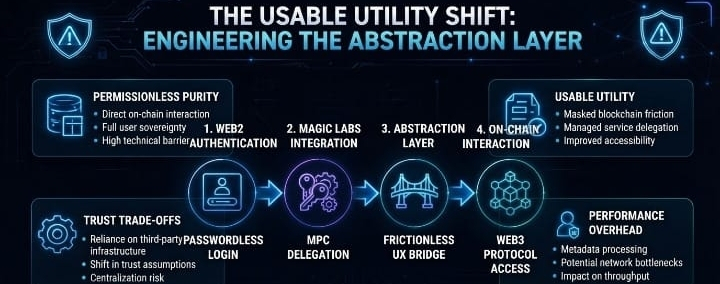
In the architecture of decentralized systems user experience is often a euphemism for hiding the complexity of private key management. The recent partnership with Magic Labs promises a seamless transition from Web2 authentication to Web3 interaction but as protocol engineers. We must look past the marketing layer to the on chain reality. The promise is a passwordless familiar login experience. The reality is an abstraction layer that introduces new dependencies.
At the technical core the integration operates by delegating key management to a managed service. While this effectively solves the bonboarding drop off problem moving users away from seed phrase management it forces a trade off in trust. In theory the whitepaper suggests full decentralization via non custodial Delegated Key Management System (DKMS) schemes. In practice the protocol must now account for the availability and integrity of the Magic Labs infrastructure. If the authentication provider experiences downtime or a security compromise, the on chain reality is that user assets while technically on chain become functionally inaccessible. We have swapped the risk of user negligence (losing a seed phrase) for the risk of centralized dependency (infrastructure failure).
Furthermore the abstraction of signing transactions adds a layer of metadata processing that, if not optimized, can bloat transaction validation times. While the onboarding flow looks sleek, the overhead of verifying the cryptographic proofs generated by the Magic Labs SDK must be processed by the network nodes. If this verification overhead scales linearly with user count the protocol faces a potential bottleneck that could increase gas costs or latency for all participants.
Market Context: $NEWT [+2.93%]
NEWT
The current market momentum shows that solid technology and real utility are finally getting the recognition they deserve.
#bullish #newton #MagicLabs #BlockchainEngineering
Conclusion
We are witnessing a shift from
permissionless purity to usable utility. The Magic Labs integration successfully masks the friction of blockchain interaction. But engineers should remain vigilant. Convenience is rarely free. It is usually paid for in either trust or performance overhead. Do not mistake a cleaner UI for a more decentralized protocol the abstraction layer is a bridge not the destination.
The Frictionless Fallacy: Analyzing the Magic Labs Integration
@NewtonProtocol
In the architecture of decentralized systems user experience is often a euphemism for hiding the complexity of private key management. The recent partnership with Magic Labs promises a seamless transition from Web2 authentication to Web3 interaction but as protocol engineers. We must look past the marketing layer to the on chain reality. The promise is a passwordless familiar login experience. The reality is an abstraction layer that introduces new dependencies.
At the technical core the integration operates by delegating key management to a managed service. While this effectively solves the bonboarding drop off problem moving users away from seed phrase management it forces a trade off in trust. In theory the whitepaper suggests full decentralization via non custodial Delegated Key Management System (DKMS) schemes. In practice the protocol must now account for the availability and integrity of the Magic Labs infrastructure. If the authentication provider experiences downtime or a security compromise, the on chain reality is that user assets while technically on chain become functionally inaccessible. We have swapped the risk of user negligence (losing a seed phrase) for the risk of centralized dependency (infrastructure failure).
Furthermore the abstraction of signing transactions adds a layer of metadata processing that, if not optimized, can bloat transaction validation times. While the onboarding flow looks sleek, the overhead of verifying the cryptographic proofs generated by the Magic Labs SDK must be processed by the network nodes. If this verification overhead scales linearly with user count the protocol faces a potential bottleneck that could increase gas costs or latency for all participants.
Market Context: $NEWT [+2.93%]
NEWT
The current market momentum shows that solid technology and real utility are finally getting the recognition they deserve.
#bullish #newton #MagicLabs #BlockchainEngineering
Conclusion
We are witnessing a shift from
permissionless purity to usable utility. The Magic Labs integration successfully masks the friction of blockchain interaction. But engineers should remain vigilant. Convenience is rarely free. It is usually paid for in either trust or performance overhead. Do not mistake a cleaner UI for a more decentralized protocol the abstraction layer is a bridge not the destination.
In the architecture of decentralized systems user experience is often a euphemism for hiding the complexity of private key management. The recent partnership with Magic Labs promises a seamless transition from Web2 authentication to Web3 interaction but as protocol engineers. We must look past the marketing layer to the on chain reality. The promise is a passwordless familiar login experience. The reality is an abstraction layer that introduces new dependencies.
At the technical core the integration operates by delegating key management to a managed service. While this effectively solves the bonboarding drop off problem moving users away from seed phrase management it forces a trade off in trust. In theory the whitepaper suggests full decentralization via non custodial Delegated Key Management System (DKMS) schemes. In practice the protocol must now account for the availability and integrity of the Magic Labs infrastructure. If the authentication provider experiences downtime or a security compromise, the on chain reality is that user assets while technically on chain become functionally inaccessible. We have swapped the risk of user negligence (losing a seed phrase) for the risk of centralized dependency (infrastructure failure).
Furthermore the abstraction of signing transactions adds a layer of metadata processing that, if not optimized, can bloat transaction validation times. While the onboarding flow looks sleek, the overhead of verifying the cryptographic proofs generated by the Magic Labs SDK must be processed by the network nodes. If this verification overhead scales linearly with user count the protocol faces a potential bottleneck that could increase gas costs or latency for all participants.
Market Context: $NEWT [+2.93%]
NEWT
The current market momentum shows that solid technology and real utility are finally getting the recognition they deserve.
#bullish #newton #MagicLabs #BlockchainEngineering
Conclusion
We are witnessing a shift from
permissionless purity to usable utility. The Magic Labs integration successfully masks the friction of blockchain interaction. But engineers should remain vigilant. Convenience is rarely free. It is usually paid for in either trust or performance overhead. Do not mistake a cleaner UI for a more decentralized protocol the abstraction layer is a bridge not the destination.
4
1
70

#newt $NEWT I’ve noticed that the smallest improvements often tell the biggest story. That’s why I keep revisiting Newton Protocol. Instead of looking for dramatic announcements, I pay attention to the details that quietly improve the overall experience. Those steady refinements give me confidence that the project is focused on building something practical. For me, thoughtful progress is always more meaningful than short-lived attention. @NewtonProtocol #newton
#newt $NEWT I’ve noticed that the smallest improvements often tell the biggest story. That’s why I keep revisiting Newton Protocol. Instead of looking for dramatic announcements, I pay attention to the details that quietly improve the overall experience. Those steady refinements give me confidence that the project is focused on building something practical. For me, thoughtful progress is always more meaningful than short-lived attention. @NewtonProtocol #newton
2
101

Lately, I've been asking myself one question: am I investing in real products, or am I just following the latest trend?
I've seen many narratives attract a lot of money for a short time, then lose attention once the rewards slow down. That's why I'm much more careful with new investments now.
That thinking made me take a closer look at Newton Protocol instead of simply following the hype.
The interesting part for me wasn't just the AI story. It was the idea of giving AI-powered trading strategies a safer place to run. If more traders and developers start trusting AI with real money, the infrastructure behind it could become more important than any single strategy.
At the same time, I'm staying careful. AI is getting a lot of attention, but attention doesn't always turn into long-term users. If developers stop building or people don't find real value, liquidity can disappear quickly.
For now, I'm keeping my position small and watching a few things: Are users still active after the excitement fades? Are developers still building? Are people coming back because the product is useful, not just because of rewards?
One lesson I've learned is simple: trends can bring money, but real usage is what keeps it there.
What do you think? Will AI projects be valued by real user activity in the future, or will the market keep following the AI narrative first?
$T $EVAA
$NEWT #Newt #newton @NewtonProtocol
Lately, I've been asking myself one question: am I investing in real products, or am I just following the latest trend?
I've seen many narratives attract a lot of money for a short time, then lose attention once the rewards slow down. That's why I'm much more careful with new investments now.
That thinking made me take a closer look at Newton Protocol instead of simply following the hype.
The interesting part for me wasn't just the AI story. It was the idea of giving AI-powered trading strategies a safer place to run. If more traders and developers start trusting AI with real money, the infrastructure behind it could become more important than any single strategy.
At the same time, I'm staying careful. AI is getting a lot of attention, but attention doesn't always turn into long-term users. If developers stop building or people don't find real value, liquidity can disappear quickly.
For now, I'm keeping my position small and watching a few things: Are users still active after the excitement fades? Are developers still building? Are people coming back because the product is useful, not just because of rewards?
One lesson I've learned is simple: trends can bring money, but real usage is what keeps it there.
What do you think? Will AI projects be valued by real user activity in the future, or will the market keep following the AI narrative first?
$T $EVAA
$NEWT #Newt #newton @NewtonProtocol
I've seen many narratives attract a lot of money for a short time, then lose attention once the rewards slow down. That's why I'm much more careful with new investments now.
That thinking made me take a closer look at Newton Protocol instead of simply following the hype.
The interesting part for me wasn't just the AI story. It was the idea of giving AI-powered trading strategies a safer place to run. If more traders and developers start trusting AI with real money, the infrastructure behind it could become more important than any single strategy.
At the same time, I'm staying careful. AI is getting a lot of attention, but attention doesn't always turn into long-term users. If developers stop building or people don't find real value, liquidity can disappear quickly.
For now, I'm keeping my position small and watching a few things: Are users still active after the excitement fades? Are developers still building? Are people coming back because the product is useful, not just because of rewards?
One lesson I've learned is simple: trends can bring money, but real usage is what keeps it there.
What do you think? Will AI projects be valued by real user activity in the future, or will the market keep following the AI narrative first?
$T $EVAA
$NEWT #Newt #newton @NewtonProtocol
AI-powered Automation
0%
Verifiable AI Execution
0%
Developer Ecosystem Growth 💹
0%
Token Price Appreciation
0%
0 votes • Voting closed
457

·
--
I've become a lot less interested in AI as a narrative and a lot more interested in how capital behaves around it. @NewtonProtocol That's why I've been watching Newton Protocol differently.#Binance
The question isn't whether automated strategies can execute trades. We already know they can. The question is whether serious capital is willing to stay when those strategies are making decisions through volatile markets.#newton
One thing I've learned after a few market cycles is that high transaction counts don't impress me anymore. Automated systems can generate endless activity without creating much real economic value. What matters is whether fees remain healthy, wallets keep returning, and liquidity sticks around after incentives lose their edge.
I also think verification matters more than intelligence. During a bull market, almost every strategy looks smart. It's during sharp drawdowns that trust gets tested. If users understand how decisions are executed and why they happened, they're far more likely to stay engaged instead of pulling capital at the first sign of stress.#Birliktekazanalım
That's the lens I'm using with Newton Protocol. I'm paying less attention to the AI narrative and more attention to the quality of the capital interacting with the protocol. In the long run, sticky liquidity and repeat participation tell a much clearer story than headline activity ever will.
#GillibrandCallsForDigitalAssetEthicsBan #RevolutToDelistUSDT
@NewtonProtocol $NEWT
{future}(NEWTUSDT)
$LAB
{alpha}(560x7ec43cf65f1663f820427c62a5780b8f2e25593a)
$VANRY
{future}(VANRYUSDT)
I've become a lot less interested in AI as a narrative and a lot more interested in how capital behaves around it. @NewtonProtocol That's why I've been watching Newton Protocol differently.#Binance
The question isn't whether automated strategies can execute trades. We already know they can. The question is whether serious capital is willing to stay when those strategies are making decisions through volatile markets.#newton
One thing I've learned after a few market cycles is that high transaction counts don't impress me anymore. Automated systems can generate endless activity without creating much real economic value. What matters is whether fees remain healthy, wallets keep returning, and liquidity sticks around after incentives lose their edge.
I also think verification matters more than intelligence. During a bull market, almost every strategy looks smart. It's during sharp drawdowns that trust gets tested. If users understand how decisions are executed and why they happened, they're far more likely to stay engaged instead of pulling capital at the first sign of stress.#Birliktekazanalım
That's the lens I'm using with Newton Protocol. I'm paying less attention to the AI narrative and more attention to the quality of the capital interacting with the protocol. In the long run, sticky liquidity and repeat participation tell a much clearer story than headline activity ever will.
#GillibrandCallsForDigitalAssetEthicsBan #RevolutToDelistUSDT
@NewtonProtocol $NEWT
$LAB
$VANRY
The question isn't whether automated strategies can execute trades. We already know they can. The question is whether serious capital is willing to stay when those strategies are making decisions through volatile markets.#newton
One thing I've learned after a few market cycles is that high transaction counts don't impress me anymore. Automated systems can generate endless activity without creating much real economic value. What matters is whether fees remain healthy, wallets keep returning, and liquidity sticks around after incentives lose their edge.
I also think verification matters more than intelligence. During a bull market, almost every strategy looks smart. It's during sharp drawdowns that trust gets tested. If users understand how decisions are executed and why they happened, they're far more likely to stay engaged instead of pulling capital at the first sign of stress.#Birliktekazanalım
That's the lens I'm using with Newton Protocol. I'm paying less attention to the AI narrative and more attention to the quality of the capital interacting with the protocol. In the long run, sticky liquidity and repeat participation tell a much clearer story than headline activity ever will.
#GillibrandCallsForDigitalAssetEthicsBan #RevolutToDelistUSDT
@NewtonProtocol $NEWT
$LAB
$VANRY
🔹Supports more policy. design
75%
🔹Hides critical requirements
25%
4 votes • Voting closed
2
186

Article
The Security Signal Most People Ignore Isn't the Data—It's the Time#Newton The deeper I explored Newton Protocol's architecture, the more one idea stood out:
Sometimes the most valuable information isn't hidden in the data itself—it's hidden in how long a system takes to respond.
Latency is usually discussed as a performance metric. Faster execution, lower delays, better user experience.
Newton's documentation reveals another dimension entirely.
It treats timing as part of the protocol's security model.
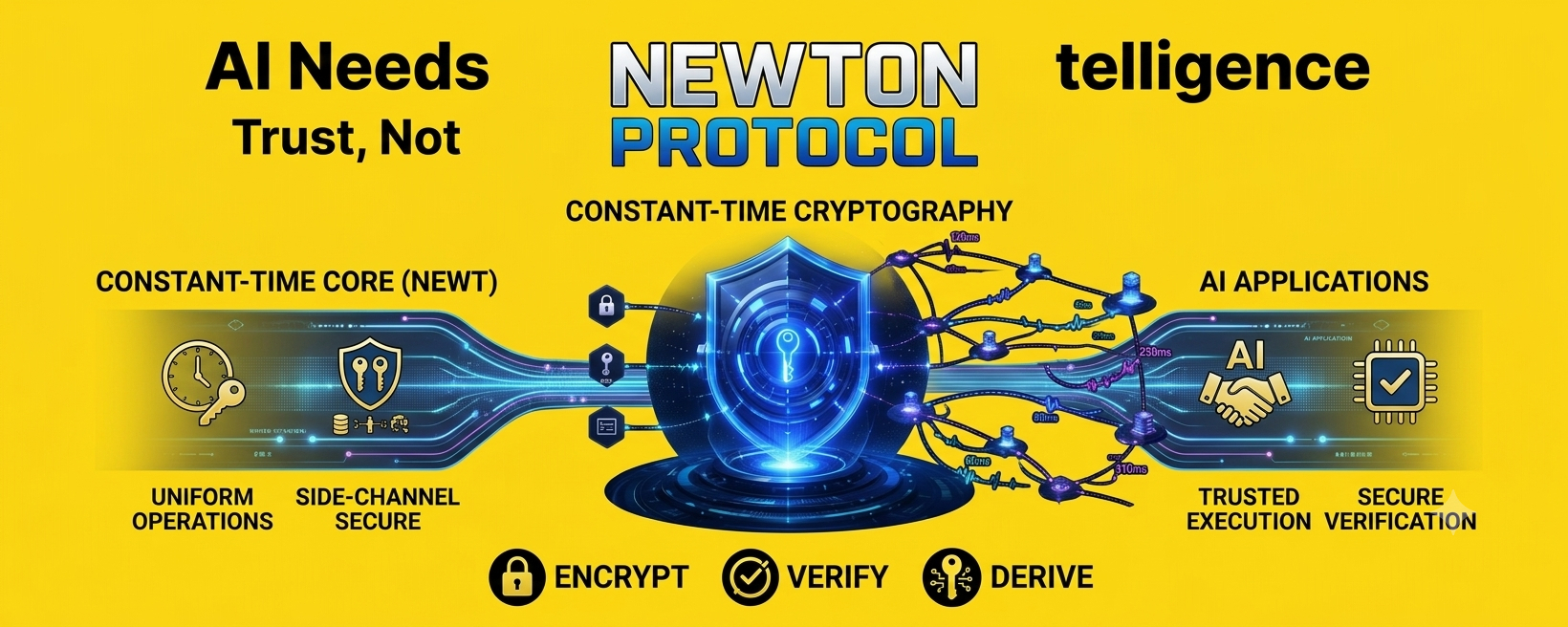
The protocol relies on audited constant-time implementations for cryptographic primitives such as secp256k1, Ed25519, X25519, and HPKE. Their purpose isn't simply efficient execution. Their real objective is to ensure that cryptographic operations don't reveal sensitive key material through measurable timing differences.
That may sound like a subtle engineering detail.
In reality, it's one of the strongest forms of defensive design.
If the execution time of a cryptographic operation changes depending on a secret key, an attacker collecting enough timing samples could gradually extract information that should remain permanently hidden.
Constant-time implementations are specifically designed to eliminate that relationship.
The result is a far stronger security boundary around the protocol's most sensitive operations.
This is where Newton's design philosophy becomes interesting.
Rather than expecting higher-level application logic to compensate for cryptographic weaknesses, the protocol strengthens security at the foundation itself.
But while reading further, another observation became impossible to ignore.
Constant-time cryptography is not the same as constant-time infrastructure.
Newton never suggests otherwise.
Its documentation explains that end-to-end request latency is influenced primarily by policy evaluation, network communication, data retrieval, and workflow complexity. The cryptographic operations themselves typically complete within microseconds or low-millisecond ranges on standard hardware, making them only a small part of the overall execution time.
That distinction changes the conversation.
A timing variation inside a cryptographic algorithm can become a security risk because it may expose secret material.
A timing variation across an application's full execution path is different. It often reflects the amount of computation, policy processing, database access, or coordination required to complete a request.
Those are fundamentally different problems.
One concerns the confidentiality of cryptographic secrets.
The other concerns what an outside observer might infer from system behaviour over time.
That difference deserves far more attention than it receives.
Even with perfectly protected cryptographic operations, applications can still exhibit observable response patterns. Different authorization paths, policy complexity, or backend workloads may naturally require different processing times.
Newton doesn't present these behaviours as vulnerabilities.
Nor should it.
They represent broader architectural considerations that exist across modern distributed systems, not weaknesses unique to Newton.
This is why I believe Newton's security model is both realistic and technically mature.
It focuses on solving the problems cryptography is meant to solve while avoiding exaggerated claims about making every layer of the system indistinguishable.
That's an important distinction.
Strong security isn't about pretending every request behaves identically.
It's about ensuring that the operations responsible for protecting sensitive secrets remain mathematically and operationally resistant to information leakage.
From there, application developers can evaluate whether broader response-time patterns reveal anything meaningful within their own systems.
To me, that's the bigger lesson.
Security isn't achieved through a single mechanism.
It's built by understanding where information can leak, reducing unnecessary exposure at every layer, and recognising that different risks require different defences.
Newton's constant-time cryptography establishes a strong boundary around sensitive key operations.
The next challenge belongs to developers: deciding whether the behaviour of their complete applications reveals more than they intend.
Question for the community:
As AI agents and autonomous financial systems become more common, should developers focus only on protecting cryptographic operations, or will analysing application-level timing behaviour become just as important for building truly trustworthy infrastructure?
🗳️ What's Your Opinion?
$NEWT #Newt @NewtonProtocol
The Security Signal Most People Ignore Isn't the Data—It's the Time
#Newton The deeper I explored Newton Protocol's architecture, the more one idea stood out:
Sometimes the most valuable information isn't hidden in the data itself—it's hidden in how long a system takes to respond.
Latency is usually discussed as a performance metric. Faster execution, lower delays, better user experience.
Newton's documentation reveals another dimension entirely.
It treats timing as part of the protocol's security model.
The protocol relies on audited constant-time implementations for cryptographic primitives such as secp256k1, Ed25519, X25519, and HPKE. Their purpose isn't simply efficient execution. Their real objective is to ensure that cryptographic operations don't reveal sensitive key material through measurable timing differences.
That may sound like a subtle engineering detail.
In reality, it's one of the strongest forms of defensive design.
If the execution time of a cryptographic operation changes depending on a secret key, an attacker collecting enough timing samples could gradually extract information that should remain permanently hidden.
Constant-time implementations are specifically designed to eliminate that relationship.
The result is a far stronger security boundary around the protocol's most sensitive operations.
This is where Newton's design philosophy becomes interesting.
Rather than expecting higher-level application logic to compensate for cryptographic weaknesses, the protocol strengthens security at the foundation itself.
But while reading further, another observation became impossible to ignore.
Constant-time cryptography is not the same as constant-time infrastructure.
Newton never suggests otherwise.
Its documentation explains that end-to-end request latency is influenced primarily by policy evaluation, network communication, data retrieval, and workflow complexity. The cryptographic operations themselves typically complete within microseconds or low-millisecond ranges on standard hardware, making them only a small part of the overall execution time.
That distinction changes the conversation.
A timing variation inside a cryptographic algorithm can become a security risk because it may expose secret material.
A timing variation across an application's full execution path is different. It often reflects the amount of computation, policy processing, database access, or coordination required to complete a request.
Those are fundamentally different problems.
One concerns the confidentiality of cryptographic secrets.
The other concerns what an outside observer might infer from system behaviour over time.
That difference deserves far more attention than it receives.
Even with perfectly protected cryptographic operations, applications can still exhibit observable response patterns. Different authorization paths, policy complexity, or backend workloads may naturally require different processing times.
Newton doesn't present these behaviours as vulnerabilities.
Nor should it.
They represent broader architectural considerations that exist across modern distributed systems, not weaknesses unique to Newton.
This is why I believe Newton's security model is both realistic and technically mature.
It focuses on solving the problems cryptography is meant to solve while avoiding exaggerated claims about making every layer of the system indistinguishable.
That's an important distinction.
Strong security isn't about pretending every request behaves identically.
It's about ensuring that the operations responsible for protecting sensitive secrets remain mathematically and operationally resistant to information leakage.
From there, application developers can evaluate whether broader response-time patterns reveal anything meaningful within their own systems.
To me, that's the bigger lesson.
Security isn't achieved through a single mechanism.
It's built by understanding where information can leak, reducing unnecessary exposure at every layer, and recognising that different risks require different defences.
Newton's constant-time cryptography establishes a strong boundary around sensitive key operations.
The next challenge belongs to developers: deciding whether the behaviour of their complete applications reveals more than they intend.
Question for the community:
As AI agents and autonomous financial systems become more common, should developers focus only on protecting cryptographic operations, or will analysing application-level timing behaviour become just as important for building truly trustworthy infrastructure?
🗳️ What's Your Opinion?
$NEWT #Newt @NewtonProtocol
Sometimes the most valuable information isn't hidden in the data itself—it's hidden in how long a system takes to respond.
Latency is usually discussed as a performance metric. Faster execution, lower delays, better user experience.
Newton's documentation reveals another dimension entirely.
It treats timing as part of the protocol's security model.
The protocol relies on audited constant-time implementations for cryptographic primitives such as secp256k1, Ed25519, X25519, and HPKE. Their purpose isn't simply efficient execution. Their real objective is to ensure that cryptographic operations don't reveal sensitive key material through measurable timing differences.
That may sound like a subtle engineering detail.
In reality, it's one of the strongest forms of defensive design.
If the execution time of a cryptographic operation changes depending on a secret key, an attacker collecting enough timing samples could gradually extract information that should remain permanently hidden.
Constant-time implementations are specifically designed to eliminate that relationship.
The result is a far stronger security boundary around the protocol's most sensitive operations.
This is where Newton's design philosophy becomes interesting.
Rather than expecting higher-level application logic to compensate for cryptographic weaknesses, the protocol strengthens security at the foundation itself.
But while reading further, another observation became impossible to ignore.
Constant-time cryptography is not the same as constant-time infrastructure.
Newton never suggests otherwise.
Its documentation explains that end-to-end request latency is influenced primarily by policy evaluation, network communication, data retrieval, and workflow complexity. The cryptographic operations themselves typically complete within microseconds or low-millisecond ranges on standard hardware, making them only a small part of the overall execution time.
That distinction changes the conversation.
A timing variation inside a cryptographic algorithm can become a security risk because it may expose secret material.
A timing variation across an application's full execution path is different. It often reflects the amount of computation, policy processing, database access, or coordination required to complete a request.
Those are fundamentally different problems.
One concerns the confidentiality of cryptographic secrets.
The other concerns what an outside observer might infer from system behaviour over time.
That difference deserves far more attention than it receives.
Even with perfectly protected cryptographic operations, applications can still exhibit observable response patterns. Different authorization paths, policy complexity, or backend workloads may naturally require different processing times.
Newton doesn't present these behaviours as vulnerabilities.
Nor should it.
They represent broader architectural considerations that exist across modern distributed systems, not weaknesses unique to Newton.
This is why I believe Newton's security model is both realistic and technically mature.
It focuses on solving the problems cryptography is meant to solve while avoiding exaggerated claims about making every layer of the system indistinguishable.
That's an important distinction.
Strong security isn't about pretending every request behaves identically.
It's about ensuring that the operations responsible for protecting sensitive secrets remain mathematically and operationally resistant to information leakage.
From there, application developers can evaluate whether broader response-time patterns reveal anything meaningful within their own systems.
To me, that's the bigger lesson.
Security isn't achieved through a single mechanism.
It's built by understanding where information can leak, reducing unnecessary exposure at every layer, and recognising that different risks require different defences.
Newton's constant-time cryptography establishes a strong boundary around sensitive key operations.
The next challenge belongs to developers: deciding whether the behaviour of their complete applications reveals more than they intend.
Question for the community:
As AI agents and autonomous financial systems become more common, should developers focus only on protecting cryptographic operations, or will analysing application-level timing behaviour become just as important for building truly trustworthy infrastructure?
🗳️ What's Your Opinion?
$NEWT #Newt @NewtonProtocol
20
1
86


Article
@NewtonprotocolThe launch of the Newton Mainnet Beta is an exciting milestone for the decentralized ecosystem. It represents more than just another blockchain release—it is an opportunity to test real infrastructure, improve network performance, and strengthen community participation before full-scale adoption. I appreciate how @NewtonProtocol l is encouraging users and developers to explore the beta, provide feedback, and help refine the network through real-world testing.
The vision behind Newton Protocol focuses on creating a more efficient and accessible decentralized environment where innovation can continue to grow. Community involvement during the Mainnet Beta is especially important because every participant contributes valuable insights that can improve stability, security, and usability.
As the ecosystem develops, I look forward to seeing more applications, integrations, and developer activity built around the network. The success of any blockchain depends on both strong technology and an active community, and Newton Protocol appears to be building both.
If you're interested in following the project's progress, keep an eye on @NewtonProtocol for the latest updates, announcements, and opportunities to participate. I'm excited to watch how the ecosystem evolves and how $NEWT supports the growth of the network.
#newton
@Newtonprotocol
The launch of the Newton Mainnet Beta is an exciting milestone for the decentralized ecosystem. It represents more than just another blockchain release—it is an opportunity to test real infrastructure, improve network performance, and strengthen community participation before full-scale adoption. I appreciate how @NewtonProtocol l is encouraging users and developers to explore the beta, provide feedback, and help refine the network through real-world testing.
The vision behind Newton Protocol focuses on creating a more efficient and accessible decentralized environment where innovation can continue to grow. Community involvement during the Mainnet Beta is especially important because every participant contributes valuable insights that can improve stability, security, and usability.
As the ecosystem develops, I look forward to seeing more applications, integrations, and developer activity built around the network. The success of any blockchain depends on both strong technology and an active community, and Newton Protocol appears to be building both.
If you're interested in following the project's progress, keep an eye on @NewtonProtocol for the latest updates, announcements, and opportunities to participate. I'm excited to watch how the ecosystem evolves and how $NEWT supports the growth of the network.
#newton
The vision behind Newton Protocol focuses on creating a more efficient and accessible decentralized environment where innovation can continue to grow. Community involvement during the Mainnet Beta is especially important because every participant contributes valuable insights that can improve stability, security, and usability.
As the ecosystem develops, I look forward to seeing more applications, integrations, and developer activity built around the network. The success of any blockchain depends on both strong technology and an active community, and Newton Protocol appears to be building both.
If you're interested in following the project's progress, keep an eye on @NewtonProtocol for the latest updates, announcements, and opportunities to participate. I'm excited to watch how the ecosystem evolves and how $NEWT supports the growth of the network.
#newton
29


Article
Exploring Newton Protocol and the Value of the Mainnet BetaExploring Newton Protocol and the Value of the Mainnet Beta
The launch of the Newton Mainnet Beta is an exciting step toward building a more secure and practical future for AI-powered applications. @NewtonProtocol is working to create an ecosystem where AI agents can operate with greater transparency, verifiable actions, and stronger security. The Mainnet Beta gives developers and community members an opportunity to explore new features, test real-world use cases, and provide valuable feedback that can help improve the network before wider adoption. I believe projects that combine blockchain technology with trustworthy AI infrastructure have strong long-term potential. It will be interesting to see how the ecosystem grows and how the community contributes to its development. Looking forward to following future updates and innovations from the team. $NEWT #newton @NewtonProtocol
Exploring Newton Protocol and the Value of the Mainnet Beta
Exploring Newton Protocol and the Value of the Mainnet Beta
The launch of the Newton Mainnet Beta is an exciting step toward building a more secure and practical future for AI-powered applications. @NewtonProtocol is working to create an ecosystem where AI agents can operate with greater transparency, verifiable actions, and stronger security. The Mainnet Beta gives developers and community members an opportunity to explore new features, test real-world use cases, and provide valuable feedback that can help improve the network before wider adoption. I believe projects that combine blockchain technology with trustworthy AI infrastructure have strong long-term potential. It will be interesting to see how the ecosystem grows and how the community contributes to its development. Looking forward to following future updates and innovations from the team. $NEWT #newton @NewtonProtocol
The launch of the Newton Mainnet Beta is an exciting step toward building a more secure and practical future for AI-powered applications. @NewtonProtocol is working to create an ecosystem where AI agents can operate with greater transparency, verifiable actions, and stronger security. The Mainnet Beta gives developers and community members an opportunity to explore new features, test real-world use cases, and provide valuable feedback that can help improve the network before wider adoption. I believe projects that combine blockchain technology with trustworthy AI infrastructure have strong long-term potential. It will be interesting to see how the ecosystem grows and how the community contributes to its development. Looking forward to following future updates and innovations from the team. $NEWT #newton @NewtonProtocol
27

·
--
Newton In topExcited to see the progress of @NewtonProtocol and the launch of the Newton Mainnet Beta. The project is focused on building a decentralized infrastructure that gives users more control while supporting secure and scalable on-chain applications. Looking forward to seeing the ecosystem grow and how developers and the community contribute to its future. $NEWT #Newt $NEWT The launch of the Newton Mainnet Beta is an exciting milestone for @NewtonProtocol and the broader Web3 ecosystem. As blockchain technology continues to evolve, users and developers are looking for networks that are secure, scalable, efficient, and easy to build on. Newton Protocol aims to address these needs by creating a decentralized infrastructure designed for the next generation of blockchain applications.
The Mainnet Beta represents an important step in the project's development. It allows the community to experience the network in a live environment while helping the team test performance, improve stability, and gather valuable feedback. A successful beta phase is essential because it enables developers to identify areas for improvement before the network reaches full maturity.
One of the most interesting aspects of Newton Protocol is its focus on building an ecosystem where developers can create decentralized applications with greater confidence. A reliable blockchain network is not only about speed but also about security, transparency, and long-term sustainability. These qualities are becoming increasingly important as more users and businesses explore blockchain technology.
Community participation is another key factor behind the success of Newton Protocol. During the Mainnet Beta, users have the opportunity to explore the network, learn about its features, and contribute feedback that can help shape future updates. This collaborative approach strengthens the ecosystem and encourages innovation from both developers and community members.
The native token, $NEWT, plays an important role within the Newton ecosystem. As the project grows, the token is expected to support various activities across the network while encouraging participation from users and builders. A healthy ecosystem depends on active engagement, and the continued development of Newton Protocol could create new opportunities for everyone involved.
The blockchain industry is becoming increasingly competitive, with many projects introducing new technologies and solutions. What makes Newton Protocol worth watching is its commitment to continuous improvement and the steady rollout of important milestones such as the Mainnet Beta. Strong technology combined with an active community often creates the foundation for long-term success.
As adoption of decentralized technologies continues to increase, projects that focus on usability, performance, and security will have greater opportunities to stand out. Newton Protocol appears to be moving in that direction by building a network that supports developers while remaining accessible to users. The Mainnet Beta is only the beginning, and it will be interesting to follow the project's progress as new features and improvements are introduced.
I look forward to seeing how @NewtonProtocol continues to expand its ecosystem, attract developers, and strengthen community participation. Every successful blockchain starts with a solid foundation, and the Mainnet Beta is an important milestone on that journey. Best wishes to the entire Newton community as they continue building the future of decentralized technolog$y. $NEWT #Newt #Newton
Newton In top
Excited to see the progress of @NewtonProtocol and the launch of the Newton Mainnet Beta. The project is focused on building a decentralized infrastructure that gives users more control while supporting secure and scalable on-chain applications. Looking forward to seeing the ecosystem grow and how developers and the community contribute to its future. $NEWT #Newt $NEWT The launch of the Newton Mainnet Beta is an exciting milestone for @NewtonProtocol and the broader Web3 ecosystem. As blockchain technology continues to evolve, users and developers are looking for networks that are secure, scalable, efficient, and easy to build on. Newton Protocol aims to address these needs by creating a decentralized infrastructure designed for the next generation of blockchain applications.
The Mainnet Beta represents an important step in the project's development. It allows the community to experience the network in a live environment while helping the team test performance, improve stability, and gather valuable feedback. A successful beta phase is essential because it enables developers to identify areas for improvement before the network reaches full maturity.
One of the most interesting aspects of Newton Protocol is its focus on building an ecosystem where developers can create decentralized applications with greater confidence. A reliable blockchain network is not only about speed but also about security, transparency, and long-term sustainability. These qualities are becoming increasingly important as more users and businesses explore blockchain technology.
Community participation is another key factor behind the success of Newton Protocol. During the Mainnet Beta, users have the opportunity to explore the network, learn about its features, and contribute feedback that can help shape future updates. This collaborative approach strengthens the ecosystem and encourages innovation from both developers and community members.
The native token, $NEWT , plays an important role within the Newton ecosystem. As the project grows, the token is expected to support various activities across the network while encouraging participation from users and builders. A healthy ecosystem depends on active engagement, and the continued development of Newton Protocol could create new opportunities for everyone involved.
The blockchain industry is becoming increasingly competitive, with many projects introducing new technologies and solutions. What makes Newton Protocol worth watching is its commitment to continuous improvement and the steady rollout of important milestones such as the Mainnet Beta. Strong technology combined with an active community often creates the foundation for long-term success.
As adoption of decentralized technologies continues to increase, projects that focus on usability, performance, and security will have greater opportunities to stand out. Newton Protocol appears to be moving in that direction by building a network that supports developers while remaining accessible to users. The Mainnet Beta is only the beginning, and it will be interesting to follow the project's progress as new features and improvements are introduced.
I look forward to seeing how @NewtonProtocol continues to expand its ecosystem, attract developers, and strengthen community participation. Every successful blockchain starts with a solid foundation, and the Mainnet Beta is an important milestone on that journey. Best wishes to the entire Newton community as they continue building the future of decentralized technolog$y. $NEWT #Newt #Newton
The Mainnet Beta represents an important step in the project's development. It allows the community to experience the network in a live environment while helping the team test performance, improve stability, and gather valuable feedback. A successful beta phase is essential because it enables developers to identify areas for improvement before the network reaches full maturity.
One of the most interesting aspects of Newton Protocol is its focus on building an ecosystem where developers can create decentralized applications with greater confidence. A reliable blockchain network is not only about speed but also about security, transparency, and long-term sustainability. These qualities are becoming increasingly important as more users and businesses explore blockchain technology.
Community participation is another key factor behind the success of Newton Protocol. During the Mainnet Beta, users have the opportunity to explore the network, learn about its features, and contribute feedback that can help shape future updates. This collaborative approach strengthens the ecosystem and encourages innovation from both developers and community members.
The native token, $NEWT , plays an important role within the Newton ecosystem. As the project grows, the token is expected to support various activities across the network while encouraging participation from users and builders. A healthy ecosystem depends on active engagement, and the continued development of Newton Protocol could create new opportunities for everyone involved.
The blockchain industry is becoming increasingly competitive, with many projects introducing new technologies and solutions. What makes Newton Protocol worth watching is its commitment to continuous improvement and the steady rollout of important milestones such as the Mainnet Beta. Strong technology combined with an active community often creates the foundation for long-term success.
As adoption of decentralized technologies continues to increase, projects that focus on usability, performance, and security will have greater opportunities to stand out. Newton Protocol appears to be moving in that direction by building a network that supports developers while remaining accessible to users. The Mainnet Beta is only the beginning, and it will be interesting to follow the project's progress as new features and improvements are introduced.
I look forward to seeing how @NewtonProtocol continues to expand its ecosystem, attract developers, and strengthen community participation. Every successful blockchain starts with a solid foundation, and the Mainnet Beta is an important milestone on that journey. Best wishes to the entire Newton community as they continue building the future of decentralized technolog$y. $NEWT #Newt #Newton
3

·
--
Newton Protocol Mainnet Beta: A New Era for Decentralized DataThe launch of the @NewtonProtocol Mainnet Beta marks an exciting step forward for the Web3 ecosystem. As blockchain technology continues to evolve, the need for accurate, secure, and decentralized real-world data is becoming more important than ever. Newton Protocol is working to solve this challenge by building a decentralized oracle network that connects blockchain applications with trusted external data sources.
The Mainnet Beta allows developers and community members to experience the network in a real environment while helping improve performance before wider adoption. This stage is important because it provides valuable feedback, enhances network security, and strengthens the overall ecosystem.
The $NEWT token plays a key role in the Newton Protocol ecosystem. It is designed to support network participation, incentivize contributors, and help maintain a transparent and decentralized infrastructure. As the ecosystem grows, $NEWT has the potential to become an important part of the protocol's long-term development.
One of the biggest advantages of Newton Protocol is its focus on transparency, reliability, and scalability. These qualities are essential for decentralized finance (DeFi), gaming, AI applications, and other Web3 projects that depend on trustworthy real-world information. By providing secure oracle services, Newton Protocol aims to reduce risks while improving the efficiency of decentralized applications.
I believe the Mainnet Beta is an important milestone that demonstrates the team's commitment to innovation and community-driven development. It will be interesting to watch how developers build on the platform and how the ecosystem expands over time.#newton
Newton Protocol Mainnet Beta: A New Era for Decentralized Data
The launch of the @NewtonProtocol Mainnet Beta marks an exciting step forward for the Web3 ecosystem. As blockchain technology continues to evolve, the need for accurate, secure, and decentralized real-world data is becoming more important than ever. Newton Protocol is working to solve this challenge by building a decentralized oracle network that connects blockchain applications with trusted external data sources.
The Mainnet Beta allows developers and community members to experience the network in a real environment while helping improve performance before wider adoption. This stage is important because it provides valuable feedback, enhances network security, and strengthens the overall ecosystem.
The $NEWT token plays a key role in the Newton Protocol ecosystem. It is designed to support network participation, incentivize contributors, and help maintain a transparent and decentralized infrastructure. As the ecosystem grows, $NEWT has the potential to become an important part of the protocol's long-term development.
One of the biggest advantages of Newton Protocol is its focus on transparency, reliability, and scalability. These qualities are essential for decentralized finance (DeFi), gaming, AI applications, and other Web3 projects that depend on trustworthy real-world information. By providing secure oracle services, Newton Protocol aims to reduce risks while improving the efficiency of decentralized applications.
I believe the Mainnet Beta is an important milestone that demonstrates the team's commitment to innovation and community-driven development. It will be interesting to watch how developers build on the platform and how the ecosystem expands over time.#newton
The Mainnet Beta allows developers and community members to experience the network in a real environment while helping improve performance before wider adoption. This stage is important because it provides valuable feedback, enhances network security, and strengthens the overall ecosystem.
The $NEWT token plays a key role in the Newton Protocol ecosystem. It is designed to support network participation, incentivize contributors, and help maintain a transparent and decentralized infrastructure. As the ecosystem grows, $NEWT has the potential to become an important part of the protocol's long-term development.
One of the biggest advantages of Newton Protocol is its focus on transparency, reliability, and scalability. These qualities are essential for decentralized finance (DeFi), gaming, AI applications, and other Web3 projects that depend on trustworthy real-world information. By providing secure oracle services, Newton Protocol aims to reduce risks while improving the efficiency of decentralized applications.
I believe the Mainnet Beta is an important milestone that demonstrates the team's commitment to innovation and community-driven development. It will be interesting to watch how developers build on the platform and how the ecosystem expands over time.#newton
70
Article
Newton Protocol (NEWT): The Real Problem Isn't Making AI Smarter—It's Teaching It When to StopI've spent enough time around crypto to notice a pattern. Every few months, someone promises that artificial intelligence is about to transform finance. The pitch changes, the branding changes, the token changes, but the promise is usually the same: let AI do the hard work while you sit back.
On paper, it sounds wonderful.
Then reality shows up.
The moment you allow software to touch your money, the conversation changes completely. I don't care how intelligent an AI model is if it can accidentally approve the wrong transaction, chase a bad trading signal, or make a decision I never wanted it to make. Intelligence isn't the first question anymore. Trust is.
That's the problem Newton Protocol is trying to tackle, and, honestly, it's a far more interesting problem than simply building another AI product.
Most people think the future of AI in finance is about finding the next profitable trade before everyone else. I think that's the easy part. The harder challenge is figuring out how to let AI work for you without quietly handing it the keys to everything you own.
Picture this.
You hire a personal financial assistant. They're brilliant. They never sleep. They can monitor thousands of markets at once. They notice opportunities before any human possibly could.
Would you give that person unrestricted access to every bank account you own?
Probably not.
You'd create rules.
Maybe they can move money between two accounts but can't withdraw it. Maybe they can recommend investments but can't execute them without approval. Maybe every action they take gets recorded so you can check it later.
That's not because you assume they'll steal from you.
It's because smart people make mistakes too.
AI is no different.
I've watched enough crypto projects over the years to know that the industry often becomes obsessed with capability while almost ignoring accountability. Everyone wants faster automation. Smarter algorithms. Bigger datasets.
Very few stop to ask what happens when those systems inevitably get something wrong.
Newton Protocol starts from that uncomfortable question instead of pretending it doesn't exist.
Its entire philosophy feels less like building a genius trader and more like building a very disciplined employee.
That difference matters.
If you've ever used an AI assistant, you've probably experienced moments where it confidently produced an answer that sounded perfect... until you realized it was completely wrong. Sometimes that's funny.
When money is involved, it isn't funny anymore.
A single incorrect transaction on a blockchain usually can't be reversed with a customer support phone call. There isn't a manager waiting to refund a mistaken transfer because the AI misunderstood your instructions.
That's why the usual "AI can automate everything" narrative has always felt incomplete to me.
Automation without guardrails isn't freedom.
It's risk.
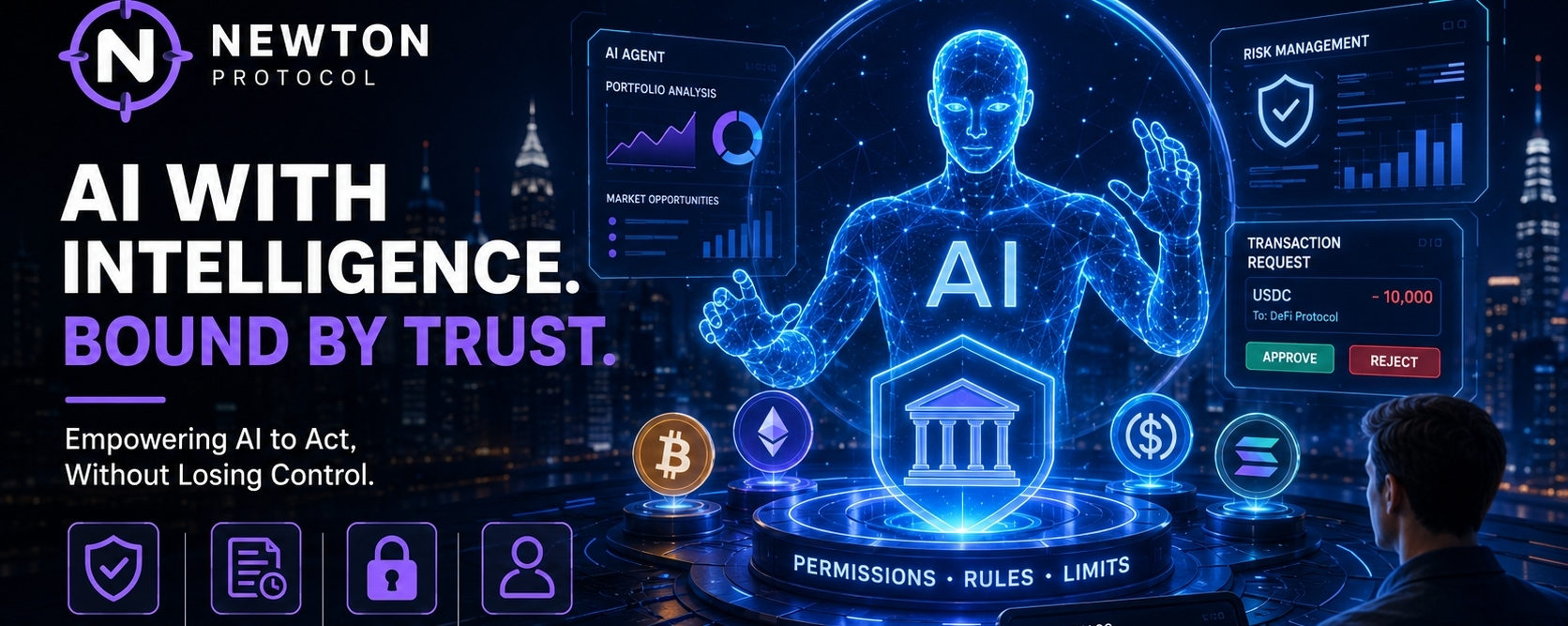
Newton Protocol attempts to solve this by creating an environment where AI operates inside clearly defined boundaries rather than unlimited authority.
Think about the cruise control in your car.
It's incredibly useful.
But cruise control doesn't suddenly decide your destination should change because traffic looks lighter somewhere else. It follows the limits you've already chosen. You're still responsible. You're still in control.
Financial AI needs that same relationship with users.
Not blind independence.
Disciplined assistance.
The crypto industry has another problem that rarely gets enough attention.
Nothing ever closes.
Traditional stock markets eventually ring the closing bell. Traders go home. Banks shut their doors for the evening.
Crypto doesn't.
Prices move at three in the morning.
Markets react on holidays.
Opportunities disappear while you're asleep.
That's exactly why AI is becoming so attractive in this space. Machines don't need coffee breaks. They don't panic during market crashes. They don't get tired after staring at charts for twelve hours.
But there's a trade-off hiding underneath all that convenience.
Every bit of automation also increases the amount of trust you're placing in software.
That's where Newton's approach becomes interesting.
Rather than asking users to trust AI because it's intelligent, it asks them to trust the system because the AI is restricted.
Those aren't the same thing.
It's the difference between hiring an incredibly talented chef and locking the medicine cabinet before they start cooking.
One is about skill.
The other is about sensible precautions.
There's another layer to the project that deserves attention.
Newton also wants developers to build AI-powered financial applications on top of its infrastructure.
If that sounds abstract, think about your smartphone.
Thousands of apps exist because Apple and Google created secure operating systems developers could build on.
Every developer didn't have to invent mobile security from scratch.
Newton is trying to create something similar for AI in crypto.
Instead of every team independently solving questions like permission management, verification, or execution security, developers could build specialized AI tools on top of a common foundation.
At least, that's the vision.
Whether it actually plays out that way is another story.
Crypto has never been short on ambitious visions.
Execution has always been the harder part.
Competition is another obstacle.
Artificial intelligence is currently the hottest trend in technology, which means nearly every blockchain wants to attach itself to the narrative somehow. Some projects genuinely solve meaningful problems.
Others simply add "AI" to the homepage and hope investors stop asking difficult questions.
Newton will eventually have to prove it's solving a problem people actually care about—not just riding a popular buzzword.
That proof won't come from whitepapers.
It'll come from adoption.
Developers have to build useful products.
Users have to trust those products.
Real transactions need to happen consistently over time.
Until then, every promise remains exactly that—a promise.
Something else is worth mentioning because it often gets lost during crypto discussions.
A good project doesn't automatically mean a good investment.
People confuse those ideas all the time.
I've seen excellent technology disappear because nobody adopted it. I've also watched mediocre products attract enormous valuations simply because market sentiment turned irrational.
Technology and token prices live in related worlds, but they don't always move together.
That's an uncomfortable truth many investors learn the expensive way.
Still, I think Newton is asking one of the more important questions facing this industry.
Not "How can AI replace people?"
Instead...
"How can AI help people without quietly taking away their control?"
That feels like the conversation we should have been having all along.
If artificial intelligence eventually becomes responsible for managing portfolios, executing trades, handling payments, negotiating contracts, or interacting with decentralized financial systems, then security won't be a feature.
It'll be the entire product.
The smartest AI in the world isn't particularly useful if nobody feels comfortable trusting it with real assets.
That's why Newton Protocol caught my attention.
Not because it promises magical returns.
Not because it claims AI will solve every financial problem overnight.
But because it starts with a far less glamorous idea that may end up being much more valuable.
Before we teach machines how to make decisions with our money, we probably need to teach them where their authority ends.
That doesn't sound flashy.
It does sound necessary.
$NEWT #Newt #newton @NewtonProtocol
Newton Protocol (NEWT): The Real Problem Isn't Making AI Smarter—It's Teaching It When to Stop
I've spent enough time around crypto to notice a pattern. Every few months, someone promises that artificial intelligence is about to transform finance. The pitch changes, the branding changes, the token changes, but the promise is usually the same: let AI do the hard work while you sit back.
On paper, it sounds wonderful.
Then reality shows up.
The moment you allow software to touch your money, the conversation changes completely. I don't care how intelligent an AI model is if it can accidentally approve the wrong transaction, chase a bad trading signal, or make a decision I never wanted it to make. Intelligence isn't the first question anymore. Trust is.
That's the problem Newton Protocol is trying to tackle, and, honestly, it's a far more interesting problem than simply building another AI product.
Most people think the future of AI in finance is about finding the next profitable trade before everyone else. I think that's the easy part. The harder challenge is figuring out how to let AI work for you without quietly handing it the keys to everything you own.
Picture this.
You hire a personal financial assistant. They're brilliant. They never sleep. They can monitor thousands of markets at once. They notice opportunities before any human possibly could.
Would you give that person unrestricted access to every bank account you own?
Probably not.
You'd create rules.
Maybe they can move money between two accounts but can't withdraw it. Maybe they can recommend investments but can't execute them without approval. Maybe every action they take gets recorded so you can check it later.
That's not because you assume they'll steal from you.
It's because smart people make mistakes too.
AI is no different.
I've watched enough crypto projects over the years to know that the industry often becomes obsessed with capability while almost ignoring accountability. Everyone wants faster automation. Smarter algorithms. Bigger datasets.
Very few stop to ask what happens when those systems inevitably get something wrong.
Newton Protocol starts from that uncomfortable question instead of pretending it doesn't exist.
Its entire philosophy feels less like building a genius trader and more like building a very disciplined employee.
That difference matters.
If you've ever used an AI assistant, you've probably experienced moments where it confidently produced an answer that sounded perfect... until you realized it was completely wrong. Sometimes that's funny.
When money is involved, it isn't funny anymore.
A single incorrect transaction on a blockchain usually can't be reversed with a customer support phone call. There isn't a manager waiting to refund a mistaken transfer because the AI misunderstood your instructions.
That's why the usual "AI can automate everything" narrative has always felt incomplete to me.
Automation without guardrails isn't freedom.
It's risk.
Newton Protocol attempts to solve this by creating an environment where AI operates inside clearly defined boundaries rather than unlimited authority.
Think about the cruise control in your car.
It's incredibly useful.
But cruise control doesn't suddenly decide your destination should change because traffic looks lighter somewhere else. It follows the limits you've already chosen. You're still responsible. You're still in control.
Financial AI needs that same relationship with users.
Not blind independence.
Disciplined assistance.
The crypto industry has another problem that rarely gets enough attention.
Nothing ever closes.
Traditional stock markets eventually ring the closing bell. Traders go home. Banks shut their doors for the evening.
Crypto doesn't.
Prices move at three in the morning.
Markets react on holidays.
Opportunities disappear while you're asleep.
That's exactly why AI is becoming so attractive in this space. Machines don't need coffee breaks. They don't panic during market crashes. They don't get tired after staring at charts for twelve hours.
But there's a trade-off hiding underneath all that convenience.
Every bit of automation also increases the amount of trust you're placing in software.
That's where Newton's approach becomes interesting.
Rather than asking users to trust AI because it's intelligent, it asks them to trust the system because the AI is restricted.
Those aren't the same thing.
It's the difference between hiring an incredibly talented chef and locking the medicine cabinet before they start cooking.
One is about skill.
The other is about sensible precautions.
There's another layer to the project that deserves attention.
Newton also wants developers to build AI-powered financial applications on top of its infrastructure.
If that sounds abstract, think about your smartphone.
Thousands of apps exist because Apple and Google created secure operating systems developers could build on.
Every developer didn't have to invent mobile security from scratch.
Newton is trying to create something similar for AI in crypto.
Instead of every team independently solving questions like permission management, verification, or execution security, developers could build specialized AI tools on top of a common foundation.
At least, that's the vision.
Whether it actually plays out that way is another story.
Crypto has never been short on ambitious visions.
Execution has always been the harder part.
Competition is another obstacle.
Artificial intelligence is currently the hottest trend in technology, which means nearly every blockchain wants to attach itself to the narrative somehow. Some projects genuinely solve meaningful problems.
Others simply add "AI" to the homepage and hope investors stop asking difficult questions.
Newton will eventually have to prove it's solving a problem people actually care about—not just riding a popular buzzword.
That proof won't come from whitepapers.
It'll come from adoption.
Developers have to build useful products.
Users have to trust those products.
Real transactions need to happen consistently over time.
Until then, every promise remains exactly that—a promise.
Something else is worth mentioning because it often gets lost during crypto discussions.
A good project doesn't automatically mean a good investment.
People confuse those ideas all the time.
I've seen excellent technology disappear because nobody adopted it. I've also watched mediocre products attract enormous valuations simply because market sentiment turned irrational.
Technology and token prices live in related worlds, but they don't always move together.
That's an uncomfortable truth many investors learn the expensive way.
Still, I think Newton is asking one of the more important questions facing this industry.
Not "How can AI replace people?"
Instead...
"How can AI help people without quietly taking away their control?"
That feels like the conversation we should have been having all along.
If artificial intelligence eventually becomes responsible for managing portfolios, executing trades, handling payments, negotiating contracts, or interacting with decentralized financial systems, then security won't be a feature.
It'll be the entire product.
The smartest AI in the world isn't particularly useful if nobody feels comfortable trusting it with real assets.
That's why Newton Protocol caught my attention.
Not because it promises magical returns.
Not because it claims AI will solve every financial problem overnight.
But because it starts with a far less glamorous idea that may end up being much more valuable.
Before we teach machines how to make decisions with our money, we probably need to teach them where their authority ends.
That doesn't sound flashy.
It does sound necessary.
$NEWT #Newt #newton @NewtonProtocol
On paper, it sounds wonderful.
Then reality shows up.
The moment you allow software to touch your money, the conversation changes completely. I don't care how intelligent an AI model is if it can accidentally approve the wrong transaction, chase a bad trading signal, or make a decision I never wanted it to make. Intelligence isn't the first question anymore. Trust is.
That's the problem Newton Protocol is trying to tackle, and, honestly, it's a far more interesting problem than simply building another AI product.
Most people think the future of AI in finance is about finding the next profitable trade before everyone else. I think that's the easy part. The harder challenge is figuring out how to let AI work for you without quietly handing it the keys to everything you own.
Picture this.
You hire a personal financial assistant. They're brilliant. They never sleep. They can monitor thousands of markets at once. They notice opportunities before any human possibly could.
Would you give that person unrestricted access to every bank account you own?
Probably not.
You'd create rules.
Maybe they can move money between two accounts but can't withdraw it. Maybe they can recommend investments but can't execute them without approval. Maybe every action they take gets recorded so you can check it later.
That's not because you assume they'll steal from you.
It's because smart people make mistakes too.
AI is no different.
I've watched enough crypto projects over the years to know that the industry often becomes obsessed with capability while almost ignoring accountability. Everyone wants faster automation. Smarter algorithms. Bigger datasets.
Very few stop to ask what happens when those systems inevitably get something wrong.
Newton Protocol starts from that uncomfortable question instead of pretending it doesn't exist.
Its entire philosophy feels less like building a genius trader and more like building a very disciplined employee.
That difference matters.
If you've ever used an AI assistant, you've probably experienced moments where it confidently produced an answer that sounded perfect... until you realized it was completely wrong. Sometimes that's funny.
When money is involved, it isn't funny anymore.
A single incorrect transaction on a blockchain usually can't be reversed with a customer support phone call. There isn't a manager waiting to refund a mistaken transfer because the AI misunderstood your instructions.
That's why the usual "AI can automate everything" narrative has always felt incomplete to me.
Automation without guardrails isn't freedom.
It's risk.
Newton Protocol attempts to solve this by creating an environment where AI operates inside clearly defined boundaries rather than unlimited authority.
Think about the cruise control in your car.
It's incredibly useful.
But cruise control doesn't suddenly decide your destination should change because traffic looks lighter somewhere else. It follows the limits you've already chosen. You're still responsible. You're still in control.
Financial AI needs that same relationship with users.
Not blind independence.
Disciplined assistance.
The crypto industry has another problem that rarely gets enough attention.
Nothing ever closes.
Traditional stock markets eventually ring the closing bell. Traders go home. Banks shut their doors for the evening.
Crypto doesn't.
Prices move at three in the morning.
Markets react on holidays.
Opportunities disappear while you're asleep.
That's exactly why AI is becoming so attractive in this space. Machines don't need coffee breaks. They don't panic during market crashes. They don't get tired after staring at charts for twelve hours.
But there's a trade-off hiding underneath all that convenience.
Every bit of automation also increases the amount of trust you're placing in software.
That's where Newton's approach becomes interesting.
Rather than asking users to trust AI because it's intelligent, it asks them to trust the system because the AI is restricted.
Those aren't the same thing.
It's the difference between hiring an incredibly talented chef and locking the medicine cabinet before they start cooking.
One is about skill.
The other is about sensible precautions.
There's another layer to the project that deserves attention.
Newton also wants developers to build AI-powered financial applications on top of its infrastructure.
If that sounds abstract, think about your smartphone.
Thousands of apps exist because Apple and Google created secure operating systems developers could build on.
Every developer didn't have to invent mobile security from scratch.
Newton is trying to create something similar for AI in crypto.
Instead of every team independently solving questions like permission management, verification, or execution security, developers could build specialized AI tools on top of a common foundation.
At least, that's the vision.
Whether it actually plays out that way is another story.
Crypto has never been short on ambitious visions.
Execution has always been the harder part.
Competition is another obstacle.
Artificial intelligence is currently the hottest trend in technology, which means nearly every blockchain wants to attach itself to the narrative somehow. Some projects genuinely solve meaningful problems.
Others simply add "AI" to the homepage and hope investors stop asking difficult questions.
Newton will eventually have to prove it's solving a problem people actually care about—not just riding a popular buzzword.
That proof won't come from whitepapers.
It'll come from adoption.
Developers have to build useful products.
Users have to trust those products.
Real transactions need to happen consistently over time.
Until then, every promise remains exactly that—a promise.
Something else is worth mentioning because it often gets lost during crypto discussions.
A good project doesn't automatically mean a good investment.
People confuse those ideas all the time.
I've seen excellent technology disappear because nobody adopted it. I've also watched mediocre products attract enormous valuations simply because market sentiment turned irrational.
Technology and token prices live in related worlds, but they don't always move together.
That's an uncomfortable truth many investors learn the expensive way.
Still, I think Newton is asking one of the more important questions facing this industry.
Not "How can AI replace people?"
Instead...
"How can AI help people without quietly taking away their control?"
That feels like the conversation we should have been having all along.
If artificial intelligence eventually becomes responsible for managing portfolios, executing trades, handling payments, negotiating contracts, or interacting with decentralized financial systems, then security won't be a feature.
It'll be the entire product.
The smartest AI in the world isn't particularly useful if nobody feels comfortable trusting it with real assets.
That's why Newton Protocol caught my attention.
Not because it promises magical returns.
Not because it claims AI will solve every financial problem overnight.
But because it starts with a far less glamorous idea that may end up being much more valuable.
Before we teach machines how to make decisions with our money, we probably need to teach them where their authority ends.
That doesn't sound flashy.
It does sound necessary.
$NEWT #Newt #newton @NewtonProtocol
12
2
160

·
--
Newton#newton Newton (NEWT) is a cryptocurrency project focused on building a decentralized digital economy with fast, transparent, and community-driven value exchange. Like many crypto assets, its appeal depends on adoption, utility, tokenomics, and market sentiment. Before investing, always review its latest fundamentals, trading volume, roadmap, and risks, because crypto prices can be highly volatile.
Newton
#newton Newton (NEWT) is a cryptocurrency project focused on building a decentralized digital economy with fast, transparent, and community-driven value exchange. Like many crypto assets, its appeal depends on adoption, utility, tokenomics, and market sentiment. Before investing, always review its latest fundamentals, trading volume, roadmap, and risks, because crypto prices can be highly volatile.
83

🚀 Unlocking the Future of Verifiable On-Chain Automation with Newton ProtocolThe integration of Artificial Intelligence (AI) and blockchain technology is evolving rapidly, and newton protocol is leading this revolution from the front. With the recent launch of the Newton Mainnet Beta, the protocol is introducing a powerful, decentralized infrastructure layer designed to bring trust, security, and absolute transparency to AI-driven strategies and automated trading.
What Makes Newton Protocol Unique?
Unlike traditional centralized setups where AI operations happen behind closed doors, Newton protocol operates as an Actively Validated Service (AVS). It bridges the gap between transaction intent and final on-chain execution. By utilizing specialized tools like VaultKit, developers can create advanced trading and automation models while keeping the underlying logic completely protected through zero-knowledge parameters.
Why $NEWT Matters
At the core of this innovative ecosystem is the $NEWT token. It serves as the primary utility token powering the network, facilitating protocol service fees for all authorization and verification tasks. As real-world assets (RWAs) and institutional capital continue to migrate on-chain, having a private yet completely verifiable compliance layer becomes essential.
The Newton Mainnet Beta is a massive milestone that proves secure, policy-enforced on-chain automation is no longer just a theory—it is a reality. Keep a close eye on this project as it continues to reshape Web3 infrastructure!
#newton otocol
🚀 Unlocking the Future of Verifiable On-Chain Automation with Newton Protocol
The integration of Artificial Intelligence (AI) and blockchain technology is evolving rapidly, and newton protocol is leading this revolution from the front. With the recent launch of the Newton Mainnet Beta, the protocol is introducing a powerful, decentralized infrastructure layer designed to bring trust, security, and absolute transparency to AI-driven strategies and automated trading.
What Makes Newton Protocol Unique?
Unlike traditional centralized setups where AI operations happen behind closed doors, Newton protocol operates as an Actively Validated Service (AVS). It bridges the gap between transaction intent and final on-chain execution. By utilizing specialized tools like VaultKit, developers can create advanced trading and automation models while keeping the underlying logic completely protected through zero-knowledge parameters.
Why $NEWT Matters
At the core of this innovative ecosystem is the $NEWT token. It serves as the primary utility token powering the network, facilitating protocol service fees for all authorization and verification tasks. As real-world assets (RWAs) and institutional capital continue to migrate on-chain, having a private yet completely verifiable compliance layer becomes essential.
The Newton Mainnet Beta is a massive milestone that proves secure, policy-enforced on-chain automation is no longer just a theory—it is a reality. Keep a close eye on this project as it continues to reshape Web3 infrastructure!
#newton otocol
What Makes Newton Protocol Unique?
Unlike traditional centralized setups where AI operations happen behind closed doors, Newton protocol operates as an Actively Validated Service (AVS). It bridges the gap between transaction intent and final on-chain execution. By utilizing specialized tools like VaultKit, developers can create advanced trading and automation models while keeping the underlying logic completely protected through zero-knowledge parameters.
Why $NEWT Matters
At the core of this innovative ecosystem is the $NEWT token. It serves as the primary utility token powering the network, facilitating protocol service fees for all authorization and verification tasks. As real-world assets (RWAs) and institutional capital continue to migrate on-chain, having a private yet completely verifiable compliance layer becomes essential.
The Newton Mainnet Beta is a massive milestone that proves secure, policy-enforced on-chain automation is no longer just a theory—it is a reality. Keep a close eye on this project as it continues to reshape Web3 infrastructure!
#newton otocol
2
81

·
--
Article
NEWTON PROTOCOL#NEWTON IS BEST ASSET. it's good for our future and can get your wealth to its highest peak. Everytime it gives a best example of best asset and prove it's worth. $NEWT is ALL TIME HIGH ASSET IN BEST WAY. We should give it $NEWT a chance to give a boost to our wealth and can access all time high envourmental boost. It's protocol is always good and best. We should give it a try and it's all time high asset in all good way so what are we waiting for. Invest in it and give it a shot , rest it'll do the work for us and for itself . It is the best asset ever. It's newton protocol is always best and we should be lucky to have it. $NEWT always prove itself. We should be a part of it and by this we can grow our wealth also. It is best and can easiest way to invest in. Newton protocol always come in a best way and we should give it a try. Its a good and envourmental asset.
NEWTON PROTOCOL
#NEWTON IS BEST ASSET. it's good for our future and can get your wealth to its highest peak. Everytime it gives a best example of best asset and prove it's worth. $NEWT is ALL TIME HIGH ASSET IN BEST WAY. We should give it $NEWT a chance to give a boost to our wealth and can access all time high envourmental boost. It's protocol is always good and best. We should give it a try and it's all time high asset in all good way so what are we waiting for. Invest in it and give it a shot , rest it'll do the work for us and for itself . It is the best asset ever. It's newton protocol is always best and we should be lucky to have it. $NEWT always prove itself. We should be a part of it and by this we can grow our wealth also. It is best and can easiest way to invest in. Newton protocol always come in a best way and we should give it a try. Its a good and envourmental asset.
1
1
8

·
--
#newt $NEWT I just checked out Newton Protocol Mainnet Beta!
It looks promising for Web3 builders and users.
The gasless experience and AI agents are really cool. good project
Excited to see where @NewtonProtocol goes next!
@NewtonProtocol $NEWT #newton
#newt $NEWT I just checked out Newton Protocol Mainnet Beta!
It looks promising for Web3 builders and users.
The gasless experience and AI agents are really cool. good project
Excited to see where @NewtonProtocol goes next!
@NewtonProtocol $NEWT #newton
It looks promising for Web3 builders and users.
The gasless experience and AI agents are really cool. good project
Excited to see where @NewtonProtocol goes next!
@NewtonProtocol $NEWT #newton
1
82
I am incredibly excited about the potential of @NewtonProtocol and the recent launch of Newton Mainnet Beta! This advanced blockchain infrastructure is designed to solve major scalability issues while keeping gas fees low and affordable for everyone. The native token $NEWT plays a vital role within this growing ecosystem, serving as the essential fuel for transactions and decentralized applications. Whether you are a developer looking for a high-performance network or a Web3 enthusiast, keeping a close eye on Newton is highly recommended. Let's support the future of Web3! #Newt #Newton #Ad
I am incredibly excited about the potential of @NewtonProtocol and the recent launch of Newton Mainnet Beta! This advanced blockchain infrastructure is designed to solve major scalability issues while keeping gas fees low and affordable for everyone. The native token $NEWT plays a vital role within this growing ecosystem, serving as the essential fuel for transactions and decentralized applications. Whether you are a developer looking for a high-performance network or a Web3 enthusiast, keeping a close eye on Newton is highly recommended. Let's support the future of Web3! #Newt #Newton #Ad
1
63
Lately I've been thinking less about chasing the newest trend and more about which projects can still matter after the hype is gone.
Finding opportunities isn't the hard part anymore. Deciding where to put my money is.
That's why I started looking at Newton Protocol.
What caught my attention wasn't just the AI story. It was the idea of making AI actions easier to verify instead of asking users to trust every decision.
For example, imagine I let an AI manage part of my portfolio. It buys Bitcoin when certain conditions are met or moves my funds into another strategy. I don't just want good results. I also want to know why it made those decisions and be able to check that everything happened as expected.
That makes more sense to me than simply saying, "Our AI trades better."
The opportunity is clear. If more people start using AI to manage their crypto, platforms that help build trust could become more valuable over time.
The risk is also clear. AI is one of the most crowded sectors in crypto right now. If users don't stay after the excitement fades, many projects will struggle.
One lesson I've learned is that I don't invest because a narrative is popular. I invest when I believe the problem being solved will still matter a year from now.
Do you think trust will become the most important part of AI in crypto, or will performance always matter more?
$TAC $CAP
$NEWT #Newt #newton @NewtonProtocol
what's the biggest challenge for Ai finance ?
Lately I've been thinking less about chasing the newest trend and more about which projects can still matter after the hype is gone.
Finding opportunities isn't the hard part anymore. Deciding where to put my money is.
That's why I started looking at Newton Protocol.
What caught my attention wasn't just the AI story. It was the idea of making AI actions easier to verify instead of asking users to trust every decision.
For example, imagine I let an AI manage part of my portfolio. It buys Bitcoin when certain conditions are met or moves my funds into another strategy. I don't just want good results. I also want to know why it made those decisions and be able to check that everything happened as expected.
That makes more sense to me than simply saying, "Our AI trades better."
The opportunity is clear. If more people start using AI to manage their crypto, platforms that help build trust could become more valuable over time.
The risk is also clear. AI is one of the most crowded sectors in crypto right now. If users don't stay after the excitement fades, many projects will struggle.
One lesson I've learned is that I don't invest because a narrative is popular. I invest when I believe the problem being solved will still matter a year from now.
Do you think trust will become the most important part of AI in crypto, or will performance always matter more?
$TAC $CAP
$NEWT #Newt #newton @NewtonProtocol
what's the biggest challenge for Ai finance ?
Finding opportunities isn't the hard part anymore. Deciding where to put my money is.
That's why I started looking at Newton Protocol.
What caught my attention wasn't just the AI story. It was the idea of making AI actions easier to verify instead of asking users to trust every decision.
For example, imagine I let an AI manage part of my portfolio. It buys Bitcoin when certain conditions are met or moves my funds into another strategy. I don't just want good results. I also want to know why it made those decisions and be able to check that everything happened as expected.
That makes more sense to me than simply saying, "Our AI trades better."
The opportunity is clear. If more people start using AI to manage their crypto, platforms that help build trust could become more valuable over time.
The risk is also clear. AI is one of the most crowded sectors in crypto right now. If users don't stay after the excitement fades, many projects will struggle.
One lesson I've learned is that I don't invest because a narrative is popular. I invest when I believe the problem being solved will still matter a year from now.
Do you think trust will become the most important part of AI in crypto, or will performance always matter more?
$TAC $CAP
$NEWT #Newt #newton @NewtonProtocol
what's the biggest challenge for Ai finance ?
Trust
100%
User habits
0%
Infrastructure
0%
Timing
0%
1 votes • Voting closed
4
1
284

·
--
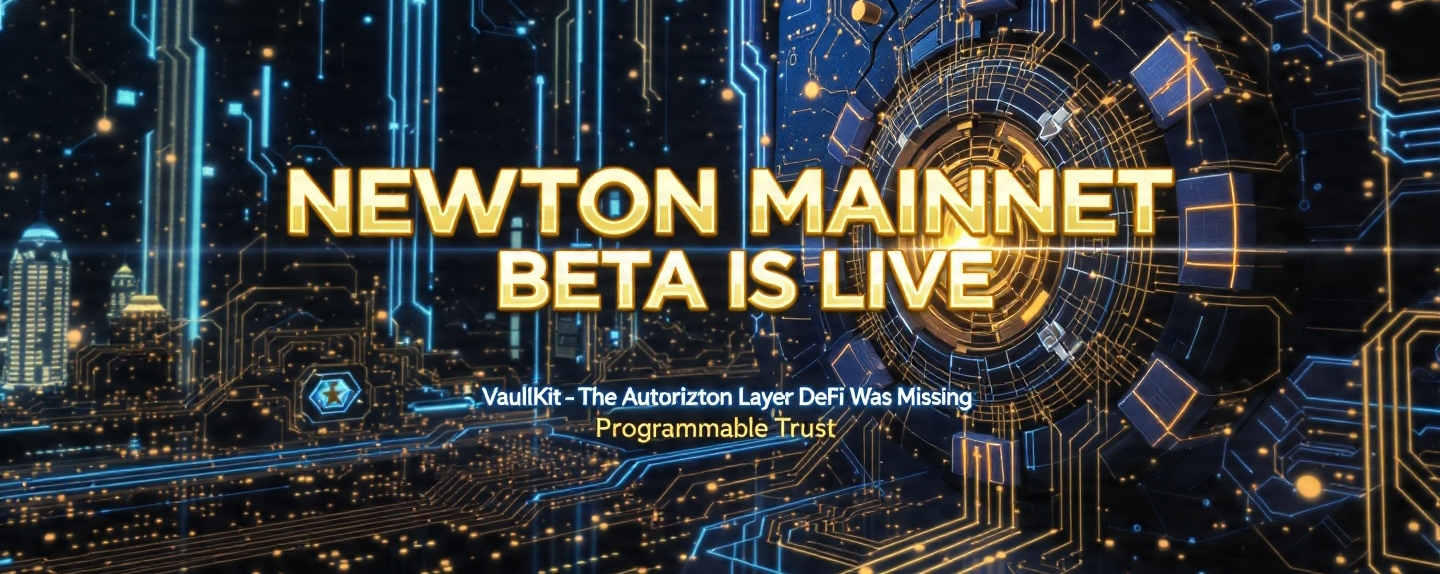
Article
Newton Mainnet Beta is LIVE: The Authorization Layer DeFi Was MissingDeFi rebuilt finance from scratch, but it forgot one critical layer - AUTHORIZATION.
For years we had tokens, vaults, stablecoins, and RWAs moving onchain, but there were no programmable guardrails to control WHAT should execute. That's the gap @NewtonProtocol (https://www.binance.com/en/square/profile/newtonprotocol ) is closing, and the Newton Mainnet Beta is now LIVE!
What is Newton Mainnet Beta?
Newton is not another L1 or DeFi app. It is the first verifiable authorization layer for onchain finance. It checks every transaction against predefined policies BEFORE settlement and writes a signed attestation that anyone can verify.
Introducing VaultKit - The Game Changer
VaultKit is the SDK that makes your vault's rules actually enforceable onchain. Billions are locked in 3,700+ vaults across 80 chains, but yield was programmable while rules were not. With VaultKit, rules are written onchain and enforced at the protocol level.
Why This is HUGE for Institutions:
1. Programmable Compliance: KYC, AML, counterparty limits - all automated. 2. Private & Verifiable: This is the core breakthrough. Institutions get confidentiality for strategies, and regulators get proof of compliance without seeing every position. Private where it protects, verifiable where it matters. 3. Deterministic Trust: No more blind execution. If a transaction violates policy, it never settles.
This is cypherpunk infrastructure for an institutional era. Capital moves at the speed of code, now compliance will too. This is how trillions move onchain safely.
I'm incredibly bullish on the future being built by Newton. This is the infra we actually needed.
What's your take? Will the authorization layer become as important as the execution layer? Comment below!
$NEWT #Newt #newton #VaultKit #PiaaryAdil #CryptoPakistan
Newton Mainnet Beta is LIVE: The Authorization Layer DeFi Was Missing
DeFi rebuilt finance from scratch, but it forgot one critical layer - AUTHORIZATION.
For years we had tokens, vaults, stablecoins, and RWAs moving onchain, but there were no programmable guardrails to control WHAT should execute. That's the gap @NewtonProtocol (https://www.binance.com/en/square/profile/newtonprotocol ) is closing, and the Newton Mainnet Beta is now LIVE!
What is Newton Mainnet Beta?
Newton is not another L1 or DeFi app. It is the first verifiable authorization layer for onchain finance. It checks every transaction against predefined policies BEFORE settlement and writes a signed attestation that anyone can verify.
Introducing VaultKit - The Game Changer
VaultKit is the SDK that makes your vault's rules actually enforceable onchain. Billions are locked in 3,700+ vaults across 80 chains, but yield was programmable while rules were not. With VaultKit, rules are written onchain and enforced at the protocol level.
Why This is HUGE for Institutions:
1. Programmable Compliance: KYC, AML, counterparty limits - all automated. 2. Private & Verifiable: This is the core breakthrough. Institutions get confidentiality for strategies, and regulators get proof of compliance without seeing every position. Private where it protects, verifiable where it matters. 3. Deterministic Trust: No more blind execution. If a transaction violates policy, it never settles.
This is cypherpunk infrastructure for an institutional era. Capital moves at the speed of code, now compliance will too. This is how trillions move onchain safely.
I'm incredibly bullish on the future being built by Newton. This is the infra we actually needed.
What's your take? Will the authorization layer become as important as the execution layer? Comment below!
$NEWT #Newt #newton #VaultKit #PiaaryAdil #CryptoPakistan
For years we had tokens, vaults, stablecoins, and RWAs moving onchain, but there were no programmable guardrails to control WHAT should execute. That's the gap @NewtonProtocol (https://www.binance.com/en/square/profile/newtonprotocol ) is closing, and the Newton Mainnet Beta is now LIVE!
What is Newton Mainnet Beta?
Newton is not another L1 or DeFi app. It is the first verifiable authorization layer for onchain finance. It checks every transaction against predefined policies BEFORE settlement and writes a signed attestation that anyone can verify.
Introducing VaultKit - The Game Changer
VaultKit is the SDK that makes your vault's rules actually enforceable onchain. Billions are locked in 3,700+ vaults across 80 chains, but yield was programmable while rules were not. With VaultKit, rules are written onchain and enforced at the protocol level.
Why This is HUGE for Institutions:
1. Programmable Compliance: KYC, AML, counterparty limits - all automated. 2. Private & Verifiable: This is the core breakthrough. Institutions get confidentiality for strategies, and regulators get proof of compliance without seeing every position. Private where it protects, verifiable where it matters. 3. Deterministic Trust: No more blind execution. If a transaction violates policy, it never settles.
This is cypherpunk infrastructure for an institutional era. Capital moves at the speed of code, now compliance will too. This is how trillions move onchain safely.
I'm incredibly bullish on the future being built by Newton. This is the infra we actually needed.
What's your take? Will the authorization layer become as important as the execution layer? Comment below!
$NEWT #Newt #newton #VaultKit #PiaaryAdil #CryptoPakistan
7
3
77

·
--
🚨 Here's something most people haven't noticed about Newton Protocol.
Everyone is talking about what AI can do.
Almost nobody is asking who gets permission to do it.
That difference matters.
Because the future of Web3 won't depend on the smartest AI...
It will depend on the most trusted AI.
Automation without trust creates risk.
Automation with verifiable permissions creates adoption.
That's the conversation I believe Newton Protocol is really starting.
The biggest breakthrough isn't making AI more powerful.
It's making AI accountable.
@NewtonProtocol
#Newton #AI #Web3 #BinanceSquare #Crypto $NEWT
🚨 Here's something most people haven't noticed about Newton Protocol.
Everyone is talking about what AI can do.
Almost nobody is asking who gets permission to do it.
That difference matters.
Because the future of Web3 won't depend on the smartest AI...
It will depend on the most trusted AI.
Automation without trust creates risk.
Automation with verifiable permissions creates adoption.
That's the conversation I believe Newton Protocol is really starting.
The biggest breakthrough isn't making AI more powerful.
It's making AI accountable.
@NewtonProtocol
#Newton #AI #Web3 #BinanceSquare #Crypto $NEWT
Everyone is talking about what AI can do.
Almost nobody is asking who gets permission to do it.
That difference matters.
Because the future of Web3 won't depend on the smartest AI...
It will depend on the most trusted AI.
Automation without trust creates risk.
Automation with verifiable permissions creates adoption.
That's the conversation I believe Newton Protocol is really starting.
The biggest breakthrough isn't making AI more powerful.
It's making AI accountable.
@NewtonProtocol
#Newton #AI #Web3 #BinanceSquare #Crypto $NEWT
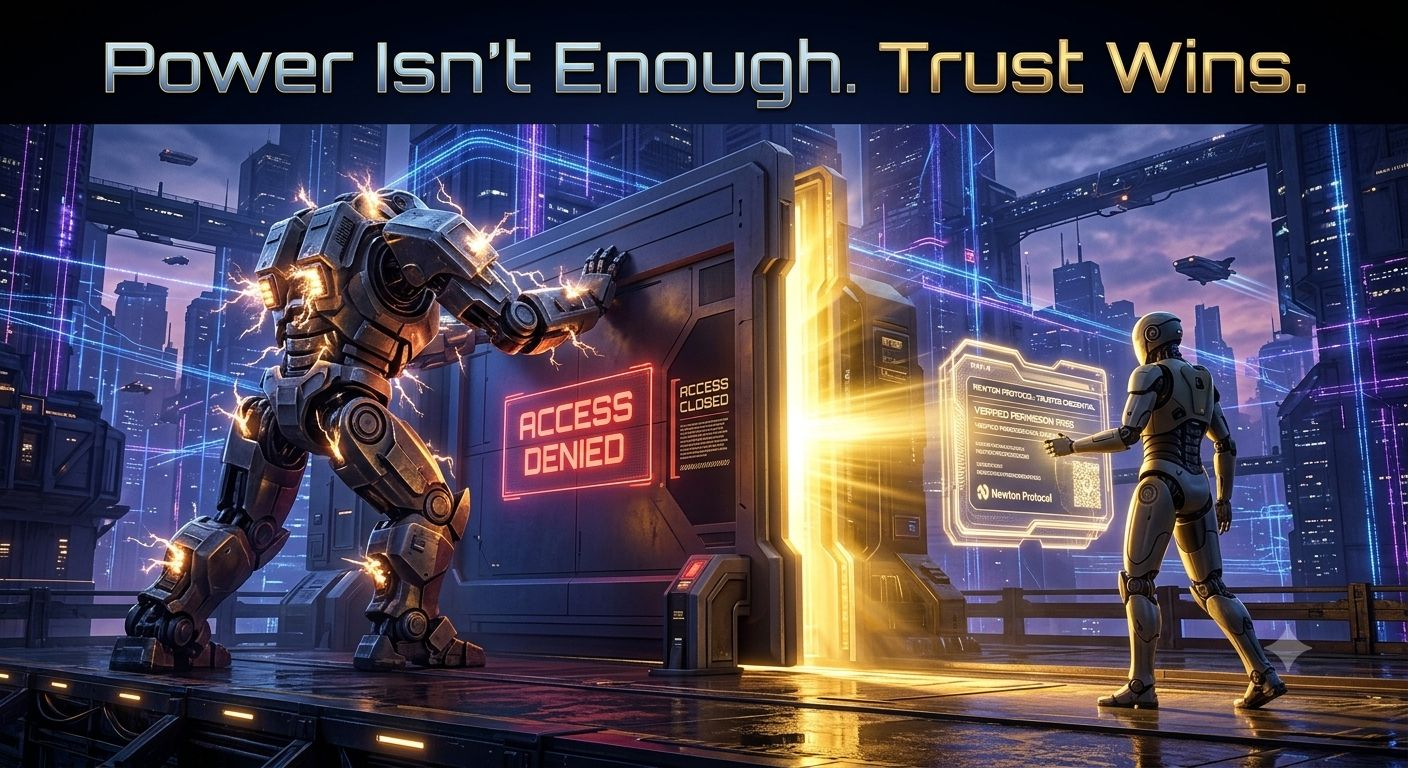
7
90
·
--
Exploring the Newton Mainnet Beta with @NewtonProtocolI'm excited to see the progress made by @NewtonProtocol with the launch of the Newton Mainnet Beta. This milestone reflects the team's dedication to building a secure, scalable, and developer-friendly blockchain infrastructure. Reaching the Mainnet Beta stage is an important achievement because it allows the community to experience the network while helping improve its stability, performance, and reliability through real-world testing.
What stands out to me is Newton Protocol's focus on creating technology that supports developers, builders, and users. A successful blockchain ecosystem depends on continuous innovation, transparent development, and an active community. The Mainnet Beta creates opportunities for developers to build new decentralized applications while encouraging users to explore the network and provide valuable feedback.
I believe that community participation is one of the biggest strengths of any blockchain project. Every suggestion, test, and discussion can help improve the protocol and prepare it for wider adoption. As the ecosystem grows, I hope to see more partnerships, useful applications, educational resources, and developer activity that bring long-term value to the community.
Congratulations to @NewtonProtocol for reaching this important milestone. I'm looking forward to future updates, continued ecosystem growth, and seeing how $NEWT develops as the project moves toward broader adoption. The future looks promising, and I'm excited to follow the journey. #newton $NEWT
Exploring the Newton Mainnet Beta with @NewtonProtocol
I'm excited to see the progress made by @NewtonProtocol with the launch of the Newton Mainnet Beta. This milestone reflects the team's dedication to building a secure, scalable, and developer-friendly blockchain infrastructure. Reaching the Mainnet Beta stage is an important achievement because it allows the community to experience the network while helping improve its stability, performance, and reliability through real-world testing.
What stands out to me is Newton Protocol's focus on creating technology that supports developers, builders, and users. A successful blockchain ecosystem depends on continuous innovation, transparent development, and an active community. The Mainnet Beta creates opportunities for developers to build new decentralized applications while encouraging users to explore the network and provide valuable feedback.
I believe that community participation is one of the biggest strengths of any blockchain project. Every suggestion, test, and discussion can help improve the protocol and prepare it for wider adoption. As the ecosystem grows, I hope to see more partnerships, useful applications, educational resources, and developer activity that bring long-term value to the community.
Congratulations to @NewtonProtocol for reaching this important milestone. I'm looking forward to future updates, continued ecosystem growth, and seeing how $NEWT develops as the project moves toward broader adoption. The future looks promising, and I'm excited to follow the journey. #newton $NEWT
What stands out to me is Newton Protocol's focus on creating technology that supports developers, builders, and users. A successful blockchain ecosystem depends on continuous innovation, transparent development, and an active community. The Mainnet Beta creates opportunities for developers to build new decentralized applications while encouraging users to explore the network and provide valuable feedback.
I believe that community participation is one of the biggest strengths of any blockchain project. Every suggestion, test, and discussion can help improve the protocol and prepare it for wider adoption. As the ecosystem grows, I hope to see more partnerships, useful applications, educational resources, and developer activity that bring long-term value to the community.
Congratulations to @NewtonProtocol for reaching this important milestone. I'm looking forward to future updates, continued ecosystem growth, and seeing how $NEWT develops as the project moves toward broader adoption. The future looks promising, and I'm excited to follow the journey. #newton $NEWT
33
Log in to explore more content
Join global crypto users on Binance Square
⚡️ Get latest and useful information about crypto.
💬 Trusted by the world’s largest crypto exchange.
👍 Discover real insights from verified creators.
Email / Phone number
Trending Topics
1
#BTCTops$80K
24,774 views
173 Discussing
2
#USWeeklyInitialJoblessClaimsRiseTo206000
51,133 views
914 Discussing
3
#NvidiaToAcquireHuggingFaceFor$12.9B
3,631 views
57 Discussing
4
#SnowflakeSurges24%OnEarningsBeat
9,621 views
300 Discussing
5
#USISMServicesRisesTo55.4InAugust
9,968 views
242 Discussing
6
#SECNewCryptoRulesAimToBringFirmsBackToUS
20,666 views
432 Discussing
7
#USGainsControlOfVenezuelanOilFields
25,997 views
509 Discussing
8
#CFTCScrutinizesPredictionMarketAffiliates
27,337 views
526 Discussing
9
#EtherXRPETFInflowStreaksEnd
40,743 views
652 Discussing
10
#PredictionMarketsPutCLARITYAct2026OddsAt15%
30,572 views
544 Discussing