

#kelpdao
kelpdao
158,431 views
459 Discussing
Hot
Latest


KelpDAO filed a lawsuit against LayerZero over $292M rsETH exploit
#KelpDAO sued #LayerZero and co-founder Bryan Pellegrino in the Supreme Court of British Columbia over an April 18 exploit that affected 116,500 rsETH, valued at roughly $292M. Evercrest alleges LayerZero failed to disclose security risks or recommend multi-DVN setups, while also accusing the company of negligent misrepresentation and defamation. It is seeking damages after more than $650M in user withdrawals since the exploit. The case could face increased scrutiny under MiCA and CFT compliance rules.
👉 theblock.co/news/regulation/2026-09-25-kelpdao-sues-layerzero-claims-it-endorsed-setup-used-in-292-million-rseth-exploit-416361
KelpDAO filed a lawsuit against LayerZero over $292M rsETH exploit
#KelpDAO sued #LayerZero and co-founder Bryan Pellegrino in the Supreme Court of British Columbia over an April 18 exploit that affected 116,500 rsETH, valued at roughly $292M. Evercrest alleges LayerZero failed to disclose security risks or recommend multi-DVN setups, while also accusing the company of negligent misrepresentation and defamation. It is seeking damages after more than $650M in user withdrawals since the exploit. The case could face increased scrutiny under MiCA and CFT compliance rules.
👉 theblock.co/news/regulation/2026-09-25-kelpdao-sues-layerzero-claims-it-endorsed-setup-used-in-292-million-rseth-exploit-416361
#KelpDAO sued #LayerZero and co-founder Bryan Pellegrino in the Supreme Court of British Columbia over an April 18 exploit that affected 116,500 rsETH, valued at roughly $292M. Evercrest alleges LayerZero failed to disclose security risks or recommend multi-DVN setups, while also accusing the company of negligent misrepresentation and defamation. It is seeking damages after more than $650M in user withdrawals since the exploit. The case could face increased scrutiny under MiCA and CFT compliance rules.
👉 theblock.co/news/regulation/2026-09-25-kelpdao-sues-layerzero-claims-it-endorsed-setup-used-in-292-million-rseth-exploit-416361
333

·
--
[An $292 million hacker incident ends up in court! Who should be held responsible: KelpDAO or LayerZero?🔥]
[🚀 币圈安全事件,进群聊](https://app.binance.com/uni-qr/MwYFhLo4)
This year’s biggest DeFi attack in the crypto market has now seen new developments.
KelpDAO has officially sued the cross-chain protocol LayerZero, seeking to assign responsibility for the approximately $292 million attack that occurred in April.
At the time, the attacker stole 116,500 rsETH from KelpDAO’s cross-chain bridge, which then triggered a chain reaction—multiple DeFi protocols paused trading and borrowing of the affected assets, and the DeFi market even faced a liquidity crisis for a time.
The question is: whose problem is it, really?
KelpDAO believes LayerZero failed to adequately disclose the risks of its own technology. Moreover, after LayerZero-related infrastructure was compromised, the forged cross-chain messages were ultimately validated and passed through.
But LayerZero tells a completely different story.
LayerZero previously said that KelpDAO used a “single-validator” configuration—meaning it relied on only one validation path. If that validator is compromised, it could become a single point of failure for the entire cross-chain bridge.
So now the dispute has shifted from “whose technology went wrong” to “who should be responsible for the $292 million loss.”
📌 What truly deserves attention here isn’t just the $292 million loss, but the security of cross-chain bridges: when a DeFi protocol moves assets across different chains, any issue in the underlying validation mechanism, infrastructure, or permission configuration can amplify technical risk into massive financial losses.
And how this lawsuit ultimately rules may also become an important precedent for how future DeFi projects handle accountability for cross-chain security.
#KelpDAO
[An $292 million hacker incident ends up in court! Who should be held responsible: KelpDAO or LayerZero?🔥]
🚀 币圈安全事件,进群聊
This year’s biggest DeFi attack in the crypto market has now seen new developments.
KelpDAO has officially sued the cross-chain protocol LayerZero, seeking to assign responsibility for the approximately $292 million attack that occurred in April.
At the time, the attacker stole 116,500 rsETH from KelpDAO’s cross-chain bridge, which then triggered a chain reaction—multiple DeFi protocols paused trading and borrowing of the affected assets, and the DeFi market even faced a liquidity crisis for a time.
The question is: whose problem is it, really?
KelpDAO believes LayerZero failed to adequately disclose the risks of its own technology. Moreover, after LayerZero-related infrastructure was compromised, the forged cross-chain messages were ultimately validated and passed through.
But LayerZero tells a completely different story.
LayerZero previously said that KelpDAO used a “single-validator” configuration—meaning it relied on only one validation path. If that validator is compromised, it could become a single point of failure for the entire cross-chain bridge.
So now the dispute has shifted from “whose technology went wrong” to “who should be responsible for the $292 million loss.”
📌 What truly deserves attention here isn’t just the $292 million loss, but the security of cross-chain bridges: when a DeFi protocol moves assets across different chains, any issue in the underlying validation mechanism, infrastructure, or permission configuration can amplify technical risk into massive financial losses.
And how this lawsuit ultimately rules may also become an important precedent for how future DeFi projects handle accountability for cross-chain security.
#KelpDAO
🚀 币圈安全事件,进群聊
This year’s biggest DeFi attack in the crypto market has now seen new developments.
KelpDAO has officially sued the cross-chain protocol LayerZero, seeking to assign responsibility for the approximately $292 million attack that occurred in April.
At the time, the attacker stole 116,500 rsETH from KelpDAO’s cross-chain bridge, which then triggered a chain reaction—multiple DeFi protocols paused trading and borrowing of the affected assets, and the DeFi market even faced a liquidity crisis for a time.
The question is: whose problem is it, really?
KelpDAO believes LayerZero failed to adequately disclose the risks of its own technology. Moreover, after LayerZero-related infrastructure was compromised, the forged cross-chain messages were ultimately validated and passed through.
But LayerZero tells a completely different story.
LayerZero previously said that KelpDAO used a “single-validator” configuration—meaning it relied on only one validation path. If that validator is compromised, it could become a single point of failure for the entire cross-chain bridge.
So now the dispute has shifted from “whose technology went wrong” to “who should be responsible for the $292 million loss.”
📌 What truly deserves attention here isn’t just the $292 million loss, but the security of cross-chain bridges: when a DeFi protocol moves assets across different chains, any issue in the underlying validation mechanism, infrastructure, or permission configuration can amplify technical risk into massive financial losses.
And how this lawsuit ultimately rules may also become an important precedent for how future DeFi projects handle accountability for cross-chain security.
#KelpDAO

1
243

KelpDAO files a lawsuit against LayerZero and its CEO, Bryan Pellegrino, after the $292M hack of the rsETH bridge. The organization claims that LayerZero approved the bridge before the attack, while the CEO denies any responsibility.
#KelpDAO #LayerZero #rsETH #Crypto #BinanceSquare
Read more: https://cointelegraph.com/news/kelpdao-layerzero-lawsuit-rseth-exploit?utm_source=rss_feed&utm_medium=rss&utm_campaign=rss_partner_inbound
KelpDAO files a lawsuit against LayerZero and its CEO, Bryan Pellegrino, after the $292M hack of the rsETH bridge. The organization claims that LayerZero approved the bridge before the attack, while the CEO denies any responsibility.
#KelpDAO #LayerZero #rsETH #Crypto #BinanceSquare
Read more: https://cointelegraph.com/news/kelpdao-layerzero-lawsuit-rseth-exploit?utm_source=rss_feed&utm_medium=rss&utm_campaign=rss_partner_inbound
#KelpDAO #LayerZero #rsETH #Crypto #BinanceSquare
Read more: https://cointelegraph.com/news/kelpdao-layerzero-lawsuit-rseth-exploit?utm_source=rss_feed&utm_medium=rss&utm_campaign=rss_partner_inbound
56

·
--
The DeFi ecosystem faces a new legal and technical earthquake after a lawsuit filed by KelpDAO against LayerZero and its CEO, seeking accountability for the $292 million exploit in rsETH tokens. ⚖️🔍
What happened? KelpDAO argues that the bridge infrastructure and configuration were approved before the attack, while the other side has rejected the allegations, calling them unfounded. This dispute sparks a critical debate about security in cross-chain bridges and the legal responsibility of the underlying protocols in the face of million-dollar breaches. 🌉💥
Why it matters: The outcome of this case will set a key precedent on liquidity custody and risk design in blockchain interoperability, directly affecting institutional trust in wrapped products.
What to watch: Statements from both technical defenses, expert reports on the bridge code, and the impact on the liquidity of the affected assets across the DeFi sector. 📊
#DeFi #Ciberseguridad #LayerZero #KelpDAO $BTC $ETH
The DeFi ecosystem faces a new legal and technical earthquake after a lawsuit filed by KelpDAO against LayerZero and its CEO, seeking accountability for the $292 million exploit in rsETH tokens. ⚖️🔍
What happened? KelpDAO argues that the bridge infrastructure and configuration were approved before the attack, while the other side has rejected the allegations, calling them unfounded. This dispute sparks a critical debate about security in cross-chain bridges and the legal responsibility of the underlying protocols in the face of million-dollar breaches. 🌉💥
Why it matters: The outcome of this case will set a key precedent on liquidity custody and risk design in blockchain interoperability, directly affecting institutional trust in wrapped products.
What to watch: Statements from both technical defenses, expert reports on the bridge code, and the impact on the liquidity of the affected assets across the DeFi sector. 📊
#DeFi #Ciberseguridad #LayerZero #KelpDAO $BTC $ETH
What happened? KelpDAO argues that the bridge infrastructure and configuration were approved before the attack, while the other side has rejected the allegations, calling them unfounded. This dispute sparks a critical debate about security in cross-chain bridges and the legal responsibility of the underlying protocols in the face of million-dollar breaches. 🌉💥
Why it matters: The outcome of this case will set a key precedent on liquidity custody and risk design in blockchain interoperability, directly affecting institutional trust in wrapped products.
What to watch: Statements from both technical defenses, expert reports on the bridge code, and the impact on the liquidity of the affected assets across the DeFi sector. 📊
#DeFi #Ciberseguridad #LayerZero #KelpDAO $BTC $ETH
12

🚨BREAKING NEWS: KelpDAO processess LayerZero and its CEO due to exploitation of the vulnerability that caused a loss of US$292 million in rsETH.
KelpDAO alleges that undisclosed risks and a unique verifier configuration (1 of 1) allowed hackers linked to North Korea to drain 116,500 rsETH.
The dispute centers on whether LayerZero endorsed the unique verifier configuration that, according to KelpDAO, left the platform vulnerable. LayerZero CEO Pellegrino calls the allegations "baseless" and promises to challenge them in Vancouver courts.
KelpDAO says it is migrating to a safer platform to protect its users. The battle over responsibility for the US$292 million loss will now be taken to court.
$QI $QNT $XPL 👀👀👀👀
{spot}(XPLUSDT)
{spot}(QNTUSDT)
{spot}(QIUSDT)
#CryptoNewss #KelpDAO #LayerZero #CFTCUpdatesGuidanceOnTokenizedAssets #bullish
🚨BREAKING NEWS: KelpDAO processess LayerZero and its CEO due to exploitation of the vulnerability that caused a loss of US$292 million in rsETH.
KelpDAO alleges that undisclosed risks and a unique verifier configuration (1 of 1) allowed hackers linked to North Korea to drain 116,500 rsETH.
The dispute centers on whether LayerZero endorsed the unique verifier configuration that, according to KelpDAO, left the platform vulnerable. LayerZero CEO Pellegrino calls the allegations "baseless" and promises to challenge them in Vancouver courts.
KelpDAO says it is migrating to a safer platform to protect its users. The battle over responsibility for the US$292 million loss will now be taken to court.
$QI $QNT $XPL 👀👀👀👀
#CryptoNewss #KelpDAO #LayerZero #CFTCUpdatesGuidanceOnTokenizedAssets #bullish
KelpDAO alleges that undisclosed risks and a unique verifier configuration (1 of 1) allowed hackers linked to North Korea to drain 116,500 rsETH.
The dispute centers on whether LayerZero endorsed the unique verifier configuration that, according to KelpDAO, left the platform vulnerable. LayerZero CEO Pellegrino calls the allegations "baseless" and promises to challenge them in Vancouver courts.
KelpDAO says it is migrating to a safer platform to protect its users. The battle over responsibility for the US$292 million loss will now be taken to court.
$QI $QNT $XPL 👀👀👀👀
#CryptoNewss #KelpDAO #LayerZero #CFTCUpdatesGuidanceOnTokenizedAssets #bullish

477

·
--
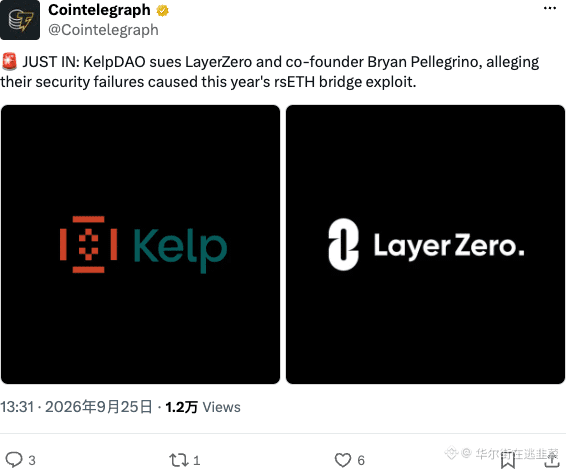
LayerZero has a big problem on its hands. KelpDAO has directly sued it and Bryan Pellegrino, alleging that security negligence led to this year’s rsETH bridge being hacked. This time, it’s not just a public apology via a tweet—it’s straight to court. In the cross-chain bridge business, trust is everything. Once the lawsuit is filed, LayerZero’s audits, insurance, and institutional partnerships will all be torn apart. On the flip side, this move by KelpDAO also sets a rule of the road for the industry: if a bridge’s security fails, the protocol side can’t just shove the blame—responsibility has to be taken.
$ZRO #LayerZero #KelpDAO #rsETH
LayerZero has a big problem on its hands. KelpDAO has directly sued it and Bryan Pellegrino, alleging that security negligence led to this year’s rsETH bridge being hacked. This time, it’s not just a public apology via a tweet—it’s straight to court. In the cross-chain bridge business, trust is everything. Once the lawsuit is filed, LayerZero’s audits, insurance, and institutional partnerships will all be torn apart. On the flip side, this move by KelpDAO also sets a rule of the road for the industry: if a bridge’s security fails, the protocol side can’t just shove the blame—responsibility has to be taken.
$ZRO #LayerZero #KelpDAO #rsETH
$ZRO #LayerZero #KelpDAO #rsETH
风中浪客:
跨链桥出事最怕扯皮,KelpDAO 直接起诉算是把 $ZRO 架火上烤了。桥这生意信任一崩比啥都贵,先观望,别急着接飞刀。
1
111
·
--
Verified
🔧 Kelp DAO confirms that rs$ETH has fully recovered after 5 weeks of damage control following the $293 million attack.
{future}(ETHUSDT)
According to the latest announcement, the final batch of 20,373.7 rsETH has been transferred to the cross-chain bridge system, officially completing the recovery plan. Currently, the mint, redeem, and reward distribution functions are all back to normal operation.
📊 The attack on April 18 not only impacted Kelp DAO but also created a domino effect across the entire DeFi ecosystem. The hackers used a large amount of rsETH as collateral to borrow WETH, causing the lending protocol to incur a bad debt of around $190 million.
👀 Although the recovery process has been completed, the total value locked (TVL) in the DeFi market has not yet returned to pre-incident levels, indicating that the effects of large-scale hacks still linger.
#DeFi #rsETH #KelpDAO #Crypto
🔧 Kelp DAO confirms that rs$ETH has fully recovered after 5 weeks of damage control following the $293 million attack.
According to the latest announcement, the final batch of 20,373.7 rsETH has been transferred to the cross-chain bridge system, officially completing the recovery plan. Currently, the mint, redeem, and reward distribution functions are all back to normal operation.
📊 The attack on April 18 not only impacted Kelp DAO but also created a domino effect across the entire DeFi ecosystem. The hackers used a large amount of rsETH as collateral to borrow WETH, causing the lending protocol to incur a bad debt of around $190 million.
👀 Although the recovery process has been completed, the total value locked (TVL) in the DeFi market has not yet returned to pre-incident levels, indicating that the effects of large-scale hacks still linger.
#DeFi #rsETH #KelpDAO #Crypto
According to the latest announcement, the final batch of 20,373.7 rsETH has been transferred to the cross-chain bridge system, officially completing the recovery plan. Currently, the mint, redeem, and reward distribution functions are all back to normal operation.
📊 The attack on April 18 not only impacted Kelp DAO but also created a domino effect across the entire DeFi ecosystem. The hackers used a large amount of rsETH as collateral to borrow WETH, causing the lending protocol to incur a bad debt of around $190 million.
👀 Although the recovery process has been completed, the total value locked (TVL) in the DeFi market has not yet returned to pre-incident levels, indicating that the effects of large-scale hacks still linger.
#DeFi #rsETH #KelpDAO #Crypto

2
2.1k

·
--
The hackers from Kelp DAO have almost laundered all of the $220 million stolen funds.
The method is classic: they used mixers to sever on-chain tracking, then transferred the funds across chains using cross-chain bridges. Once the funds are on a different chain, tracking becomes exponentially harder.
$220 million, nearly impossible to recover. This is a heavy blow to DeFi security.
The issue isn't just a single project's security flaws, but the overall security standards of the entire DeFi ecosystem are still woefully inadequate. Many projects launch without thorough audits, only to scramble for solutions after a breach.
Takeaway for average users: Don't put all your assets in one protocol. Diversify your risk, use cold wallets, and avoid signing on suspicious links—these old adages become particularly crucial every time something goes wrong.
#KelpDAO #黑客 #DeFi #security
The hackers from Kelp DAO have almost laundered all of the $220 million stolen funds.
The method is classic: they used mixers to sever on-chain tracking, then transferred the funds across chains using cross-chain bridges. Once the funds are on a different chain, tracking becomes exponentially harder.
$220 million, nearly impossible to recover. This is a heavy blow to DeFi security.
The issue isn't just a single project's security flaws, but the overall security standards of the entire DeFi ecosystem are still woefully inadequate. Many projects launch without thorough audits, only to scramble for solutions after a breach.
Takeaway for average users: Don't put all your assets in one protocol. Diversify your risk, use cold wallets, and avoid signing on suspicious links—these old adages become particularly crucial every time something goes wrong.
#KelpDAO #黑客 #DeFi #security
The method is classic: they used mixers to sever on-chain tracking, then transferred the funds across chains using cross-chain bridges. Once the funds are on a different chain, tracking becomes exponentially harder.
$220 million, nearly impossible to recover. This is a heavy blow to DeFi security.
The issue isn't just a single project's security flaws, but the overall security standards of the entire DeFi ecosystem are still woefully inadequate. Many projects launch without thorough audits, only to scramble for solutions after a breach.
Takeaway for average users: Don't put all your assets in one protocol. Diversify your risk, use cold wallets, and avoid signing on suspicious links—these old adages become particularly crucial every time something goes wrong.
#KelpDAO #黑客 #DeFi #security
100

·
--
ETH: 🚀 Arbitrum just froze $70M worth of ETH in response to the KelpDAO hack ✅
The attacker moved over $176M across multiple chains, with Bitcoin becoming their new playground. 💾
By intervening early, Arbitrum prevented roughly 29% of the stolen funds from entering the laundering pipeline 🔄
A race against time ensued as investigators tracked the thief's rapid moves through THORChain and other decentralized protocols 🔮
Lazarus Group is suspected to be behind this brazen move, using complex tactics to obscure their tracks. 🔍
Is the remaining $176M still in play? Let's watch closely! 💬
Will these funds find a safe haven or will they slip through our fingers? 🛑
Are we overthinking this situation or is there real risk here? 👇
#ETH #KelpDAO #LazarusGroup
ETH: 🚀 Arbitrum just froze $70M worth of ETH in response to the KelpDAO hack ✅
The attacker moved over $176M across multiple chains, with Bitcoin becoming their new playground. 💾
By intervening early, Arbitrum prevented roughly 29% of the stolen funds from entering the laundering pipeline 🔄
A race against time ensued as investigators tracked the thief's rapid moves through THORChain and other decentralized protocols 🔮
Lazarus Group is suspected to be behind this brazen move, using complex tactics to obscure their tracks. 🔍
Is the remaining $176M still in play? Let's watch closely! 💬
Will these funds find a safe haven or will they slip through our fingers? 🛑
Are we overthinking this situation or is there real risk here? 👇
#ETH #KelpDAO #LazarusGroup
The attacker moved over $176M across multiple chains, with Bitcoin becoming their new playground. 💾
By intervening early, Arbitrum prevented roughly 29% of the stolen funds from entering the laundering pipeline 🔄
A race against time ensued as investigators tracked the thief's rapid moves through THORChain and other decentralized protocols 🔮
Lazarus Group is suspected to be behind this brazen move, using complex tactics to obscure their tracks. 🔍
Is the remaining $176M still in play? Let's watch closely! 💬
Will these funds find a safe haven or will they slip through our fingers? 🛑
Are we overthinking this situation or is there real risk here? 👇
#ETH #KelpDAO #LazarusGroup
47

·
--
Arbitrum Seals a Win, but the Hunt Continues 🛡️
Arbitrum has frozen 30,766 ETH worth over $70 million linked to the KelpDAO exploit, preventing roughly 29% of stolen funds from entering the laundering pipeline. However, the attacker is still moving assets across multiple chains and protocols, including Bitcoin. This high-level operational discipline hints at a sophisticated threat actor behind the scenes.
The Lazarus Group has been linked to previous crypto thefts using similar tactics. With over $176 million already laundered through various decentralized bridges, the race against time continues for blockchain investigators and law enforcement agencies.
Is the Lazarus Group involved in this operation? Share your thoughts below! 💬
#Arbitrum #KelpDAO #LazarusGroup
Arbitrum Seals a Win, but the Hunt Continues 🛡️
Arbitrum has frozen 30,766 ETH worth over $70 million linked to the KelpDAO exploit, preventing roughly 29% of stolen funds from entering the laundering pipeline. However, the attacker is still moving assets across multiple chains and protocols, including Bitcoin. This high-level operational discipline hints at a sophisticated threat actor behind the scenes.
The Lazarus Group has been linked to previous crypto thefts using similar tactics. With over $176 million already laundered through various decentralized bridges, the race against time continues for blockchain investigators and law enforcement agencies.
Is the Lazarus Group involved in this operation? Share your thoughts below! 💬
#Arbitrum #KelpDAO #LazarusGroup
Arbitrum has frozen 30,766 ETH worth over $70 million linked to the KelpDAO exploit, preventing roughly 29% of stolen funds from entering the laundering pipeline. However, the attacker is still moving assets across multiple chains and protocols, including Bitcoin. This high-level operational discipline hints at a sophisticated threat actor behind the scenes.
The Lazarus Group has been linked to previous crypto thefts using similar tactics. With over $176 million already laundered through various decentralized bridges, the race against time continues for blockchain investigators and law enforcement agencies.
Is the Lazarus Group involved in this operation? Share your thoughts below! 💬
#Arbitrum #KelpDAO #LazarusGroup
47

·
--
Kelp DAO hackers have pretty much completed their money laundering, with around $220 million of unfrozen funds nearly all out of the tracking range.
In April's Kelp DAO cross-chain bridge attack, about $292 million in assets were stolen, and aside from the roughly $71 million in ETH that was frozen, the rest, around $220 million, has basically been laundered. The attackers used privacy tools like THORChain, Wasabi, Tornado Cash, and Umbra to execute multiple rounds of cross-chain and mixing operations.
Why it matters: The $292 million stolen is one of the largest DeFi attacks of 2026, with only 24% of the funds frozen, making on-chain tracking a significant challenge.
#KelpDAO #DeFi #安全 #Web3 #hacker
Kelp DAO hackers have pretty much completed their money laundering, with around $220 million of unfrozen funds nearly all out of the tracking range.
In April's Kelp DAO cross-chain bridge attack, about $292 million in assets were stolen, and aside from the roughly $71 million in ETH that was frozen, the rest, around $220 million, has basically been laundered. The attackers used privacy tools like THORChain, Wasabi, Tornado Cash, and Umbra to execute multiple rounds of cross-chain and mixing operations.
Why it matters: The $292 million stolen is one of the largest DeFi attacks of 2026, with only 24% of the funds frozen, making on-chain tracking a significant challenge.
#KelpDAO #DeFi #安全 #Web3 #hacker
In April's Kelp DAO cross-chain bridge attack, about $292 million in assets were stolen, and aside from the roughly $71 million in ETH that was frozen, the rest, around $220 million, has basically been laundered. The attackers used privacy tools like THORChain, Wasabi, Tornado Cash, and Umbra to execute multiple rounds of cross-chain and mixing operations.
Why it matters: The $292 million stolen is one of the largest DeFi attacks of 2026, with only 24% of the funds frozen, making on-chain tracking a significant challenge.
#KelpDAO #DeFi #安全 #Web3 #hacker
28

·
--
Kelp DAO Alert: Starting June 15th, cross-chain support for rsETH on multiple chains will be halted. Users holding or utilizing the rsETH cross-chain functionality are advised to check their asset networks, cross-chain pathways, and related DeFi positions in advance to avoid restricted operations down the line.
These types of calendar events may not directly impact prices, but they can affect liquidity migration, cross-chain experiences, and interactions with certain protocols. Users currently engaging with the Kelp ecosystem should keep an eye on official updates and migration plans. #KelpDAO #rsETH
Kelp DAO Alert: Starting June 15th, cross-chain support for rsETH on multiple chains will be halted. Users holding or utilizing the rsETH cross-chain functionality are advised to check their asset networks, cross-chain pathways, and related DeFi positions in advance to avoid restricted operations down the line.
These types of calendar events may not directly impact prices, but they can affect liquidity migration, cross-chain experiences, and interactions with certain protocols. Users currently engaging with the Kelp ecosystem should keep an eye on official updates and migration plans. #KelpDAO #rsETH
These types of calendar events may not directly impact prices, but they can affect liquidity migration, cross-chain experiences, and interactions with certain protocols. Users currently engaging with the Kelp ecosystem should keep an eye on official updates and migration plans. #KelpDAO #rsETH
96
Kelp DAO Announcement: Starting June 15th, cross-chain support for rsETH across multiple chains will be discontinued.
The most immediate impact of this change for users is that cross-chain pathways, liquidity routing, and subsequent asset operations may no longer function as they did before. Users holding or utilizing $rsETH are advised to check their respective chains, bridging records, and related DeFi positions in a timely manner to avoid encountering operational limitations or liquidity issues after support ceases.
Stay tuned for official updates; don’t wait until you need to cross-chain to find out the entry points are closed. #KelpDAO #DeFi #Restaking
Kelp DAO Announcement: Starting June 15th, cross-chain support for rsETH across multiple chains will be discontinued.
The most immediate impact of this change for users is that cross-chain pathways, liquidity routing, and subsequent asset operations may no longer function as they did before. Users holding or utilizing $rsETH are advised to check their respective chains, bridging records, and related DeFi positions in a timely manner to avoid encountering operational limitations or liquidity issues after support ceases.
Stay tuned for official updates; don’t wait until you need to cross-chain to find out the entry points are closed. #KelpDAO #DeFi #Restaking
The most immediate impact of this change for users is that cross-chain pathways, liquidity routing, and subsequent asset operations may no longer function as they did before. Users holding or utilizing $rsETH are advised to check their respective chains, bridging records, and related DeFi positions in a timely manner to avoid encountering operational limitations or liquidity issues after support ceases.
Stay tuned for official updates; don’t wait until you need to cross-chain to find out the entry points are closed. #KelpDAO #DeFi #Restaking
100

Kelp DAO Alert: Starting June 15th, cross-chain support for rsETH across multiple chains will be halted.\n\nIf you're holding or using $rsETH, the key is not to panic, but to check three things: \n1) Which chain your assets are currently on; \n2) Whether you still rely on cross-chain transfers; \n3) If your related DeFi positions, liquidity, or exit strategies will be impacted.\n\nThese kinds of adjustments usually affect cross-chain experience and capital allocation efficiency, especially for users still frequently moving across multiple chains. It's advised to review the official guidelines ahead of time to avoid discovering limitations on bridging or migrating after support has ceased.\n\n#KelpDAO #Restaking #DeFi
Kelp DAO Alert: Starting June 15th, cross-chain support for rsETH across multiple chains will be halted.\n\nIf you're holding or using $rsETH, the key is not to panic, but to check three things: \n1) Which chain your assets are currently on; \n2) Whether you still rely on cross-chain transfers; \n3) If your related DeFi positions, liquidity, or exit strategies will be impacted.\n\nThese kinds of adjustments usually affect cross-chain experience and capital allocation efficiency, especially for users still frequently moving across multiple chains. It's advised to review the official guidelines ahead of time to avoid discovering limitations on bridging or migrating after support has ceased.\n\n#KelpDAO #Restaking #DeFi
95


·
--
🚨 **Kelp officially terminates rsETH cross-chain bridging**
KelpDAO has announced the halt of rsETH cross-chain services across 20 networks. Asset backing remains secure, but users who haven’t bridged in time need to follow the recovery process to retrieve their assets.
**Recovery Process:**
1️⃣ Burn rsETH on the source chain
2️⃣ Pay a fixed fee of 100 USDC on the Ethereum mainnet
3️⃣ Send the transaction records of both operations to the official email
The project team will settle quarterly and return rsETH to the Ethereum mainnet. Movement ecosystem users have a separate process, ensuring the same safety mechanisms.
⏰ The recovery window is open until **June 15, 2027**
⚠️ Requests should only be submitted via the officially designated email; beware of spoof channels
Users holding rsETH should act promptly.
#KelpDAO #DeFi
🚨 **Kelp officially terminates rsETH cross-chain bridging**
KelpDAO has announced the halt of rsETH cross-chain services across 20 networks. Asset backing remains secure, but users who haven’t bridged in time need to follow the recovery process to retrieve their assets.
**Recovery Process:**
1️⃣ Burn rsETH on the source chain
2️⃣ Pay a fixed fee of 100 USDC on the Ethereum mainnet
3️⃣ Send the transaction records of both operations to the official email
The project team will settle quarterly and return rsETH to the Ethereum mainnet. Movement ecosystem users have a separate process, ensuring the same safety mechanisms.
⏰ The recovery window is open until **June 15, 2027**
⚠️ Requests should only be submitted via the officially designated email; beware of spoof channels
Users holding rsETH should act promptly.
#KelpDAO #DeFi
KelpDAO has announced the halt of rsETH cross-chain services across 20 networks. Asset backing remains secure, but users who haven’t bridged in time need to follow the recovery process to retrieve their assets.
**Recovery Process:**
1️⃣ Burn rsETH on the source chain
2️⃣ Pay a fixed fee of 100 USDC on the Ethereum mainnet
3️⃣ Send the transaction records of both operations to the official email
The project team will settle quarterly and return rsETH to the Ethereum mainnet. Movement ecosystem users have a separate process, ensuring the same safety mechanisms.
⏰ The recovery window is open until **June 15, 2027**
⚠️ Requests should only be submitted via the officially designated email; beware of spoof channels
Users holding rsETH should act promptly.
#KelpDAO #DeFi
21

·
--
Kelp DAO Reminder: Starting June 15, 2026, cross-chain support for $rsETH across multiple chains will be discontinued.
Users holding or utilizing the rsETH cross-chain functionality are advised to check the network of their assets, bridging paths, and subsequent operational arrangements in advance to avoid liquidity issues, transfer limitations, or interaction restrictions as the deadline approaches. For specific affected chains and handling methods, please refer to the official announcement from Kelp DAO.
Such adjustments in cross-chain support usually impact the flow of funds, so users with related positions should prioritize risk assessment. #KelpDAO #DeFi #cross-chain
Kelp DAO Reminder: Starting June 15, 2026, cross-chain support for $rsETH across multiple chains will be discontinued.
Users holding or utilizing the rsETH cross-chain functionality are advised to check the network of their assets, bridging paths, and subsequent operational arrangements in advance to avoid liquidity issues, transfer limitations, or interaction restrictions as the deadline approaches. For specific affected chains and handling methods, please refer to the official announcement from Kelp DAO.
Such adjustments in cross-chain support usually impact the flow of funds, so users with related positions should prioritize risk assessment. #KelpDAO #DeFi #cross-chain
Users holding or utilizing the rsETH cross-chain functionality are advised to check the network of their assets, bridging paths, and subsequent operational arrangements in advance to avoid liquidity issues, transfer limitations, or interaction restrictions as the deadline approaches. For specific affected chains and handling methods, please refer to the official announcement from Kelp DAO.
Such adjustments in cross-chain support usually impact the flow of funds, so users with related positions should prioritize risk assessment. #KelpDAO #DeFi #cross-chain
102

🔥 At 3am UTC, $1.1B in Bitcoin trading volume sparked a 0.77% price surge, as the market sentiment shifted from fear to cautious optimism, with a neutral RSI of 54.5 and a bullish MACD crossover.
📊 As the DeFi lending market grapples with the KelpDAO fallout, Curve founder Michael Egorov proposes a market-based bad debt recovery model, sparking debates on #DeFiLending, #BadDebtRecovery, and #KelpDAO. With Bitcoin's price at $63,406 and Ethereum at $1,671, the market is watching closely for a potential turnaround, fueled by the bullish sentiments of top traders, who are net long 55.0% on BTC and 55.5% on ETH.
💡 The twist lies in the fact that this model could potentially replace traditional bailout methods, giving more power to the market and less to institutions, as smart money signals from Solana's CUMROCKET and getmeajob wallets show a max increase of 0.7885% and 0.1924%, respectively.
❓ Will this new model be the catalyst for a #DeFi revolution, or will it succumb to the same pitfalls that led to the KelpDAO incident, and what does this mean for the future of Bitcoin and Ethereum, as the market awaits the next move with bated breath?
🔥 At 3am UTC, $1.1B in Bitcoin trading volume sparked a 0.77% price surge, as the market sentiment shifted from fear to cautious optimism, with a neutral RSI of 54.5 and a bullish MACD crossover.
📊 As the DeFi lending market grapples with the KelpDAO fallout, Curve founder Michael Egorov proposes a market-based bad debt recovery model, sparking debates on #DeFiLending, #BadDebtRecovery, and #KelpDAO. With Bitcoin's price at $63,406 and Ethereum at $1,671, the market is watching closely for a potential turnaround, fueled by the bullish sentiments of top traders, who are net long 55.0% on BTC and 55.5% on ETH.
💡 The twist lies in the fact that this model could potentially replace traditional bailout methods, giving more power to the market and less to institutions, as smart money signals from Solana's CUMROCKET and getmeajob wallets show a max increase of 0.7885% and 0.1924%, respectively.
❓ Will this new model be the catalyst for a #DeFi revolution, or will it succumb to the same pitfalls that led to the KelpDAO incident, and what does this mean for the future of Bitcoin and Ethereum, as the market awaits the next move with bated breath?
📊 As the DeFi lending market grapples with the KelpDAO fallout, Curve founder Michael Egorov proposes a market-based bad debt recovery model, sparking debates on #DeFiLending, #BadDebtRecovery, and #KelpDAO. With Bitcoin's price at $63,406 and Ethereum at $1,671, the market is watching closely for a potential turnaround, fueled by the bullish sentiments of top traders, who are net long 55.0% on BTC and 55.5% on ETH.
💡 The twist lies in the fact that this model could potentially replace traditional bailout methods, giving more power to the market and less to institutions, as smart money signals from Solana's CUMROCKET and getmeajob wallets show a max increase of 0.7885% and 0.1924%, respectively.
❓ Will this new model be the catalyst for a #DeFi revolution, or will it succumb to the same pitfalls that led to the KelpDAO incident, and what does this mean for the future of Bitcoin and Ethereum, as the market awaits the next move with bated breath?
129

·
--
Bearish
#DEFİ
#bybit
#KelpDAO
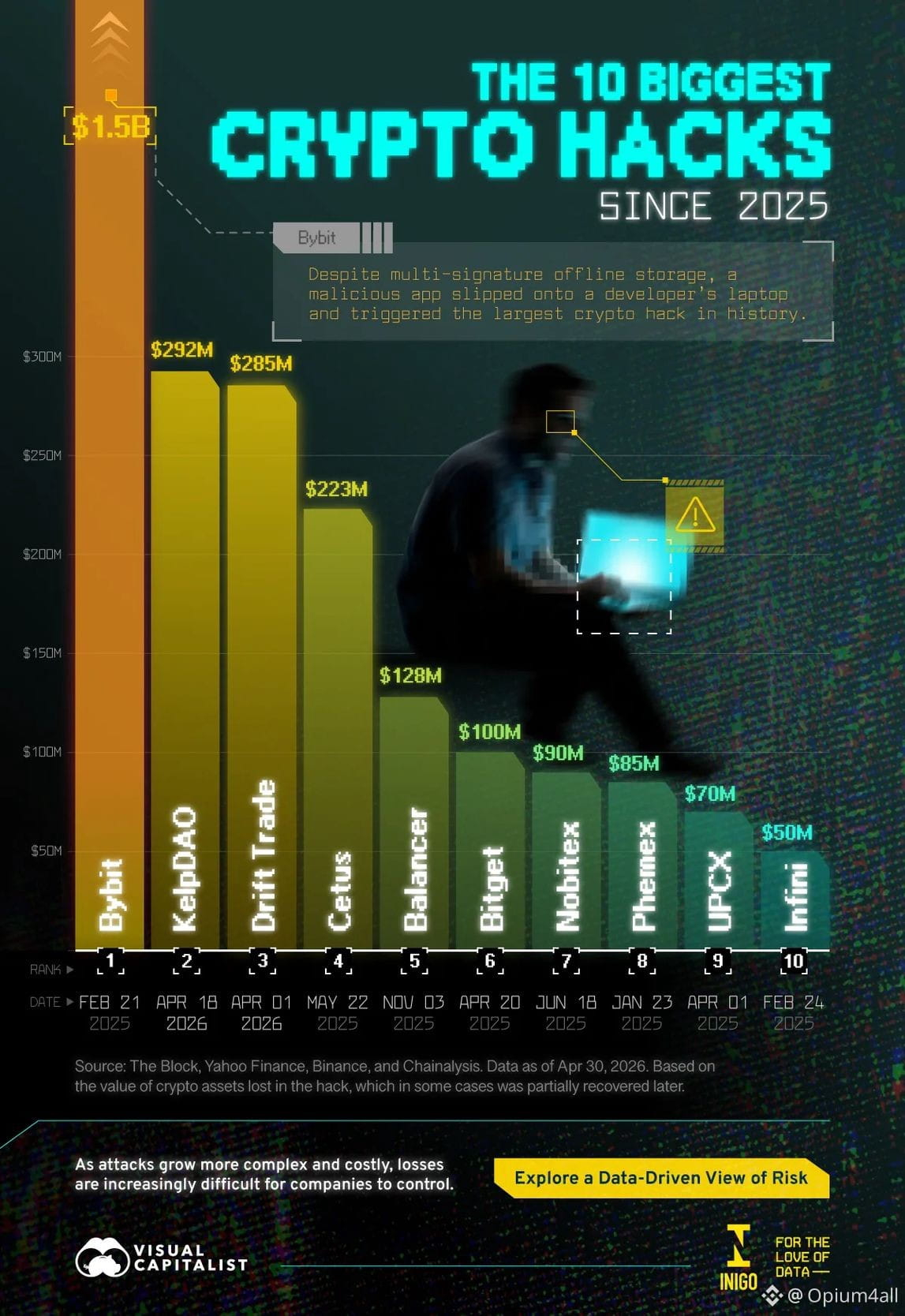
From 2025 onward, crypto hacks have not only become more frequent, but also significantly more expensive for exchanges, DeFi projects, and investors.
This is reported by Visual Capitalist.
The largest crypto hacks
The Bybit breach in February 2025 became the biggest crypto theft in the entire history of the market. As a result of the hack, the attackers stole about $1.5 billion—this is a record crypto hack in the history of the industry.
The hackers were able to gain access to a third-party developer’s workstation and discreetly embed malicious code into the transaction processing workflow. As a result, the system displayed transfers as legitimate, although in reality the funds were being redirected to the attackers’ wallets.
The second and third largest crypto hacks occurred in April 2026. These involve cases with KelpDAO and Drift Trade.
In the case of KelpDAO, the hackers attacked a third-party system that checked transactions between different blockchains. The attackers managed to:
forge a collateral deposit;
create the appearance of available collateral;
gain access to approximately $292 million in crypto assets.
In effect, the system “believed” that on one blockchain the real assets were locked, and allowed the withdrawal of the actual funds to another
#DEFİ
#bybit
#KelpDAO
From 2025 onward, crypto hacks have not only become more frequent, but also significantly more expensive for exchanges, DeFi projects, and investors.
This is reported by Visual Capitalist.
The largest crypto hacks
The Bybit breach in February 2025 became the biggest crypto theft in the entire history of the market. As a result of the hack, the attackers stole about $1.5 billion—this is a record crypto hack in the history of the industry.
The hackers were able to gain access to a third-party developer’s workstation and discreetly embed malicious code into the transaction processing workflow. As a result, the system displayed transfers as legitimate, although in reality the funds were being redirected to the attackers’ wallets.
The second and third largest crypto hacks occurred in April 2026. These involve cases with KelpDAO and Drift Trade.
In the case of KelpDAO, the hackers attacked a third-party system that checked transactions between different blockchains. The attackers managed to:
forge a collateral deposit;
create the appearance of available collateral;
gain access to approximately $292 million in crypto assets.
In effect, the system “believed” that on one blockchain the real assets were locked, and allowed the withdrawal of the actual funds to another
#bybit
#KelpDAO
From 2025 onward, crypto hacks have not only become more frequent, but also significantly more expensive for exchanges, DeFi projects, and investors.
This is reported by Visual Capitalist.
The largest crypto hacks
The Bybit breach in February 2025 became the biggest crypto theft in the entire history of the market. As a result of the hack, the attackers stole about $1.5 billion—this is a record crypto hack in the history of the industry.
The hackers were able to gain access to a third-party developer’s workstation and discreetly embed malicious code into the transaction processing workflow. As a result, the system displayed transfers as legitimate, although in reality the funds were being redirected to the attackers’ wallets.
The second and third largest crypto hacks occurred in April 2026. These involve cases with KelpDAO and Drift Trade.
In the case of KelpDAO, the hackers attacked a third-party system that checked transactions between different blockchains. The attackers managed to:
forge a collateral deposit;
create the appearance of available collateral;
gain access to approximately $292 million in crypto assets.
In effect, the system “believed” that on one blockchain the real assets were locked, and allowed the withdrawal of the actual funds to another
233

🚨🛡️ AAVE'S RESPONSE: They propose a four-layer bridge risk framework after the KelpDAO exploit.
Security in the DeFi ecosystem is taking a bold step forward. Following the recent attack vector that hit the KelpDAO restaking protocol, Aave has put forth a governance proposal to implement a groundbreaking Four-Layer Bridge Risk Framework. 📈⚖️
The defense barriers proposed by the Risk Committee:
* 1. Strict Authentication: Decentralized multi-signature validation to safeguard interchain messaging.
* 2. Dynamic Limits: Automatic supply caps to prevent external exploits from contaminating global liquidity pools. 💸❌
* 3. Automatic Circuit Breakers: Immediate market freeze of an asset if price anomalies or massive token emissions are detected in milliseconds.
* 4. Collateral Isolation: Automatic degradation of bridged assets if their real on-chain backing shows accounting discrepancies.
⚠️ Vital OpSec Alert: Exploits on external protocols highlight the importance of auditing your own wallets. If you've used bridge platforms recently, make sure to access verified security dApps and revoke unlimited spending permissions. If you're moving funds to shield yourself from volatility in your Web3 Wallet within @Binance, always check the addresses character by character manually to completely neutralize address poisoning attacks. 🔒
Is this framework the new ultimate security standard that Web3 needs to eliminate bridge hacks? I want to hear your thoughts below! 👇
#AAVE #KelpDAO #defi #CryptoNewss $AAVE $USDT
🚨🛡️ AAVE'S RESPONSE: They propose a four-layer bridge risk framework after the KelpDAO exploit.
Security in the DeFi ecosystem is taking a bold step forward. Following the recent attack vector that hit the KelpDAO restaking protocol, Aave has put forth a governance proposal to implement a groundbreaking Four-Layer Bridge Risk Framework. 📈⚖️
The defense barriers proposed by the Risk Committee:
* 1. Strict Authentication: Decentralized multi-signature validation to safeguard interchain messaging.
* 2. Dynamic Limits: Automatic supply caps to prevent external exploits from contaminating global liquidity pools. 💸❌
* 3. Automatic Circuit Breakers: Immediate market freeze of an asset if price anomalies or massive token emissions are detected in milliseconds.
* 4. Collateral Isolation: Automatic degradation of bridged assets if their real on-chain backing shows accounting discrepancies.
⚠️ Vital OpSec Alert: Exploits on external protocols highlight the importance of auditing your own wallets. If you've used bridge platforms recently, make sure to access verified security dApps and revoke unlimited spending permissions. If you're moving funds to shield yourself from volatility in your Web3 Wallet within @Binance, always check the addresses character by character manually to completely neutralize address poisoning attacks. 🔒
Is this framework the new ultimate security standard that Web3 needs to eliminate bridge hacks? I want to hear your thoughts below! 👇
#AAVE #KelpDAO #defi #CryptoNewss $AAVE $USDT
Security in the DeFi ecosystem is taking a bold step forward. Following the recent attack vector that hit the KelpDAO restaking protocol, Aave has put forth a governance proposal to implement a groundbreaking Four-Layer Bridge Risk Framework. 📈⚖️
The defense barriers proposed by the Risk Committee:
* 1. Strict Authentication: Decentralized multi-signature validation to safeguard interchain messaging.
* 2. Dynamic Limits: Automatic supply caps to prevent external exploits from contaminating global liquidity pools. 💸❌
* 3. Automatic Circuit Breakers: Immediate market freeze of an asset if price anomalies or massive token emissions are detected in milliseconds.
* 4. Collateral Isolation: Automatic degradation of bridged assets if their real on-chain backing shows accounting discrepancies.
⚠️ Vital OpSec Alert: Exploits on external protocols highlight the importance of auditing your own wallets. If you've used bridge platforms recently, make sure to access verified security dApps and revoke unlimited spending permissions. If you're moving funds to shield yourself from volatility in your Web3 Wallet within @Binance, always check the addresses character by character manually to completely neutralize address poisoning attacks. 🔒
Is this framework the new ultimate security standard that Web3 needs to eliminate bridge hacks? I want to hear your thoughts below! 👇
#AAVE #KelpDAO #defi #CryptoNewss $AAVE $USDT
1
175
Log in to explore more content
Join global crypto users on Binance Square
⚡️ Get latest and useful information about crypto.
💬 Trusted by the world’s largest crypto exchange.
👍 Discover real insights from verified creators.
Email / Phone number
Trending Topics
1
#EarningsSeason
85,419 views
825 Discussing
2
#ECBToTestAIAgentsInDigitalEuroPayments
348 views
77 Discussing
3
#JapanFSABacksFourthStablecoinTradeSettlementPilot
2,803 views
185 Discussing
4
#BitgetHackerFailsToMoveStolenFunds
11,106 views
322 Discussing
5
#BitMineETHHoldingsTop6Million
13,140 views
486 Discussing
6
#StrategyAdds1666BTCHoldingsReach847666
11,537 views
334 Discussing
7
#NvidiaApproves$150BBuyback
3,501 views
61 Discussing
8
#OpenAIDelaysGPT6.1OverSafetyIssues
24,723 views
672 Discussing
9
#AMDToAcquireWorldLabsFor$8.2B
1,741 views
52 Discussing
10
#AnthropicIPOProspectusCouldValueItOver$2T
5,560 views
75 Discussing