
#inflation
inflation
3.4M views
9,065 Discussing
Hot
Latest

Verified
🚨 The Federal Reserve just delivered its first rate hike in 3 years and completely flipped the market script.
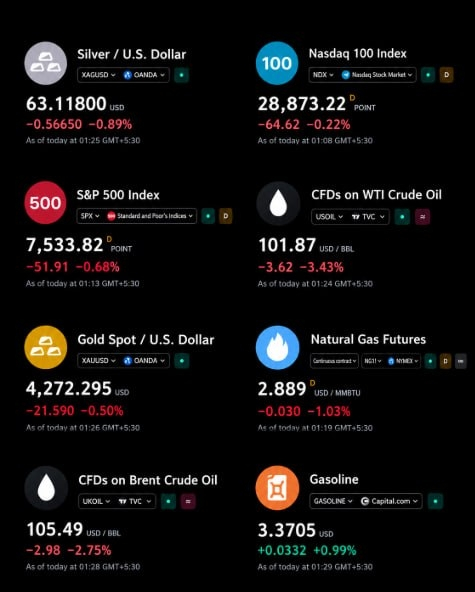
Green transformed into direct red across stocks, oil, gold, silver, and natural gas.
Here is why Fed Chair Kevin Warsh’s emergency pivot broke the market:
Investors came in betting on a soft landing and rate pauses, but the Fed was forced into hard action. The central bank just raised rates to a target range of 3.75% to 4.00%, putting an official end to the holding era.
During the press conference, Warsh didn't offer any dovish comfort. He cut straight to the point: “Inflation is too high and has been for too long.”
Risk assets immediately started unwinding. Stocks sank, commodities got crushed across the board, and capital flooded out of volatile assets.
Energy was the lone survivor. While natural gas fell with broader markets, gasoline remained up nearly +1.00% as global supply crunches and geopolitical pressure keep pump prices elevated.
The biggest shockwave was the revised dot plot. Wall Street was caught completely off guard as traders aggressively repriced TWO more rate hikes before year-end.
The cheap money era isn't coming back higher for longer is officially the mandate.
#FedHike #KevinWarsh #StockMarket #Inflation #CryptoNews
🚨 The Federal Reserve just delivered its first rate hike in 3 years and completely flipped the market script.
Green transformed into direct red across stocks, oil, gold, silver, and natural gas.
Here is why Fed Chair Kevin Warsh’s emergency pivot broke the market:
Investors came in betting on a soft landing and rate pauses, but the Fed was forced into hard action. The central bank just raised rates to a target range of 3.75% to 4.00%, putting an official end to the holding era.
During the press conference, Warsh didn't offer any dovish comfort. He cut straight to the point: “Inflation is too high and has been for too long.”
Risk assets immediately started unwinding. Stocks sank, commodities got crushed across the board, and capital flooded out of volatile assets.
Energy was the lone survivor. While natural gas fell with broader markets, gasoline remained up nearly +1.00% as global supply crunches and geopolitical pressure keep pump prices elevated.
The biggest shockwave was the revised dot plot. Wall Street was caught completely off guard as traders aggressively repriced TWO more rate hikes before year-end.
The cheap money era isn't coming back higher for longer is officially the mandate.
#FedHike #KevinWarsh #StockMarket #Inflation #CryptoNews
Green transformed into direct red across stocks, oil, gold, silver, and natural gas.
Here is why Fed Chair Kevin Warsh’s emergency pivot broke the market:
Investors came in betting on a soft landing and rate pauses, but the Fed was forced into hard action. The central bank just raised rates to a target range of 3.75% to 4.00%, putting an official end to the holding era.
During the press conference, Warsh didn't offer any dovish comfort. He cut straight to the point: “Inflation is too high and has been for too long.”
Risk assets immediately started unwinding. Stocks sank, commodities got crushed across the board, and capital flooded out of volatile assets.
Energy was the lone survivor. While natural gas fell with broader markets, gasoline remained up nearly +1.00% as global supply crunches and geopolitical pressure keep pump prices elevated.
The biggest shockwave was the revised dot plot. Wall Street was caught completely off guard as traders aggressively repriced TWO more rate hikes before year-end.
The cheap money era isn't coming back higher for longer is officially the mandate.
#FedHike #KevinWarsh #StockMarket #Inflation #CryptoNews
1
702

Eurostat released the finalized August Consumer Price Index (CPI) data for the Eurozone today, showing annual inflation cooling slightly to 3.2%, coming in below the forecast and previous reading of 3.3%. On a monthly basis, CPI held steady at 0.4%, matching market expectations.
This downward revision in the headline annual rate confirms that disinflationary trends across the bloc remain intact despite lingering energy supply uncertainties, such as Gassco's planned Norwegian gas export curtailments. For the European Central Bank, softer inflation prints relieve aggressive tightening pressure, aligning with market expectations for a more accommodative monetary path.
Across traditional markets, the lower-than-expected print puts slight downward pressure on Euro yields and trims EUR strength against the USD. Bond markets are breathing a sigh of relief as cooling inflation solidifies the case for sustained rate cuts, keeping broader financial conditions from tightening further.
For crypto assets, stable European disinflation combined with a softer global rate trajectory creates a favorable macro liquidity backdrop. If central banks continue easing monetary conditions without triggering recession fears, risk-on capital will likely rotate steadily into major assets like $BTC and broader altcoins. 📊
#EurozoneCPI #Inflation #MacroEconomics
Eurostat released the finalized August Consumer Price Index (CPI) data for the Eurozone today, showing annual inflation cooling slightly to 3.2%, coming in below the forecast and previous reading of 3.3%. On a monthly basis, CPI held steady at 0.4%, matching market expectations.
This downward revision in the headline annual rate confirms that disinflationary trends across the bloc remain intact despite lingering energy supply uncertainties, such as Gassco's planned Norwegian gas export curtailments. For the European Central Bank, softer inflation prints relieve aggressive tightening pressure, aligning with market expectations for a more accommodative monetary path.
Across traditional markets, the lower-than-expected print puts slight downward pressure on Euro yields and trims EUR strength against the USD. Bond markets are breathing a sigh of relief as cooling inflation solidifies the case for sustained rate cuts, keeping broader financial conditions from tightening further.
For crypto assets, stable European disinflation combined with a softer global rate trajectory creates a favorable macro liquidity backdrop. If central banks continue easing monetary conditions without triggering recession fears, risk-on capital will likely rotate steadily into major assets like $BTC and broader altcoins. 📊
#EurozoneCPI #Inflation #MacroEconomics
This downward revision in the headline annual rate confirms that disinflationary trends across the bloc remain intact despite lingering energy supply uncertainties, such as Gassco's planned Norwegian gas export curtailments. For the European Central Bank, softer inflation prints relieve aggressive tightening pressure, aligning with market expectations for a more accommodative monetary path.
Across traditional markets, the lower-than-expected print puts slight downward pressure on Euro yields and trims EUR strength against the USD. Bond markets are breathing a sigh of relief as cooling inflation solidifies the case for sustained rate cuts, keeping broader financial conditions from tightening further.
For crypto assets, stable European disinflation combined with a softer global rate trajectory creates a favorable macro liquidity backdrop. If central banks continue easing monetary conditions without triggering recession fears, risk-on capital will likely rotate steadily into major assets like $BTC and broader altcoins. 📊
#EurozoneCPI #Inflation #MacroEconomics
7


Verified
📈 🇬🇧 UK Inflation Accelerates to 3.1% in August: The Real Signal Is Beneath the Headline
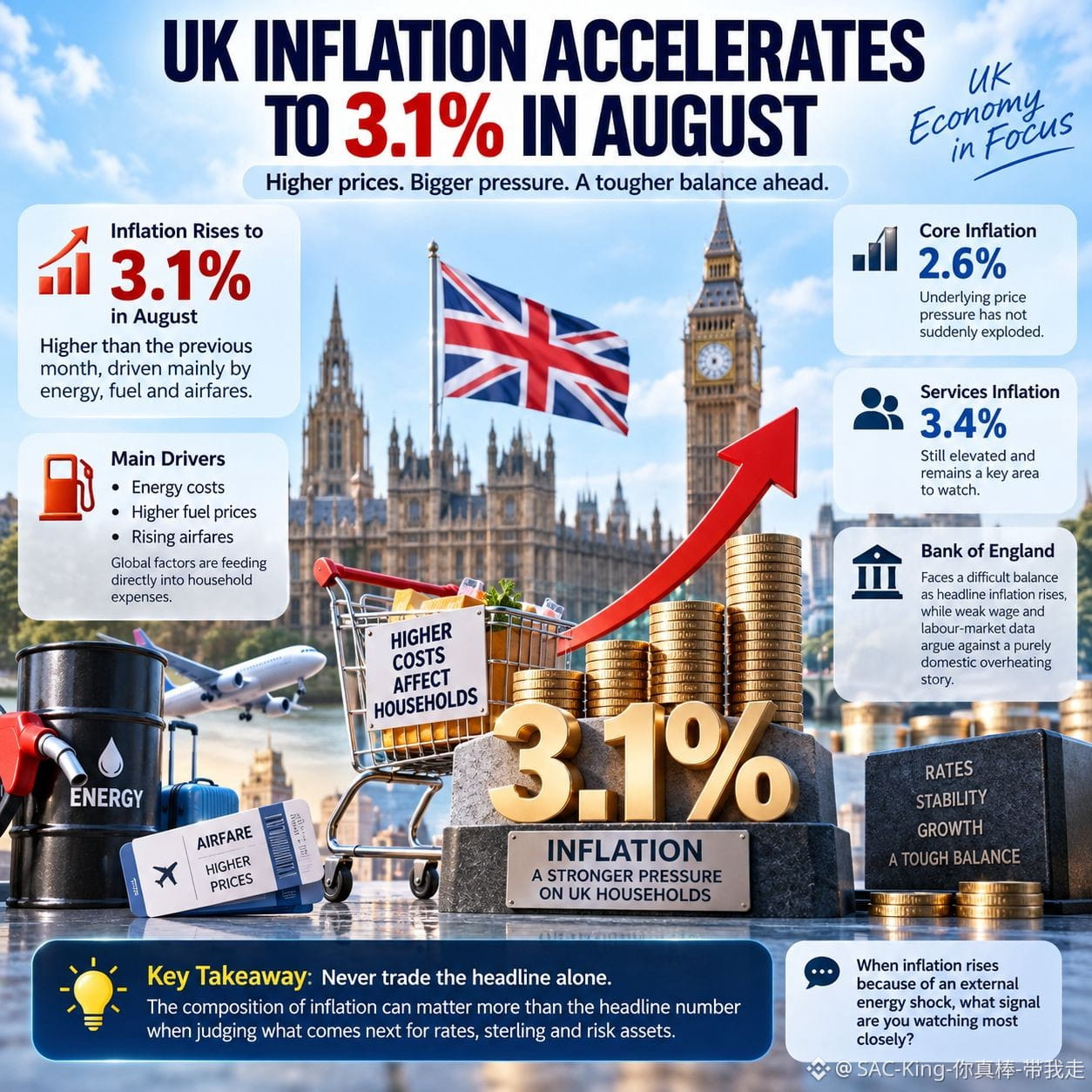
Inflation climbing to 3.1% is uncomfortable, but the more interesting detail is why it happened. August’s increase was driven largely by energy, fuel and airfares, rather than a broad acceleration across underlying prices.
Higher global energy costs are feeding directly into household expenses, reminding markets how quickly geopolitical shocks can reach everyday prices.
Yet core inflation held at 2.6%, while services inflation stayed at 3.4%. That matters because it suggests underlying price pressure has not suddenly exploded.
For the Bank of England, this creates a difficult balance: headline inflation is moving higher, but weak wage and labour-market data argue against treating the rise as purely domestic overheating.
My takeaway: never trade the headline alone. The composition of inflation can matter more than the headline number when judging what comes next for rates, sterling and risk assets.
When inflation rises because of an external energy shock, what signal are you watching most closely?
Educational purposes only, not financial advice.
#UKInflation #Inflation #GrowWithSAC $SYN $ARB $BEB
📈 🇬🇧 UK Inflation Accelerates to 3.1% in August: The Real Signal Is Beneath the Headline
Inflation climbing to 3.1% is uncomfortable, but the more interesting detail is why it happened. August’s increase was driven largely by energy, fuel and airfares, rather than a broad acceleration across underlying prices.
Higher global energy costs are feeding directly into household expenses, reminding markets how quickly geopolitical shocks can reach everyday prices.
Yet core inflation held at 2.6%, while services inflation stayed at 3.4%. That matters because it suggests underlying price pressure has not suddenly exploded.
For the Bank of England, this creates a difficult balance: headline inflation is moving higher, but weak wage and labour-market data argue against treating the rise as purely domestic overheating.
My takeaway: never trade the headline alone. The composition of inflation can matter more than the headline number when judging what comes next for rates, sterling and risk assets.
When inflation rises because of an external energy shock, what signal are you watching most closely?
Educational purposes only, not financial advice.
#UKInflation #Inflation #GrowWithSAC $SYN $ARB $BEB
Inflation climbing to 3.1% is uncomfortable, but the more interesting detail is why it happened. August’s increase was driven largely by energy, fuel and airfares, rather than a broad acceleration across underlying prices.
Higher global energy costs are feeding directly into household expenses, reminding markets how quickly geopolitical shocks can reach everyday prices.
Yet core inflation held at 2.6%, while services inflation stayed at 3.4%. That matters because it suggests underlying price pressure has not suddenly exploded.
For the Bank of England, this creates a difficult balance: headline inflation is moving higher, but weak wage and labour-market data argue against treating the rise as purely domestic overheating.
My takeaway: never trade the headline alone. The composition of inflation can matter more than the headline number when judging what comes next for rates, sterling and risk assets.
When inflation rises because of an external energy shock, what signal are you watching most closely?
Educational purposes only, not financial advice.
#UKInflation #Inflation #GrowWithSAC $SYN $ARB $BEB
154

📊 CPI vs PPI: Why Your Crypto Portfolio Cares About Inflation Data More Than You Think**
Ever wonder why Bitcoin dumps or pumps the second a U.S. inflation report drops? It's not random — it's the Fed.
Here's the chain reaction in simple terms 👇
🔹 CPI (Consumer Price Index)— what YOU pay at the store
🔹 PPI (Producer Price Index)— what businesses pay BEFORE you see the price
PPI is basically a sneak peek. If producers' costs are rising, consumer prices usually follow.
Why it moves crypto:
1️⃣ Hot inflation (above expectations) → Fed likely keeps rates high or hikes → dollar strengthens → risk assets like crypto get squeezed 📉
2️⃣ Cool inflation (below expectations) → Fed has room to cut rates → liquidity returns → risk assets breathe again 📈
Crypto is a risk asset, plain and simple. It trades on liquidity expectations, and the Fed controls the liquidity tap.
My take:Don't just watch the price — watch the calendar. CPI and PPI release dates often matter more than any chart pattern. The smart money positions itself BEFORE these reports, not after.
Knowledge is an edge. Stay sharp. 🧠⚡
#Bitcoin #Inflation #BinanceSquareFamily #CryptoEducation
📊 CPI vs PPI: Why Your Crypto Portfolio Cares About Inflation Data More Than You Think**
Ever wonder why Bitcoin dumps or pumps the second a U.S. inflation report drops? It's not random — it's the Fed.
Here's the chain reaction in simple terms 👇
🔹 CPI (Consumer Price Index)— what YOU pay at the store
🔹 PPI (Producer Price Index)— what businesses pay BEFORE you see the price
PPI is basically a sneak peek. If producers' costs are rising, consumer prices usually follow.
Why it moves crypto:
1️⃣ Hot inflation (above expectations) → Fed likely keeps rates high or hikes → dollar strengthens → risk assets like crypto get squeezed 📉
2️⃣ Cool inflation (below expectations) → Fed has room to cut rates → liquidity returns → risk assets breathe again 📈
Crypto is a risk asset, plain and simple. It trades on liquidity expectations, and the Fed controls the liquidity tap.
My take:Don't just watch the price — watch the calendar. CPI and PPI release dates often matter more than any chart pattern. The smart money positions itself BEFORE these reports, not after.
Knowledge is an edge. Stay sharp. 🧠⚡
#Bitcoin #Inflation #BinanceSquareFamily #CryptoEducation
Ever wonder why Bitcoin dumps or pumps the second a U.S. inflation report drops? It's not random — it's the Fed.
Here's the chain reaction in simple terms 👇
🔹 CPI (Consumer Price Index)— what YOU pay at the store
🔹 PPI (Producer Price Index)— what businesses pay BEFORE you see the price
PPI is basically a sneak peek. If producers' costs are rising, consumer prices usually follow.
Why it moves crypto:
1️⃣ Hot inflation (above expectations) → Fed likely keeps rates high or hikes → dollar strengthens → risk assets like crypto get squeezed 📉
2️⃣ Cool inflation (below expectations) → Fed has room to cut rates → liquidity returns → risk assets breathe again 📈
Crypto is a risk asset, plain and simple. It trades on liquidity expectations, and the Fed controls the liquidity tap.
My take:Don't just watch the price — watch the calendar. CPI and PPI release dates often matter more than any chart pattern. The smart money positions itself BEFORE these reports, not after.
Knowledge is an edge. Stay sharp. 🧠⚡
#Bitcoin #Inflation #BinanceSquareFamily #CryptoEducation

75
Crude oil benchmarks witnessed renewed selling pressure today as WTI dropped below the critical $100 per barrel threshold, falling 0.93% on the day, while Brent slid beneath $104 per barrel with a 0.92% decline. The breach of these psychological support levels reflects growing market repositioning amid shifting global macro conditions.
This pullback is significant because triple-digit oil prices have been one of the primary drivers fueling persistent global inflation concerns. A decisive breakdown below $100 signals that markets may be aggressively pricing in slowing aggregate demand and rising recession risks, counterbalancing earlier supply disruption fears.
Across traditional finance, sustained weakness in energy commodities tends to ease headline inflation expectations. This dynamic could provide room for sovereign bond yields to stabilize and temper aggressive central bank tightening paths, though lingering recessionary headwinds could cap broader risk asset rallies in the short term.
For the crypto market, cooling energy costs offer a constructive macroeconomic backdrop. Lower inflationary pressures could eventually soften central bank liquidity drains, creating a more favorable environment for speculative capital and risk-on assets like $BTC as liquidity conditions improve over the medium term.
#OilPrices #MacroEconomics #Inflation
Crude oil benchmarks witnessed renewed selling pressure today as WTI dropped below the critical $100 per barrel threshold, falling 0.93% on the day, while Brent slid beneath $104 per barrel with a 0.92% decline. The breach of these psychological support levels reflects growing market repositioning amid shifting global macro conditions.
This pullback is significant because triple-digit oil prices have been one of the primary drivers fueling persistent global inflation concerns. A decisive breakdown below $100 signals that markets may be aggressively pricing in slowing aggregate demand and rising recession risks, counterbalancing earlier supply disruption fears.
Across traditional finance, sustained weakness in energy commodities tends to ease headline inflation expectations. This dynamic could provide room for sovereign bond yields to stabilize and temper aggressive central bank tightening paths, though lingering recessionary headwinds could cap broader risk asset rallies in the short term.
For the crypto market, cooling energy costs offer a constructive macroeconomic backdrop. Lower inflationary pressures could eventually soften central bank liquidity drains, creating a more favorable environment for speculative capital and risk-on assets like $BTC as liquidity conditions improve over the medium term.
#OilPrices #MacroEconomics #Inflation
This pullback is significant because triple-digit oil prices have been one of the primary drivers fueling persistent global inflation concerns. A decisive breakdown below $100 signals that markets may be aggressively pricing in slowing aggregate demand and rising recession risks, counterbalancing earlier supply disruption fears.
Across traditional finance, sustained weakness in energy commodities tends to ease headline inflation expectations. This dynamic could provide room for sovereign bond yields to stabilize and temper aggressive central bank tightening paths, though lingering recessionary headwinds could cap broader risk asset rallies in the short term.
For the crypto market, cooling energy costs offer a constructive macroeconomic backdrop. Lower inflationary pressures could eventually soften central bank liquidity drains, creating a more favorable environment for speculative capital and risk-on assets like $BTC as liquidity conditions improve over the medium term.
#OilPrices #MacroEconomics #Inflation
352

·
--
Bullish
#FedRateWatch - FOMC September
👀
This week is crucial for the Fed's next move! 🚀
August CPI Rose 0.3% Month-over-Month:
Inflation remains sticky and the probability of a 25bp hike is now close to 90%. The real question is - will this be a one-off hike or the start of a longer hiking cycle?
Market Impact:
👉Bitcoin: Risk-off sentiment could trigger a correction, but the structural uptrend remains intact.
😍Tech Stocks: A Fed pause would spark an explosive rally.
😘Gold: Positioned strongly as a hedging asset if rates continue rising.
My Trading Strategy: 🎯
💥Short-term: Expecting consolidation before the hike announcement.
💥BTC Position: Following a DCA strategy, treating volatility as opportunity.
💥Tech Allocation: Selective buying on dips - conviction in growth names remains strong.
👻Key Questions:
Is this hike setting up a new bear market, or just another correction chapter? The battle between BTC resilience and tech recovery is worth watching closely.
What's your trading plan for September? Share your strategy below!
#Fed #bitcoin #Inflation #fomc $NVDAB
{spot}(NVDABUSDT)
$BTC $NVDA.US
{stock_us}(NVDA.US)
{future}(BTCUSDT)
#FedRateWatch - FOMC September
👀
This week is crucial for the Fed's next move! 🚀
August CPI Rose 0.3% Month-over-Month:
Inflation remains sticky and the probability of a 25bp hike is now close to 90%. The real question is - will this be a one-off hike or the start of a longer hiking cycle?
Market Impact:
👉Bitcoin: Risk-off sentiment could trigger a correction, but the structural uptrend remains intact.
😍Tech Stocks: A Fed pause would spark an explosive rally.
😘Gold: Positioned strongly as a hedging asset if rates continue rising.
My Trading Strategy: 🎯
💥Short-term: Expecting consolidation before the hike announcement.
💥BTC Position: Following a DCA strategy, treating volatility as opportunity.
💥Tech Allocation: Selective buying on dips - conviction in growth names remains strong.
👻Key Questions:
Is this hike setting up a new bear market, or just another correction chapter? The battle between BTC resilience and tech recovery is worth watching closely.
What's your trading plan for September? Share your strategy below!
#Fed #bitcoin #Inflation #fomc $NVDAB
$BTC $NVDA.US
👀
This week is crucial for the Fed's next move! 🚀
August CPI Rose 0.3% Month-over-Month:
Inflation remains sticky and the probability of a 25bp hike is now close to 90%. The real question is - will this be a one-off hike or the start of a longer hiking cycle?
Market Impact:
👉Bitcoin: Risk-off sentiment could trigger a correction, but the structural uptrend remains intact.
😍Tech Stocks: A Fed pause would spark an explosive rally.
😘Gold: Positioned strongly as a hedging asset if rates continue rising.
My Trading Strategy: 🎯
💥Short-term: Expecting consolidation before the hike announcement.
💥BTC Position: Following a DCA strategy, treating volatility as opportunity.
💥Tech Allocation: Selective buying on dips - conviction in growth names remains strong.
👻Key Questions:
Is this hike setting up a new bear market, or just another correction chapter? The battle between BTC resilience and tech recovery is worth watching closely.
What's your trading plan for September? Share your strategy below!
#Fed #bitcoin #Inflation #fomc $NVDAB
$BTC $NVDA.US
1
73

·
--
🦈 $BTC UNDER PRESSURE AS DIESEL PRINTS RECORD HIGH ⚡
Diesel at $6.26 is not just an energy chart, it is a tax on every truck, food shelf, and shipping container. 🦈 Smart money watches this because sticky transport costs can keep core inflation hot, forcing the Fed to stay hawkish. ⚡ That pressure can drain speculative liquidity and make risk assets fragile until the cost curve cools. 💡 The key question is whether $BTC can absorb higher rates or needs a cleaner macro bid first. 👇 Are you positioning for resilience or expecting energy inflation to drag crypto lower?
⚠️ Not financial advice. Always manage your risk. 🛡️
🏷️ #BTC #Macro #Inflation #Crypto
📊 🦈
🦈 $BTC UNDER PRESSURE AS DIESEL PRINTS RECORD HIGH ⚡
Diesel at $6.26 is not just an energy chart, it is a tax on every truck, food shelf, and shipping container. 🦈 Smart money watches this because sticky transport costs can keep core inflation hot, forcing the Fed to stay hawkish. ⚡ That pressure can drain speculative liquidity and make risk assets fragile until the cost curve cools. 💡 The key question is whether $BTC can absorb higher rates or needs a cleaner macro bid first. 👇 Are you positioning for resilience or expecting energy inflation to drag crypto lower?
⚠️ Not financial advice. Always manage your risk. 🛡️
🏷️ #BTC #Macro #Inflation #Crypto
📊 🦈
Diesel at $6.26 is not just an energy chart, it is a tax on every truck, food shelf, and shipping container. 🦈 Smart money watches this because sticky transport costs can keep core inflation hot, forcing the Fed to stay hawkish. ⚡ That pressure can drain speculative liquidity and make risk assets fragile until the cost curve cools. 💡 The key question is whether $BTC can absorb higher rates or needs a cleaner macro bid first. 👇 Are you positioning for resilience or expecting energy inflation to drag crypto lower?
⚠️ Not financial advice. Always manage your risk. 🛡️
🏷️ #BTC #Macro #Inflation #Crypto
📊 🦈
19
In a fresh macro research report released on Monday, investment banking giant Morgan Stanley updated its Federal Reserve outlook, projecting two additional 25 bps rate hikes in September and December amid stubborn global inflation drivers.
This shift in Wall Street expectations comes as disinflation proves slower than expected, driven by second-round energy costs, soaring AI infrastructure spending, and elevated neutral rate estimates. The inflationary backdrop is reinforced globally by rising UK energy forecasts, where household power bills are projected to jump roughly 25% by January, threatening to push British inflation above 4%—double the central bank's official target.
For traditional financial markets, hawkish policy recalibrations are pushing bond yields higher and bolstering the US dollar index, keeping downward pressure on broad risk assets. Fixed-income markets must price in persistent structural inflation as central banks from the Fed to the ECB remain backed into a corner.
For the crypto sector, tighter liquidity dynamics and a resilient dollar mean risk appetite remains constrained in the near term. $BTC and major digital assets could face choppy price action as institutional flows hesitate to deploy aggressive capital into speculative assets while risk-free yields remain elevated.
#Fed #InterestRates #Inflation
In a fresh macro research report released on Monday, investment banking giant Morgan Stanley updated its Federal Reserve outlook, projecting two additional 25 bps rate hikes in September and December amid stubborn global inflation drivers.
This shift in Wall Street expectations comes as disinflation proves slower than expected, driven by second-round energy costs, soaring AI infrastructure spending, and elevated neutral rate estimates. The inflationary backdrop is reinforced globally by rising UK energy forecasts, where household power bills are projected to jump roughly 25% by January, threatening to push British inflation above 4%—double the central bank's official target.
For traditional financial markets, hawkish policy recalibrations are pushing bond yields higher and bolstering the US dollar index, keeping downward pressure on broad risk assets. Fixed-income markets must price in persistent structural inflation as central banks from the Fed to the ECB remain backed into a corner.
For the crypto sector, tighter liquidity dynamics and a resilient dollar mean risk appetite remains constrained in the near term. $BTC and major digital assets could face choppy price action as institutional flows hesitate to deploy aggressive capital into speculative assets while risk-free yields remain elevated.
#Fed #InterestRates #Inflation
This shift in Wall Street expectations comes as disinflation proves slower than expected, driven by second-round energy costs, soaring AI infrastructure spending, and elevated neutral rate estimates. The inflationary backdrop is reinforced globally by rising UK energy forecasts, where household power bills are projected to jump roughly 25% by January, threatening to push British inflation above 4%—double the central bank's official target.
For traditional financial markets, hawkish policy recalibrations are pushing bond yields higher and bolstering the US dollar index, keeping downward pressure on broad risk assets. Fixed-income markets must price in persistent structural inflation as central banks from the Fed to the ECB remain backed into a corner.
For the crypto sector, tighter liquidity dynamics and a resilient dollar mean risk appetite remains constrained in the near term. $BTC and major digital assets could face choppy price action as institutional flows hesitate to deploy aggressive capital into speculative assets while risk-free yields remain elevated.
#Fed #InterestRates #Inflation
11

·
--
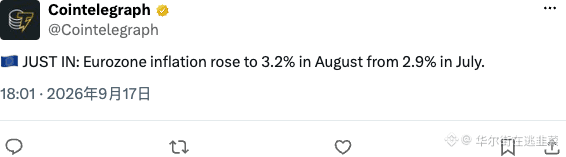
The ECB has just shown some breathing room: in August, inflation rebounded directly to 3.2%, up from the prior 2.9%. Rate-cut expectations now have to be pushed further back again; the euro strengthens and the dollar faces pressure, and risk assets will likely wobble in the short term. Don’t rush to bottom-fish—inflation is something that cures all kinds of defiance.
$BTC $ETH #Eurozone #Inflation #ECB #BTC
The ECB has just shown some breathing room: in August, inflation rebounded directly to 3.2%, up from the prior 2.9%. Rate-cut expectations now have to be pushed further back again; the euro strengthens and the dollar faces pressure, and risk assets will likely wobble in the short term. Don’t rush to bottom-fish—inflation is something that cures all kinds of defiance.
$BTC $ETH #Eurozone #Inflation #ECB #BTC
$BTC $ETH #Eurozone #Inflation #ECB #BTC
218

The latest data released by the EU’s statistical office shows the final Eurozone CPI figures for August. The data indicates that the Eurozone’s August CPI annual rate final value actually came in at 3.2%, below the market’s prior expectation of 3.3%. Meanwhile, the August CPI month-on-month final value was 0.4%, fully matching market expectations and in line with the previous figure. The inflation data showed an unexpectedly cooling trend, giving the European Central Bank more room to maneuver for its future monetary policy.
From a macro technical perspective, the decline in the inflation annual rate to 3.2% suggests that price pressures in the Eurozone are steadily easing. Although Norwegian gas operator Gassco increased the amount of supply disruption for September 18–19 to 55.1 million cubic meters, raising short-term concerns on the energy front, the overall downward trend in inflation has not been disrupted, and the previously feared risk of a second-round inflationary surge has been further discredited.
This data is directly positive for global risk assets. The easing of Eurozone inflation strengthens the market’s expectations that the ECB will continue to adopt a more accommodative stance in the future, limiting the upside space for yields on European sovereign bonds. The global liquidity environment is expected to remain marginally loose, and the upward momentum of the U.S. dollar index is also somewhat constrained, providing support for commodities and equity markets.
As for the crypto market, $BTC and the technical setup of major risk assets are currently in a buildup phase. The continued slowdown in macro inflation is providing rebound momentum for crypto assets from the liquidity base layer. As the ECB’s rate-cut path becomes clearer, off-exchange capital is expected to flow back into Risk-on assets; in the short term, the crypto market may seize the opportunity to launch a new round of upside breakout tests.📈
#EurozoneCPI #Inflation #MacroEconomics
The latest data released by the EU’s statistical office shows the final Eurozone CPI figures for August. The data indicates that the Eurozone’s August CPI annual rate final value actually came in at 3.2%, below the market’s prior expectation of 3.3%. Meanwhile, the August CPI month-on-month final value was 0.4%, fully matching market expectations and in line with the previous figure. The inflation data showed an unexpectedly cooling trend, giving the European Central Bank more room to maneuver for its future monetary policy.
From a macro technical perspective, the decline in the inflation annual rate to 3.2% suggests that price pressures in the Eurozone are steadily easing. Although Norwegian gas operator Gassco increased the amount of supply disruption for September 18–19 to 55.1 million cubic meters, raising short-term concerns on the energy front, the overall downward trend in inflation has not been disrupted, and the previously feared risk of a second-round inflationary surge has been further discredited.
This data is directly positive for global risk assets. The easing of Eurozone inflation strengthens the market’s expectations that the ECB will continue to adopt a more accommodative stance in the future, limiting the upside space for yields on European sovereign bonds. The global liquidity environment is expected to remain marginally loose, and the upward momentum of the U.S. dollar index is also somewhat constrained, providing support for commodities and equity markets.
As for the crypto market, $BTC and the technical setup of major risk assets are currently in a buildup phase. The continued slowdown in macro inflation is providing rebound momentum for crypto assets from the liquidity base layer. As the ECB’s rate-cut path becomes clearer, off-exchange capital is expected to flow back into Risk-on assets; in the short term, the crypto market may seize the opportunity to launch a new round of upside breakout tests.📈
#EurozoneCPI #Inflation #MacroEconomics
From a macro technical perspective, the decline in the inflation annual rate to 3.2% suggests that price pressures in the Eurozone are steadily easing. Although Norwegian gas operator Gassco increased the amount of supply disruption for September 18–19 to 55.1 million cubic meters, raising short-term concerns on the energy front, the overall downward trend in inflation has not been disrupted, and the previously feared risk of a second-round inflationary surge has been further discredited.
This data is directly positive for global risk assets. The easing of Eurozone inflation strengthens the market’s expectations that the ECB will continue to adopt a more accommodative stance in the future, limiting the upside space for yields on European sovereign bonds. The global liquidity environment is expected to remain marginally loose, and the upward momentum of the U.S. dollar index is also somewhat constrained, providing support for commodities and equity markets.
As for the crypto market, $BTC and the technical setup of major risk assets are currently in a buildup phase. The continued slowdown in macro inflation is providing rebound momentum for crypto assets from the liquidity base layer. As the ECB’s rate-cut path becomes clearer, off-exchange capital is expected to flow back into Risk-on assets; in the short term, the crypto market may seize the opportunity to launch a new round of upside breakout tests.📈
#EurozoneCPI #Inflation #MacroEconomics
69

·
--
The European Statistics Office has just released official inflation data (CPI) for August for the Eurozone, recording a year-on-year growth rate of 3.2%, lower than the 3.3% forecast by experts, and unchanged from the previous month. Meanwhile, the month-on-month CPI reached 0.4%, fully matching market expectations.
Slightly cooling annual CPI compared with expectations is a positive sign for the economy of the common currency area in Europe. The data reinforces the view that inflation pressure is gradually being brought under more stable control, creating additional room for the European Central Bank (ECB) to consider a schedule for easing monetary policy in upcoming meetings without being overly concerned about the risk of price spikes.
For traditional financial markets, cooling inflation data helps government bond yields in the Eurozone remain stable and reduces pressure for higher interest rates on the EUR. As fears of another aggressive tightening subside, risk appetite among investors in global stock markets is also increasingly reinforced.
For the crypto market, a macro environment with cooling inflation and prospects for rate cuts in major economies has always been a catalyst supporting long-term liquidity. This stability helps capital flows become less cautious, laying a positive foundation for risk assets such as $BTC as investors await further signals on the next policy move.
#Eurozone #Inflation #ECB
The European Statistics Office has just released official inflation data (CPI) for August for the Eurozone, recording a year-on-year growth rate of 3.2%, lower than the 3.3% forecast by experts, and unchanged from the previous month. Meanwhile, the month-on-month CPI reached 0.4%, fully matching market expectations.
Slightly cooling annual CPI compared with expectations is a positive sign for the economy of the common currency area in Europe. The data reinforces the view that inflation pressure is gradually being brought under more stable control, creating additional room for the European Central Bank (ECB) to consider a schedule for easing monetary policy in upcoming meetings without being overly concerned about the risk of price spikes.
For traditional financial markets, cooling inflation data helps government bond yields in the Eurozone remain stable and reduces pressure for higher interest rates on the EUR. As fears of another aggressive tightening subside, risk appetite among investors in global stock markets is also increasingly reinforced.
For the crypto market, a macro environment with cooling inflation and prospects for rate cuts in major economies has always been a catalyst supporting long-term liquidity. This stability helps capital flows become less cautious, laying a positive foundation for risk assets such as $BTC as investors await further signals on the next policy move.
#Eurozone #Inflation #ECB
Slightly cooling annual CPI compared with expectations is a positive sign for the economy of the common currency area in Europe. The data reinforces the view that inflation pressure is gradually being brought under more stable control, creating additional room for the European Central Bank (ECB) to consider a schedule for easing monetary policy in upcoming meetings without being overly concerned about the risk of price spikes.
For traditional financial markets, cooling inflation data helps government bond yields in the Eurozone remain stable and reduces pressure for higher interest rates on the EUR. As fears of another aggressive tightening subside, risk appetite among investors in global stock markets is also increasingly reinforced.
For the crypto market, a macro environment with cooling inflation and prospects for rate cuts in major economies has always been a catalyst supporting long-term liquidity. This stability helps capital flows become less cautious, laying a positive foundation for risk assets such as $BTC as investors await further signals on the next policy move.
#Eurozone #Inflation #ECB
128

·
--
🚨 U.S. Diesel Prices Hit a Record High, While Bitcoin and Gold Perform Weakly 🧠
📊 | $BTC | $ETH | $BNB |
-Please follow, like, and comment to get the latest market insights. 📈
-The U.S. diesel price has reached a record high, breaking the $1.90 per gallon mark.
-High oil prices may push consumer prices higher, further intensifying inflation concerns.
-The Federal Reserve may continue raising interest rates to curb inflation.
-Meanwhile, Bitcoin and gold prices are showing weak performance, with losses widening. 🔥
-As oil prices remain elevated, inflation pressure may drive the Fed to quicken its rate-hike pace.
-Bitcoin could benefit from demand for inflation hedging, but short-term volatility is likely to remain high.
-Whale activity suggests distribution at high levels and possible accumulation at lower levels.
-In the near term, the market may face selling pressure, with volatility increasing.
-How do you think the relationship between oil prices and crypto assets will evolve?
-Welcome to follow and leave a comment to discuss market trends together.
#Bitcoin #Crypto #Oil #Whales #Inflation
🚨 U.S. Diesel Prices Hit a Record High, While Bitcoin and Gold Perform Weakly 🧠
📊 | $BTC | $ETH | $BNB |
-Please follow, like, and comment to get the latest market insights. 📈
-The U.S. diesel price has reached a record high, breaking the $1.90 per gallon mark.
-High oil prices may push consumer prices higher, further intensifying inflation concerns.
-The Federal Reserve may continue raising interest rates to curb inflation.
-Meanwhile, Bitcoin and gold prices are showing weak performance, with losses widening. 🔥
-As oil prices remain elevated, inflation pressure may drive the Fed to quicken its rate-hike pace.
-Bitcoin could benefit from demand for inflation hedging, but short-term volatility is likely to remain high.
-Whale activity suggests distribution at high levels and possible accumulation at lower levels.
-In the near term, the market may face selling pressure, with volatility increasing.
-How do you think the relationship between oil prices and crypto assets will evolve?
-Welcome to follow and leave a comment to discuss market trends together.
#Bitcoin #Crypto #Oil #Whales #Inflation
📊 | $BTC | $ETH | $BNB |
-Please follow, like, and comment to get the latest market insights. 📈
-The U.S. diesel price has reached a record high, breaking the $1.90 per gallon mark.
-High oil prices may push consumer prices higher, further intensifying inflation concerns.
-The Federal Reserve may continue raising interest rates to curb inflation.
-Meanwhile, Bitcoin and gold prices are showing weak performance, with losses widening. 🔥
-As oil prices remain elevated, inflation pressure may drive the Fed to quicken its rate-hike pace.
-Bitcoin could benefit from demand for inflation hedging, but short-term volatility is likely to remain high.
-Whale activity suggests distribution at high levels and possible accumulation at lower levels.
-In the near term, the market may face selling pressure, with volatility increasing.
-How do you think the relationship between oil prices and crypto assets will evolve?
-Welcome to follow and leave a comment to discuss market trends together.
#Bitcoin #Crypto #Oil #Whales #Inflation
5

·
--
Bearish
🌡️ CPI — the good news and the hidden warning
The headline numbers looked reassuring. CPI came in at 3.4% YoY — exactly as expected, unchanged from July. Core CPI dropped to 2.4% YoY — the lowest level since February 2026. Inflation excluding food and energy is genuinely approaching the Fed's 2% target. That is real progress and the market noticed — $BTC initially dumped then recovered back above $77,000 within the same hour. 👀
But here is what most posts won't tell you. The monthly core CPI came in at 0.3% — above the 0.2% consensus. Every single analyst forecast was between 0.16% and 0.24%. The actual came in at 0.29% — beating the entire forecast range. At an annualised pace that is 3.5% — well above the Fed's target. Shelter, airfares, education and used cars led the acceleration. The annual number looks good. The monthly number does not. 🧠
✅ CPI YoY: 3.4% — in line with forecast
✅ Core CPI YoY: 2.4% — lowest since February, approaching 2% target
⚠️ Core CPI MoM: 0.3% — above 0.2% consensus, beat entire forecast range
⚠️ Annualised monthly pace: 3.5% — not consistent with 2% target
🏠 Shelter, airfares, education: all accelerating this month
#cpi #dyor #inflation #corecpi
{future}(BTCUSDT)
{future}(ETHUSDT)
{future}(BNBUSDT)
🌡️ CPI — the good news and the hidden warning
The headline numbers looked reassuring. CPI came in at 3.4% YoY — exactly as expected, unchanged from July. Core CPI dropped to 2.4% YoY — the lowest level since February 2026. Inflation excluding food and energy is genuinely approaching the Fed's 2% target. That is real progress and the market noticed — $BTC initially dumped then recovered back above $77,000 within the same hour. 👀
But here is what most posts won't tell you. The monthly core CPI came in at 0.3% — above the 0.2% consensus. Every single analyst forecast was between 0.16% and 0.24%. The actual came in at 0.29% — beating the entire forecast range. At an annualised pace that is 3.5% — well above the Fed's target. Shelter, airfares, education and used cars led the acceleration. The annual number looks good. The monthly number does not. 🧠
✅ CPI YoY: 3.4% — in line with forecast
✅ Core CPI YoY: 2.4% — lowest since February, approaching 2% target
⚠️ Core CPI MoM: 0.3% — above 0.2% consensus, beat entire forecast range
⚠️ Annualised monthly pace: 3.5% — not consistent with 2% target
🏠 Shelter, airfares, education: all accelerating this month
#cpi #dyor #inflation #corecpi
The headline numbers looked reassuring. CPI came in at 3.4% YoY — exactly as expected, unchanged from July. Core CPI dropped to 2.4% YoY — the lowest level since February 2026. Inflation excluding food and energy is genuinely approaching the Fed's 2% target. That is real progress and the market noticed — $BTC initially dumped then recovered back above $77,000 within the same hour. 👀
But here is what most posts won't tell you. The monthly core CPI came in at 0.3% — above the 0.2% consensus. Every single analyst forecast was between 0.16% and 0.24%. The actual came in at 0.29% — beating the entire forecast range. At an annualised pace that is 3.5% — well above the Fed's target. Shelter, airfares, education and used cars led the acceleration. The annual number looks good. The monthly number does not. 🧠
✅ CPI YoY: 3.4% — in line with forecast
✅ Core CPI YoY: 2.4% — lowest since February, approaching 2% target
⚠️ Core CPI MoM: 0.3% — above 0.2% consensus, beat entire forecast range
⚠️ Annualised monthly pace: 3.5% — not consistent with 2% target
🏠 Shelter, airfares, education: all accelerating this month
#cpi #dyor #inflation #corecpi
42
·
--
🏭 PPI — the pipeline is hot
The day before CPI — PPI dropped and it was not pretty. PPI rose 0.4% MoM — above the 0.0% flat reading last month. Annual PPI accelerated to 5.4% YoY from 4.8% in July. Energy prices rose 4.2% during the month — driven by Brent crude surging back above $111/barrel on new Houthi attacks on Saudi infrastructure. The pipeline is hot. What shows up in PPI today shows up in CPI in 2-3 months. The good CPI number we see today may not last. 😬
🏭 PPI MoM: +0.4% — rebound after flat July
🏭 PPI YoY: 5.4% — up from 4.8%, accelerating
⛽ Energy PPI: +4.2% MoM — oil back above $111
⚠️ Pipeline inflation: 2-3 month delay before hitting consumers
🚨 Brent: $111/barrel — Houthis hit Saudi infrastructure again
🚨 Rate hike probability September 15-16: 85% on CME FedWatch
#PPI #FedWatch #DYOR* #Inflation
{future}(BTCUSDT)
{future}(XRPUSDT)
{future}(LINKUSDT)
🏭 PPI — the pipeline is hot
The day before CPI — PPI dropped and it was not pretty. PPI rose 0.4% MoM — above the 0.0% flat reading last month. Annual PPI accelerated to 5.4% YoY from 4.8% in July. Energy prices rose 4.2% during the month — driven by Brent crude surging back above $111/barrel on new Houthi attacks on Saudi infrastructure. The pipeline is hot. What shows up in PPI today shows up in CPI in 2-3 months. The good CPI number we see today may not last. 😬
🏭 PPI MoM: +0.4% — rebound after flat July
🏭 PPI YoY: 5.4% — up from 4.8%, accelerating
⛽ Energy PPI: +4.2% MoM — oil back above $111
⚠️ Pipeline inflation: 2-3 month delay before hitting consumers
🚨 Brent: $111/barrel — Houthis hit Saudi infrastructure again
🚨 Rate hike probability September 15-16: 85% on CME FedWatch
#PPI #FedWatch #DYOR* #Inflation
The day before CPI — PPI dropped and it was not pretty. PPI rose 0.4% MoM — above the 0.0% flat reading last month. Annual PPI accelerated to 5.4% YoY from 4.8% in July. Energy prices rose 4.2% during the month — driven by Brent crude surging back above $111/barrel on new Houthi attacks on Saudi infrastructure. The pipeline is hot. What shows up in PPI today shows up in CPI in 2-3 months. The good CPI number we see today may not last. 😬
🏭 PPI MoM: +0.4% — rebound after flat July
🏭 PPI YoY: 5.4% — up from 4.8%, accelerating
⛽ Energy PPI: +4.2% MoM — oil back above $111
⚠️ Pipeline inflation: 2-3 month delay before hitting consumers
🚨 Brent: $111/barrel — Houthis hit Saudi infrastructure again
🚨 Rate hike probability September 15-16: 85% on CME FedWatch
#PPI #FedWatch #DYOR* #Inflation
37

In mid-September, the U.S. Department of Commerce released the core macroeconomic data for August. Retail sales surged by 1.2% month-on-month, well above market expectations of 0.8%; the prior value was also revised from -0.6% to -0.5%. At the same time, August import price indices rose by 0.7%, significantly exceeding expectations of 0.4%; the prior value was revised from -0.4% to -0.3%.
These two key figures show that the resilience of U.S. consumer demand is far stronger than the market had priced in earlier. However, when viewed from the standpoint of inflation stickiness, strong domestic demand combined with a rebound in import prices suggests that imported inflationary pressure is not dissipating as quickly as expected. This directly undermines market optimism about the Federal Reserve being able to launch an aggressive rate-cutting cycle in the future, and may even force monetary policy to remain tight for a longer period.
In traditional financial markets, the stronger-than-expected economic resilience is pushing the U.S. dollar index and U.S. Treasury yields higher in stages, weighing on the performance of non–yielding assets such as gold. Expectations for a liquidity-loosening cycle are being pushed back, and the shadow of elevated borrowing costs continues to loom over risk-asset valuation frameworks.
For the crypto market represented by $BTC , tighter macro liquidity expectations are absolutely not a positive. With risk-free yields remaining elevated, the willingness of incremental capital entering from off-exchange is more cautious. In the near term, digital assets that lack sustained inflows may face more severe liquidity pressure and downside risks.📉
#RetailSales #Inflation #CryptoMacro
In mid-September, the U.S. Department of Commerce released the core macroeconomic data for August. Retail sales surged by 1.2% month-on-month, well above market expectations of 0.8%; the prior value was also revised from -0.6% to -0.5%. At the same time, August import price indices rose by 0.7%, significantly exceeding expectations of 0.4%; the prior value was revised from -0.4% to -0.3%.
These two key figures show that the resilience of U.S. consumer demand is far stronger than the market had priced in earlier. However, when viewed from the standpoint of inflation stickiness, strong domestic demand combined with a rebound in import prices suggests that imported inflationary pressure is not dissipating as quickly as expected. This directly undermines market optimism about the Federal Reserve being able to launch an aggressive rate-cutting cycle in the future, and may even force monetary policy to remain tight for a longer period.
In traditional financial markets, the stronger-than-expected economic resilience is pushing the U.S. dollar index and U.S. Treasury yields higher in stages, weighing on the performance of non–yielding assets such as gold. Expectations for a liquidity-loosening cycle are being pushed back, and the shadow of elevated borrowing costs continues to loom over risk-asset valuation frameworks.
For the crypto market represented by $BTC , tighter macro liquidity expectations are absolutely not a positive. With risk-free yields remaining elevated, the willingness of incremental capital entering from off-exchange is more cautious. In the near term, digital assets that lack sustained inflows may face more severe liquidity pressure and downside risks.📉
#RetailSales #Inflation #CryptoMacro
These two key figures show that the resilience of U.S. consumer demand is far stronger than the market had priced in earlier. However, when viewed from the standpoint of inflation stickiness, strong domestic demand combined with a rebound in import prices suggests that imported inflationary pressure is not dissipating as quickly as expected. This directly undermines market optimism about the Federal Reserve being able to launch an aggressive rate-cutting cycle in the future, and may even force monetary policy to remain tight for a longer period.
In traditional financial markets, the stronger-than-expected economic resilience is pushing the U.S. dollar index and U.S. Treasury yields higher in stages, weighing on the performance of non–yielding assets such as gold. Expectations for a liquidity-loosening cycle are being pushed back, and the shadow of elevated borrowing costs continues to loom over risk-asset valuation frameworks.
For the crypto market represented by $BTC , tighter macro liquidity expectations are absolutely not a positive. With risk-free yields remaining elevated, the willingness of incremental capital entering from off-exchange is more cautious. In the near term, digital assets that lack sustained inflows may face more severe liquidity pressure and downside risks.📉
#RetailSales #Inflation #CryptoMacro
5
The US 10-year Treasury Inflation-Protected Securities (TIPS) yield has surged to 2.622%, reaching its highest level since 2008, amid escalating Middle East tensions following warnings from Yemen's Foreign Ministry via Iran's state broadcaster (IRIB) regarding over 300 airstrikes by Saudi Arabia in recent days.
This benchmark real yield hitting multi-decade highs reflects structural tightness in global financial conditions. Markets are factoring in prolonged higher real borrowing costs as geopolitical risks threaten energy supplies and keep inflationary tailwinds alive.
For broader financial markets, elevated real yields strengthen the US Dollar and put sustained pressure on equity multiples and commodities. Fixed-income investors now demand a significantly higher real return, which naturally draws liquidity away from traditional risk-on assets.
For the crypto sector, higher risk-free real rates create a challenging environment for $BTC and the broader digital asset market. As capital costs remain high, institutional inflows into risk assets may slow down until macroeconomic conditions signal a clear dovish pivot.
#MacroEconomics #TIPS #BondYields #Inflation
The US 10-year Treasury Inflation-Protected Securities (TIPS) yield has surged to 2.622%, reaching its highest level since 2008, amid escalating Middle East tensions following warnings from Yemen's Foreign Ministry via Iran's state broadcaster (IRIB) regarding over 300 airstrikes by Saudi Arabia in recent days.
This benchmark real yield hitting multi-decade highs reflects structural tightness in global financial conditions. Markets are factoring in prolonged higher real borrowing costs as geopolitical risks threaten energy supplies and keep inflationary tailwinds alive.
For broader financial markets, elevated real yields strengthen the US Dollar and put sustained pressure on equity multiples and commodities. Fixed-income investors now demand a significantly higher real return, which naturally draws liquidity away from traditional risk-on assets.
For the crypto sector, higher risk-free real rates create a challenging environment for $BTC and the broader digital asset market. As capital costs remain high, institutional inflows into risk assets may slow down until macroeconomic conditions signal a clear dovish pivot.
#MacroEconomics #TIPS #BondYields #Inflation
This benchmark real yield hitting multi-decade highs reflects structural tightness in global financial conditions. Markets are factoring in prolonged higher real borrowing costs as geopolitical risks threaten energy supplies and keep inflationary tailwinds alive.
For broader financial markets, elevated real yields strengthen the US Dollar and put sustained pressure on equity multiples and commodities. Fixed-income investors now demand a significantly higher real return, which naturally draws liquidity away from traditional risk-on assets.
For the crypto sector, higher risk-free real rates create a challenging environment for $BTC and the broader digital asset market. As capital costs remain high, institutional inflows into risk assets may slow down until macroeconomic conditions signal a clear dovish pivot.
#MacroEconomics #TIPS #BondYields #Inflation
4
Statistics Canada reported on Tuesday that Canada's headline CPI for August fell by 0.1% month-over-month, coming in cooler than market expectations of 0.0% and marking a sharp deceleration from the previous 0.50% print.
This negative inflation print highlights a tangible easing of domestic price pressures, reinforcing the narrative that aggressive central bank tightening is effectively cooling consumer demand. Against the backdrop of volatile global energy markets—with Brent crude hovering above $105/bbl and WTI near $99.47/bbl alongside US plans to refill the SPR—a localized drop in CPI provides critical breathing room for monetary policymakers.
Across broader financial markets, the data tempers hawkish expectations for the Bank of Canada, contrasting sharply with persistent bond market stress in Europe, where UK 2-year gilt yields surged 10 bps to 4.918%. Easing Canadian inflation helps anchor sovereign yields and reduces upward pressure on short-term rates across developed economies.
For crypto assets, confirmation of disinflation in major economies provides a supportive macro backdrop. As rate-hiking cycles near their peaks, downward pressure on speculative capital begins to lift, paving the way for improved liquidity conditions across $BTC and high-beta altcoins.
#MacroEconomics #Inflation #BankOfCanada
Statistics Canada reported on Tuesday that Canada's headline CPI for August fell by 0.1% month-over-month, coming in cooler than market expectations of 0.0% and marking a sharp deceleration from the previous 0.50% print.
This negative inflation print highlights a tangible easing of domestic price pressures, reinforcing the narrative that aggressive central bank tightening is effectively cooling consumer demand. Against the backdrop of volatile global energy markets—with Brent crude hovering above $105/bbl and WTI near $99.47/bbl alongside US plans to refill the SPR—a localized drop in CPI provides critical breathing room for monetary policymakers.
Across broader financial markets, the data tempers hawkish expectations for the Bank of Canada, contrasting sharply with persistent bond market stress in Europe, where UK 2-year gilt yields surged 10 bps to 4.918%. Easing Canadian inflation helps anchor sovereign yields and reduces upward pressure on short-term rates across developed economies.
For crypto assets, confirmation of disinflation in major economies provides a supportive macro backdrop. As rate-hiking cycles near their peaks, downward pressure on speculative capital begins to lift, paving the way for improved liquidity conditions across $BTC and high-beta altcoins.
#MacroEconomics #Inflation #BankOfCanada
This negative inflation print highlights a tangible easing of domestic price pressures, reinforcing the narrative that aggressive central bank tightening is effectively cooling consumer demand. Against the backdrop of volatile global energy markets—with Brent crude hovering above $105/bbl and WTI near $99.47/bbl alongside US plans to refill the SPR—a localized drop in CPI provides critical breathing room for monetary policymakers.
Across broader financial markets, the data tempers hawkish expectations for the Bank of Canada, contrasting sharply with persistent bond market stress in Europe, where UK 2-year gilt yields surged 10 bps to 4.918%. Easing Canadian inflation helps anchor sovereign yields and reduces upward pressure on short-term rates across developed economies.
For crypto assets, confirmation of disinflation in major economies provides a supportive macro backdrop. As rate-hiking cycles near their peaks, downward pressure on speculative capital begins to lift, paving the way for improved liquidity conditions across $BTC and high-beta altcoins.
#MacroEconomics #Inflation #BankOfCanada
1

·
--
The Argentinian government expects average inflation to reach 21.1% by 2027! The fiat currency continues to lose value, and regular people's wallets are getting squeezed again. With high inflation like this, demand for Bitcoin and other crypto assets as a store of value will only grow stronger. Argentinians have already started using cryptocurrencies to hedge against risk, and this situation will intensify in the coming years. $BTC $USDT #通胀 #加密货币
Argentina's government expects average inflation of 21.1% by 2027! The fiat currency keeps losing value, and regular people's wallets are getting squeezed. With high inflation like this, demand for Bitcoin and other crypto as a store of value will only grow stronger. Argentinians are already turning to crypto to hedge against inflation, and this trend will accelerate in the coming years. $BTC $USDT #inflation #cryptocurrency
The Argentinian government expects average inflation to reach 21.1% by 2027! The fiat currency continues to lose value, and regular people's wallets are getting squeezed again. With high inflation like this, demand for Bitcoin and other crypto assets as a store of value will only grow stronger. Argentinians have already started using cryptocurrencies to hedge against risk, and this situation will intensify in the coming years. $BTC $USDT #通胀 #加密货币
Argentina's government expects average inflation of 21.1% by 2027! The fiat currency keeps losing value, and regular people's wallets are getting squeezed. With high inflation like this, demand for Bitcoin and other crypto as a store of value will only grow stronger. Argentinians are already turning to crypto to hedge against inflation, and this trend will accelerate in the coming years. $BTC $USDT #inflation #cryptocurrency
Argentina's government expects average inflation of 21.1% by 2027! The fiat currency keeps losing value, and regular people's wallets are getting squeezed. With high inflation like this, demand for Bitcoin and other crypto as a store of value will only grow stronger. Argentinians are already turning to crypto to hedge against inflation, and this trend will accelerate in the coming years. $BTC $USDT #inflation #cryptocurrency
143

·
--
US diesel futures prices refreshed their all-time highest closing record in the just-ended trading day, and this spike in the energy market immediately triggered widespread discussion among traders.
As the “lifeblood” of global transportation and heavy industry, diesel prices directly affect logistics costs and production endpoints. Previously, market expectations were that as the interest-rate-hike cycle deepens, energy demand would gradually cool off. But this time, diesel futures went against the trend to hit a new all-time high, indicating that structural tightness on the supply side has not truly eased—and it also introduces new variables for the inflation outlook going forward.
From the perspective of macro financial markets, persistently high fuel costs often transmit quickly to core CPI and prices of various commodities, which may make the Fed more cautious when considering easing or the timing of rate cuts. In an environment where energy costs push up inflation expectations, US Treasury yields and the US dollar index are likely to remain elevated with volatile sideways movement. As a result, the pace of valuation repairs in traditional risk assets also carries an additional layer of uncertainty.
For the crypto market, changes in expectations for macro liquidity remain one of the core drivers of short-term price action. If energy-driven inflation raises risk-aversion sentiment, capital may keep a wait-and-see stance in the short run, and even put liquidity-related pressure on major assets such as $BTC . On the other hand, the anti-inflation narrative may also be brought back into the conversation during asset-allocation discussions. Overall, the market appears to be in a balanced state of tug-of-war between bulls and bears, and going forward it is still necessary to closely monitor changes in inflation data and fund flows.
#EnergyCrisis #Inflation #MacroEconomics
US diesel futures prices refreshed their all-time highest closing record in the just-ended trading day, and this spike in the energy market immediately triggered widespread discussion among traders.
As the “lifeblood” of global transportation and heavy industry, diesel prices directly affect logistics costs and production endpoints. Previously, market expectations were that as the interest-rate-hike cycle deepens, energy demand would gradually cool off. But this time, diesel futures went against the trend to hit a new all-time high, indicating that structural tightness on the supply side has not truly eased—and it also introduces new variables for the inflation outlook going forward.
From the perspective of macro financial markets, persistently high fuel costs often transmit quickly to core CPI and prices of various commodities, which may make the Fed more cautious when considering easing or the timing of rate cuts. In an environment where energy costs push up inflation expectations, US Treasury yields and the US dollar index are likely to remain elevated with volatile sideways movement. As a result, the pace of valuation repairs in traditional risk assets also carries an additional layer of uncertainty.
For the crypto market, changes in expectations for macro liquidity remain one of the core drivers of short-term price action. If energy-driven inflation raises risk-aversion sentiment, capital may keep a wait-and-see stance in the short run, and even put liquidity-related pressure on major assets such as $BTC . On the other hand, the anti-inflation narrative may also be brought back into the conversation during asset-allocation discussions. Overall, the market appears to be in a balanced state of tug-of-war between bulls and bears, and going forward it is still necessary to closely monitor changes in inflation data and fund flows.
#EnergyCrisis #Inflation #MacroEconomics
As the “lifeblood” of global transportation and heavy industry, diesel prices directly affect logistics costs and production endpoints. Previously, market expectations were that as the interest-rate-hike cycle deepens, energy demand would gradually cool off. But this time, diesel futures went against the trend to hit a new all-time high, indicating that structural tightness on the supply side has not truly eased—and it also introduces new variables for the inflation outlook going forward.
From the perspective of macro financial markets, persistently high fuel costs often transmit quickly to core CPI and prices of various commodities, which may make the Fed more cautious when considering easing or the timing of rate cuts. In an environment where energy costs push up inflation expectations, US Treasury yields and the US dollar index are likely to remain elevated with volatile sideways movement. As a result, the pace of valuation repairs in traditional risk assets also carries an additional layer of uncertainty.
For the crypto market, changes in expectations for macro liquidity remain one of the core drivers of short-term price action. If energy-driven inflation raises risk-aversion sentiment, capital may keep a wait-and-see stance in the short run, and even put liquidity-related pressure on major assets such as $BTC . On the other hand, the anti-inflation narrative may also be brought back into the conversation during asset-allocation discussions. Overall, the market appears to be in a balanced state of tug-of-war between bulls and bears, and going forward it is still necessary to closely monitor changes in inflation data and fund flows.
#EnergyCrisis #Inflation #MacroEconomics
792
U.S. diesel futures prices closed at a record high on the most recent trading day. As the core “bloodstream” of the global industrial and transportation supply chain, such an extreme breakout in diesel prices is by no means merely a commodity-speculation episode; it directly reflects the intensification of structural imbalances on the energy supply side.
This move looks especially sensitive at the current stage. Diesel prices run directly through the entire chain of logistics, agricultural production, and industrial manufacturing. Their surge will quickly translate into second-round inflation pressures on both the production and consumption sides. Against the backdrop of market-wide expectations that major central banks are turning policy, the return of energy costs directly shatters the optimistic view that inflation can smoothly return to target.
In macro financial markets, the re-ignition of energy-inflation expectations will bring heavy selling pressure to the U.S. Treasury market, pushing medium- and long-term Treasury yields and the U.S. dollar index back into strengthening. Continued expectations for a tightening cycle will not only suppress the valuation center of risk assets, but may also force the Federal Reserve to maintain high interest rates for a longer period (Higher for Longer), worsening the risks of economic slowdown and stagflation.
For crypto markets, tighter expectations for macro liquidity will deliver a direct blow. Under the squeeze of both risk-off sentiment and liquidity withdrawal, high-beta assets such as $BTC will face clear upside resistance and pullback pressure in the near term. If energy prices continue to stay at historic highs, investors should be alert to the possibility of asset revaluation triggered by further damage to risk appetite.
#EnergyCrisis #Inflation #MacroEconomy
U.S. diesel futures prices closed at a record high on the most recent trading day. As the core “bloodstream” of the global industrial and transportation supply chain, such an extreme breakout in diesel prices is by no means merely a commodity-speculation episode; it directly reflects the intensification of structural imbalances on the energy supply side.
This move looks especially sensitive at the current stage. Diesel prices run directly through the entire chain of logistics, agricultural production, and industrial manufacturing. Their surge will quickly translate into second-round inflation pressures on both the production and consumption sides. Against the backdrop of market-wide expectations that major central banks are turning policy, the return of energy costs directly shatters the optimistic view that inflation can smoothly return to target.
In macro financial markets, the re-ignition of energy-inflation expectations will bring heavy selling pressure to the U.S. Treasury market, pushing medium- and long-term Treasury yields and the U.S. dollar index back into strengthening. Continued expectations for a tightening cycle will not only suppress the valuation center of risk assets, but may also force the Federal Reserve to maintain high interest rates for a longer period (Higher for Longer), worsening the risks of economic slowdown and stagflation.
For crypto markets, tighter expectations for macro liquidity will deliver a direct blow. Under the squeeze of both risk-off sentiment and liquidity withdrawal, high-beta assets such as $BTC will face clear upside resistance and pullback pressure in the near term. If energy prices continue to stay at historic highs, investors should be alert to the possibility of asset revaluation triggered by further damage to risk appetite.
#EnergyCrisis #Inflation #MacroEconomy
This move looks especially sensitive at the current stage. Diesel prices run directly through the entire chain of logistics, agricultural production, and industrial manufacturing. Their surge will quickly translate into second-round inflation pressures on both the production and consumption sides. Against the backdrop of market-wide expectations that major central banks are turning policy, the return of energy costs directly shatters the optimistic view that inflation can smoothly return to target.
In macro financial markets, the re-ignition of energy-inflation expectations will bring heavy selling pressure to the U.S. Treasury market, pushing medium- and long-term Treasury yields and the U.S. dollar index back into strengthening. Continued expectations for a tightening cycle will not only suppress the valuation center of risk assets, but may also force the Federal Reserve to maintain high interest rates for a longer period (Higher for Longer), worsening the risks of economic slowdown and stagflation.
For crypto markets, tighter expectations for macro liquidity will deliver a direct blow. Under the squeeze of both risk-off sentiment and liquidity withdrawal, high-beta assets such as $BTC will face clear upside resistance and pullback pressure in the near term. If energy prices continue to stay at historic highs, investors should be alert to the possibility of asset revaluation triggered by further damage to risk appetite.
#EnergyCrisis #Inflation #MacroEconomy
511
Log in to explore more content
Join global crypto users on Binance Square
⚡️ Get latest and useful information about crypto.
💬 Trusted by the world’s largest crypto exchange.
👍 Discover real insights from verified creators.
Email / Phone number
Trending Topics
1
#BOJHikesRatesTo31YearHigh
3 views
8 Discussing
2
#ChainlinkPowersBottomlinePaymentPlatform
3,129 views
122 Discussing
3
#StellarActivatesProtocol28At211TPS
11,203 views
301 Discussing
4
#SECGrantsInnovationExemptionForTokenizedStocks
8,808 views
248 Discussing
5
#XRPGains3%AsRippleAddsMPPSupport
6,913 views
187 Discussing
6
#SPGlobalToAcquireOpenZeppelin
4,629 views
137 Discussing
7
#WorldLaunchesSelfCustodyAppIn150Countries
1,750 views
63 Discussing
8
#BitcoinSurpasses$77000
21,638 views
249 Discussing
9
#ParadigmDisclosesZECHolding
95,230 views
1,287 Discussing
10
#BitcoinETFsShed$450M
30,040 views
235 Discussing