
#cryptonews
cryptonews
117.1M views
336,312 Discussing
Hot
Latest

·
--
Verified
🚨 BREAKING: MONERO DROPS 11%+ — KUCOIN DELISTING SPARKS SELL-OFF!
Monero (XMR) is facing a sharp sell-off as another major exchange moves to remove the privacy-focused cryptocurrency. 📉
📊 HERE'S WHAT HAPPENED:
▪️XMR dropped around 13% in 24 hours on November 27.
▪️KuCoin announced it will delist all four XMR spot trading pairs on November 30.
▪️MEXC had already removed XMR spot trading earlier this month.
▪️KuCoin withdrawals are scheduled to remain available until December 31.
⚠️ WHY DOES THIS MATTER?
Fewer exchange listings can reduce trading access and liquidity, potentially leading to wider spreads and sharper price swings.
🔍 WHAT'S NEXT FOR XMR?
The market will be watching whether Monero can stabilize or face further pressure as the delisting deadline approaches.
💬 Is this just a temporary setback for Monero, or could more exchange delistings follow? 👀
$PORTAL - $XMR - $BULLA
{future}(PORTALUSDT)
{future}(HAEDALUSDT)
{future}(XMRUSDT)
#Monero #XMR #CryptoNews
#MoneroFalls13%OnDelistings
"Can XMR recover from this sell-off"!?⚡
🚨 BREAKING: MONERO DROPS 11%+ — KUCOIN DELISTING SPARKS SELL-OFF!
Monero (XMR) is facing a sharp sell-off as another major exchange moves to remove the privacy-focused cryptocurrency. 📉
📊 HERE'S WHAT HAPPENED:
▪️XMR dropped around 13% in 24 hours on November 27.
▪️KuCoin announced it will delist all four XMR spot trading pairs on November 30.
▪️MEXC had already removed XMR spot trading earlier this month.
▪️KuCoin withdrawals are scheduled to remain available until December 31.
⚠️ WHY DOES THIS MATTER?
Fewer exchange listings can reduce trading access and liquidity, potentially leading to wider spreads and sharper price swings.
🔍 WHAT'S NEXT FOR XMR?
The market will be watching whether Monero can stabilize or face further pressure as the delisting deadline approaches.
💬 Is this just a temporary setback for Monero, or could more exchange delistings follow? 👀
$PORTAL - $XMR - $BULLA
#Monero #XMR #CryptoNews
#MoneroFalls13%OnDelistings
"Can XMR recover from this sell-off"!?⚡
🟢 YES — Recovery Ahead 🚀
🔴 NO — More Pressure 📉
14 hr(s) left
11
3
2.3k

Verified
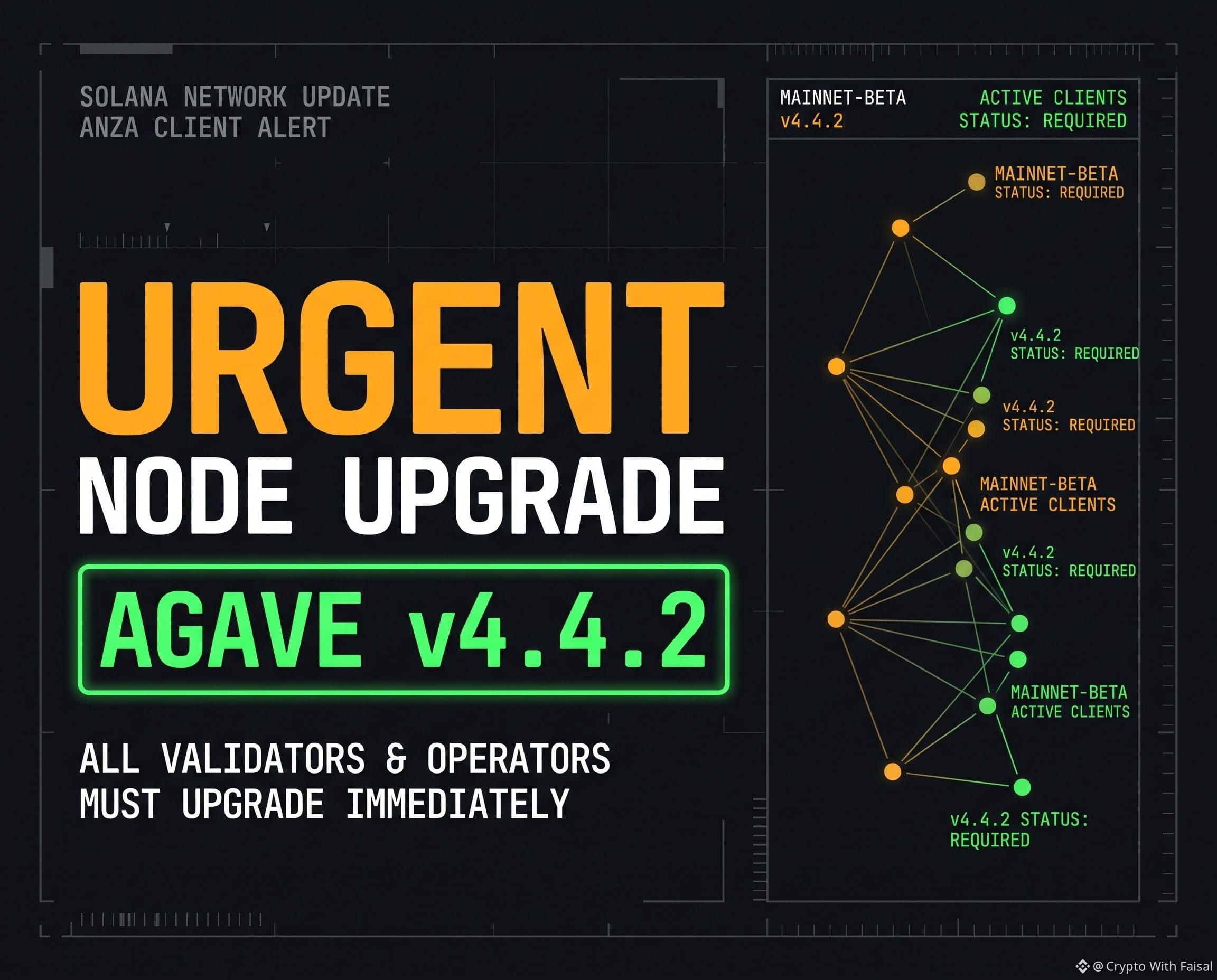
🚨 Solana Node Alert: Anza Urges Immediate Upgrade to Agave v4.4.2
Solana client team Anza has issued a mainnet notice calling on all validators and node operators—regardless of staking status—to immediately upgrade their Agave client to v4.4.2.
⚡ Key Rollout Details:
Ecosystem Ready: Jito-Solana and Harmonic have already shipped matching builds based on Agave v4.4.2, while testnet and devnet nodes move to v4.5.0-rc.1.
Network Status: Anza confirmed all Solana clusters remain secure and are operating normally.
📊 Trader & Holder Takeaway:
Fast, coordinated client updates like this are healthy infrastructure maintenance, not an outage. Regular SOL holders and traders need to take zero action—stay sharp and ignore any fake "wallet migration" links.
How are you positioning on SOL heading into December? Drop your levels below 👇
$SOL
{future}(SOLUSDT)
$JUP
{future}(JUPUSDT)
$JTO
{future}(JTOUSDT)
#anzaurgessolananodesupgradeagave #Solana #SOL #CryptoNews
🚨 Solana Node Alert: Anza Urges Immediate Upgrade to Agave v4.4.2
Solana client team Anza has issued a mainnet notice calling on all validators and node operators—regardless of staking status—to immediately upgrade their Agave client to v4.4.2.
⚡ Key Rollout Details:
Ecosystem Ready: Jito-Solana and Harmonic have already shipped matching builds based on Agave v4.4.2, while testnet and devnet nodes move to v4.5.0-rc.1.
Network Status: Anza confirmed all Solana clusters remain secure and are operating normally.
📊 Trader & Holder Takeaway:
Fast, coordinated client updates like this are healthy infrastructure maintenance, not an outage. Regular SOL holders and traders need to take zero action—stay sharp and ignore any fake "wallet migration" links.
How are you positioning on SOL heading into December? Drop your levels below 👇
$SOL
$JUP
$JTO
#anzaurgessolananodesupgradeagave #Solana #SOL #CryptoNews
2
1.3k

·
--

Article
Japan could have been at the top today. A promise made 41 years ago changed everything.$BTC
{future}(BTCUSDT)
Japan could have been at the top today. A promise made 41 years ago changed everything.
Japan is projected to be the world's 6th-largest economy in 2027.
Most people read that as Japan shrinking.
Japan isn't shrinking; it's paying the price for a promise it made to its ally, the US, 41 years ago.
Meanwhile, this week the US prepared a new tariff on Japanese goods.
I'll show you that promise and the reason for this tariff.
In the 1980s, Japanese car, television and chip companies were growing rapidly in the US market. Because the yen was cheap, they could sell their goods cheaply.
As US companies lost out to this competition, Congress wanted to impose restrictions on Japanese goods.
In 1985, Japan made a promise to its ally and agreed to let the yen strengthen.
Japan expected the yen to appreciate by 20%, but within 3 years it had appreciated by 100%.
Japanese companies no longer had a price advantage in the US. They would either have to raise prices and lose customers or give up their profits.
As the yen strengthened, Japan lowered interest rates to protect its companies, and it paid the real price after that decision.
People and companies bought stocks and land with cheap loans, and prices rose rapidly.
When Japan's central bank raised interest rates to stop this rise, stock and land prices fell, and the economy slowed.
Japan lowered interest rates again and kept them near zero for 30 years.
As other countries raised interest rates, the yen lost value and hit a 40-year low this summer. Today, 1 dollar is worth about 160 yen.
A country can fall in the economic rankings without shrinking, because those rankings are calculated in dollars.
Japan's economy is at a record high in yen, but it looks small in dollars because the yen has weakened.
Imagine you have 160 yen. In 2012, you could buy 2 dollars with that money; today, you can buy 1 dollar.
If the yen were at its 2012 value, Japan would be the world's 3rd-largest economy today.
Toyota has also been the world's best-selling car company for 6 years.
The justification for this week's tariff is that Japan is overproducing cars, steel and chips.
In my view, the real reason is the weak yen, because when the yen is weak, Japanese companies regain a price advantage in the US.
41 years ago, the response to this situation was a stronger yen; today, the response is a tariff.
The US is preparing this tariff for the foreign country that owes it the most money. Japanese companies also employ more than 1 million people in the US.
So what would happen in the markets if the yen strengthened again today?
Investors borrowed yen in Japan at near-zero interest rates and used that money to buy stocks, bonds and Bitcoin.
As long as the yen stays weak, they profit from this trade.
Today, the Japanese yen is present in almost every market.
If the yen strengthens rapidly, borrowing becomes more expensive, and investors sell their stocks and Bitcoin to repay their loans.
In 2024, the yen strengthened rapidly over a few weeks.
Japan's stock market fell 12% in a single day, and Bitcoin lost about 15% of its value in a few hours.
Japan is raising interest rates in small steps, with the next rate decision on December 18.
If the yen strengthens slowly, investors will repay their loans over time, and Japan will rise in the rankings.
Economic rankings measure a country's currency, not its promises.
In a book he wrote in 1899, Japanese author Inazo Nitobe described samurai as follows.
A samurai's word was sufficient assurance, and their promises were often kept without a written document.
This is my personal analysis.
I'm following developments. I'll keep you informed.
Japan could have been at the top today. A promise made 41 years ago changed everything.
$BTC
Japan could have been at the top today. A promise made 41 years ago changed everything.
Japan is projected to be the world's 6th-largest economy in 2027.
Most people read that as Japan shrinking.
Japan isn't shrinking; it's paying the price for a promise it made to its ally, the US, 41 years ago.
Meanwhile, this week the US prepared a new tariff on Japanese goods.
I'll show you that promise and the reason for this tariff.
In the 1980s, Japanese car, television and chip companies were growing rapidly in the US market. Because the yen was cheap, they could sell their goods cheaply.
As US companies lost out to this competition, Congress wanted to impose restrictions on Japanese goods.
In 1985, Japan made a promise to its ally and agreed to let the yen strengthen.
Japan expected the yen to appreciate by 20%, but within 3 years it had appreciated by 100%.
Japanese companies no longer had a price advantage in the US. They would either have to raise prices and lose customers or give up their profits.
As the yen strengthened, Japan lowered interest rates to protect its companies, and it paid the real price after that decision.
People and companies bought stocks and land with cheap loans, and prices rose rapidly.
When Japan's central bank raised interest rates to stop this rise, stock and land prices fell, and the economy slowed.
Japan lowered interest rates again and kept them near zero for 30 years.
As other countries raised interest rates, the yen lost value and hit a 40-year low this summer. Today, 1 dollar is worth about 160 yen.
A country can fall in the economic rankings without shrinking, because those rankings are calculated in dollars.
Japan's economy is at a record high in yen, but it looks small in dollars because the yen has weakened.
Imagine you have 160 yen. In 2012, you could buy 2 dollars with that money; today, you can buy 1 dollar.
If the yen were at its 2012 value, Japan would be the world's 3rd-largest economy today.
Toyota has also been the world's best-selling car company for 6 years.
The justification for this week's tariff is that Japan is overproducing cars, steel and chips.
In my view, the real reason is the weak yen, because when the yen is weak, Japanese companies regain a price advantage in the US.
41 years ago, the response to this situation was a stronger yen; today, the response is a tariff.
The US is preparing this tariff for the foreign country that owes it the most money. Japanese companies also employ more than 1 million people in the US.
So what would happen in the markets if the yen strengthened again today?
Investors borrowed yen in Japan at near-zero interest rates and used that money to buy stocks, bonds and Bitcoin.
As long as the yen stays weak, they profit from this trade.
Today, the Japanese yen is present in almost every market.
If the yen strengthens rapidly, borrowing becomes more expensive, and investors sell their stocks and Bitcoin to repay their loans.
In 2024, the yen strengthened rapidly over a few weeks.
Japan's stock market fell 12% in a single day, and Bitcoin lost about 15% of its value in a few hours.
Japan is raising interest rates in small steps, with the next rate decision on December 18.
If the yen strengthens slowly, investors will repay their loans over time, and Japan will rise in the rankings.
Economic rankings measure a country's currency, not its promises.
In a book he wrote in 1899, Japanese author Inazo Nitobe described samurai as follows.
A samurai's word was sufficient assurance, and their promises were often kept without a written document.
This is my personal analysis.
I'm following developments. I'll keep you informed.
Japan could have been at the top today. A promise made 41 years ago changed everything.
Japan is projected to be the world's 6th-largest economy in 2027.
Most people read that as Japan shrinking.
Japan isn't shrinking; it's paying the price for a promise it made to its ally, the US, 41 years ago.
Meanwhile, this week the US prepared a new tariff on Japanese goods.
I'll show you that promise and the reason for this tariff.
In the 1980s, Japanese car, television and chip companies were growing rapidly in the US market. Because the yen was cheap, they could sell their goods cheaply.
As US companies lost out to this competition, Congress wanted to impose restrictions on Japanese goods.
In 1985, Japan made a promise to its ally and agreed to let the yen strengthen.
Japan expected the yen to appreciate by 20%, but within 3 years it had appreciated by 100%.
Japanese companies no longer had a price advantage in the US. They would either have to raise prices and lose customers or give up their profits.
As the yen strengthened, Japan lowered interest rates to protect its companies, and it paid the real price after that decision.
People and companies bought stocks and land with cheap loans, and prices rose rapidly.
When Japan's central bank raised interest rates to stop this rise, stock and land prices fell, and the economy slowed.
Japan lowered interest rates again and kept them near zero for 30 years.
As other countries raised interest rates, the yen lost value and hit a 40-year low this summer. Today, 1 dollar is worth about 160 yen.
A country can fall in the economic rankings without shrinking, because those rankings are calculated in dollars.
Japan's economy is at a record high in yen, but it looks small in dollars because the yen has weakened.
Imagine you have 160 yen. In 2012, you could buy 2 dollars with that money; today, you can buy 1 dollar.
If the yen were at its 2012 value, Japan would be the world's 3rd-largest economy today.
Toyota has also been the world's best-selling car company for 6 years.
The justification for this week's tariff is that Japan is overproducing cars, steel and chips.
In my view, the real reason is the weak yen, because when the yen is weak, Japanese companies regain a price advantage in the US.
41 years ago, the response to this situation was a stronger yen; today, the response is a tariff.
The US is preparing this tariff for the foreign country that owes it the most money. Japanese companies also employ more than 1 million people in the US.
So what would happen in the markets if the yen strengthened again today?
Investors borrowed yen in Japan at near-zero interest rates and used that money to buy stocks, bonds and Bitcoin.
As long as the yen stays weak, they profit from this trade.
Today, the Japanese yen is present in almost every market.
If the yen strengthens rapidly, borrowing becomes more expensive, and investors sell their stocks and Bitcoin to repay their loans.
In 2024, the yen strengthened rapidly over a few weeks.
Japan's stock market fell 12% in a single day, and Bitcoin lost about 15% of its value in a few hours.
Japan is raising interest rates in small steps, with the next rate decision on December 18.
If the yen strengthens slowly, investors will repay their loans over time, and Japan will rise in the rankings.
Economic rankings measure a country's currency, not its promises.
In a book he wrote in 1899, Japanese author Inazo Nitobe described samurai as follows.
A samurai's word was sufficient assurance, and their promises were often kept without a written document.
This is my personal analysis.
I'm following developments. I'll keep you informed.
43


·
--
🛡️ OKX CEO Star Xu denies $2B hack rumor
OKX founder and CEO Star Xu said claims that the exchange lost more than $2 billion in a hack are false, noting that OKX's on-chain transactions are public and verifiable. He added that OKX will keep strengthening its systems and security.
The rumor spread as OKX Europe faced technical issues on Nov 27 that left some users unable to access the platform, with the head of OKX Europe saying the team was investigating and restoring service.
⭐ A month after Binance's $6.3B hack, any big-exchange hack rumor can trigger panic withdrawals — verify before reacting.
#OKX #CryptoSecurity #CryptoNews

2
857

·
--
🚨 $150 MILLION BTC EXIT! AGUILATrades CLOSES ALL BITCOIN LONG POSITIONS
A major move has caught the crypto market's attention as AguilaTrades has completely closed its Bitcoin long positions, reducing its exposure by approximately $150 million.
According to on-chain data reported by Odaily, the trader closed positions totaling 2,440 BTC between November 27 and the early hours of November 28, 2026. The address currently holds no BTC positions.
The biggest part of the exit happened within just over an hour, when approximately $143 million worth of positions were closed. The move reportedly resulted in a realized loss of around $3.34 million, showing that even large traders are not immune to market volatility.
Interestingly, despite this recent loss, AguilaTrades recorded approximately $10.88 million in net profit from Bitcoin trading between November 12 and November 27.
This exit raises an important question about the trader's market outlook. Is this simply a move to secure profits and reduce exposure, or does it signal caution ahead of Bitcoin's next major move?
For now, the wallet has no active BTC positions, and traders will be watching closely for its next move.
Big players are adjusting their exposure. The next Bitcoin move deserves attention.
#Bitcoin #BTC #CryptoNews #Whales $BTC
{spot}(BTCUSDT)
🚨 $150 MILLION BTC EXIT! AGUILATrades CLOSES ALL BITCOIN LONG POSITIONS
A major move has caught the crypto market's attention as AguilaTrades has completely closed its Bitcoin long positions, reducing its exposure by approximately $150 million.
According to on-chain data reported by Odaily, the trader closed positions totaling 2,440 BTC between November 27 and the early hours of November 28, 2026. The address currently holds no BTC positions.
The biggest part of the exit happened within just over an hour, when approximately $143 million worth of positions were closed. The move reportedly resulted in a realized loss of around $3.34 million, showing that even large traders are not immune to market volatility.
Interestingly, despite this recent loss, AguilaTrades recorded approximately $10.88 million in net profit from Bitcoin trading between November 12 and November 27.
This exit raises an important question about the trader's market outlook. Is this simply a move to secure profits and reduce exposure, or does it signal caution ahead of Bitcoin's next major move?
For now, the wallet has no active BTC positions, and traders will be watching closely for its next move.
Big players are adjusting their exposure. The next Bitcoin move deserves attention.
#Bitcoin #BTC #CryptoNews #Whales $BTC
1
468
·
--
Bullish
🚨 BREAKING: WHY CAN SPAIN FREEZE CRYPTO ACCOUNTS WITHOUT A COURT ORDER? 🇪🇸
Spain has introduced new powers allowing its financial intelligence unit, Sepblac, to temporarily freeze crypto, bank and payment accounts suspected of money laundering or terrorist financing.
📌 Here are the key details of Spain's new powers:
• Up to 5 business days: Suspicious accounts can be temporarily frozen. 🏦
• Up to 10 business days: Ongoing transactions can be suspended. ⛔
• No prior court approval: Sepblac can initiate these measures based on its own investigations. ⚖️
📅 January 25, 2027: The measures are scheduled to take effect, pending parliamentary ratification.
🔍 Any extension beyond these deadlines will require court approval following a request from public prosecutors.
This move is part of Spain's implementation of the EU's anti-money laundering framework. 🇪🇺
💬 Will these new powers improve crypto security, or raise concerns about users' control over their funds?
$ZEC - $BTC - $THE
{future}(ZECUSDT)
{spot}(BTCUSDT)
{future}(THEUSDT)
#CryptoNews #Spain #CryptoRegulation
🚨 BREAKING: WHY CAN SPAIN FREEZE CRYPTO ACCOUNTS WITHOUT A COURT ORDER? 🇪🇸
Spain has introduced new powers allowing its financial intelligence unit, Sepblac, to temporarily freeze crypto, bank and payment accounts suspected of money laundering or terrorist financing.
📌 Here are the key details of Spain's new powers:
• Up to 5 business days: Suspicious accounts can be temporarily frozen. 🏦
• Up to 10 business days: Ongoing transactions can be suspended. ⛔
• No prior court approval: Sepblac can initiate these measures based on its own investigations. ⚖️
📅 January 25, 2027: The measures are scheduled to take effect, pending parliamentary ratification.
🔍 Any extension beyond these deadlines will require court approval following a request from public prosecutors.
This move is part of Spain's implementation of the EU's anti-money laundering framework. 🇪🇺
💬 Will these new powers improve crypto security, or raise concerns about users' control over their funds?
$ZEC - $BTC - $THE
#CryptoNews #Spain #CryptoRegulation

1
1
210

·
--
Bitcoin Slips Below $59K as Stocks Rebound 📉
**What happened:** Cointelegraph reports that Bitcoin price volatility returned at the Wall Street open, with BTC/USD dropping to local lows of $58,700 while stocks and gold headed higher.
**Why it matters for traders:** A divergence between $BTC and equities and gold could signal that crypto is trading on its own flows rather than following broader risk appetite. Sharp moves at the Wall Street open may thin out order book liquidity and widen slippage, which could raise the cost of entering or exiting leveraged positions. If volatility persists, funding rates may swing and liquidation clusters could add to price moves in either direction.
**What to watch:**
- Whether BTC holds or loses the $58,700 local low, a level where reactions may show whether the move was a brief flush or something more.
- Whether the gap between crypto and stocks narrows or keeps widening through the next sessions, and any shift in funding rates alongside it.
Follow for daily market and trading-cost notes.
#CryptoNews #Macro #Bitcoin
— BasisBack Research · not financial advice
62

·
--
Bitcoin Loses 0K as November ETF Outflows Hit Record .39B — XMR Delistings, Bridge Hacks, VTB LaunchBitcoin slipped back below $60,000 on Saturday as the November ETF exodus set a record and the market digested one of the quietest, strangest weeks of the year: a 98-minute block gap, a 15% Monero delisting plunge, and a fresh wave of exchange and bridge security incidents. Here is what moved in the last 24 hours.
**Market snapshot**
BTC traded around $60,200 (-0.85% over 24h) after briefly losing the $60,000 level overnight; ETH sat near $1,670 (-1.9%), SOL near $72, XRP near $0.95 and BNB near $553. Total crypto market capitalization held around $2.08–2.11 trillion with bitcoin dominance near 57–58%. Friday's relief rally faded after the Nasdaq 100 gave back most of its early gains, and roughly $162 million of long positions were liquidated in a single hour as BTC lost the round number.
**ETF flows: a record month of redemptions**
US spot bitcoin ETFs have now recorded about $5.39 billion in November net outflows through November 25 — the worst month since the funds launched in January 2024, surpassing June's previous record of $4.51 billion. The streak hit seven consecutive trading days, with $453 million leaving on November 25 alone; BlackRock's IBIT accounted for roughly $330 million of that day. JPMorgan analysts, per The Block, believe the intensity points to retail-driven selling. Fed funds markets are now pricing as many as three rate hikes by June 2027, per COINOTAG, which keeps a hawkish overlay on risk assets. Deribit also settled around $6.8 billion in bitcoin options at Friday's expiry, a mechanical but real volatility event.
**Bull read**
Long-term holders and whales are still accumulating: whale wallets kept buying through the crash, Bitcoin's supply profit/loss ratio sits at an 11-year low (a classic capitulation signal), and the price is trading below its 200-week average — a zone that has historically contained cycle lows. Arthur Hayes's weekend-liquidity warning aside, Monday's post-holiday session will bring the first clean ETF flow print in four days, and a reversal would be a strong signal. Coinbase CEO Brian Armstrong publicly called the bottom and sees BTC at $400,000 by 2030; CZ said $60,000 is already "a good price."
**Bear read**
Momentum is still firmly negative. ETFs have shed about 68,000 BTC in 30 days, USDT supply on Ethereum and Tron dropped $8.1 billion over 60 days, and the hashrate posted its first annual decline since the 2021 China mining ban. Bitcoin's correlation with gold has now surpassed its 2020 record — defensive positioning, not risk-on. Monero fell as much as 15% to around $436 after KuCoin confirmed delisting for November 30, the latest in a run of exchange removals, a reminder that liquidity exits hit hard in thin books.
**Security and enforcement**
- OKX's CEO publicly dismissed circulating claims of a "$2 billion hack" as fake news.
- The ATOSHI cross-chain bridge leaked its private key, with about 201 million ATOS stolen and sold, per PANews.
- Chainflip is planning a recovery fund after a $12.6 million hack.
- Tether said it will charge a 20% fee to return frozen USDT to hack victims — a policy that will draw scrutiny.
- Mining pool operator Braiins flagged an ongoing campaign hijacking hashrate and capturing miners' profits.
- NovaTech's founders were ordered to forfeit more than $1.3 billion over a Ponzi scheme that targeted Haitian communities.
**Regulation and adoption**
Russia's second-largest bank, VTB, launched bitcoin trading for qualified investors on November 27 despite a US sanctions blacklisting. Binance Brasil won Brazil's first crypto foreign-exchange license from the central bank, and Binance is planning tokenized IPOs. A Bank of Japan executive called for stablecoins to be anchored to central bank money with reserve oversight. Insurance broker Aon is using Solana for stablecoin payments. Israel's Discount Bank launched BTC and ETH trading with a 2% fee on both sides. XRP's Binance deposit share hit 91.4%, the highest since 2019, ahead of GraniteShares' two 3x leveraged XRP ETFs going effective November 30. Solana validators were urged by Anza to immediately upgrade to Agave v4.4.2, and Hyperliquid's HYPE rallied 8% toward $66 on Franklin Templeton ETF inclusion.
**What to watch next**
- Nov 30: KuCoin delists Monero; GraniteShares 3x XRP ETFs go effective.
- Dec 2: Bybit WSOT 2026 ends (up to 10M USDT prize pool).
- Dec 3: Sky/Spark governance spell execution.
- Dec 4: Bluefin shuts down its Sui perpetuals product.
- Dec 8–9: FOMC meeting — the single biggest macro risk; markets currently price three hikes by mid-2027.
- Dec 15: Ethereum Glamsterdam Hoodi testnet upgrade and the EIP-8037 storage-fee test.
- Monday, Nov 30: first post-holiday ETF flow print after seven straight days of outflows.
This article is for informational purposes only and is not investment advice. Figures are as reported by the cited sources at publication time.
Sources: The Block (Daily newsletter, SoSoValue flow data), COINOTAG, Crypto-Economy, AnyCoin News, Sharpe Terminal, Crypto Bulletin, RSI Hunter, CryptoSynk, Metal Pay.
$BTC $XMR
#Bitcoin #CryptoNews #Altcoins
Bitcoin Loses 0K as November ETF Outflows Hit Record .39B — XMR Delistings, Bridge Hacks, VTB Launch
Bitcoin slipped back below $60,000 on Saturday as the November ETF exodus set a record and the market digested one of the quietest, strangest weeks of the year: a 98-minute block gap, a 15% Monero delisting plunge, and a fresh wave of exchange and bridge security incidents. Here is what moved in the last 24 hours.
**Market snapshot**
BTC traded around $60,200 (-0.85% over 24h) after briefly losing the $60,000 level overnight; ETH sat near $1,670 (-1.9%), SOL near $72, XRP near $0.95 and BNB near $553. Total crypto market capitalization held around $2.08–2.11 trillion with bitcoin dominance near 57–58%. Friday's relief rally faded after the Nasdaq 100 gave back most of its early gains, and roughly $162 million of long positions were liquidated in a single hour as BTC lost the round number.
**ETF flows: a record month of redemptions**
US spot bitcoin ETFs have now recorded about $5.39 billion in November net outflows through November 25 — the worst month since the funds launched in January 2024, surpassing June's previous record of $4.51 billion. The streak hit seven consecutive trading days, with $453 million leaving on November 25 alone; BlackRock's IBIT accounted for roughly $330 million of that day. JPMorgan analysts, per The Block, believe the intensity points to retail-driven selling. Fed funds markets are now pricing as many as three rate hikes by June 2027, per COINOTAG, which keeps a hawkish overlay on risk assets. Deribit also settled around $6.8 billion in bitcoin options at Friday's expiry, a mechanical but real volatility event.
**Bull read**
Long-term holders and whales are still accumulating: whale wallets kept buying through the crash, Bitcoin's supply profit/loss ratio sits at an 11-year low (a classic capitulation signal), and the price is trading below its 200-week average — a zone that has historically contained cycle lows. Arthur Hayes's weekend-liquidity warning aside, Monday's post-holiday session will bring the first clean ETF flow print in four days, and a reversal would be a strong signal. Coinbase CEO Brian Armstrong publicly called the bottom and sees BTC at $400,000 by 2030; CZ said $60,000 is already "a good price."
**Bear read**
Momentum is still firmly negative. ETFs have shed about 68,000 BTC in 30 days, USDT supply on Ethereum and Tron dropped $8.1 billion over 60 days, and the hashrate posted its first annual decline since the 2021 China mining ban. Bitcoin's correlation with gold has now surpassed its 2020 record — defensive positioning, not risk-on. Monero fell as much as 15% to around $436 after KuCoin confirmed delisting for November 30, the latest in a run of exchange removals, a reminder that liquidity exits hit hard in thin books.
**Security and enforcement**
- OKX's CEO publicly dismissed circulating claims of a "$2 billion hack" as fake news.
- The ATOSHI cross-chain bridge leaked its private key, with about 201 million ATOS stolen and sold, per PANews.
- Chainflip is planning a recovery fund after a $12.6 million hack.
- Tether said it will charge a 20% fee to return frozen USDT to hack victims — a policy that will draw scrutiny.
- Mining pool operator Braiins flagged an ongoing campaign hijacking hashrate and capturing miners' profits.
- NovaTech's founders were ordered to forfeit more than $1.3 billion over a Ponzi scheme that targeted Haitian communities.
**Regulation and adoption**
Russia's second-largest bank, VTB, launched bitcoin trading for qualified investors on November 27 despite a US sanctions blacklisting. Binance Brasil won Brazil's first crypto foreign-exchange license from the central bank, and Binance is planning tokenized IPOs. A Bank of Japan executive called for stablecoins to be anchored to central bank money with reserve oversight. Insurance broker Aon is using Solana for stablecoin payments. Israel's Discount Bank launched BTC and ETH trading with a 2% fee on both sides. XRP's Binance deposit share hit 91.4%, the highest since 2019, ahead of GraniteShares' two 3x leveraged XRP ETFs going effective November 30. Solana validators were urged by Anza to immediately upgrade to Agave v4.4.2, and Hyperliquid's HYPE rallied 8% toward $66 on Franklin Templeton ETF inclusion.
**What to watch next**
- Nov 30: KuCoin delists Monero; GraniteShares 3x XRP ETFs go effective.
- Dec 2: Bybit WSOT 2026 ends (up to 10M USDT prize pool).
- Dec 3: Sky/Spark governance spell execution.
- Dec 4: Bluefin shuts down its Sui perpetuals product.
- Dec 8–9: FOMC meeting — the single biggest macro risk; markets currently price three hikes by mid-2027.
- Dec 15: Ethereum Glamsterdam Hoodi testnet upgrade and the EIP-8037 storage-fee test.
- Monday, Nov 30: first post-holiday ETF flow print after seven straight days of outflows.
This article is for informational purposes only and is not investment advice. Figures are as reported by the cited sources at publication time.
Sources: The Block (Daily newsletter, SoSoValue flow data), COINOTAG, Crypto-Economy, AnyCoin News, Sharpe Terminal, Crypto Bulletin, RSI Hunter, CryptoSynk, Metal Pay.
$BTC $XMR
#Bitcoin #CryptoNews #Altcoins
209

This breach shows serious flaws in security checks.
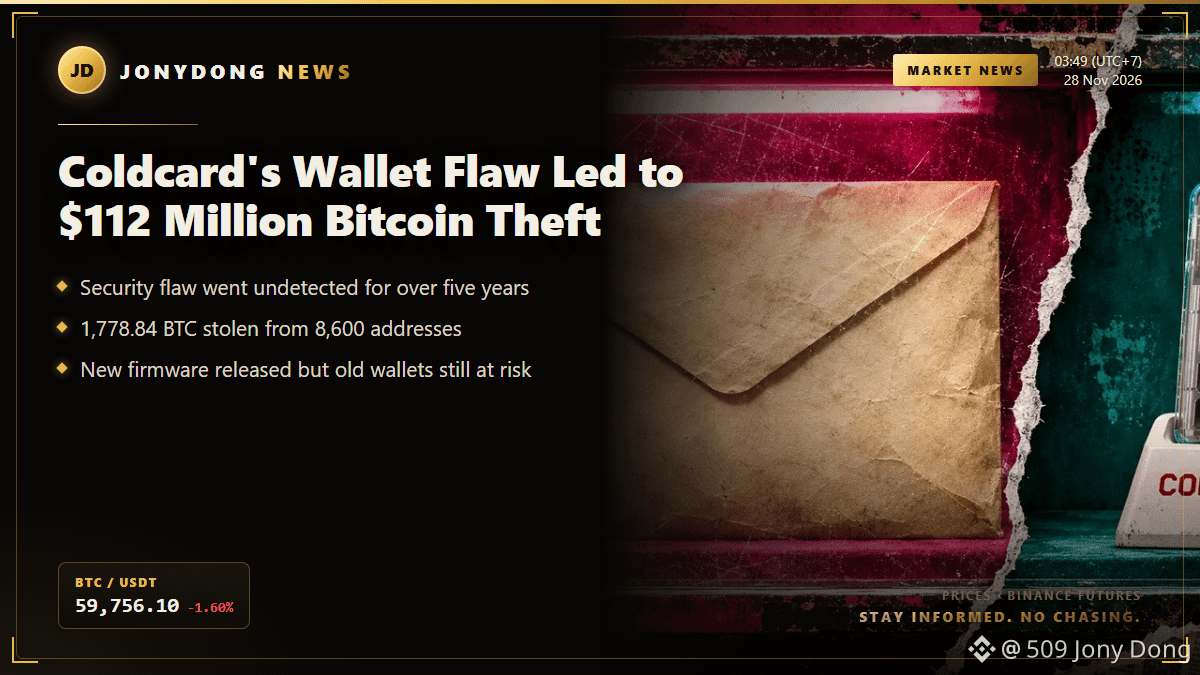
Coldcard's Wallet Flaw Led to $112 Million Bitcoin Theft
A big security flaw in Coldcard's Bitcoin hardware wallets allowed attackers to steal substantial amounts of Bitcoin without accessing the devices. This vulnerability, introduced in March 2021, went unnoticed despite at least 15 independent security reviews. Coinkite, the manufacturer, revealed that the issue weakened the recovery phrases generated by their wallets, enabling thefts from over 8,600 addresses.
Galaxy Research's analysis estimated that 1,778.84 BTC, valued at $112.7 million, was stolen due to this defect. The company has acknowledged that the actual number of affected customers could be higher than the identified 236 accounts. The flaw stemmed from a firmware configuration error that caused devices to use a weak software-based random number generator instead of a hardware one, allowing attackers to reconstruct private keys.
Although Coinkite has released a firmware update to address this issue, wallets affected by the initial flaw remain vulnerable. Users are advised to generate new recovery phrases and transfer their Bitcoin to secure wallets. This incident shows the importance of rigorous security checks in crypto hardware, as even established products can have serious flaws that lead to big losses.
$BTC
#Security #CryptoNews
1
1
125

·
--
Privacy coins are being erased from centralized exchanges — and Monero is now the test case.
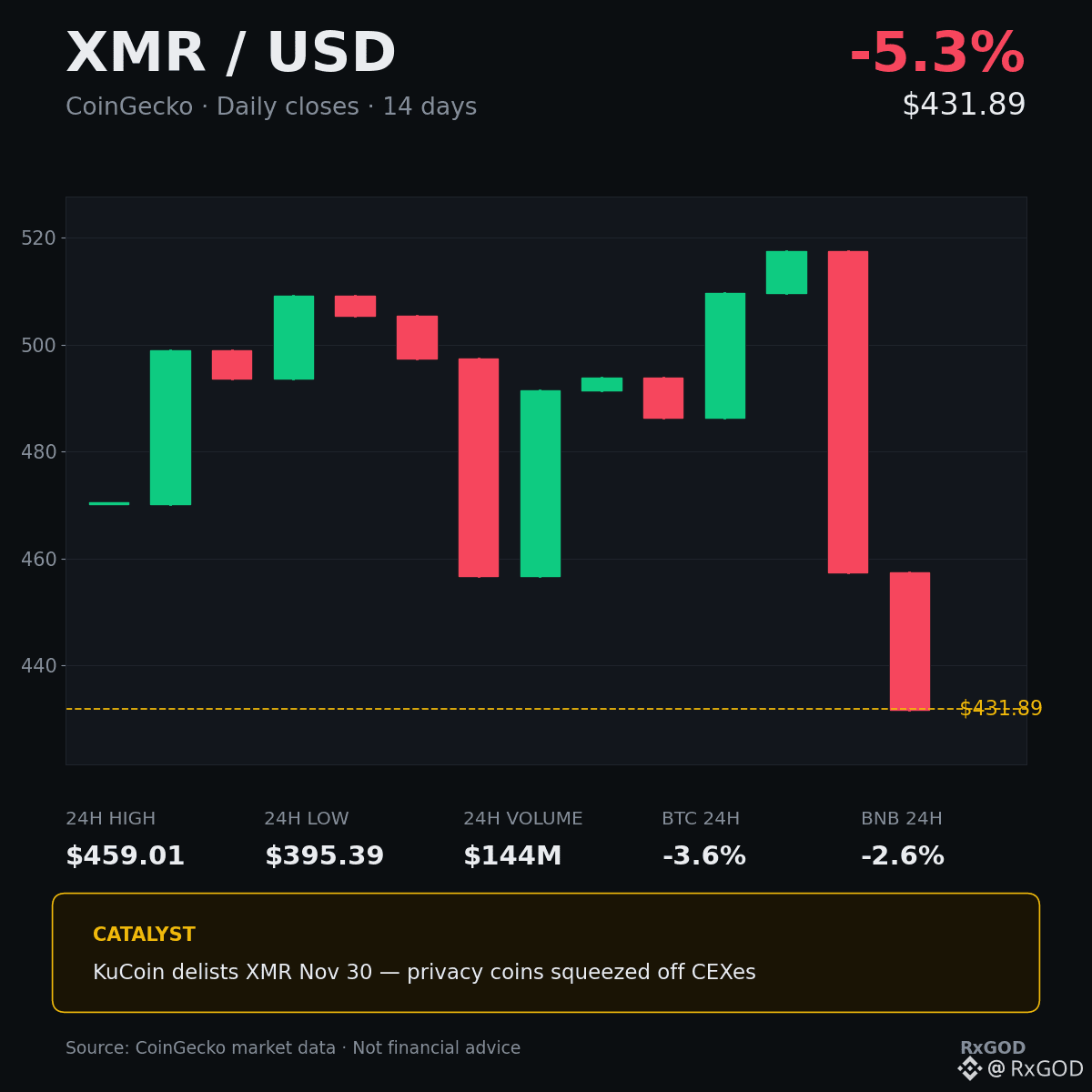
$XMR trades at $431.89, down 5.3% in 24 hours and roughly 31% from about $625 on November 3. It sits near the bottom of its 14-day range ($399–$535), just above Thursday's low of $430 — the day it suffered its biggest single-day slide since June 4, falling more than 11%.
The trigger is a deadline: KuCoin delists all four XMR spot pairs on November 30 at 08:00 UTC, barely 40 hours away. Deposits are already closed for good, and withdrawals shut on December 31. KuCoin handled about 60% of Monero's centralized-exchange volume, and MEXC dropped XMR earlier this month — Binance and Kraken's EEA arm exited long ago. The whole privacy-coin sector is down nearly 50% since September.
Regulation is the backdrop: the EU's anti-money-laundering rules bar regulated firms from servicing 'anonymity-enhancing coins' from July 10, 2027, and exchanges are front-running it.
The counter-case: Monero's FCMP++ upgrade is in security audits after an October public beta, self-custody is untouched, and $XMR still carries an ~$8.1B market cap. Meanwhile $BTC sits at $59,529, down 3.5%.
Is this the slow death of privacy on CEXes — or the last cheap entry before XMR goes fully off-exchange? $350 or $500 first?
Not financial advice — DYOR.
#Monero #PrivacyCoins #ExtremeFear #CryptoNews

🚨 $ETH CORE UPGRADE FRICTION SPARKS SMART CONTRACT WARS! ⚡
Under the hood of the upcoming Glamsterdam upgrade, a quiet architectural shift around storage fees is testing legacy smart contracts. When core changes threaten older code, volatility follows the infrastructure layer. Vitalik stepping in to demand proper dev support shows the weight of keeping the ecosystem stable. 📊
For market participants, this is a masterclass in separating network noise from actual risk. Rushing into unhedged DeFi positions right now is an amateur trap. Keep your capital protected, audit your bag exposure, and let the dust settle before chasing breakout momentum. ⚡
Are you rotating out of vulnerable legacy protocols or holding your ground through the upgrade noise? 👇
⚠️ Not financial advice. Always manage your risk. 🛡️
🏷️ #ETH #Ethereum #DeFi #CryptoNews
🔥 💎


·
--
🚨 ANOTHER US BANK COLLAPSE SPARKS MACRO SHOCKWAVES STRAIGHT INTO $BTC 💥
Traditional finance is cracking at the seams as another regional lender closes its doors, proving that centralized debt systems remain structurally fragile. 🏦 When legacy banking wobbles, sovereign decentralized ledgers absorb the flight to safety. 🌊
Weekend liquidity is notoriously paper-thin, making chasing high-leverage breakouts a dangerous game for unprepared participants. Keep your powder dry, respect macro volatility, and let order flow dictate your next big allocation. 📊
💬 Are you positioning for a macro-driven flight to safety or sitting on cash until Monday open? 👇
⚠️ Not financial advice. Always manage your risk. 🛡️
🏷️ #BTC #Macro #CryptoNews #BankingCrisis
🔥 💎

1

·
--
Article
The Week in Crypto, Explained: Bitcoin's $62K Rejection, Record ETF Outflows, and What to Watch NextBitcoin climbed to $62,000 on Thanksgiving — then gave it all back in a day. November is now on track to be $BTC's worst month since June. This is the week that was, in plain English: what happened, why it happened, and the levels that decide what comes next.
THE WEEK IN NUMBERS
$BTC is trading around $59,800 as I write this on Saturday, down roughly 2–3% in the last 24 hours and about 24% over the last 30 days. It touched $62,000 during the holiday, then fell below $59,000 at one point on Black Friday as US trading resumed.
$ETH sits near $1,655, down about 4.5% on the day and roughly 26% over 30 days. $SOL is around $71, down about 2.5% on the day and about 26% over the month. The total crypto market is worth about $2.08 trillion, down 3.5% in 24 hours, and the Fear & Greed Index reads 10–12 — extreme fear. Bitcoin dominance is 57.8%, which tells you this was not a Bitcoin-only sell-off. The whole market fell together.
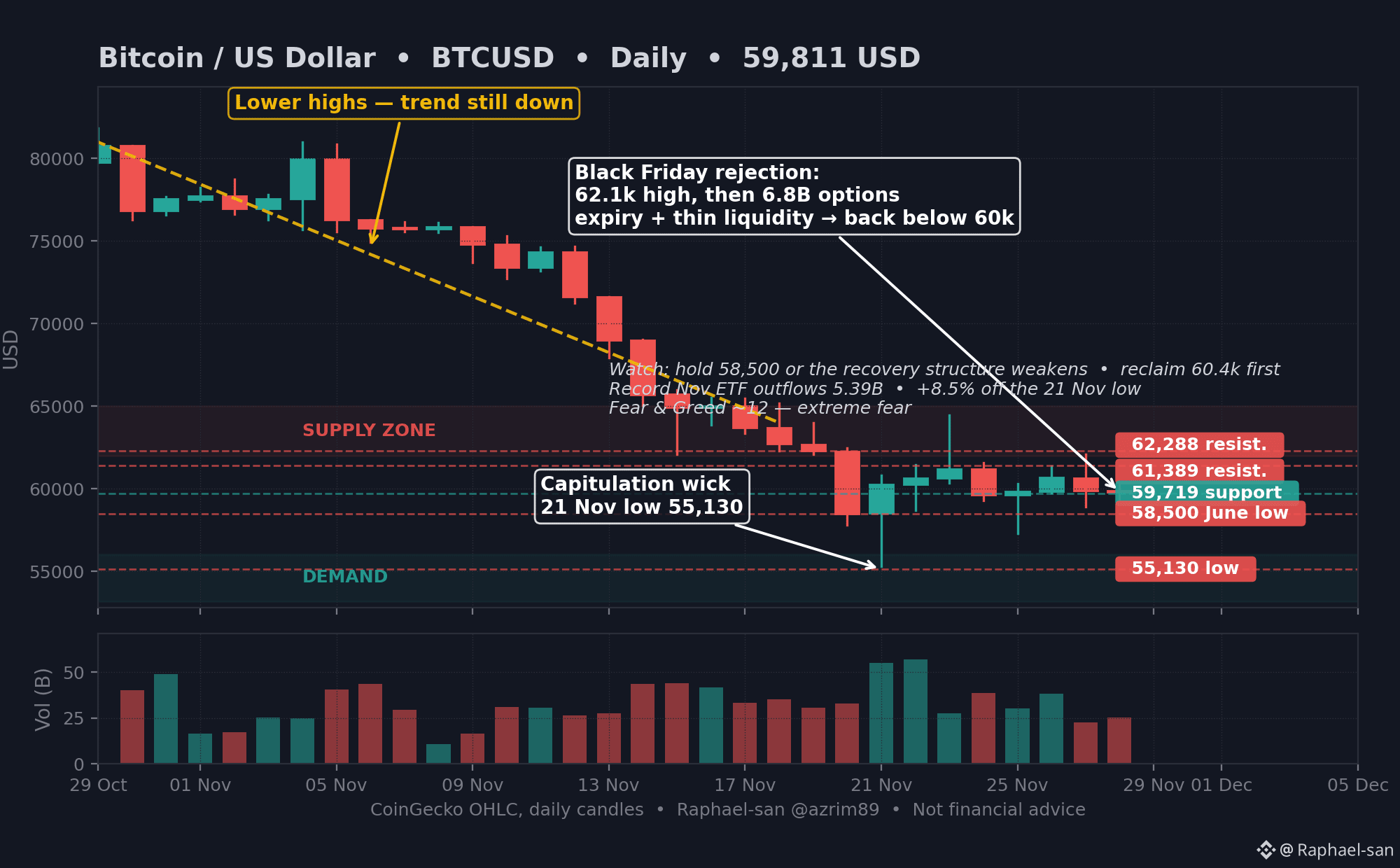
Context matters: $BTC is still about 8.5% above its 21 November low of $55,130. This week was a failed bounce, not a fresh collapse. That distinction matters for what comes next.
WHAT ACTUALLY DROVE THE SELLING
Three forces stacked up at the same time.
First, the options expiry. About $6.8 billion in Bitcoin options expired on Friday 27 November. When that much positioning settles at once, hedging flows alone can push price around — and this one landed on a Thanksgiving week, when US desks were thin and liquidity was at its weakest. The rally to $62,000 happened while America was on holiday. The reversal happened when it came back.
Second, the ETF flows. US spot Bitcoin ETFs have now seen seven straight sessions of outflows. They lost $453 million on 25 November alone, led by BlackRock's IBIT at about $330 million, and November outflows have reached roughly $5.39 billion — a record month. Institutions are not panic-selling in one dramatic day. They are selling steadily, every day, for weeks. That is the heavier signal.
Third, the macro backdrop. Core PCE came in at 3.3% versus 3.2% expected earlier in the week, and a new tariff proposal added to the risk-off mood. Neither is a crypto story on its own. But when inflation runs hot and trade headlines turn hostile, the first thing funds sell is the volatile stuff. Bitcoin is the volatile stuff.
Add liquidations on top — about $150 million of Bitcoin positions were wiped out in 24 hours, up 124% on the prior day — and you get the shape of this week: a thin-liquidity rally, a wall of institutional selling, and leveraged longs getting flushed on the way down.
THE OTHER SIDE OF THE TRADE
Here is the part most headlines skip. While ETFs sold, large holders bought. CryptoQuant data shows whales added 121,117 $BTC in the fourth quarter even as the price fell almost 30%. And Glassnode data shows sizable buy orders stacked between $50,000 and $58,000. Orders can be withdrawn, so that is not a guarantee — but it is real demand sitting below the market, and it is the reason the 21 November low held.
Alts told the same two-sided story. On Friday, before the Black Friday slide, $SOL was up about 3.3% and led a short-term altcoin rebound alongside HYPE (+6.1%) and FET (+5.9%). The rebound did not survive the weekend, but the fact that buyers stepped in first for alts — not just Bitcoin — is worth noting. Capitulation usually looks like nobody buying anything. That is not what Friday looked like.
The structural news kept coming, too. Malaysia approved the world's first Shariah-compliant spot Bitcoin ETF. Russia's VTB bank opened Bitcoin purchases to qualified clients. Binance unveiled a plan for tokenized IPOs, letting companies go public by issuing shares directly on a blockchain. None of these move price today. All of them are the kind of plumbing that matters over years, and they kept arriving in the middle of a 20% down month.
LEVELS THAT MATTER NEXT WEEK
The chart tells the story cleanly. Bitcoin is still making lower highs — the downtrend that started in late October is intact, and the $62,000–$65,000 supply zone rejected price again.
On the downside, the first test is $58,500, the June low. Losing it weakens the whole recovery structure and opens the door toward $57,300 (the PCE dip) and then the 21 November low at $55,130. On the upside, Bitcoin first has to reclaim $60,000–$60,400. Above that, $61,315 is the next test, and a daily close above $62,000 would be the first higher high in weeks — the first real sign the trend is turning.
My read: this is a market waiting for a reason to believe again, and the reason will probably not be a chart pattern. It will be the ETF flows turning. Seven straight days of outflows is the story of this month. One day of inflows will not end it, but a week of them would change the conversation completely. Until then, every bounce is guilty until proven innocent.
One honest note: analyst Michaël van de Poppe expects a December pullback toward $60,000–$62,000, followed by a possible move toward $100,000 before February 2027. That is his personal outlook, not a certainty — and December has a habit of humbling forecasts. Treat it as one scenario, not a prediction.
WHAT I'M WATCHING
Three things, in order: whether $58,500 holds over the weekend, whether ETF flows show any sign of turning next week, and whether $SOL and the alts keep leading on the days the market does bounce. If alts lead the bounces and Bitcoin holds its lows, that is a market building a base. If Bitcoin loses $58,500 while alts fall faster, that is a market still looking for its floor.
November punished everyone who bought the dip too early. It also rewarded, quietly, the people who waited for structure instead of headlines. Next week will tell us which group was right.
Not financial advice — just one trader's read on the week. Chart: daily candles from CoinGecko, levels marked.
$BTC $ETH $SOL
#Bitcoin #Crypto #CryptoNews
What is your plan for next week — buying the dip, waiting for $58,500 to hold, or sitting this one out?
The Week in Crypto, Explained: Bitcoin's $62K Rejection, Record ETF Outflows, and What to Watch Next
Bitcoin climbed to $62,000 on Thanksgiving — then gave it all back in a day. November is now on track to be $BTC 's worst month since June. This is the week that was, in plain English: what happened, why it happened, and the levels that decide what comes next.
THE WEEK IN NUMBERS
$BTC is trading around $59,800 as I write this on Saturday, down roughly 2–3% in the last 24 hours and about 24% over the last 30 days. It touched $62,000 during the holiday, then fell below $59,000 at one point on Black Friday as US trading resumed.
$ETH sits near $1,655, down about 4.5% on the day and roughly 26% over 30 days. $SOL is around $71, down about 2.5% on the day and about 26% over the month. The total crypto market is worth about $2.08 trillion, down 3.5% in 24 hours, and the Fear & Greed Index reads 10–12 — extreme fear. Bitcoin dominance is 57.8%, which tells you this was not a Bitcoin-only sell-off. The whole market fell together.
Context matters: $BTC is still about 8.5% above its 21 November low of $55,130. This week was a failed bounce, not a fresh collapse. That distinction matters for what comes next.
WHAT ACTUALLY DROVE THE SELLING
Three forces stacked up at the same time.
First, the options expiry. About $6.8 billion in Bitcoin options expired on Friday 27 November. When that much positioning settles at once, hedging flows alone can push price around — and this one landed on a Thanksgiving week, when US desks were thin and liquidity was at its weakest. The rally to $62,000 happened while America was on holiday. The reversal happened when it came back.
Second, the ETF flows. US spot Bitcoin ETFs have now seen seven straight sessions of outflows. They lost $453 million on 25 November alone, led by BlackRock's IBIT at about $330 million, and November outflows have reached roughly $5.39 billion — a record month. Institutions are not panic-selling in one dramatic day. They are selling steadily, every day, for weeks. That is the heavier signal.
Third, the macro backdrop. Core PCE came in at 3.3% versus 3.2% expected earlier in the week, and a new tariff proposal added to the risk-off mood. Neither is a crypto story on its own. But when inflation runs hot and trade headlines turn hostile, the first thing funds sell is the volatile stuff. Bitcoin is the volatile stuff.
Add liquidations on top — about $150 million of Bitcoin positions were wiped out in 24 hours, up 124% on the prior day — and you get the shape of this week: a thin-liquidity rally, a wall of institutional selling, and leveraged longs getting flushed on the way down.
THE OTHER SIDE OF THE TRADE
Here is the part most headlines skip. While ETFs sold, large holders bought. CryptoQuant data shows whales added 121,117 $BTC in the fourth quarter even as the price fell almost 30%. And Glassnode data shows sizable buy orders stacked between $50,000 and $58,000. Orders can be withdrawn, so that is not a guarantee — but it is real demand sitting below the market, and it is the reason the 21 November low held.
Alts told the same two-sided story. On Friday, before the Black Friday slide, $SOL was up about 3.3% and led a short-term altcoin rebound alongside HYPE (+6.1%) and FET (+5.9%). The rebound did not survive the weekend, but the fact that buyers stepped in first for alts — not just Bitcoin — is worth noting. Capitulation usually looks like nobody buying anything. That is not what Friday looked like.
The structural news kept coming, too. Malaysia approved the world's first Shariah-compliant spot Bitcoin ETF. Russia's VTB bank opened Bitcoin purchases to qualified clients. Binance unveiled a plan for tokenized IPOs, letting companies go public by issuing shares directly on a blockchain. None of these move price today. All of them are the kind of plumbing that matters over years, and they kept arriving in the middle of a 20% down month.
LEVELS THAT MATTER NEXT WEEK
The chart tells the story cleanly. Bitcoin is still making lower highs — the downtrend that started in late October is intact, and the $62,000–$65,000 supply zone rejected price again.
On the downside, the first test is $58,500, the June low. Losing it weakens the whole recovery structure and opens the door toward $57,300 (the PCE dip) and then the 21 November low at $55,130. On the upside, Bitcoin first has to reclaim $60,000–$60,400. Above that, $61,315 is the next test, and a daily close above $62,000 would be the first higher high in weeks — the first real sign the trend is turning.
My read: this is a market waiting for a reason to believe again, and the reason will probably not be a chart pattern. It will be the ETF flows turning. Seven straight days of outflows is the story of this month. One day of inflows will not end it, but a week of them would change the conversation completely. Until then, every bounce is guilty until proven innocent.
One honest note: analyst Michaël van de Poppe expects a December pullback toward $60,000–$62,000, followed by a possible move toward $100,000 before February 2027. That is his personal outlook, not a certainty — and December has a habit of humbling forecasts. Treat it as one scenario, not a prediction.
WHAT I'M WATCHING
Three things, in order: whether $58,500 holds over the weekend, whether ETF flows show any sign of turning next week, and whether $SOL and the alts keep leading on the days the market does bounce. If alts lead the bounces and Bitcoin holds its lows, that is a market building a base. If Bitcoin loses $58,500 while alts fall faster, that is a market still looking for its floor.
November punished everyone who bought the dip too early. It also rewarded, quietly, the people who waited for structure instead of headlines. Next week will tell us which group was right.
Not financial advice — just one trader's read on the week. Chart: daily candles from CoinGecko, levels marked.
$BTC $ETH $SOL
#Bitcoin #Crypto #CryptoNews
What is your plan for next week — buying the dip, waiting for $58,500 to hold, or sitting this one out?
19

🔥 CRYPTO HOURLY — BREAKING UPDATES 🔥
━━━━━━━━━━━━━━━━━━━━
⚪ Neutral - Saudi's Hormuz Bypass: Why OPEC+ Production May Fall Short of Expectations
• Saudi Arabia bypasses Hormuz via Red Sea pipeline, shunting OPEC+ output through Yanbu. This may limit actual market supply increases despite quota hikes.
━━━━━━━━━━━━━━━━━━━━
📈 Market Sentiment: 10 (Extreme Fear)
📊 Stay ahead. Think smart. Trade safe.
#cryptonews
Disclaimer: Includes third-party opinions. No advice.
BTC: -3.57% (H: 61861.6 L: 58792.4) | ETH: -4.54% (H: 1736.87 L: 1634.03) | SOL: -2.97% (H: 73.93 L: 70.12)
━━━━━━━━━━━━━━━━━━━━
⚪ Neutral - Saudi's Hormuz Bypass: Why OPEC+ Production May Fall Short of Expectations
• Saudi Arabia bypasses Hormuz via Red Sea pipeline, shunting OPEC+ output through Yanbu. This may limit actual market supply increases despite quota hikes.
━━━━━━━━━━━━━━━━━━━━
📈 Market Sentiment: 10 (Extreme Fear)
📊 Stay ahead. Think smart. Trade safe.
#cryptonews
Disclaimer: Includes third-party opinions. No advice.
BTC: -3.57% (H: 61861.6 L: 58792.4) | ETH: -4.54% (H: 1736.87 L: 1634.03) | SOL: -2.97% (H: 73.93 L: 70.12)
33
·
--
While US spot Bitcoin ETFs just bled a record $5.78B in November, a new door for Bitcoin demand opened in Southeast Asia — the first of its kind in the world.
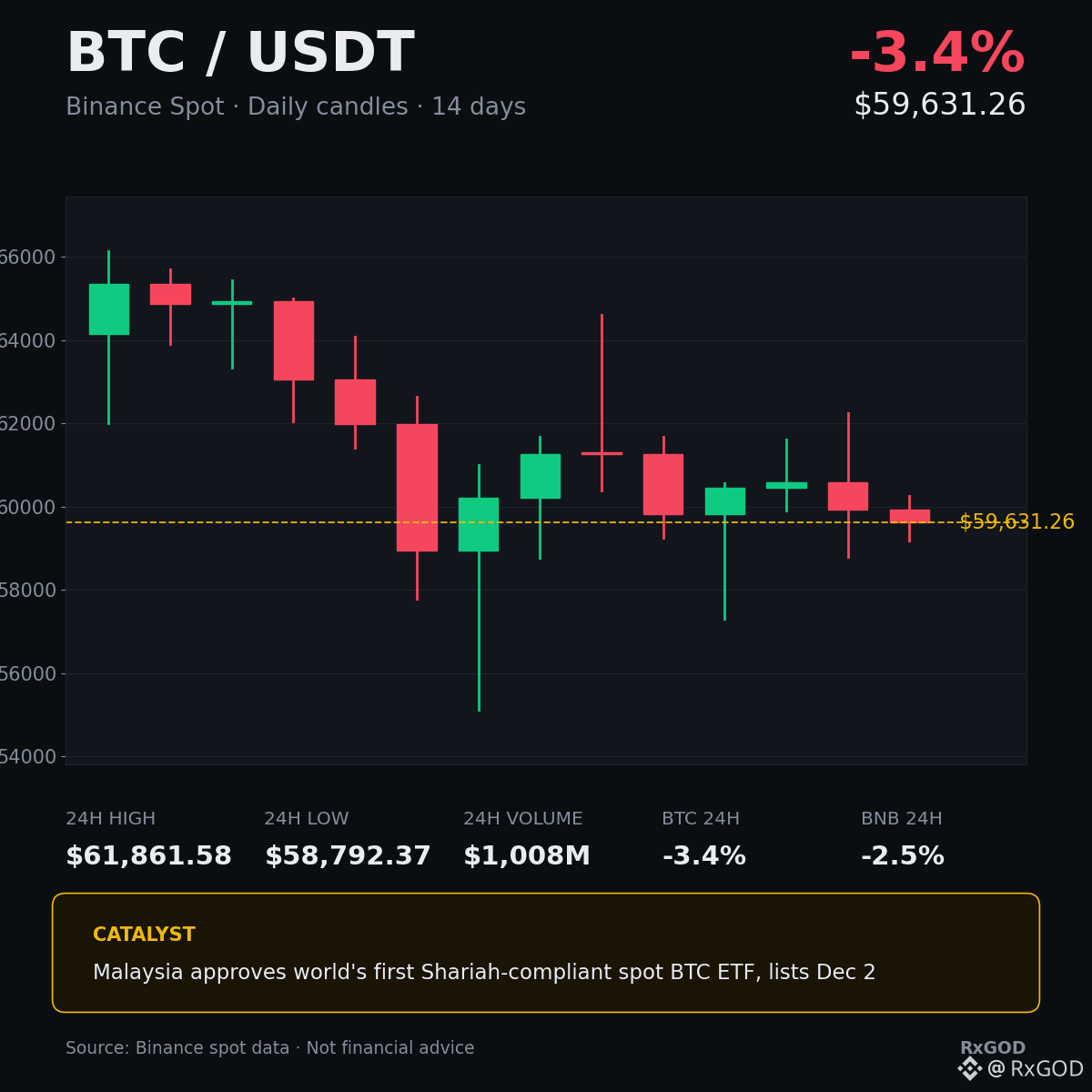
Malaysia has approved the Halogen Shariah Bitcoin ETF, the world's first Shariah-compliant $BTC ETF. It lists on Bursa Malaysia on December 2, tracking the FTSE Bitcoin Index with at least 95% of NAV in spot Bitcoin. The offering runs up to 1 billion units at $1 each — a $1B raise — under tickers BTCETF-MYR and BTCETF-USD, with fees up to 0.6%.
Halogen Capital, Malaysia's first licensed digital asset fund manager, runs the fund. Amanie Advisors certifies Shariah compliance and BitGo holds the Bitcoin in custody. Anyone with a brokerage account can buy it from December 2 — though the Shariah label covers the fund's structure, not the price.
$BTC trades at $59,631, down 3.4% in 24 hours and 8.7% over 14 days, at 41% of its two-week range. US ETFs are bleeding while Malaysia opens a regulated lane to nearly 2 billion Muslims — many of whom could not touch Bitcoin before for religious reasons.
But be honest about the risks: the label does not dampen volatility, the 0.6% fee is more than double most US spot ETFs, and the December 2 listing can still change.
Does a Shariah-compliant wrapper unlock new Bitcoin demand, or is it a label on the same volatile asset? ETF or real $BTC — which would you pick?
Not financial advice — DYOR.
#Bitcoin #BitcoinETF #ExtremeFear #CryptoNews
·
--
Russia's second-largest bank just started selling Bitcoin — ten weeks after Washington blacklisted it as one of the world's most heavily sanctioned financial institutions.
VTB opened crypto trading for qualified investors on November 27 in its VTB My Investments app, a day after the Bank of Russia approved a mandatory crypto knowledge test. Trades run over the counter for now, with VTB handling buying, custody and record-keeping itself on Russian infrastructure.
Every buyer must pass first: at least 7 of 8 questions right, covering regulation, volatility, security and stablecoins. It is free, retryable the same day, and valid for a year. Ordinary Russians face tighter limits — only $BTC, $ETH and USDT, capped at 300,000 rubles a year per broker. SPB Exchange follows on December 1 with spot BTC, ETH and USDT against the ruble.
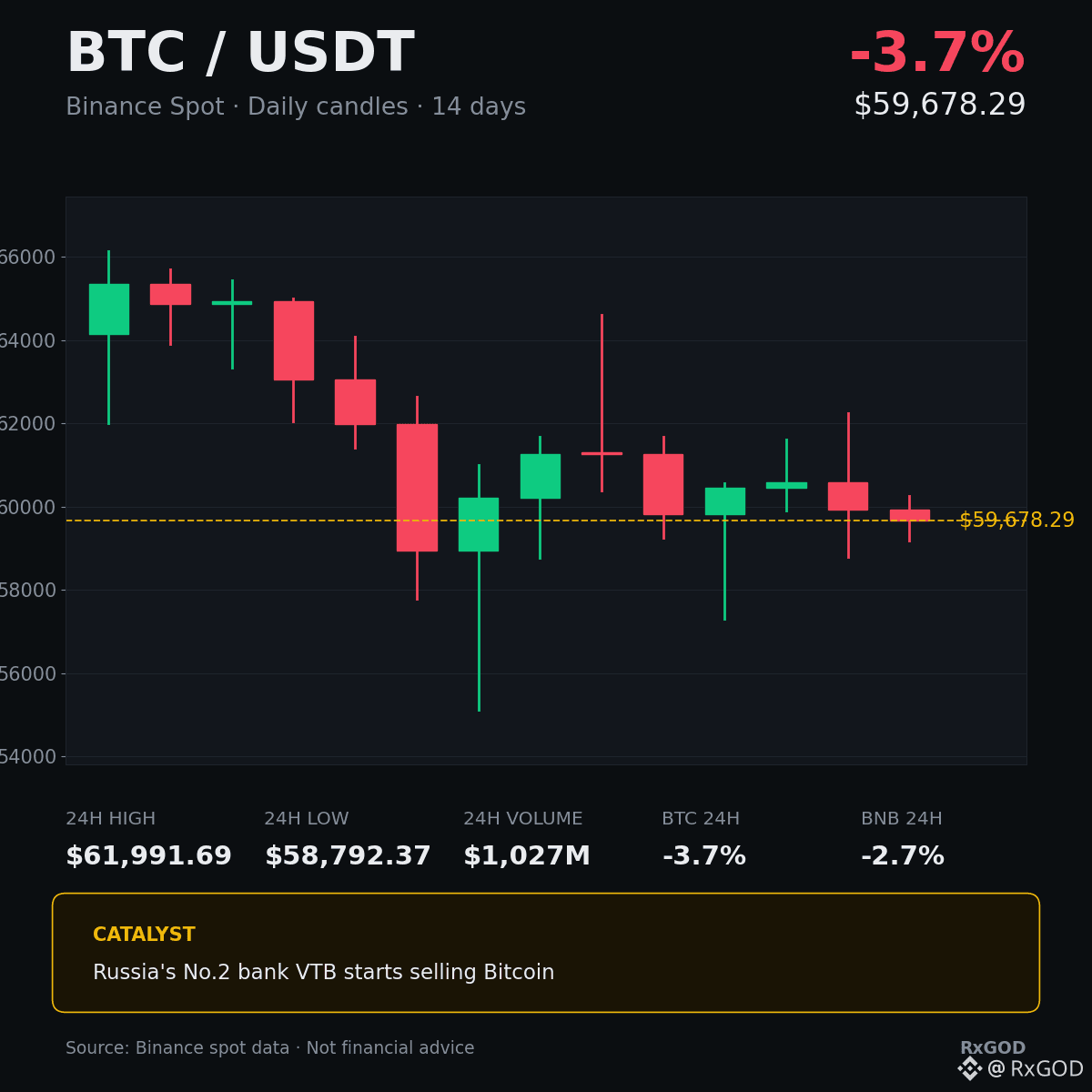
Real, regulated bank adoption — inside a sanctioned system — and the market has barely blinked. Bitcoin trades at $59,678, down 3.7% in 24 hours and 8.7% over 14 days, mid-range at 41% of its $55,130–$66,132 band. Fear & Greed reads 10, Extreme Fear, and November ETF outflows hit a record $5.78B.
The honest caveat: VTB's door is narrow — qualified investors only, OTC, no exchange yet — and a sanctioned bank selling Bitcoin raises compliance questions downstream. Adoption does not automatically mean demand.
Would you pass a government crypto exam to buy Bitcoin — or is a test the opposite of what crypto is for? Does bank adoption in sanctioned countries help Bitcoin's image, or hurt it?
Not financial advice — DYOR.
#Bitcoin #BitcoinAdoption #ExtremeFear #CryptoNews
Russia's second-largest bank just started selling Bitcoin — ten weeks after Washington blacklisted it as one of the world's most heavily sanctioned financial institutions.
VTB opened crypto trading for qualified investors on November 27 in its VTB My Investments app, a day after the Bank of Russia approved a mandatory crypto knowledge test. Trades run over the counter for now, with VTB handling buying, custody and record-keeping itself on Russian infrastructure.
Every buyer must pass first: at least 7 of 8 questions right, covering regulation, volatility, security and stablecoins. It is free, retryable the same day, and valid for a year. Ordinary Russians face tighter limits — only $BTC , $ETH and USDT, capped at 300,000 rubles a year per broker. SPB Exchange follows on December 1 with spot BTC, ETH and USDT against the ruble.
Real, regulated bank adoption — inside a sanctioned system — and the market has barely blinked. Bitcoin trades at $59,678, down 3.7% in 24 hours and 8.7% over 14 days, mid-range at 41% of its $55,130–$66,132 band. Fear & Greed reads 10, Extreme Fear, and November ETF outflows hit a record $5.78B.
The honest caveat: VTB's door is narrow — qualified investors only, OTC, no exchange yet — and a sanctioned bank selling Bitcoin raises compliance questions downstream. Adoption does not automatically mean demand.
Would you pass a government crypto exam to buy Bitcoin — or is a test the opposite of what crypto is for? Does bank adoption in sanctioned countries help Bitcoin's image, or hurt it?
Not financial advice — DYOR.
#Bitcoin #BitcoinAdoption #ExtremeFear #CryptoNews

Binance Gets Green Light to Open Asia Headquarters in Bhutan
Binance has received in-principle approval to establish an Asia hub in Bhutan, advancing its crypto tourism payment system launched there in 2025. This marks a key expansion milestone. Binance's Bhutan hub could boost regional crypto adoption and services.
Source: Cointelegraph · 08:26 UTC
AI illustration
#cryptonews #breakingcrypto #cryptoupdate #crypto

🔥 CRYPTO HOURLY — BREAKING UPDATES 🔥
━━━━━━━━━━━━━━━━━━━━
🟢 Bullish - Binance gets approval and aims to launch an Asia hub in Bhutan.
• Binance secured preliminary approval to expand into Bhutan after its 2025 crypto tourism payments, hinting at a major Asian market push.
━━━━━━━━━━━━━━━━━━━━
📈 Market Sentiment: 10 (Extreme Fear)
📊 Stay ahead. Think smart. Trade safe.
#cryptonews #BNB $BNB
Disclaimer: Includes third-party opinions. No advice.
BTC: -3.40% (H: 62248.9 L: 58792.4) | ETH: -4.56% (H: 1744 L: 1634.03) | SOL: -2.80% (H: 73.93 L: 70.12)
━━━━━━━━━━━━━━━━━━━━
🟢 Bullish - Binance gets approval and aims to launch an Asia hub in Bhutan.
• Binance secured preliminary approval to expand into Bhutan after its 2025 crypto tourism payments, hinting at a major Asian market push.
━━━━━━━━━━━━━━━━━━━━
📈 Market Sentiment: 10 (Extreme Fear)
📊 Stay ahead. Think smart. Trade safe.
#cryptonews #BNB $BNB
Disclaimer: Includes third-party opinions. No advice.
BTC: -3.40% (H: 62248.9 L: 58792.4) | ETH: -4.56% (H: 1744 L: 1634.03) | SOL: -2.80% (H: 73.93 L: 70.12)
6
·
--
Bitcoin took Thanksgiving off — literally. On Nov 26, the network went 98 minutes and 19 seconds without mining a single block, the longest gap since July and the 69th longest since 2011. Anyone broadcasting right after block 977,697 waited over 90 minutes for a first confirmation, whatever the fee.
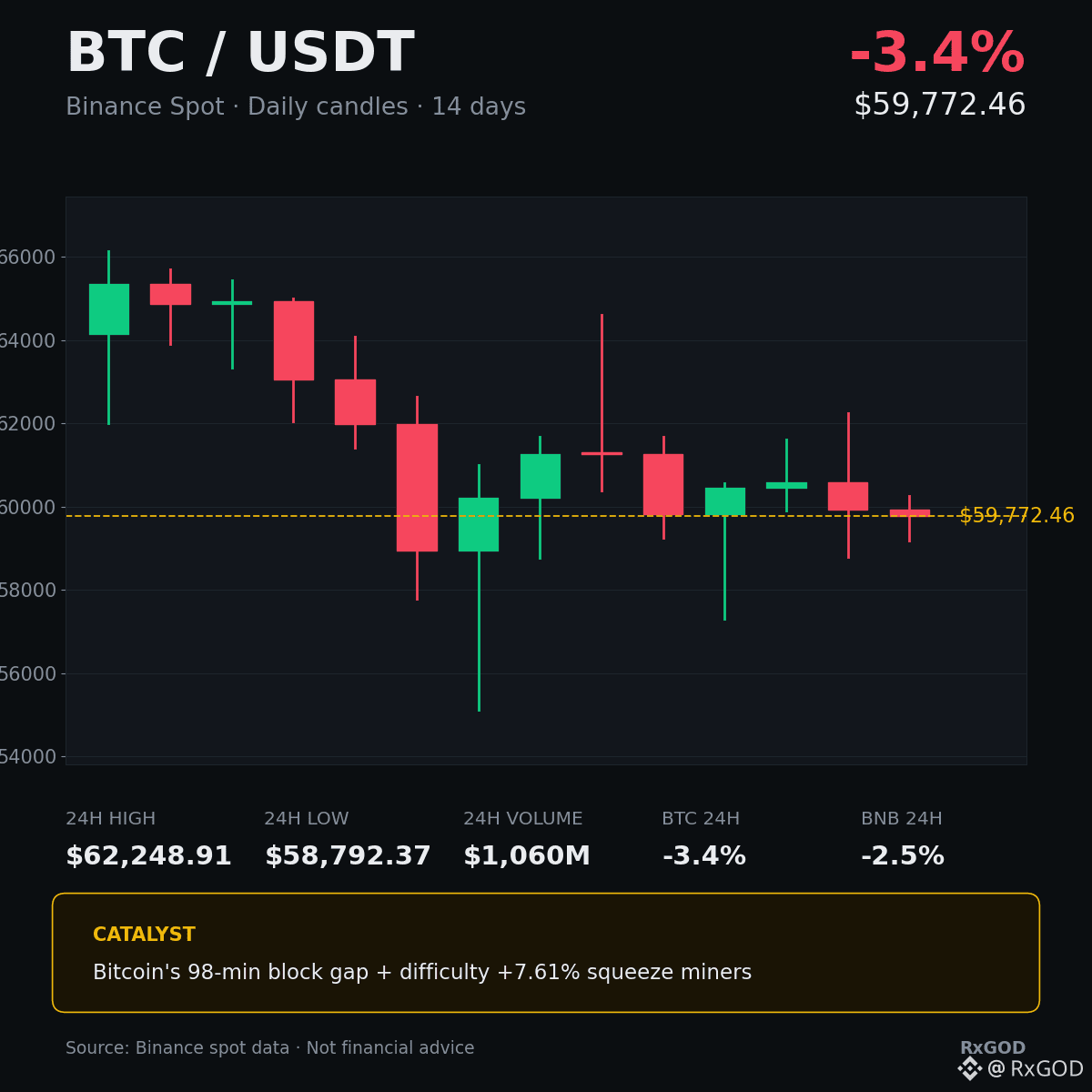
Here's the twist: the very next day, mining difficulty jumped 7.61% to 145.09 trillion — reversing much of the 9.1% relief cut from Nov 14. The network demanded more work per block just as miners are switching machines off. Hashrate has contracted 8% year over year — the first annual decline since China's 2021 ban — and hashprice sits near an all-time low. Daily revenue per petahash fell to $29.36 on Nov 23.
Foundry USA eventually mined block 977,698, packing 3,723 transactions and collecting just 0.1562 $BTC in fees. The next retarget is already projected at -4.62%.
$BTC trades at $59,772, down 3.4% in 24 hours and 26% in a month, at 42% of its 14-day range ($55,130–$66,132), with Fear & Greed stuck at 10 — Extreme Fear.
Honest caveat: one long gap is statistics, not a broken chain. Blocks arrive randomly, and the expected wait stays ~10 minutes even after 90 minutes of silence. The real signal is miner economics, not the clock.
So is this just harmless variance — or an early warning that miners are capitulating? If hashrate keeps sliding, does the next difficulty cut come in time? What's your read?
Not financial advice — DYOR.
#Bitcoin #BitcoinMining #ExtremeFear #CryptoNews

·
--
🚨 *BREAKING CRYPTO NEWS* 🤖
🔥 *Fidelity’s spot Bitcoin ETF records $20.8 million in net outflows*
📄 *Key Takeaways:*
The recent outflows from Fidelity's Bitcoin ETF highlight investor caution and potential reevaluation of cryptocurrency exposure amid market volatility.
The post Fidelity’s spot Bitcoin ETF records $2
📊 *AI Market Intelligence:*
• *Severity:* High Volatility Expected ⚡
• *Sentiment:* Shifted to Dynamic/Uncertain 📈
• *Liquidity:* Order book imbalances detected near key levels.
💡 *Trader Action Plan:*
Adjust stop-loss parameters and avoid unconfirmed breakouts on high leverage.
$BTC $ETH$BNB #CryptoNews #MarketScanner #CamboAI
🚨 *BREAKING CRYPTO NEWS* 🤖
🔥 *Fidelity’s spot Bitcoin ETF records $20.8 million in net outflows*
📄 *Key Takeaways:*
The recent outflows from Fidelity's Bitcoin ETF highlight investor caution and potential reevaluation of cryptocurrency exposure amid market volatility.
The post Fidelity’s spot Bitcoin ETF records $2
📊 *AI Market Intelligence:*
• *Severity:* High Volatility Expected ⚡
• *Sentiment:* Shifted to Dynamic/Uncertain 📈
• *Liquidity:* Order book imbalances detected near key levels.
💡 *Trader Action Plan:*
Adjust stop-loss parameters and avoid unconfirmed breakouts on high leverage.
$BTC $ETH $BNB #CryptoNews #MarketScanner #CamboAI
Log in to explore more content
Join global crypto users on Binance Square
⚡️ Get latest and useful information about crypto.
💬 Trusted by the world’s largest crypto exchange.
👍 Discover real insights from verified creators.
Email / Phone number
Trending Topics
1
#EvolveAtBinanceBlockchainWeek
1.5M views
16,558 Discussing
2
#ChainflipVaultTheftHaltsProtocol
15,264 views
261 Discussing
3
#ColdcardFlawLeadsToTheftOfAtLeast1789BTC
9,096 views
91 Discussing
4
#VitalikWantsWalletChipDesignsOpened
23,353 views
348 Discussing
5
#MalaysiaFirstBitcoinETFToListOnDecember2
7,996 views
102 Discussing
6
#ClaudeAccusedOfDroppingUserPreferences
7,416 views
86 Discussing
7
#DowJonesAdds591.99Points
10,835 views
71 Discussing
8
#SECIssuesNoActionLetterOnMoleculeModel
966 views
17 Discussing
9
#AnzaUrgesSolanaNodesUpgradeAgave
8,484 views
153 Discussing
10
#EthereumGlamsterdamKeepsStorageFeeChange
51,037 views
492 Discussing