Binance Square
2xnmore
492 Posts

2xnmore

MSc | Altcoin Analyst • AI • RWA | Seeing what the market hasn’t priced in yet
14 Following
807 Followers
1.0K+ Liked
Posts
PINNED
·
--
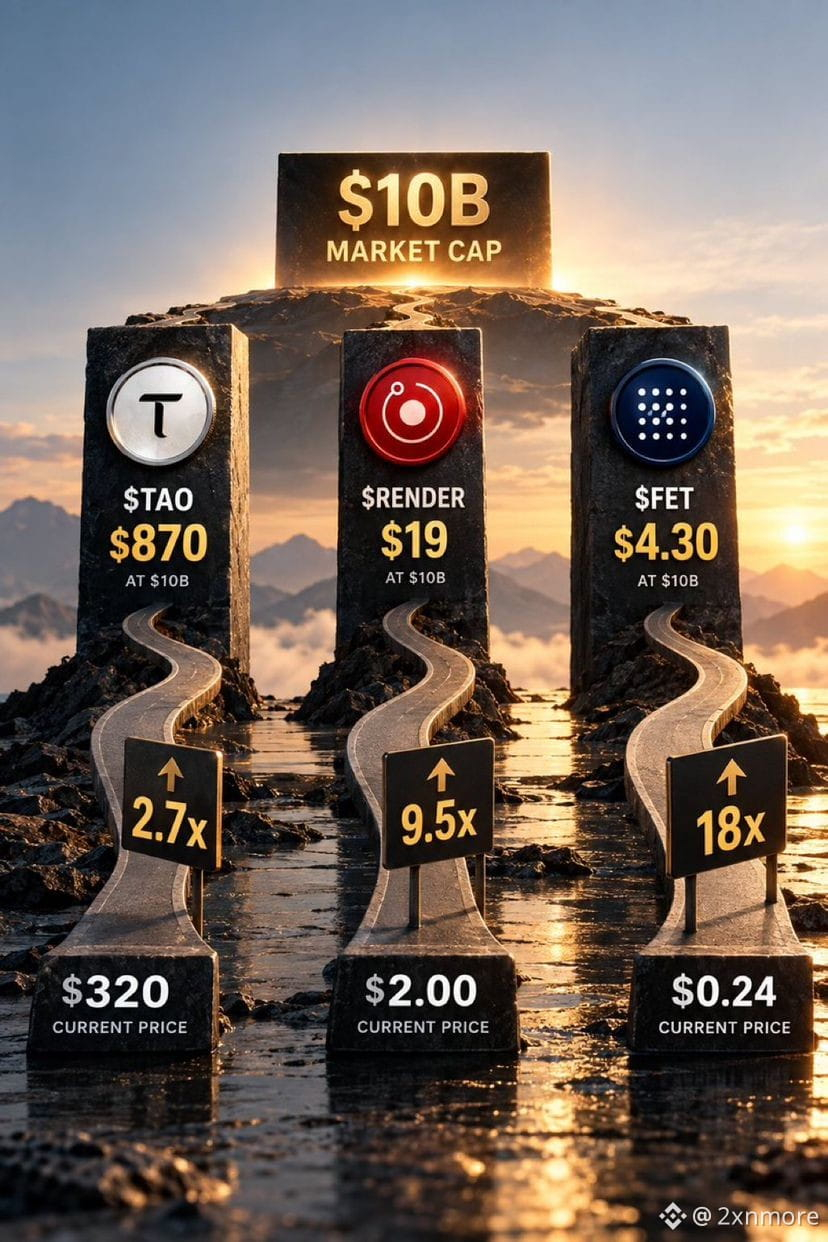
The coin you can afford more of is usually the one that can afford to go nowhere. Price per coin is lying to you. Put $TAO, $RENDER and $FET on the same line: a $10B market cap. $TAO at $10B: $870 $RENDER at $10B: $19 $FET at $10B: $4.30 Now look at how far each one is from that line today. $TAO from $320: 2.7x $RENDER from $2.00: 9.5x $FET from $0.24: 18x Same destination, completely different distance. The coin that looks cheapest needs the biggest move. That is unit bias, the oldest trap in crypto. People buy the coin with the lower price because it feels like it has more room to run. But room is measured in market cap, not price. And here is the part almost nobody accounts for. The line moves. TAO prints about 3,600 new tokens a day, so the price it needs to reach $10B slips lower every month. Any token with ongoing emissions has a target that quietly shifts under your feet. So before you buy anything because it looks cheap, ask one question. What market cap does my target price imply, and does this project deserve it? At $10B, which one are you actually holding: the 2.7x, the 9.5x or the 18x?
The coin you can afford more of is usually the one that can afford to go nowhere.

Price per coin is lying to you.

Put $TAO, $RENDER and $FET on the same line: a $10B market cap.

$TAO at $10B:
$870

$RENDER at $10B:
$19

$FET at $10B:
$4.30

Now look at how far each one is from that line today.

$TAO from $320:
2.7x

$RENDER from $2.00:
9.5x

$FET from $0.24:
18x

Same destination, completely different distance.

The coin that looks cheapest needs the biggest move.

That is unit bias, the oldest trap in crypto. People buy the coin with the lower price because it feels like it has more room to run. But room is measured in market cap, not price.

And here is the part almost nobody accounts for.

The line moves. TAO prints about 3,600 new tokens a day, so the price it needs to reach $10B slips lower every month.

Any token with ongoing emissions has a target that quietly shifts under your feet.

So before you buy anything because it looks cheap, ask one question.

What market cap does my target price imply, and does this project deserve it?

At $10B, which one are you actually holding: the 2.7x, the 9.5x or the 18x?
PINNED
Your alt just pumped 40%, and it may still need to 6x just to get back to its old high. That is the math nobody posts during a green week. A coin that falls 85% does not need an 85% rally to recover. It needs about 567%. Here is what every name from this week's bounce needs to reclaim its all time high. $TAO 2.2x $SOL 2.4x $LINK 3.7x $ONDO 3.9x $NEAR 4.2x $SUI 4.5x $INJ 6.7x $RENDER 6.8x $QUBIC 8x or more $AVAX 13x $FET 14x $ICP 34x, or 210x from its $700 launch week print Every name except TAO and SOL is still 70% or more below its peak. Two things stand out. The leaders are the closest. TAO and SOL need less than 2.5x, which is part of why the market keeps treating them as leaders. The deepest holes belong to names that peaked on old narratives. AVAX and ICP topped in 2021 and have spent nearly five years far below those highs. A new cycle does not automatically bring old leaders back. So before you celebrate a bounce, ask one question. Is this coin recovering, or just bouncing inside a much bigger drawdown? The coins closest to their highs already have the market's trust. The ones furthest away need a new story, not a green week.
Your alt just pumped 40%, and it may still need to 6x just to get back to its old high.

That is the math nobody posts during a green week.

A coin that falls 85% does not need an 85% rally to recover. It needs about 567%.

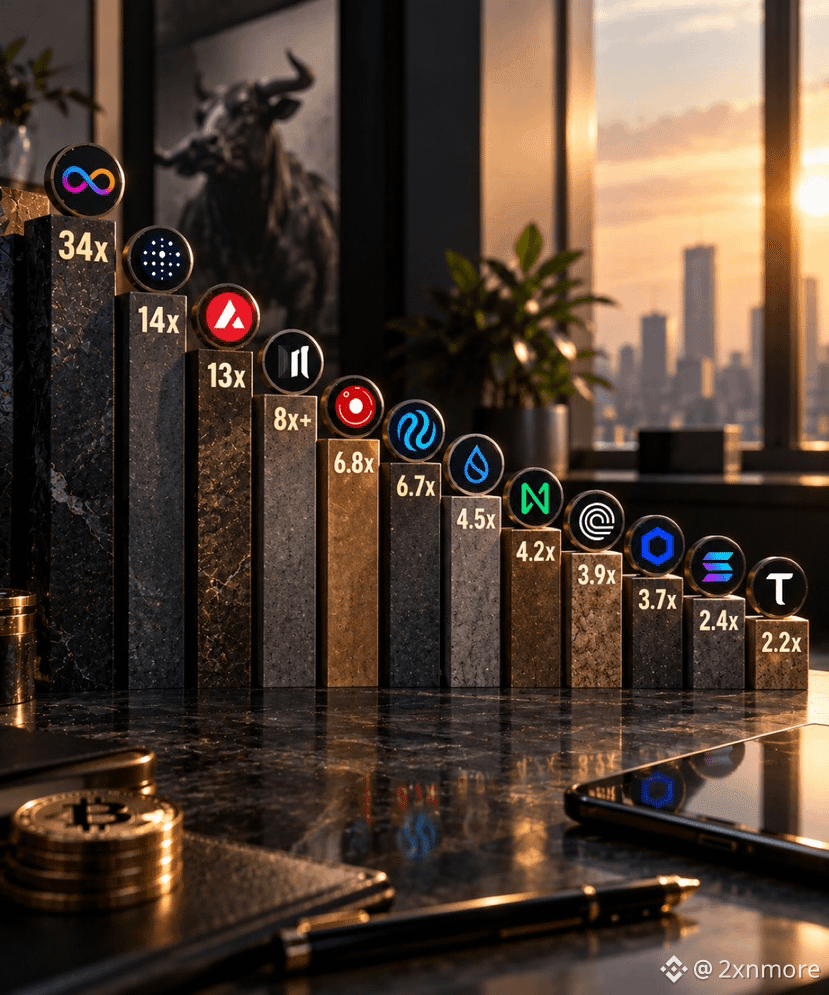
Here is what every name from this week's bounce needs to reclaim its all time high.

$TAO 2.2x
$SOL 2.4x
$LINK 3.7x
$ONDO 3.9x
$NEAR 4.2x
$SUI 4.5x
$INJ 6.7x
$RENDER 6.8x
$QUBIC 8x or more
$AVAX 13x
$FET 14x
$ICP 34x, or 210x from its $700 launch week print

Every name except TAO and SOL is still 70% or more below its peak.

Two things stand out.

The leaders are the closest. TAO and SOL need less than 2.5x, which is part of why the market keeps treating them as leaders.

The deepest holes belong to names that peaked on old narratives.

AVAX and ICP topped in 2021 and have spent nearly five years far below those highs.

A new cycle does not automatically bring old leaders back.

So before you celebrate a bounce, ask one question.

Is this coin recovering, or just bouncing inside a much bigger drawdown?

The coins closest to their highs already have the market's trust.

The ones furthest away need a new story, not a green week.
You do not need a bigger green week. You need to know which token actually gets paid. $UNI is a $5.6B exchange token. $TAO is a $3.4B network token. Uniswap already runs the venue. The fee switch is on. September burns hit about $14.7M. The chart understands that. Bittensor already runs the marketplace. Subnets are live. The chart is still pricing the network, not a clean fee line. One is cash flow the market already knows how to score. One is scarcity the market is still learning how to score. Most of CT will pick the louder tape. The people who read the docs pick the one that still has a job if the timeline goes quiet. UNI pays you by burning supply. TAO pays you only if subnets keep selling work someone actually buys. Delete the ticker and ask what stops. If Uniswap volume dies, the burn dies. If subnet demand dies, the 21 million cap is just a sticker. Which one are you actually holding, and can you name what pays you? NFA | DYOR {spot}(TAOUSDT)
You do not need a bigger green week.

You need to know which token actually gets paid.

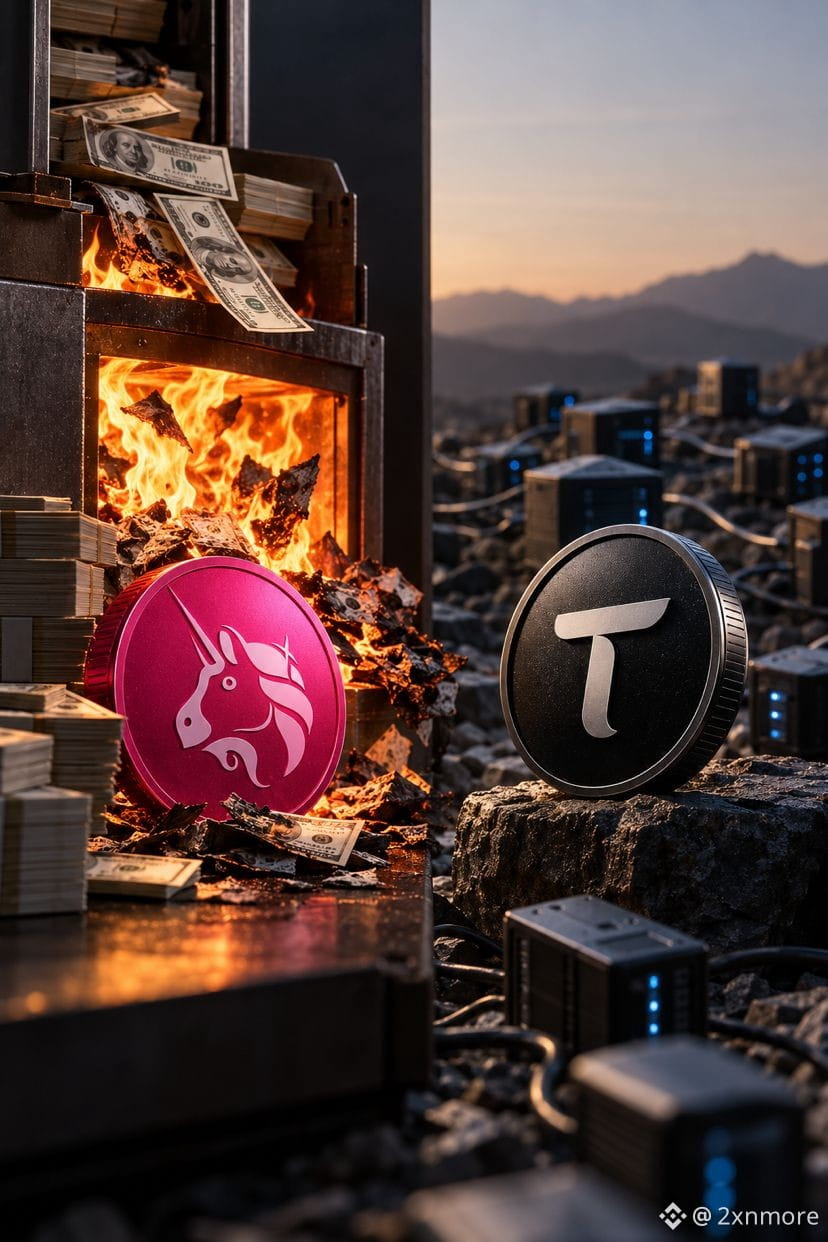
$UNI is a $5.6B exchange token.

$TAO is a $3.4B network token.

Uniswap already runs the venue. The fee switch is on.

September burns hit about $14.7M.

The chart understands that.

Bittensor already runs the marketplace. Subnets are live.

The chart is still pricing the network, not a clean fee line.

One is cash flow the market already knows how to score.

One is scarcity the market is still learning how to score.

Most of CT will pick the louder tape.

The people who read the docs pick the one that still has a job if the timeline goes quiet.

UNI pays you by burning supply.

TAO pays you only if subnets keep selling work someone actually buys.

Delete the ticker and ask what stops.

If Uniswap volume dies, the burn dies.

If subnet demand dies, the 21 million cap is just a sticker.

Which one are you actually holding, and can you name what pays you?

NFA | DYOR
Everyone keeps telling me not to let money change me. Meanwhile, me when my $TAO bags are back at all time high.
Everyone keeps telling me not to let money change me.

Meanwhile, me when my $TAO bags are back at all time high.
Most of CT is picking coins for 2026. I am picking the ones that still have a job in 2029 if the timeline goes quiet. That is the whole list. A three year bid is not a target. It is a name you can defend when nobody is asking. $HYPE Has to keep being the venue size actually trades. $ONDO Has to turn a working stack into capture. The machine can win while the token waits. $TAO Has to keep settling real subnet demand. Root is the network bid. Alpha is a single subnet bet. $ETH Has to stay the default place serious issuance lives. $LINK Has to stay the rail you cannot rip out. $ZEC Has to stay the liquid privacy bid when the market remembers why it exists. $SUI Has to keep turning throughput into users who come back. $BNB Has to keep being distribution, not culture. If a coin needs a new story every quarter to hold a floor, it does not earn a 2027 to 2029 number. It earns a trade. Rank these by whether they still get paid if CT stops talking. That order will tell you more than the multiples.
Most of CT is picking coins for 2026.

I am picking the ones that still have a job in 2029 if the timeline goes quiet.

That is the whole list.

A three year bid is not a target. It is a name you can defend when nobody is asking.

$HYPE
Has to keep being the venue size actually trades.

$ONDO
Has to turn a working stack into capture. The machine can win while the token waits.

$TAO
Has to keep settling real subnet demand. Root is the network bid. Alpha is a single subnet bet.

$ETH
Has to stay the default place serious issuance lives.

$LINK
Has to stay the rail you cannot rip out.

$ZEC
Has to stay the liquid privacy bid when the market remembers why it exists.

$SUI
Has to keep turning throughput into users who come back.

$BNB
Has to keep being distribution, not culture.

If a coin needs a new story every quarter to hold a floor, it does not earn a 2027 to 2029 number. It earns a trade.

Rank these by whether they still get paid if CT stops talking.

That order will tell you more than the multiples.
Bittensor $TAO is going to be a global phenomenon {spot}(TAOUSDT)
Bittensor $TAO is going to be a global phenomenon
2xnmore
·
--
Your Staked $TAO Is Earning. It Just Is Not in Your Wallet.
Most people holding $TAO have never staked a single coin.
Not because it is hard. Because nobody walked them through it in one place, in plain words, from the first click to the last.
So their TAO sits idle while the network pays the people who showed up.
That is the idle tax. You never see the bill. You just watch someone else's stack grow.
This article pays it off, and updates the parts that quietly changed since the first version.
By the end you will know what staking actually is, the two doors, what Root Reborn changed, every fee, the mistakes that drain people, and the exact steps to move TAO from sleeping to earning.
Read it once. You should not need to ask again.
What staking actually is
Staking is delegating your TAO to a validator.
You are not locking it in a vault. You are not handing it to a company. You are pointing it at a validator who uses that stake to help run Bittensor. In return you earn a share of what that validator produces.
There is still no lock. No unbonding period. You can unstake when you want. The TAO is spendable immediately.
There are two completely different ways to do this. That difference is the whole article.
Door one. Root stake.
You keep TAO as TAO.
You stake on subnet 0, the root network. There is no pool swap. No alpha token. No slippage on the principal. One TAO in is one TAO of root principal.
This is the lower risk door.
Here is what most guides still have wrong. Root rewards do not just appear on your balance anymore.
Since Root Reborn, dividends accrue into your validator's basket. That basket is a mix of subnet alpha earned across the network. Your share of it is claimable. It does not compound by itself.
Root now has two balances.
Principal. TAO, 1 to 1, no pool risk.
Accrued yield. Sitting in the basket until you claim it.
Unclaimed yield can move with subnet prices. The principal does not.
Claiming is a separate action. It costs a small chain fee that scales with how many holdings sit in the basket. If the fee is larger than the accrued yield, wait.
Root is simple. It is not automatic anymore.
Door two. Alpha stake.
You sell TAO into a subnet's liquidity pool and receive that subnet's token, called alpha. That alpha is then staked to a validator on that subnet.
This is a different asset.
Your alpha balance is designed to grow as emissions land. That part is real.
The exchange rate between that alpha and TAO is not guaranteed. It moves both ways.
So here is the trap.
You can hold more alpha than you started with and still have less TAO than you started with, because the alpha to TAO price fell.
More tokens. Less value.
That is the most expensive confusion in Bittensor. People screenshot a rising alpha balance and call it profit. The only score that matters when you unstake is how much TAO comes back out.
Counting tokens is not counting value.
Why this matters more after v440
v440 put a gate on emissions.
Demand still matters. But weak subnets below the bar now keep far less emission. Strong subnets keep more. A parked tail subnet can still exist and still look like it has an APY. That APY is often a mirage.
After v440, picking any alpha is not a strategy. Picking the room inside door two is the strategy.
If you cannot say in one sentence why that subnet keeps demand, you do not have a thesis. You have a coin flip with slippage attached.
The comparison, in one screen
Root.
You stay in TAO. No pool, no swap fee, no slippage on principal. Yield accrues in a validator basket and must be claimed. Lower risk to principal. Share of network emissions shrinks over time by design as subnets mature.
Alpha.
You buy a separate token through a pool. Default swap fee is about 0.05%, taken in TAO on the way in and in alpha on the way out. Your own trade can move the price against you. Balance can grow while TAO value falls. Direct bet on one subnet.
Neither is better. They are different tools.
Root is for people who want simple network exposure without picking a winner.
Alpha is for people who will underwrite one subnet and accept the price risk.
How to choose a validator
Do not click the name at the top of the list.
Look at four things.
How much stake is already behind them.
VTrust. That is how accurate their evaluations are. High VTrust across many subnets is the cleanest quality signal for root.
Take rate. The validator's cut comes out before you get paid.
Whether they are actually doing the work. Your stake is a vote. Idle stake on a lazy validator is how the network gets worse and your yield gets thinner.
Use the validator explorer. Read the history. Then stake.
How to know what you will earn
Use realized yield, not a marketed APY.
Alpha APYs are usually quoted in alpha. That number can look large while the TAO value of the position is falling. Treat any advertised alpha APY as a token count, not a return, until you check what it actually did in TAO terms.
Root yield is slower and cleaner. It also declines over time as more capital and more emission move into subnets. That decline is the system working, not a bug.
Past returns are not a promise. They beat a screenshot.
The exact steps
This is the Taostats path most people use.
Get a wallet with a browser extension.
Open the subnet page. Root if you want door one. A specific subnet if you want door two.
Connect the wallet. Approve the permission. Unlock it.
Check two balances. Free TAO you can stake, and any alpha you already hold.
Pick the validator. Do not skip this.
Enter the amount. If you hit Max, read the slippage estimate before you blink.
Set slippage tolerance. For alpha, this is the guardrail against a bad fill.
Confirm. Approve the wallet popup. Wait for the chain.
That is the whole flow.
Leave a sliver of TAO unstaked. Interfaces often do this on purpose so you can pay the later unstake fee.
A very small stake can get rejected outright. Do not test the chain with dust.
If you move stake between validators on the same subnet, that is not a swap. No pool fee. No price impact. Changing subnets is a swap.
The fees, with nothing hidden
Every action pays a small chain transaction fee.
Root stake and unstake. No extra staking fee. Principal moves 1 to 1.
Root claim. Separate fee. Check the estimate first. Do not claim a tiny amount of yield if the fee eats it.
Alpha stake. Default around 0.05% of the input, taken in TAO before the swap.
Alpha unstake. Default around 0.05% of the input, taken in alpha before the swap back to TAO.
Subnet owners can change that fee.
If you batch several actions in one session, the batch itself has a small extra chain fee. The interface does not keep it.
The mistakes that quietly cost people
Confusing more alpha with more TAO.
Taking the default validator.
Chasing the loudest APY on a subnet the market is leaving.
Hitting Max into a thin pool and eating slippage.
Treating alpha like a savings account.
Forgetting to claim root yield, then thinking root pays nothing.
Claiming root dust and lighting it on fees.
Staking the last TAO and getting stuck with no gas for the exit.
Pre stake checklist
Wallet connected and unlocked.
Root or alpha decided.
If alpha, one sentence on why that subnet keeps demand after the emission gate.
Validator checked for stake, VTrust, and take.
Amount set.
Slippage read.
Fees understood.
Dust left for the later unstake.
Then confirm.
If something looks broken
A missing stake is usually a wallet permission, a rejected dust amount, or a page that has not refreshed. Do not assume the funds vanished. Check the explorer against your address before you panic click anything else.
The bottom line
Unstaked TAO is a volunteer donation to everyone who did the work.
Root turns TAO into a claim on the whole network, with principal protected and yield sitting in a basket until you take it.
Alpha turns TAO into a bet on one subnet. The balance can grow. The value can fall. Both can be true at the same time.
No lock. No mystery. One honest decision instead of one blind click.
Most holders have done neither.
Save this. The next time someone asks how staking works, send them here.
Educational only. Not financial advice. Mechanics move with runtime upgrades. Read the live Taostats and Bittensor docs before you sign anything.
Promo post, to share the article:
My July staking guide is out of date, and that is a good thing. Root Reborn changed how yield actually lands in your wallet.
Rewrote the whole piece. Root versus alpha, the fee changes, the v440 emission gate, and the exact steps, updated for how Bittensor actually works today.
If you have not staked a single coin yet, this is the one to read first.
You do not need 21 $TAO You need one. 21 million will ever exist, and daily issuance was already cut in half last December. That math only gets harder from here. One whole coin is the entry ticket. Everything above it is conviction. The people holding zero are the ones who will explain later why they were "waiting for a dip." {spot}(TAOUSDT)
You do not need 21 $TAO

You need one.

21 million will ever exist, and daily issuance was already cut in half last December.

That math only gets harder from here.

One whole coin is the entry ticket. Everything above it is conviction.

The people holding zero are the ones who will explain later why they were "waiting for a dip."
If your coin isn't on this list, I didn't miss it. These are the only names I'm willing to put 2027 to 2029 numbers on. Target range, multiple from today: $HYPE $120 to $250 (2.1x to 4.4x) $ONDO $1.50 to $2.50 (1.9x to 3.2x) $TAO $600 to $1,000 (1.6x to 2.7x) $ETH $4k to $7k (1.5x to 2.6x) $LINK $20 to $40 (1.3x to 2.5x) $ZEC $2,000 to $3,200 (1.4x to 2.3x) $SUI $1.50 to $3.00 (1.1x to 2.2x) $BNB $900 to $1,400 (1.2x to 1.9x) Most of CT is still trading vibes. I just don't think the rest earn a three year bid.
If your coin isn't on this list, I didn't miss it.

These are the only names I'm willing to put 2027 to 2029 numbers on.

Target range, multiple from today:

$HYPE $120 to $250 (2.1x to 4.4x)

$ONDO $1.50 to $2.50 (1.9x to 3.2x)

$TAO $600 to $1,000 (1.6x to 2.7x)

$ETH $4k to $7k (1.5x to 2.6x)

$LINK $20 to $40 (1.3x to 2.5x)

$ZEC $2,000 to $3,200 (1.4x to 2.3x)

$SUI $1.50 to $3.00 (1.1x to 2.2x)

$BNB $900 to $1,400 (1.2x to 1.9x)

Most of CT is still trading vibes.

I just don't think the rest earn a three year bid.
You told everyone you bought the bottom. You never told them where it went after. $FET, entry near $0.66, now $0.22. $RENDER, entry near $3.92, now $1.92. $ONDO, entry near $1.02, now $0.50. $QUBIC, entry near $0.0000011, now $0.0000005. $LINK, entry near $22, now $14.40. $SOL, entry near $210, now $119. Every one of those is still underwater from the tweet you pinned. $ZEC was not in that screenshot. It was the ugly one. Privacy coin. Dead narrative. Off the timeline. Then it ran. Off the lows it is up more than anything on that list. Off last month it is still the only name in this group that actually paid. Nobody deletes the losing tweet. Everyone just stops replying to it. Silence is not conviction. Silence is a drawdown nobody wants to talk about out loud. $ZEC is the reminder that the bag you were embarrassed to post is sometimes the only one still working. Which one of yours are you still holding, and are you actually still holding it or just still watching it.
You told everyone you bought the bottom.

You never told them where it went after.

$FET, entry near $0.66, now $0.22.

$RENDER, entry near $3.92, now $1.92.

$ONDO, entry near $1.02, now $0.50.

$QUBIC, entry near $0.0000011, now $0.0000005.

$LINK, entry near $22, now $14.40.

$SOL, entry near $210, now $119.

Every one of those is still underwater from the tweet you pinned.

$ZEC was not in that screenshot.

It was the ugly one. Privacy coin. Dead narrative. Off the timeline.

Then it ran. Off the lows it is up more than anything on that list. Off last month it is still the only name in this group that actually paid.

Nobody deletes the losing tweet. Everyone just stops replying to it.

Silence is not conviction. Silence is a drawdown nobody wants to talk about out loud.

$ZEC is the reminder that the bag you were embarrassed to post is sometimes the only one still working.

Which one of yours are you still holding, and are you actually still holding it or just still watching it.
There are more millionaires on Earth than there will ever be $TAO. 57.5 million dollar millionaires. 21 million $TAO, ever. Only about 11.3 million exist today. The rest trickles out at roughly 3,600 a day, and that rate halves again. Nearly three millionaires for every coin that will ever exist. Most people will never run this math. They check the candle and scroll. But a hard cap alone pays nobody. It only bites if subnets keep producing work people pay real money for. If that holds, one whole $TAO puts you in a smaller club than the world's millionaires. The people who skipped the math will call it luck. {spot}(TAOUSDT)
There are more millionaires on Earth than there will ever be $TAO .

57.5 million dollar millionaires.
21 million $TAO , ever.

Only about 11.3 million exist today. The rest trickles out at roughly 3,600 a day, and that rate halves again.

Nearly three millionaires for every coin that will ever exist.

Most people will never run this math. They check the candle and scroll.

But a hard cap alone pays nobody. It only bites if subnets keep producing work people pay real money for.

If that holds, one whole $TAO puts you in a smaller club than the world's millionaires.

The people who skipped the math will call it luck.
Verified
Ondo stacked BlackRock, DTCC, and Tesla into a single month. If you hold $ONDO , none of it touched your bag. That is not bearish. It is the one detail that tells you what this token is actually worth. The timeline scored September as five separate wins. They are one machine, and the part everyone is excited about is not the part that pays you. Policy, TradFi pipe, inventory, crypto distribution, product. For the first time, every layer connects. Now run the test nobody ran. Delete $ONDO from the stack and ask what stops working. The DTCC seat still works. The Alpaca conversion still works. The NEAR route still works. The BlackRock models still work. Not one of them requires the token. That is the real gap between the company winning and the holder winning. It closes with a fee switch, a buyback, or a product that needs $ONDO. Until then you are long the story, not the cash flow. I mapped all five layers and the three questions that size any branded RWA headline before it goes near a portfolio. Ondo already won September. The token is still waiting for its invitation. {spot}(ONDOUSDT)
Ondo stacked BlackRock, DTCC, and Tesla into a single month.

If you hold $ONDO , none of it touched your bag.

That is not bearish. It is the one detail that tells you what this token is actually worth.

The timeline scored September as five separate wins.

They are one machine, and the part everyone is excited about is not the part that pays you.

Policy, TradFi pipe, inventory, crypto distribution, product. For the first time, every layer connects.

Now run the test nobody ran. Delete $ONDO from the stack and ask what stops working.

The DTCC seat still works.
The Alpaca conversion still works.
The NEAR route still works.
The BlackRock models still work.

Not one of them requires the token.

That is the real gap between the company winning and the holder winning.

It closes with a fee switch, a buyback, or a product that needs $ONDO .

Until then you are long the story, not the cash flow.

I mapped all five layers and the three questions that size any branded RWA headline before it goes near a portfolio.

Ondo already won September.

The token is still waiting for its invitation.
One of these sectors will be a 2024 leftover by the end of 2026. Which one is already dead money? A. AI compute ( $RENDER $QUBIC ) B. Tokenised stocks ( $ONDO $LINK) C. Privacy ( $ZEC ) D. Meme infrastructure ( $PUMP ) Name the loser, not the winner. That is the harder call.
One of these sectors will be a 2024 leftover by the end of 2026.

Which one is already dead money?

A. AI compute ( $RENDER $QUBIC )

B. Tokenised stocks ( $ONDO $LINK)

C. Privacy ( $ZEC )

D. Meme infrastructure ( $PUMP )

Name the loser, not the winner.

That is the harder call.
Partly True
Bittensor just made it possible to run a full AI company from one wallet. No extra accounts. No offchain billing systems. No waiting for someone to approve you. That is the real announcement from Const at Exploit. For the past year, Bittensor quietly became a working AI stack. Compute, storage, inference, routing. Real products with real revenue. The problem was that none of those pieces talked to each other cleanly. Builders had to stitch everything together themselves. Gamma tokens are the fix. Burn, Credit, Spend. Starting in 2027, you burn a subnet's alpha token and receive Gamma credits at the current dollar price. Those credits stay fixed even if the token moves later. Then you spend them as usage anywhere on the network. This sounds small, but it is not. A team can now pay another team inside Bittensor for compute or inference just by allocating part of its emissions. New projects can wrap existing ones. One $TAO wallet becomes the key to the entire stack. Regular users will barely notice. Power users just got far more freedom. The bigger play: Bittensor is turning a collection of separate subnets into one economic layer anyone can build on without permission. Execution will decide if it lands. Most people are still valuing the subnets. The ones paying attention are valuing the layer underneath.
Bittensor just made it possible to run a full AI company from one wallet.

No extra accounts.
No offchain billing systems.
No waiting for someone to approve you.

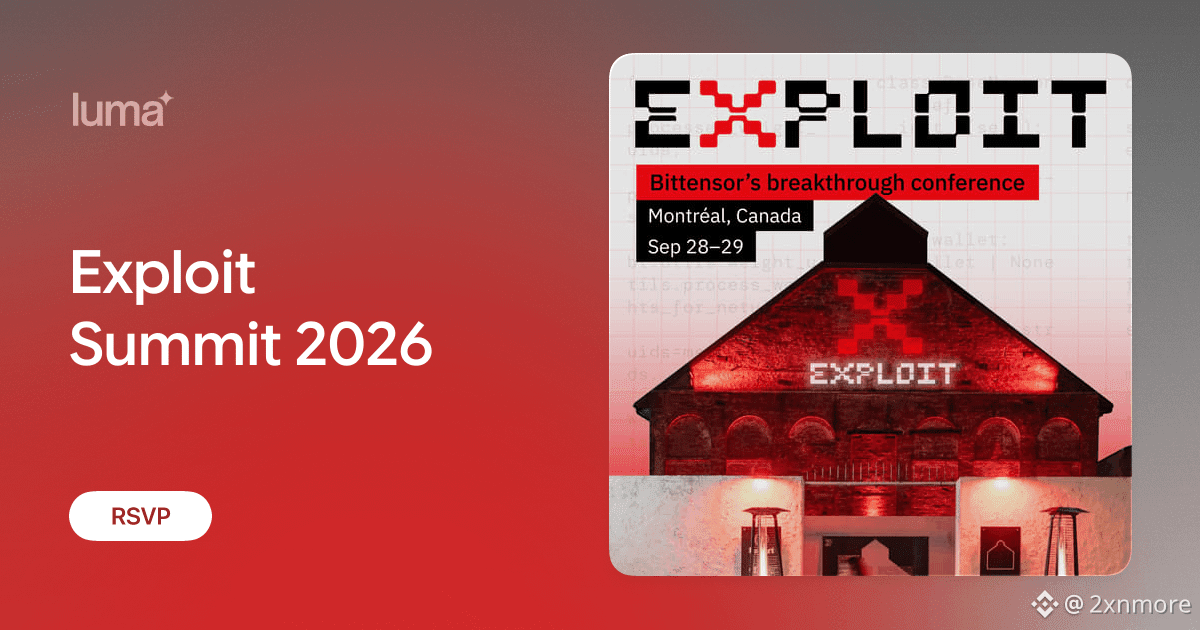
That is the real announcement from Const at Exploit.

For the past year, Bittensor quietly became a working AI stack.

Compute, storage, inference, routing.
Real products with real revenue.

The problem was that none of those pieces talked to each other cleanly.

Builders had to stitch everything together themselves.

Gamma tokens are the fix.

Burn, Credit, Spend.

Starting in 2027, you burn a subnet's alpha token and receive Gamma credits at the current dollar price.

Those credits stay fixed even if the token moves later.

Then you spend them as usage anywhere on the network.

This sounds small, but it is not.

A team can now pay another team inside Bittensor for compute or inference just by allocating part of its emissions.

New projects can wrap existing ones.

One $TAO wallet becomes the key to the entire stack.

Regular users will barely notice. Power users just got far more freedom.

The bigger play: Bittensor is turning a collection of separate subnets into one economic layer anyone can build on without permission.

Execution will decide if it lands.

Most people are still valuing the subnets.

The ones paying attention are valuing the layer underneath.
Usage can 10x and the token still dies. That is the only question that matters on these 8. Does the product paying customers force anyone to buy or burn the token. Passes. $RENDER Jobs get paid in the token. $INJ Fees burn supply every week. $TAO You stake it to earn from the subnets. $QUBIC Mining is the product. Fails. $ONDO DTCC, Alpaca, treasuries. Company gets paid. Token gets a headline. $FET Agents can ship. Token is still a story. $LINK Oracles run on fees that do not need you to hold LINK. $PLUME Chain can fill up. Token does not have to. Same test. Half of the basket is inventory. Half is a press release. If the hype cycle ended tomorrow, which two would you still hold. Drop them.
Usage can 10x and the token still dies.

That is the only question that matters on these 8.

Does the product paying customers force anyone to buy or burn the token.

Passes.

$RENDER
Jobs get paid in the token.

$INJ
Fees burn supply every week.

$TAO
You stake it to earn from the subnets.

$QUBIC
Mining is the product.

Fails.

$ONDO
DTCC, Alpaca, treasuries. Company gets paid. Token gets a headline.

$FET
Agents can ship. Token is still a story.

$LINK
Oracles run on fees that do not need you to hold LINK.

$PLUME
Chain can fill up. Token does not have to.

Same test. Half of the basket is inventory. Half is a press release.

If the hype cycle ended tomorrow, which two would you still hold. Drop them.
$TAO just pulled back 4% off its September high. Here is the level that actually matters. TAO ran from 200 in August to 340 this month. That is a real trend, not a random pump. Today it printed a rejection wick at 309 and closed near 296. RSI 14 sits at 58. That is a cooling pullback inside an uptrend, not a breakdown. Oversold starts under 30. MACD is still positive with the histogram holding above zero. Momentum has not flipped yet. 279 is the level to watch. That is the recent support shelf. Hold it and this reads as a normal shakeout after a strong run. Lose it with conviction and the next real floor sits back near 240, where TAO based for most of the summer. 340 is the level TAO has to reclaim to confirm the breakout is still alive. Until then, this is a pullback inside a trend, not a trend change. The people who bought the August floor are not worried about a red daily candle in September. Where does TAO find its buyers first, 279 or 240? {spot}(TAOUSDT)
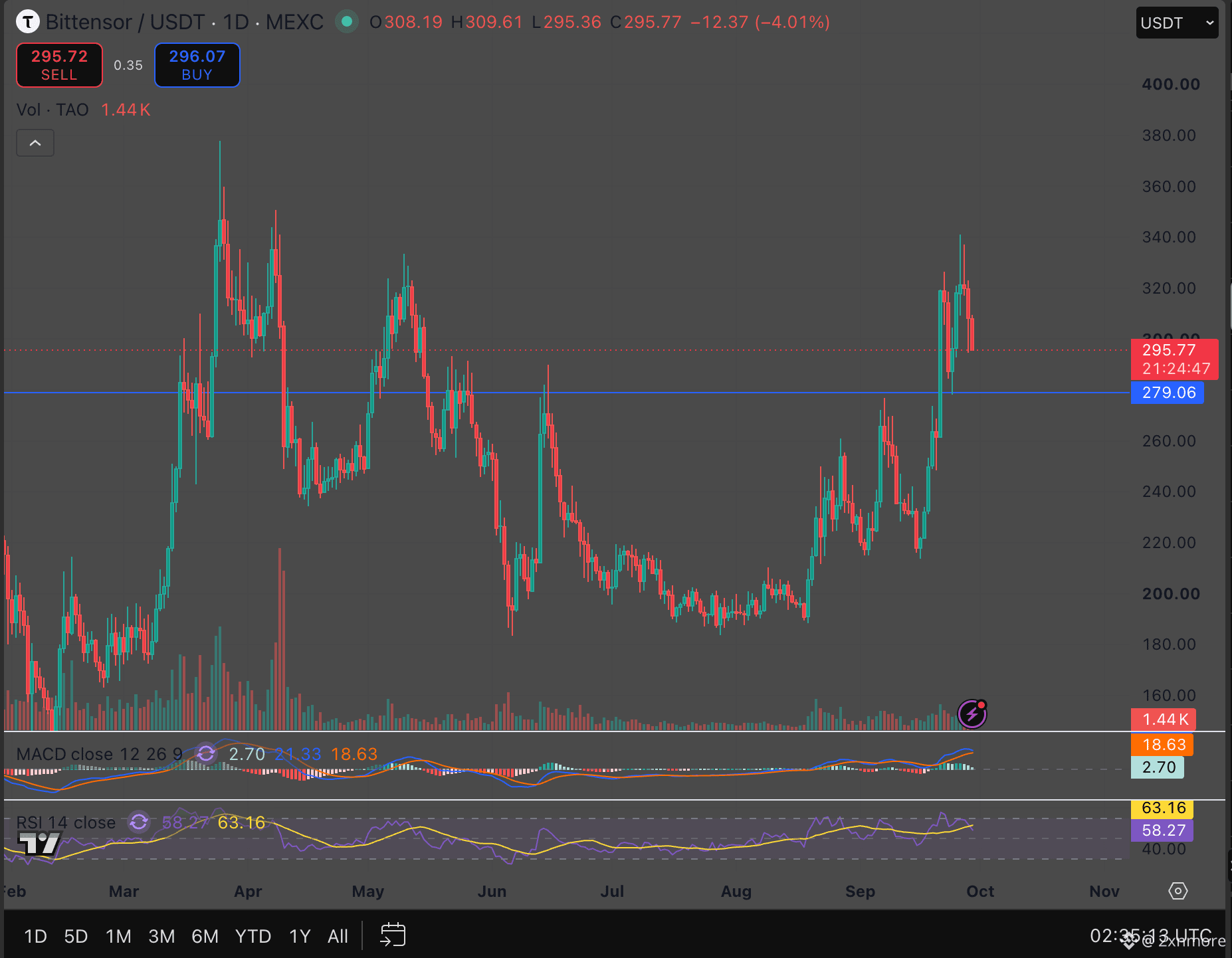
$TAO just pulled back 4% off its September high.

Here is the level that actually matters.

TAO ran from 200 in August to 340 this month.

That is a real trend, not a random pump.

Today it printed a rejection wick at 309 and closed near 296.

RSI 14 sits at 58.

That is a cooling pullback inside an uptrend, not a breakdown. Oversold starts under 30.

MACD is still positive with the histogram holding above zero.

Momentum has not flipped yet.

279 is the level to watch.

That is the recent support shelf. Hold it and this reads as a normal shakeout after a strong run.

Lose it with conviction and the next real floor sits back near 240, where TAO based for most of the summer.

340 is the level TAO has to reclaim to confirm the breakout is still alive.

Until then, this is a pullback inside a trend, not a trend change.

The people who bought the August floor are not worried about a red daily candle in September.

Where does TAO find its buyers first, 279 or 240?
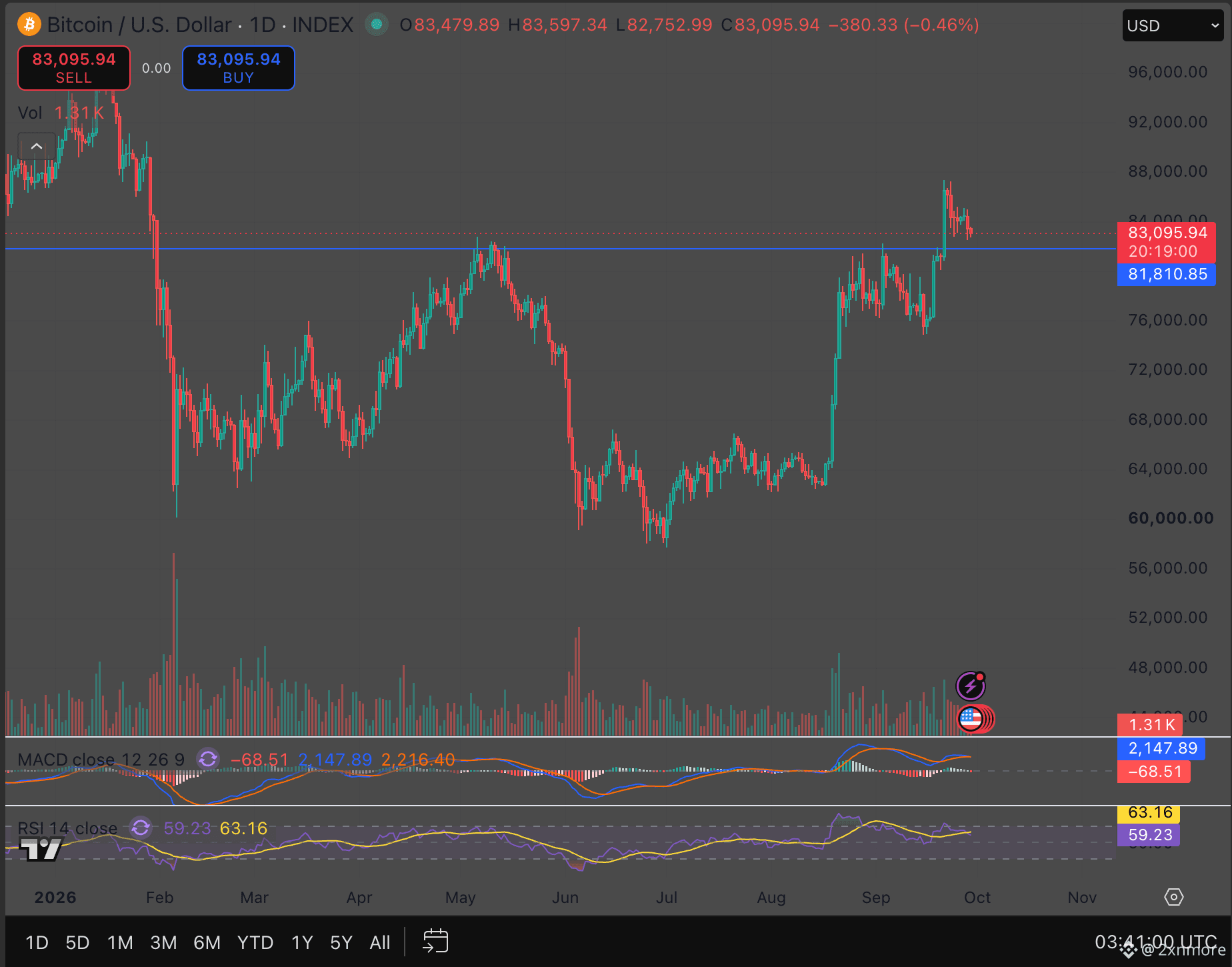
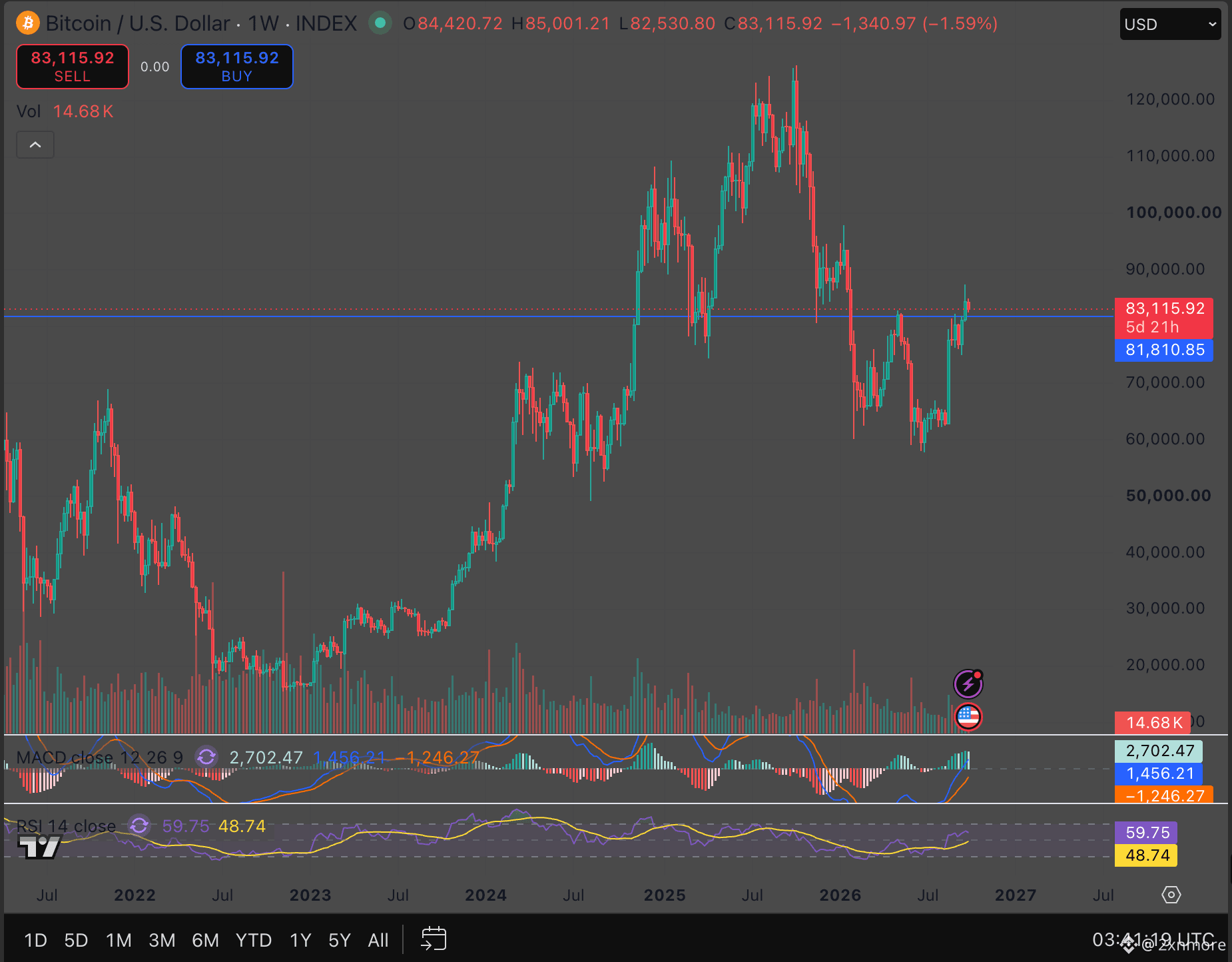
$BTC just gave back its whole September breakout in one red week. Here is the level that decides whether that was a pause or a top. Bitcoin ran from the June low near 60,000 to a fresh high just above 85,000 this month. That move broke a long consolidation range and pulled the whole market up with it. This week closed down 1.59%. It opened at 84,420, tagged 85,001, and closed at 83,115. That is a clean rejection one day after tapping a fresh high. The daily MACD histogram flipped negative today for the first time since the September rally started. Momentum is stalling right where the chart says it should. RSI 14 still sits in the high 50s to low 60s. That is not overbought. Overbought starts above 70. So this reads as a pause inside an uptrend, not a confirmed top yet. 81,810 is the level to watch. That is the support sitting directly under current price, and it lines up with where this pullback has to hold for the breakout thesis to stay alive. 85,001 is the level bulls need to reclaim to prove the high was not the top. Lose 81,810 with real conviction and Bitcoin is back testing the base it broke out of in September, the wide chop zone down near 76,000 to 79,000 where this whole move started. Until 81,810 breaks, sellers have won a week, not the trend. Does Bitcoin defend 81,810 here, or does September's breakout turn out to be the top everyone will screenshot later? {spot}(BTCUSDT)
$BTC just gave back its whole September breakout in one red week.

Here is the level that decides whether that was a pause or a top.

Bitcoin ran from the June low near 60,000 to a fresh high just above 85,000 this month.

That move broke a long consolidation range and pulled the whole market up with it.

This week closed down 1.59%.

It opened at 84,420, tagged 85,001, and closed at 83,115.

That is a clean rejection one day after tapping a fresh high.

The daily MACD histogram flipped negative today for the first time since the September rally started.

Momentum is stalling right where the chart says it should.

RSI 14 still sits in the high 50s to low 60s.

That is not overbought. Overbought starts above 70.

So this reads as a pause inside an uptrend, not a confirmed top yet.

81,810 is the level to watch.

That is the support sitting directly under current price, and it lines up with where this pullback has to hold for the breakout thesis to stay alive.

85,001 is the level bulls need to reclaim to prove the high was not the top.

Lose 81,810 with real conviction and Bitcoin is back testing the base it broke out of in September, the wide chop zone down near 76,000 to 79,000 where this whole move started.

Until 81,810 breaks, sellers have won a week, not the trend.

Does Bitcoin defend 81,810 here, or does September's breakout turn out to be the top everyone will screenshot later?
Ask anyone holding AI coins what their token actually does for AI. Most can't answer in one sentence. That's why they keep rotating into the wrong one every cycle. Here is how I sort the top AI crypto projects before I ever touch a chart. Compute, Intelligence, Agents. 1. Compute: the rails AI runs on $RENDER for decentralised GPU power $ICP and $NEAR for onchain AI infrastructure 2. Intelligence: the networks producing the models $TAO Bittensor $VVV Venice for private, uncensored inference 3. Agents: the apps putting AI to work $VIRTUAL Virtuals Protocol $FET Artificial Superintelligence Alliance Where does $INJ fit? It is a strong chain, but its AI angle is tooling rather than the core bet. Narratives rotate every cycle, but the layer that captures real usage is the one that keeps the bid. So what does your AI coin actually do?
Ask anyone holding AI coins what their token actually does for AI. Most can't answer in one sentence.

That's why they keep rotating into the wrong one every cycle.

Here is how I sort the top AI crypto projects before I ever touch a chart.

Compute, Intelligence, Agents.

1. Compute: the rails AI runs on
$RENDER for decentralised GPU power
$ICP and $NEAR for onchain AI infrastructure

2. Intelligence: the networks producing the models
$TAO Bittensor
$VVV Venice for private, uncensored inference

3. Agents: the apps putting AI to work
$VIRTUAL Virtuals Protocol
$FET Artificial Superintelligence Alliance

Where does $INJ fit? It is a strong chain, but its AI angle is tooling rather than the core bet.

Narratives rotate every cycle, but the layer that captures real usage is the one that keeps the bid.

So what does your AI coin actually do?
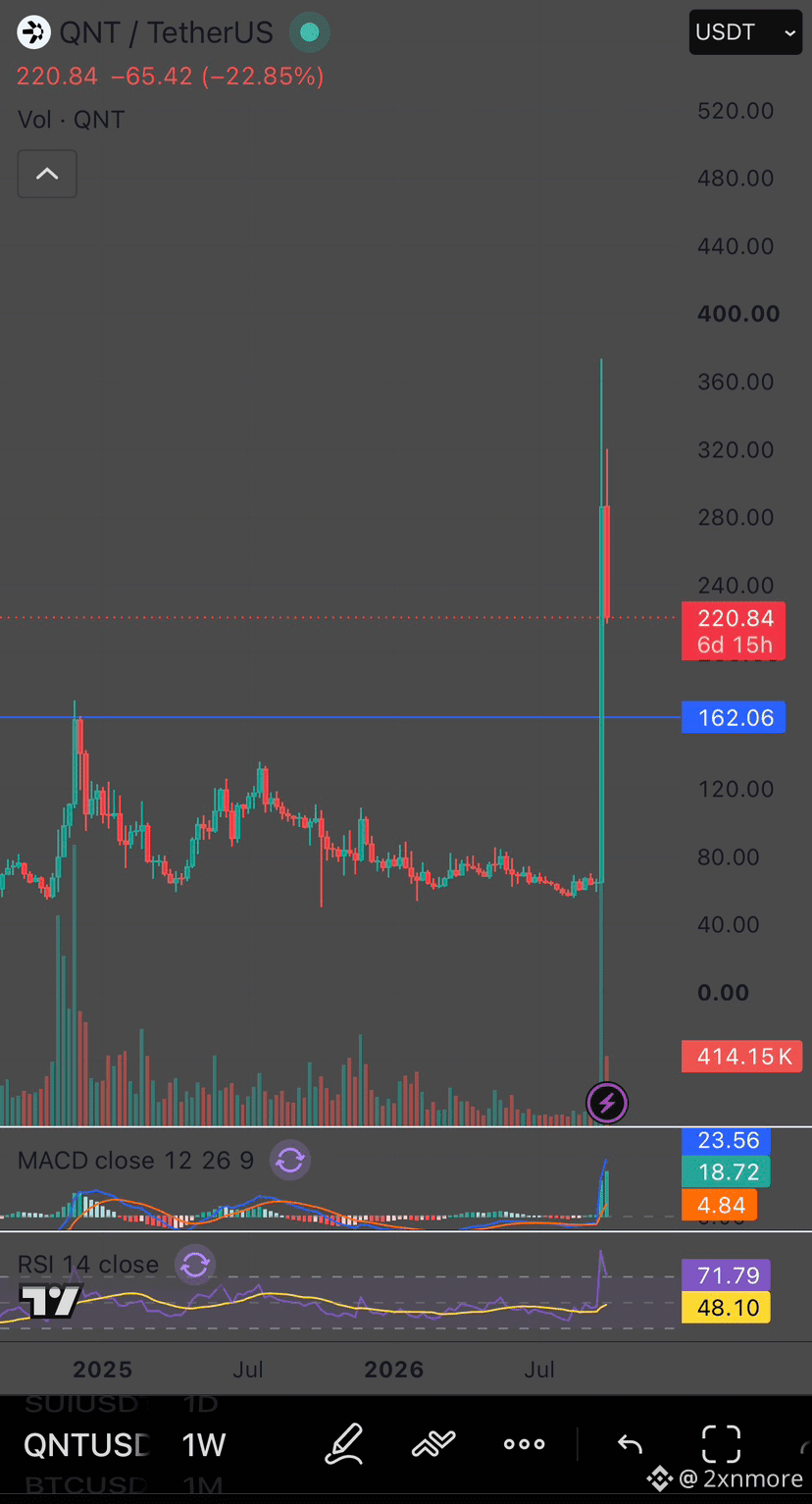
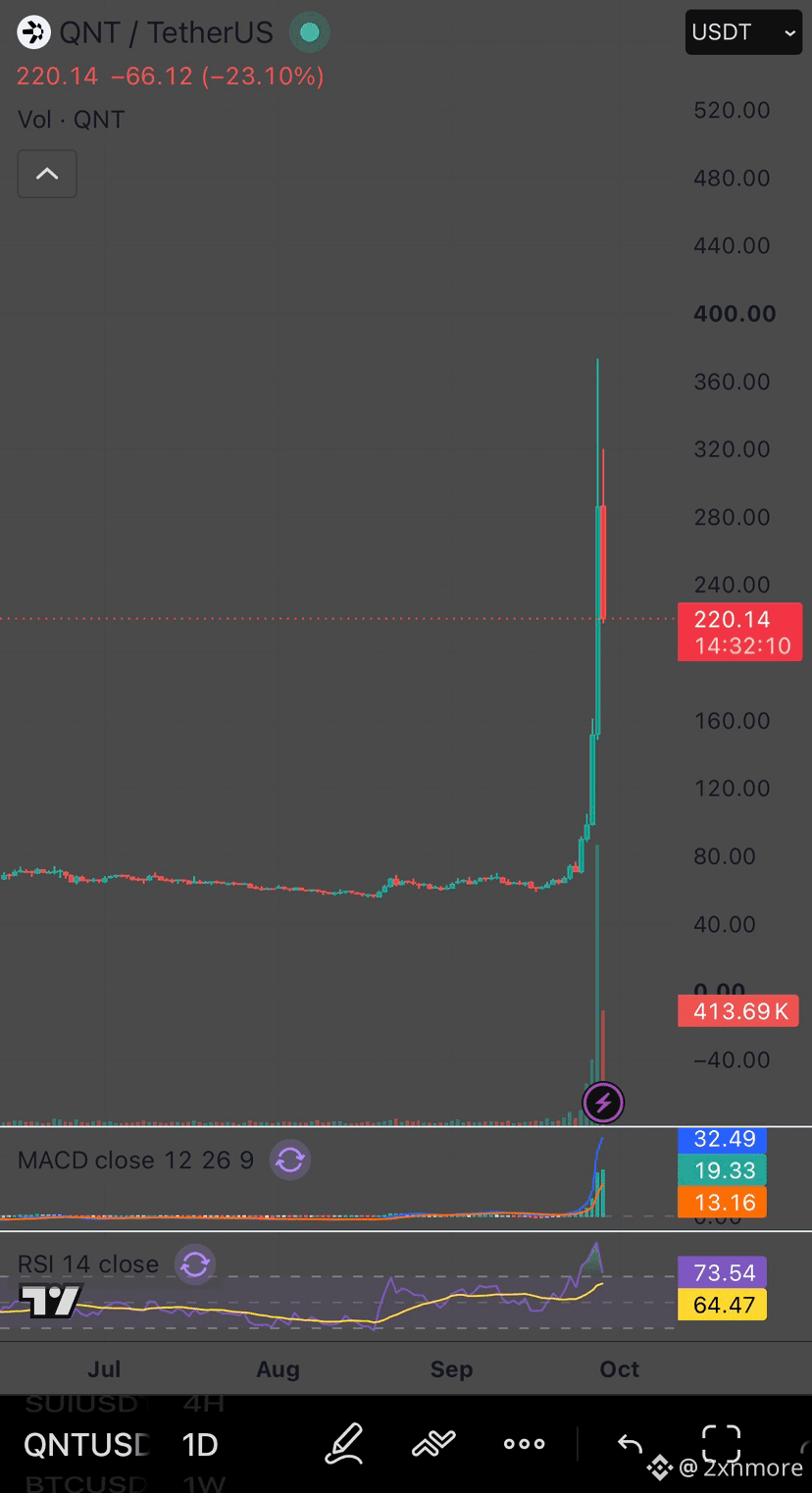
$QNT made bag holders some decent gains. Now the sell off is happening, could $162 be the next support?
Which AI Crypto will Lead the AI Crypto Narrative? ● $NEAR Near Protocol ● $TAO Bittensor ● $ICP Internet Computer Protocol ● $RENDER Render Token ● $INJ Injective ● $VIRTUAL Virtuals Protocol ● $FET Artificial Super Intelligence ● $VVV Venice Token
Which AI Crypto will Lead the AI Crypto Narrative?

● $NEAR Near Protocol
● $TAO Bittensor
● $ICP Internet Computer Protocol
● $RENDER Render Token
● $INJ Injective
● $VIRTUAL Virtuals Protocol
● $FET Artificial Super Intelligence
● $VVV Venice Token
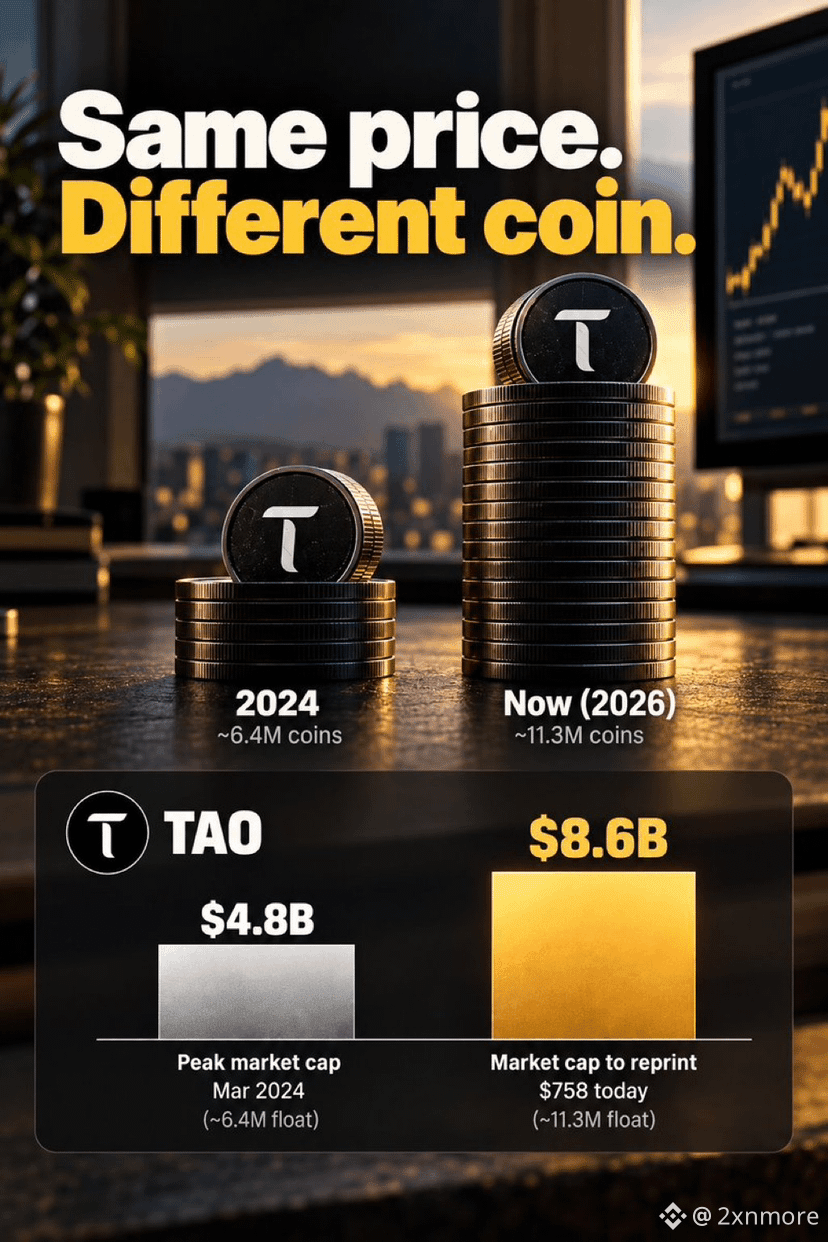
Your alt just pumped 40%. The price chart says it is still 4x from the old high. That number is the optimistic one. An all time high is set at one specific supply. After that, tokens unlock, emissions keep running, and some projects merge into a bigger float. Same price, more coins, bigger market cap. Here is the math in round numbers. A coin tops at $10 with 100M tokens out. That is a $1B peak. Four years later, 200M tokens circulate. $10 today is a $2B coin. It has to be worth twice its best day just to tie the old print. That is how this week's bounce actually reads. $TAO Price to the Mar 2024 high: ~2.3x Float then: ~6M Float now: ~11.3M Old peak cap: ~$4.5B Cap needed to reprint $758: ~$8.6B $SUI Price to the Jan 2025 high: ~4.5x Float then: ~3.0B Float now: ~4.1B Old peak cap: ~$16B Cap needed to reprint $5.35: ~$22B $AVAX Price to the 2021 high: ~13x Float then: ~224M Float now: ~443M Old peak cap: ~$32B Cap needed to reprint $145: ~$64B $FET Price to the Mar 2024 high: ~14x The ASI merger more than doubled the FET supply. $3.45 on today's ~2.31B float is an ~$8B coin, not the cap it printed at the high. None of that shows up on a price chart. Then there is the overhead. Holders who bought near the top want their money back. They sell the moment price tags their entry. The longer a coin sits under the high, the thicker that wall gets. Before you call any bounce a recovery, run four checks. 1. How many times does price need to multiply to reclaim the high? 2. How much has circulating supply grown since that high? 3. How much still unlocks or emits over the next 12 months? 4. Is demand coming from revenue and usage, or from last cycle's narrative? If the answers come back big, big, big, and narrative, you are holding a bounce, not a recovery. A price chart shows you how far a coin fell. A supply chart shows you whether it can climb back. Which name clears its old peak valuation first?
Your alt just pumped 40%.

The price chart says it is still 4x from the old high.

That number is the optimistic one.

An all time high is set at one specific supply.

After that, tokens unlock, emissions keep running, and some projects merge into a bigger float.

Same price, more coins, bigger market cap.

Here is the math in round numbers.

A coin tops at $10 with 100M tokens out.

That is a $1B peak.

Four years later, 200M tokens circulate.

$10 today is a $2B coin.

It has to be worth twice its best day just to tie the old print.

That is how this week's bounce actually reads.

$TAO
Price to the Mar 2024 high: ~2.3x
Float then: ~6M
Float now: ~11.3M
Old peak cap: ~$4.5B
Cap needed to reprint $758: ~$8.6B

$SUI
Price to the Jan 2025 high: ~4.5x
Float then: ~3.0B
Float now: ~4.1B
Old peak cap: ~$16B
Cap needed to reprint $5.35: ~$22B

$AVAX
Price to the 2021 high: ~13x
Float then: ~224M
Float now: ~443M
Old peak cap: ~$32B
Cap needed to reprint $145: ~$64B

$FET
Price to the Mar 2024 high: ~14x
The ASI merger more than doubled the FET supply.
$3.45 on today's ~2.31B float is an ~$8B coin, not the cap it printed at the high.

None of that shows up on a price chart.

Then there is the overhead.

Holders who bought near the top want their money back. They sell the moment price tags their entry.

The longer a coin sits under the high, the thicker that wall gets.

Before you call any bounce a recovery, run four checks.

1. How many times does price need to multiply to reclaim the high?

2. How much has circulating supply grown since that high?

3. How much still unlocks or emits over the next 12 months?

4. Is demand coming from revenue and usage, or from last cycle's narrative?

If the answers come back big, big, big, and narrative, you are holding a bounce, not a recovery.

A price chart shows you how far a coin fell.

A supply chart shows you whether it can climb back.

Which name clears its old peak valuation first?
Log in to explore more content
Join global crypto users on Binance Square
⚡️ Get latest and useful information about crypto.
💬 Trusted by the world’s largest crypto exchange.
👍 Discover real insights from verified creators.
Email / Phone number
Sitemap
Cookie Preferences
Platform T&Cs