
Bykaranteli
14.8k Posts

Bykaranteli
Report
Block User
All Social Media @Bykaranteli
Frequent Trader
5.7 Years
6 Following
10.2K+ Followers
31.6K+ Liked
Posts
All
Quotes
Videos
Live
PINNED
·
--
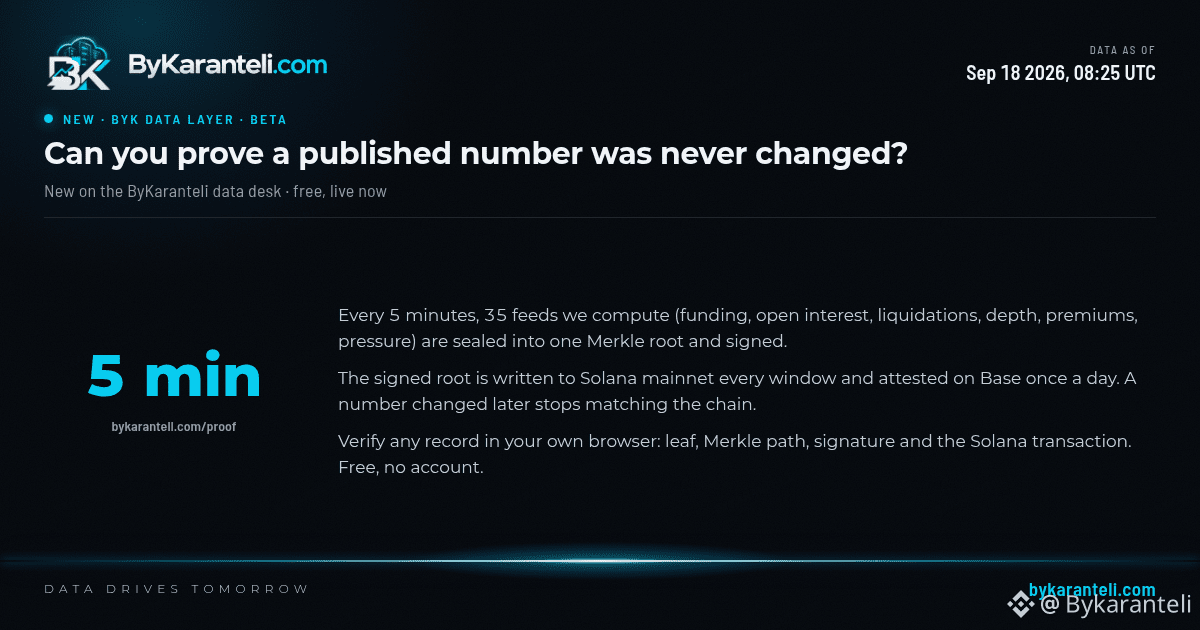
Our data now leaves a receipt on public blockchains. Every 5 minutes, 35 feeds we compute (funding, open interest, liquidations, order book depth, premiums and pressure scores for $BTC, $ETH, $SOL and more) are sealed into one Merkle root, signed by an isolated key and written to Solana mainnet, with a daily attestation on Base. If anyone, including us, changed one of those numbers afterwards, it would stop matching the chain. You do not have to take our word for it: the verifier on our proof page rebuilds a record, checks its signature and reads the anchor straight from Solana in your own browser. Beta, on mainnet since 18 September. Free, no account needed.
Our data now leaves a receipt on public blockchains. Every 5 minutes, 35 feeds we compute (funding, open interest, liquidations, order book depth, premiums and pressure scores for $BTC , $ETH , $SOL and more) are sealed into one Merkle root, signed by an isolated key and written to Solana mainnet, with a daily attestation on Base. If anyone, including us, changed one of those numbers afterwards, it would stop matching the chain. You do not have to take our word for it: the verifier on our proof page rebuilds a record, checks its signature and reads the anchor straight from Solana in your own browser. Beta, on mainnet since 18 September. Free, no account needed.
1
3
63
·
--
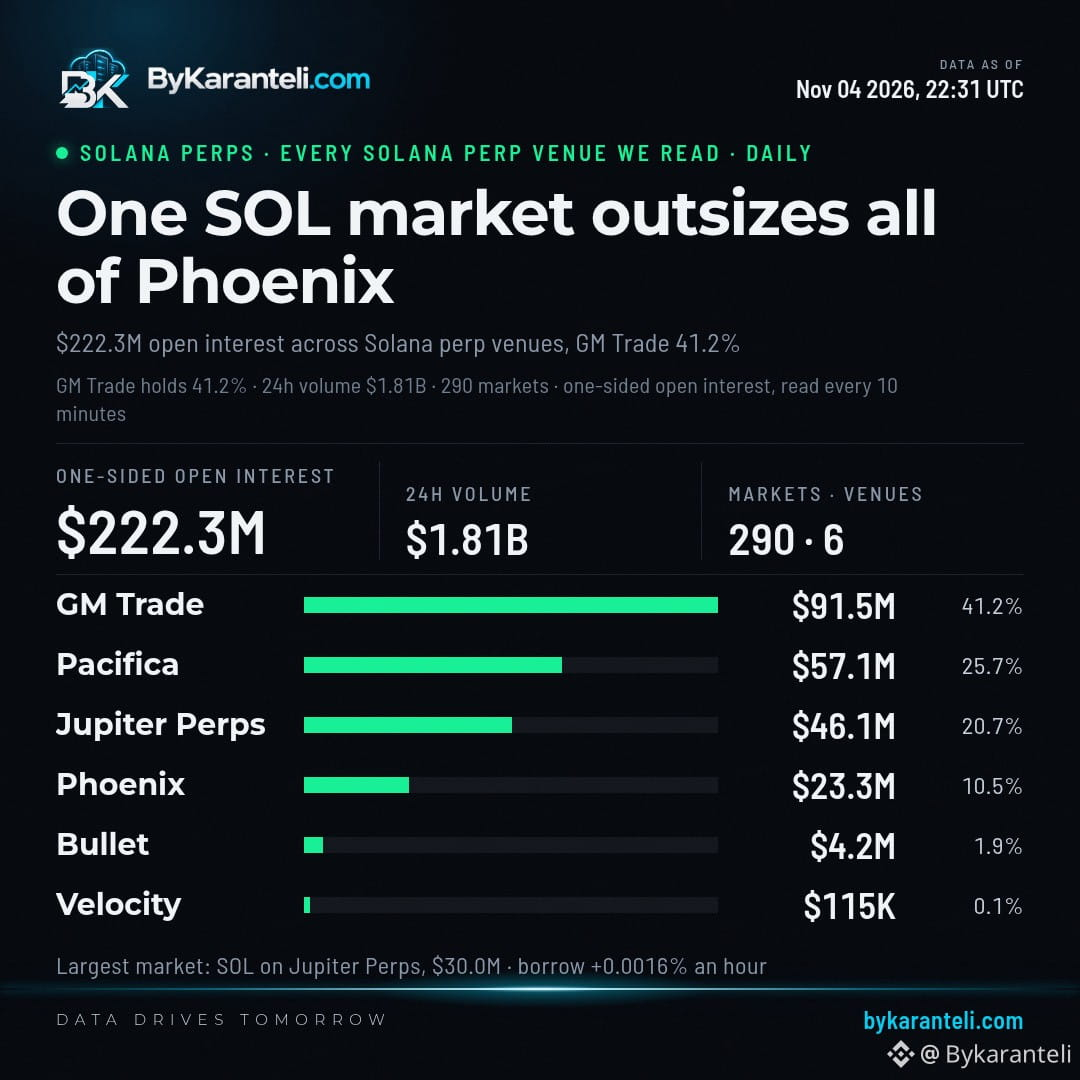
One market on its own, SOL on Jupiter Perps, holds $30.0M of open positions. That's more than Phoenix holds across all of its markets ($23.3M), and well above Bullet ($4.2M) and Velocity ($115K).
Across six venues and 290 markets, Solana's perp board kept $222.3M open on Nov 4, against $1.81B traded over the 24 hours. GM Trade leads with $91.5M (41.2%), ahead of Pacifica at $57.1M (25.7%) and Jupiter Perps at $46.1M (20.7%).
Keeping that SOL position open on Jupiter cost an hourly borrow fee of +0.0016%, the fee the venue charges open positions where other venues use funding.
·
--
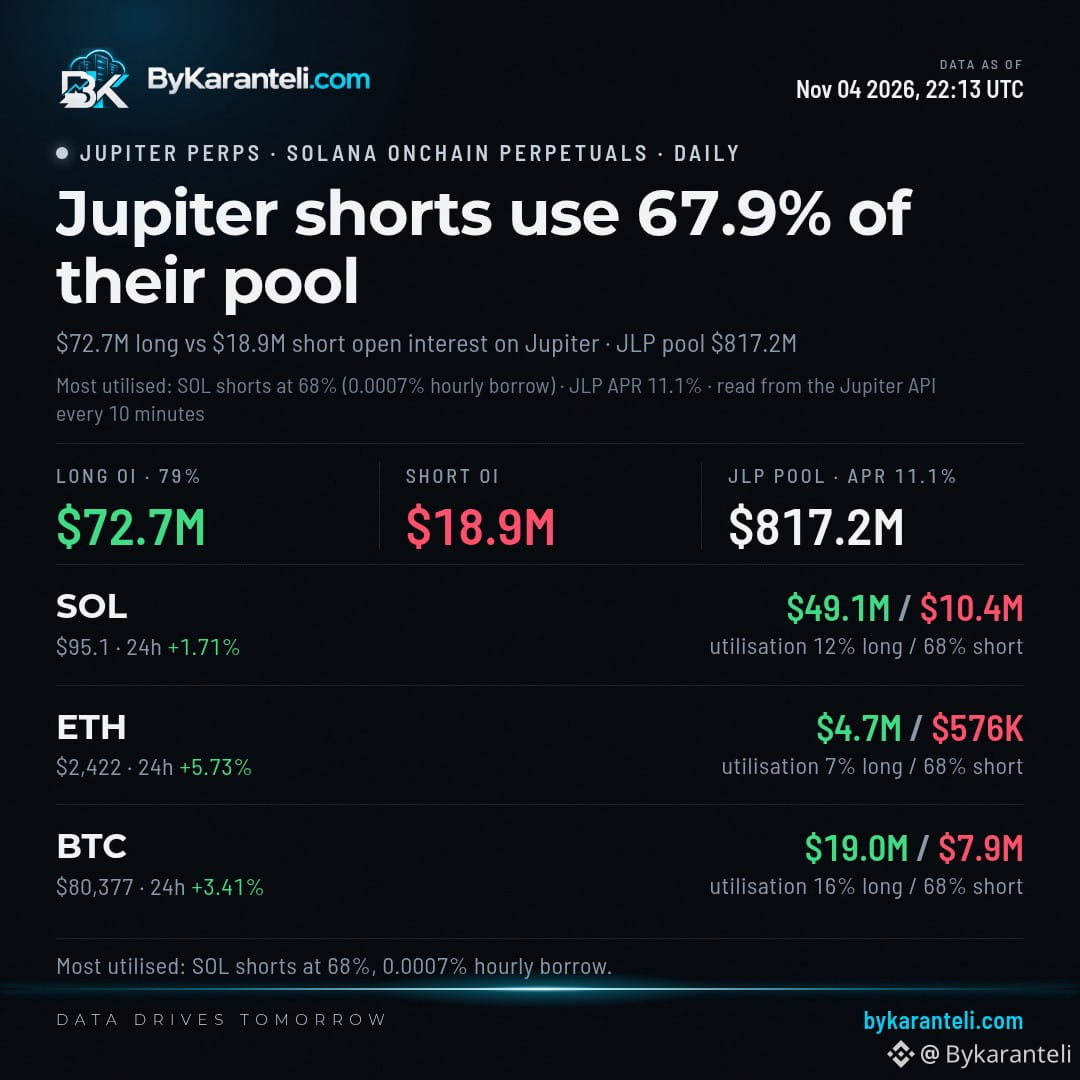
Buyers hold 79.4% of the open bets on Jupiter Perps, yet it's the pool backing the sellers that runs tight. Shorts on Solana, Ether and Bitcoin each use 67.89% of the capacity set aside for them.
On the long side, usage runs from just 7.15% to 15.83% across the three markets. In dollars, longs hold $72.7M against $18.9M of shorts, and Solana carries the bulk with $49.1M long and $10.4M short at $95.10.
The JLP pool, the liquidity that takes the other side of these trades, holds $817.2M and pays depositors an 11.13% annual rate.
7
·
--
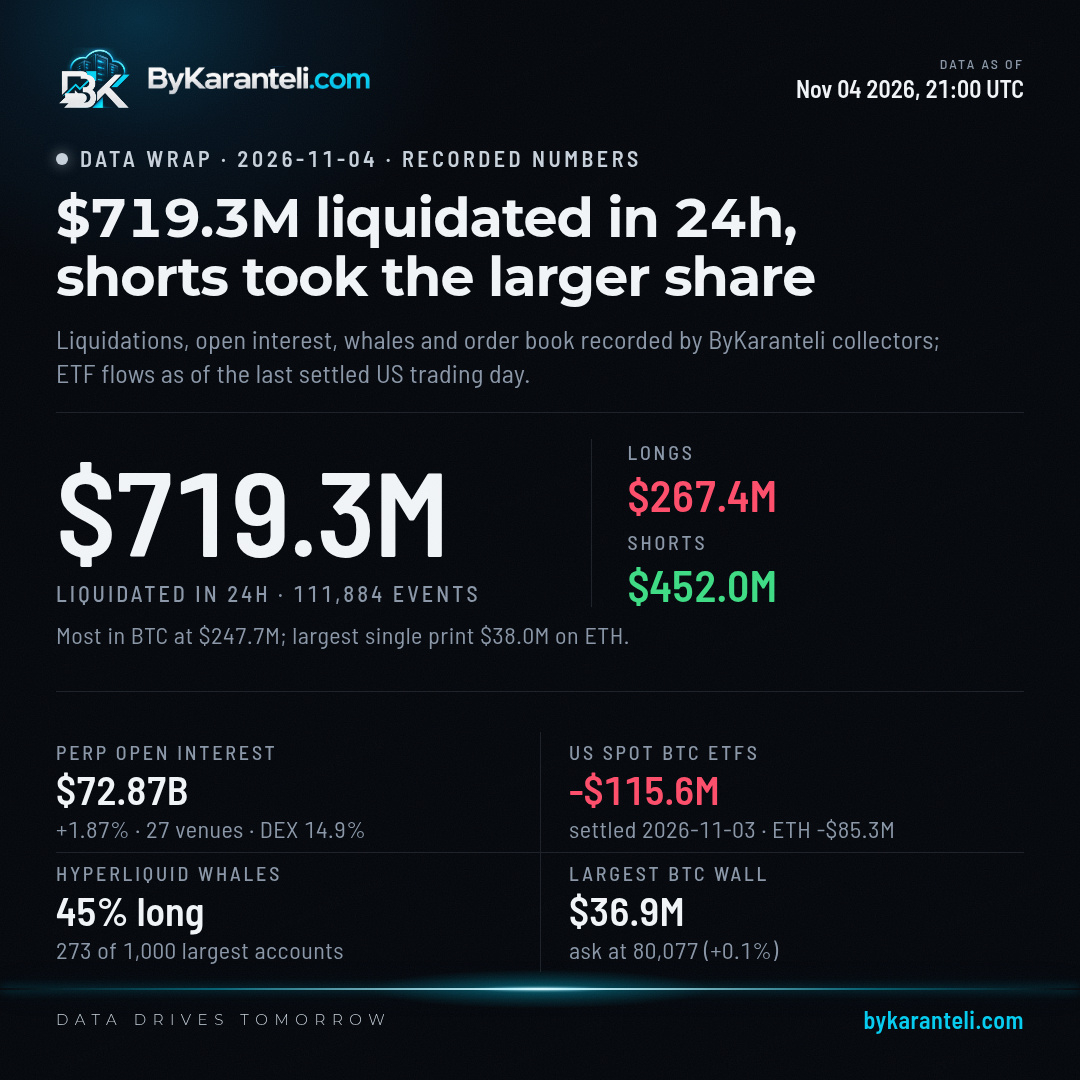
Short sellers paid most of the bill in the 24 hours to Nov 4. Of $719.3M in recorded liquidations, $452.0M came from traders forced out of bets on a fall, against $267.4M from longs. $BTC led with $247.7M, and the largest single closure was $38.0M on $ETH.
Open futures bets across 27 venues reached $72.87B, 1.87% above a day earlier. Money left US spot ETFs on Nov 3, with -$115.6M from the Bitcoin funds and -$85.3M from the Ether funds.
The largest Hyperliquid accounts by equity hold 45% of their open notional long. On the Bitcoin spot books we track, $36.9M of sell orders rests at $80.1K, 0.05% above mid.
Short sellers paid most of the bill in the 24 hours to Nov 4. Of $719.3M in recorded liquidations, $452.0M came from traders forced out of bets on a fall, against $267.4M from longs. $BTC led with $247.7M, and the largest single closure was $38.0M on $ETH .
Open futures bets across 27 venues reached $72.87B, 1.87% above a day earlier. Money left US spot ETFs on Nov 3, with -$115.6M from the Bitcoin funds and -$85.3M from the Ether funds.
The largest Hyperliquid accounts by equity hold 45% of their open notional long. On the Bitcoin spot books we track, $36.9M of sell orders rests at $80.1K, 0.05% above mid.
21
·
--
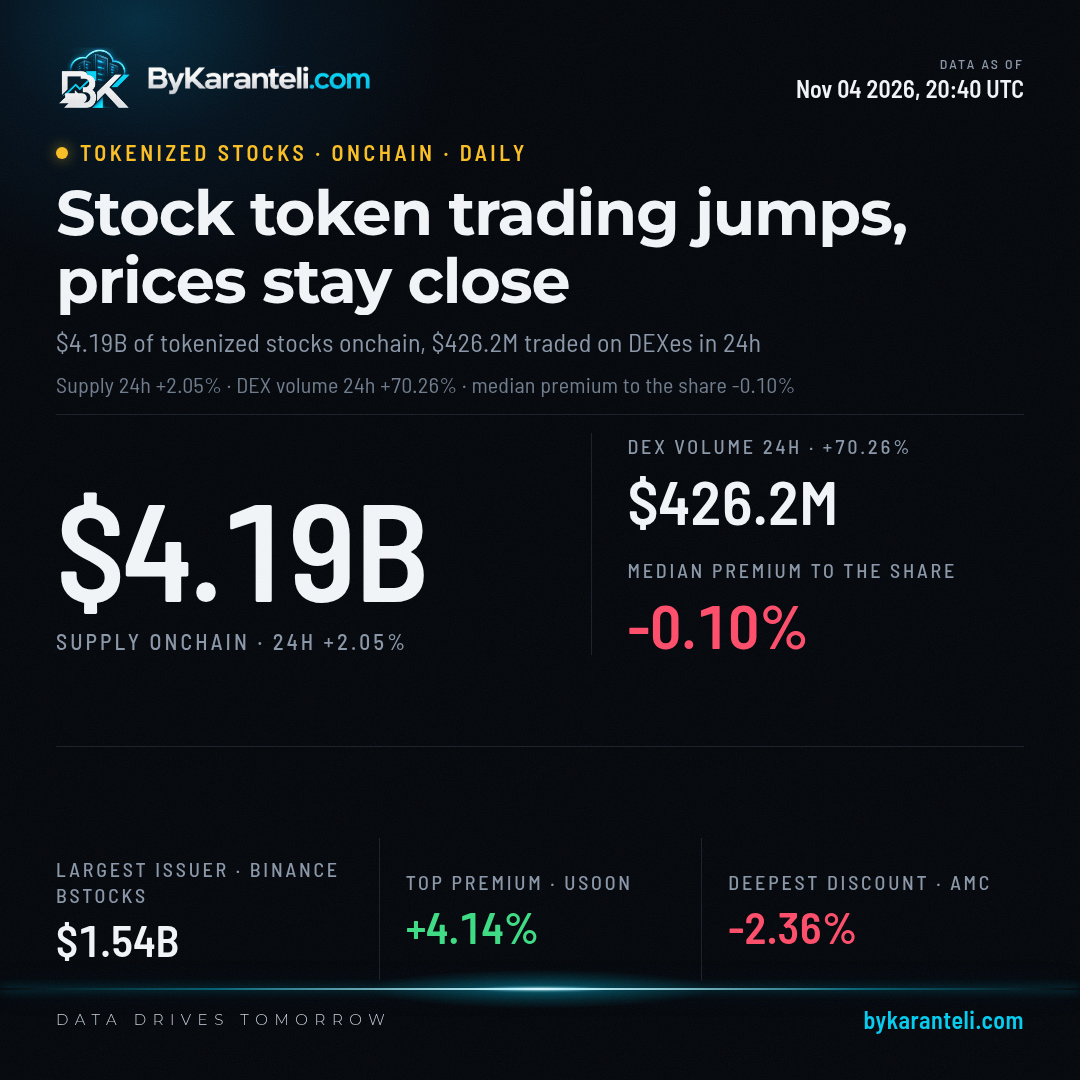
Busier trading did not pull tokenized stocks away from the shares they track on Nov 4. These tokens each follow one listed share and trade around the clock, and decentralized exchange volume reached $426.2M, +70.26% on the day.
The median token priced at -0.10% to its real share during the open session. The outliers sat at both ends: USOon Solana at +4.14% and AMC Robinhood Chain at -2.36%.
Supply valued at the share price came to $4.19B, +2.05% since the last recorded day. Binance bStocks is the largest issuer at $1.54B.
The median token priced at -0.10% to its real share during the open session. The outliers sat at both ends: USOon Solana at +4.14% and AMC Robinhood Chain at -2.36%.
Supply valued at the share price came to $4.19B, +2.05% since the last recorded day. Binance bStocks is the largest issuer at $1.54B.
28
·
--
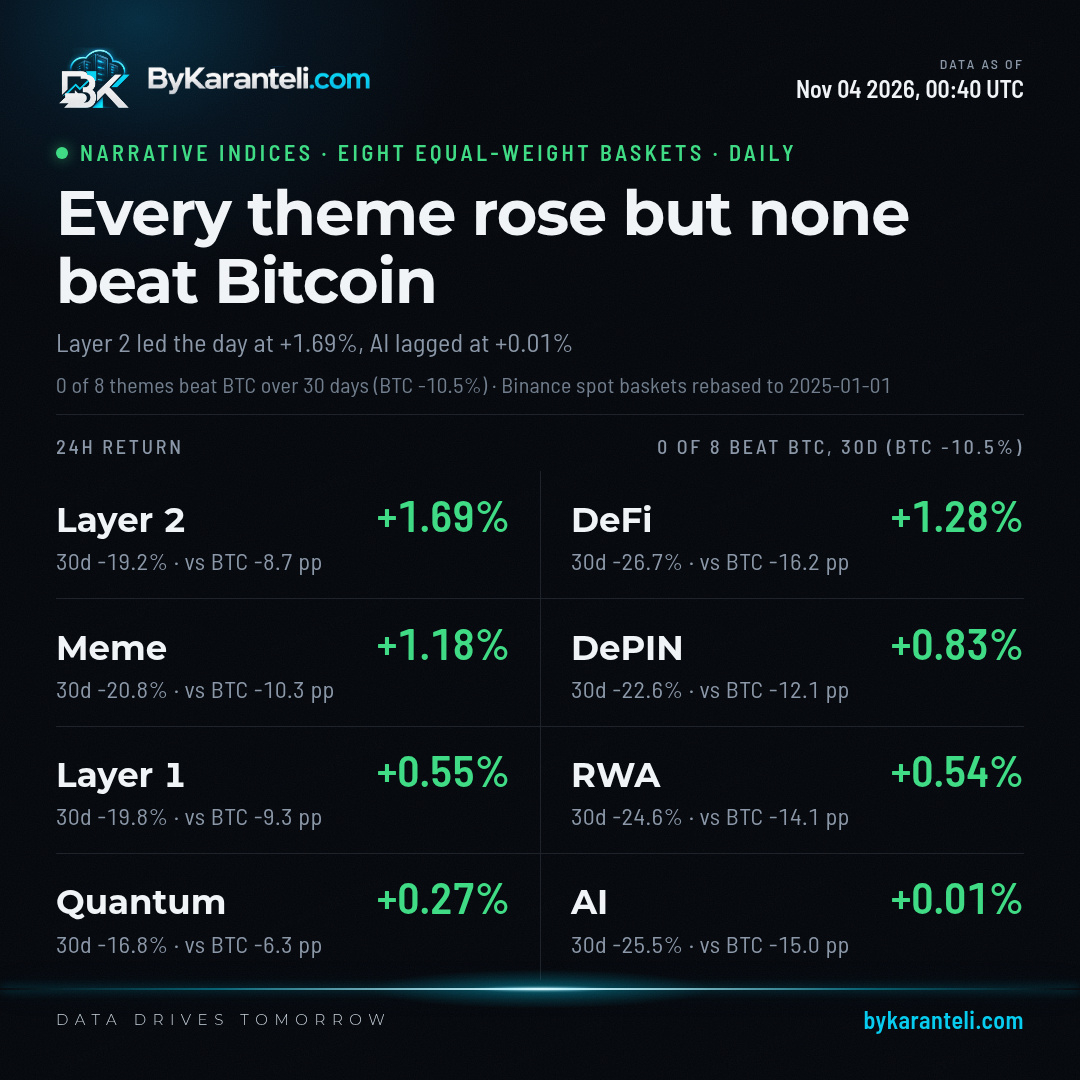
All eight theme baskets we track ended the 24 hours to Nov 4 higher. Layer 2 led at +1.69%, and AI barely moved at +0.01%.
The 30 day picture is far weaker. Bitcoin returned -10.5% over that stretch, and not a single basket kept up with it. Quantum came closest at -16.8%, 6.3 percentage points behind. DeFi trailed furthest at -26.7%, 16.2 points back, with AI next at -25.5%.
Each basket is an equal weight group of Binance spot pairs. One green day across the board still leaves holders of every theme further down on the month than Bitcoin holders.
11
·
--
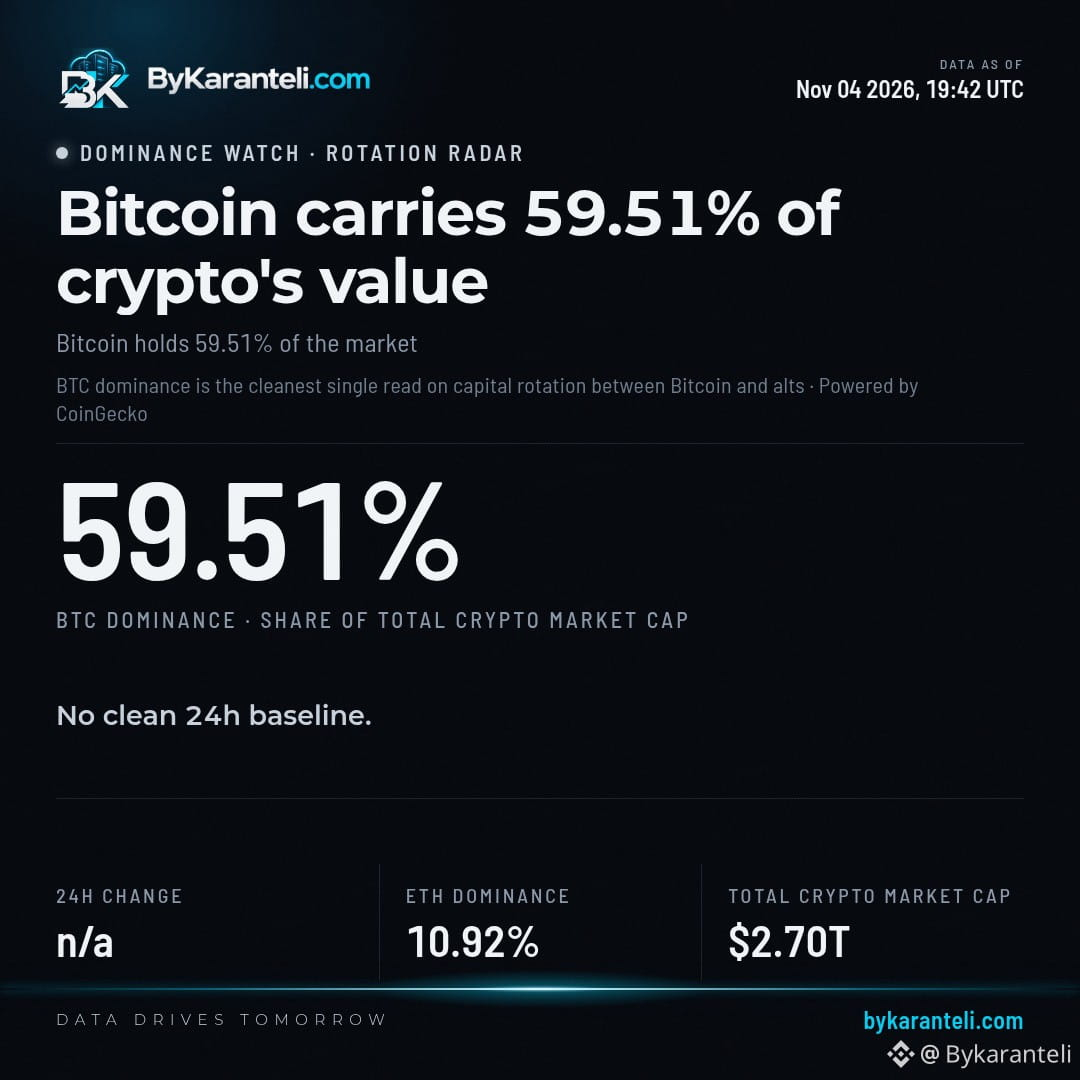
More than half of all value in crypto sits in a single coin. Bitcoin carries 59.51% of the $2.70T market as of 19:42 UTC on Nov 4.
Ether holds the second largest share at 10.92%. Every other token, from large caps to the newest listings, divides what is left between them.
No 24 hour change came with this reading. It shows where money sits on Nov 4, not which way it is moving. A single day of share data says nothing about money leaving Bitcoin for smaller coins.
9
·
--
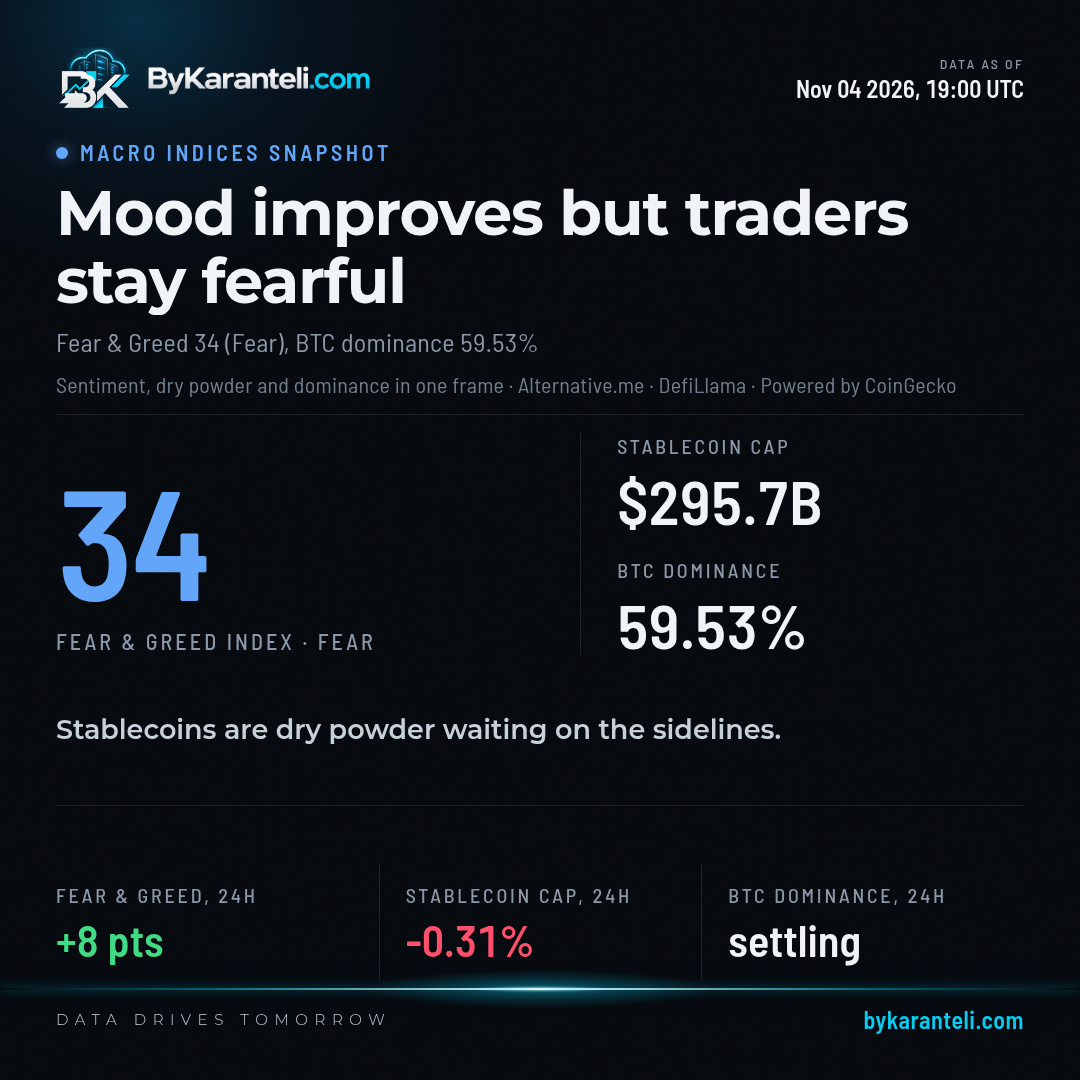
An 8 point lift in the Fear and Greed index, a single score of how nervous or bold traders feel, still leaves it at 34 and inside fear as of 19:00 UTC on Nov 4. The mood got lighter over the day, but it hasn't left the nervous zone.
The cash parked on crypto rails didn't grow with it. Total stablecoin supply, the dollar tokens traders keep ready to buy with, moved -0.31% over the same 24 hours to $295.70B.
$BTC holds 59.53% of the whole crypto market's value, so Bitcoin still outweighs every other coin combined.
The cash parked on crypto rails didn't grow with it. Total stablecoin supply, the dollar tokens traders keep ready to buy with, moved -0.31% over the same 24 hours to $295.70B.
$BTC holds 59.53% of the whole crypto market's value, so Bitcoin still outweighs every other coin combined.
24
·
--
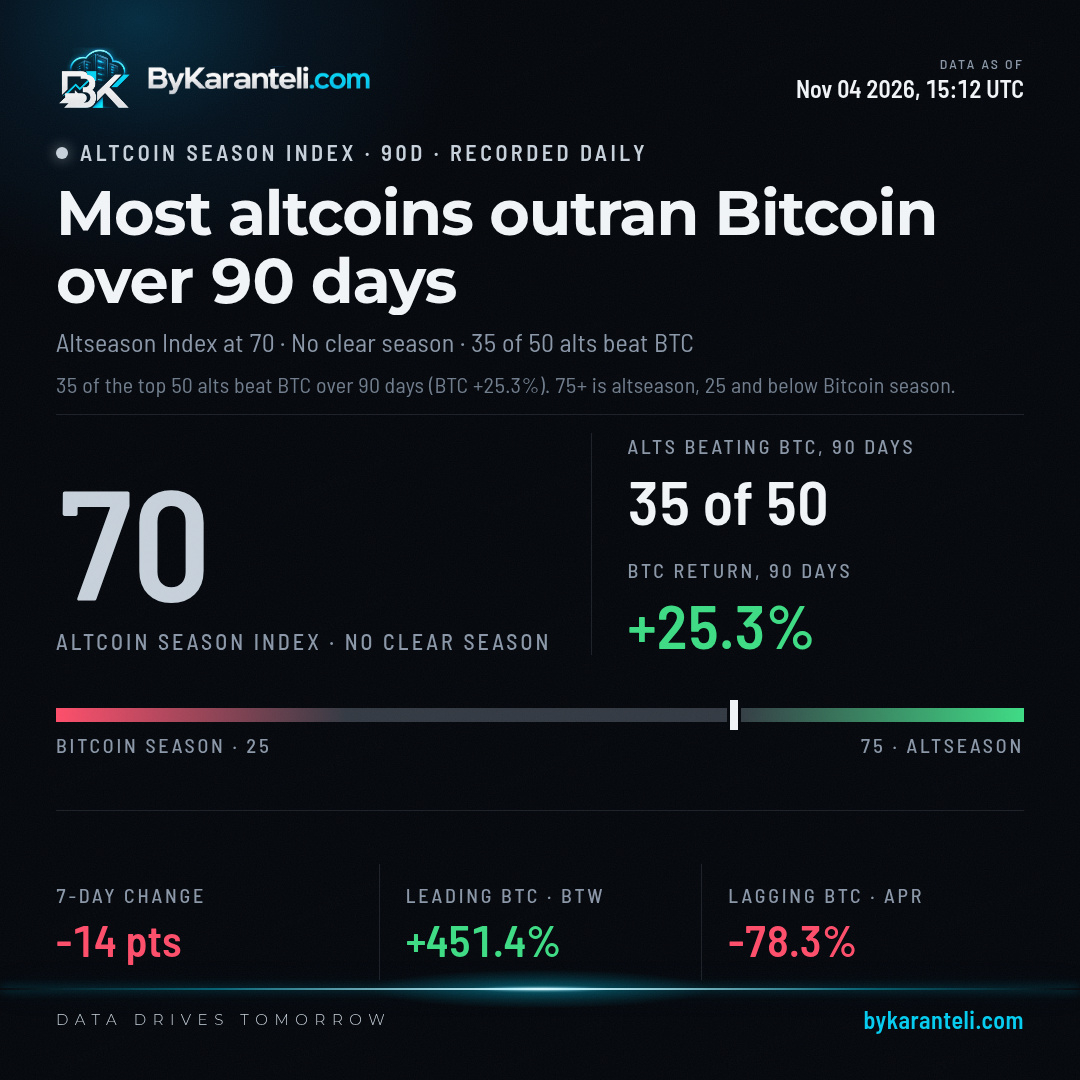
35 of the 50 altcoins we sample outran Bitcoin over the past 90 days, and $BTC itself gained 25.3% in that window. That puts the Altcoin Season Index at 70 on Nov 4, short of the 75 line where altseason begins, so the market still reads as no clear season.
The index is 14 points lower than it was a week earlier.
Inside the group, the gap is wide. $BTW led with +451.4% over 90 days, and $APR trailed at -78.3%.
The index is 14 points lower than it was a week earlier.
Inside the group, the gap is wide. $BTW led with +451.4% over 90 days, and $APR trailed at -78.3%.
19
·
--
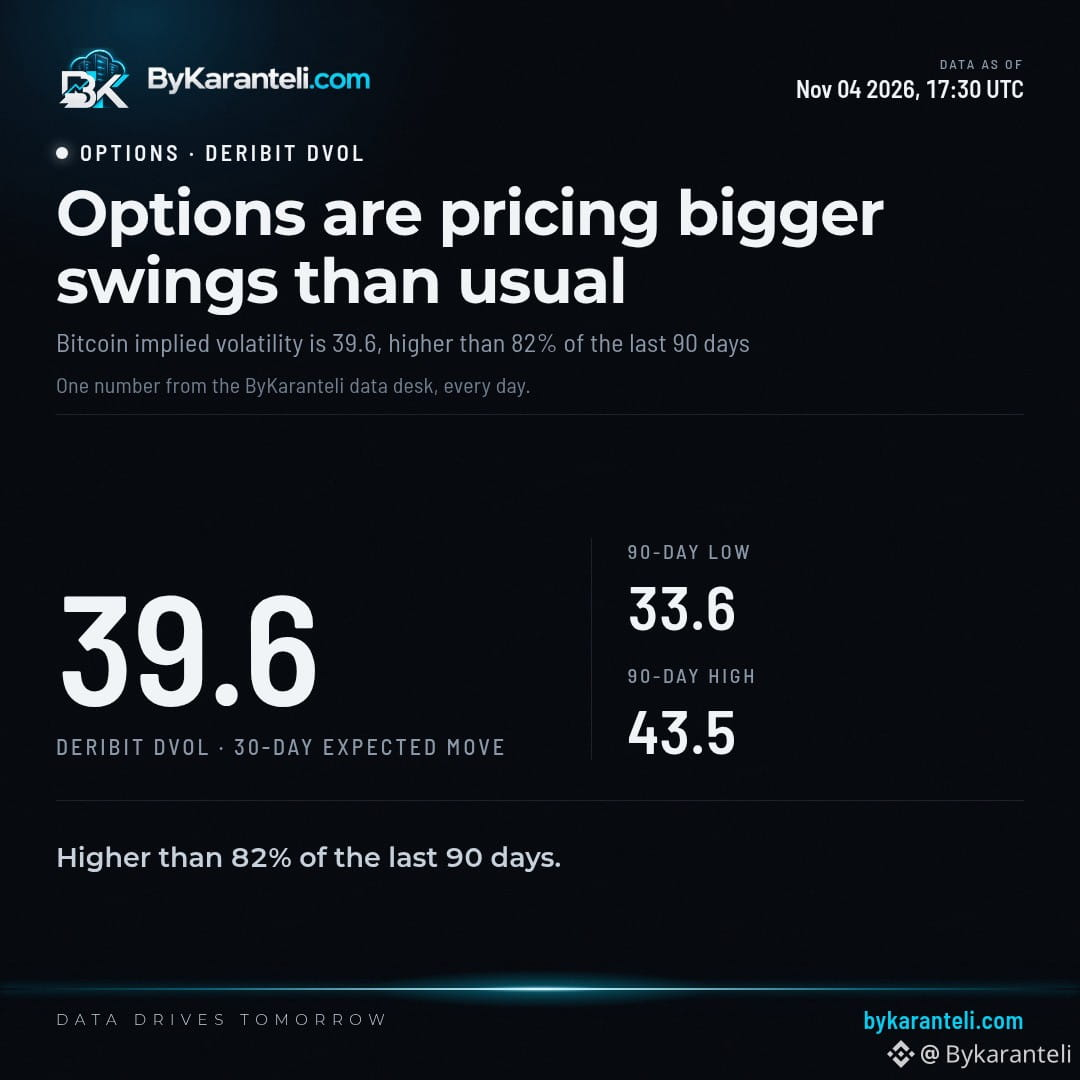
Options traders are pricing bigger swings than usual. The DVOL index reads 39.6, higher than 82% of readings over the last 90 days.
DVOL is a volatility index built from option prices. It measures how large a move the options market is paying for, not which direction that move takes. Over the 90 day window it ranged from 33.6 to 43.5, so this reading sits in the upper part of that span without reaching the top.
When the index is this high, both downside protection and upside bets cost more for anyone buying options.
8
·
--
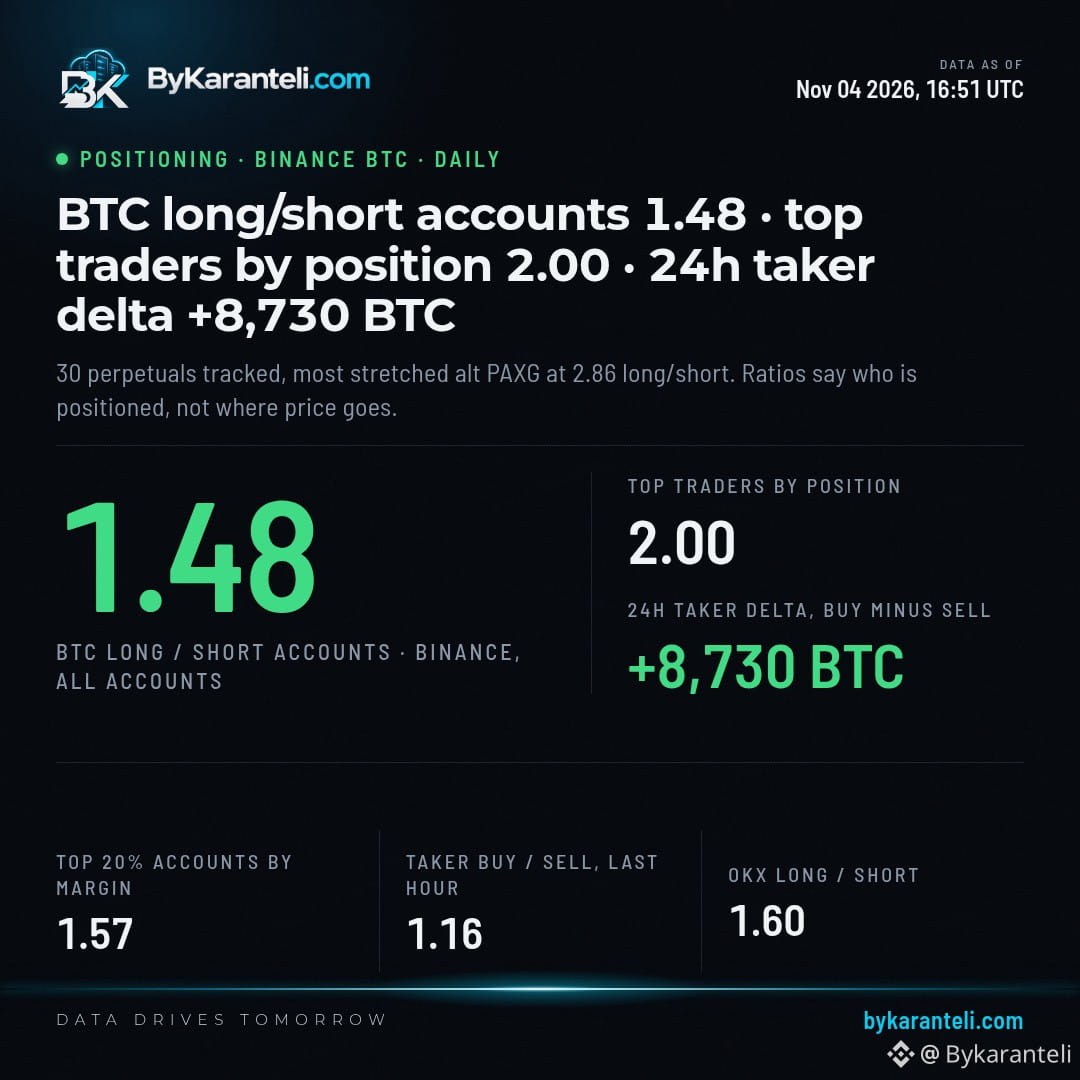
The biggest Bitcoin traders on Binance are leaning further toward a rise than the crowd. On Nov 4, weighted by position size, top traders held 2 in bets on a rise for every 1 on a fall. Across all Binance accounts the count was 1.48.
Counted by account instead of by money, those same top traders came in at 1.57, and OKX read 1.6. Over the 24 hours, traders hitting buy orders outpaced those hitting sell orders by +8,730 BTC, and in the last hour buy volume ran 1.16 times sell volume.
Among 30 tracked coins, $PAXG had the most one sided crowd, with 2.86 accounts long for every one short.
3
·
--
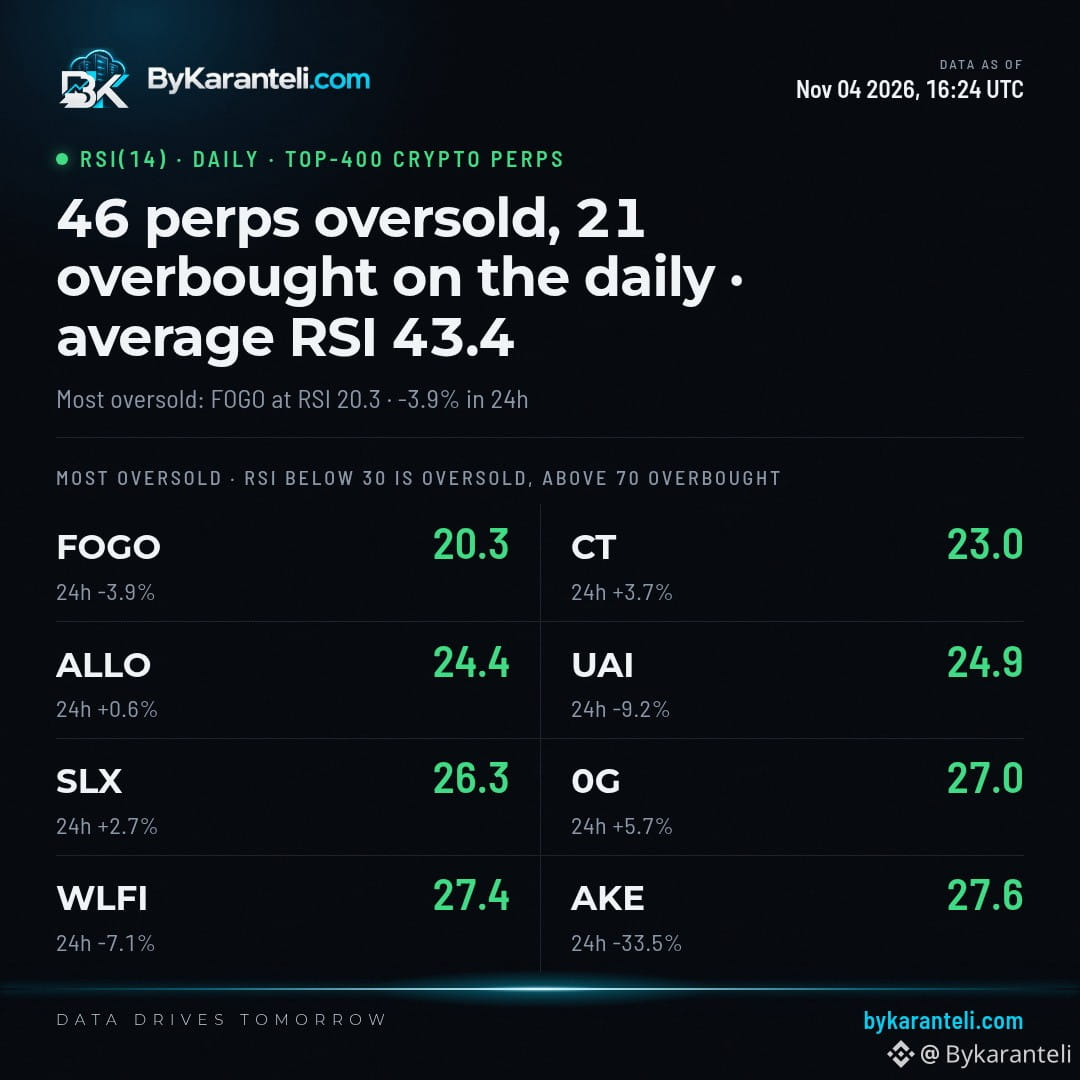
On the daily Wilder RSI(14), 46 of 400 crypto perps are oversold and 21 are overbought, with $FOGO the most oversold at 20.3. Next are $CT at 23.0, +3.7% and $ALLO at 24.4, +0.6%. The heatmap shows the same contracts across eight intervals.
On the daily Wilder RSI(14), 46 of 400 crypto perps are oversold and 21 are overbought, with $FOGO the most oversold at 20.3. Next are $CT at 23.0, +3.7% and $ALLO at 24.4, +0.6%. The heatmap shows the same contracts across eight intervals.
22
·
--
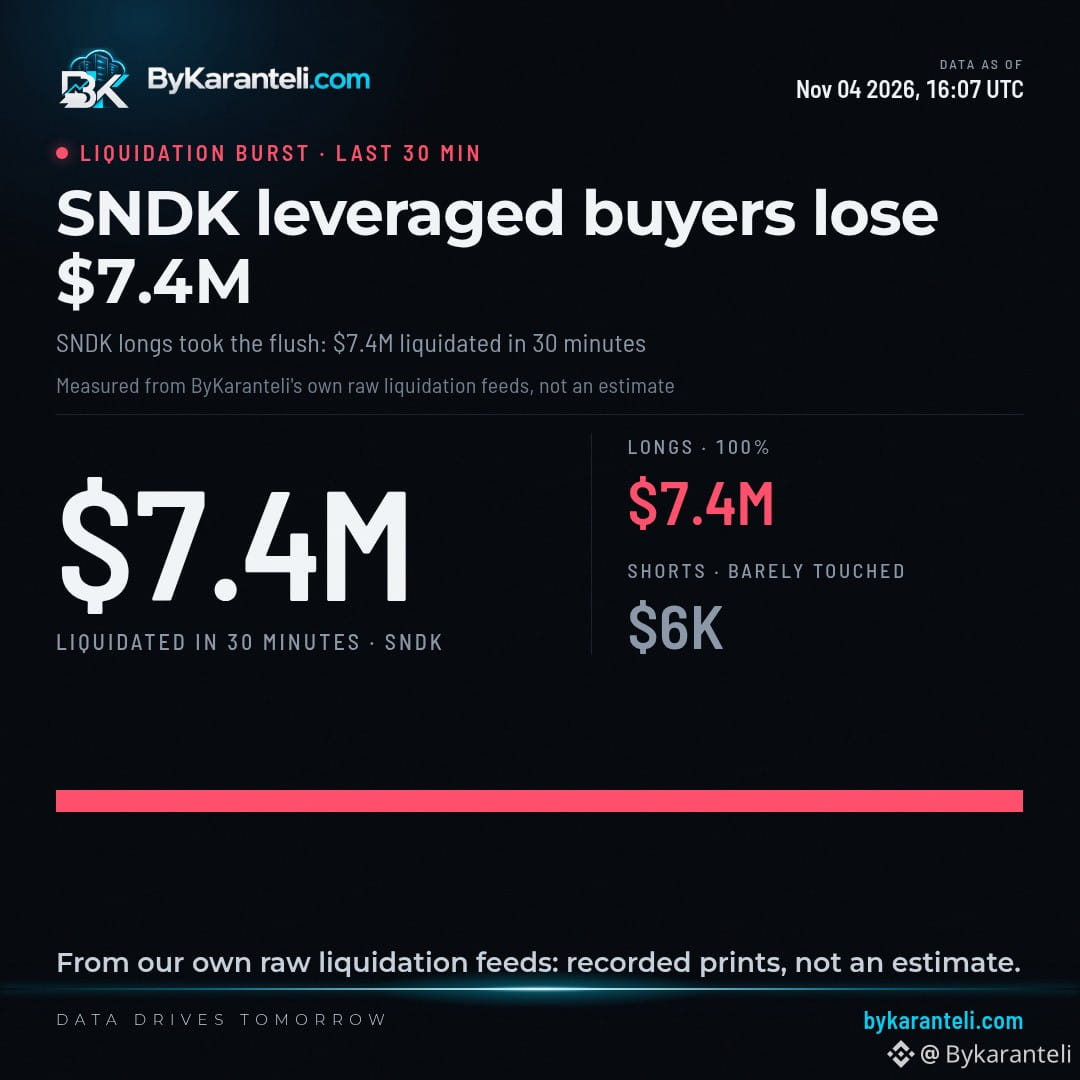
$SNDK just went through a lopsided half hour. Across the major venues, $7.4M of long positions, bets on a higher price made with borrowed money, were closed by force in the last 30 minutes.
The other side was almost untouched. Short positions lost just $5.6K over the same window.
Nearly all of the pain sat with leveraged buyers, whose collateral could no longer cover the move against them.
The other side was almost untouched. Short positions lost just $5.6K over the same window.
Nearly all of the pain sat with leveraged buyers, whose collateral could no longer cover the move against them.
9
·
--
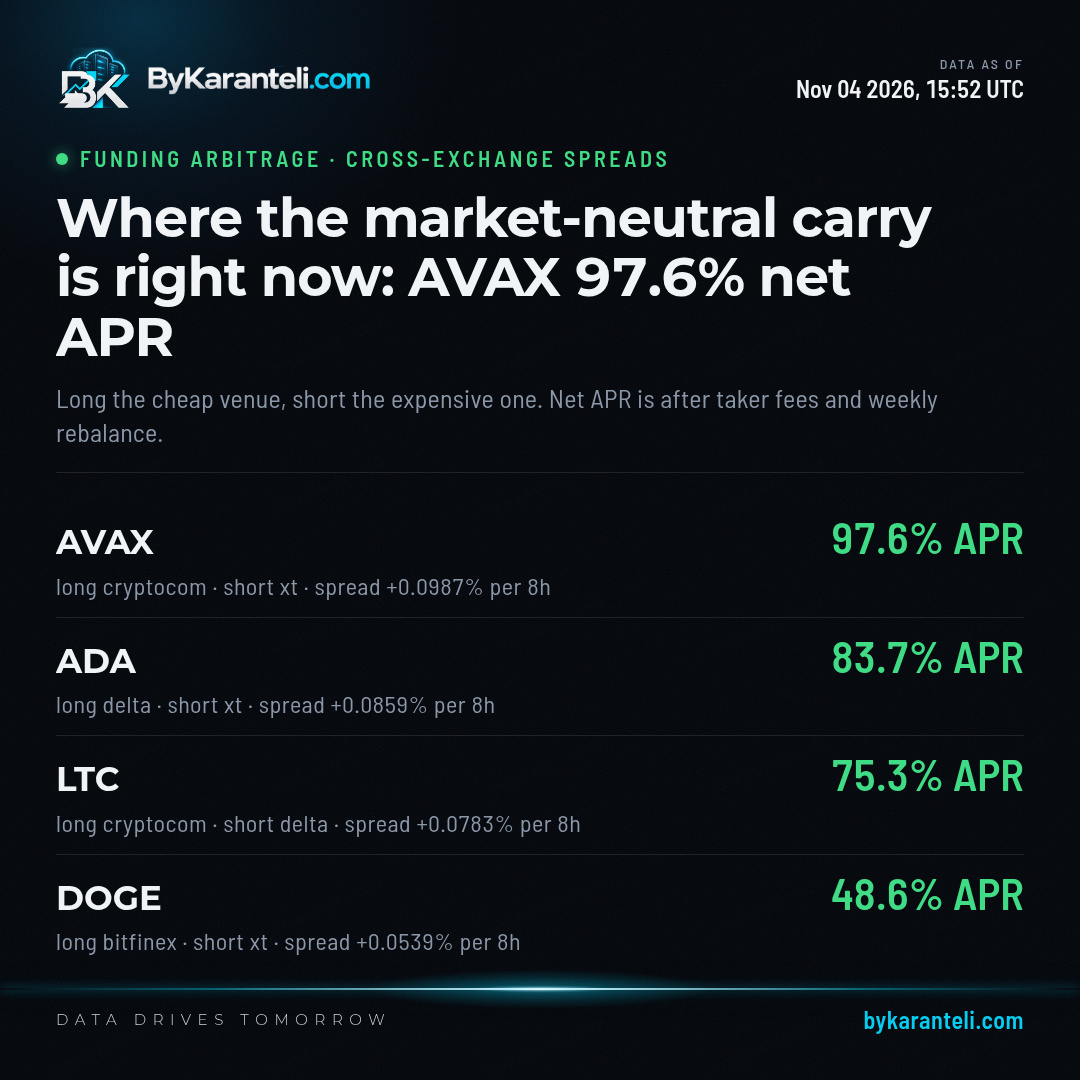
The widest spread on the board is $AVAX, long on cryptocom and short on xt, with a net annualized rate after fees of 97.62%. This is the kind of edge desks farm while others argue direction, a clean read on where leverage is sitting in the spread.
The widest spread on the board is $AVAX , long on cryptocom and short on xt, with a net annualized rate after fees of 97.62%. This is the kind of edge desks farm while others argue direction, a clean read on where leverage is sitting in the spread.
21
·
--
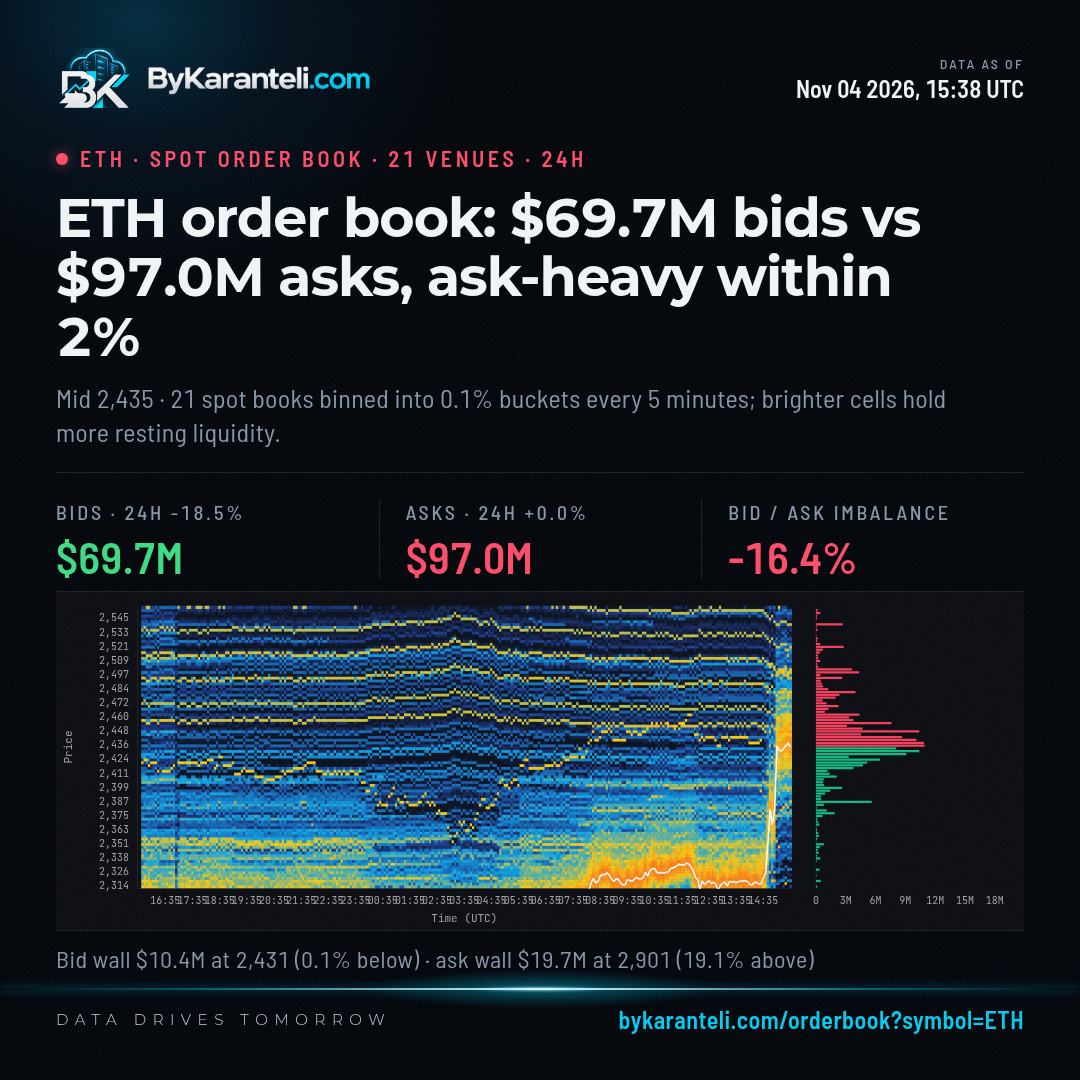
Ether climbed 6.1% over the 24 hours to 15:38 UTC on Nov 4, yet the buyers resting near the price got thinner. Bids within 2% of mid fell 18.5% across 21 spot venues. Offers on the other side were unchanged at 0%.
That leaves $97.01M of asks against $69.71M of bids, a -16.4% imbalance with sellers holding the heavier book. The biggest bid wall, $10.40M at $2,430.94, sits just 0.15% under the mid. The largest offer, $19.73M at $2,900.81, rests 19.15% above it.
This is a snapshot of the book, and resting orders can be pulled at any time.
38
·
--
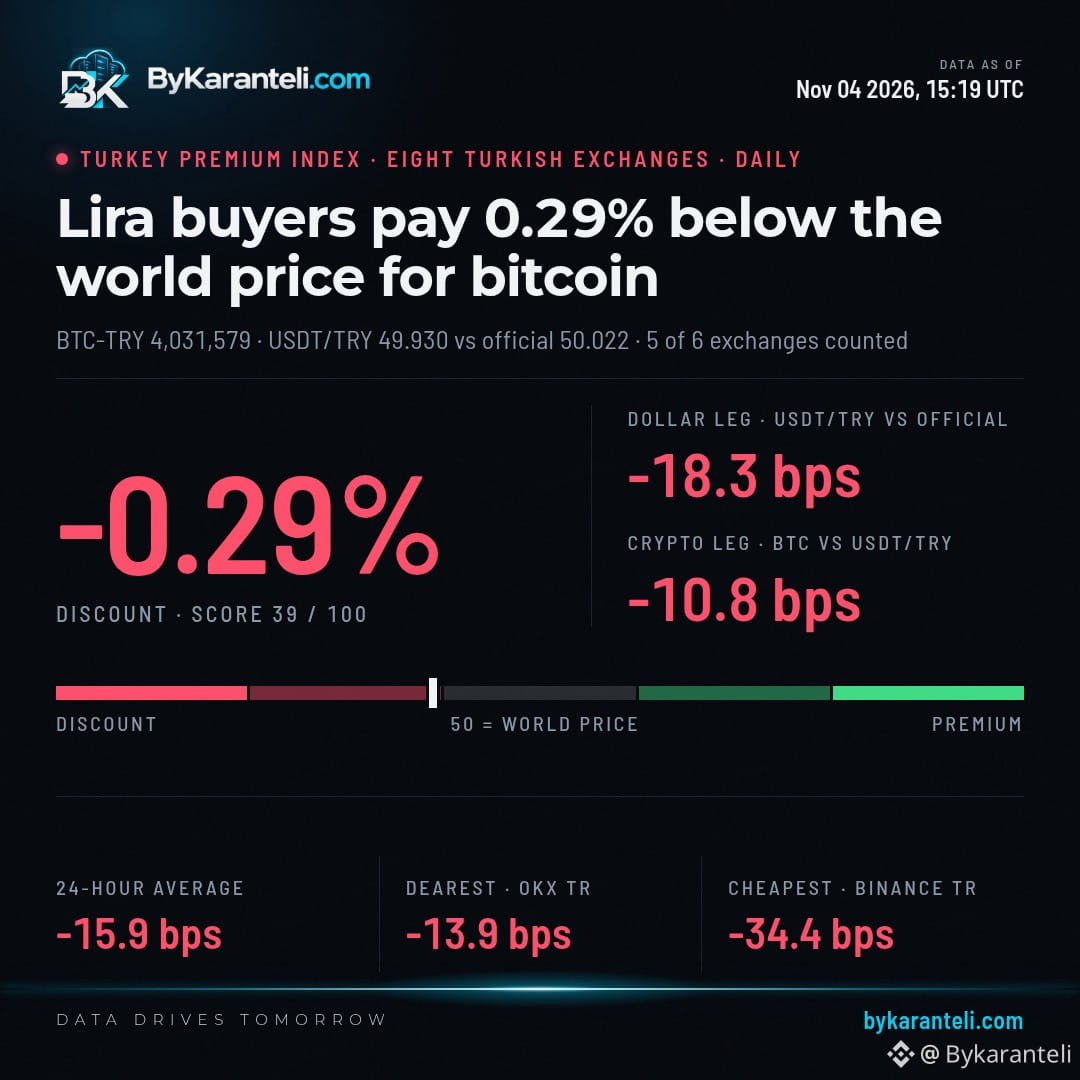
Lira buyers paid less for Bitcoin than the rest of the world on Nov 4. The Turkey Premium Index read -0.29% (-29.2 bps), a score of 39 / 100 in the discount regime, below its 24 hour average of -15.9 bps.
The dollar did more of the work than the coin. Tether traded under the official lira rate, a dollar leg of -18.3 bps, against a crypto leg of -10.8 bps.
Across the five eligible Turkish exchanges, OKX TR was the dearest at -13.9 bps and Binance TR the cheapest at -34.4 bps. This is a price gap, not a trade anyone can lock in.
54
·
--
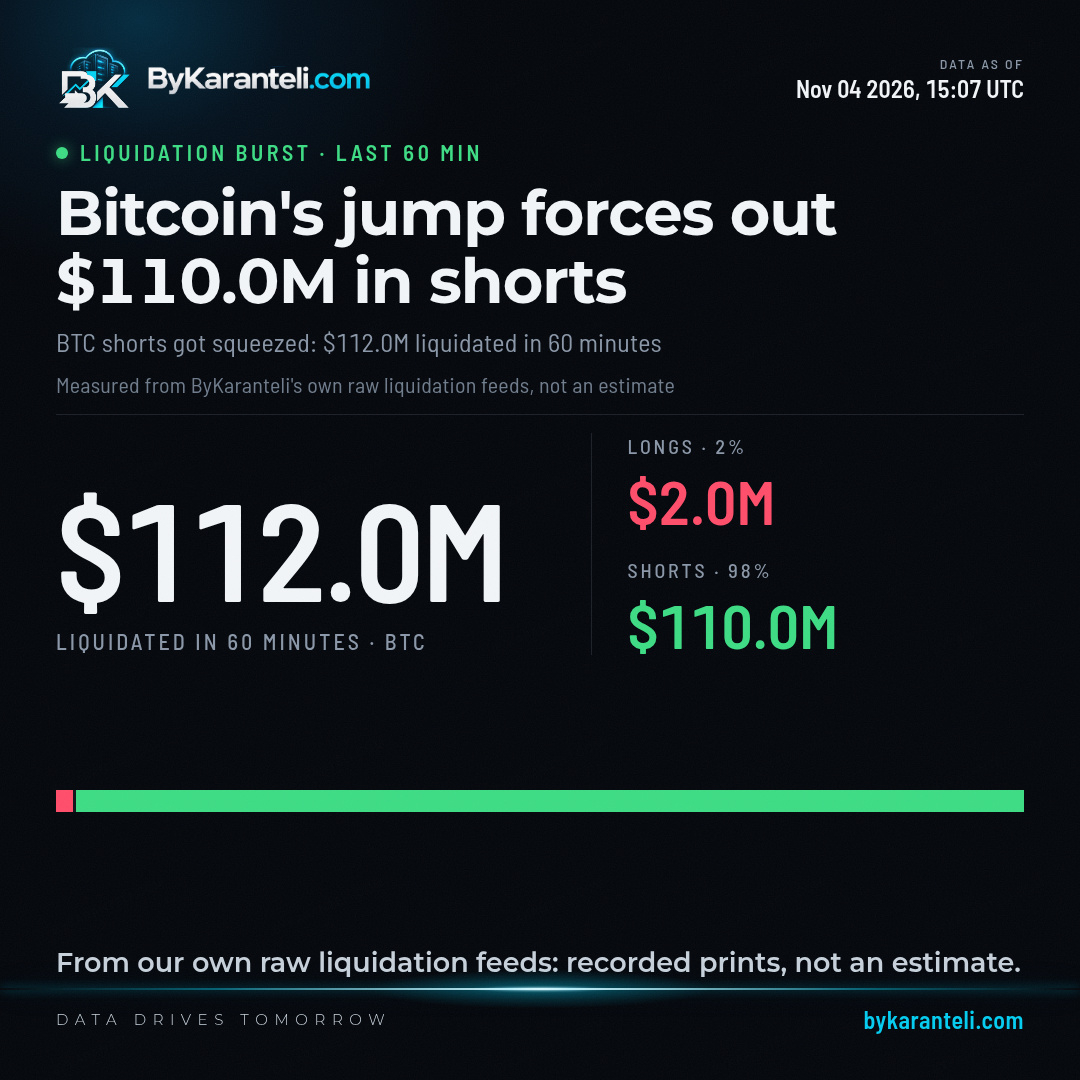
Bitcoin climbed 2.7% in roughly the last hour to $80,454, and the traders caught betting on a fall paid for it. Our streams recorded $110.0M in short liquidations over the past 60 minutes, positions that exchanges closed by force as the price moved against them.
The long side lost just $2.0M in the same window. Over 24 hours $BTC is up 3.99%.
Funding reads 0.01% per interval, so traders holding longs pay a small fee to keep them open. These are recorded figures from our own collectors, a floor for the whole market rather than the full total.
The long side lost just $2.0M in the same window. Over 24 hours $BTC is up 3.99%.
Funding reads 0.01% per interval, so traders holding longs pay a small fee to keep them open. These are recorded figures from our own collectors, a floor for the whole market rather than the full total.
44
·
--
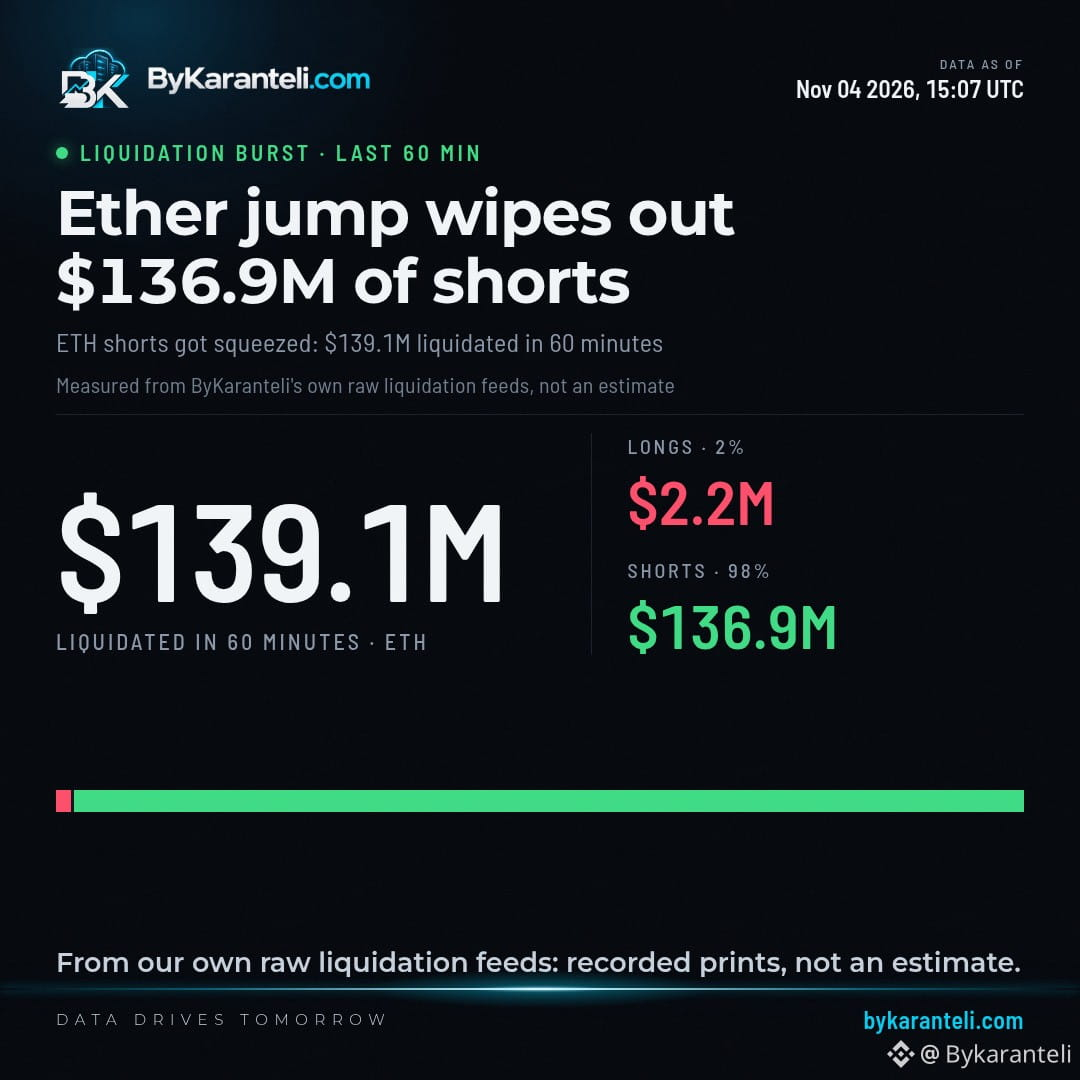
Ether just ran up 5.16% in roughly an hour to $2,437.66, and the traders caught short paid for it. Our streams recorded $136.9M in short liquidations over the last 60 minutes. These are bets on a lower price that exchanges closed by force.
The long side barely felt the move, with $2.2M liquidated over the same hour. These are recorded figures from our own collectors, so the full market total is at least this large.
$ETH is up 6.61% over 24 hours. Funding stands at 0.01% per interval, the small fee traders holding longs pay to keep them open.
35
·
--
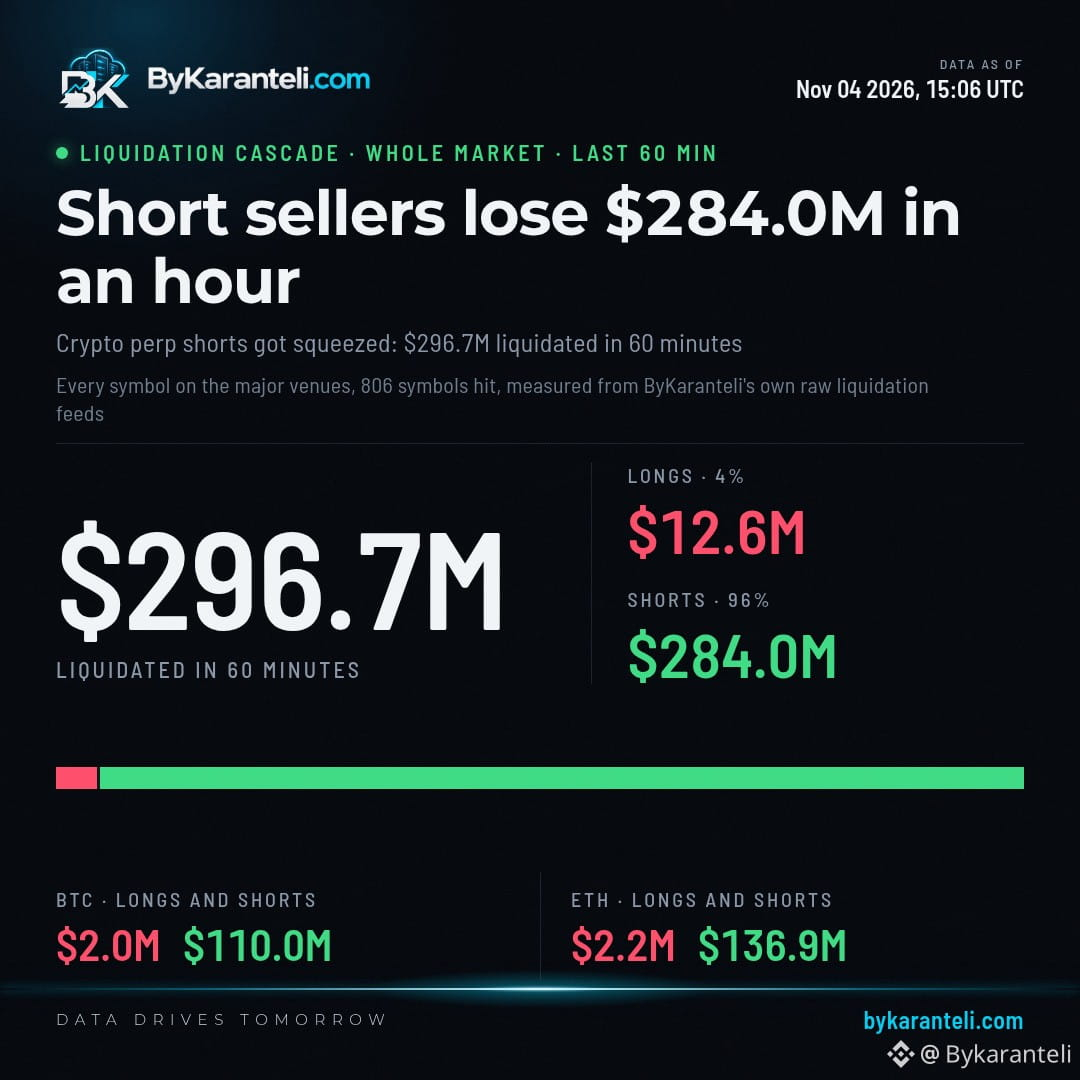
The squeeze on crypto shorts is still growing. Over the last 60 minutes, $296.7M of leveraged positions were closed by force across 806 coins on the major venues, and 96% of it, $284.0M, belonged to traders betting on lower prices. At our 14:51 UTC alert, the same 60 minute window stood at $92.6M.
Ether took the most damage, with $136.9M of $ETH shorts liquidated against $110.0M for $BTC. The two largest single closures were both Ether shorts on Htx at 15:04 UTC, worth $38.0M and $15.7M.
$BTC trades at $80,478, 4.22% higher over 24 hours, with a session low of $75,690. $ETH is at $2,438, up 6.87%.
The squeeze on crypto shorts is still growing. Over the last 60 minutes, $296.7M of leveraged positions were closed by force across 806 coins on the major venues, and 96% of it, $284.0M, belonged to traders betting on lower prices. At our 14:51 UTC alert, the same 60 minute window stood at $92.6M.
Ether took the most damage, with $136.9M of $ETH shorts liquidated against $110.0M for $BTC . The two largest single closures were both Ether shorts on Htx at 15:04 UTC, worth $38.0M and $15.7M.
$BTC trades at $80,478, 4.22% higher over 24 hours, with a session low of $75,690. $ETH is at $2,438, up 6.87%.
21
·
--
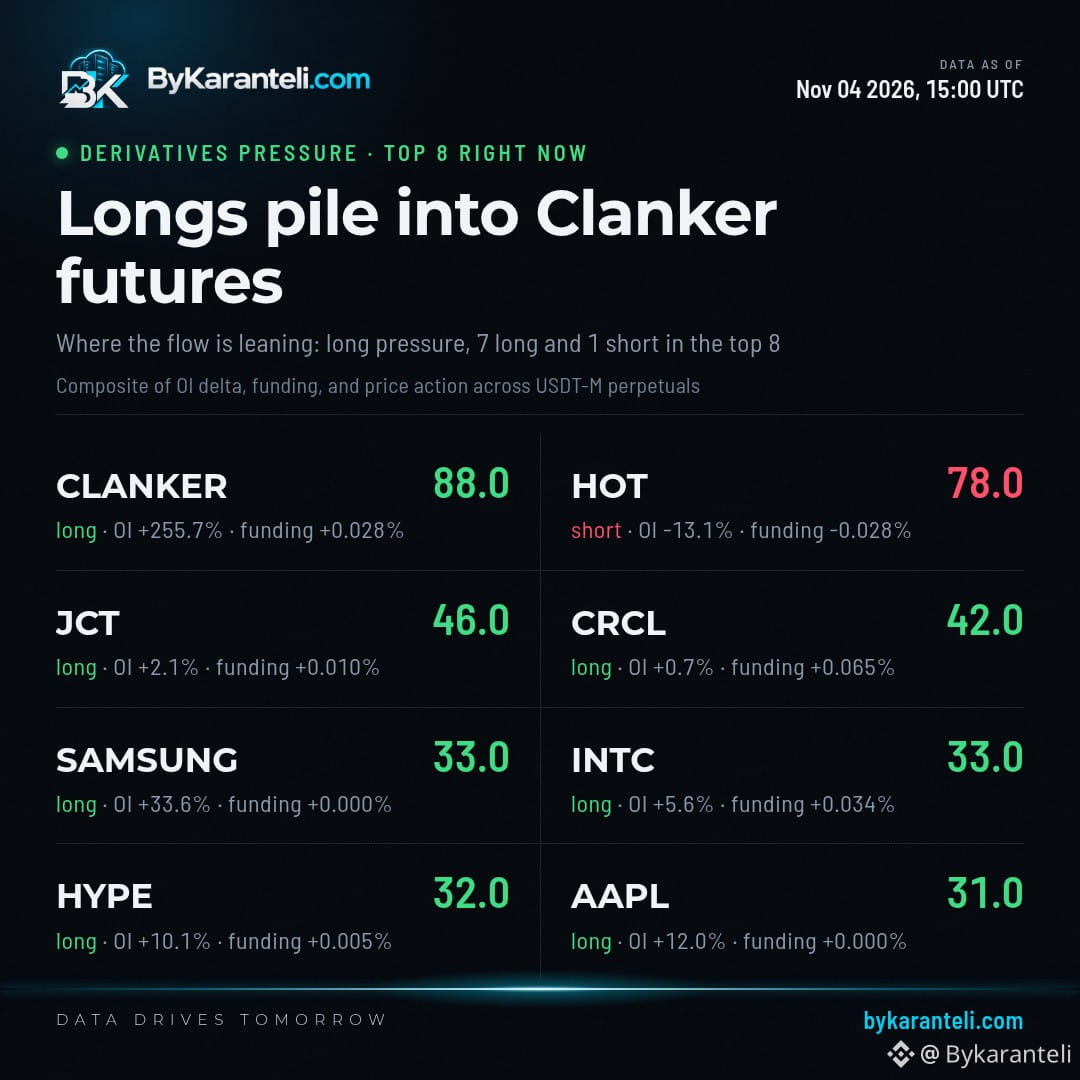
Open futures bets on $CLANKER grew 255.68% in the 24 hours to 15:00 UTC on Nov 4, the biggest build on our pressure board. Buyers pay 0.03% in funding, the fee longs hand shorts to keep positions open, so the new money is landing on the side that already pays.
The rest of the board leans long too. Open bets on Samsung contracts grew 33.65% and on Apple 11.96%, both with funding at 0%. That is new money arriving without either side paying for it.
$HOT runs the other way. Open bets there fell 13.06% and funding is at -0.03%, with shorts paying longs, as money leaves a market where sellers still carry the cost.
57
Log in to explore more content
Join global crypto users on Binance Square
⚡️ Get latest and useful information about crypto.
💬 Trusted by the world’s largest crypto exchange.
👍 Discover real insights from verified creators.
Email / Phone number
Trending Topics
BTCRebounds80K
36,523 views
582 Discussing
BITCOIN UPDATE I’M STILL BEARISH, AND HERE’S WHY! 🚨⚠️
As you all witnessed, BTC bounced back from the $75,700 area and touched $81K. First, the market trapped long traders, and then it trapped short traders.
I’m still bearish. First of all, as everyone knows, Democrats won today’s US midterm elections, and in my view, this outcome is bearish for the market.
The market can remain volatile in the short term and trap as many traders as it wants, but that doesn’t change the overall market outlook.
There are several important upcoming events, including US Non Farm Payrolls (November 6), US CPI Inflation (November 10), US PPI (November 13), US Retail Sales (November 17), FOMC Meeting Minutes (November 18), US PCE Inflation (November 25), Federal Reserve interest rate expectations, the US Dollar Index (DXY), Treasury Yields, Nasdaq performance, Bitcoin ETF flows, and ongoing( Iran ) Israel geopolitical developments. All of these could have a significant impact on Bitcoin and the overall crypto market.
But don’t get too carried away by Bitcoin’s recent movement. Technically speaking, there hasn’t been any major bullish move yet. Yesterday, BTC was trading between $80K and $82K, and even today, it’s still around the same range.
If you want to turn bullish, that’s entirely your choice.
In my previous post, I clearly explained that BTC had technical support in the $75K / $76K zone, and the price bounced from that support and made its way back towards $80K. But this wasn’t something I had failed to mention before. In fact, I repeatedly mentioned in my posts that BTC could move towards $80K, $81K, or even $82K.
Despite that, I’m still bearish.
And I don’t have just one reason to support my bearish outlook. I have several reasons, which I’ve already explained in my previous posts.
For now, I’ll continue to wait for BTC to drop below $74K, which I believe could happen very soon. In my view, such a correction is also necessary for the market.
Anyone looking for crypto guidance just let me know.
#BTCRebounds80K
Strategic Adviser
·14 Likes
·9.4k views
Binance98PercentReplenished
29,640 views
497 Discussing
USMidterms-WhatAreMarketsExpecting?
311,504 views
1,997 Discussing