
MIND FLARE
4.8k Beiträge

MIND FLARE
 Square Verified+
Melden
Nutzer blockieren
🔥Blogger (crypto)| They call us dreamers but we ‘re the ones who don’t sleep| Trading Crypto with Discipline, Not with Emotion(Sharing market insights)

ASTER Halter
Regelmäßiger Trader
1.2 Jahre
368 Following
34.2K+ Follower
13.1K+ Like gegeben
Beiträge
Alle
Zitierungen
Videos
Live
PINNED
·
--
Bullisch
$DEXE befindet sich noch in einer Reparatur-/Instandsetzungsphase. Der Kurs ist von 2.707 abgefallen und notiert nun unter beiden gleitenden Durchschnitten MA7 (2.325) und MA25 (2.366). Entscheidend ist, ob der Bereich 2.24–2.27 weiter Verkäufe absorbiert. Wenn diese Basis hält, könnte ein Rückeroberung der Zone 2.32–2.37 wieder 2.42 ermöglichen. Fällt 2.24, dann liegt die nächste relevante Unterstützung bei etwa 2.12–2.02.
$NIL wirkt deutlich gesünder. Der Kurs hält sich über MA7 (0.0514) und MA25 (0.0491), nachdem er auf 0.05395 gestiegen ist. Solange 0.0514–0.0520 hält, sieht das eher nach einer Konsolidierung nahe den Hochs aus als nach einem gescheiterten Ausbruch. Ein sauberer Anstieg durch 0.05395–0.0543 würde eine weitere Ausdehnungsphase bestätigen, während das Verfehlen von 0.0514 dieses Setup schwächen würde.
Mein Eindruck: NIL konsolidiert Stärke; DEXE braucht weiterhin eine Rückeroberung, bevor die Dynamik wieder konstruktiv wird.
{spot}(DEXEUSDT)
{spot}(NILUSDT)
#DEXE/USDT #NIL
$DEXE befindet sich noch in einer Reparatur-/Instandsetzungsphase. Der Kurs ist von 2.707 abgefallen und notiert nun unter beiden gleitenden Durchschnitten MA7 (2.325) und MA25 (2.366). Entscheidend ist, ob der Bereich 2.24–2.27 weiter Verkäufe absorbiert. Wenn diese Basis hält, könnte ein Rückeroberung der Zone 2.32–2.37 wieder 2.42 ermöglichen. Fällt 2.24, dann liegt die nächste relevante Unterstützung bei etwa 2.12–2.02.
$NIL wirkt deutlich gesünder. Der Kurs hält sich über MA7 (0.0514) und MA25 (0.0491), nachdem er auf 0.05395 gestiegen ist. Solange 0.0514–0.0520 hält, sieht das eher nach einer Konsolidierung nahe den Hochs aus als nach einem gescheiterten Ausbruch. Ein sauberer Anstieg durch 0.05395–0.0543 würde eine weitere Ausdehnungsphase bestätigen, während das Verfehlen von 0.0514 dieses Setup schwächen würde.
Mein Eindruck: NIL konsolidiert Stärke; DEXE braucht weiterhin eine Rückeroberung, bevor die Dynamik wieder konstruktiv wird.
#DEXE/USDT #NIL
$NIL wirkt deutlich gesünder. Der Kurs hält sich über MA7 (0.0514) und MA25 (0.0491), nachdem er auf 0.05395 gestiegen ist. Solange 0.0514–0.0520 hält, sieht das eher nach einer Konsolidierung nahe den Hochs aus als nach einem gescheiterten Ausbruch. Ein sauberer Anstieg durch 0.05395–0.0543 würde eine weitere Ausdehnungsphase bestätigen, während das Verfehlen von 0.0514 dieses Setup schwächen würde.
Mein Eindruck: NIL konsolidiert Stärke; DEXE braucht weiterhin eine Rückeroberung, bevor die Dynamik wieder konstruktiv wird.
#DEXE/USDT #NIL
$NIL > 0.054
30%
$DEXE > 2.37
55%
Both retrace
8%
Wait for support
7%
40 Stimmen • Abstimmung beendet
9
3
77
188.5k
PINNED
·
--
Bullisch
$TUT hat den saubereren 1H-Trend. Der Move von 0.0357 → 0.0846 ist noch dabei, höhere Hochs und höhere Tiefs auszubilden, während der Preis gut oberhalb der steigenden MA7 gehalten wird. Der Haken ist die Extension: Bei 0.0825 ist es bereits von kurzfristigem Support zu weit gelaufen. 0.0846–0.0870 ist die unmittelbare Widerstandszone; 0.0748–0.0720 ist der Bereich, in dem ich sehen möchte, dass Käufer verteidigen, falls der Momentum abkühlt.
$1000CAT ist anders. Der Großteil seines +42%-Moves kam von einer einzigen Expansionskerze, und jetzt nimmt das Volumen ab, während der Kurs sich unter 0.00227–0.00244 konsolidiert. Wenn 0.00206–0.00211 gehalten werden, würde das nach Absorption nach dem Impuls aussehen. Verliert man 0.00206, steigt die Wahrscheinlichkeit eines tieferen Re-sets Richtung 0.00185–0.00171.
Meine Einschätzung: TUT hat die stärkere Trendqualität 1000CAT hat die spannendere Kompressions-Setup.
{spot}(TUTUSDT)
{spot}(1000CATUSDT)
#TUT #1000cat
Was bricht zuerst?
$TUT hat den saubereren 1H-Trend. Der Move von 0.0357 → 0.0846 ist noch dabei, höhere Hochs und höhere Tiefs auszubilden, während der Preis gut oberhalb der steigenden MA7 gehalten wird. Der Haken ist die Extension: Bei 0.0825 ist es bereits von kurzfristigem Support zu weit gelaufen. 0.0846–0.0870 ist die unmittelbare Widerstandszone; 0.0748–0.0720 ist der Bereich, in dem ich sehen möchte, dass Käufer verteidigen, falls der Momentum abkühlt.
$1000CAT ist anders. Der Großteil seines +42%-Moves kam von einer einzigen Expansionskerze, und jetzt nimmt das Volumen ab, während der Kurs sich unter 0.00227–0.00244 konsolidiert. Wenn 0.00206–0.00211 gehalten werden, würde das nach Absorption nach dem Impuls aussehen. Verliert man 0.00206, steigt die Wahrscheinlichkeit eines tieferen Re-sets Richtung 0.00185–0.00171.
Meine Einschätzung: TUT hat die stärkere Trendqualität 1000CAT hat die spannendere Kompressions-Setup.
#TUT #1000cat
Was bricht zuerst?
$1000CAT ist anders. Der Großteil seines +42%-Moves kam von einer einzigen Expansionskerze, und jetzt nimmt das Volumen ab, während der Kurs sich unter 0.00227–0.00244 konsolidiert. Wenn 0.00206–0.00211 gehalten werden, würde das nach Absorption nach dem Impuls aussehen. Verliert man 0.00206, steigt die Wahrscheinlichkeit eines tieferen Re-sets Richtung 0.00185–0.00171.
Meine Einschätzung: TUT hat die stärkere Trendqualität 1000CAT hat die spannendere Kompressions-Setup.
#TUT #1000cat
Was bricht zuerst?
$TUT > 0.0846
45%
$1000CAT > 0.00244
18%
Both pull back
28%
Wait for support
9%
74 Stimmen • Abstimmung beendet
18
1
114
292.7k
·
--
Bullisch
$FTT befindet sich bei 0.2954 in einer Erholungsphase innerhalb einer Range, nachdem es die Zurückweisung bei 0.3462 gegeben hat. Der Kurs ist es gelungen, wieder über MA7 bei 0.2896 zu kommen, wodurch die kurzfristige Struktur am Leben bleibt. Die wiederholten oberen Dochte im Bereich von etwa 0.30–0.323 zeigen jedoch, dass noch Angebot oberhalb liegt. Für mich ist 0.289–0.285 die erste Unterstützung, die halten muss. Wenn Käufer auf 1H über 0.300–0.305 schließen können, öffnet sich der Weg Richtung 0.323, dann 0.346. Wenn dieser Reclaim fehlschlägt und der Kurs wieder unter 0.285 rutscht, würde ich mit einem erneuten Test von 0.267–0.256 rechnen, statt mit einer sofortigen Fortsetzung.
$NIL bei 0.06805 hat ein klareres Momentum-Profil. Es brach aus dem Bereich 0.060–0.064 aus und handelt nun knapp unter dem 24h-Hoch bei 0.06877, während MA7 (0.06406) unterhalb des Preises steigt. Das ist genau die Art von Setup, bei der die nächste Entscheidung einfach ist: Entweder akzeptiert der Kurs über 0.0688–0.0693, oder er kühlt wieder Richtung 0.0645–0.0640 ab. Ein tieferer Verlust dieser Zone würde 0.062–0.060 wieder in den Fokus rücken.
Technisch betrachtet: FTT repariert weiterhin eine Zurückweisung; NIL testet, ob ein frischer Ausbruch die Bewegung verlängern kann. Das deutlichere Fortsetzungs-Signal käme von NIL, das über dem Widerstand hält, während FTT noch beweisen muss, dass es das Angebot oberhalb von 0.30 überwinden kann.
Nur zu Bildungszwecken, keine finanzielle Beratung.
{spot}(FTTUSDT)
{spot}(NILUSDT)
Welches Setup wirkt von hier aus überzeugender?
$FTT befindet sich bei 0.2954 in einer Erholungsphase innerhalb einer Range, nachdem es die Zurückweisung bei 0.3462 gegeben hat. Der Kurs ist es gelungen, wieder über MA7 bei 0.2896 zu kommen, wodurch die kurzfristige Struktur am Leben bleibt. Die wiederholten oberen Dochte im Bereich von etwa 0.30–0.323 zeigen jedoch, dass noch Angebot oberhalb liegt. Für mich ist 0.289–0.285 die erste Unterstützung, die halten muss. Wenn Käufer auf 1H über 0.300–0.305 schließen können, öffnet sich der Weg Richtung 0.323, dann 0.346. Wenn dieser Reclaim fehlschlägt und der Kurs wieder unter 0.285 rutscht, würde ich mit einem erneuten Test von 0.267–0.256 rechnen, statt mit einer sofortigen Fortsetzung.
$NIL bei 0.06805 hat ein klareres Momentum-Profil. Es brach aus dem Bereich 0.060–0.064 aus und handelt nun knapp unter dem 24h-Hoch bei 0.06877, während MA7 (0.06406) unterhalb des Preises steigt. Das ist genau die Art von Setup, bei der die nächste Entscheidung einfach ist: Entweder akzeptiert der Kurs über 0.0688–0.0693, oder er kühlt wieder Richtung 0.0645–0.0640 ab. Ein tieferer Verlust dieser Zone würde 0.062–0.060 wieder in den Fokus rücken.
Technisch betrachtet: FTT repariert weiterhin eine Zurückweisung; NIL testet, ob ein frischer Ausbruch die Bewegung verlängern kann. Das deutlichere Fortsetzungs-Signal käme von NIL, das über dem Widerstand hält, während FTT noch beweisen muss, dass es das Angebot oberhalb von 0.30 überwinden kann.
Nur zu Bildungszwecken, keine finanzielle Beratung.
Welches Setup wirkt von hier aus überzeugender?
$NIL bei 0.06805 hat ein klareres Momentum-Profil. Es brach aus dem Bereich 0.060–0.064 aus und handelt nun knapp unter dem 24h-Hoch bei 0.06877, während MA7 (0.06406) unterhalb des Preises steigt. Das ist genau die Art von Setup, bei der die nächste Entscheidung einfach ist: Entweder akzeptiert der Kurs über 0.0688–0.0693, oder er kühlt wieder Richtung 0.0645–0.0640 ab. Ein tieferer Verlust dieser Zone würde 0.062–0.060 wieder in den Fokus rücken.
Technisch betrachtet: FTT repariert weiterhin eine Zurückweisung; NIL testet, ob ein frischer Ausbruch die Bewegung verlängern kann. Das deutlichere Fortsetzungs-Signal käme von NIL, das über dem Widerstand hält, während FTT noch beweisen muss, dass es das Angebot oberhalb von 0.30 überwinden kann.
Nur zu Bildungszwecken, keine finanzielle Beratung.
Welches Setup wirkt von hier aus überzeugender?
$NIL clears 0.0693
11%
$FTT reclaims 0.305
45%
Both pull back first
22%
Range continues
22%
9 Stimmen • Abstimmung beendet
1
1.6k
·
--
Bullisch
$ONE at 0.001593 ist auf 1H technisch gesehen immer noch stark. Der Preis liegt über MA7 0.001423, MA25 0.001073 und MA99 0.000790, während der letzte Push 0.001695 erreichte, ohne den Ausbruch sofort wieder zu verlieren. Die wichtige Zone liegt jetzt bei 0.00150–0.00142. Wenn diese Zone bei einem Rücksetzer hält, ist ein weiterer Test von 0.001695–0.00172 realistisch. Ein sauberes 1H-Close über diesem Widerstand würde die Expansion am Leben halten; fällt 0.00142, dann wäre 0.00132 der nächste Bereich, den man im Blick behalten sollte.
$AVA at 0.3025 verhält sich dagegen anders. Der Trend ist weiterhin bullisch, aber der Kurs konsolidiert nach der Ablehnung von 0.3320 und das Volumen hat begonnen, sich abzukühlen. MA7 bei 0.2852 ist die erste echte Unterstützung. Solange 0.285–0.267 intakt bleibt, sieht das weiterhin eher nach Konsolidierung auf hohem Niveau aus, statt nach Verteilung. Bullen müssen etwa 0.310–0.315 zurückerobern, bevor es zu einem weiteren sauberen Versuch bei 0.332 kommt. Unter 0.267 schwächt sich die Struktur schnell und es öffnet sich Raum in Richtung 0.231.
Technisch betrachtet hat ONE also weiterhin den stärkeren Momentum, während AVA die sauberere Pullback-Struktur hat. ONE ist näher an der Fortsetzung des Breakouts; AVA braucht noch eine weitere Rückeroberung, um zu beweisen, dass Käufer weiterhin die Oberseite der Range kontrollieren.
{spot}(ONEUSDT)
{spot}(AVAUSDT)
#ONE #AVA
Welche Bestätigung würdest du von hier an eher vertrauen?
$ONE at 0.001593 ist auf 1H technisch gesehen immer noch stark. Der Preis liegt über MA7 0.001423, MA25 0.001073 und MA99 0.000790, während der letzte Push 0.001695 erreichte, ohne den Ausbruch sofort wieder zu verlieren. Die wichtige Zone liegt jetzt bei 0.00150–0.00142. Wenn diese Zone bei einem Rücksetzer hält, ist ein weiterer Test von 0.001695–0.00172 realistisch. Ein sauberes 1H-Close über diesem Widerstand würde die Expansion am Leben halten; fällt 0.00142, dann wäre 0.00132 der nächste Bereich, den man im Blick behalten sollte.
$AVA at 0.3025 verhält sich dagegen anders. Der Trend ist weiterhin bullisch, aber der Kurs konsolidiert nach der Ablehnung von 0.3320 und das Volumen hat begonnen, sich abzukühlen. MA7 bei 0.2852 ist die erste echte Unterstützung. Solange 0.285–0.267 intakt bleibt, sieht das weiterhin eher nach Konsolidierung auf hohem Niveau aus, statt nach Verteilung. Bullen müssen etwa 0.310–0.315 zurückerobern, bevor es zu einem weiteren sauberen Versuch bei 0.332 kommt. Unter 0.267 schwächt sich die Struktur schnell und es öffnet sich Raum in Richtung 0.231.
Technisch betrachtet hat ONE also weiterhin den stärkeren Momentum, während AVA die sauberere Pullback-Struktur hat. ONE ist näher an der Fortsetzung des Breakouts; AVA braucht noch eine weitere Rückeroberung, um zu beweisen, dass Käufer weiterhin die Oberseite der Range kontrollieren.
#ONE #AVA
Welche Bestätigung würdest du von hier an eher vertrauen?
$AVA at 0.3025 verhält sich dagegen anders. Der Trend ist weiterhin bullisch, aber der Kurs konsolidiert nach der Ablehnung von 0.3320 und das Volumen hat begonnen, sich abzukühlen. MA7 bei 0.2852 ist die erste echte Unterstützung. Solange 0.285–0.267 intakt bleibt, sieht das weiterhin eher nach Konsolidierung auf hohem Niveau aus, statt nach Verteilung. Bullen müssen etwa 0.310–0.315 zurückerobern, bevor es zu einem weiteren sauberen Versuch bei 0.332 kommt. Unter 0.267 schwächt sich die Struktur schnell und es öffnet sich Raum in Richtung 0.231.
Technisch betrachtet hat ONE also weiterhin den stärkeren Momentum, während AVA die sauberere Pullback-Struktur hat. ONE ist näher an der Fortsetzung des Breakouts; AVA braucht noch eine weitere Rückeroberung, um zu beweisen, dass Käufer weiterhin die Oberseite der Range kontrollieren.
#ONE #AVA
Welche Bestätigung würdest du von hier an eher vertrauen?
$ONE closes above 0.00170
28%
$AVA reclaims 0.315
27%
$ONE retests 0.00142
27%
$AVA loses 0.285
18%
11 Stimmen • Abstimmung beendet
1
1
4.5k
·
--
Bullisch
$SAGA at 0.02404 hält weiterhin eine ordentliche Ausbruchsstruktur. Der Kurs liegt über MA7 (0.02219), MA25 (0.02000) und MA99 (0.01784), und das stärkste Volumen kam mit der Expansionskerze statt bei der Rücksetzerkerze. Das ist konstruktiv. Der entscheidende Bereich ist jetzt 0.0234–0.0230: Wenn diese Zone weiter als Unterstützung wirkt, haben Käufer noch eine saubere Chance auf 0.02475. Ein bestätigter Ausbruch über 0.02475 mit erneutem Volumen würde den Schwung am Leben halten. Wenn 0.0230 jedoch nachgibt, würde ich mit einem tieferen Retest in Richtung MA7 um 0.0222 statt einer direkten Fortsetzung rechnen.
$ASTR at 0.006802 ist kurzfristig deutlich schwächer. Der Kurs liegt unter MA7 (0.006943) und MA25 (0.006917), nachdem er wiederholt im Bereich um 0.0070 gescheitert ist, während das Volumen austrocknet. Damit ist 0.00666 die Kursmarke, die jetzt zählt. Halten und zurückerobern von 0.00692–0.00702, und die Struktur kann sich in Richtung 0.00729 erholen. 0.00666 verlieren, und die nächste bedeutende Unterstützung liegt viel tiefer bei etwa 0.00630, wo MA99 sitzt.
Der technische Unterschied ist also einfach: SAGA konsolidiert über einem Ausbruch; ASTR versucht, einen kurzfristigen Breakdown zu stoppen. Ich würde bei SAGA Fortsetzungsvolumen wollen und bei ASTR eine tatsächliche Rückeroberung, bevor ich die nächste Bewegung jeweils als bestätigt werte.
{spot}(SAGAUSDT)
{spot}(ASTRUSDT)
#SAGA #ASTR
$SAGA at 0.02404 hält weiterhin eine ordentliche Ausbruchsstruktur. Der Kurs liegt über MA7 (0.02219), MA25 (0.02000) und MA99 (0.01784), und das stärkste Volumen kam mit der Expansionskerze statt bei der Rücksetzerkerze. Das ist konstruktiv. Der entscheidende Bereich ist jetzt 0.0234–0.0230: Wenn diese Zone weiter als Unterstützung wirkt, haben Käufer noch eine saubere Chance auf 0.02475. Ein bestätigter Ausbruch über 0.02475 mit erneutem Volumen würde den Schwung am Leben halten. Wenn 0.0230 jedoch nachgibt, würde ich mit einem tieferen Retest in Richtung MA7 um 0.0222 statt einer direkten Fortsetzung rechnen.
$ASTR at 0.006802 ist kurzfristig deutlich schwächer. Der Kurs liegt unter MA7 (0.006943) und MA25 (0.006917), nachdem er wiederholt im Bereich um 0.0070 gescheitert ist, während das Volumen austrocknet. Damit ist 0.00666 die Kursmarke, die jetzt zählt. Halten und zurückerobern von 0.00692–0.00702, und die Struktur kann sich in Richtung 0.00729 erholen. 0.00666 verlieren, und die nächste bedeutende Unterstützung liegt viel tiefer bei etwa 0.00630, wo MA99 sitzt.
Der technische Unterschied ist also einfach: SAGA konsolidiert über einem Ausbruch; ASTR versucht, einen kurzfristigen Breakdown zu stoppen. Ich würde bei SAGA Fortsetzungsvolumen wollen und bei ASTR eine tatsächliche Rückeroberung, bevor ich die nächste Bewegung jeweils als bestätigt werte.
#SAGA #ASTR
$ASTR at 0.006802 ist kurzfristig deutlich schwächer. Der Kurs liegt unter MA7 (0.006943) und MA25 (0.006917), nachdem er wiederholt im Bereich um 0.0070 gescheitert ist, während das Volumen austrocknet. Damit ist 0.00666 die Kursmarke, die jetzt zählt. Halten und zurückerobern von 0.00692–0.00702, und die Struktur kann sich in Richtung 0.00729 erholen. 0.00666 verlieren, und die nächste bedeutende Unterstützung liegt viel tiefer bei etwa 0.00630, wo MA99 sitzt.
Der technische Unterschied ist also einfach: SAGA konsolidiert über einem Ausbruch; ASTR versucht, einen kurzfristigen Breakdown zu stoppen. Ich würde bei SAGA Fortsetzungsvolumen wollen und bei ASTR eine tatsächliche Rückeroberung, bevor ich die nächste Bewegung jeweils als bestätigt werte.
#SAGA #ASTR
$SAGA breaks 0.02475
68%
$ASTR reclaims 0.0070
16%
$SAGA retests 0.0222
11%
$ASTR loses 0.00666
5%
19 Stimmen • Abstimmung beendet
1
2
6.3k
·
--
Der Jobs-Report hat die Debatte um die Fed nicht beigelegt. Er gab den Entscheidungsträgern lediglich mehr Spielraum zum Handeln.
Im August stiegen die Lohnsummen um 162.000, während die Arbeitslosenquote bei 4,1% blieb—das zeigt, dass der Arbeitsmarkt weiterhin robust ist. Nun wird der CPI zum entscheidenden Test.
Ein höherer Schlagzeilen-CPI allein dürfte keinen Zinsschritt auslösen, insbesondere wenn Energiepreise den Großteil des Anstiegs verursachen. Das stärkere Signal kommt aus der Kerninflation und den Preisen für Dienstleistungen.
Wenn die Schlagzeileninflation steigt, während die Kerninflation abkühlt, kann die Fed die Zinssätze dennoch rechtfertigt halten. Aber wenn beides heiß bleibt, wird ein Anstieg um 25 Bp deutlich wahrscheinlicher.
Dieses Ergebnis wäre negativ für Growth-Aktien, weil höhere Renditen den Wert zukünftiger Gewinne senken. Gold könnte in der ersten Reaktion ebenfalls fallen, falls der Dollar stärker wird; doch anhaltende Inflation könnte Käufer wieder zurückholen, sobald die anfängliche Volatilität abklingt.
Die Ausgangslage ist klar: Eine zu heiße Kerninflation wäre negativ für Growth-Aktien, während Gold nach der ersten Marktreaktion wieder bullisch drehen könnte.
Ich würde der Eröffnungs-„Kerze“ nicht hinterherjagen. Die Details werden entscheiden, ob der erste Impuls Bestand hat.
#CPIWatch
Was wird die Fed als Nächstes tun?
Der Jobs-Report hat die Debatte um die Fed nicht beigelegt. Er gab den Entscheidungsträgern lediglich mehr Spielraum zum Handeln.
Im August stiegen die Lohnsummen um 162.000, während die Arbeitslosenquote bei 4,1% blieb—das zeigt, dass der Arbeitsmarkt weiterhin robust ist. Nun wird der CPI zum entscheidenden Test.
Ein höherer Schlagzeilen-CPI allein dürfte keinen Zinsschritt auslösen, insbesondere wenn Energiepreise den Großteil des Anstiegs verursachen. Das stärkere Signal kommt aus der Kerninflation und den Preisen für Dienstleistungen.
Wenn die Schlagzeileninflation steigt, während die Kerninflation abkühlt, kann die Fed die Zinssätze dennoch rechtfertigt halten. Aber wenn beides heiß bleibt, wird ein Anstieg um 25 Bp deutlich wahrscheinlicher.
Dieses Ergebnis wäre negativ für Growth-Aktien, weil höhere Renditen den Wert zukünftiger Gewinne senken. Gold könnte in der ersten Reaktion ebenfalls fallen, falls der Dollar stärker wird; doch anhaltende Inflation könnte Käufer wieder zurückholen, sobald die anfängliche Volatilität abklingt.
Die Ausgangslage ist klar: Eine zu heiße Kerninflation wäre negativ für Growth-Aktien, während Gold nach der ersten Marktreaktion wieder bullisch drehen könnte.
Ich würde der Eröffnungs-„Kerze“ nicht hinterherjagen. Die Details werden entscheiden, ob der erste Impuls Bestand hat.
#CPIWatch
Was wird die Fed als Nächstes tun?
Im August stiegen die Lohnsummen um 162.000, während die Arbeitslosenquote bei 4,1% blieb—das zeigt, dass der Arbeitsmarkt weiterhin robust ist. Nun wird der CPI zum entscheidenden Test.
Ein höherer Schlagzeilen-CPI allein dürfte keinen Zinsschritt auslösen, insbesondere wenn Energiepreise den Großteil des Anstiegs verursachen. Das stärkere Signal kommt aus der Kerninflation und den Preisen für Dienstleistungen.
Wenn die Schlagzeileninflation steigt, während die Kerninflation abkühlt, kann die Fed die Zinssätze dennoch rechtfertigt halten. Aber wenn beides heiß bleibt, wird ein Anstieg um 25 Bp deutlich wahrscheinlicher.
Dieses Ergebnis wäre negativ für Growth-Aktien, weil höhere Renditen den Wert zukünftiger Gewinne senken. Gold könnte in der ersten Reaktion ebenfalls fallen, falls der Dollar stärker wird; doch anhaltende Inflation könnte Käufer wieder zurückholen, sobald die anfängliche Volatilität abklingt.
Die Ausgangslage ist klar: Eine zu heiße Kerninflation wäre negativ für Growth-Aktien, während Gold nach der ersten Marktreaktion wieder bullisch drehen könnte.
Ich würde der Eröffnungs-„Kerze“ nicht hinterherjagen. Die Details werden entscheiden, ob der erste Impuls Bestand hat.
#CPIWatch
Was wird die Fed als Nächstes tun?
Hike 25 bps
75%
Hold rates
0%
Too close
25%
4 Stimmen • Abstimmung beendet
1
2
748
·
--
$BTC is beginnt, auf dem 1H schwer zu wirken.
Bei 77.675 US-Dollar handelt der Preis unter den MA7 (78.005), MA25 (78.366) und MA99 (79.977). Noch wichtiger: Jeder Rücksetzer seit 78.564 US-Dollar wurde in den Verkauf gedrückt, während der jüngste Rückgang mit stärkerem rotem Volumen einhergeht. Das hält die kurzfristige Kontrolle bei den Verkäufern.
77.650 US-Dollar ist die unmittelbare Zone, die ich im Blick habe. Wenn BTC diese Marke bei einem sauberen 1H-Close verliert, kann sich die Bewegung in Richtung 77,3K–77,0K ausdehnen, bevor Käufer einen weiteren bedeutenden Test wagen.
Für Bullen gilt: Ein simples Abprallen reicht nicht. BTC muss zuerst 77,9K–78,0K zurückerobern. Darüber wird die Zone 78,22K–78,36K zum echten Widerstandsbereich. Solange diese Levels nicht zurückerobert sind, würde ich Aufwärtskerzen eher als Entlastungs-Rückläufe betrachten – nicht als bestätigte Trendwende.
Das Interessante hier ist: BTC braucht keinen riesigen Dump, um bärisch zu bleiben – es muss nur weiter scheitern, indem es unter den fallenden kurzfristigen Durchschnitten bleibt.
{spot}(BTCUSDT)
#BTC
$BTC is beginnt, auf dem 1H schwer zu wirken.
Bei 77.675 US-Dollar handelt der Preis unter den MA7 (78.005), MA25 (78.366) und MA99 (79.977). Noch wichtiger: Jeder Rücksetzer seit 78.564 US-Dollar wurde in den Verkauf gedrückt, während der jüngste Rückgang mit stärkerem rotem Volumen einhergeht. Das hält die kurzfristige Kontrolle bei den Verkäufern.
77.650 US-Dollar ist die unmittelbare Zone, die ich im Blick habe. Wenn BTC diese Marke bei einem sauberen 1H-Close verliert, kann sich die Bewegung in Richtung 77,3K–77,0K ausdehnen, bevor Käufer einen weiteren bedeutenden Test wagen.
Für Bullen gilt: Ein simples Abprallen reicht nicht. BTC muss zuerst 77,9K–78,0K zurückerobern. Darüber wird die Zone 78,22K–78,36K zum echten Widerstandsbereich. Solange diese Levels nicht zurückerobert sind, würde ich Aufwärtskerzen eher als Entlastungs-Rückläufe betrachten – nicht als bestätigte Trendwende.
Das Interessante hier ist: BTC braucht keinen riesigen Dump, um bärisch zu bleiben – es muss nur weiter scheitern, indem es unter den fallenden kurzfristigen Durchschnitten bleibt.
#BTC
Bei 77.675 US-Dollar handelt der Preis unter den MA7 (78.005), MA25 (78.366) und MA99 (79.977). Noch wichtiger: Jeder Rücksetzer seit 78.564 US-Dollar wurde in den Verkauf gedrückt, während der jüngste Rückgang mit stärkerem rotem Volumen einhergeht. Das hält die kurzfristige Kontrolle bei den Verkäufern.
77.650 US-Dollar ist die unmittelbare Zone, die ich im Blick habe. Wenn BTC diese Marke bei einem sauberen 1H-Close verliert, kann sich die Bewegung in Richtung 77,3K–77,0K ausdehnen, bevor Käufer einen weiteren bedeutenden Test wagen.
Für Bullen gilt: Ein simples Abprallen reicht nicht. BTC muss zuerst 77,9K–78,0K zurückerobern. Darüber wird die Zone 78,22K–78,36K zum echten Widerstandsbereich. Solange diese Levels nicht zurückerobert sind, würde ich Aufwärtskerzen eher als Entlastungs-Rückläufe betrachten – nicht als bestätigte Trendwende.
Das Interessante hier ist: BTC braucht keinen riesigen Dump, um bärisch zu bleiben – es muss nur weiter scheitern, indem es unter den fallenden kurzfristigen Durchschnitten bleibt.
#BTC
Bounce from $77.6K
26%
Break toward $77K
35%
Reclaim $78.3K
30%
More chop first
9%
23 Stimmen • Abstimmung beendet
9
1
50
72.7k
·
--
Bullisch
REZ versucht, den ersten Spike in eine ordentliche höhere Basis zu verwandeln, während VTHO noch mit der Abkühlung nach dem Ausbruch beschäftigt ist.
Bei 0.003632 liegt $REZ über MA7 (0.003388), MA25 (0.003245) und MA99 (0.003170). Dieser bullische MA-Stack ist wichtig, weil der Rücksetzer von 0.00405 die neue Struktur nicht gebrochen hat. Der unmittelbare Kampf liegt bei 0.00365–0.00388; eine Akzeptanz oberhalb dieser Zone würde 0.00405 wieder ins Spiel bringen. Auf der Abwärtsseite ist 0.00342–0.00338 die erste Unterstützung, während 0.00325–0.00320 der stärkere Invalidationsbereich ist. Das Volumen ist nach dem Impuls abgekühlt, daher braucht der nächste Ausbruch Beteiligung – nicht nur noch ein dünner Docht.
$VTHO bei 0.000678 liegt weiterhin über MA25 und MA99, daher bleibt der größere 1H-Trend konstruktiv, aber der kurzfristige Momentum ist schwächer, weil der Kurs knapp unter MA7 (0.000688) sitzt. Ein Reclaim von 0.000694–0.000700 würde das Setup verbessern und 0.000749 wieder eröffnen. Wenn Käufer 0.000650–0.000623 nicht verteidigen, kann sich die Bewegung in Richtung 0.00055–0.000514 zurückdrehen.
Derzeit hat REZ die sauberere Trendstruktur. VTHO braucht einen Reclaim, bevor ich einer frischen Fortsetzung vertrauen würde.
{spot}(VTHOUSDT)
{spot}(REZUSDT)
#VTHO #REZ
REZ versucht, den ersten Spike in eine ordentliche höhere Basis zu verwandeln, während VTHO noch mit der Abkühlung nach dem Ausbruch beschäftigt ist.
Bei 0.003632 liegt $REZ über MA7 (0.003388), MA25 (0.003245) und MA99 (0.003170). Dieser bullische MA-Stack ist wichtig, weil der Rücksetzer von 0.00405 die neue Struktur nicht gebrochen hat. Der unmittelbare Kampf liegt bei 0.00365–0.00388; eine Akzeptanz oberhalb dieser Zone würde 0.00405 wieder ins Spiel bringen. Auf der Abwärtsseite ist 0.00342–0.00338 die erste Unterstützung, während 0.00325–0.00320 der stärkere Invalidationsbereich ist. Das Volumen ist nach dem Impuls abgekühlt, daher braucht der nächste Ausbruch Beteiligung – nicht nur noch ein dünner Docht.
$VTHO bei 0.000678 liegt weiterhin über MA25 und MA99, daher bleibt der größere 1H-Trend konstruktiv, aber der kurzfristige Momentum ist schwächer, weil der Kurs knapp unter MA7 (0.000688) sitzt. Ein Reclaim von 0.000694–0.000700 würde das Setup verbessern und 0.000749 wieder eröffnen. Wenn Käufer 0.000650–0.000623 nicht verteidigen, kann sich die Bewegung in Richtung 0.00055–0.000514 zurückdrehen.
Derzeit hat REZ die sauberere Trendstruktur. VTHO braucht einen Reclaim, bevor ich einer frischen Fortsetzung vertrauen würde.
#VTHO #REZ
Bei 0.003632 liegt $REZ über MA7 (0.003388), MA25 (0.003245) und MA99 (0.003170). Dieser bullische MA-Stack ist wichtig, weil der Rücksetzer von 0.00405 die neue Struktur nicht gebrochen hat. Der unmittelbare Kampf liegt bei 0.00365–0.00388; eine Akzeptanz oberhalb dieser Zone würde 0.00405 wieder ins Spiel bringen. Auf der Abwärtsseite ist 0.00342–0.00338 die erste Unterstützung, während 0.00325–0.00320 der stärkere Invalidationsbereich ist. Das Volumen ist nach dem Impuls abgekühlt, daher braucht der nächste Ausbruch Beteiligung – nicht nur noch ein dünner Docht.
$VTHO bei 0.000678 liegt weiterhin über MA25 und MA99, daher bleibt der größere 1H-Trend konstruktiv, aber der kurzfristige Momentum ist schwächer, weil der Kurs knapp unter MA7 (0.000688) sitzt. Ein Reclaim von 0.000694–0.000700 würde das Setup verbessern und 0.000749 wieder eröffnen. Wenn Käufer 0.000650–0.000623 nicht verteidigen, kann sich die Bewegung in Richtung 0.00055–0.000514 zurückdrehen.
Derzeit hat REZ die sauberere Trendstruktur. VTHO braucht einen Reclaim, bevor ich einer frischen Fortsetzung vertrauen würde.
#VTHO #REZ
$REZ breakout
33%
$VTHO reclaim
59%
Both retrace
4%
Wait for retest
4%
27 Stimmen • Abstimmung beendet
1
2
9.2k
·
--
Bullisch
$IOST hat die sauberere 1H-Struktur. Der Ausbruch ausgehend von 0.00090 wurde mit Volumen erweitert, und der Kurs hält sich weiterhin über MA7 nahe 0.00100, trotz der Zurückweisung von 0.001189. Wenn 0.00100–0.00097 hält, sieht das eher nach einem Breakout-Retest als nach Distribution aus, wobei 0.00110 → 0.001189 wieder ins Spiel kommt. Wenn 0.00097 verloren geht, wird 0.00093–0.00090 zur nächsten Unterstützungszone.
$SOPH hat deutlich stärkeren Momentum, ist aber auch wesentlich weiter gelaufen. Der Kurs ist fast doppelt so hoch und wird gut über MA7 bei 0.00786 gehandelt. Der Ablehnungs-Wick von 0.01167 plus hohes Volumen zeigt echten Angebotsdruck nahe dem Hoch. Das Halten von 0.0090–0.0093 hält die Fortsetzung am Leben, aber das Verlieren dieses Bereichs könnte ein beschleunigtes Reset hin zu 0.0079–0.00735 auslösen. Eine saubere Rückeroberung von 0.01045 würde die Chancen auf einen weiteren Versuch bei 0.01167 verbessern.
Mein Fazit: IOST bietet die gesündere Struktur; SOPH bietet das größere Momentum, aber auch das größere Erschöpfungsrisiko.
#IOST #SOPH
{spot}(IOSTUSDT)
{spot}(SOPHUSDT)
Welche Setups halten besser?
$IOST hat die sauberere 1H-Struktur. Der Ausbruch ausgehend von 0.00090 wurde mit Volumen erweitert, und der Kurs hält sich weiterhin über MA7 nahe 0.00100, trotz der Zurückweisung von 0.001189. Wenn 0.00100–0.00097 hält, sieht das eher nach einem Breakout-Retest als nach Distribution aus, wobei 0.00110 → 0.001189 wieder ins Spiel kommt. Wenn 0.00097 verloren geht, wird 0.00093–0.00090 zur nächsten Unterstützungszone.
$SOPH hat deutlich stärkeren Momentum, ist aber auch wesentlich weiter gelaufen. Der Kurs ist fast doppelt so hoch und wird gut über MA7 bei 0.00786 gehandelt. Der Ablehnungs-Wick von 0.01167 plus hohes Volumen zeigt echten Angebotsdruck nahe dem Hoch. Das Halten von 0.0090–0.0093 hält die Fortsetzung am Leben, aber das Verlieren dieses Bereichs könnte ein beschleunigtes Reset hin zu 0.0079–0.00735 auslösen. Eine saubere Rückeroberung von 0.01045 würde die Chancen auf einen weiteren Versuch bei 0.01167 verbessern.
Mein Fazit: IOST bietet die gesündere Struktur; SOPH bietet das größere Momentum, aber auch das größere Erschöpfungsrisiko.
#IOST #SOPH
Welche Setups halten besser?
$SOPH hat deutlich stärkeren Momentum, ist aber auch wesentlich weiter gelaufen. Der Kurs ist fast doppelt so hoch und wird gut über MA7 bei 0.00786 gehandelt. Der Ablehnungs-Wick von 0.01167 plus hohes Volumen zeigt echten Angebotsdruck nahe dem Hoch. Das Halten von 0.0090–0.0093 hält die Fortsetzung am Leben, aber das Verlieren dieses Bereichs könnte ein beschleunigtes Reset hin zu 0.0079–0.00735 auslösen. Eine saubere Rückeroberung von 0.01045 würde die Chancen auf einen weiteren Versuch bei 0.01167 verbessern.
Mein Fazit: IOST bietet die gesündere Struktur; SOPH bietet das größere Momentum, aber auch das größere Erschöpfungsrisiko.
#IOST #SOPH
Welche Setups halten besser?
$IOST > 0.00110
41%
$SOPH > 0.01045
41%
Both retrace
4%
Wait for support
14%
22 Stimmen • Abstimmung beendet
3
1
32
55k
·
--
Bullisch
$CHIP hält sich oberhalb von MA7 bei etwa 0,0541, aber der Kurs komprimiert knapp unter 0,0565–0,0570, während das Volumen abkühlt. Das ist konstruktiv, solange 0,0530–0,0540 hält; ein Ausbruch über 0,0565 könnte den Schwung neu entfachen, während der Verlust von 0,0530 einen tieferen Retest in Richtung 0,0507–0,0475 eröffnet.
$MUBARAK wirkt in dieser Phase stärker. Er hat den ersten Ausbruch-Rücksetzer absorbiert und drückt bereits wieder in die Widerstandszone 0,03226–0,03256, wobei der Kurs deutlich über MA7 und MA25 liegt. Das Halten von 0,0305–0,0296 bewahrt die höhere-Tief-Struktur; darunter wird 0,0280 zur entscheidenden Reset-Zone.
Mein Eindruck: CHIP konsolidiert unter dem Widerstand, während MUBARAK ihn aktiv testet. MUBARAK hat den saubereren Momentum-Vorteil, außer CHIP bricht 0,0565 mit Volumen.
{spot}(CHIPUSDT)
{spot}(MUBARAKUSDT)
#CHIP #MUBARAK
Was bricht zuerst?
$CHIP hält sich oberhalb von MA7 bei etwa 0,0541, aber der Kurs komprimiert knapp unter 0,0565–0,0570, während das Volumen abkühlt. Das ist konstruktiv, solange 0,0530–0,0540 hält; ein Ausbruch über 0,0565 könnte den Schwung neu entfachen, während der Verlust von 0,0530 einen tieferen Retest in Richtung 0,0507–0,0475 eröffnet.
$MUBARAK wirkt in dieser Phase stärker. Er hat den ersten Ausbruch-Rücksetzer absorbiert und drückt bereits wieder in die Widerstandszone 0,03226–0,03256, wobei der Kurs deutlich über MA7 und MA25 liegt. Das Halten von 0,0305–0,0296 bewahrt die höhere-Tief-Struktur; darunter wird 0,0280 zur entscheidenden Reset-Zone.
Mein Eindruck: CHIP konsolidiert unter dem Widerstand, während MUBARAK ihn aktiv testet. MUBARAK hat den saubereren Momentum-Vorteil, außer CHIP bricht 0,0565 mit Volumen.
#CHIP #MUBARAK
Was bricht zuerst?
$MUBARAK wirkt in dieser Phase stärker. Er hat den ersten Ausbruch-Rücksetzer absorbiert und drückt bereits wieder in die Widerstandszone 0,03226–0,03256, wobei der Kurs deutlich über MA7 und MA25 liegt. Das Halten von 0,0305–0,0296 bewahrt die höhere-Tief-Struktur; darunter wird 0,0280 zur entscheidenden Reset-Zone.
Mein Eindruck: CHIP konsolidiert unter dem Widerstand, während MUBARAK ihn aktiv testet. MUBARAK hat den saubereren Momentum-Vorteil, außer CHIP bricht 0,0565 mit Volumen.
#CHIP #MUBARAK
Was bricht zuerst?
$MUBARAK > 0.0323
46%
$CHIP > 0.0565
43%
Both reject
6%
Both continue
5%
35 Stimmen • Abstimmung beendet
1
28
59.5k
·
--
Bullisch
$ACE hat die sauberere 1H-Fortsetzungsstruktur. Der Ausbruch durch 0.183–0.196 erfolgte mit starkem Volumen, und der Kurs akzeptiert die Nähe der Hochs immer noch, statt die Bewegung sofort wieder zurückzugeben. 0.205–0.196 ist jetzt die entscheidende Unterstützungszone; halte sie und 0.2206–0.224 bleibt der nächste Widerstandstest. Ein Verlust von 0.196 würde die stärkere 0.183–0.175-Reset-Zone freilegen.
$SC ist bereits durch seine Expansionsphase gegangen. Nachdem 0.001099 getaggt wurde, hat sich der Kurs um 0.00086 komprimiert, während das Volumen abklingt, und bleibt unter MA7 nahe 0.000892. Die Bullen müssen 0.000892–0.000921 zurückerobern, bevor ein weiterer Schub in Richtung 0.00102–0.00110 überzeugend wird. 0.000834–0.000826 ist die Unterstützung, die nicht weiter scheitern darf; darunter wird 0.000793 zum realistischeren Magneten.
Meine Einschätzung: ACE hält die Ausbruch-Akzeptanz; SC beweist immer noch, ob sein Spike in eine Basis übergehen kann.
#ACE #SC
{spot}(ACEUSDT)
{spot}(SCUSDT)
Was bestätigt zuerst?
$ACE hat die sauberere 1H-Fortsetzungsstruktur. Der Ausbruch durch 0.183–0.196 erfolgte mit starkem Volumen, und der Kurs akzeptiert die Nähe der Hochs immer noch, statt die Bewegung sofort wieder zurückzugeben. 0.205–0.196 ist jetzt die entscheidende Unterstützungszone; halte sie und 0.2206–0.224 bleibt der nächste Widerstandstest. Ein Verlust von 0.196 würde die stärkere 0.183–0.175-Reset-Zone freilegen.
$SC ist bereits durch seine Expansionsphase gegangen. Nachdem 0.001099 getaggt wurde, hat sich der Kurs um 0.00086 komprimiert, während das Volumen abklingt, und bleibt unter MA7 nahe 0.000892. Die Bullen müssen 0.000892–0.000921 zurückerobern, bevor ein weiterer Schub in Richtung 0.00102–0.00110 überzeugend wird. 0.000834–0.000826 ist die Unterstützung, die nicht weiter scheitern darf; darunter wird 0.000793 zum realistischeren Magneten.
Meine Einschätzung: ACE hält die Ausbruch-Akzeptanz; SC beweist immer noch, ob sein Spike in eine Basis übergehen kann.
#ACE #SC
Was bestätigt zuerst?
$SC ist bereits durch seine Expansionsphase gegangen. Nachdem 0.001099 getaggt wurde, hat sich der Kurs um 0.00086 komprimiert, während das Volumen abklingt, und bleibt unter MA7 nahe 0.000892. Die Bullen müssen 0.000892–0.000921 zurückerobern, bevor ein weiterer Schub in Richtung 0.00102–0.00110 überzeugend wird. 0.000834–0.000826 ist die Unterstützung, die nicht weiter scheitern darf; darunter wird 0.000793 zum realistischeren Magneten.
Meine Einschätzung: ACE hält die Ausbruch-Akzeptanz; SC beweist immer noch, ob sein Spike in eine Basis übergehen kann.
#ACE #SC
Was bestätigt zuerst?
$ACE > 0.2206
42%
$SC > 0.000921
33%
Both pull back
17%
Wait for support
8%
24 Stimmen • Abstimmung beendet
2
11
9.6k
·
--
Bullisch
$ZKC is immer noch das stärkere Momentum-Setup. Nach dem Lauf auf 0.0744 zog der Kurs zwar zurück, hält sich aber nahezu exakt um MA7 bei 0.0675. Das ist wichtig, weil die Bewegung die Struktur noch nicht gebrochen hat. 0.066–0.0616 ist die entscheidende Support-Zone; wenn Käufer sie verteidigen, bleibt 0.0688 → 0.0744 offen. Wenn 0.0616 verloren geht, rückt das nächste relevante Reset näher an 0.0544–0.0501.
$PROM ist deutlich stärker komprimiert. Der Kurs ist nach der Abweisung bei 7.434 zwischen MA7 (6.979) und MA25 (6.931) gefangen, während das Volumen abnimmt. Das bedeutet meistens, dass die nächste Bewegung Bestätigung braucht statt Vorhersage. Ein Halten von 6.90–6.93 hält einen Anstoß Richtung 7.20–7.43 möglich. Ein klarer Verlust dieses Bereichs bringt 6.48–6.34 wieder ins Spiel.
Mein Eindruck: ZKC kühlt innerhalb eines Aufwärtstrends ab; PROM steht an einem Entscheidungs-Punkt.
{spot}(ZKCUSDT)
{spot}(PROMUSDT)
#ZKC #PROM
Was bestätigt zuerst?
$ZKC is immer noch das stärkere Momentum-Setup. Nach dem Lauf auf 0.0744 zog der Kurs zwar zurück, hält sich aber nahezu exakt um MA7 bei 0.0675. Das ist wichtig, weil die Bewegung die Struktur noch nicht gebrochen hat. 0.066–0.0616 ist die entscheidende Support-Zone; wenn Käufer sie verteidigen, bleibt 0.0688 → 0.0744 offen. Wenn 0.0616 verloren geht, rückt das nächste relevante Reset näher an 0.0544–0.0501.
$PROM ist deutlich stärker komprimiert. Der Kurs ist nach der Abweisung bei 7.434 zwischen MA7 (6.979) und MA25 (6.931) gefangen, während das Volumen abnimmt. Das bedeutet meistens, dass die nächste Bewegung Bestätigung braucht statt Vorhersage. Ein Halten von 6.90–6.93 hält einen Anstoß Richtung 7.20–7.43 möglich. Ein klarer Verlust dieses Bereichs bringt 6.48–6.34 wieder ins Spiel.
Mein Eindruck: ZKC kühlt innerhalb eines Aufwärtstrends ab; PROM steht an einem Entscheidungs-Punkt.
#ZKC #PROM
Was bestätigt zuerst?
$PROM ist deutlich stärker komprimiert. Der Kurs ist nach der Abweisung bei 7.434 zwischen MA7 (6.979) und MA25 (6.931) gefangen, während das Volumen abnimmt. Das bedeutet meistens, dass die nächste Bewegung Bestätigung braucht statt Vorhersage. Ein Halten von 6.90–6.93 hält einen Anstoß Richtung 7.20–7.43 möglich. Ein klarer Verlust dieses Bereichs bringt 6.48–6.34 wieder ins Spiel.
Mein Eindruck: ZKC kühlt innerhalb eines Aufwärtstrends ab; PROM steht an einem Entscheidungs-Punkt.
#ZKC #PROM
Was bestätigt zuerst?
$ZKC > 0.0744
36%
$PROM > 7.43
43%
Both retrace
15%
Wait for support
6%
33 Stimmen • Abstimmung beendet
3
64
112.3k
·
--
Ich habe eine grobe Liste erstellt, was Dusk noch braucht, bevor regulierte Assets in großem Maßstab darüber bewegt werden können.
Einige Punkte ließen sich leicht vorstellen, dass die Community sie unterstützen würde: neue dApps, Wallets, Trading-Tools und Liquiditätsprogramme.
Der Rest war deutlich weniger aufregend.
Sicherheitsaudits.
Custody-Integrationen.
Compliance-Tools.
Onboarding von Emittenten.
Rechtliche und Reporting-Infrastruktur.
Langfristige Wartung von Software, die Nutzer möglicherweise nie bemerken.
Diese Liste brachte mich dazu, die OpenDusk-Abstimmung aus einem anderen Blickwinkel zu betrachten.
Wenn sie genehmigt wird, würden verbrannte Block-Belohnungen eine Community-Stiftung für die Entwicklung des Ökosystems finanzieren. Der naheliegende Vorteil ist, dass Finanzierungsentscheidungen nicht mehr ausschließlich bei der Dusk Foundation liegen.
Aber Community-Finanzierung bringt ihre eigene Verzerrung mit sich.
Sichtbare Produkte lassen sich leichter erklären und bewerben. Eine neue Exchange-Oberfläche kann Nutzern zeigen, Volume und Screenshots. Ein Custody-Connector oder ein Reporting-Modul kann Monate in Anspruch nehmen, fast keine öffentliche Begeisterung erzeugen, selbst wenn eine Institution es ohne dieses nicht betreiben könnte.
Das ist für Dusk noch wichtiger als für eine allgemeine Purpose-Chain.
Dusk versucht nicht nur, Krypto-Nutzer anzuziehen. Es will Emittenten, regulierte Handelsplätze und Finanzinstitutionen unterstützen. Ihre wichtigsten Anforderungen sind möglicherweise die am wenigsten attraktiven Vorschläge in einer öffentlichen Abstimmung.
Daher könnte der eigentliche OpenDusk-Test nicht darin bestehen, ob die Community Projekte auswählen kann.
Es könnte vielmehr darum gehen, ob die Community notwendige Arbeit finanzieren kann, die nicht aufregend aussieht.
Ich würde beobachten, wie Vorschläge bewertet werden, wenn eine beliebte Consumer-dApp mit einem Audit, einer Compliance-Integration oder einem Settlement-Tool um dasselbe Treasury-Kapital konkurriert.
Wenn OpenDusk konsequent das finanziert, was die meiste Aufmerksamkeit bekommt, kann das Aktivität erzeugen, ohne den institutionellen Stack abzuschließen.
Manchmal ist die stärkste Governance-Entscheidung, für Infrastruktur zu bezahlen, die niemand feiern wird, die aber jeder ernsthafte Marktteilnehmer irgendwann brauchen wird.
@Dusk_Foundation $DUSK #dusk
{spot}(DUSKUSDT)
Worauf sollte OpenDusk zuerst priorisieren?
Ich habe eine grobe Liste erstellt, was Dusk noch braucht, bevor regulierte Assets in großem Maßstab darüber bewegt werden können.
Einige Punkte ließen sich leicht vorstellen, dass die Community sie unterstützen würde: neue dApps, Wallets, Trading-Tools und Liquiditätsprogramme.
Der Rest war deutlich weniger aufregend.
Sicherheitsaudits.
Custody-Integrationen.
Compliance-Tools.
Onboarding von Emittenten.
Rechtliche und Reporting-Infrastruktur.
Langfristige Wartung von Software, die Nutzer möglicherweise nie bemerken.
Diese Liste brachte mich dazu, die OpenDusk-Abstimmung aus einem anderen Blickwinkel zu betrachten.
Wenn sie genehmigt wird, würden verbrannte Block-Belohnungen eine Community-Stiftung für die Entwicklung des Ökosystems finanzieren. Der naheliegende Vorteil ist, dass Finanzierungsentscheidungen nicht mehr ausschließlich bei der Dusk Foundation liegen.
Aber Community-Finanzierung bringt ihre eigene Verzerrung mit sich.
Sichtbare Produkte lassen sich leichter erklären und bewerben. Eine neue Exchange-Oberfläche kann Nutzern zeigen, Volume und Screenshots. Ein Custody-Connector oder ein Reporting-Modul kann Monate in Anspruch nehmen, fast keine öffentliche Begeisterung erzeugen, selbst wenn eine Institution es ohne dieses nicht betreiben könnte.
Das ist für Dusk noch wichtiger als für eine allgemeine Purpose-Chain.
Dusk versucht nicht nur, Krypto-Nutzer anzuziehen. Es will Emittenten, regulierte Handelsplätze und Finanzinstitutionen unterstützen. Ihre wichtigsten Anforderungen sind möglicherweise die am wenigsten attraktiven Vorschläge in einer öffentlichen Abstimmung.
Daher könnte der eigentliche OpenDusk-Test nicht darin bestehen, ob die Community Projekte auswählen kann.
Es könnte vielmehr darum gehen, ob die Community notwendige Arbeit finanzieren kann, die nicht aufregend aussieht.
Ich würde beobachten, wie Vorschläge bewertet werden, wenn eine beliebte Consumer-dApp mit einem Audit, einer Compliance-Integration oder einem Settlement-Tool um dasselbe Treasury-Kapital konkurriert.
Wenn OpenDusk konsequent das finanziert, was die meiste Aufmerksamkeit bekommt, kann das Aktivität erzeugen, ohne den institutionellen Stack abzuschließen.
Manchmal ist die stärkste Governance-Entscheidung, für Infrastruktur zu bezahlen, die niemand feiern wird, die aber jeder ernsthafte Marktteilnehmer irgendwann brauchen wird.
@Dusk $DUSK #dusk
Worauf sollte OpenDusk zuerst priorisieren?
Einige Punkte ließen sich leicht vorstellen, dass die Community sie unterstützen würde: neue dApps, Wallets, Trading-Tools und Liquiditätsprogramme.
Der Rest war deutlich weniger aufregend.
Sicherheitsaudits.
Custody-Integrationen.
Compliance-Tools.
Onboarding von Emittenten.
Rechtliche und Reporting-Infrastruktur.
Langfristige Wartung von Software, die Nutzer möglicherweise nie bemerken.
Diese Liste brachte mich dazu, die OpenDusk-Abstimmung aus einem anderen Blickwinkel zu betrachten.
Wenn sie genehmigt wird, würden verbrannte Block-Belohnungen eine Community-Stiftung für die Entwicklung des Ökosystems finanzieren. Der naheliegende Vorteil ist, dass Finanzierungsentscheidungen nicht mehr ausschließlich bei der Dusk Foundation liegen.
Aber Community-Finanzierung bringt ihre eigene Verzerrung mit sich.
Sichtbare Produkte lassen sich leichter erklären und bewerben. Eine neue Exchange-Oberfläche kann Nutzern zeigen, Volume und Screenshots. Ein Custody-Connector oder ein Reporting-Modul kann Monate in Anspruch nehmen, fast keine öffentliche Begeisterung erzeugen, selbst wenn eine Institution es ohne dieses nicht betreiben könnte.
Das ist für Dusk noch wichtiger als für eine allgemeine Purpose-Chain.
Dusk versucht nicht nur, Krypto-Nutzer anzuziehen. Es will Emittenten, regulierte Handelsplätze und Finanzinstitutionen unterstützen. Ihre wichtigsten Anforderungen sind möglicherweise die am wenigsten attraktiven Vorschläge in einer öffentlichen Abstimmung.
Daher könnte der eigentliche OpenDusk-Test nicht darin bestehen, ob die Community Projekte auswählen kann.
Es könnte vielmehr darum gehen, ob die Community notwendige Arbeit finanzieren kann, die nicht aufregend aussieht.
Ich würde beobachten, wie Vorschläge bewertet werden, wenn eine beliebte Consumer-dApp mit einem Audit, einer Compliance-Integration oder einem Settlement-Tool um dasselbe Treasury-Kapital konkurriert.
Wenn OpenDusk konsequent das finanziert, was die meiste Aufmerksamkeit bekommt, kann das Aktivität erzeugen, ohne den institutionellen Stack abzuschließen.
Manchmal ist die stärkste Governance-Entscheidung, für Infrastruktur zu bezahlen, die niemand feiern wird, die aber jeder ernsthafte Marktteilnehmer irgendwann brauchen wird.
@Dusk $DUSK #dusk
Worauf sollte OpenDusk zuerst priorisieren?
Security audits
50%
Custody rails
0%
Compliance
50%
Consumer dApps
0%
4 Stimmen • Abstimmung beendet
2
554
·
--
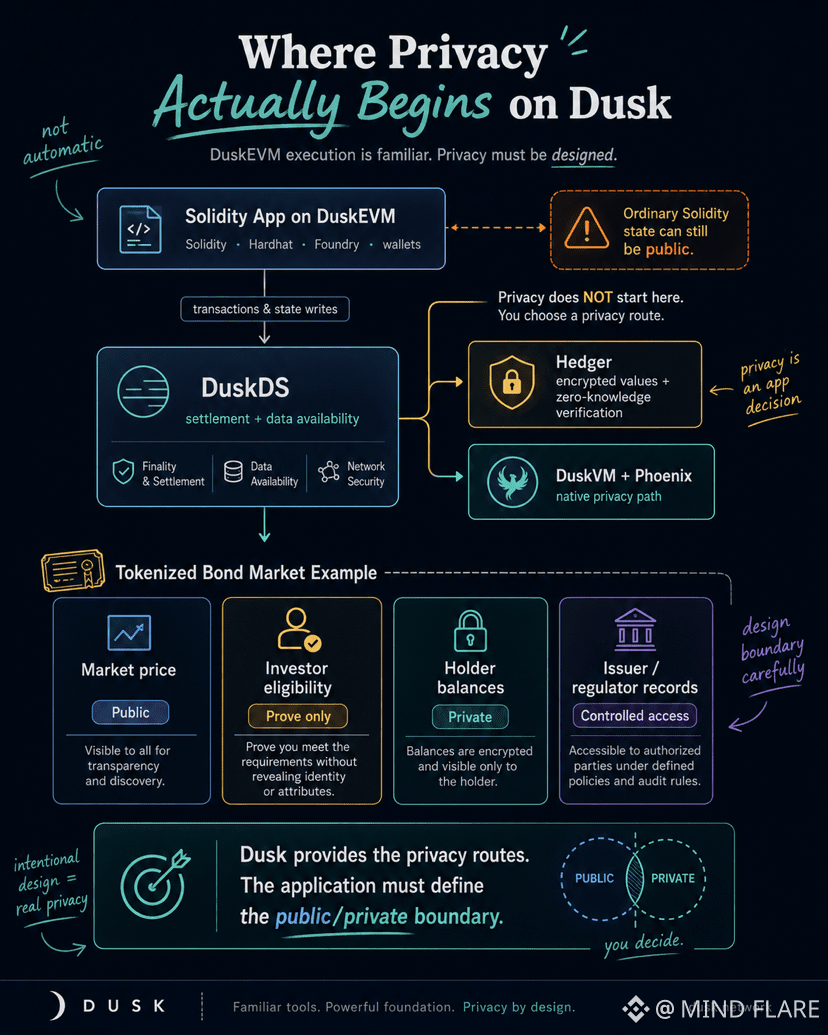
Ich habe versucht nachzuverfolgen, wo Privatsphäre tatsächlich in einer Solidity-Anwendung beginnt – bei @Dusk_Foundation .
Ich ging davon aus, dass ein auf DuskEVM bereitgestellter Vertrag gewissermaßen die Privatsphäre von Dusk erbt, weil seine Daten und die Abwicklung irgendwann über DuskDS laufen.
So funktioniert der Stack jedoch nicht.
DuskEVM bietet Entwicklern eine vertraute EVM-Ausführung. Sie können Solidity, Hardhat, Foundry und bestehende Wallets nutzen. Unterhalb davon sitzt DuskDS als Abwicklungs- und Data-Availability-Basis.
Aber ein normaler Solidity-Vertrag kann seinen Zustand weiterhin wie jede andere EVM-Anwendung veröffentlichen.
Vertraulichkeit muss über Hedger in die Anwendung hineingedacht werden – oder näher an Dusk’ native Privatsphäre-Pfad über DuskVM und Phoenix ausgelagert werden. Sie wird nicht automatisch hinzugefügt, nur weil der Vertrag im Dusk-Ökosystem läuft.
Diese Grenze hat mich zum Innehalten gebracht.
Stell dir einen tokenisierten Anleihemarkt vor.
Der Marktpreis muss möglicherweise öffentlich bleiben.
Die Eignung der Anleger muss nur nachgewiesen werden.
Die Kontostände der Inhaber sollten wahrscheinlich privat bleiben.
Der Emittent oder der Regulator könnte einen kontrollierten Zugriff auf bestimmte Datensätze verlangen.
Diese vier Bausteine lassen sich nicht einfach in denselben öffentlichen Solidity-Status einbetten.
Hedger soll einen Teil davon lösen, indem Werte verschlüsselt bleiben, während Zero-Knowledge-Proofs verifizieren, dass die Transaktion die Regeln eingehalten hat. Aber der Entwickler muss dennoch festlegen, was in den verschlüsselten Ablauf fließt, was öffentlich bleibt und wer Offenlegungsrechte erhält.
Eine einzige schlechte Design-Entscheidung könnte sensible Finanzdaten freilegen, bevor überhaupt Kryptografie eine Chance hat, sie zu schützen.
Daher liegt mein Fokus weniger darauf, wie viele kryptografische Primitive Dusk unterstützt.
Ich beobachte, ob seine Tools die öffentliche/private Grenze klar genug machen, damit normale Solidity-Teams sie korrekt verwenden können.
Dusk kann die Privatsphäre-Routen bereitstellen. Diese Architekturentscheidung kann es jedoch nicht für jede Anwendung übernehmen.
#dusk $DUSK
{spot}(DUSKUSDT)
Ich habe versucht nachzuverfolgen, wo Privatsphäre tatsächlich in einer Solidity-Anwendung beginnt – bei @Dusk .
Ich ging davon aus, dass ein auf DuskEVM bereitgestellter Vertrag gewissermaßen die Privatsphäre von Dusk erbt, weil seine Daten und die Abwicklung irgendwann über DuskDS laufen.
So funktioniert der Stack jedoch nicht.
DuskEVM bietet Entwicklern eine vertraute EVM-Ausführung. Sie können Solidity, Hardhat, Foundry und bestehende Wallets nutzen. Unterhalb davon sitzt DuskDS als Abwicklungs- und Data-Availability-Basis.
Aber ein normaler Solidity-Vertrag kann seinen Zustand weiterhin wie jede andere EVM-Anwendung veröffentlichen.
Vertraulichkeit muss über Hedger in die Anwendung hineingedacht werden – oder näher an Dusk’ native Privatsphäre-Pfad über DuskVM und Phoenix ausgelagert werden. Sie wird nicht automatisch hinzugefügt, nur weil der Vertrag im Dusk-Ökosystem läuft.
Diese Grenze hat mich zum Innehalten gebracht.
Stell dir einen tokenisierten Anleihemarkt vor.
Der Marktpreis muss möglicherweise öffentlich bleiben.
Die Eignung der Anleger muss nur nachgewiesen werden.
Die Kontostände der Inhaber sollten wahrscheinlich privat bleiben.
Der Emittent oder der Regulator könnte einen kontrollierten Zugriff auf bestimmte Datensätze verlangen.
Diese vier Bausteine lassen sich nicht einfach in denselben öffentlichen Solidity-Status einbetten.
Hedger soll einen Teil davon lösen, indem Werte verschlüsselt bleiben, während Zero-Knowledge-Proofs verifizieren, dass die Transaktion die Regeln eingehalten hat. Aber der Entwickler muss dennoch festlegen, was in den verschlüsselten Ablauf fließt, was öffentlich bleibt und wer Offenlegungsrechte erhält.
Eine einzige schlechte Design-Entscheidung könnte sensible Finanzdaten freilegen, bevor überhaupt Kryptografie eine Chance hat, sie zu schützen.
Daher liegt mein Fokus weniger darauf, wie viele kryptografische Primitive Dusk unterstützt.
Ich beobachte, ob seine Tools die öffentliche/private Grenze klar genug machen, damit normale Solidity-Teams sie korrekt verwenden können.
Dusk kann die Privatsphäre-Routen bereitstellen. Diese Architekturentscheidung kann es jedoch nicht für jede Anwendung übernehmen.
#dusk $DUSK
Ich ging davon aus, dass ein auf DuskEVM bereitgestellter Vertrag gewissermaßen die Privatsphäre von Dusk erbt, weil seine Daten und die Abwicklung irgendwann über DuskDS laufen.
So funktioniert der Stack jedoch nicht.
DuskEVM bietet Entwicklern eine vertraute EVM-Ausführung. Sie können Solidity, Hardhat, Foundry und bestehende Wallets nutzen. Unterhalb davon sitzt DuskDS als Abwicklungs- und Data-Availability-Basis.
Aber ein normaler Solidity-Vertrag kann seinen Zustand weiterhin wie jede andere EVM-Anwendung veröffentlichen.
Vertraulichkeit muss über Hedger in die Anwendung hineingedacht werden – oder näher an Dusk’ native Privatsphäre-Pfad über DuskVM und Phoenix ausgelagert werden. Sie wird nicht automatisch hinzugefügt, nur weil der Vertrag im Dusk-Ökosystem läuft.
Diese Grenze hat mich zum Innehalten gebracht.
Stell dir einen tokenisierten Anleihemarkt vor.
Der Marktpreis muss möglicherweise öffentlich bleiben.
Die Eignung der Anleger muss nur nachgewiesen werden.
Die Kontostände der Inhaber sollten wahrscheinlich privat bleiben.
Der Emittent oder der Regulator könnte einen kontrollierten Zugriff auf bestimmte Datensätze verlangen.
Diese vier Bausteine lassen sich nicht einfach in denselben öffentlichen Solidity-Status einbetten.
Hedger soll einen Teil davon lösen, indem Werte verschlüsselt bleiben, während Zero-Knowledge-Proofs verifizieren, dass die Transaktion die Regeln eingehalten hat. Aber der Entwickler muss dennoch festlegen, was in den verschlüsselten Ablauf fließt, was öffentlich bleibt und wer Offenlegungsrechte erhält.
Eine einzige schlechte Design-Entscheidung könnte sensible Finanzdaten freilegen, bevor überhaupt Kryptografie eine Chance hat, sie zu schützen.
Daher liegt mein Fokus weniger darauf, wie viele kryptografische Primitive Dusk unterstützt.
Ich beobachte, ob seine Tools die öffentliche/private Grenze klar genug machen, damit normale Solidity-Teams sie korrekt verwenden können.
Dusk kann die Privatsphäre-Routen bereitstellen. Diese Architekturentscheidung kann es jedoch nicht für jede Anwendung übernehmen.
#dusk $DUSK
1
393
·
--
Bullisch
$ONG abgelehnt 0.0930 und ist nun unter den MA7 bei 0.0869 gerutscht. Das macht den Bereich 0.0869–0.0898 zur ersten Rückeroberungszone. Wenn 0.0835–0.0817 hält, während das Volumen zurückgeht, kann das zu einem gesunden Reset werden, bevor ein weiterer Versuch bei 0.0930 startet. Verliert man diese Zone, wird 0.0796–0.0789 zum stärkeren Support.
$PROM hatte bei 4.991 eine deutlich schärfere Angebotsreaktion, wobei die Zurückweisung auf hohem Volumen ankam. Der Unterschied ist: Der Preis hält sich weiterhin über seinem steigenden MA7 nahe 4.27. Solange 4.15–4.27 überlebt, ist der Trend nicht gebrochen und 4.60 → 4.99 kann wieder ins Spiel kommen. Ein klarer Verlust von 4.15 würde MA25 um 3.88 freilegen.
Mein Eindruck: ONG braucht eine Rückeroberung; PROM braucht Unterstützung, um zu überleben. Keines davon ist hier ein sauberer Chase.
{spot}(ONGUSDT)
{spot}(PROMUSDT)
#ONG #PROM
Was wird zuerst geklärt?
$ONG abgelehnt 0.0930 und ist nun unter den MA7 bei 0.0869 gerutscht. Das macht den Bereich 0.0869–0.0898 zur ersten Rückeroberungszone. Wenn 0.0835–0.0817 hält, während das Volumen zurückgeht, kann das zu einem gesunden Reset werden, bevor ein weiterer Versuch bei 0.0930 startet. Verliert man diese Zone, wird 0.0796–0.0789 zum stärkeren Support.
$PROM hatte bei 4.991 eine deutlich schärfere Angebotsreaktion, wobei die Zurückweisung auf hohem Volumen ankam. Der Unterschied ist: Der Preis hält sich weiterhin über seinem steigenden MA7 nahe 4.27. Solange 4.15–4.27 überlebt, ist der Trend nicht gebrochen und 4.60 → 4.99 kann wieder ins Spiel kommen. Ein klarer Verlust von 4.15 würde MA25 um 3.88 freilegen.
Mein Eindruck: ONG braucht eine Rückeroberung; PROM braucht Unterstützung, um zu überleben. Keines davon ist hier ein sauberer Chase.
#ONG #PROM
Was wird zuerst geklärt?
$PROM hatte bei 4.991 eine deutlich schärfere Angebotsreaktion, wobei die Zurückweisung auf hohem Volumen ankam. Der Unterschied ist: Der Preis hält sich weiterhin über seinem steigenden MA7 nahe 4.27. Solange 4.15–4.27 überlebt, ist der Trend nicht gebrochen und 4.60 → 4.99 kann wieder ins Spiel kommen. Ein klarer Verlust von 4.15 würde MA25 um 3.88 freilegen.
Mein Eindruck: ONG braucht eine Rückeroberung; PROM braucht Unterstützung, um zu überleben. Keines davon ist hier ein sauberer Chase.
#ONG #PROM
Was wird zuerst geklärt?
$ONG reclaims
52%
$PROM holds
43%
Both retrace
0%
Wait for support
5%
21 Stimmen • Abstimmung beendet
7
1
63
139.7k
·
--
Verifiziert
Ich habe immer wieder eine selektive Offenlegung über @Dusk_Foundation material gesehen, also habe ich nach dem tatsächlichen Punkt gesucht, an dem das Protokoll entscheidet, wer was sehen darf.
Die Dokus führten mich durch drei verschiedene Komponenten.
Moonlight verarbeitet öffentliche Kontenaktivitäten.
Phoenix verarbeitet verschleierte Übertragungen.
Citadel ermöglicht es einem Nutzer, ein Attribut wie Wohnsitz oder Investor-Status nachzuweisen, ohne den Rest seiner Identität preiszugeben.
Bisher klar.
Dann bin ich zur Seite „Assets & Regulations“ gegangen und habe eine Detailstelle gefunden, die mich innehalten ließ.
Dusk beschreibt selektive Offenlegung als Muster, sagt aber, dass das genaue Zugriffssteuerungsdesign von den rechtlichen und produktbezogenen Anforderungen des jeweiligen Assets abhängt.
Das bedeutet: Dusk stellt die Privacy- und Identitäts-Tools bereit, scheint aber keine universelle Offenlegungsrichtlinie für jede Anwendung vorzuschreiben.
Der Emittent, der Handelsplatz oder die Anwendung muss weiterhin entscheiden, welches Credential akzeptiert wird, welche Übertragung fehlschlagen sollte und welche Partei bestimmte Informationen erhalten darf.
Das hat meine Sicht auf die Privacy-Aussage verändert.
Die Blockchain kann eine Position vor der Öffentlichkeit verbergen und nachweisen, dass der Inhaber berechtigt ist. Aber der schwierige Teil ist nicht verschwunden. Er hat sich in die Regeln rund um das Asset verlagert.
Beispielsweise kann ein Emittent einer tokenisierten Anleihe Eigentumsdaten für das Servicing benötigen. Ein Handelsplatz braucht eventuell nur den Nachweis, dass ein Käufer berechtigt ist. Ein Regulator benötigt möglicherweise Transaktionsaufzeichnungen für eine definierte Untersuchung.
Diese drei Parteien sollten nicht automatisch dieselbe Sicht erhalten.
Dusk’s Architektur kann diese Trennung unterstützen. Aber die Qualität des endgültigen Systems hängt davon ab, wie sorgfältig jede Anwendung diese Berechtigungen definiert und wer sie später ändern kann.
Das ist der Teil, den ich prüfen würde, bevor ich mich auf die ZK-Sprache konzentriere.
Nicht nur, ob die Daten privat sind, sondern wer die Offenlegungsrichtlinie für die ersten Live-Assets auf Dusk schreibt und ob Investoren diese Regeln sehen können, bevor sie in den Markt eintreten.
#dusk $DUSK
{spot}(DUSKUSDT)
Was ist in Dusk’s Offenlegungsrichtlinie am wichtigsten?
Ich habe immer wieder eine selektive Offenlegung über @Dusk material gesehen, also habe ich nach dem tatsächlichen Punkt gesucht, an dem das Protokoll entscheidet, wer was sehen darf.
Die Dokus führten mich durch drei verschiedene Komponenten.
Moonlight verarbeitet öffentliche Kontenaktivitäten.
Phoenix verarbeitet verschleierte Übertragungen.
Citadel ermöglicht es einem Nutzer, ein Attribut wie Wohnsitz oder Investor-Status nachzuweisen, ohne den Rest seiner Identität preiszugeben.
Bisher klar.
Dann bin ich zur Seite „Assets & Regulations“ gegangen und habe eine Detailstelle gefunden, die mich innehalten ließ.
Dusk beschreibt selektive Offenlegung als Muster, sagt aber, dass das genaue Zugriffssteuerungsdesign von den rechtlichen und produktbezogenen Anforderungen des jeweiligen Assets abhängt.
Das bedeutet: Dusk stellt die Privacy- und Identitäts-Tools bereit, scheint aber keine universelle Offenlegungsrichtlinie für jede Anwendung vorzuschreiben.
Der Emittent, der Handelsplatz oder die Anwendung muss weiterhin entscheiden, welches Credential akzeptiert wird, welche Übertragung fehlschlagen sollte und welche Partei bestimmte Informationen erhalten darf.
Das hat meine Sicht auf die Privacy-Aussage verändert.
Die Blockchain kann eine Position vor der Öffentlichkeit verbergen und nachweisen, dass der Inhaber berechtigt ist. Aber der schwierige Teil ist nicht verschwunden. Er hat sich in die Regeln rund um das Asset verlagert.
Beispielsweise kann ein Emittent einer tokenisierten Anleihe Eigentumsdaten für das Servicing benötigen. Ein Handelsplatz braucht eventuell nur den Nachweis, dass ein Käufer berechtigt ist. Ein Regulator benötigt möglicherweise Transaktionsaufzeichnungen für eine definierte Untersuchung.
Diese drei Parteien sollten nicht automatisch dieselbe Sicht erhalten.
Dusk’s Architektur kann diese Trennung unterstützen. Aber die Qualität des endgültigen Systems hängt davon ab, wie sorgfältig jede Anwendung diese Berechtigungen definiert und wer sie später ändern kann.
Das ist der Teil, den ich prüfen würde, bevor ich mich auf die ZK-Sprache konzentriere.
Nicht nur, ob die Daten privat sind, sondern wer die Offenlegungsrichtlinie für die ersten Live-Assets auf Dusk schreibt und ob Investoren diese Regeln sehen können, bevor sie in den Markt eintreten.
#dusk $DUSK
Was ist in Dusk’s Offenlegungsrichtlinie am wichtigsten?
Die Dokus führten mich durch drei verschiedene Komponenten.
Moonlight verarbeitet öffentliche Kontenaktivitäten.
Phoenix verarbeitet verschleierte Übertragungen.
Citadel ermöglicht es einem Nutzer, ein Attribut wie Wohnsitz oder Investor-Status nachzuweisen, ohne den Rest seiner Identität preiszugeben.
Bisher klar.
Dann bin ich zur Seite „Assets & Regulations“ gegangen und habe eine Detailstelle gefunden, die mich innehalten ließ.
Dusk beschreibt selektive Offenlegung als Muster, sagt aber, dass das genaue Zugriffssteuerungsdesign von den rechtlichen und produktbezogenen Anforderungen des jeweiligen Assets abhängt.
Das bedeutet: Dusk stellt die Privacy- und Identitäts-Tools bereit, scheint aber keine universelle Offenlegungsrichtlinie für jede Anwendung vorzuschreiben.
Der Emittent, der Handelsplatz oder die Anwendung muss weiterhin entscheiden, welches Credential akzeptiert wird, welche Übertragung fehlschlagen sollte und welche Partei bestimmte Informationen erhalten darf.
Das hat meine Sicht auf die Privacy-Aussage verändert.
Die Blockchain kann eine Position vor der Öffentlichkeit verbergen und nachweisen, dass der Inhaber berechtigt ist. Aber der schwierige Teil ist nicht verschwunden. Er hat sich in die Regeln rund um das Asset verlagert.
Beispielsweise kann ein Emittent einer tokenisierten Anleihe Eigentumsdaten für das Servicing benötigen. Ein Handelsplatz braucht eventuell nur den Nachweis, dass ein Käufer berechtigt ist. Ein Regulator benötigt möglicherweise Transaktionsaufzeichnungen für eine definierte Untersuchung.
Diese drei Parteien sollten nicht automatisch dieselbe Sicht erhalten.
Dusk’s Architektur kann diese Trennung unterstützen. Aber die Qualität des endgültigen Systems hängt davon ab, wie sorgfältig jede Anwendung diese Berechtigungen definiert und wer sie später ändern kann.
Das ist der Teil, den ich prüfen würde, bevor ich mich auf die ZK-Sprache konzentriere.
Nicht nur, ob die Daten privat sind, sondern wer die Offenlegungsrichtlinie für die ersten Live-Assets auf Dusk schreibt und ob Investoren diese Regeln sehen können, bevor sie in den Markt eintreten.
#dusk $DUSK
Was ist in Dusk’s Offenlegungsrichtlinie am wichtigsten?
Clear access rules
0%
Public permissions
67%
Change controls
33%
Investor consent
0%
3 Stimmen • Abstimmung beendet
5
689
·
--
Bullisch
Ich habe früher mehr Assets und Nutzer unter @Dusk_Foundation als unkompliziertes bullisches Argument für $DUSK gelesen.
Der neueste Ökosystem-Plan hat mich veranlasst, zwei sehr unterschiedliche Wertschleifen zu trennen.
Die erste ist dem Netzwerk selbst zu eigen. Wenn mehr Anwendungen Transaktionen über Dusk abwickeln, wird mehr Dusk für Gebühren verwendet und mehr wirtschaftliche Aktivität erreicht Validatoren und Staker.
Die zweite Schleife ist weniger automatisch.
Dusk Trade und die geplante ECSP-Operation könnten Produktumsatz generieren, indem sie europäische Unternehmen mit Investoren verbinden und regulierte Angebote verteilen. Aber der Umsatz, den ein Produkt erzielt, wird nicht automatisch zur Nachfrage nach seinem Netzwerk-Token.
Dusk scheint diese Lücke zu erkennen. Das Team untersucht mehrere Wege, um Produkteinnahmen zurück mit DUSK zu verbinden: Ausschüttungen an Staker, Rückkäufe und Burns oder eine gemeinschaftlich per Governance gesteuerte Allokation.
Diese Unterscheidung ist für mich entscheidend.
Entdecken ist nicht dasselbe wie ein festes Mechanismus-Design. Ein Rückkauf erzeugt eine andere Wirkung als eine Staker-Ausschüttung, während eine Verteilung, die der Governance überlassen wird, eine ganz zusätzliche Entscheidungsebene einführt.
Das Spannende ist, dass Dusk möglicherweise beide Seiten der Schleife steuern kann: die Produkte, die die Aktivität auslösen, und die Infrastruktur, in der diese Aktivität abgewickelt wird. Wenn ein KMU-Angebot über den ECSP-Weg beginnt, Investoren über Dusk Trade erreicht und anschließend Onchain-Transfers auslöst oder Service-Events bereitstellt, kann sich der Wert potenziell über dasselbe Ökosystem mehr als einmal bewegen.
Aber dieses Ergebnis muss gemessen werden, nicht angenommen.
Ich würde beobachten, wie viele Angebote tatsächlich die Plattform erreichen, wie viel Kapital sie einsammeln, wie viel nachfolgende Aktivität auf Dusk abgewickelt wird und welcher Anteil der Produkteinnahmen, falls überhaupt, formell mit DUSK verbunden ist.
Die überzeugendste Token-Utility-Geschichte wäre nicht, dass das Ökosystem gewachsen ist.
Sie wäre zu zeigen, wie genau dieses Wachstum beim Token ankommt.
#dusk
{spot}(DUSKUSDT)
Welcher Mechanismus würde das Wachstum des Dusk-Ökosystems mit $DUSK am effektivsten verbinden?
Ich habe früher mehr Assets und Nutzer unter @Dusk als unkompliziertes bullisches Argument für $DUSK gelesen.
Der neueste Ökosystem-Plan hat mich veranlasst, zwei sehr unterschiedliche Wertschleifen zu trennen.
Die erste ist dem Netzwerk selbst zu eigen. Wenn mehr Anwendungen Transaktionen über Dusk abwickeln, wird mehr Dusk für Gebühren verwendet und mehr wirtschaftliche Aktivität erreicht Validatoren und Staker.
Die zweite Schleife ist weniger automatisch.
Dusk Trade und die geplante ECSP-Operation könnten Produktumsatz generieren, indem sie europäische Unternehmen mit Investoren verbinden und regulierte Angebote verteilen. Aber der Umsatz, den ein Produkt erzielt, wird nicht automatisch zur Nachfrage nach seinem Netzwerk-Token.
Dusk scheint diese Lücke zu erkennen. Das Team untersucht mehrere Wege, um Produkteinnahmen zurück mit DUSK zu verbinden: Ausschüttungen an Staker, Rückkäufe und Burns oder eine gemeinschaftlich per Governance gesteuerte Allokation.
Diese Unterscheidung ist für mich entscheidend.
Entdecken ist nicht dasselbe wie ein festes Mechanismus-Design. Ein Rückkauf erzeugt eine andere Wirkung als eine Staker-Ausschüttung, während eine Verteilung, die der Governance überlassen wird, eine ganz zusätzliche Entscheidungsebene einführt.
Das Spannende ist, dass Dusk möglicherweise beide Seiten der Schleife steuern kann: die Produkte, die die Aktivität auslösen, und die Infrastruktur, in der diese Aktivität abgewickelt wird. Wenn ein KMU-Angebot über den ECSP-Weg beginnt, Investoren über Dusk Trade erreicht und anschließend Onchain-Transfers auslöst oder Service-Events bereitstellt, kann sich der Wert potenziell über dasselbe Ökosystem mehr als einmal bewegen.
Aber dieses Ergebnis muss gemessen werden, nicht angenommen.
Ich würde beobachten, wie viele Angebote tatsächlich die Plattform erreichen, wie viel Kapital sie einsammeln, wie viel nachfolgende Aktivität auf Dusk abgewickelt wird und welcher Anteil der Produkteinnahmen, falls überhaupt, formell mit DUSK verbunden ist.
Die überzeugendste Token-Utility-Geschichte wäre nicht, dass das Ökosystem gewachsen ist.
Sie wäre zu zeigen, wie genau dieses Wachstum beim Token ankommt.
#dusk
Welcher Mechanismus würde das Wachstum des Dusk-Ökosystems mit $DUSK am effektivsten verbinden?
Der neueste Ökosystem-Plan hat mich veranlasst, zwei sehr unterschiedliche Wertschleifen zu trennen.
Die erste ist dem Netzwerk selbst zu eigen. Wenn mehr Anwendungen Transaktionen über Dusk abwickeln, wird mehr Dusk für Gebühren verwendet und mehr wirtschaftliche Aktivität erreicht Validatoren und Staker.
Die zweite Schleife ist weniger automatisch.
Dusk Trade und die geplante ECSP-Operation könnten Produktumsatz generieren, indem sie europäische Unternehmen mit Investoren verbinden und regulierte Angebote verteilen. Aber der Umsatz, den ein Produkt erzielt, wird nicht automatisch zur Nachfrage nach seinem Netzwerk-Token.
Dusk scheint diese Lücke zu erkennen. Das Team untersucht mehrere Wege, um Produkteinnahmen zurück mit DUSK zu verbinden: Ausschüttungen an Staker, Rückkäufe und Burns oder eine gemeinschaftlich per Governance gesteuerte Allokation.
Diese Unterscheidung ist für mich entscheidend.
Entdecken ist nicht dasselbe wie ein festes Mechanismus-Design. Ein Rückkauf erzeugt eine andere Wirkung als eine Staker-Ausschüttung, während eine Verteilung, die der Governance überlassen wird, eine ganz zusätzliche Entscheidungsebene einführt.
Das Spannende ist, dass Dusk möglicherweise beide Seiten der Schleife steuern kann: die Produkte, die die Aktivität auslösen, und die Infrastruktur, in der diese Aktivität abgewickelt wird. Wenn ein KMU-Angebot über den ECSP-Weg beginnt, Investoren über Dusk Trade erreicht und anschließend Onchain-Transfers auslöst oder Service-Events bereitstellt, kann sich der Wert potenziell über dasselbe Ökosystem mehr als einmal bewegen.
Aber dieses Ergebnis muss gemessen werden, nicht angenommen.
Ich würde beobachten, wie viele Angebote tatsächlich die Plattform erreichen, wie viel Kapital sie einsammeln, wie viel nachfolgende Aktivität auf Dusk abgewickelt wird und welcher Anteil der Produkteinnahmen, falls überhaupt, formell mit DUSK verbunden ist.
Die überzeugendste Token-Utility-Geschichte wäre nicht, dass das Ökosystem gewachsen ist.
Sie wäre zu zeigen, wie genau dieses Wachstum beim Token ankommt.
#dusk
Welcher Mechanismus würde das Wachstum des Dusk-Ökosystems mit $DUSK am effektivsten verbinden?
🔘 Buybacks and burns
67%
🔘 Revenue for stakers
0%
🔘 Community allocation
33%
🔘 A hybrid model
0%
3 Stimmen • Abstimmung beendet
1
4
960
·
--
@Dusk_Foundation sollte mehr Ökosystem-Aktivität bedeuten, dass für Netzwerkgebühren mehr DUSK verwendet wird.
Technisch gesehen ja.
DUSK wird für Abrechnung und Staking auf DuskDS verwendet, während DuskEVM und DuskVM es ebenfalls für die Ausführung nutzen.
Dann habe ich mir diesen Ablauf als normaler Dusk-Trade-Kunde angesehen.
Jemand, der in eine europäische KMU-Anleihe investiert, möchte wahrscheinlich keinen separaten Gastoken kaufen, ihn überbrücken und Gebühren berechnen, bevor er sich anmeldet.
Ein reibungsloseres Produktdesign würde die meiste davon verbergen.
Dusk Trade könnte Gebühren sponsern, Transaktionen bündeln oder DUSK hinter der Oberfläche handhaben, sodass der Investor lediglich Euro und den zu kaufenden Vermögenswert sieht.
Das würde weiterhin eine DUSK-Nutzung darunter erzeugen.
Aber es verändert, wer die Nachfrage erzeugt.
Anstatt dass jeder neue Investor DUSK persönlich kauft, könnte die Anwendung oder der Abrechnungsbetreiber das Gas-Inventar für Tausende von Nutzern kaufen und verwalten.
Das macht ein reines Wachstum der Nutzer zu einer schwachen Abkürzung, um die Token-Nachfrage abzuschätzen.
Zehntausend Investoren, deren Handlungen in eine kleine Zahl von Abrechnungen gebündelt sind, könnten weniger Gas verbrauchen als eine einzige aktive Finanzanwendung, die ständig Vermögenswerte zwischen Verträgen verschiebt.
Ich sage nicht, dass der Gebührennutzen schwach ist. Ich sage, dass die Umwandlungsrate unbekannt ist.
Das hängt von der Transaktionsbündelung, gesponserten Gebühren, der Häufigkeit der Abrechnungen und davon ab, wie sich die Aktivität zwischen Dusk Trade, DuskEVM und DuskDS bewegt.
Die sinnvolle Kennzahl wäre DUSK, das pro Euro Produktvolumen verbraucht wird.
Solange diese Zahl nicht existiert, bedeutet mehr Nutzer zwar tendenziell mehr Token-Nachfrage, aber sie lässt sich unmöglich korrekt bepreisen.
#dusk $DUSK
{spot}(DUSKUSDT)
Was wird die meiste $DUSK Gebührennachfrage antreiben?
@Dusk sollte mehr Ökosystem-Aktivität bedeuten, dass für Netzwerkgebühren mehr DUSK verwendet wird.
Technisch gesehen ja.
DUSK wird für Abrechnung und Staking auf DuskDS verwendet, während DuskEVM und DuskVM es ebenfalls für die Ausführung nutzen.
Dann habe ich mir diesen Ablauf als normaler Dusk-Trade-Kunde angesehen.
Jemand, der in eine europäische KMU-Anleihe investiert, möchte wahrscheinlich keinen separaten Gastoken kaufen, ihn überbrücken und Gebühren berechnen, bevor er sich anmeldet.
Ein reibungsloseres Produktdesign würde die meiste davon verbergen.
Dusk Trade könnte Gebühren sponsern, Transaktionen bündeln oder DUSK hinter der Oberfläche handhaben, sodass der Investor lediglich Euro und den zu kaufenden Vermögenswert sieht.
Das würde weiterhin eine DUSK-Nutzung darunter erzeugen.
Aber es verändert, wer die Nachfrage erzeugt.
Anstatt dass jeder neue Investor DUSK persönlich kauft, könnte die Anwendung oder der Abrechnungsbetreiber das Gas-Inventar für Tausende von Nutzern kaufen und verwalten.
Das macht ein reines Wachstum der Nutzer zu einer schwachen Abkürzung, um die Token-Nachfrage abzuschätzen.
Zehntausend Investoren, deren Handlungen in eine kleine Zahl von Abrechnungen gebündelt sind, könnten weniger Gas verbrauchen als eine einzige aktive Finanzanwendung, die ständig Vermögenswerte zwischen Verträgen verschiebt.
Ich sage nicht, dass der Gebührennutzen schwach ist. Ich sage, dass die Umwandlungsrate unbekannt ist.
Das hängt von der Transaktionsbündelung, gesponserten Gebühren, der Häufigkeit der Abrechnungen und davon ab, wie sich die Aktivität zwischen Dusk Trade, DuskEVM und DuskDS bewegt.
Die sinnvolle Kennzahl wäre DUSK, das pro Euro Produktvolumen verbraucht wird.
Solange diese Zahl nicht existiert, bedeutet mehr Nutzer zwar tendenziell mehr Token-Nachfrage, aber sie lässt sich unmöglich korrekt bepreisen.
#dusk $DUSK
Was wird die meiste $DUSK Gebührennachfrage antreiben?
Technisch gesehen ja.
DUSK wird für Abrechnung und Staking auf DuskDS verwendet, während DuskEVM und DuskVM es ebenfalls für die Ausführung nutzen.
Dann habe ich mir diesen Ablauf als normaler Dusk-Trade-Kunde angesehen.
Jemand, der in eine europäische KMU-Anleihe investiert, möchte wahrscheinlich keinen separaten Gastoken kaufen, ihn überbrücken und Gebühren berechnen, bevor er sich anmeldet.
Ein reibungsloseres Produktdesign würde die meiste davon verbergen.
Dusk Trade könnte Gebühren sponsern, Transaktionen bündeln oder DUSK hinter der Oberfläche handhaben, sodass der Investor lediglich Euro und den zu kaufenden Vermögenswert sieht.
Das würde weiterhin eine DUSK-Nutzung darunter erzeugen.
Aber es verändert, wer die Nachfrage erzeugt.
Anstatt dass jeder neue Investor DUSK persönlich kauft, könnte die Anwendung oder der Abrechnungsbetreiber das Gas-Inventar für Tausende von Nutzern kaufen und verwalten.
Das macht ein reines Wachstum der Nutzer zu einer schwachen Abkürzung, um die Token-Nachfrage abzuschätzen.
Zehntausend Investoren, deren Handlungen in eine kleine Zahl von Abrechnungen gebündelt sind, könnten weniger Gas verbrauchen als eine einzige aktive Finanzanwendung, die ständig Vermögenswerte zwischen Verträgen verschiebt.
Ich sage nicht, dass der Gebührennutzen schwach ist. Ich sage, dass die Umwandlungsrate unbekannt ist.
Das hängt von der Transaktionsbündelung, gesponserten Gebühren, der Häufigkeit der Abrechnungen und davon ab, wie sich die Aktivität zwischen Dusk Trade, DuskEVM und DuskDS bewegt.
Die sinnvolle Kennzahl wäre DUSK, das pro Euro Produktvolumen verbraucht wird.
Solange diese Zahl nicht existiert, bedeutet mehr Nutzer zwar tendenziell mehr Token-Nachfrage, aber sie lässt sich unmöglich korrekt bepreisen.
#dusk $DUSK
Was wird die meiste $DUSK Gebührennachfrage antreiben?
More users
50%
App activity
0%
Settlements
50%
Transaction size
0%
2 Stimmen • Abstimmung beendet
7
10
1.1k
·
--
Bullisch
$SC hat gerade eine klassische Liquiditätsausweitung gedruckt: eine riesige 1H-Kerze hat auf 0.000935 geschoben und wurde direkt danach scharf zurückgewiesen. Dadurch ist jetzt die wichtige Haltezone 0.00067–0.00062. Wenn Käufer den Pullback dort absorbieren, kann 0.000766 → 0.00086 erneut getestet werden. Wenn 0.00062 fällt, sieht der Spike eher nach Erschöpfung als nach Fortsetzung aus.
$TRUMP ist weiter in der Post-Pump-Phase. Seit der 3.68-Rückweisung macht der Kurs niedrigere Hochs und liegt nun unter MA7 bei 2.64. Bullen müssen 2.64–2.75 zurückerobern, bevor sich der Momentum-Wert verbessert. Andernfalls wären 2.45 und dann MA25 nahe 2.27 die Levels, die ich im Blick hätte.
Mein Eindruck: SC hat zwar noch Momentum, muss aber beweisen, dass der Breakout halten kann. TRUMP braucht eine Rückeroberung, bevor ich einer weiteren Aufwärtswelle vertraue.
{spot}(SCUSDT)
{spot}(TRUMPUSDT)
#SC #TRUMP
Was bestätigt zuerst?
$SC hat gerade eine klassische Liquiditätsausweitung gedruckt: eine riesige 1H-Kerze hat auf 0.000935 geschoben und wurde direkt danach scharf zurückgewiesen. Dadurch ist jetzt die wichtige Haltezone 0.00067–0.00062. Wenn Käufer den Pullback dort absorbieren, kann 0.000766 → 0.00086 erneut getestet werden. Wenn 0.00062 fällt, sieht der Spike eher nach Erschöpfung als nach Fortsetzung aus.
$TRUMP ist weiter in der Post-Pump-Phase. Seit der 3.68-Rückweisung macht der Kurs niedrigere Hochs und liegt nun unter MA7 bei 2.64. Bullen müssen 2.64–2.75 zurückerobern, bevor sich der Momentum-Wert verbessert. Andernfalls wären 2.45 und dann MA25 nahe 2.27 die Levels, die ich im Blick hätte.
Mein Eindruck: SC hat zwar noch Momentum, muss aber beweisen, dass der Breakout halten kann. TRUMP braucht eine Rückeroberung, bevor ich einer weiteren Aufwärtswelle vertraue.
#SC #TRUMP
Was bestätigt zuerst?
$TRUMP ist weiter in der Post-Pump-Phase. Seit der 3.68-Rückweisung macht der Kurs niedrigere Hochs und liegt nun unter MA7 bei 2.64. Bullen müssen 2.64–2.75 zurückerobern, bevor sich der Momentum-Wert verbessert. Andernfalls wären 2.45 und dann MA25 nahe 2.27 die Levels, die ich im Blick hätte.
Mein Eindruck: SC hat zwar noch Momentum, muss aber beweisen, dass der Breakout halten kann. TRUMP braucht eine Rückeroberung, bevor ich einer weiteren Aufwärtswelle vertraue.
#SC #TRUMP
Was bestätigt zuerst?
$SC holds support
53%
$TRUMP reclaims
42%
Both retrace
0%
Wait for setup
5%
19 Stimmen • Abstimmung beendet
3
8k
·
--
Ich habe @termmax Allokationsoptionen durchgegangen, und die größte Zahl war nicht der Staking-Bonus.
Es waren die 70%, auf die ein Nutzer dauerhaft verzichten kann.
Wenn eine Allokation oberhalb der Vesting-Schwelle liegt, besteht eine Option darin, 30% sofort zu beanspruchen und alles andere aufzugeben.
Die Alternative bietet jetzt 15%, während die verbleibenden 85% über drei oder sechs Monate verfallen, mit einer zusätzlichen Staking-Option.
Das macht diese Seite weniger zu einer normalen Claim-Seite und eher zu einer Liquiditätsentscheidung.
Der größere Bonus mag attraktiv aussehen, aber er entschädigt Nutzer dafür, dass sie Zeit- und Preisrisiken eingehen. Ein Token, der erst Monate später freigeschaltet wird, könnte mehr wert sein oder deutlich weniger als zur Zeit des TGE.
Der 30%-Weg bietet mehr sofortige Liquidität, aber die geopferten 70% können nie zurückgeholt werden.
Daher würde ich diese Wege nicht allein anhand von Bonus-Prozentsätzen vergleichen.
Ich würde die garantierte, jetzt verfügbare Liquiditäts-Allokation mit der Menge vergleichen, die gesperrt wird, dem Entsperrplan und der Frage, wie viel Exposition ich nach dem TGE tatsächlich haben möchte.
$TMX zwingt Nutzer zur Wahl zwischen Sicherheit heute und größerer langfristiger Exposition.
Keiner der beiden Wege ist automatisch besser. Der teure Fehler wäre, einen auszuwählen, ohne auszurechnen, was dauerhaft aufgegeben wird.
#TermMax
Ich habe @TermMax Allokationsoptionen durchgegangen, und die größte Zahl war nicht der Staking-Bonus.
Es waren die 70%, auf die ein Nutzer dauerhaft verzichten kann.
Wenn eine Allokation oberhalb der Vesting-Schwelle liegt, besteht eine Option darin, 30% sofort zu beanspruchen und alles andere aufzugeben.
Die Alternative bietet jetzt 15%, während die verbleibenden 85% über drei oder sechs Monate verfallen, mit einer zusätzlichen Staking-Option.
Das macht diese Seite weniger zu einer normalen Claim-Seite und eher zu einer Liquiditätsentscheidung.
Der größere Bonus mag attraktiv aussehen, aber er entschädigt Nutzer dafür, dass sie Zeit- und Preisrisiken eingehen. Ein Token, der erst Monate später freigeschaltet wird, könnte mehr wert sein oder deutlich weniger als zur Zeit des TGE.
Der 30%-Weg bietet mehr sofortige Liquidität, aber die geopferten 70% können nie zurückgeholt werden.
Daher würde ich diese Wege nicht allein anhand von Bonus-Prozentsätzen vergleichen.
Ich würde die garantierte, jetzt verfügbare Liquiditäts-Allokation mit der Menge vergleichen, die gesperrt wird, dem Entsperrplan und der Frage, wie viel Exposition ich nach dem TGE tatsächlich haben möchte.
$TMX zwingt Nutzer zur Wahl zwischen Sicherheit heute und größerer langfristiger Exposition.
Keiner der beiden Wege ist automatisch besser. Der teure Fehler wäre, einen auszuwählen, ohne auszurechnen, was dauerhaft aufgegeben wird.
#TermMax
Es waren die 70%, auf die ein Nutzer dauerhaft verzichten kann.
Wenn eine Allokation oberhalb der Vesting-Schwelle liegt, besteht eine Option darin, 30% sofort zu beanspruchen und alles andere aufzugeben.
Die Alternative bietet jetzt 15%, während die verbleibenden 85% über drei oder sechs Monate verfallen, mit einer zusätzlichen Staking-Option.
Das macht diese Seite weniger zu einer normalen Claim-Seite und eher zu einer Liquiditätsentscheidung.
Der größere Bonus mag attraktiv aussehen, aber er entschädigt Nutzer dafür, dass sie Zeit- und Preisrisiken eingehen. Ein Token, der erst Monate später freigeschaltet wird, könnte mehr wert sein oder deutlich weniger als zur Zeit des TGE.
Der 30%-Weg bietet mehr sofortige Liquidität, aber die geopferten 70% können nie zurückgeholt werden.
Daher würde ich diese Wege nicht allein anhand von Bonus-Prozentsätzen vergleichen.
Ich würde die garantierte, jetzt verfügbare Liquiditäts-Allokation mit der Menge vergleichen, die gesperrt wird, dem Entsperrplan und der Frage, wie viel Exposition ich nach dem TGE tatsächlich haben möchte.
$TMX zwingt Nutzer zur Wahl zwischen Sicherheit heute und größerer langfristiger Exposition.
Keiner der beiden Wege ist automatisch besser. Der teure Fehler wäre, einen auszuwählen, ohne auszurechnen, was dauerhaft aufgegeben wird.
#TermMax
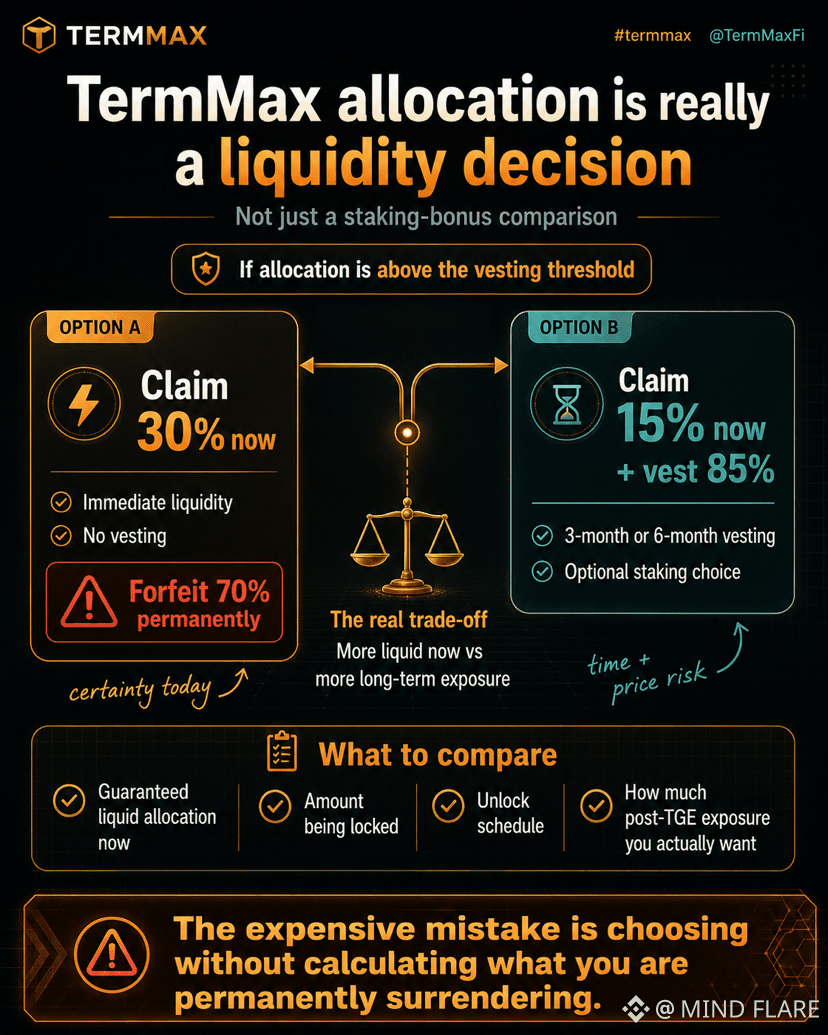
3
617
Anmelden und weiter Inhalte entdecken
Krypto-Nutzer weltweit auf Binance Square kennenlernen
⚡️ Bleib in Sachen Krypto stets am Puls.
💬 Die weltgrößte Kryptobörse vertraut darauf.
👍 Erhalte verlässliche Einblicke von verifizierten Creators.
E-Mail-Adresse/Telefonnummer
Trendthemen
CircleLaunchesInstitutionalBTCBackedBorrowing
2 Aufrufe
16 Kommentare
#CircleLaunchesInstitutionalBTCBackedBorrowing
👀
🚨 ₿ BITCOIN HAT SOEBEN EINE WEITERE INSTITUTIONELLE STORY BEKOMMEN
Circle steigt in institutionelle BTC-gestützte Kredite ein — das bedeutet, dass Institutionen potenziell Bitcoin als Sicherheit nutzen können, um Liquidität zu erhalten, ohne ihre BTC zu verkaufen. 🏦₿💰
🔥 Warum ich das beobachte: Weniger Verkaufsdruck auf BTC + mehr institutioneller Zugang zu Liquidität = eine Story, die man im Blick behalten sollte.
📊 HANDELS-RADAR:
Beobachte die Reaktion von $BTC , das Volumen und die Stimmung bezüglich institutioneller Mittelzuflüsse im Zusammenhang mit dieser Schlagzeile.
Keine blinden Einstiege.
Abwarten auf Bestätigung → Risiko managen → DYOR. ⚠️
👀 #BTC : HALTEN, LONG ODER WARTEN?
#Binance #trading #trade
Shourov Saha-01
·0 Likes
·16 Aufrufe
BitcoinHits$85K
2,791 Aufrufe
126 Kommentare
ZetaChainVotesToMigrateZETAToSolana
2 Aufrufe
12 Kommentare