
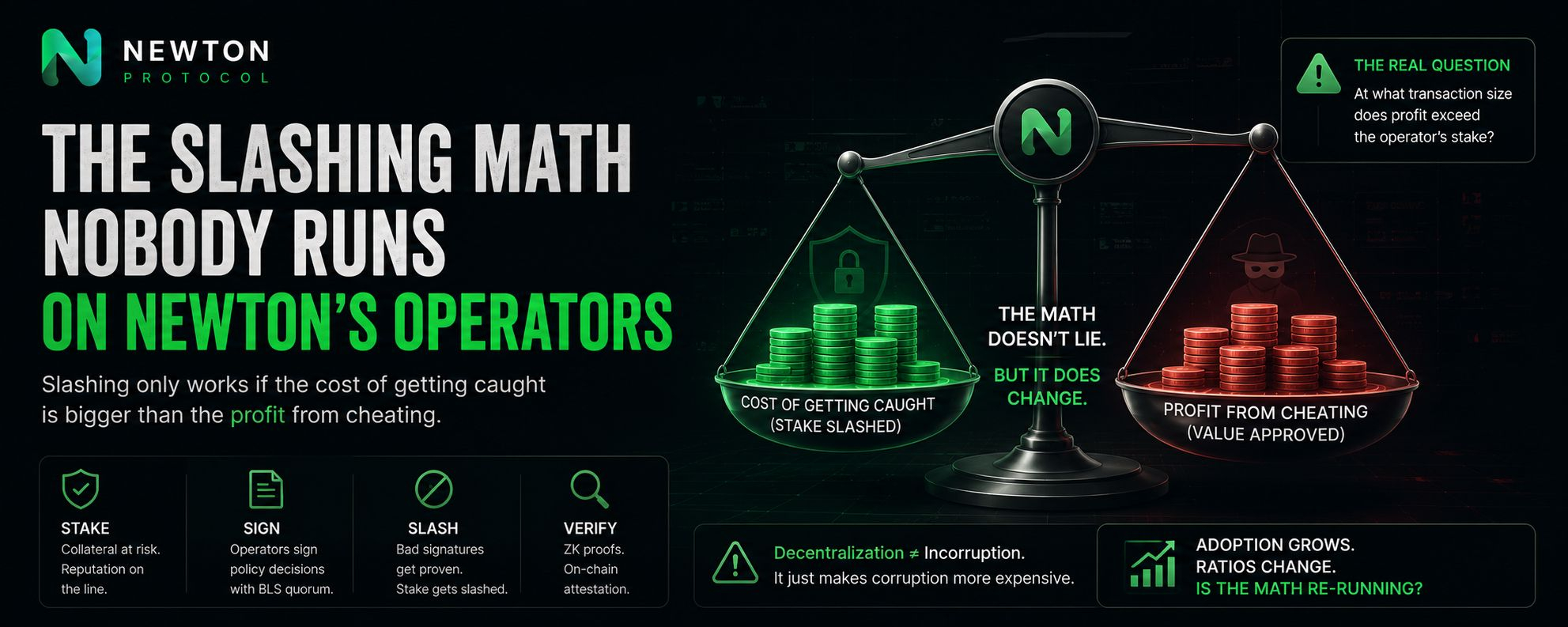

I keep coming back to a number that never gets said out loud in any Newton thread I've read: how much does it actually cost an operator to lie.
Everyone talks about the policy layer, Rego, zkPermissions, the Keystore rollup, like the interesting part is the logic. But underneath the logic is a much older, much dumber question. Newton's operators aren't trusted because they're honest. They're trusted because they've staked NEWT as collateral, and if they sign off on a bad transaction, that collateral gets slashed. Fine. Standard crypto-economic security. Except security bought with slashing only works if the cost of getting caught is bigger than the profit from cheating, and that ratio isn't fixed. It moves depending on how much value is actually flowing through the thing they're approving in that moment.
Here's what got me thinking about it. I was reading through how EigenLayer-style AVS security actually breaks down in practice, not the marketing version, the "what happens if operators collude" version. The logic is almost embarrassingly simple once you see it. If a set of operators is only securing one service, the amount they'd have to put at risk to cheat is large relative to what they'd gain, so cheating is a bad trade. But operators rarely secure just one thing. They restake the same capital across a bunch of different services at once, and once that's true, the total profit available from corrupting several of them at the same time can end up bigger than what any single one of them has locked up as collateral. The stake doesn't multiply. The opportunity does.
Newton's operators sit inside exactly that structure, an EigenLayer-secured AVS producing BLS quorum signatures over policy decisions. Which means the honest question isn't "does the quorum mechanism work," it clearly does, the proofs verify, the aggregation checks out, the architecture is sound on paper. The question is what a transaction has to be worth before the math flips, before colluding operators looking across every policy check they're currently authorizing find a moment where the payoff from waving something through quietly outweighs what they'd lose getting caught.
I don't think that's a flaw exactly. It's just the tradeoff nobody prices in when they call something "decentralized security." Decentralization here doesn't mean no one can be corrupted, it means corruption requires coordination, and coordination has a cost that's supposed to be higher than the reward. That holds beautifully at small scale. I'm just not sure anyone's shown it holds once Newton is authorizing large, high-value institutional flows through the exact same operator set that's also checking a hundred smaller things simultaneously.
What makes this feel more urgent than abstract is that Newton is explicitly pitching itself at institutions, sanctions screening, investor eligibility, position limits, the stuff where a single approved transaction could be worth far more than any one operator's stake. The protocol's own docs are honest that operators are economically incentivized, not incorruptible. That's the right framing. It's just a framing that only stays true if someone is actively watching the ratio between total value being authorized and total value locked as collateral, continuously, as adoption grows, not as a one-time audit assumption baked in at launch.
Maybe that's the actual adoption bottleneck under the adoption bottleneck. Not whether developers can write correct Rego, not whether the policy layer scales to more chains. Whether the economic security model was sized for a small mainnet beta and quietly stops being sized for whatever comes after it.
Does anyone actually recompute that ratio as Newton grows, or does everyone just assume slashing means safe and move on?