

I used to work briefly with a small music producer who complained constantly about streaming royalties. Not because the money was small, though it was. What bothered him more was something harder to name. He knew his samples were inside other tracks. He could sometimes hear them. But the system had no way of acknowledging that, and so the acknowledgment simply never came. The value moved. The connection did not.
That feeling kept coming back to me while thinking about what @OpenLedger is actually trying to build.
Most conversations about $OPEN eventually settle on familiar territory. Token mechanics. Market cap. Whether the AI narrative has legs. Those conversations are not wrong exactly, but they tend to miss something sitting quietly underneath the technical architecture. The stranger and more interesting question is not whether OpenLedger can build a better AI platform. The question is whether it can change what a receipt looks like inside an AI economy.
Let me explain what I mean by that.
AI firms have faced growing scrutiny for scraping public data without compensation , and that scrutiny has mostly been treated as a legal or reputational problem. Something to be managed, not solved. The industry response has largely been to argue about fair use, negotiate licenses quietly, and hope the regulatory pressure softens before it crystallizes into something binding.
But there is a different way to look at the situation. The real problem is not that companies used data without paying. The real problem is that the systems never had any mechanism for attribution in the first place. There was no receipt. No trail. No way for the system to remember where something came from even if it wanted to.
OpenLedger's mainnet launched in November 2025 with the explicit goal of enabling on-chain data attribution and automated payments to contributors . On the surface that sounds like a technical upgrade. Once you sit with it longer, it starts feeling like something more structural.
The part that caught my attention most was something they quietly released earlier this year. OpenLedger built and open-sourced a payments protocol called x402 in February 2026, which leverages the unused HTTP status code 402 to allow any API endpoint, dataset, or compute resource to express its price in OPEN tokens and automatically settle when another machine accesses it. No human approval. No invoice. The machine reads the response, negotiates on price embedded in the header, and pays.
That is a strange sentence to write. Machines paying machines. But the more I think about it, the more it feels like the only logical conclusion of what attribution actually requires at scale.
Because here is the problem with how attribution is usually discussed. People imagine it as an accounting exercise. You track what went in, you calculate what came out, you distribute accordingly. Clean. Auditable. Fair.
The reality is considerably messier.
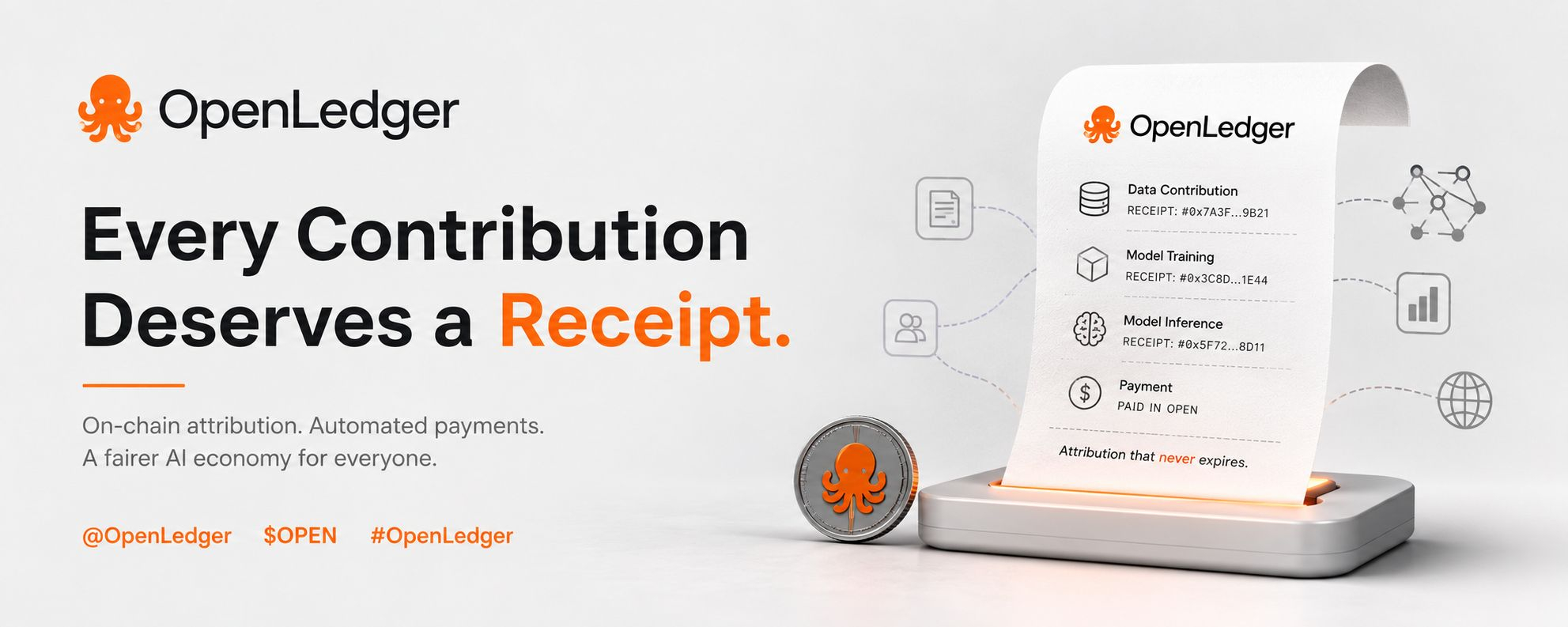
OpenLedger's Proof of Attribution records every dataset, training step, and model inference on-chain, ensuring contributors are credited and rewarded. But recording and measuring are different things. Recording is infrastructure. Measuring is judgment. And judgment at the scale of a modern AI model, trained on millions of sources, layered across hundreds of fine-tuning runs, is not a problem that infrastructure alone solves.
OpenLedger's January 2026 Attribution Engine update was specifically designed to ensure data-output links remain intact even as AI models are updated and fine-tuned over time. That is worth pausing on. The hard part is not attribution at the moment of training. The hard part is maintaining attribution across a model's entire life as it changes. Most systems simply do not attempt this. They treat a trained model as a completed object and stop tracking lineage from that point forward.
What OpenLedger seems to be arguing is that the receipt never expires.
That framing changes things considerably. Because if attribution is a one-time event tied to training, it produces a relatively modest economic shift. Contributors get paid once, the model moves on, and the underlying incentive structure stays roughly the same. But if attribution persists across every inference, every fine-tune, every downstream application built on top of the original model, then you are describing something closer to a royalty economy than a data marketplace.
Story Protocol collaborated with OpenLedger in January 2026 to build an IP layer on top of OpenLedger's technology, with Story Protocol providing machine-readable definitions for ownership, licensing terms, and permissions for derivatives, while OpenLedger enforces those licenses when data is being used for training. That combination matters more than either project would individually. One defines the rights. The other enforces them automatically.
I think most observers are still treating this as an infrastructure story. Better rails for AI development. More transparent data pipelines. Useful for compliance teams and enterprise procurement.
That framing is accurate but probably incomplete.
The more interesting possibility is that OpenLedger is participating in a slow renegotiation of something that the AI industry has treated as settled. Who has a continuing claim on intelligence after it has been built?
Current answers lean heavily toward whoever controls the model. The data that shaped it is a sunk cost. The contributors are historical actors. The economic relationship ended when training ended.
OpenLedger's stated vision is that specialized models can be built on top of community-contributed data where bloggers, researchers, forum participants, and creators are all attributed and rewarded, with every user receiving AI-powered research that reveals exactly where its knowledge originated. That is not a description of a sunk cost. That is a description of an ongoing relationship.
Whether that relationship can actually be enforced at scale is the part I remain genuinely uncertain about.
The technical challenges are real. Influence functions and token attribution methods can approximate how much a dataset shaped a given output, but approximation is not the same as precision. The June 2025 Proof of Attribution whitepaper describes two approaches: influence-function approximations for smaller models, and suffix-array-based token attribution for LLMs that checks output tokens directly. Both approaches involve tradeoffs. Both involve cases where the math gets ambiguous.
And ambiguous attribution creates disputes. Attribution systems will likely generate their own contested terrain, not eliminate it.
But here is what I keep returning to. My music producer friend did not need a perfect accounting of his samples to feel the problem was real. He needed any accounting at all. He needed the system to at least attempt to remember.
The AI industry has mostly operated as though forgetting the origin of knowledge is a neutral act. OpenLedger seems to be building on the assumption that it is not neutral at all, and that eventually the market will agree.
Maybe that moment comes quickly. Maybe the regulatory pressure, the lawsuits piling up against major AI companies, and the growing unease among professional knowledge workers all converge faster than the industry expects.
Maybe it does not. Designing incentive systems is genuinely hard, and there are plenty of examples in crypto of elegant attribution frameworks that solved the wrong version of the problem.
What feels different here is that OpenLedger is not asking people to believe in attribution as a philosophy. The platform is attempting to replicate the economics of creator platforms like YouTube while supporting the earning power of researchers, writers, and domain experts who provide training for AI systems. YouTube's model is imperfect and frequently criticized, but it produced a generation of creators who organized their entire professional lives around the assumption that their contribution was trackable and compensable.
That behavioral shift, before the economics were even fully optimized, was the more important change.
I do not know if OPEN becomes a significant asset. Predicting that requires assumptions about adoption timelines and regulatory environments and developer decisions that I am genuinely not confident making.
What I think is harder to dismiss is the underlying argument. The AI economy currently runs on a kind of structured forgetting. Data enters. Models form. The origin disappears. OpenLedger is building the infrastructure for a different assumption, one where the origin never fully disappears, where the receipt stays attached to the intelligence even after everyone involved has moved on.
My producer friend would have found that interesting.
He spent years watching value move through systems that had no memory of where it came from.
I suspect he is not the only one.