
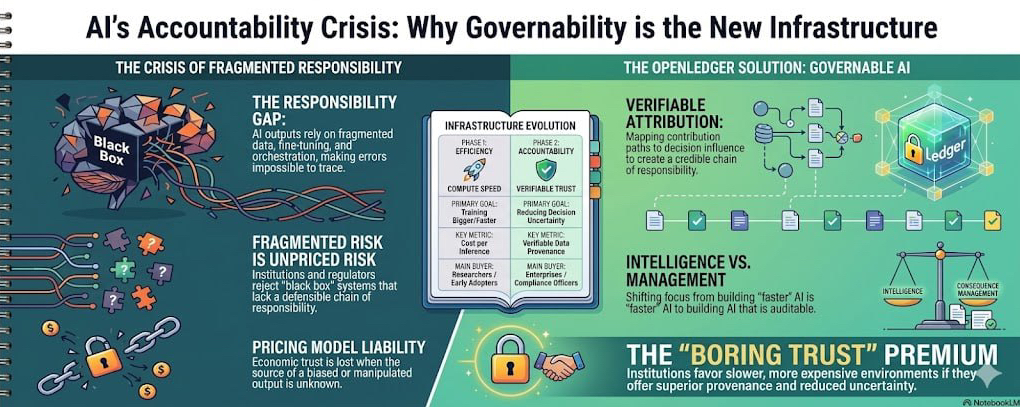
I used to believe the story. We all did. Faster models, bigger clusters, more watts. The AI narrative has been a worship of horsepower for years—a simplistic, almost religious faith that the only bottleneck was raw compute. If we just had enough GPUs, the intelligence would come. The market ate it up because it was clean. Easy to sell. You buy the machine, you get the magic.
But I've spent enough time watching real capital move to know when a story is about to crack.
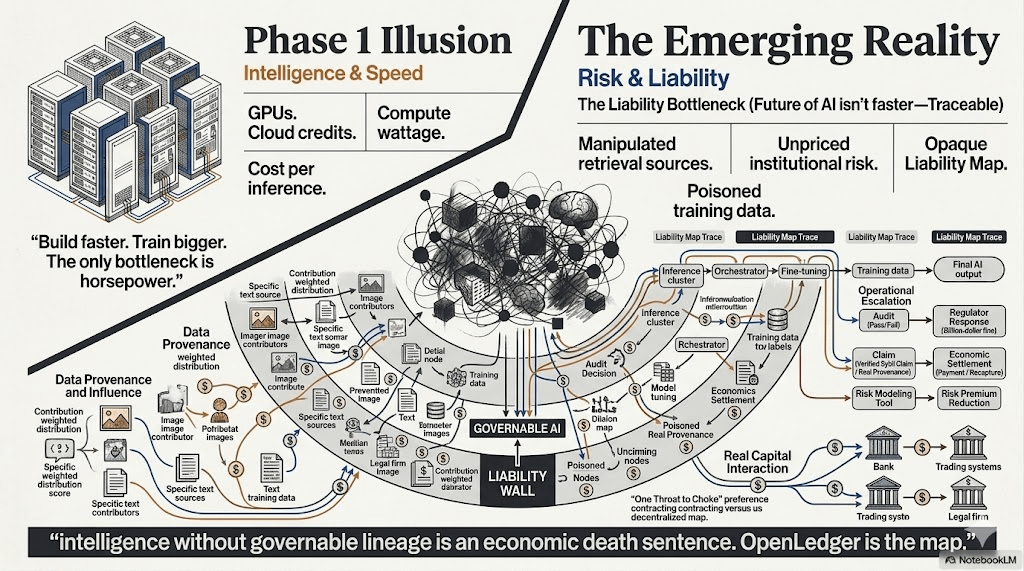
The crisis I see looming isn't a lack of intelligence. It's a total absence of accountability.
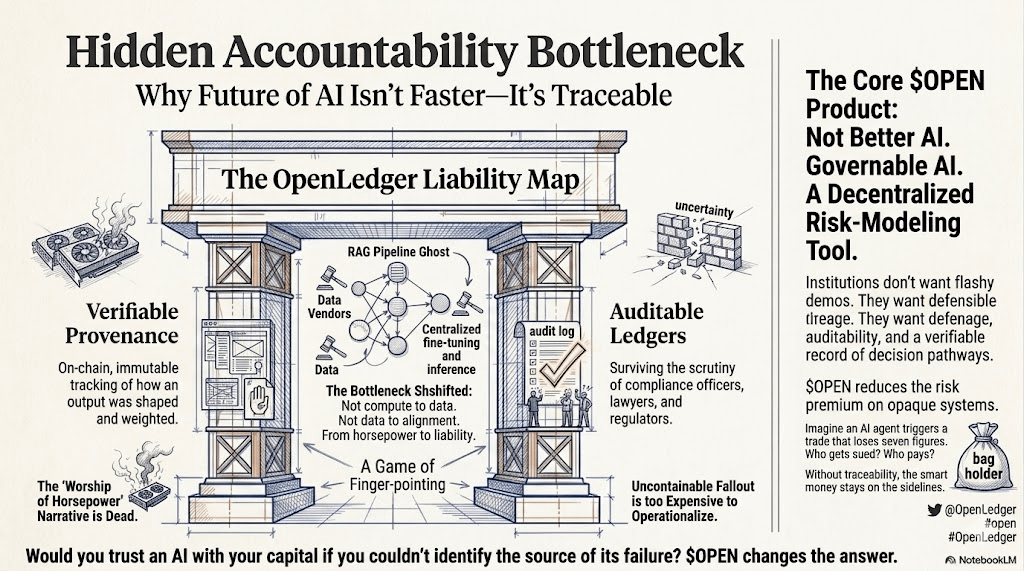
I was in a room recently—virtual, but the tension was physical. A risk consultant was describing what happens when an AI agent triggers a trade that loses seven figures. Who gets sued? Who pays? The silence was louder than any alarm. Because no one had an answer. The model was a black box. The data came from three vendors. The fine-tuning was outsourced. The inference ran on someone else's cluster. And the real-time context—pulled through a RAG pipeline—was a ghost.
Institutional capital doesn't do magic. It does risk management. And you cannot manage a risk you cannot map.
That's when I realized the bottleneck had shifted. Not from compute to data. Not from data to alignment. From horsepower to liability.
The industry is hitting a wall, and the wall is made of uncertainty. When an AI denies a loan, flags a patient, or approves a supply chain order, the question isn't "was it fast?" The question is: who is responsible when it's wrong?
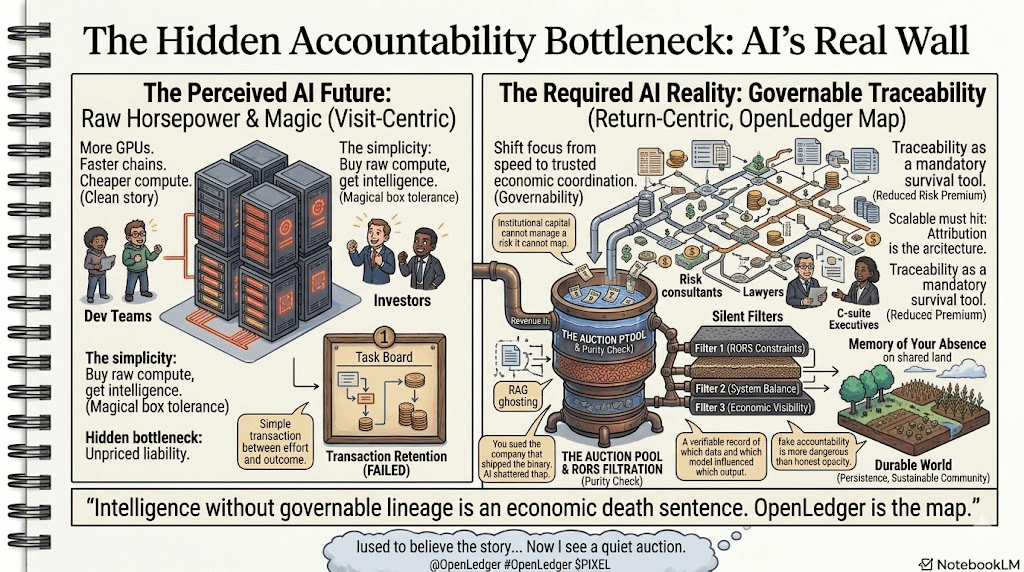
Traditional software liability was a blunt instrument. You sued the company that shipped the binary. One throat to choke. Clean. AI shattered that model into a spray of fragments. Data from one vendor. Fine-tuning from a second. Inference from a third. Orchestration from a fourth. By the time an output reaches a user, the lineage is so muddied that any failure becomes a game of finger-pointing.
I've watched compliance officers stare at AI architectures like they were reading a language that hadn't been invented yet. Their eyes go flat. Their jaws tighten. Because they know what comes next: an audit they can't pass, a regulator they can't satisfy, a loss they can't allocate. To them, this isn't innovation. It's a nightmare.
And nightmares don't get budget approval.
The market is currently chasing "Better AI." Faster inference. Lower latency. Higher accuracy. But the real money—the institutional money that doesn't tweet and doesn't farm airdrops—is sitting on the sidelines waiting for something else entirely. They're waiting for Governable AI. Meanwhile, trend coins like $FIDA and $BANANAS31 ride short-lived waves of attention, pumping on borrowed hype before drifting back into the noise—none of them solving the quiet, unglamorous problem of who pays when the model fails.
I've seen this arc before. Every enterprise technology goes through the same cycle. First, innovation is the hook. Then, compliance becomes the lock-in. Cloud security was once an unsexy overhead. Now it's mandatory survival. Audit logs were boring until the first billion-dollar fine. Traceability is the next institutional requirement. Not because regulators are fun. Because uncertainty is too expensive to operationalize.
What do institutions actually want? Not autonomy. Auditability. The ability to explain to a regulator why a specific decision was flagged. Not flashy demos. Defensible lineage. A verifiable record of which data and which model influenced which output. Not black-box brilliance. Operational escalation paths. Clear lines that a legal team can follow when the system fails.
And above all: a reduction in the risk premium. Right now, opaque systems trade at a discount because the fallout is uncontainable. Make the black box transparent, and the discount shrinks.
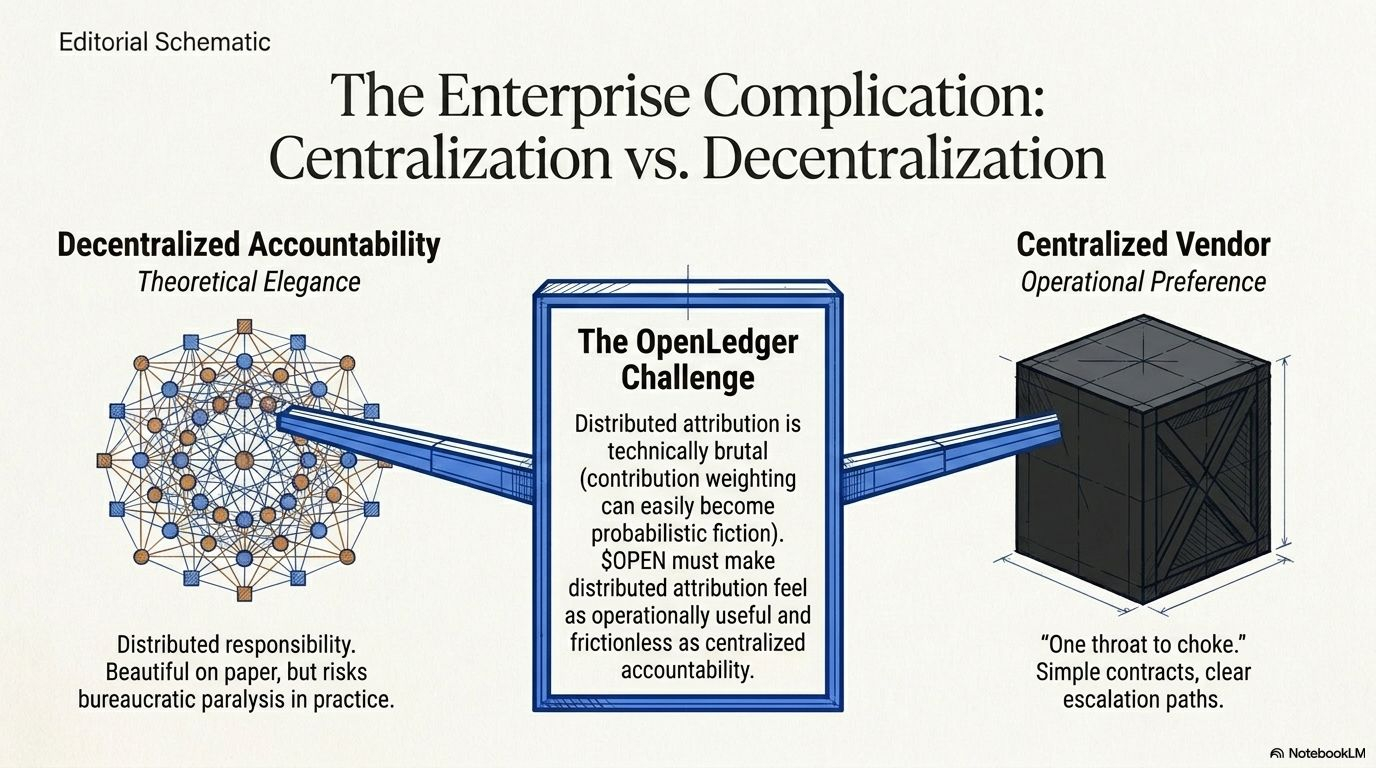
Here's the cynical part I can't shake. Attribution is brutally hard. Models don't come with ingredient lists. Training effects are probabilistic fictions. You can't point to a single data point and say "this caused that" with the certainty of a bank ledger. When you attach economic incentives to that process, you invite reputation farming, Sybil claims, manufactured provenance. Fake accountability is, in many ways, more dangerous than honest opacity—because it gives you a false sense of security while the real risk festers underneath.
And then there's the enterprise hurdle: the "one throat to choke" preference. Large institutions love centralized vendors not because they're better, but because accountability simplifies into a single contract and a single escalation path. You sue the cloud provider. You fire the consultant. You know who to call at 2 AM when the model melts down.
A decentralized protocol like OpenLedger doesn't offer that comfort. To win, it can't just be theoretically elegant. It has to be more operationally efficient at managing risk than a centralized alternative. That's a high bar. I don't know if anyone has cleared it yet.
But I'm watching. Because I keep coming back to that credit assessment example.
Imagine an AI-powered loan system. It denies a mortgage to a qualified applicant because a single contributor in the data pipeline fed manipulated labels. The lawsuit doesn't hit the data provider. It hits the bank. The bank, in turn, looks up the chain and sees nothing but fog. They can't trace the bad label to the bad actor. They can't prove intent or negligence. They just hold the bag.
That lack of traceability isn't a technical failure. It's an economic death sentence. The market already knows this. It's why opaque AI systems trade at a discount. It's why risk premiums attach to black boxes like barnacles to a hull. Until you can map liability from output back to input, the smart money stays on the sidelines.
So I've stopped asking "how fast is this model?" I ask: when it fails, who pays?
Because the next bottleneck for AI isn't intelligence. It's consequence management. The ability to survive your own mistakes. The ability to trace a bad decision back to its source, not for revenge but for correction. The ability to stand in front of a regulator or a judge and say "this is exactly where the failure happened, this is why, and this is how we fixed it."
That's not sexy. It doesn't pump tokens. It doesn't trend on Crypto Twitter. But it's the only thing that will move AI from the sandbox into the real economy.
OpenLedger is trying to build that map. $OPEN , in this context, isn't competing on compute or model quality. It's a risk-modeling tool. Its value lives in the market for reducing uncertainty. If it works, it turns infrastructure into a liability map—a living document of who contributed what, who bears which risk, who gets paid when things go right and who takes the hit when they go wrong.
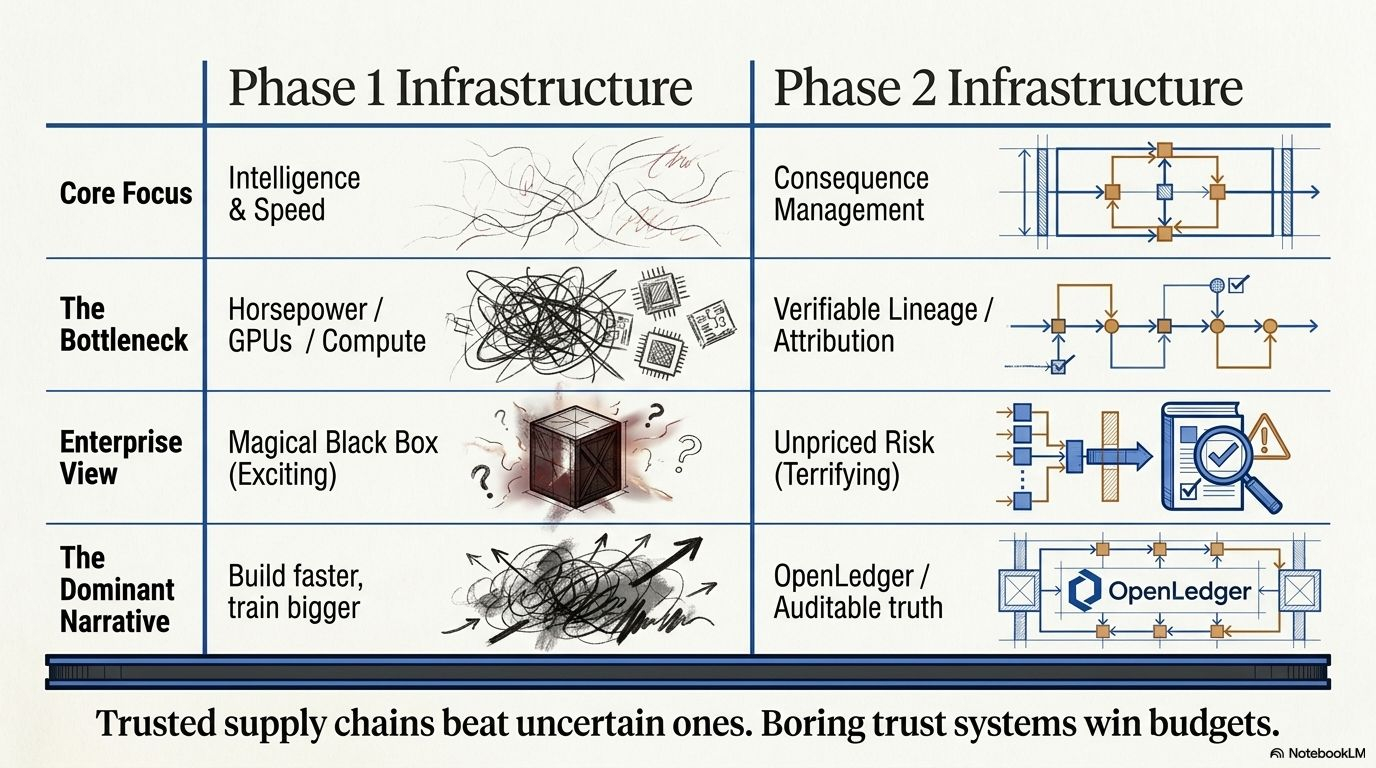
That's the accountability bottleneck. And it's the only bottleneck that actually matters.
Because here's the question I keep asking myself, the one that follows me out of every meeting, every risk assessment, every post-mortem on an AI failure that someone else had to clean up:
Would you trust an AI system with your own capital—your own savings, your own mortgage, your own retirement—if you couldn't identify the source of its failure?
Not "would you use it for fun." Not "would you let it write a tweet."
Would you let it move your money?
I wouldn't.
And until the answer changes, the future of AI isn't faster.
It's traceable.