
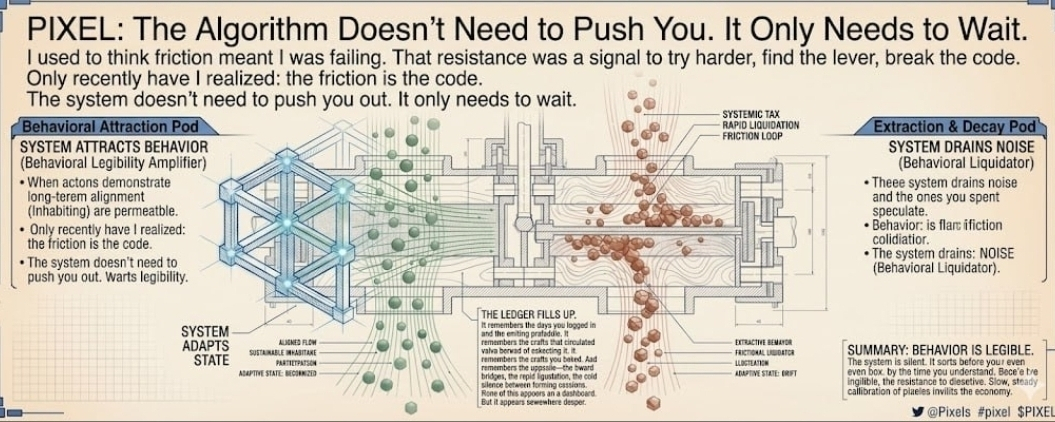
I used to think friction meant I was failing. That resistance was a signal to try harder, find the lever, break the code.
Only recently have I realized: the friction is the code.
The system doesn’t need to push you out. It only needs to wait.
Waiting is cheaper than banning. Waiting is quieter than patching. Waiting lets you leave on your own—convinced the game just “stopped being worth it”—without ever hearing the door close behind you.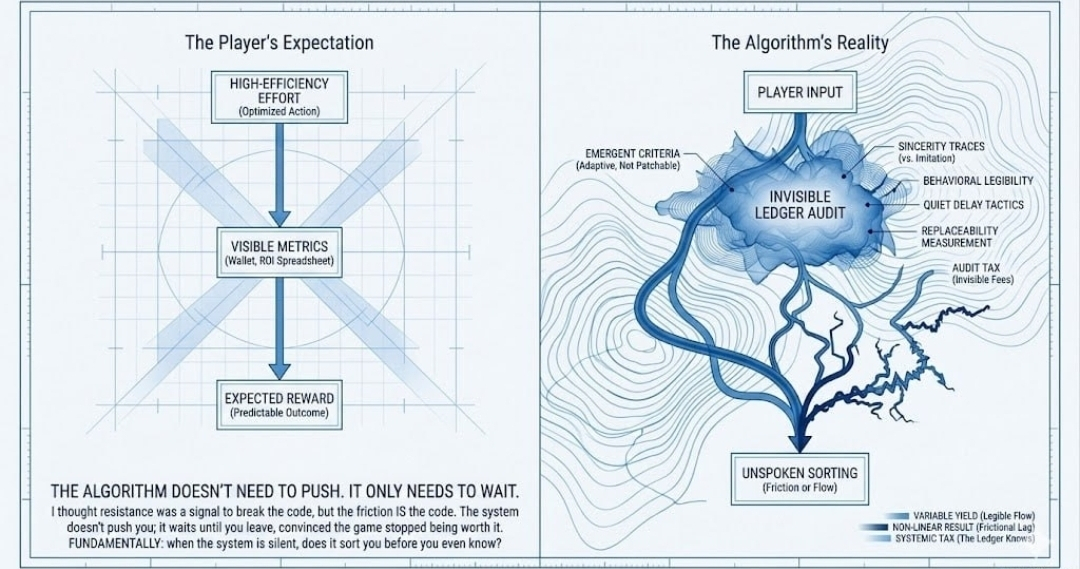
That’s the design I failed to see at first. I viewed friction operationally. I viewed resistance structurally. I viewed my flat wallet economically. But fundamentally, all three concern the same issue: when the system is silent, does it sort you before you even know you’re being sorted?
This is the true essence of Pixels.
Not whether the game works. But whether the game keeps you when keeping you costs nothing—and lets you drift when it costs something.
I remember the session I stopped blaming myself.
Twelfth consecutive day. Same route. Same precision. Spreadsheet said up. Wallet said flat. Muted. As if someone turned down the volume on my output without touching my input.
No announcements. No hidden fees. Just silence.
Then I did something I hadn’t done before. I stopped optimizing and started watching. Not the game. The other players. The ones who moved like water—effortless, slow, not hungry. They weren’t extracting. They were inhabiting.
And the system was rewarding them for it. Not with more. With smoother.
That’s when the real weight hit me.
Contrary to popular belief, the algorithm does not care about your peak output. It cares about your baseline. A player who spikes to 100 and drops to zero is a liability. A player who holds 60, every day, is an asset.
I had been treating Pixels like a vending machine. Put in effort. Get rewards. Walk away. Come back hungry.
But vending machines don’t remember you. They don’t build a ledger. They don’t ask whether you showed up when no one was looking.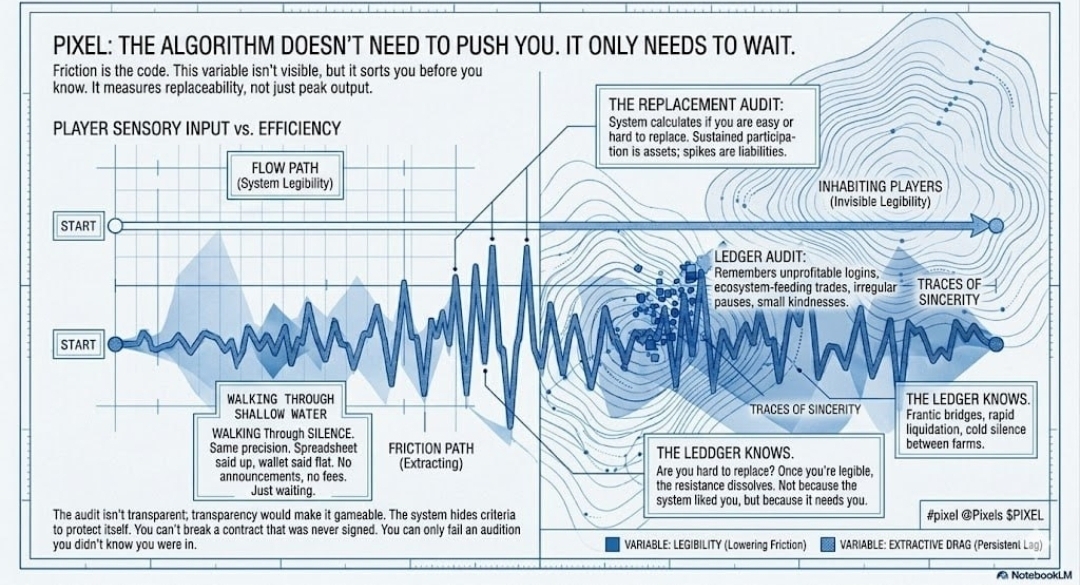
The ledger fills up.
It remembers the days you logged in and did nothing profitable. It remembers the trades that circulated value instead of extracting it. It remembers the crafts that fed the ecosystem rather than your wallet. And it remembers the opposite—the frantic bridges, the rapid liquidation, the cold silence between farming sessions.
None of this appears on a dashboard. But it appears somewhere deeper. In the invisible tax on your withdrawals. In the quiet delay that separates your transaction from the player next to you who did the same thing but got confirmed faster.
You feel it before you understand it. By the time you understand it, you’ve already been sorted.
I’ve watched players rage-quit. They call it rigged. Unfair. They say the rules changed without being written.
They’re right—except the rules were never written. They were emergent. Adaptive. Alive. You can’t break a contract that was never signed. You can only fail an audition you didn’t know you were in.
That’s the power shift no one talks about.
The audit isn’t transparent because transparency would make it gameable. The system hides its criteria not to deceive you, but to protect itself. If you knew exactly which behaviors earned the low-friction path, you’d simulate them without sincerity. And the algorithm would know. Because sincerity leaves traces that imitation cannot fake.
Irregular pauses. Small kindnesses to new players. Logging in on a day when nothing is on fire and no rewards are boosted.
Those moments cost you efficiency. But they buy you legibility.
Once you’re legible, the resistance starts to dissolve. Not instantly. Session by session. A little less lag. A slightly better craft outcome. A withdrawal that clears in minutes instead of hours. Nothing you can screenshot. Just a steady, unspoken recalibration of your place inside the economy.
I don’t check my wallet the same way anymore. I don’t obsess over daily ROI.
Instead, I ask myself a quieter question before every login: am I showing up as someone this place would miss if I left?
That question isn’t sentimental. It’s strategic.
Because the algorithm isn’t just measuring your behavior. It’s measuring your replaceability. If you’re easy to lose, the system lets you drift. If you’re hard to replace, the system oils your path. Not because it likes you. Because it needs you. Sustained participation is the only thing that keeps the loop from collapsing.
So I’ve stopped trying to beat the system.
I’ve started trying to become indispensable to it.
That means doing things that don’t optimize my personal return. Helping other players. Holding assets longer than necessary. Participating in events with no obvious rewards. Actions that look irrational on a spreadsheet but feel inevitable once you understand the audit.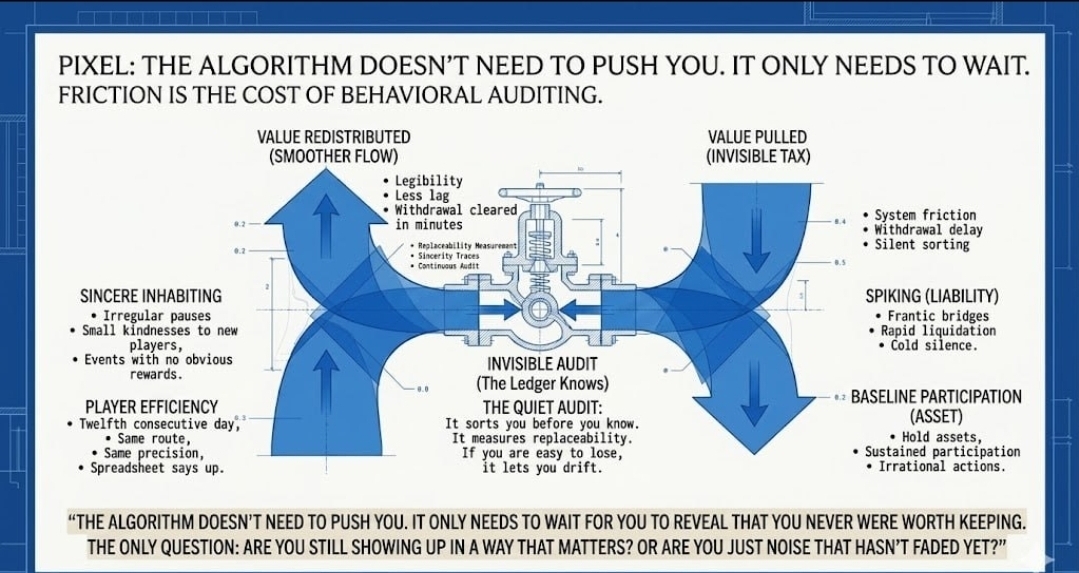
Slowly, imperceptibly, the friction has lessened.
Not because the system rewarded me. Because it recognized me.
That’s the most powerful shift of all.
The algorithm doesn’t need to push you. It only needs to wait for you to become someone worth keeping—or to reveal that you never were. Either way, it wins. Either way, the loop continues with or without you.
The only question that remains is personal.
Are you still showing up in a way that matters?
Or are you just noise that hasn’t faded yet?
The ledger knows.
And it’s still waiting.