
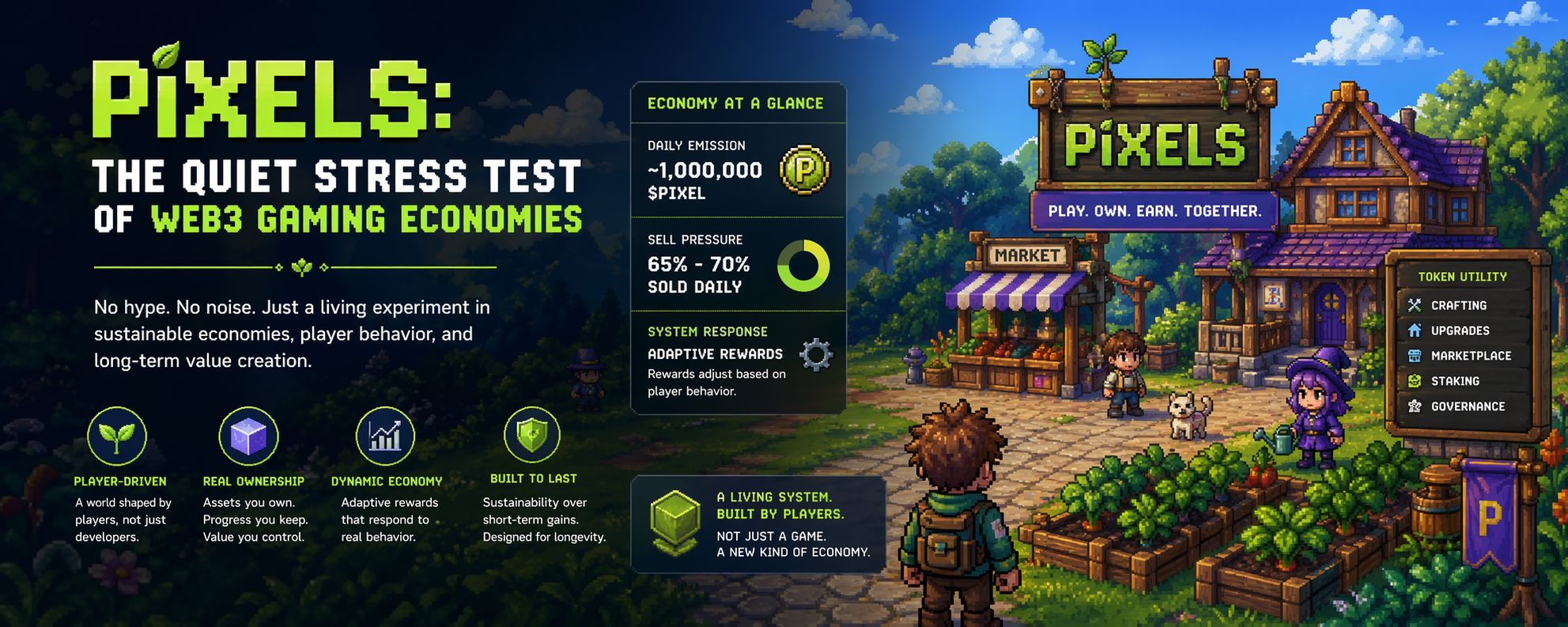

In every market cycle, there are projects that dominate attention and then there are projects that quietly test assumptions.
Pixels belongs to the second category.
It is not the loudest GameFi project. It is not driven by aggressive hype cycles or constant narrative reinvention. Instead, it sits in a more subtle position within Web3 gaming a live economic experiment disguised as a casual farming game.
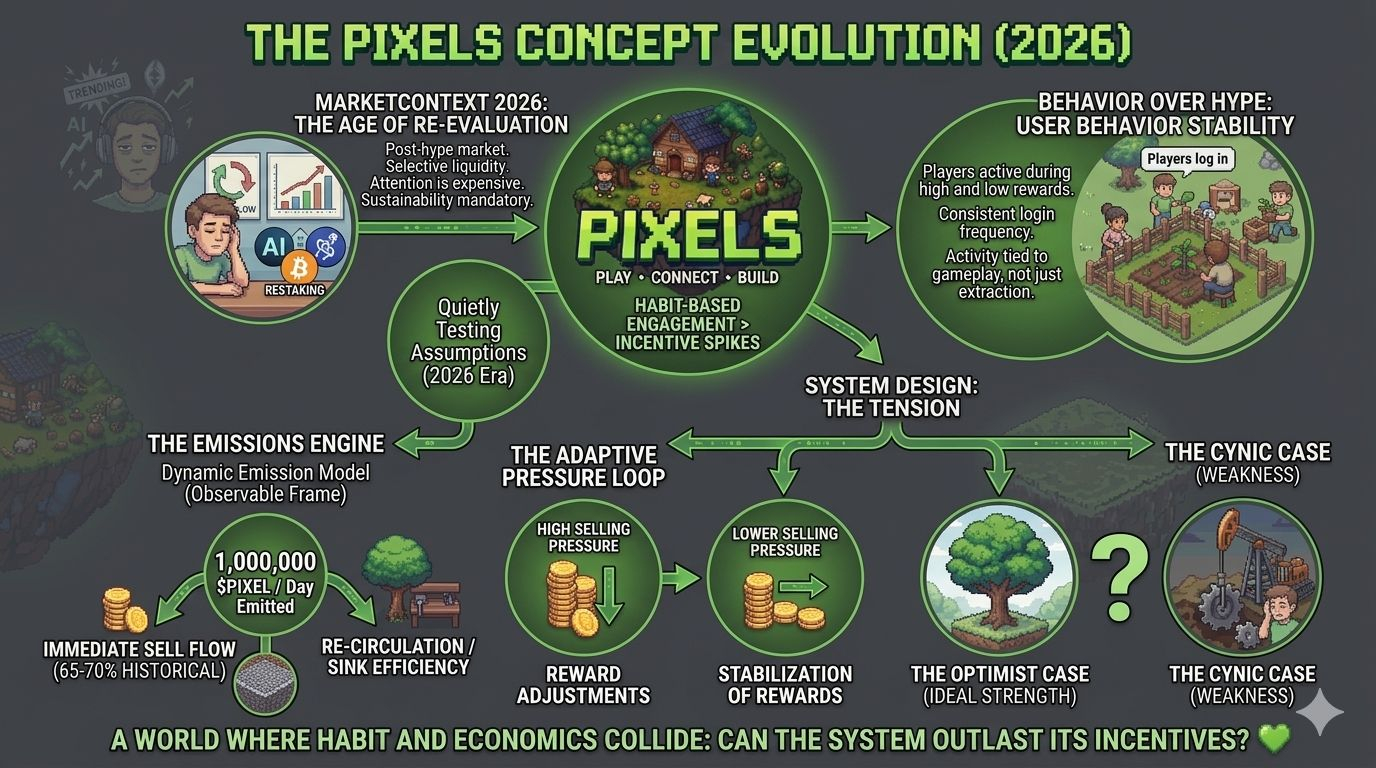
And in 2026, when crypto has already rotated through AI narratives, restaking speculation, and multiple layers of liquidity compression, these “quiet systems” start becoming more important than the loud ones.
Because attention is no longer cheap. And sustainability is no longer optional.
Why Pixels Is Being Re-evaluated
The current crypto environment is very different from earlier cycles.
We are no longer in a phase where:
every new token gets reflexive liquidity
every GameFi project can bootstrap users with emissions alone
narrative momentum is enough to sustain engagement
Instead, the market has become selective. Liquidity is rotating slower. Users are more cautious. Capital efficiency matters more than storytelling.
In this environment, most GameFi projects struggle with one core issue:
They can attract users, but they cannot keep behavior stable once incentives normalize.
#Pixels being observed differently because it does not fully rely on aggressive short-term incentive expansion. Its growth pattern has been more organic, with engagement driven by routine interaction loops rather than purely reward-driven farming cycles.
That alone makes it structurally interesting in the current market phase.
Behavior Over Hype: The First Real Signal
Most Web3 analysis begins with token charts.
But Pixels forces a different entry point: user behavior stability.
Across observed cycles, engagement patterns suggest something important:
Players are not only active during high-reward phases
Login frequency remains relatively consistent
Activity is tied to gameplay loops, not just token extraction events
This is crucial because it breaks a common GameFi pattern:
Incentive-driven spikes followed by extraction-driven exits.
Instead, Pixels shows partial signs of what could be described as habit-based retention, where users continue interacting even when short-term financial optimization is not the primary driver.
This does not mean incentives are irrelevant. It means they are not the only variable shaping participation.
And in GameFi history, that distinction is rare. The Economic Engine: Emissions and Adaptive Pressure
At the core of the system is a continuously active emission model.
Current structure (simplified observable framework):
Around 1,000,000 $PIXEL/day emitted
A significant portion (historically ~65–70%) enters immediate sell flow
This creates consistent downward liquidity pressure in the market
However, unlike static emission systems, Pixels introduces a feedback mechanism:
High selling pressure → reward adjustments downward
Lower selling pressure → stabilization or recalibration of rewards
This creates a dynamic incentive loop, where player behavior directly influences future reward structures.
On paper, this is efficient.
In practice, it creates a psychological tension:
Players are not just reacting to price—they are indirectly reacting to collective behavior.
This is where most GameFi systems become fragile.
Because once users feel that their earnings depend on unpredictable collective actions rather than personal strategy, trust begins to weaken—even if the system is economically rational.
The Reservoir Model: Understanding the System Intuitively
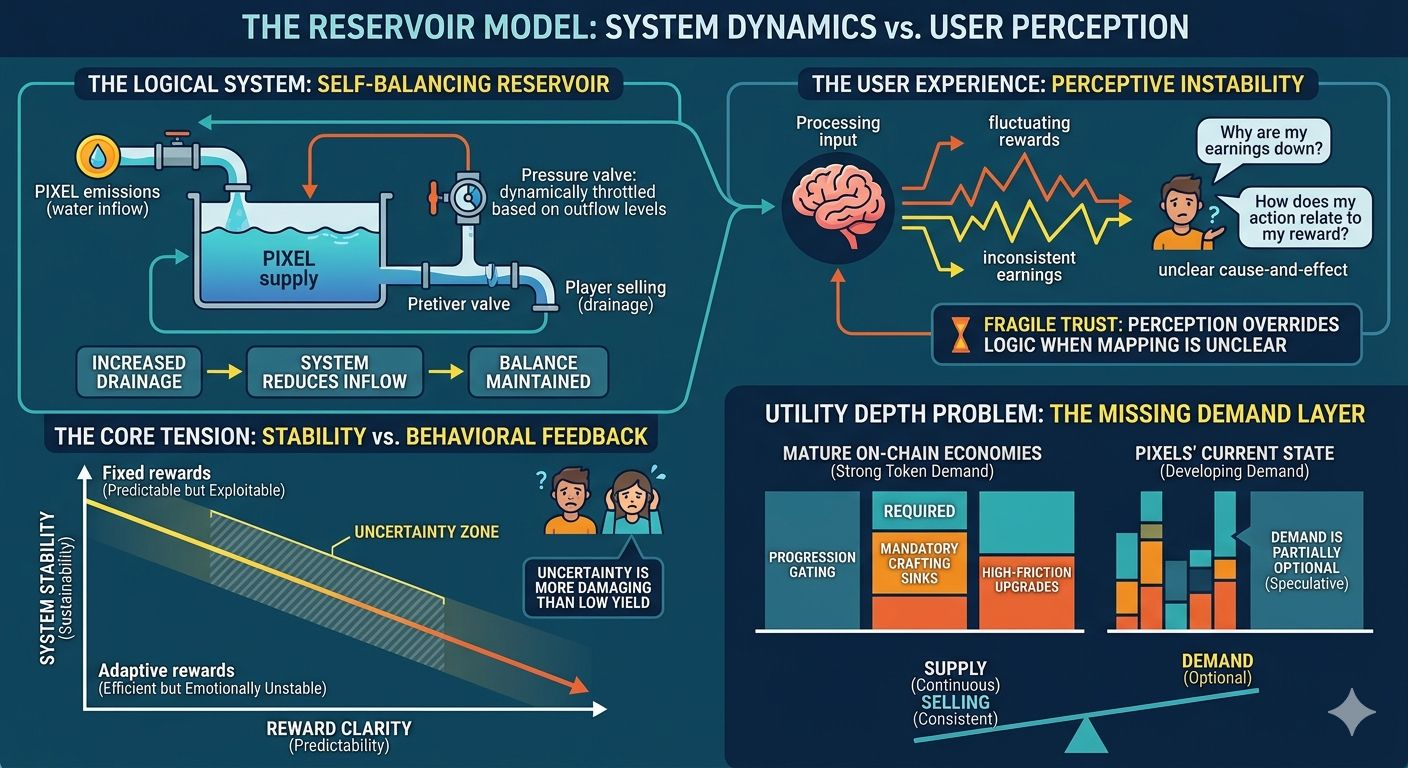
A useful way to understand Pixels’ structure is through a simple model:
PIXEL emissions = water inflow
Player selling = drainage
Reward adjustment = pressure valve
When drainage increases:
system reduces inflow
When drainage decreases:system stabilizes or increases incentives
Technically, this is a self-balancing mechanism.
But psychologically, users do not experience balance.
They experience:
fluctuating rewards
inconsistent earnings
unclear cause-and-effect relationships
And in crypto economies, perception often overrides logic.
If users cannot clearly map action → outcome → reward, trust becomes fragile—even if the system is mathematically sound.
The Core Tension: Stability vs Behavioral Feedback
Every adaptive GameFi system eventually hits the same contradiction:
Fixed rewards = predictable but exploitable
Adaptive rewards = efficient but emotionally unstable
Pixels sits directly inside this tradeoff.
The goal is clear
prevent extraction cycles from destroying long-term sustainability.
But the side effect is equally clear:
introducing uncertainty into user earnings.
And in Web3 gaming, uncertainty is often more damaging than low yield.
Because users can accept earning less.
But they struggle with not understanding why they are earning less.
Utility Depth Problem: The Missing Demand Layer
Another structural observation is the utility layer of $PIXEL .
While the token is integrated into gameplay systems, the depth of mandatory demand is still developing.
In mature on-chain economies, strong tokens usually have
progression gating
mandatory crafting sinks
high-friction upgrades tied to token usage
irreversible consumption loops
In Pixels, some of these exist, but not at a level where demand fully offsets emission pressure.
This creates a structural imbalance:
supply is continuous
selling is consistent
demand is partially optional
And optional demand in GameFi usually leads to speculative pricing behavior rather than stable economic equilibrium.
Comparison to Earlier GameFi Cycles
To understand Pixels’ positioning, it helps to compare it with previous models
Axie-style economies:
Fixed emissions
High early rewards
Fast user acquisition
Rapid extraction collapse
Modern adaptive systems (Pixels direction):
Dynamic emissions
Behavior-linked rewards
Attempted long-term equilibrium
Slower but more complex sustainability model
The difference is not just design—it is philosophy.
Older systems optimized for growth speed.
Newer systems attempt to optimize for survival under variable behavior conditions.
Pixels is closer to the second category.
The Psychological Layer: Trust vs Earnings
One of the most underestimated aspects of GameFi is this:
Pixels is currently operating in a space where:
earnings exist
gameplay is stable
activity remains consistent
But perception of reward stability is still evolving.
If players can understand:
why rewards change
what triggers adjustments
how collective behavior impacts emissions
Then lower earnings can still be acceptable.
But if the system remains partially opaque, users begin to interpret changes as randomness rather than logic.
And randomness destroys long-term trust faster than losses.
Why Pixels Matters Now
In the current crypto cycle, attention is shifting away from pure speculation toward:
sustainable yield systems
user-retention-driven ecosystems
real behavioral economies
long-duration engagement loops
Pixels sits exactly at this intersection.
It is not trying to be a short-term token play.
It is testing something harder:
Can a Web3 game build an economy where player behavior and system design continuously co-evolve without collapsing trust?
That is a fundamentally different challenge than traditional GameFi launches.
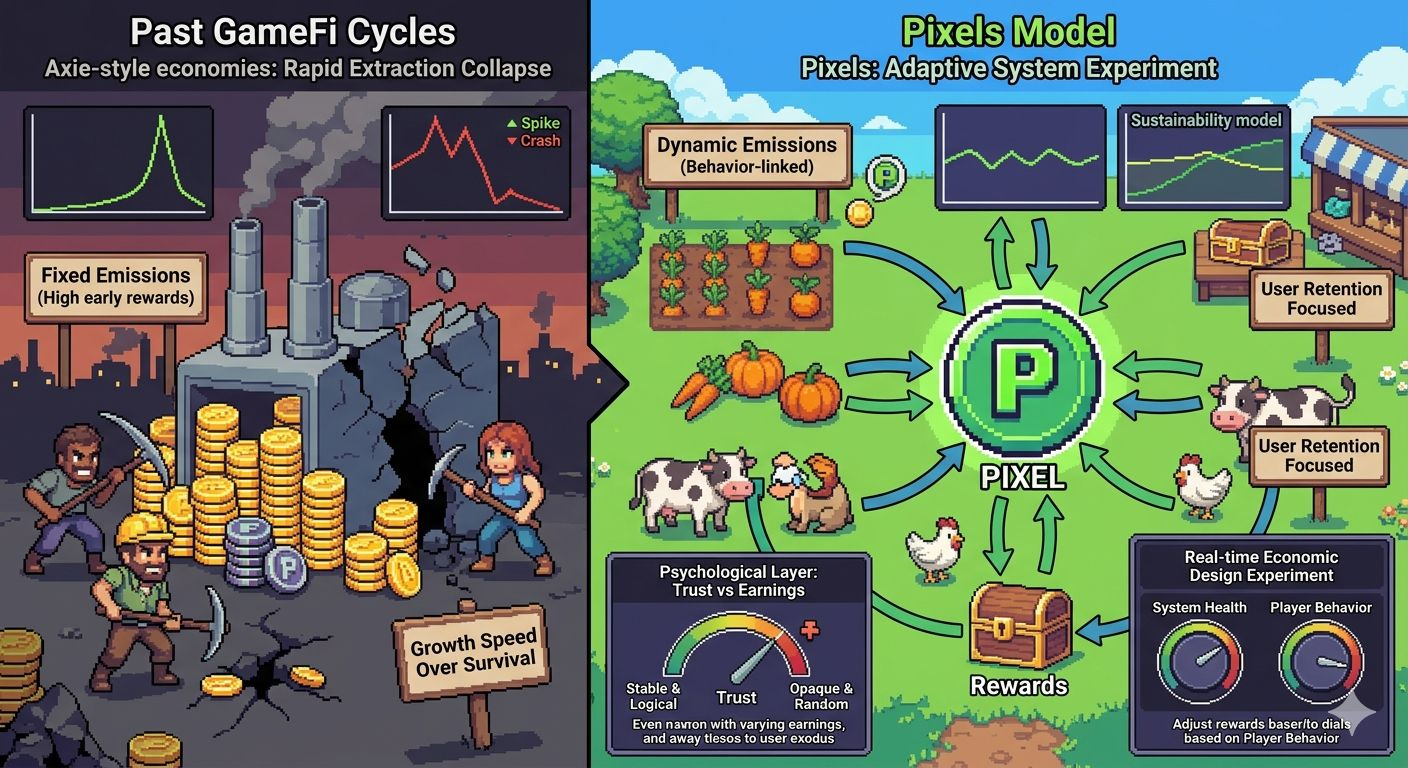
At this stage, Pixels should not be viewed as a solved system.
It is closer to an ongoing experiment in real-time economic design.
Key risks remain:
over-reliance on adaptive reward changes
insufficient token sink depth
perception gap between system logic and user understanding
external liquidity shocks distorting behavior
But it also carries a rare strength:
consistent user presence without extreme incentive spikes
emerging behavioral stability
low narrative dependence compared to typical GameFi cycles
In a market that constantly cycles through attention-driven hype, that alone is meaningful.
Because most Web3 games are trying to attract users.
Pixels is trying to understand whether users can be sustained without constant force.
Conclusion
#pixel is not just a farming game.
It is a live stress test of whether Web3 economies can adapt to collective behavior while still maintaining user trust.
And in a space where most systems fail not because they are unprofitable—but because they are misunderstood—that question becomes more important than price action itself.
The system is still evolving. The outcome is still uncertain.
But one thing is clear
Pixels is not asking whether GameFi can grow.
It is asking whether GameFi can last.

