
I have seen too many crypto projects promise transformation while delivering very little that people actually return to. After enough time in this market, that gap becomes hard to ignore. A strong story can travel fast. A durable product moves differently. It earns repetition. It creates routine. It gives people a reason to come back even when the token is quiet, the market mood is bad, and nobody is posting victory threads. That is the lens I keep coming back to with Pixels.
Most people, in my view, still read Pixels too simply. They look at the pixel-art farming surface, the social buzz, the token layer, the Ronin migration, and they decide too early what it is. Either they dismiss it as a lightweight game wrapped in crypto rails, or they overstate it as proof that Web3 gaming has already figured itself out. I do not think either reading is serious enough.
The real question for me is narrower and more important: does Pixels create something people actually live inside, repeat, and emotionally settle into, or is it still leaning on incentives and market attention to feel larger than it is?
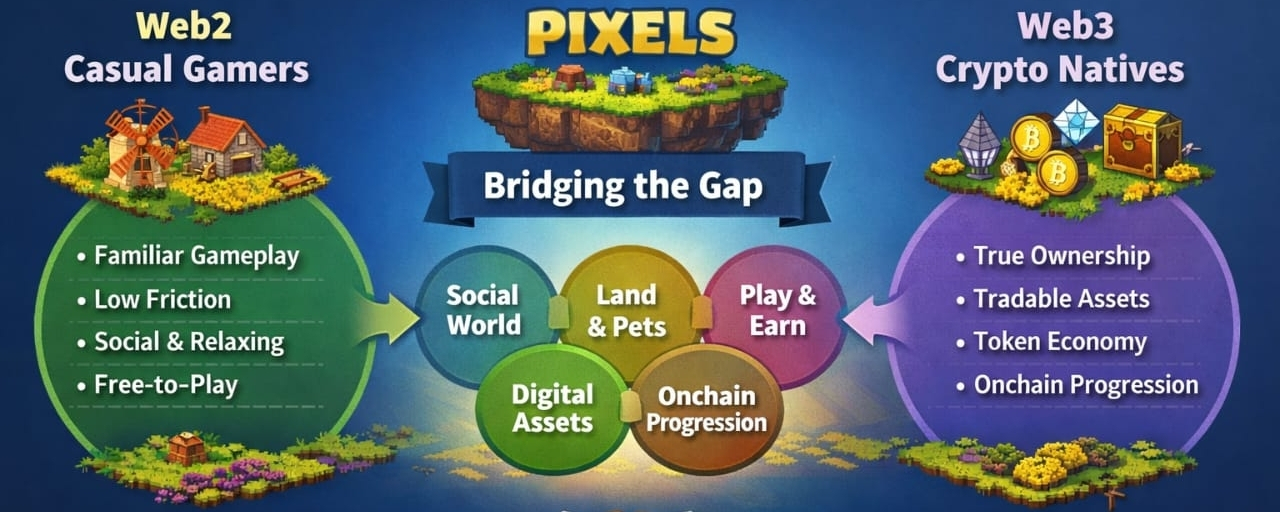
What makes Pixels interesting is that it does not begin by forcing the crypto pitch. The game loop is familiar. Farming, gathering, crafting, exploration, avatars, land, pets, progression, social presence. That matters. The shape of the experience is legible to a Web2 casual player because it resembles patterns people already understand from cozy farming and life-sim games. Pixels presents itself as free-to-play, social, and low-friction, which is exactly the kind of entry point that reduces the psychological cost of trying something new. Ronin’s gaming-focused wallet and onboarding stack also help lower that friction on the blockchain side.
That dual accessibility is the first reason Pixels can appeal to both Web2 casual gamers and Web3-native users at the same time. Casual players can interact with a loop that feels understandable before they ever need a thesis on ownership. Web3-native users, meanwhile, can see the extra layers immediately: wallets, tradable assets, land, pets, utility tokens, onchain identity, and a broader economy attached to progression. Pixels explicitly frames itself around experiences where users own progress and where digital collectibles can be integrated into the game structure.
That sounds obvious on paper, but the part I pay attention to is not whether those systems exist. It is whether they feel native.
In bad Web3 games, ownership is decorative. The chain is there because the deck needed one more slide. You can feel it. The asset layer sits on top of weak gameplay like a sales wrapper. In Pixels, I think the stronger case is that the blockchain layer at least tries to structure participation rather than merely advertise it. Land, pets, utility tokens, and wallet-linked identity are not just collectible side items. They are tied to how players move through the world, store value, access utility, and interpret progress. That does not automatically make the design great, but it does mean the onchain layer is closer to structural than ornamental.
What makes Web2 casual gamers tolerate that added complexity is that the front door is still a game, not a financial dashboard. That matters more than crypto people sometimes admit. Most normal players do not wake up wanting sovereignty over digital assets. They wake up wanting something relaxing, social, rewarding, and easy to understand. Pixels seems to understand that. The appeal starts with mood and loop design, not ideology.
At the same time, what makes Web3-native users stay interested is exactly what makes many traditional gamers suspicious: the presence of transferable value, interoperable identity, and a visible economy. A crypto-native player does not just ask, “Is this fun?” They also ask, “Does my time compound? Does my position in the ecosystem matter? Is there an economy here that makes participation legible?” Pixels gives them enough of that language to stay engaged. The existence of in-game utility like $BERRY, broader ecosystem ambition around $PIXEL, NFTs such as pets and land, and Ronin-native trading infrastructure all signal that participation can extend beyond pure session-based play.
That is where the overlap happens. Web2 players get familiarity. Web3 players get ownership. The product tries to meet both without fully alienating either.But that balance is fragile, and that is where my skepticism sits.
Because the same features that make Pixels attractive to Web3 users can also distort the experience. Once tokens and tradable assets enter the loop, behavior changes. People optimize. They industrialize routine. They stop inhabiting the world and start extracting from it. That risk is not theoretical in crypto gaming. We have seen it again and again. A soft social game can become a labor interface very quickly if the economy becomes the dominant reason to log in.
So when I look at Pixels, what makes me pause is not whether it has traction. It clearly has had strong moments of adoption, including large jumps in daily activity around its Ronin era and public messaging around sustainability and long-term economy design. What makes me pause is whether the game can keep player behavior centered on attachment rather than extraction.
That distinction matters more than most people think. Habit is not the same as dependence. Repetition is not the same as loyalty. A lot of crypto products manufacture return behavior through incentives, but the moment incentives weaken, so does meaning. Real retention comes from identity, comfort, social fabric, routine, and a sense that the world still matters when the economy is less exciting.
Pixels has a better shot at that than many Web3 games because its aesthetic and genre work in its favor. Farming and world-building loops are naturally repeatable. They are built for maintenance, incremental progress, and light emotional investment. Social casual design is already closer to habit-forming than many combat-heavy or speculative game economies. In other words, Pixels is not trying to force retention onto a genre that resists it. It is using a genre where repetition already makes sense. That is a genuine advantage.
Still, the deeper test is whether the game’s systems reinforce presence or optimization.
What I keep noticing is that the strongest version of the Pixels thesis is not “players can earn.” It is “players can belong.” If the project wins, I do not think it will be because blockchain finally made gaming profitable. I think it will be because Pixels found a way to turn ownership into continuity. A place where identity, social interaction, land, routine, and progression all make the world feel a little more persistent. A little more personal. A little less disposable.
That is the version that can speak to both sides. Casual gamers do not need to become crypto believers; they just need the world to feel alive and sticky. Web3-native users do not need constant speculation; they need proof that onchain systems are improving persistence instead of suffocating play.
And to be fair, Pixels does seem unusually aware of this tension. Its own public framing emphasizes sustainability, good game design, and lessons from successful Web2 and Web3 games, which tells me the team at least understands that pure extraction is a dead end. Understanding the problem is not the same as solving it, but it is better than pretending the problem does not exist.
Trust is another piece here that people underrate. A casual player entering anything adjacent to Web3 is already carrying skepticism. Scams, wallet friction, token volatility, weird UX, and the general cultural baggage of crypto all sit in the background. Pixels benefits from being on Ronin, which is explicitly positioned as gaming-first and battle-tested infrastructure with wallet integration designed for game environments. That does not remove risk, but it does create a more coherent environment than the older model where games were awkwardly stapled onto general-purpose chains.
For Web3-native users, trust looks different. They want to know whether the economy has structure, whether assets have utility beyond novelty, whether the ecosystem is deepening, and whether the team is serious about operational maturity. Public-facing support systems, security reporting, and repeated emphasis on ecosystem design are small signals, but they matter because trust in Web3 is often built through many boring details rather than one big announcement.
Even so, I would not oversell where Pixels is today.
The weak point, to me, is that broad accessibility and tokenized depth are not naturally harmonious forever. Sooner or later, one side starts pressuring the other. If the economy becomes too important, casual players feel secondary. If the game becomes too soft and self-contained, crypto-native users lose the sense that ownership matters. Managing that contradiction is the actual work. Not marketing. Not community excitement. Not exchange listing narratives. Design work.
That is why I do not read Pixels as a solved case. I read it as one of the more serious experiments in trying to merge two audiences without making either experience completely fake.
My judgment is that Pixels does deserve real attention, but not for the lazy reason people usually give. It is not interesting just because it is popular, on Ronin, or visibly onchain. It is interesting because it is trying to answer one of the hardest questions in crypto gaming honestly: can a game feel natural enough for normal players while still giving crypto-native users a meaningful ownership layer? That is a much better question than “can users farm value here?”
Right now, I think the answer is: partially, and more convincingly than most.
Pixels appeals to Web2 casual gamers because it leads with a familiar, low-friction, socially legible world. It appeals to Web3-native users because the economy, asset ownership, and wallet-linked progression are not entirely cosmetic. The bridge works because the product does not force both groups to value the same thing for the same reason. One comes for comfort and habit. The other comes for structure and ownership. The best case is that both eventually meet in the same world for different reasons.
That possibility is real enough that I pay attention.
But the sustainability of that attention will depend on whether Pixels keeps strengthening attachment over extraction, routine over reward-chasing, and lived-in identity over speculative noise. If it can do that, then it is more than a clean narrative. If it cannot, it risks becoming another well-packaged example of crypto mistaking activity for permanence.
