Deep Dive: The Decentralised AI Model Training Arena
As the master Leonardo da Vinci once said, "Learning never exhausts the mind." But in the age of artificial intelligence, it seems learning might just exhaust our planet's supply of computational power. The AI revolution, which is on track to pour over $15.7 trillion into the global economy by 2030, is fundamentally built on two things: data and the sheer force of computation. The problem is, the scale of AI models is growing at a blistering pace, with the compute needed for training doubling roughly every five months. This has created a massive bottleneck. A small handful of giant cloud companies hold the keys to the kingdom, controlling the GPU supply and creating a system that is expensive, permissioned, and frankly, a bit fragile for something so important.
This is where the story gets interesting. We're seeing a paradigm shift, an emerging arena called Decentralized AI (DeAI) model training, which uses the core ideas of blockchain and Web3 to challenge this centralized control. Let's look at the numbers. The market for AI training data is set to hit around $3.5 billion by 2025, growing at a clip of about 25% each year. All that data needs processing. The Blockchain AI market itself is expected to be worth nearly $681 million in 2025, growing at a healthy 23% to 28% CAGR. And if we zoom out to the bigger picture, the whole Decentralized Physical Infrastructure (DePIN) space, which DeAI is a part of, is projected to blow past $32 billion in 2025. What this all means is that AI's hunger for data and compute is creating a huge demand. DePIN and blockchain are stepping in to provide the supply, a global, open, and economically smart network for building intelligence. We've already seen how token incentives can get people to coordinate physical hardware like wireless hotspots and storage drives; now we're applying that same playbook to the most valuable digital production process in the world: creating artificial intelligence. I. The DeAI Stack The push for decentralized AI stems from a deep philosophical mission to build a more open, resilient, and equitable AI ecosystem. It's about fostering innovation and resisting the concentration of power that we see today. Proponents often contrast two ways of organizing the world: a "Taxis," which is a centrally designed and controlled order, versus a "Cosmos," a decentralized, emergent order that grows from autonomous interactions.
A centralized approach to AI could create a sort of "autocomplete for life," where AI systems subtly nudge human actions and, choice by choice, wear away our ability to think for ourselves. Decentralization is the proposed antidote. It's a framework where AI is a tool to enhance human flourishing, not direct it. By spreading out control over data, models, and compute, DeAI aims to put power back into the hands of users, creators, and communities, making sure the future of intelligence is something we share, not something a few companies own. II. Deconstructing the DeAI Stack At its heart, you can break AI down into three basic pieces: data, compute, and algorithms. The DeAI movement is all about rebuilding each of these pillars on a decentralized foundation.
❍ Pillar 1: Decentralized Data The fuel for any powerful AI is a massive and varied dataset. In the old model, this data gets locked away in centralized systems like Amazon Web Services or Google Cloud. This creates single points of failure, censorship risks, and makes it hard for newcomers to get access. Decentralized storage networks provide an alternative, offering a permanent, censorship-resistant, and verifiable home for AI training data. Projects like Filecoin and Arweave are key players here. Filecoin uses a global network of storage providers, incentivizing them with tokens to reliably store data. It uses clever cryptographic proofs like Proof-of-Replication and Proof-of-Spacetime to make sure the data is safe and available. Arweave has a different take: you pay once, and your data is stored forever on an immutable "permaweb". By turning data into a public good, these networks create a solid, transparent foundation for AI development, ensuring the datasets used for training are secure and open to everyone. ❍ Pillar 2: Decentralized Compute The biggest setback in AI right now is getting access to high-performance compute, especially GPUs. DeAI tackles this head-on by creating protocols that can gather and coordinate compute power from all over the world, from consumer-grade GPUs in people's homes to idle machines in data centers. This turns computational power from a scarce resource you rent from a few gatekeepers into a liquid, global commodity. Projects like Prime Intellect, Gensyn, and Nous Research are building the marketplaces for this new compute economy. ❍ Pillar 3: Decentralized Algorithms & Models Getting the data and compute is one thing. The real work is in coordinating the process of training, making sure the work is done correctly, and getting everyone to collaborate in an environment where you can't necessarily trust anyone. This is where a mix of Web3 technologies comes together to form the operational core of DeAI.
Blockchain & Smart Contracts: Think of these as the unchangeable and transparent rulebook. Blockchains provide a shared ledger to track who did what, and smart contracts automatically enforce the rules and hand out rewards, so you don't need a middleman.Federated Learning: This is a key privacy-preserving technique. It lets AI models train on data scattered across different locations without the data ever having to move. Only the model updates get shared, not your personal information, which keeps user data private and secure.Tokenomics: This is the economic engine. Tokens create a mini-economy that rewards people for contributing valuable things, be it data, compute power, or improvements to the AI models. It gets everyone's incentives aligned toward the shared goal of building better AI. The beauty of this stack is its modularity. An AI developer could grab a dataset from Arweave, use Gensyn's network for verifiable training, and then deploy the finished model on a specialized Bittensor subnet to make money. This interoperability turns the pieces of AI development into "intelligence legos," sparking a much more dynamic and innovative ecosystem than any single, closed platform ever could. III. How Decentralized Model Training Works Imagine the goal is to create a world-class AI chef. The old, centralized way is to lock one apprentice in a single, secret kitchen (like Google's) with a giant, secret cookbook. The decentralized way, using a technique called Federated Learning, is more like running a global cooking club.
The master recipe (the "global model") is sent to thousands of local chefs all over the world. Each chef tries the recipe in their own kitchen, using their unique local ingredients and methods ("local data"). They don't share their secret ingredients; they just make notes on how to improve the recipe ("model updates"). These notes are sent back to the club headquarters. The club then combines all the notes to create a new, improved master recipe, which gets sent out for the next round. The whole thing is managed by a transparent, automated club charter (the "blockchain"), which makes sure every chef who helps out gets credit and is rewarded fairly ("token rewards"). ❍ Key Mechanisms That analogy maps pretty closely to the technical workflow that allows for this kind of collaborative training. It’s a complex thing, but it boils down to a few key mechanisms that make it all possible.
Distributed Data Parallelism: This is the starting point. Instead of one giant computer crunching one massive dataset, the dataset is broken up into smaller pieces and distributed across many different computers (nodes) in the network. Each of these nodes gets a complete copy of the AI model to work with. This allows for a huge amount of parallel processing, dramatically speeding things up. Each node trains its model replica on its unique slice of data.Low-Communication Algorithms: A major challenge is keeping all those model replicas in sync without clogging the internet. If every node had to constantly broadcast every tiny update to every other node, it would be incredibly slow and inefficient. This is where low-communication algorithms come in. Techniques like DiLoCo (Distributed Low-Communication) allow nodes to perform hundreds of local training steps on their own before needing to synchronize their progress with the wider network. Newer methods like NoLoCo (No-all-reduce Low-Communication) go even further, replacing massive group synchronizations with a "gossip" method where nodes just periodically average their updates with a single, randomly chosen peer.Compression: To further reduce the communication burden, networks use compression techniques. This is like zipping a file before you email it. Model updates, which are just big lists of numbers, can be compressed to make them smaller and faster to send. Quantization, for example, reduces the precision of these numbers (say, from a 32-bit float to an 8-bit integer), which can shrink the data size by a factor of four or more with minimal impact on accuracy. Pruning is another method that removes unimportant connections within the model, making it smaller and more efficient.Incentive and Validation: In a trustless network, you need to make sure everyone plays fair and gets rewarded for their work. This is the job of the blockchain and its token economy. Smart contracts act as automated escrow, holding and distributing token rewards to participants who contribute useful compute or data. To prevent cheating, networks use validation mechanisms. This can involve validators randomly re-running a small piece of a node's computation to verify its correctness or using cryptographic proofs to ensure the integrity of the results. This creates a system of "Proof-of-Intelligence" where valuable contributions are verifiably rewarded.Fault Tolerance: Decentralized networks are made up of unreliable, globally distributed computers. Nodes can drop offline at any moment. The system needs to be ableto handle this without the whole training process crashing. This is where fault tolerance comes in. Frameworks like Prime Intellect's ElasticDeviceMesh allow nodes to dynamically join or leave a training run without causing a system-wide failure. Techniques like asynchronous checkpointing regularly save the model's progress, so if a node fails, the network can quickly recover from the last saved state instead of starting from scratch. This continuous, iterative workflow fundamentally changes what an AI model is. It's no longer a static object created and owned by one company. It becomes a living system, a consensus state that is constantly being refined by a global collective. The model isn't a product; it's a protocol, collectively maintained and secured by its network. IV. Decentralized Training Protocols The theoretical framework of decentralized AI is now being implemented by a growing number of innovative projects, each with a unique strategy and technical approach. These protocols create a competitive arena where different models of collaboration, verification, and incentivization are being tested at scale.
❍ The Modular Marketplace: Bittensor's Subnet Ecosystem Bittensor operates as an "internet of digital commodities," a meta-protocol hosting numerous specialized "subnets." Each subnet is a competitive, incentive-driven market for a specific AI task, from text generation to protein folding. Within this ecosystem, two subnets are particularly relevant to decentralized training.
Templar (Subnet 3) is focused on creating a permissionless and antifragile platform for decentralized pre-training. It embodies a pure, competitive approach where miners train models (currently up to 8 billion parameters, with a roadmap toward 70 billion) and are rewarded based on performance, driving a relentless race to produce the best possible intelligence.
Macrocosmos (Subnet 9) represents a significant evolution with its IOTA (Incentivised Orchestrated Training Architecture). IOTA moves beyond isolated competition toward orchestrated collaboration. It employs a hub-and-spoke architecture where an Orchestrator coordinates data- and pipeline-parallel training across a network of miners. Instead of each miner training an entire model, they are assigned specific layers of a much larger model. This division of labor allows the collective to train models at a scale far beyond the capacity of any single participant. Validators perform "shadow audits" to verify work, and a granular incentive system rewards contributions fairly, fostering a collaborative yet accountable environment. ❍ The Verifiable Compute Layer: Gensyn's Trustless Network Gensyn's primary focus is on solving one of the hardest problems in the space: verifiable machine learning. Its protocol, built as a custom Ethereum L2 Rollup, is designed to provide cryptographic proof of correctness for deep learning computations performed on untrusted nodes.
A key innovation from Gensyn's research is NoLoCo (No-all-reduce Low-Communication), a novel optimization method for distributed training. Traditional methods require a global "all-reduce" synchronization step, which creates a bottleneck, especially on low-bandwidth networks. NoLoCo eliminates this step entirely. Instead, it uses a gossip-based protocol where nodes periodically average their model weights with a single, randomly selected peer. This, combined with a modified Nesterov momentum optimizer and random routing of activations, allows the network to converge efficiently without global synchronization, making it ideal for training over heterogeneous, internet-connected hardware. Gensyn's RL Swarm testnet application demonstrates this stack in action, enabling collaborative reinforcement learning in a decentralized setting. ❍ The Global Compute Aggregator: Prime Intellect's Open Framework Prime Intellect is building a peer-to-peer protocol to aggregate global compute resources into a unified marketplace, effectively creating an "Airbnb for compute". Their PRIME framework is engineered for fault-tolerant, high-performance training on a network of unreliable and globally distributed workers.
The framework is built on an adapted version of the DiLoCo (Distributed Low-Communication) algorithm, which allows nodes to perform many local training steps before requiring a less frequent global synchronization. Prime Intellect has augmented this with significant engineering breakthroughs. The ElasticDeviceMesh allows nodes to dynamically join or leave a training run without crashing the system. Asynchronous checkpointing to RAM-backed filesystems minimizes downtime. Finally, they developed custom int8 all-reduce kernels, which reduce the communication payload during synchronization by a factor of four, drastically lowering bandwidth requirements. This robust technical stack enabled them to successfully orchestrate the world's first decentralized training of a 10-billion-parameter model, INTELLECT-1. ❍ The Open-Source Collective: Nous Research's Community-Driven Approach Nous Research operates as a decentralized AI research collective with a strong open-source ethos, building its infrastructure on the Solana blockchain for its high throughput and low transaction costs.
Their flagship platform, Nous Psyche, is a decentralized training network powered by two core technologies: DisTrO (Distributed Training Over-the-Internet) and its underlying optimization algorithm, DeMo (Decoupled Momentum Optimization). Developed in collaboration with an OpenAI co-founder, these technologies are designed for extreme bandwidth efficiency, claiming a reduction of 1,000x to 10,000x compared to conventional methods. This breakthrough makes it feasible to participate in large-scale model training using consumer-grade GPUs and standard internet connections, radically democratizing access to AI development. ❍ The Pluralistic Future: Pluralis AI's Protocol Learning Pluralis AI is tackling a higher-level challenge: not just how to train models, but how to align them with diverse and pluralistic human values in a privacy-preserving manner.
Their PluralLLM framework introduces a federated learning-based approach to preference alignment, a task traditionally handled by centralized methods like Reinforcement Learning from Human Feedback (RLHF). With PluralLLM, different user groups can collaboratively train a preference predictor model without ever sharing their sensitive, underlying preference data. The framework uses Federated Averaging to aggregate these preference updates, achieving faster convergence and better alignment scores than centralized methods while preserving both privacy and fairness. Their overarching concept of Protocol Learning further ensures that no single participant can obtain the complete model, solving critical intellectual property and trust issues inherent in collaborative AI development.
While the decentralized AI training arena holds a promising Future, its path to mainstream adoption is filled with significant challenges. The technical complexity of managing and synchronizing computations across thousands of unreliable nodes remains a formidable engineering hurdle. Furthermore, the lack of clear legal and regulatory frameworks for decentralized autonomous systems and collectively owned intellectual property creates uncertainty for developers and investors alike. Ultimately, for these networks to achieve long-term viability, they must evolve beyond speculation and attract real, paying customers for their computational services, thereby generating sustainable, protocol-driven revenue. And we believe they'll eventually cross the road even before our speculation.
Artificial intelligence (AI) has become a common term in everydays lingo, while blockchain, though often seen as distinct, is gaining prominence in the tech world, especially within the Finance space. Concepts like "AI Blockchain," "AI Crypto," and similar terms highlight the convergence of these two powerful technologies. Though distinct, AI and blockchain are increasingly being combined to drive innovation, complexity, and transformation across various industries.
The integration of AI and blockchain is creating a multi-layered ecosystem with the potential to revolutionize industries, enhance security, and improve efficiencies. Though both are different and polar opposite of each other. But, De-Centralisation of Artificial intelligence quite the right thing towards giving the authority to the people.
The Whole Decentralized AI ecosystem can be understood by breaking it down into three primary layers: the Application Layer, the Middleware Layer, and the Infrastructure Layer. Each of these layers consists of sub-layers that work together to enable the seamless creation and deployment of AI within blockchain frameworks. Let's Find out How These Actually Works...... TL;DR Application Layer: Users interact with AI-enhanced blockchain services in this layer. Examples include AI-powered finance, healthcare, education, and supply chain solutions.Middleware Layer: This layer connects applications to infrastructure. It provides services like AI training networks, oracles, and decentralized agents for seamless AI operations.Infrastructure Layer: The backbone of the ecosystem, this layer offers decentralized cloud computing, GPU rendering, and storage solutions for scalable, secure AI and blockchain operations.
🅃🄴🄲🄷🄰🄽🄳🅃🄸🄿🅂123
💡Application Layer The Application Layer is the most tangible part of the ecosystem, where end-users interact with AI-enhanced blockchain services. It integrates AI with blockchain to create innovative applications, driving the evolution of user experiences across various domains.
User-Facing Applications: AI-Driven Financial Platforms: Beyond AI Trading Bots, platforms like Numerai leverage AI to manage decentralized hedge funds. Users can contribute models to predict stock market movements, and the best-performing models are used to inform real-world trading decisions. This democratizes access to sophisticated financial strategies and leverages collective intelligence.AI-Powered Decentralized Autonomous Organizations (DAOs): DAOstack utilizes AI to optimize decision-making processes within DAOs, ensuring more efficient governance by predicting outcomes, suggesting actions, and automating routine decisions.Healthcare dApps: Doc.ai is a project that integrates AI with blockchain to offer personalized health insights. Patients can manage their health data securely, while AI analyzes patterns to provide tailored health recommendations.Education Platforms: SingularityNET and Aletheia AI have been pioneering in using AI within education by offering personalized learning experiences, where AI-driven tutors provide tailored guidance to students, enhancing learning outcomes through decentralized platforms.
Enterprise Solutions: AI-Powered Supply Chain: Morpheus.Network utilizes AI to streamline global supply chains. By combining blockchain's transparency with AI's predictive capabilities, it enhances logistics efficiency, predicts disruptions, and automates compliance with global trade regulations. AI-Enhanced Identity Verification: Civic and uPort integrate AI with blockchain to offer advanced identity verification solutions. AI analyzes user behavior to detect fraud, while blockchain ensures that personal data remains secure and under the control of the user.Smart City Solutions: MXC Foundation leverages AI and blockchain to optimize urban infrastructure, managing everything from energy consumption to traffic flow in real-time, thereby improving efficiency and reducing operational costs.
🏵️ Middleware Layer The Middleware Layer connects the user-facing applications with the underlying infrastructure, providing essential services that facilitate the seamless operation of AI on the blockchain. This layer ensures interoperability, scalability, and efficiency.
AI Training Networks: Decentralized AI training networks on blockchain combine the power of artificial intelligence with the security and transparency of blockchain technology. In this model, AI training data is distributed across multiple nodes on a blockchain network, ensuring data privacy, security, and preventing data centralization. Ocean Protocol: This protocol focuses on democratizing AI by providing a marketplace for data sharing. Data providers can monetize their datasets, and AI developers can access diverse, high-quality data for training their models, all while ensuring data privacy through blockchain.Cortex: A decentralized AI platform that allows developers to upload AI models onto the blockchain, where they can be accessed and utilized by dApps. This ensures that AI models are transparent, auditable, and tamper-proof. Bittensor: The case of a sublayer class for such an implementation can be seen with Bittensor. It's a decentralized machine learning network where participants are incentivized to put in their computational resources and datasets. This network is underlain by the TAO token economy that rewards contributors according to the value they add to model training. This democratized model of AI training is, in actuality, revolutionizing the process by which models are developed, making it possible even for small players to contribute and benefit from leading-edge AI research.
AI Agents and Autonomous Systems: In this sublayer, the focus is more on platforms that allow the creation and deployment of autonomous AI agents that are then able to execute tasks in an independent manner. These interact with other agents, users, and systems in the blockchain environment to create a self-sustaining AI-driven process ecosystem. SingularityNET: A decentralized marketplace for AI services where developers can offer their AI solutions to a global audience. SingularityNET’s AI agents can autonomously negotiate, interact, and execute services, facilitating a decentralized economy of AI services.iExec: This platform provides decentralized cloud computing resources specifically for AI applications, enabling developers to run their AI algorithms on a decentralized network, which enhances security and scalability while reducing costs. Fetch.AI: One class example of this sub-layer is Fetch.AI, which acts as a kind of decentralized middleware on top of which fully autonomous "agents" represent users in conducting operations. These agents are capable of negotiating and executing transactions, managing data, or optimizing processes, such as supply chain logistics or decentralized energy management. Fetch.AI is setting the foundations for a new era of decentralized automation where AI agents manage complicated tasks across a range of industries.
AI-Powered Oracles: Oracles are very important in bringing off-chain data on-chain. This sub-layer involves integrating AI into oracles to enhance the accuracy and reliability of the data which smart contracts depend on. Oraichain: Oraichain offers AI-powered Oracle services, providing advanced data inputs to smart contracts for dApps with more complex, dynamic interaction. It allows smart contracts that are nimble in data analytics or machine learning models behind contract execution to relate to events taking place in the real world. Chainlink: Beyond simple data feeds, Chainlink integrates AI to process and deliver complex data analytics to smart contracts. It can analyze large datasets, predict outcomes, and offer decision-making support to decentralized applications, enhancing their functionality. Augur: While primarily a prediction market, Augur uses AI to analyze historical data and predict future events, feeding these insights into decentralized prediction markets. The integration of AI ensures more accurate and reliable predictions.
⚡ Infrastructure Layer The Infrastructure Layer forms the backbone of the Crypto AI ecosystem, providing the essential computational power, storage, and networking required to support AI and blockchain operations. This layer ensures that the ecosystem is scalable, secure, and resilient.
Decentralized Cloud Computing: The sub-layer platforms behind this layer provide alternatives to centralized cloud services in order to keep everything decentralized. This gives scalability and flexible computing power to support AI workloads. They leverage otherwise idle resources in global data centers to create an elastic, more reliable, and cheaper cloud infrastructure. Akash Network: Akash is a decentralized cloud computing platform that shares unutilized computation resources by users, forming a marketplace for cloud services in a way that becomes more resilient, cost-effective, and secure than centralized providers. For AI developers, Akash offers a lot of computing power to train models or run complex algorithms, hence becoming a core component of the decentralized AI infrastructure. Ankr: Ankr offers a decentralized cloud infrastructure where users can deploy AI workloads. It provides a cost-effective alternative to traditional cloud services by leveraging underutilized resources in data centers globally, ensuring high availability and resilience.Dfinity: The Internet Computer by Dfinity aims to replace traditional IT infrastructure by providing a decentralized platform for running software and applications. For AI developers, this means deploying AI applications directly onto a decentralized internet, eliminating reliance on centralized cloud providers.
Distributed Computing Networks: This sublayer consists of platforms that perform computations on a global network of machines in such a manner that they offer the infrastructure required for large-scale workloads related to AI processing. Gensyn: The primary focus of Gensyn lies in decentralized infrastructure for AI workloads, providing a platform where users contribute their hardware resources to fuel AI training and inference tasks. A distributed approach can ensure the scalability of infrastructure and satisfy the demands of more complex AI applications. Hadron: This platform focuses on decentralized AI computation, where users can rent out idle computational power to AI developers. Hadron’s decentralized network is particularly suited for AI tasks that require massive parallel processing, such as training deep learning models. Hummingbot: An open-source project that allows users to create high-frequency trading bots on decentralized exchanges (DEXs). Hummingbot uses distributed computing resources to execute complex AI-driven trading strategies in real-time.
Decentralized GPU Rendering: In the case of most AI tasks, especially those with integrated graphics, and in those cases with large-scale data processing, GPU rendering is key. Such platforms offer a decentralized access to GPU resources, meaning now it would be possible to perform heavy computation tasks that do not rely on centralized services. Render Network: The network concentrates on decentralized GPU rendering power, which is able to do AI tasks—to be exact, those executed in an intensely processing way—neural net training and 3D rendering. This enables the Render Network to leverage the world's largest pool of GPUs, offering an economic and scalable solution to AI developers while reducing the time to market for AI-driven products and services. DeepBrain Chain: A decentralized AI computing platform that integrates GPU computing power with blockchain technology. It provides AI developers with access to distributed GPU resources, reducing the cost of training AI models while ensuring data privacy. NKN (New Kind of Network): While primarily a decentralized data transmission network, NKN provides the underlying infrastructure to support distributed GPU rendering, enabling efficient AI model training and deployment across a decentralized network.
Decentralized Storage Solutions: The management of vast amounts of data that would both be generated by and processed in AI applications requires decentralized storage. It includes platforms in this sublayer, which ensure accessibility and security in providing storage solutions. Filecoin : Filecoin is a decentralized storage network where people can store and retrieve data. This provides a scalable, economically proven alternative to centralized solutions for the many times huge amounts of data required in AI applications. At best. At best, this sublayer would serve as an underpinning element to ensure data integrity and availability across AI-driven dApps and services. Arweave: This project offers a permanent, decentralized storage solution ideal for preserving the vast amounts of data generated by AI applications. Arweave ensures data immutability and availability, which is critical for the integrity of AI-driven applications. Storj: Another decentralized storage solution, Storj enables AI developers to store and retrieve large datasets across a distributed network securely. Storj’s decentralized nature ensures data redundancy and protection against single points of failure.
🟪 How Specific Layers Work Together? Data Generation and Storage: Data is the lifeblood of AI. The Infrastructure Layer’s decentralized storage solutions like Filecoin and Storj ensure that the vast amounts of data generated are securely stored, easily accessible, and immutable. This data is then fed into AI models housed on decentralized AI training networks like Ocean Protocol or Bittensor.AI Model Training and Deployment: The Middleware Layer, with platforms like iExec and Ankr, provides the necessary computational power to train AI models. These models can be decentralized using platforms like Cortex, where they become available for use by dApps. Execution and Interaction: Once trained, these AI models are deployed within the Application Layer, where user-facing applications like ChainGPT and Numerai utilize them to deliver personalized services, perform financial analysis, or enhance security through AI-driven fraud detection.Real-Time Data Processing: Oracles in the Middleware Layer, like Oraichain and Chainlink, feed real-time, AI-processed data to smart contracts, enabling dynamic and responsive decentralized applications.Autonomous Systems Management: AI agents from platforms like Fetch.AI operate autonomously, interacting with other agents and systems across the blockchain ecosystem to execute tasks, optimize processes, and manage decentralized operations without human intervention.
🔼 Data Credit > Binance Research > Messari > Blockworks > Coinbase Research > Four Pillars > Galaxy > Medium
$22 billion. That's how much money is now parked in yield-bearing stablecoins as of November 2025, up 300% year-over-year. To put this in perspective, that's like every person in Florida suddenly deciding to stuff their mattresses with crypto that pays them to sleep on it. While traditional stablecoins like USDT and USDC just sit there doing nothing,like cash under your mattress,yield-bearing stablecoins are working 24/7, generating returns that make your bank's 0.01% savings account look like a bad joke. We're talking about 4-10% annual yields on dollar-pegged assets, in an economy where finding decent returns feels impossible.
The numbers are honestly pretty wild when you think about it. Total stablecoin supply hit $307 billion in 2025, doubling since 2022, with yield-bearing models capturing 90% of new issuance. That means nearly every new stablecoin dollar minted this year is earning someone money just for existing. But here's the thing that really gets me,this isn't just some DeFi experiment anymore. BlackRock's tokenized funds are getting outpaced by protocols like Ethena's USDe, which minted $13.7 billion in supply by becoming the backbone of modern arbitrage trading. Ethereum liquid staking tokens alone added $34 billion in value this year. The regulatory landscape shifted dramatically too. The U.S. GENIUS Act passed in July, creating a framework that's actually letting institutions dive in without breaking compliance rules. This isn't hype,it's infrastructure reshaping DeFi into what's looking like a $1 trillion+ on-chain economy. Yeah, there are risks. USDe depegged to $0.65 in October during a massive liquidation event. Stream Finance collapsed with $93 million in losses. But the resilience has been surprising,most of these assets recovered quickly, and the yield mechanisms kept working even under stress. What we're seeing is the closing of what analysts call the "yield gap",where crypto's productive assets historically lagged traditional finance's 55-65% yield dominance by a factor of 5-6x. That gap? It's shrinking fast. ❍ What Are Yield Bearing Stablecoins?
Look, if you've been in crypto for more than five minutes, you know what stablecoins are. USDC, USDT, DAI,digital dollars that (usually) hold their $1 peg. But yield-bearing stablecoins? They're basically stablecoins that decided to get a job. Think of regular stablecoins as your checking account,stable, boring, earning nothing. Yield-bearing stablecoins are like having that same stability but with your money automatically investing itself while you sleep. They maintain their dollar peg (well, most of the time) while generating passive income for holders. The magic happens because these aren't just sitting in bank vaults collecting dust. The protocols behind them deploy reserves into productive strategies,lending pools, U.S. Treasuries, arbitrage trades, even staking rewards. Then they pass those returns back to holders, either by increasing your token balance (rebasing) or by letting the token price slowly drift above $1 as yields accumulate. Here's where it gets interesting though. These aren't like traditional finance yield products where you lock up money for months. Most yield-bearing stablecoins are composable,you can use them as collateral, trade them, provide liquidity, or loop them for leveraged yields. Try doing that with a CD.
The yield sources vary wildly: DeFi-Native Models tap into the crypto economy's natural demand for leverage and liquidity. When someone wants to borrow USDC on Aave to buy more ETH, your yield-bearing stablecoin might be earning the interest they're paying. Simple supply and demand. RWA-Backed Models work more like traditional money market funds, except on-chain. Your stablecoins get invested in U.S. Treasuries or bank deposits, earning whatever the Federal Reserve's interest rates allow. Currently that's around 4-5%, which honestly beats most savings accounts. Synthetic Models get weird,in the best way. They use derivatives and arbitrage to create dollar exposure without actually holding dollars. Ethena's USDe, for example, buys ETH and simultaneously shorts ETH futures, creating a delta-neutral position that earns funding rates when traders are bullish. Hybrid Models combine multiple strategies because, honestly, why pick just one? They might allocate 50% to Treasuries for stability and 50% to DeFi lending for higher yields, rebalancing based on market conditions. The beauty of this setup is automation. Smart contracts handle everything,minting, burning, yield distribution, rebalancing. No human intervention needed, which means lower fees and 24/7 operation. Your money literally works weekends. But let's be real about the trade-offs. Traditional stablecoins are boring by design,their only job is staying at $1. Yield-bearing stablecoins have to juggle peg stability AND yield generation, which means more complexity, more smart contract risk, and more ways things can go wrong. The regulatory picture is getting clearer though. The GENIUS Act created a framework where yield-bearing stablecoins can operate legally in the U.S., as long as they follow certain reserve requirements and avoid direct interest payments to consumers (hence the wrapper tokens). Europe's MiCA regulations are similar,strict but workable. What's really driving adoption is the realization that idle capital is expensive capital. If you're holding USDC that's earning 0% while inflation runs 3%, you're losing money in real terms. Yield-bearing stablecoins fix that without forcing you to take on the volatility of actual crypto investments. ❍ Types of Yield Bearing Stablecoins Alright, so you want to understand the different flavors of yield-bearing stablecoins? Think of it like ice cream,they're all cold and sweet, but the ingredients and how they're made determine everything else.
I. LST-Backed Stablecoins (Liquid Staking Token Collateral) These are like the chocolate vanilla of the space,familiar ingredients, reliable results. LST-backed stablecoins work by taking your volatile crypto (usually ETH) as collateral, but way more than needed (think 150% overcollateralization), then using that collateral to earn staking rewards. How it works: You deposit $150 worth of ETH to mint $100 worth of stablecoin. The protocol stakes your ETH, earning around 4-6% annually from Ethereum's consensus rewards. That yield gets passed to stablecoin holders. If ETH crashes hard enough to threaten the peg, liquidation bots sell your collateral to maintain the backing ratio. Real Example - sDAI (Sky Protocol): This is probably the most battle-tested example. sDAI takes DAI (which is already overcollateralized with ETH and other assets) and wraps it in a yield-bearing token that earns from MakerDAO's Dai Savings Rate (DSR). Currently earning 5.57% APY with $98.82 million in TVL. The yield comes from protocol fees generated by the broader MakerDAO ecosystem,when people borrow DAI, they pay interest, and some of that flows to sDAI holders. Historical performance has been solid: averaged 6-8% through 2024, peaked at 16% during the ETH bull run earlier this year, though it's settled down as staking rewards normalized. The peg held even during October's crypto crash, though it did briefly dip to $0.99. Analogy: It's like putting your car up as collateral for a loan, but instead of borrowing money, you're creating digital dollars. While your car sits in the lot, it's somehow earning rental income that gets paid to you. If your car loses too much value, they sell it to protect the lender, but until then, you're earning steady returns. Risks: ETH volatility is the big one. If ETH drops 50% overnight (it's happened before), you might get liquidated even with overcollateralization. Smart contract bugs are another concern, though MakerDAO has been around long enough to iron out most issues. The yields also fluctuate with staking demand,bear markets mean lower returns. II. RWA-Backed Stablecoins (Real World Asset Collateral) These are the "boring but dependable" option. RWA-backed stablecoins invest in traditional financial assets like U.S. Treasuries, money market funds, or bank deposits. Think of them as on-chain CDs that you can actually use. How it works: You deposit USDC, the protocol uses that money to buy Treasury bills or park it in bank accounts, and you get yield-bearing tokens representing your claim on those assets. The yield comes from whatever the U.S. government is paying on short-term debt (currently 4-5%) minus small management fees. Real Example - USDY (Ondo Finance): Backed by short-term U.S. Treasuries through BlackRock's BUIDL fund. Currently earning 3.99% APY with $667.5 million in TVL across multiple chains. You can redeem daily, and the peg has been rock-solid at $1.11 (reflecting accumulated yield) with zero significant depegs. What's cool about USDY is the regulatory compliance,it's structured to meet U.S. securities requirements while still being composable in DeFi. You can use it as collateral on Aave, provide liquidity on Uniswap, or just hold it for the yield. Another Example - USDM (Mountain Protocol): Similar Treasury-backing but fully regulated in Bermuda, earning around 5% fixed with ~$500 million TVL. The regulatory clarity actually matters here,institutions trust it more than experimental DeFi protocols. Analogy: This is like having a high-yield savings account that you can actually spend from. Your money goes into government bonds (the safest investment on Earth), you earn the bond interest, but unlike traditional bonds, you can access your money anytime and use it like cash. Risks: The yields are tied to Federal Reserve policy, so if rates drop, your returns drop. There's also custodial risk,someone has to hold the actual Treasury bills, and if that custodian fails, you're in trouble. Regulatory changes could impact operations, though recent frameworks have been favorable. III. Synthetic (Delta-Neutral) Stablecoins Here's where things get spicy. Synthetic stablecoins don't actually hold dollars or dollar-backed assets. Instead, they create dollar exposure through derivatives magic, earning yield from market structure inefficiencies. How it works: Take Ethena's USDe as the prime example. The protocol buys ETH (creating upward exposure) and simultaneously shorts ETH futures (creating downward exposure). The long and short positions cancel out price-wise, but the short position earns funding rates when the market is bullish (longs pay shorts). Plus, the ETH collateral gets staked for additional yield. Real Example - USDe (Ethena): Currently earning 5.25% APY with $8.5 billion in TVL (down from a peak of $15 billion). The yield comes from two sources: ETH staking rewards (~4%) and perpetual futures funding rates (variable, but positive when traders are bullish). Total revenue over the past year was $450 million, all flowing to stakers. The genius is in the arbitrage opportunity. When USDe trades below $1, arbitrageurs can buy it, redeem for exactly $1 worth of collateral, and pocket the difference. This keeps the peg tight without requiring traditional reserves. But October's crash showed the risks. When $20 billion in crypto got liquidated, funding rates went negative (shorts started paying longs), and USDe briefly depegged to $0.65 as the model's assumptions broke down. It recovered, but not without sweating. Analogy: Imagine you run a casino where you bet on both red and black in roulette, so you can't lose on the outcome. But you earn money from the house edge and from the excitement fees charged to other gamblers. You're market-neutral but still profitable,until something weird happens with the roulette wheel itself. Risks: Basis trade unwind is the big scary one. If futures markets break down or funding rates go persistently negative, the yield disappears and the peg comes under pressure. There's also counterparty risk from the exchanges where the hedging happens. Ethena mitigates this with an insurance fund, but it's still experimental compared to traditional models. IV. Hybrid Models The "why choose?" approach. These protocols blend multiple strategies to balance yield and stability, often using AI or algorithmic rebalancing to optimize allocations. Real Example - SIERRA (Avalanche): Combines U.S. Treasuries with DeFi lending (Aave, Morpho) using algorithmic rebalancing. Currently earning 5-8% APY with significantly lower volatility than pure DeFi strategies. The AI adjusts the Treasury/DeFi allocation based on market conditions,more conservative during stress, more aggressive during calm periods. Analogy: It's like having a robo-advisor for your stablecoin that automatically moves money between bonds and higher-yielding investments based on market conditions, always trying to maximize returns while keeping risk manageable. Risks: Complexity is both a feature and a bug. The algorithmic rebalancing could malfunction, or the protocol could be exposed to multiple failure modes at once. But the diversification also provides some protection against any single strategy failing. ❍ How Stablecoins Generate Yields The dirty secret of yield-bearing stablecoins is that the "yield" isn't coming from nowhere. It's coming from real economic activity, and understanding where it comes from is crucial to evaluating whether it's sustainable. I. Staking Rewards This is probably the most straightforward source. When you stake ETH or other proof-of-stake tokens, you're essentially getting paid to help secure the network. The blockchain inflates the token supply to reward stakers, and that inflation becomes your yield. Real Data: Ethereum staking currently yields about 4-6% annually, though it fluctuates based on how much ETH is staked and network activity. When gas fees are high, stakers earn more from transaction tips. During the bull run earlier this year, yields peaked around 8-9% before settling back down. sDAI leverages this through MakerDAO's broader strategy. The protocol stakes a portion of its collateral and passes those rewards to sDAI holders. With $98.82 million in TVL earning 5.57% APY, that's about $5.5 million annually flowing to holders from staking activities. Sustainability: This is probably the most sustainable yield source because it's directly tied to blockchain security economics. As long as Ethereum exists and needs validators, staking rewards will exist. The yields might fluctuate, but they're not going to zero unless the entire blockchain fails. Analogy: Think of it like earning dividends from owning shares in a utility company. The company needs to exist to provide electricity, and shareholders get paid for providing the capital that keeps the lights on. II. Lending and Borrowing DeFi lending is basically traditional banking without the bank. Borrowers pay interest to access capital, lenders earn that interest minus platform fees. Real Data: Aave, the largest DeFi lending platform, currently offers 4-7% APY on USDC deposits, fluctuating based on borrowing demand. During peak leverage periods (like when everyone wants to buy ETH with borrowed USDC), rates can spike to 12%+ before cooling down. The yields come from real demand for leverage. Traders borrow stablecoins to buy crypto without selling their existing positions. Institutions borrow for arbitrage or yield farming. Even traditional businesses might borrow USDC for working capital if it's cheaper than bank loans. Historical Performance: Lending yields averaged around 5% through 2024, but spiked to 15-20% during the spring bull run when leverage demand exploded. They've since normalized, but the baseline yield reflects genuine economic activity. Sustainability: This depends on continued demand for crypto leverage and DeFi adoption. Bear markets hurt because fewer people want to borrow, but the yields never go completely to zero as long as there's any economic activity. Analogy: It's like peer-to-peer lending, but automated and transparent. Your money gets lent to people who need capital, they pay interest, and you earn most of that interest while the platform takes a small cut. III. Liquidity Provision and Market Making DEXs (decentralized exchanges) need liquidity to function. Liquidity providers deposit tokens into pools and earn fees from trading volume plus any additional incentives. Real Data: Curve pools currently offer modest base yields (0-2%) but can reach 5%+ when you factor in CRV token rewards. The 3Pool (USDC/USDT/DAI) has about $1 billion in TVL and generates fees from the massive volume of stablecoin trading. The beauty for yield-bearing stablecoins is minimal impermanent loss. When you're providing liquidity between different stablecoins or between a stablecoin and its yield-bearing version, price movements are tiny, so you keep most of the fee income. Example: sDAI/DAI pools on Curve let you earn both the underlying DAI Savings Rate AND trading fees from people arbitraging between the two tokens. During high-activity periods, this can add 1-2% annually on top of the base yield. Sustainability: Depends on trading volume and token incentives. Base yields are sustainable as long as people trade, but token rewards can dry up if projects stop subsidizing liquidity. IV. Treasury Investments The most boring but stable option. Protocols invest in U.S. Treasury bills, money market funds, or high-grade corporate debt, earning whatever traditional finance offers. Real Data: USDY earns 3.99% APY by holding Treasury bills through BlackRock's tokenized fund. USDM does something similar with 5% fixed returns. These yields directly track Federal Reserve policy,when the Fed raises rates, yields go up, and vice versa. What makes this interesting is the accessibility. Normally, you need $10,000+ to buy Treasury bills directly, and they're not exactly liquid. RWA-backed stablecoins give you Treasury exposure with $1 minimums and instant liquidity through DeFi protocols. Sustainability: As sustainable as the U.S. government, basically. The yields will fluctuate with interest rates, but they're backed by the full faith and credit of the Treasury. The main risk is rates going to zero, but even then, you're not losing principal. Analogy: It's like having a money market fund that you can spend like cash. Your money goes into the safest investments on Earth, but you can still use it to buy coffee or provide DeFi liquidity. V. Arbitrage and Basis Trading This is where things get sophisticated. Arbitrage involves exploiting price differences across markets, while basis trading captures the spread between spot prices and futures contracts. Real Example: Ethena's USDe uses basis trading extensively. The protocol buys ETH at $3,000 and simultaneously sells ETH futures at $3,050. When both contracts expire, they pocket the $50 difference regardless of where ETH price went. Plus, they earn funding rates when futures are trading at a premium. Real Data: USDe has generated $450 million in revenue over the past year using these strategies, with current yields around 5.25% APY. During high volatility periods, basis trades can yield 15-20% annualized, though they can also go negative during market stress. The October crash demonstrated both the power and the risk. When crypto markets melted down, the basis trades initially performed well (volatility is good for arbitrage), but then funding rates flipped negative and futures markets became dislocated. USDe briefly depegged but recovered as markets normalized. Sustainability: This depends on continued market inefficiency and volatility. As long as crypto markets aren't perfectly efficient (and they're definitely not), arbitrage opportunities will exist. But the yields are inherently variable and can disappear during extreme stress. Analogy: It's like being a foreign exchange trader at an airport, making money on the spread between buy and sell prices. Most of the time it's profitable, but during chaos (like a natural disaster), the normal relationships can break down. The key insight is that sustainable yields come from real economic value creation,securing networks, facilitating lending, or providing liquidity. The speculative stuff like basis trading can generate higher returns but tends to be cyclical and risky. Most successful yield-bearing stablecoins blend multiple sources to balance return and stability. Pure plays on any single strategy tend to be either too risky or too low-yielding for mass adoption. ❍ Top 5 Yield Bearing Stablecoins Let's get into the meat of what actually matters,which yield-bearing stablecoins have real scale, actual users, and aren't just marketing experiments with fancy whitepapers.
1. sUSDe (Ethena Protocol) - The Synthetic Heavyweight TVL: $7.831 billion | APY: 5.25% | Circulating Supply: 8.395 billion USDe sUSDe is basically the poster child for how crazy ambitious yield-bearing stablecoins can get. It's the staked version of Ethena's USDe, which creates synthetic dollar exposure through delta-neutral strategies that would make traditional finance risk managers break out in hives. Here's the breakdown: Ethena deposits your money into staked ETH (earning ~4% base yield) while simultaneously shorting ETH perpetual futures on exchanges like Binance. The long ETH position and short futures position cancel out price-wise, but the short earns funding rates when traders are bullish. Add the two together, and you get that 5.25% yield. Performance: This thing absolutely exploded in 2025. Supply peaked at $12 billion in August,that's 15% of USDC's entire supply, achieved in less than a year. Though it did pull back to $8.4 billion after October's market chaos when funding rates went negative and everyone remembered that synthetic stablecoins can be fragile. defillama What's impressive is the integration depth. Binance uses USDe as collateral for their 280 million users with $190 billion in assets. Aave and Pendle let you loop the position for leveraged yields north of 20%. That's the kind of institutional adoption that separates real protocols from science experiments. On-Chain Metrics: Transaction volume hit $366 billion year-to-date with 1.73 million transactions. For context, that's more volume than some entire blockchain ecosystems. The holder distribution is surprisingly decentralized,about 150,000 total holders with the top 10 controlling around 25% (mostly exchanges and protocols). The Reality Check: October 2025 showed what happens when the basis trade breaks down. USDe depegged to $0.65 during a massive liquidation event when funding rates flipped negative. It recovered, but not before reminding everyone that synthetic stablecoins are only as stable as their underlying assumptions.
2. sUSDS (Sky Protocol, formerly MakerDAO) - The Battle-Tested Giant TVL: $5.729 billion | APY: 4.50% | Circulating Supply: 9.143 billion USDS If sUSDe is the flashy newcomer, sUSDS is the grizzled veteran. This is MakerDAO's yield-bearing wrapper for their newly rebranded USDS token, earning from the Sky Savings Rate (SSR) that's funded by one of DeFi's most sustainable revenue engines. The mechanism is refreshingly simple compared to synthetic schemes: overcollateralized loans (mostly ETH and stablecoins) generate interest, liquidation fees, and protocol revenue, and some of that flows to sUSDS holders. No derivatives, no funding rate exposure, just good old-fashioned interest income from people borrowing money. Performance: TVL grew 50% year-to-date to $5.7 billion post-rebrand, though it's had some adoption challenges as the market tries to figure out the difference between DAI, USDS, and sUSDS. That said, MakerDAO/Sky generated $104 million in fees during Q3 alone, providing real revenue to back the yields. defillama The November announcement of a $2.5 billion RWA allocation with Obex is huge,that's protocols finally bridging the gap between DeFi yields and traditional finance stability. On-Chain Metrics: $621 billion in yearly transaction volume across 1.01 million transactions. The holder distribution is healthier than most, with about 200,000 holders and only 20% concentration in the top 10 wallets. Credibility Factor: This protocol has been battle-tested through multiple bear markets and black swan events. MakerDAO has $54.5 million in funding from a16z and Paradigm, and has been generating real revenue since 2017. If you want boring but reliable yields, this is probably your safest bet. 3. syrupUSDC (Maple Finance) - The Institutional Play TVL: $2.92 billion | APY: 6.93% | Circulating Supply: 1.346 billion Maple took a different approach,instead of trying to democratize yield access, they focused on institutional lending markets and just wrapped the whole thing in a user-friendly token. syrupUSDC deposits your USDC into institutional lending pools where companies and funds borrow at 9.2% average rates. The institutional focus shows in the numbers. AUM hit $3.3 billion in October, up 2x from Q1, driven by partnerships with firms like BlockTower and GSR who need regulated, above-board lending. This isn't teenagers yoloing into leverage; it's actual businesses borrowing for actual business purposes. Performance: TVL exploded 880% year-to-date from $0.3 billion, with Q3 revenue up 66% to $2.18 million. The expansion to Arbitrum helped them cross $1 billion in supply, proving the multi-chain thesis. On-Chain Metrics: Transaction volume is lower,$2.9 billion annually with 69,000 transactions,but that reflects the institutional client base. These are large, infrequent transactions, not retail yield farming. About 50,000 total holders with 30% concentrated in the top 10 wallets (institutions and liquidity pools). The Trade-off: Higher yields come with higher risks. The 6.93% APY depends on borrowers actually paying back their loans. Maple mitigates this through overcollateralization and active loan management, but there's still credit risk that pure Treasury-backed models don't have.
4. USDY (Ondo Finance) - The TradFi Bridge TVL: $1.8 billion | APY: 4% | Circulating Supply: 624 million USDY is what happens when you take the most boring investment strategy possible (short-term Treasury bills) and make it actually useful by putting it on-chain. It's backed by tokenized U.S. Treasuries through partnerships with BlackRock, earning whatever the U.S. government is paying on short-term debt. The magic is in the infrastructure. USDY works across Ethereum, Stellar, and Sei, enabling cross-border payments and treasury management for businesses that need dollar exposure without the hassle of traditional banking. The September launch on Stellar and Sei specifically targeted payment corridors where traditional banking is slow and expensive. Performance: TVL doubled year-to-date to $1.8 billion with $1.7 billion in net inflows, mostly from institutions looking for regulatory-compliant yield. Q4 earnings hit $3.25 million, which might not sound like much, but it's pure, low-risk yield backed by the U.S. government. On-Chain Metrics: Transaction volume is modest,$685 million year-to-date with only 2,900 transactions,but that's intentional. This isn't designed for DeFi yield farming; it's designed for treasury management and payments. About 10,000 holders with 40% concentration in institutional wallets. Regulatory Clarity: This is probably the most compliant yield-bearing stablecoin in existence, structured to meet U.S. securities requirements while maintaining composability. The partnerships with regulated entities like BlackRock provide institutional comfort that DeFi-native protocols can't match. 5. sUSDf (Falcon Finance) - The Fast-Growing Wildcard TVL: $1.5 billion staked | APY: 8.96% | Circulating Supply: 2.008 billion USDf sUSDf is the new kid making noise. Launched early 2025, it's already hit $1.5 billion in staked TVL by offering multi-collateral backing (12+ assets) and promising to expand into RWAs like T-bills and gold. The yield mechanism blends basis trading and arbitrage similar to Ethena, but with broader collateral support beyond just ETH. The 8.96% APY is higher than most competitors, though that comes with the obvious question of sustainability,high yields in crypto often signal high risks. Performance: Supply grew 9.2% month-over-month to $2 billion in October, with 59,000 monthly users. For a protocol that didn't exist a year ago, hitting $1.5 billion in TVL is genuinely impressive. On-Chain Metrics: $2 billion in transaction volume year-to-date across 414,000 transactions shows strong retail adoption. About 100,000 holders with relatively low concentration (15% in top 10) suggests organic, distributed growth rather than whale-driven pumping. Investment Backing: $24 million raised from World Liberty Financial and $10 million from M2 Group/Cypher Capital in October provides runway and credibility, though the protocol is still proving its long-term viability. The ranking basically comes down to a risk-return spectrum. If you want maximum safety, go with USDY or sUSDS. If you want maximum yield and don't mind complexity, sUSDe and sUSDf are your options. syrupUSDC sits in the middle with institutional backing but credit risk. What's clear is that this market has real scale and diversity now. These aren't just experimental DeFi protocols anymore,they're handling billions in institutional and retail capital, with real revenue and sustainable business models. ❍ Risks of Yield Bearing Stablecoins Now we get to the part that makes lawyers nervous and risk managers reach for the antacids. Yield-bearing stablecoins offer returns that traditional finance can't match, but they're also introducing risks that didn't exist when stablecoins were just boring dollars sitting in bank accounts.
I. Smart Contract Vulnerabilities The first thing to understand is that yield-bearing stablecoins are essentially software programs handling billions of dollars. And software has bugs. Unlike traditional banks that rely on legal contracts and human oversight, these protocols run automatically through smart contracts that are immutable once deployed. Real-World Carnage: In September 2025, Sui-based yield protocol Nemo got drained for $2.4 million through a smart contract exploit that manipulated the yield calculation logic. The attacker basically convinced the contract that they deserved more tokens than they actually put in, and the code dutifully paid out. defisafety This followed a pattern from 2024 where Origin Dollar (OUSD) faced repeated security failures in its DeFi wrapper functions, leading to $5 million in frozen funds and temporary protocol shutdowns. The problem wasn't malicious intent,it was code that didn't account for edge cases in yield distribution. The Scale Problem: H1 2025 saw 344 crypto incidents causing $2.47 billion in losses industry-wide, with smart contract bugs responsible for $1.6 billion of that. Yield-bearing protocols accounted for 15% of DeFi exploits because their yield distribution mechanisms are inherently more complex than simple token transfers. certik What This Means: Every additional feature,auto-compounding, cross-chain bridges, integration with lending protocols,is another potential attack vector. sUSDe's integration with Aave and Pendle creates more yield opportunities, but it also means more smart contracts that could fail simultaneously. Mitigation Reality Check: Audits help, but they're not magic. CertiK and Halborn can find obvious vulnerabilities, but they can't predict every possible interaction between complex protocols. Bug bounties are useful ($1 million for Ethena), but most white-hat hackers aren't going to spend months reverse-engineering yield mechanisms for a potential payout. The harsh truth is that smart contract risk is existential. If the contract fails catastrophically, your money could just disappear with no legal recourse. Traditional banks have FDIC insurance; smart contracts have "code is law" and prayer. II. Depegging Events
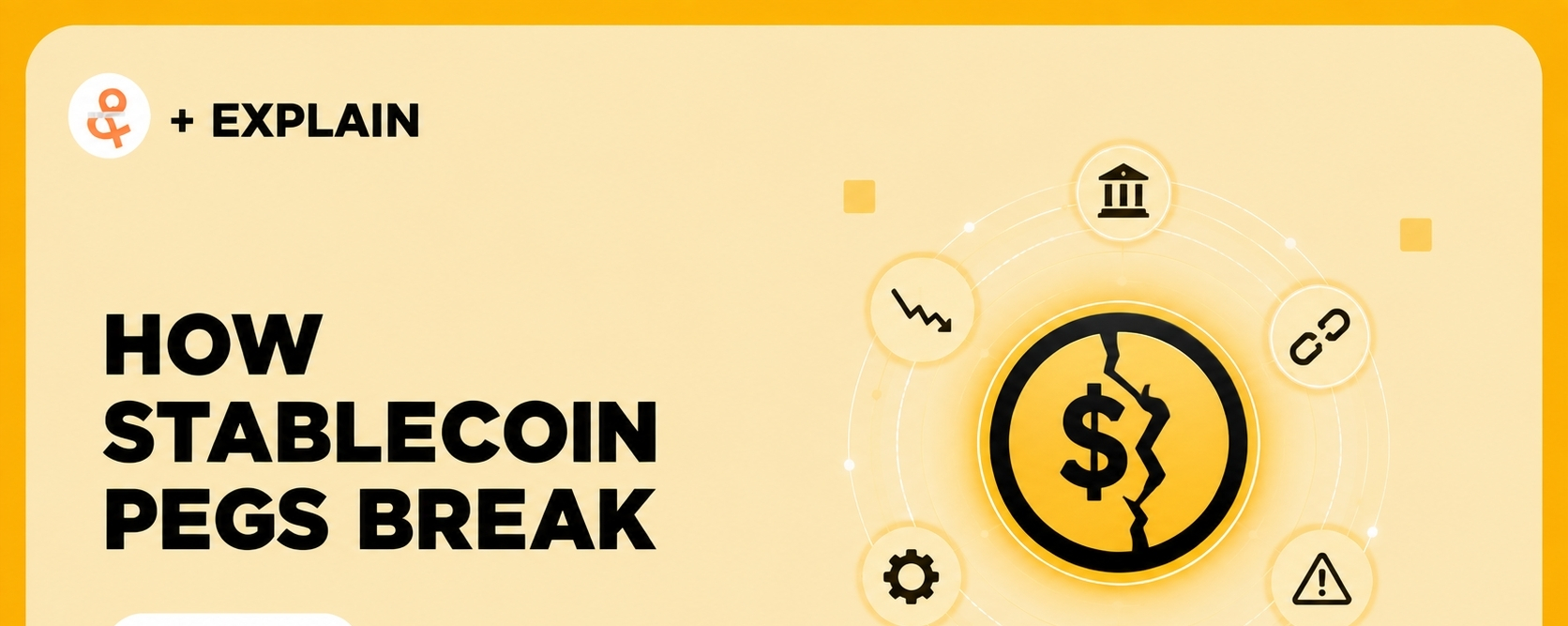
Depegging is when the stablecoin's price breaks away from $1, usually downward, turning your "stable" asset into a volatile mess. For yield-bearing stablecoins, this risk is amplified because the yield mechanisms can actually accelerate depegging under stress. October 2025: The Reality Check: Ethena's USDe provided a masterclass in how quickly things can go wrong. During the October crypto liquidation event,$20 billion in positions getting closed,USDe depegged to $0.65 as its basis trade strategy collapsed. coindesk What happened was that funding rates flipped negative (shorts started paying longs instead of the reverse), the delta-neutral strategy that generates USDe's yield stopped working, and panic selling accelerated the depeg. The token recovered to $0.95+ within days, but anyone who needed liquidity during the crisis got crushed. Stream Finance: Total Collapse: November 2025 brought an even worse example. Stream Finance's XUSD depegged to $0.43 after their fund manager lost $93 million on leveraged trades, freezing $160 million in user funds. This wasn't a temporary liquidity crisis,this was protocol death. theblock The Contagion Effect: Moody's reported 800+ depeg events in 2024-2025, up from 600 in 2023. When one yield-bearing stablecoin depegs, it creates doubt about the entire category. USDe's October crisis wiped $19 billion in crypto liquidations and reduced yield-bearing TVL by 40-50% temporarily. Why Yield Makes It Worse: Traditional stablecoins like USDC can survive runs because they hold actual dollars. Yield-bearing stablecoins often hold more complex assets (staked ETH, Treasury tokens, basis trade positions) that can't be liquidated instantly at face value during stress. The feedback loop is vicious: depeg concerns cause selling, selling creates liquidity pressure, liquidity pressure forces fire sales of underlying assets, fire sales worsen the depeg. Rinse and repeat until either the protocol dies or market conditions stabilize. III. Yield Sustainability Collapse High yields in crypto often signal high risks, and yield-bearing stablecoins are no exception. The yields come from real economic activity, but that activity can disappear quickly during downturns. The Basis Trade Unwinding: Ethena's 25% yields earlier in 2025 came from basis trades that work great in bull markets but can invert during stress. When futures premiums disappear or go negative, the entire yield mechanism breaks down. October's event showed this clearly,funding rates that had been consistently positive for months suddenly flipped, wiping out the yield advantage overnight. DeFi Lending Collapse: Yields from protocols like Aave fell from 12% to 4-6% during H1 2025 as borrowing demand dried up. When fewer people want leverage, lenders earn less. This affects protocols like syrupUSDC that depend on sustained borrowing demand from institutions. RWA Interest Rate Exposure: Treasury-backed stablecoins like USDY are directly exposed to Federal Reserve policy. If rates drop to zero (like they did in 2020-2021), the yield advantage disappears. The protocol still works, but the economic incentive to hold yield-bearing stablecoins over regular ones evaporates. Real Numbers: Basis trade failures contributed to 20% of 2025's $2.47 billion in crypto losses. Ethena's insurance fund had to cover $100 million in potential shortfalls when their strategies stopped working temporarily. IV. Regulatory Pressure and Uncertainty The regulatory environment around yield-bearing stablecoins is evolving rapidly, and not always in favor of innovation. The GENIUS Act passed in July 2025 created clarity but also restrictions that could limit future growth. Direct Yield Bans: The GENIUS Act prohibits direct yield payments to consumers, forcing protocols to use wrapper tokens (like sUSDe wrapping USDe). This adds complexity and potentially reduces adoption among less sophisticated users who just want simple yield without understanding the technical differences. EU Enforcement: Post-MiCA implementation, Binance delisted non-compliant USDT in the European Union, reducing its EEA trading volume by 20%. Circle's MiCA license helped USDC grow to $61 billion in supply, but compliance costs are substantial and favor large issuers. Banking Industry Pushback: Traditional banks are lobbying aggressively against stablecoin yields, arguing they create unfair competition for deposit-gathering. The Bank Policy Institute proposed extending GENIUS Act restrictions to exchanges, which could effectively kill yield-bearing stablecoins for U.S. users. Offshore Risks: Protocols operating offshore (like Tether's 4% yield programs) face increasing SEC scrutiny. Proposed fines exceeded $100 million in 2025, and global regulatory coordination could squeeze non-compliant issuers entirely. Market Bifurcation: Regulation is splitting the market between compliant protocols (USDC, PYUSD) that captured 50% growth and non-compliant ones that lost 10% market share. This creates a two-tier system where regulatory compliance becomes the primary competitive advantage. V. Counterparty and Custodial Risks Yield-bearing stablecoins often depend on third parties,custodians, fund managers, exchanges,that introduce single points of failure absent in simpler protocols. The Stream Finance Disaster: The $93 million fund manager loss wasn't a smart contract bug or market volatility,it was human error and potential fraud. Someone made leveraged bets with user funds and lost, highlighting how yield strategies can introduce counterparty risks that don't exist with simple stablecoin holdings. Exchange Dependency: Ethena's delta-neutral strategies depend on exchanges like Binance and Bybit for futures positions. When Bybit suffered a $1.5 billion hack in February 2025, it didn't directly impact USDe (the positions were secured), but it demonstrated how dependent these protocols are on external infrastructure. Custody Concentration: RWA-backed stablecoins like USDY depend on custodians to hold the underlying Treasury bills. If BlackRock's custody systems fail or face regulatory action, the entire protocol could freeze. This is traditional finance risk imported into DeFi. H1 2025 Numbers: $2.47 billion in total crypto losses, with 60% attributed to counterparty issues including exchange hacks, custody failures, and fund manager fraud. Yield-bearing protocols were disproportionately affected because of their reliance on external partners. VI. Liquidity Crises During stress events, yield-bearing stablecoins can become illiquid precisely when users need to exit most urgently. This creates death spirals where illiquidity feeds depegging which feeds more illiquidity. Market Depth Problems: USDe's October depeg saw 40% slippage on Binance because sell orders overwhelmed available liquidity. For context, USDC rarely sees more than 0.1% slippage even during major market events because of its deep, distributed liquidity. Redemption Delays: Many yield-bearing stablecoins have redemption mechanisms that work fine during normal conditions but break down under stress. Daily redemption limits, processing delays, and minimum redemption amounts can trap users when they need liquidity most. Cross-Chain Complexity: Multi-chain protocols face additional liquidity fragmentation. USDY operates across Ethereum, Stellar, and Sei, but liquidity isn't always balanced across chains. Users might find deep liquidity on Ethereum but thin markets on other chains. Cascade Effects: When one major holder (like an institution) needs to exit, it can consume available liquidity and trigger a cascade of redemptions. This affected $300 million in TVL during 2025's depeg events. The brutal reality is that yield-bearing stablecoins introduce multiple new failure modes while often providing only modest yield premiums over traditional alternatives. For institutional treasury management, the risk-adjusted returns might not justify the complexity. But for users who understand the risks and size their positions appropriately, these protocols offer genuine innovation in programmable money. The key is avoiding the yield-chasing mentality that drove much of 2025's losses and focusing on protocols with sustainable business models and strong risk management.
The market is maturing,protocols with real revenue, conservative risk management, and regulatory compliance are separating from the yield-farming casinos. But caveat emptor remains the rule.
The $HEMI Virtual Machine (hVM) is an advanced execution environment that embeds a full, indexed Bitcoin node directly within the Ethereum Virtual Machine (EVM). This integration creates a "Bitcoin-aware" smart contract platform where developers can use standard Solidity code to directly query Bitcoin’s state, such as transaction history and UTXO data, without relying on external oracles or relayers.
By synchronizing all @Hemi nodes with a "Processed Bitcoin View," the network ensures that these queries remain deterministic and secure across the entire ecosystem, effectively allowing Bitcoin to function as a native asset for complex DeFi applications.
hBitVM (or the Hemi Bitcoin Virtual Machine) serves as the network's security and bridging layer, specifically designed to secure the "Tunnels" that connect Bitcoin and Ethereum. It utilizes a "1-of-N" trust model based on the BitVM2 concept, ensuring that assets locked in the bridge remain secure as long as at least one participant acts honestly.
ALERT: TRUST WALLET EXTENSION COMPROMISED - Trust Wallet confirms a security incident affecting its Chrome browser extension v2.68, following reports of user funds being drained.
The team has urged users running v2.68 to disable the extension immediately and upgrade to v2.69. Mobile-only users and all other extension versions are not affected.
"Hey Bro, Tell me one thing How Do Smart Contracts Work? I don't Fully Understand" Bro, you know the difference between buying a Coke from a Shopkeeper and buying one from a Vending Machine?
...With the Shopkeeper, you have to trust him. You hand him the cash, and he might give you the Coke, or he might say "Wait, I need more money," or he might just close the shop and leave. There is a human in the middle.
...With the Vending Machine, there is no human. There is only a hard rule: IF $2 is inserted AND Button A1 is pressed THEN drop the Coke. It doesn't care who you are, it doesn't get tired, and it can't change its mind. That Vending Machine is a Smart Contract. A Smart Contract is just a digital Vending Machine living on the blockchain. It holds funds (like the machine holds sodas) and follows strict instructions written in code.
The Trigger: You send money or data (Insert Coin).The Logic: The code checks if you followed the rules (Did you pay enough?).The Action: It automatically releases the token, NFT, or funds (Drops the Coke). It removes the "Middleman Risk." You don't need a lawyer or a bank to promise they will pay you. The code guarantees it. Okay, but how does it actually work? Here are a couple of details that didn't fit the simple analogy:
Immutability: Once you put the Vending Machine on the blockchain, you can't easily change the prices or swap the Coke for Pepsi. The code is "sealed." This is great for trust (the dev can't rug you easily), but bad if there is a bug (you can't just "patch" it like a normal app).Gas Fees: A real Vending Machine needs electricity to run. A Smart Contract needs "Gas" (ETH, SOL) to run. Every time you push a button (interact), you have to pay a tiny fee to the network to power that computation. Why does this matter? It lets strangers do business without knowing or trusting each other.
If we bet on a football game, we don't need to trust each other to pay up. We lock our money in a Smart Contract that says: "Check ESPN score. If Team A wins, send all money to Bro A." It happens automatically. No cheating possible.
• CZ proposes wallet fixes after major USDT scam • Pudgy Penguins take over Las Vegas Sphere • $BTC Bitcoin flash crashes on thin liquidity pair • Crypto derivatives volume hits new record • Crypto M&A activity reaches record $8.6B • Pressure mounts in U.S. for comprehensive crypto bill • $XRP spot products surpass $1.25B AUM
Polymarket is widely considered easy to use due to an intuitive, ultra-fast web and mobile interface that simplifies complex prediction trading into straightforward "Yes" or "No" shares. In 2025, the platform has improved accessibility by allowing users to sign up with a standard email or link common crypto wallets like MetaMask or Other Wallet.
While it requires the stablecoin USDC on the Polygon network to trade, it offers integrated onboarding solutions, including deposits via debit card or PayPal, which help beginners navigate the initial cryptocurrency hurdles.
Its competitive edge in 2025 remains its zero-fee structure for trading, depositing, and withdrawing, making it more cost-effective than traditional centralized alternatives. They just broke the barrier of complex things and that makes the platform easy to use despite the crypto part.
$IOTA been one of the superlative project who continuously shipping in 2025. Their RWA roadmap is too good. And their ADAPT Partnarship is transforming both RWA sector and Africa.
The @IOTA ADAPT Partnership in Africa is a major initiative led by the IOTA Foundation with the African Continental Free Trade Area (AfCFTA), Tony Blair Institute for Global Change, and World Economic Forum to build a shared digital infrastructure for pan-African trade.
They're aiming to double intra-African trade by 2035 by connecting data, identities, and payments seamlessly, reducing costs, and streamlining processes using IOTA's decentralized tech. Pilots are already live in countries like Kenya, Ghana, and Rwanda, establishing a unified network for goods, data, and money flow.
- Polymarket been the dominant force of prediction market since day 1. This is one of the biggest wins of Crypto in 2025. Every single events are influenced by polymarket and the numbers are witness of this.
The 2025 numbers are Crazy, It boasted over 250–500k monthly active traders, a projected $18B in trading volume for 2025, and over 17M monthly website visits.
The biggest win here is it's usability & simplicity. Polymarket been the source of majority defi activity in polygon. And now it's spreading among others.
It's $POLY token is one of the most anticipated crypto TGE. Experts saying it could be the biggest Airdrop in crypto. You can safely position yourself by making bets and using polymarket.
What is Binance "Anti-Phishing Code" and How to Set It Up
400 Million. That's the staggering amount stolen by crypto phishers in just the second quarter of 2025 alone.
We've all felt that jolt of panic. You post a simple question on Twitter or Telegram about a stuck transaction, and within seconds, a DM lands in your inbox. The profile picture is a perfect Binance logo. The username is "Binance_Support_Agent_117." The message is professional, polite, and helpful. They tell you your account has been flagged for a "security review" or your funds are "at risk" and that you need to act immediately. They just need you to "verify your wallet" on a special support portal, a link they've conveniently provided.
This is the new face of crypto theft. It's a social engineering scam, and it's devastatingly effective. Recent reports show these "impersonation" scams are a multi-billion dollar industry, with total losses in the first half of 2025 exceeding $2.5 billion. Scammers are now using AI-generated scripts and "smishing" (SMS phishing) to build trust and exploit your panic. They aren't hacking the system; they are hacking you. They are relying on your fear to trick you into willingly handing over your login. But there is a simple, 60-second setup that makes you completely immune to their most powerful weapon. This guide will break down the Anti-Phishing Code, a feature that acts as your personal "safe word" with Binance. II. What is the Anti-Phishing Code? Binance's Anti-Phishing Code is essentially a personalized security fingerprint that acts as your first line of defense against scammers trying to trick you. Think of it as a secret handshake between you and Binance - only legitimate messages from the platform will include this special code that you create. The code itself is a unique combination of 6 to 8 characters that you choose, mixing uppercase letters, lowercase letters, numbers, and underscores. For example, you might create something like "Safe2025" or "MyCode_1". Once you set it up, every single authentic email and SMS message from Binance will automatically include your personalized code at the end.
What makes this feature particularly powerful is its simplicity. You don't need any technical knowledge to use it effectively. When you receive a message claiming to be from Binance, you simply look for your code at the bottom. If it's there and matches exactly what you set, the message is genuine. If it's missing or incorrect, you know immediately that it's a scam attempt. The feature was initially launched for emails but was expanded in 2025 to include SMS messages in select regions due to the rising threat of "smishing" (SMS-based phishing). This expansion came as a direct response to the increasing sophistication of scammers who were exploiting text messages to impersonate Binance customer support. III. How Anti-Phising Code Gives an Extra Layer of Security The Anti-Phishing Code creates a protective barrier that scammers simply cannot replicate without accessing your actual Binance account. This additional security layer works by providing instant verification of communication authenticity, which is crucial in an environment where crypto losses are often permanent and irreversible.
Key Security Benefits: Immediate Visual Verification: Unlike complex security protocols that require technical understanding, the Anti-Phishing Code offers instant recognition. You can spot fake messages within seconds of receiving them, preventing the initial engagement that often leads to successful scams.Protection Against Social Engineering: Scammers frequently exploit urgency and fear to bypass logical thinking. The code acts as a forced pause mechanism - if you train yourself to always check for it, you create a mental barrier against impulsive responses to urgent-sounding messages.Complementary Defense System: The code works alongside other security features like two-factor authentication (2FA) and withdrawal whitelisting to create multiple layers of protection. While 2FA secures your account access, the Anti-Phishing Code specifically targets communication-based threats.Adaptation to Evolving Threats: As scamming techniques become more sophisticated, including AI-generated content and deepfake technologies, having a simple verification method becomes increasingly valuable. The code provides a low-tech solution to high-tech problems.User Education Enhancement: The feature naturally increases awareness about phishing attempts. Users who actively check for their code develop better security habits and become more vigilant about suspicious communications overall. The importance of this extra layer becomes clear when considering recent statistics. In the first half of 2025 alone, crypto-related security incidents resulted in nearly $2.5 billion in total losses, with phishing attacks responsible for approximately $400 million in the second quarter. These numbers represent real people losing their life savings to increasingly sophisticated scam operations. IV. How Anti Phishing Code Works The Anti-Phishing Code operates on a simple but effective principle: creating a unique identifier that only you and Binance know. Understanding how it works helps you use it more effectively and appreciate its security value.
❍ The Technical Process: When you create your code, Binance stores it securely in your account settings, encrypted and tied to your specific user profile. Every time the system generates an outgoing email or SMS to your registered contact information, it automatically appends your personalized code to the message. The process is entirely automated - you don't need to do anything except check for its presence. The code appears in a standardized format, typically at the end of messages. In emails, you'll see it after the main content and signature, formatted as "Anti-Phishing Code: [YourCode]". For SMS messages, it appears similarly: "Anti-Phishing Code: YourCode123". This consistent formatting makes it easy to locate and verify. ❍ Why Scammers Cannot Replicate It: Scammers face an impossible challenge when trying to include your Anti-Phishing Code in their fake messages. To obtain your code, they would need direct access to your Binance account, which would require bypassing multiple security layers including your password and 2FA. If they had that level of access, they wouldn't need to send phishing messages - they could simply access your funds directly. This creates what security experts call an "asymmetric advantage" - you have easy access to verify authenticity, while attackers cannot feasibly replicate the verification method. Even if scammers somehow obtained old emails containing your code, they would still face the challenge that users are encouraged to update their codes regularly. ❍ Integration with Communication Systems: The code works seamlessly across different communication channels. For emails, it integrates with Binance's automated email system, appearing in everything from login alerts to withdrawal confirmations. The SMS integration, launched in 2025, covers security notifications and account alerts in supported regions. Importantly, the code doesn't interfere with the actual content or functionality of messages. It simply provides an additional verification element that doesn't affect delivery speed or readability. The system also maintains consistency - once you set a code, every legitimate message will include it until you choose to change it. ❍ Verification Process: When you receive any message claiming to be from Binance, the verification process is straightforward. Look at the end of the message for the specific format "Anti-Phishing Code:" followed by your exact code. The code must match character-for-character, including capitalization and any special characters you included. If the message lacks the code entirely, contains an incorrect code, or shows the right code but in the wrong format, treat it as suspicious. This black-and-white verification method eliminates guesswork and provides clear guidance for users of all technical skill levels. V. How To Set-up Anti-Phishing Code On Binance Setting up your Anti-Phishing Code is a straightforward process that takes just a few minutes but provides long-term security benefits. The setup process is nearly identical across both the mobile app and web platforms, with slight navigation differences. ❍ Prerequisites Before Setup: Before beginning the setup process, ensure you meet these basic requirements. First, you must have an active Binance account with verified email and phone number. Two-factor authentication (2FA) must be enabled, as you'll need it to verify the code creation. This can be Google Authenticator, SMS-based 2FA, or passkey authentication. Make sure you're using official Binance platforms - the authentic app from Google Play Store or Apple App Store, or the verified website at binance.com. Avoid any third-party apps or websites that might be imposters. Finally, choose your code in advance. Remember, it must be 6-8 characters long and include at least three of these elements: uppercase letters, lowercase letters, digits, and underscores. ❍ Mobile App Setup (iOS and Android):
Open your Binance app and log in with your credentials.Once logged in, tap the menu icon in the top-left corner (three horizontal lines), then tap on your profile icon to access the "Account Info" section.From the Account Info screen, select "Security" to view all available security options.Scroll down until you find "Anti-Phishing Code" in the security options list. If you haven't set one up before, you'll see a "Create" button next to it.Tap "Create" to begin the setup process. You'll be taken to a new screen with an input field for your code.Enter your chosen 6-8 character code in the provided field. The app will show you the requirements as you type.Once you've entered a valid code, tap "Submit". The system will then prompt you to verify the setup using your chosen 2FA method.Complete the 2FA verification by entering the code from your Google Authenticator app, SMS, or using your passkey.After successful verification, you'll see a confirmation message: "Anti-Phishing Code created successfully". The feature is now active. ❍ Web Version Setup: For the web setup, navigate to the official binance.com and log into your account. Complete any 2FA verification if prompted.Once logged in, locate your profile icon in the top-right corner of the page and hover over it to reveal a dropdown menu.Click "Account" from the dropdown menu to access your account settings.On the Account page, click the "Security" tab to view security options.Scroll down to the "Advanced Security" section where you'll find the "Anti-Phishing Code" option with an "Enable" button next to it.Click "Enable" to start the creation process, then click "Create" on the confirmation screen.You'll see an input field where you can enter your 6-8 character code. Type your chosen code, ensuring it meets the displayed requirements.Once you've entered a valid code, click "Submit" to proceed.You'll be prompted to complete 2FA verification using your preferred method. After entering the correct 2FA code, you'll receive a confirmation message: "Anti-Phishing Code enabled". The setup is now complete. ❍ Verification After Setup: To verify that your Anti-Phishing Code is working correctly, you can trigger a test email from Binance. One simple way is to change a minor account setting (like notification preferences) that generates a confirmation email. Check the email you receive - your code should appear at the bottom in the format "Anti-Phishing Code: [YourCode]". You can also verify the setup by checking your Security settings in either the app or web version. The Anti-Phishing Code section should now show "Enabled" with an option to "Change" rather than "Create". If you don't see this status, repeat the setup process. ❍ Updating or Changing Your Code: Security experts recommend updating your Anti-Phishing Code monthly or whenever you suspect it might have been compromised. To change your code in the mobile app, go to Menu → Profile → Account Info → Security → Anti-Phishing Code, then tap "Change Anti-Phishing Code". For the web version, navigate to Profile → Account → Security → Advanced Security, then click "Change" next to Anti-Phishing Code. In both cases, you'll need to enter a new 6-8 character code and verify the change with 2FA. The old code becomes invalid immediately after successful verification. ❍ Common Setup Mistakes to Avoid: Many beginners make preventable mistakes during setup. Avoid using simple codes like "123456" or personal information like birthdates. Don't share your code with anyone, including people claiming to be Binance support staff. Make sure to write down your code in a secure location, as you'll need to remember it to verify messages. Another common mistake is not enabling 2FA before attempting setup. The Anti-Phishing Code requires 2FA verification, so this must be configured first. Also, ensure you're using the official Binance platforms - fake apps and websites are common and can steal your information during what appears to be legitimate setup processes. Finally, don't forget to actually check for your code when receiving messages. The feature only provides security if you actively use it to verify communications. Train yourself to automatically look for the code before clicking any links or responding to urgent-sounding messages from Binance.
- • $BTC Adam Back dismisses Bitcoin quantum computing fears • Terraform administrator sues Jump over Terra collapse • SEC seeks industry bans for former FTX executives • Galaxy predicts stablecoins overtake ACH by 2026 • VanEck updates Avalanche ETF filing to include staking • $TRX TRON bridges onto Coinbase Base network
2025 is about to end and we haven't got the most awaited “elixir” for crypto Bros, - Altseason. If you invested in a timely manner you might've got some gains in your pocket, thanks to narratives and crazy performance of some sectors. Apart from Bitcoin and some Blue-chips, the market didn't give anyone mercy. But, in crypto the opportunity is everywhere and sometimes it's hiding below those big coins. Low-cap coins are considered as very much risky Play by pundits but they come with a more lucrative possibility of winning. Here is our list of 5 Low-Cap Altcoins You must Keep in your Watchlist.
Aerodrome (AERO) Aerodrome Finance operates as the central liquidity hub on Base, Coinbase's Layer 2 network. We Already Talked About Aerodrome in our Project Spotlight Report. The protocol functions as an automated market maker (AMM) that uses a vote-escrowed governance model, where users lock AERO tokens to receive veAERO, granting them voting power over emissions directed to various liquidity pools. This mechanism creates incentives for protocols to accumulate voting power and direct liquidity rewards toward their own pools, generating a competitive flywheel effect for liquidity providers. The platform has secured strategic backing from the Base Ecosystem Fund and operates with a circulating supply of approximately 906 million AERO out of a total 1.8 billion tokens. Recent exchange expansion includes a Robinhood spot listing added in early December 2025 and Hyperliquid perpetual futures support launched in November, providing broader accessibility across both centralized and decentralized venues. Okey, the development momentum accelerated in November 2025 when Dromos Labs announced a merger plan to create a new Aero protocol targeting Ethereum mainnet expansion by Q2 2026. The team also introduced Aero Ignition in October, a token launch tool designed for liquidity bootstrapping on Base. These initiatives position the protocol for cross-chain expansion beyond its current Base-native operations. Protocol metrics demonstrate consistent activity with total value locked around $472 million and 24-hour DEX volumes reaching $618 million as of mid-December 2025. The emissions model continues distributing approximately 33.8 million AERO weekly, primarily through gauge-based rewards that incentivize liquidity provision across selected pools. Virtuals Protocol (VIRTUAL) Virtuals Protocol represents an emerging category focused on AI agent infrastructure, where autonomous agents operate as tokenized entities within an onchain ecosystem. The platform centers around its ACP (Agent Contribution Protocol) payment layer, which facilitates transactions between AI agents and users. Each agent can earn revenue through services, with activity tracked through what the protocol terms "agentic GDP," which reached $370 million by December 2025. The protocol launched with a $16 million initial offering and has since expanded to major exchange listings including Binance and other major Exchanges . The VIRTUAL token maintains a 1 billion total supply with approximately 656 million in circulation, serving both governance functions and as the payment medium within the agent economy. Recently they climbed a significant leap in December when they released x402 v2 for agent deployment and integration of a Base-Solana asset bridge enabling cross-chain agent operations and token launches. Read More About x402 . A notable partnership with OpenMind AGI, announced mid-December, extends the ACP framework to embodied AI robotics applications, expanding beyond purely digital agents. The ecosystem reportedly supports over 20 active agent projects implementing features ranging from Hyperliquid perpetual trading to fund marketplace infrastructure. The protocol experienced a security incident in November 2025 involving a rogue agent exploit but resolved it with full $531,000 user reimbursement, demonstrating operational resilience. Current metrics show 24-hour fees around $40,000 and daily active addresses averaging over 3,400, indicating sustained developer and user engagement. The platform's Butler agent integration provides enhanced agent coordination capabilities within the expanding ecosystem. Aave (AAVE) Aave operates as one of DeFi's largest non-custodial lending and borrowing protocols, enabling users to supply assets to liquidity pools and borrow against collateral across multiple blockchain networks. The protocol uses an overcollateralized model where borrowers must maintain specific loan-to-value ratios to prevent liquidation. Aave has evolved through multiple iterations, with governance controlled by AAVE token holders who vote on protocol parameters, risk frameworks, and treasury management. The platform maintains a total value locked around $33.7 billion as of mid-December 2025, generating daily fees near $2.9 million across its various deployment networks. The token has a maximum supply of 16 million with approximately 15.2 million currently circulating, with daily unlocks of roughly 1,224 AAVE continuing through the vesting schedule. Recent institutional activity includes a notable whale deposit of $1 billion USDT in mid-December 2025, signaling continued confidence in the protocol's core money market utility. Development priorities center on the V4 upgrade currently in testnet phase, introducing modular liquidity infrastructure with a Hub-Spoke architecture designed to improve capital efficiency and cross-chain operations. The protocol deployed on Mantle Layer 2 in early December 2025, specifically targeting real-world asset (RWA) lending markets. Aave also issues GHO, an overcollateralized stablecoin, adding another dimension to its product suite. Governance dynamics became contentious in mid-December 2025 when the Aave DAO raised concerns about approximately $10 million in annual fees allegedly diverted by Aave Labs through CoW Swap routing, highlighting ongoing debates around protocol value capture and stakeholder alignment. Despite short-term governance friction, community sentiment remains focused on fundamental strength, with discussions emphasizing revenue leadership among DeFi protocols and expanding accessibility through new exchange-traded product listings. Pendle (PENDLE) Pendle Protocol specializes in yield tokenization, splitting interest-bearing assets into two components: principal tokens (PT) representing the underlying asset and yield tokens (YT) representing future yield streams. This separation enables sophisticated strategies including fixed-yield positions for risk-averse participants and leveraged yield exposure for those seeking amplified returns. The protocol supports assets across Ethereum, Arbitrum, Optimism, and BNB Chain, with markets for liquid staking derivatives, lending protocol yields, and real-world asset positions. The platform reported record 2025 performance metrics in early December: average total value locked of $5.8 billion (up 79% year-over-year), peak TVL of $13.4 billion, and trading volume of $47.8 billion (up 36.5% year-over-year). These figures generated approximately $40 million in annualized revenue. Current TVL stands around $3.7 billion with daily active users near 700, maintaining concentrated but engaged user activity. Product expansion accelerated with the launch of Boros, a funding-rate derivatives platform that achieved $80 million in open interest and $5.5 billion in notional volume during early operations. The protocol also signaled entry into Solana's ecosystem with a fixed-yield product teased in mid-December 2025. A partnership with Galaxy Digital announced in November focuses on delivering onchain fixed-income exposure through Pendle's yield tokenization infrastructure, targeting institutional participants. The PENDLE token operates with approximately 164 million circulating out of a 281 million total supply, using vePENDLE for governance where longer lock periods grant higher voting weight. Daily unlocks average around 17,000 PENDLE, with liquidity incentives structured to decay weekly through 2026, creating predictable emission schedules for stakeholders evaluating long-term positions. Basic Attention Token (BAT) Basic Attention Token powers the Brave browser's privacy-centric advertising ecosystem, functioning as the medium of exchange between advertisers, publishers, and users. The model rewards users with BAT for viewing opt-in advertisements while compensating content creators based on attention metrics. This approach attempts to realign incentives in digital advertising by removing intermediary data harvesting and giving users control over their attention and data privacy. The token operates as an ERC-20 asset with bridges to multiple chains including Solana. Brave browser adoption has expanded to 101 million monthly active users as of early December 2025, providing the fundamental user base that drives BAT's utility for ad rewards and creator tipping. The browser integrates Leo, an AI assistant that added a Skills feature in early December for enhanced prompt-based task execution, expanding functionality beyond basic browsing privacy. This user growth creates network effects as more advertisers gain access to engaged audiences willing to participate in the attention economy model. Upcoming roadmap initiatives include Brave Games launching in January 2026 with BAT reward integration, Solana self-custody payout implementation planned for Q4 2025, and Ethereum Fusaka integration scheduled for December 2025. These developments aim to expand BAT's utility across gaming, improve cross-chain functionality, and enhance network compatibility. The token maintains near-complete circulation with approximately 1.496 billion of 1.5 billion maximum supply already distributed, minimizing future dilution concerns. Community activity around BAT emphasizes the token's established utility rather than speculative positioning, with narratives focusing on privacy-focused sector overlap and real user monetization potential. The token experienced a 30-day gain of approximately 40% through mid-December 2025, supported by technical breakout patterns and consolidation near resistance levels. Brave Software, led by founder and CEO Brendan Eich (creator of JavaScript and co-founder of Mozilla), continues developing the ecosystem with strategic integrations designed to expand BAT's use cases while maintaining privacy-first principles.
Explain Like I'm Five : Modular and Monolithic Blockchains
"Hey Bro, I saw some modul or something Blockchain. What's the difference between Modular and Monolithic Blockchains?" Yes, bro these are two primary types of Blockchain. Monolithic Blockchains are classic Blockchains like Bitcoin and Modular Blockchains are like Celestia or the new Ethereum setups.
Have you seen a Pani puri seller on the market? It's always crowded. One guy literally manages 10-12 customers at the same time, remembering the counts, each person's choice, and everything. It's a messed up process and somehow it slows down the process. This is our Monolithic Blockchain, where the one layer does everything, execution, settlement, and data storage, so we get high fees and slow speeds when it gets busy.
Now, compare that to a massive Wedding Chaat Counter. You don't see one guy struggling there. You see an assembly line: one guy punches the puri, another stuffs the masala, a third dips the pani and serves, and a totally separate guy handles the coupons and cash. That is a Modular Blockchain. "But wait, does splitting it up actually make it faster?"
100%. Think about it, the guy serving the pani doesn't have to wash his hands and count dirty cash after every plate. He just serves. In crypto, this means we split the Execution (making the transaction happen fast on Layer 2) from the Settlement (finalizing the security on Layer 1). The server serves, the cashier counts. "Okay, but is it safe? What if the server messes up?" That’s the beauty of it. The wedding server doesn't need to be a security guard. He just hands over the slip to the main cashier (Layer 1) at the end of the shift. If the Main Cashier (like Ethereum) is secure, the whole system is secure. The fast layers "inherit" the security of the slow, heavy layer. "So is the Wedding Counter perfect? What's the catch?" The catch is the "gap." At the roadside stall, you pay and eat instantly. It's seamless. At the wedding counter, you have to get a coupon, walk over, wait for the server... there are extra steps. In crypto, moving money between these different modular layers requires "Bridges," and bridges can be annoying or risky. It feels less "all-in-one" than the old school way. "Why do we need this then?" Because the roadside stall collapses if a thousand people show up. The Wedding Counter is designed specifically for crowds. It’s the only way to get crypto ready for a billion users without fees jumping to $50 per transaction.
During 2021 Bullrun Dogecoin vastly outperformed bitcoin over 1000%. The DOGE/BTC ratio went mad and since then we haven't seen anything like that in crypto. Dogecoin was a classic meme on the internet featuring a dog image. The sensation got more traction when it became a Cryptocurrency and Big names like Elon musk publicly endorsed it. “DOGE TO THE MOON” became a crypto anthem for believers and From Talk show to SNL Dogecoin was literally everywhere. After it's ATH 0.73 many believers and pundits believed that it'll easily cross 1$, and that could've one of the most significant leap in crypto history. The dream is still intact but now more blurry and full of hurdles. Recently a sudden spike on Dogecoin on-chain metrics ignited the spark and people again started believing. Here's our take on this… ❍ Current DOGE Activity: Dogecoin is currently exhibiting classic signs of a "sleeping giant" beginning to stir, but the on-chain data paints a more complex picture than just a simple price pump.
According to recent data from IntoTheBlock and Santiment, Dogecoin’s daily active addresses have spiked to over 67,000, (vary date to date) marking a definitive three-month high. This metric is critical because it filters out pure price speculation and reveals actual network utility, people are logging in, moving coins, and transacting. Historically, a divergence where network activity rises while price remains stagnant (currently consolidating around $0.14 - $0.15) often precedes a significant volatility event. However, the "supply wall" remains the elephant in the room. Data from Messari and Dune Analytics highlights the sheer weight of Dogecoin's inflationary model. With a circulating supply now exceeding 168 billion DOGE, the network adds approximately 5 billion new coins annually. For the price to hit $1.00, the market cap would need to swell to roughly $168 billion, a figure nearly equivalent to the valuation of massive corporations like Disney or Sony. The holder distribution shifted notably. Whales offloaded roughly 7 billion DOGE over late 2025, with those coins moving to smaller investors and retail holders. Addresses holding between 0-100 DOGE now control over 50% of the supply, up from previous periods. One major address still holds about 23% of total supply (around $4.25 billion at recent prices), and the top 15 addresses control roughly half. Most of those belong to exchanges like Binance , which skews the concentration metrics. Supply dynamics remain unchanged. The network continues adding exactly 5 billion new DOGE per year through block rewards of 10,000 DOGE per block. Over the last 90 days, about 1.25 billion new tokens entered circulation. With 152.47 billion DOGE circulating out of a total 192.44 billion supply, the inflation rate sits at 2.6% annually. That number will keep falling as the base grows, but the absolute issuance never changes. December alone will add 424.7 million DOGE to circulation by month's end.
Transaction volume has also seen a 61% surge in early December 2025, driven largely by whale accumulation. CryptoQuant data indicates that large holders (wallets holding >10 million DOGE) have added over 300 million coins in the last week alone. This suggests that while retail traders are hesitant, "smart money" is positioning for a move, treating the $0.14 level as a robust accumulation zone. ❍ Historical Context: To understand if $1 is realistic, we have to look at some key events of Dogecoin's past.
In May 2021, Dogecoin reached its All-Time High (ATH) of $0.73, driven by a perfect storm of zero-interest-rate policies, stimulus checks, and Elon Musk’s Saturday Night Live appearance. At that peak, DOGE commanded an $88 billion market cap. Today, sitting at roughly $21 billion, it is down over 80% from those highs. The context, however, has shifted. In previous cycles, DOGE rallies were often short-lived "pump and dumps." The current chart structure is different. Dogecoin has spent nearly two years building a massive base of support between $0.06 and $0.10. Technical analysts often refer to this as a "long accumulation phase." If history rhymes, the breakout from such a prolonged slumber is typically explosive, though often slower to start than impatient traders would like. The peak however came May 4-8, 2021. Price surpassed $0.50, reaching an all-time high between $0.68 and $0.73 depending on the exchange. Market cap topped $85 billion. Those gains came almost entirely from Musk's Twitter activity and mainstream media coverage. His April 15 "Doge Barking at the Moon" tweet drove a 100% single-day gain. The May 9 announcement of SpaceX's DOGE-1 moon mission kept momentum going. Other catalysts popped up sporadically. Tesla started accepting Dogecoin for merchandise on December 14, 2021, pushing price up 20%. When Twitter changed its logo to the Doge meme on April 3-7, 2023, price jumped 30%. More recently, Trump's November 14, 2024 announcement of a Department of Government Efficiency (D.O.G.E.) with Musk's involvement caused another spike. Comparing this to the 2017 and 2021 cycles, we see that Dogecoin typically moves last in a crypto bull run. Bitcoin breaks highs first, capital rotates to Ethereum, and finally, profits flow into high-risk, high-reward assets like DOGE. With Bitcoin currently testing its own resistance, Dogecoin’s sluggishness might be just following its standard historical performance. ❍ Factors That Could Fuel a Rally Dogecoin Real-world adoption made incremental progress. Buenos Aires started accepting Dogecoin for municipal taxes including property taxes and fines through QR code payments that convert to pesos. The Dogecoin Foundation plans to release Dogebox in 2025, targeting integration with 1 million retailers for decentralized payments. Tesla continues accepting DOGE for merchandise and supercharging. Airlines like AirBaltic and Alternative Airlines take it for bookings. Retail includes Newegg electronics, Sheetz fuel stations, and Petco supplies. VPN services like ExpressVPN and CactusVPN accept subscriptions in DOGE. But adoption hasn't translated to price momentum. The Buenos Aires news barely moved the needle. Dogebox remains vaporware until actually deployed. Tesla merchandise sales don't publish volume data. These are foundation-building developments, not catalysts strong enough to drive a 7x move in two weeks. Technical patterns offered mixed signals. A symmetrical triangle on daily charts showed $0.14 support holding after the Federal Reserve's rate cut to 3.5-3.75%. A breakout above $0.16 could theoretically target $0.21 based on the pattern's height. Elon Musk's involvement cooled significantly. His recent comments referenced the government efficiency department, not the cryptocurrency. No crypto-specific endorsements appeared in December 2025 searches. Historical precedent shows Musk tweets drove the biggest rallies (January 2021's 339% surge, February's 68% jump, April's 100% spike). Without that catalyst, the meme momentum fades. ETF launches generated minimal impact. Grayscale's GDOG and 21Shares' 2x TXXD both showed low inflows and volumes despite November launches. The meme sector as a whole traded flat. SHIB at $0.000008 and PEPE at $0.000004 didn't get any major narrative to outrun the market. No broad risk-on rally supported meme coins specifically. Macro conditions provided slight tailwinds. The Fed's 25 basis point cut to 3.5-3.75% helped risk assets generally. Bitcoin held above $90,000, though the top 50 crypto market dropped -0.40% in 24 hours. Whale accumulation continued (230 million DOGE worth roughly $50 million moved into large wallets in recent weeks), but that reflected long-term positioning, not imminent price targets. The supply dynamics remain the biggest obstacle. December will add around 424.7 million DOGE through block rewards, with cumulative circulating supply reaching 152.7 billion by month's end. Daily issuance of 13.7 million DOGE continues indefinitely. For price to hit $1, market cap would need to reach $152.7 billion, requiring net buying of roughly $129.6 billion in two weeks (from current $23.1 billion). Even the 2021 peak only reached $85 billion in market cap, and that took months to build with sustained Musk hype, mainstream FOMO, and GameStop-era retail mania. Comparable meme coin rallies don't offer encouragement. SHIB and PEPE rallies tied to major exchange listings or social volume spikes. Dogecoin already trades on every major exchange with 55 trading pairs across 10 platforms. No comparable catalyst exists on the horizon for the rest of the year. A proposal to reduce block rewards from 10,000 to 1,000 DOGE per block circulates in developer discussions, but implementation timeline remains unclear and wouldn't impact December issuance even if approved tomorrow. The path from $0.14 to $1.00 by December 31, 2025 requires either an unprecedented Musk endorsement campaign, a genuine payments breakthrough with massive merchant adoption, or a retail mania that dwarfs even the 2021 peak. Current data shows rising network activity and some whale accumulation, but technical structure is weak, supply pressure is constant, social sentiment is mixed at best, and no catalyst on the near-term horizon matches the scale needed for a 700% move in 2 weeks. The three-month high in active addresses signals renewed interest, but interest doesn't equal the buying power required to overcome 13.7 million new DOGE entering circulation every single day while pushing market cap into uncharted territory. History shows us that Memecoins can be unpredictable, here 500% price rallies in a day are normal and often defines the category itself. But the overall market condition somehow spoiling the party. We aren't sure that Dogecoin will be able to climb the mountain and achieve 1$ mark before the year end but even in the future it pulls off, it'll be one of the greatest comebacks in finance history.
BTCFi is a very early narrative to catch up. The narrative isn't matured enough and we only saw what it could achieve once it drive enough eyeballs.
Hemi is a intresting project in BTCFI, it blends both Ethereum and Bitcoin. By combining Bitcoin's unparalleled security and immutability with Ethereum's flexible smart contract programmability and developer ecosystem. This unified architecture aims to solve the scalability, speed, and interoperability challenges that limit traditional, isolated blockchains.
Hemi creates a "supernetwork" that enables the fluid movement of assets and data between the Bitcoin, Ethereum, and Hemi ecosystems through secure, trust-minimized "Tunnels". This eliminates the fragmentation that divides current blockchain ecosystems and allows for cross-chain applications to be built and used without friction or reliance on risky third-party bridges.
$HEMI used for gas fees, staking (validator rewards), network governance (voting), & incentivizing ecosystem growth, enabling cross-chain DeFi (BTC as collateral for lending/stablecoins), faster/cheaper GameFi & NFT trades, and enterprise solutions like supply chain tracking, facilitating seamless asset flow and composability across blockchains.
Polymarket sentiment is one the crucial thing to check in 2025. From Election results Forecast to Latest celebrity Dating Rumor, PolyMarket is influencing everything. And crypto is the nucleus of the project.
Polymarket now is bigger than many big corporate and it's decentralized nature and easy to use Interface helped it to become the default prediction app in the globe.
The 2025 numbers are fascinating, the company is boasted over 250–500k monthly active traders, a projected $18B in trading volume for 2025, and over 17M monthly website visits.
And the upcoming $POLY token is breaking all the headlines. If everything goes smoothly, it'll be the biggest opportunity for airdrop hunters as polymarket could offer free airdrop to its active traders.