
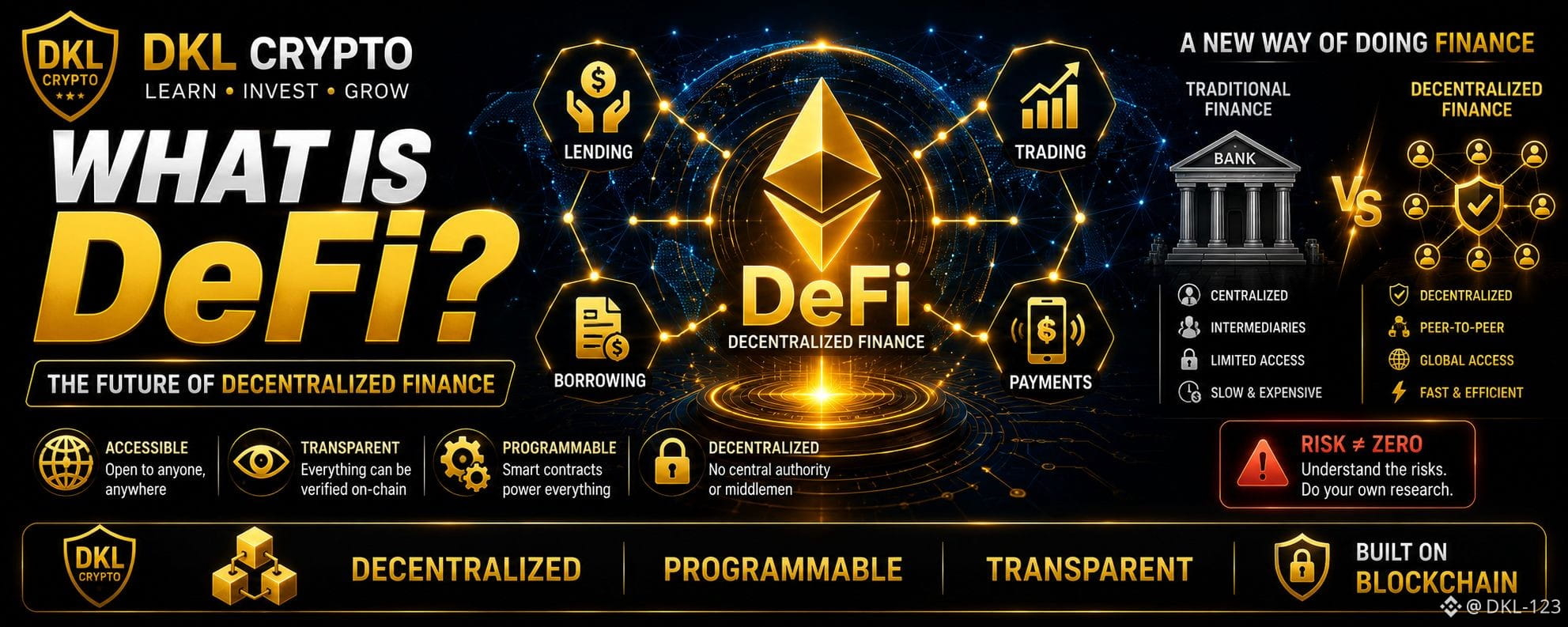

Traditional finance relies on banks and other intermediaries to help people save, borrow, lend, and transfer money. DeFi, short for Decentralized Finance, aims to provide many of these services using blockchain-based applications.
What Is DeFi?
DeFi is a collection of financial applications built on blockchain networks. Instead of relying entirely on a traditional financial institution, users can interact with smart contracts and decentralized applications.
Some DeFi services include:
• Lending and borrowing
• Decentralized exchanges
• Payments
• Asset management
•™Yield opportunities
How Does DeFi Work?
DeFi applications commonly use smart contracts—programs deployed on a blockchain that automatically execute predefined rules.
For example, a lending protocol can allow users to deposit assets and potentially earn rewards, while other users borrow assets according to the protocol's rules.
Why Are People Interested in DeFi?
DeFi can offer:
Accessibility: Anyone with the necessary technology and an internet connection may be able to access certain services.
Transparency: Blockchain transactions and smart-contract activity can often be publicly verified.
Programmability: Financial services can be combined and automated through smart contracts.
What Are the Risks?
DeFi is not risk-free.
Users should understand risks such as:
•™Smart-contract vulnerabilities
• Highly volatile assets
• Liquidity risks
• Scams and fraudulent projects
• Potential loss of funds
High returns should never be assumed to be guaranteed returns.
Final Thoughts
DeFi is one of the most interesting developments in blockchain because it attempts to make financial services more open and programmable.
But the technology is still evolving. Before using any DeFi application, research the project, understand the risks, and never commit more than you can afford to lose.
Question: Which DeFi use case interests you most—lending, decentralized exchanges, payments, or something else?