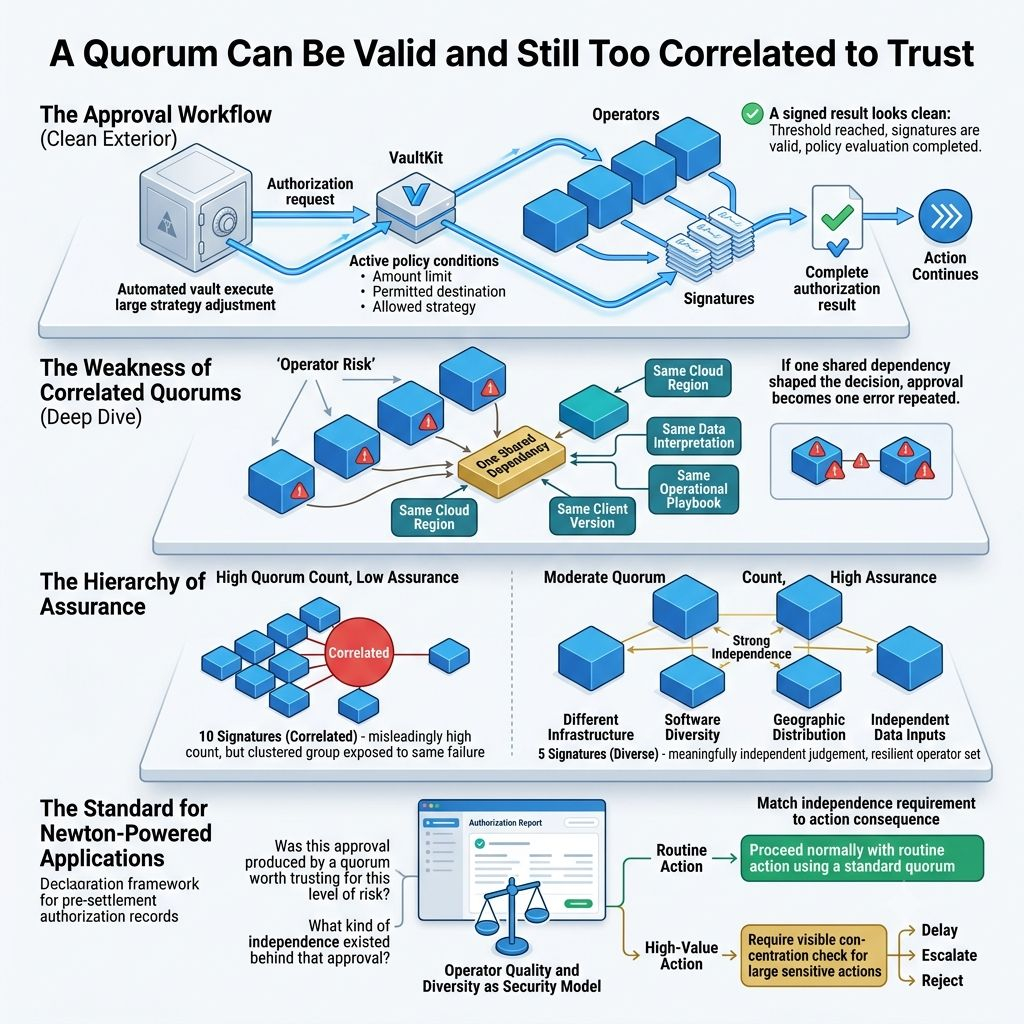
The weakest part of an approval may be that everyone who signed it failed in the same way.
That is the operator risk I keep thinking about when I look at Newton Mainnet Beta.
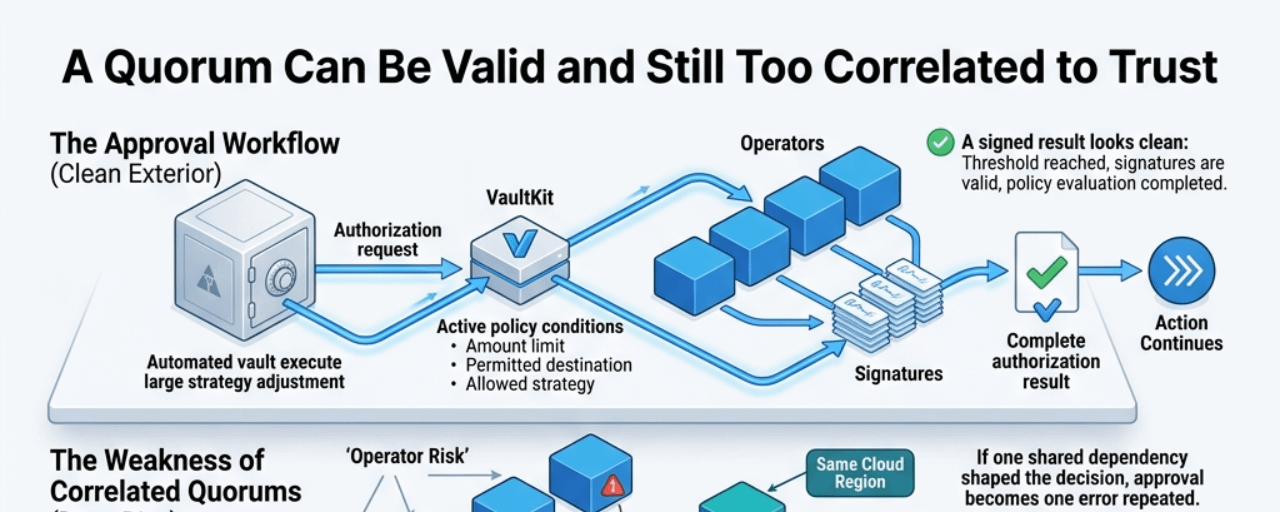
A signed authorization result can look clean from the outside.
The threshold was reached.
The signatures are valid.
The policy evaluation completed before settlement.
The application receives a result and allows the action to continue.
On paper, the system worked.
But financial security is not only about how many operators approved a request.
It is also about whether those operators were meaningfully independent from each other when the approval was produced.
Imagine an automated vault wants to execute a large strategy adjustment.
Through VaultKit, the action is checked before settlement against active policy conditions. The amount is inside the limit. The destination is permitted. The strategy is allowed. A group of operators signs the authorization result, and the vault proceeds.
Now imagine most of those operators depend on the same cloud region, the same client version, the same data interpretation, or the same operational playbook.
The quorum is valid.
The signatures are real.
Yet the system may not be as decentralized as the signature count suggests.
If one shared dependency shaped the decision, the approval becomes less like independent agreement and more like one error repeated several times.
That distinction matters because users often treat a threshold as a safety guarantee.
Five signatures sound stronger than one.
Ten signatures sound stronger than five.
But the number alone can be misleading.
A quorum of many highly correlated operators may provide less real assurance than a smaller group with stronger independence across infrastructure, software, geography, and decision inputs.
This does not make operator-based authorization weak.
It makes operator quality and diversity part of the security model.
For me, this is where Newton-powered applications should be judged carefully.
It is not enough to ask whether an authorization was signed.
It is not even enough to ask whether enough operators signed it.
The stronger question is:
What kind of independence existed behind that approval?
A serious authorization record should help future reviewers understand more than the final pass or fail result.
It should preserve enough context to evaluate whether the decision came from a resilient operator set or from a clustered group exposed to the same failure.
This does not mean every private detail about every operator must be exposed publicly.
There are privacy and security reasons to avoid revealing too much.
But the system should still make it possible to reason about concentration.
Were the approving operators distributed across different infrastructure environments?
Were they running the same implementation?
Did they rely on the same data source?
Was one entity effectively controlling several aprrovals?
Did the quorum become weaker because many participants were unavailable and only a narrow subset remained active?
These questions are important because correlated failure can hide inside normal-looking success.
A network outage can affect many operators at once.
A software bug can cause identical misinterpretation across the same client version.
A policy parsing issue can make several operators approve the same wrong action.
A data dependency can produce a shared false input.
In each case, the authorization may still produce signatures.
The problem is not that nobody approved.
The problem is that approval did not represent enough independent judgment.
This also changes how I think about liveness.
A system can remain live by accepting signatures from whichever operators are still available.
That helps execution continue.
But if the remaining available operators are all concentrated in one dependency group, the system may trade resilience for speed without making that trade-off visible.
Fast approval is useful.
Fast approval from a fragile quorum is a different risk.
Newton Mainnet Beta becomes more interesting if applications can treat these situations as meaningful differences before settlement.
A routine action with a strong, diverse quorum may proceed normally.
A larger or more sensitive action may require a higher standard of operator diversity.
A request that only reaches threshold through a narrow subset may deserve delay, escalation, or rejection.
The goal is not to make every transaction slow.
The goal is to match the independence requirement to the consequence of the action.
There is a real trade-off here.
If the diversity requirement is too strict, normal execution can become fragile.
A few outages could block safe activity.
If the requirement is too loose, the system may approve high-value actions through a technically valid but operationally weak quorum.
The right design has to balance availability with meaningful independence.
That balance should not be hidden behind a simple “approved” label.
For high-value financial automation, the reason behind approval matters.
A signed result proves that a threshold was reached.
It does not automatically prove that the threshold represented independent confidence.
This is why I would want Newton-integrated applications to make quorum quality observable in some form.
Not necessarily by exposing every operator identity to every user.
But by making the authorization record strong enough for applications, auditors, and institutions to evaluate whether the approval came from a healthy operator set.
A clean pass is useful.
A clean pass with visible concentration risk is more honest.
A clean pass with strong independence is stronger still.
That is the standard I would apply to any serious pre-settlement authorization layer.
The system should not only answer:
“Was this action approved?”
It should help answer:
“Was this approval produced by a quorum worth trusting for this level of risk?”
Because in automated finance, a signature threshold is only as strong as the independence behind it.
$NEWT @NewtonProtocol #Newt $LAB $VANRY #Velvet #xau #VANRY #Labs