
Market's been sluggish all week. Not crashing, just… tired. I had a free hour and instead of watching charts sideways I ended up deep-diving something I'd been ignoring for a while.
OpenLedger. $OPEN . #OpenLedger @OpenLedger .
I'd skimmed it before — "AI blockchain, Proof of Attribution, decentralized data" — and filed it under the usual pile of things that sound interesting but feel like infrastructure nobody asked for yet. Then I started actually pulling the threads.
Here's the thing that shifted my thinking. Everyone frames this as a decentralization story. Decentralize AI. Take it away from the big labs. That's the pitch, right? But I kept sitting with one question that nobody seems to be asking directly:
What does it actually mean for intelligence to be "owned" by a network?
Because here's what I think people are getting wrong. The shift isn't about where the model lives. It's about where the value capture goes when the model gets used.
Right now, when ChatGPT answers your question, OpenAI captures. When Gemini generates something, Google captures. Every inference, every query, every output — value flows one direction. The contributors who produced the training data got nothing after the upload. The platform absorbed it permanently.
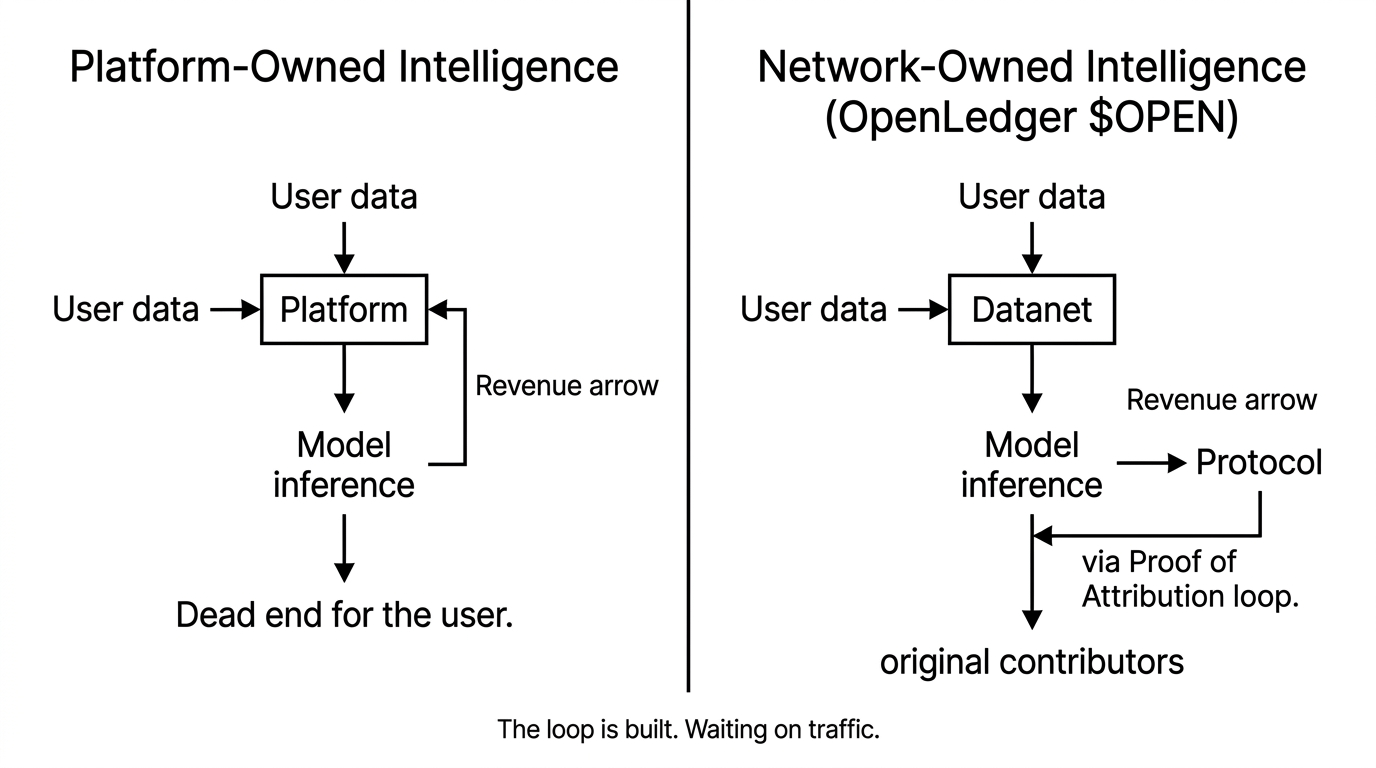
What OpenLedger is actually building — and I mean the specific mechanism, not the marketing — is a feedback loop. Every time a model gets queried, the Proof of Attribution system traces which Datanets influenced that output and routes a payment back through the chain. The intelligence earns ongoing for its contributors. Not a one-time thing. Ongoing.
I genuinely hadn't thought about it that way before. I kept thinking about it like "fair payment for data." But it's not really about that. It's about permanently restructuring where inference revenue lands. Platform-owned intelligence captures at the top. Network-owned intelligence distributes at the point of use. Different structure entirely.
But here's the part I'm not fully convinced by yet.
DeFiLlama has OpenLedger's annual protocol revenue at $693K, with fees down 23% just this past week. That's… thin. And the circulating supply has grown from 215.5M to around 290M tokens since launch — mostly reward emissions pushing contributors into the network. So the supply side of the loop is being subsidized into existence. The demand side — actual builders, actual products, actual inference traffic that triggers those attribution payouts — is still quiet.
Which means right now, the network-owned intelligence model is mostly theoretical. The pipes exist. The attribution logic works. But if the models built on OpenLedger Datanets don't get used at scale, the "ongoing royalty" story doesn't fire. Contributors hold attribution records that don't earn much because nobody's querying the models.
And the September 2026 investor unlock starts a 36-month linear release. That's a supply wave arriving right when the project needs demand momentum, not dilution pressure.
I thought about YouTube when they first launched revenue share. The idea was correct — creators should earn from their content — but it took years and massive viewer scale before the checks meant anything. The model worked eventually. But "eventually" required a lot of patience and a very specific growth trajectory.
OpenLedger might be right about everything conceptually. The structural shift from platform capture to network distribution — that part genuinely clicked for me. I just can't tell yet whether "right about the structure" is enough to survive the gap between now and when the demand side shows up.
Anyway. Still a slow week out there. Might just watch how this plays out.