
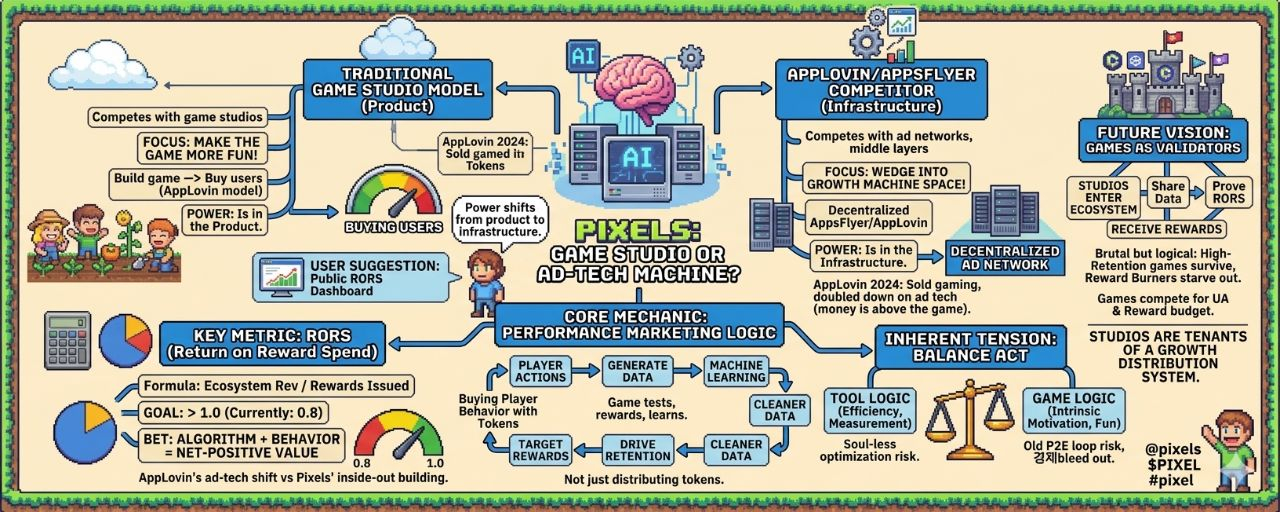
Last Tuesday night I was sitting at a café with a friend who does growth marketing for a mobile game studio. He asked what projects I was following. I said Pixels. He nodded and asked something I didn't expect: "is it competing with AppLovin or with game studios?" I laughed, thinking he was joking.
I went home and opened the whitepaper again. And realized he wasn't joking.
At first I thought the question was a stretch. Pixels is a game, so it competes with game studios, obviously. But after reading the whitepaper carefully, I got pulled in a completely different direction. Pixels doesn't just want to make a better game than other games. It's trying to wedge itself into the space where game studios used to pay an entire growth machine. In other words, it's not standing across from another game. It's standing across from the user acquisition machine.
The first pivot point is that Pixels describes itself as a "decentralized AppsFlyer or Applovin for both Web3 and Web2 games." That sounds wildly ambitious, but reading it closely it's actually pretty direct. Pixels doesn't just want to be a title that attracts players. They want to become the middle layer between capital, data, and growth. The game is no longer the final destination. The game is where the system measures, tests, rewards, and learns.
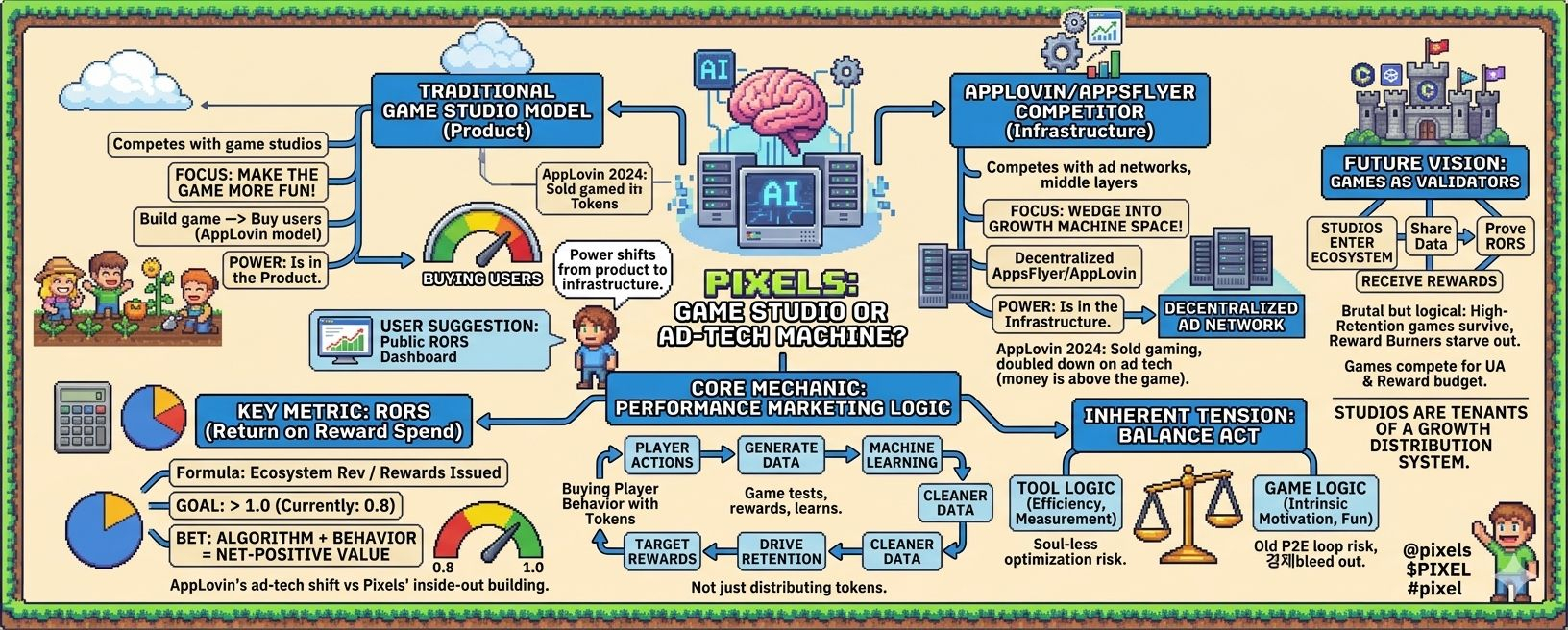
That's the biggest difference I see. A game studio asks: "how do we make this game more fun?" Pixels asks: "how do we make every reward dollar generate more value than what went in?" The whitepaper establishes a very clear metric, RORS, Return on Reward Spend, and admits it's currently around 0.8, with a goal of exceeding 1.0 so every token distributed generates net-positive revenue for the ecosystem. Reading that, I could clearly see Pixels getting pulled toward ad-tech more than game design.
From a player's perspective, Pixels is still a game. There's farming, rewards, upgrades, social loops. But looking at the underlying mechanics, it resembles an incentive distribution machine. Players aren't just playing a game. They're generating data. That data gets used to target rewards. Rewards drive retention, and retention generates cleaner data. That loop reminded me more of performance marketing logic than of a virtual world.
What shifted my perspective was the section where Pixels describes its data-driven infrastructure as a next-generation ad network, using machine learning to allocate rewards based on player behavior that drives long-term value. From that point, Pixels is no longer a place that "distributes tokens to players." It's a place that buys behavior with tokens.
And once you're buying behavior, everything changes.
AppLovin in 2024 decided to sell its entire gaming division to go all-in on ad tech. They sold the gaming business for $900 million and doubled down on the advertising platform. Meaning the company that understood gaming better than anyone concluded: the money isn't in the game, it's in the distribution layer above the game. Pixels is moving in the opposite direction. They started from the game and are building the distribution layer from the inside. Who's right depends on one question: can players replace a targeting algorithm? RORS is how Pixels is betting the answer is yes.
But here's where it gets interesting. Pixels can't fully become AppLovin, because it still has to keep the "fun" part. The project is very clear that the game needs to be enjoyable, because without an intrinsic motivator the entire growth model falls apart. So Pixels is caught between two forces. On one side is tool logic, where efficiency and measurement are everything. On the other is game logic, where the feeling of playing is what keeps people around. Lean too hard toward AppLovin and it becomes a metric optimization system without soul. Lean too hard toward game studio and it falls back into the old P2E loop, where rewards look great on paper but the economics bleed out.
No clean exit from that tension.
Small suggestion: Pixels should publish a public dashboard tracking RORS in real time. Not to hype. But so studios considering joining can evaluate where the infrastructure actually stands, instead of having to trust an AMA.
The way I see it, Pixels is trying to solve this by turning games into validators. Staking is no longer about node security or chain validation. It's game pools competing for reward and UA budget. The game isn't just a product anymore. It's an economic unit that has to prove its efficiency before getting funded. Brutal, but logical. Games that retain well, games that make players spend real money, games that generate better data, they survive. Games that just burn rewards without generating return get starved out.
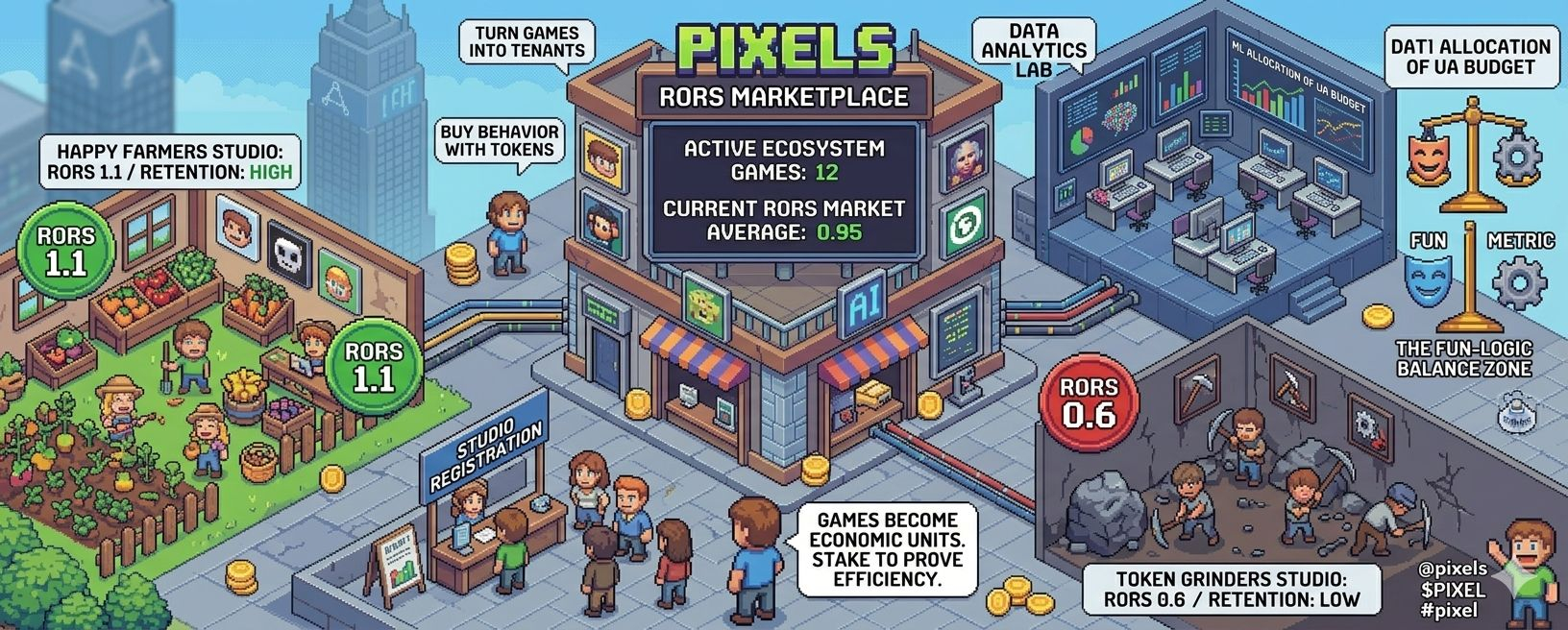
From where I stand, Pixels isn't competing with game studios in the traditional sense. It's doing something more uncomfortable: turning game studios into tenants of a growth distribution system. In the old model, studios own the game and buy users through platforms like AppLovin. In the Pixels model, studios enter the ecosystem, stake, share data, receive rewards, prove RORS, and only then expand. Power shifts from product to infrastructure.
That's not a small shift. That's the whole game changing.
So who is Pixels competing with? On the surface, game studios. Looking at the actual mechanics, AppLovin, AppsFlyer, and every middle layer currently holding the UA money flow of the entire gaming industry.
Pixels isn't trying to win at games. It's trying to become the calculator sitting underneath games. And once it gets to sit there, the rest is just a question of who ends up paying fees to whom.
