
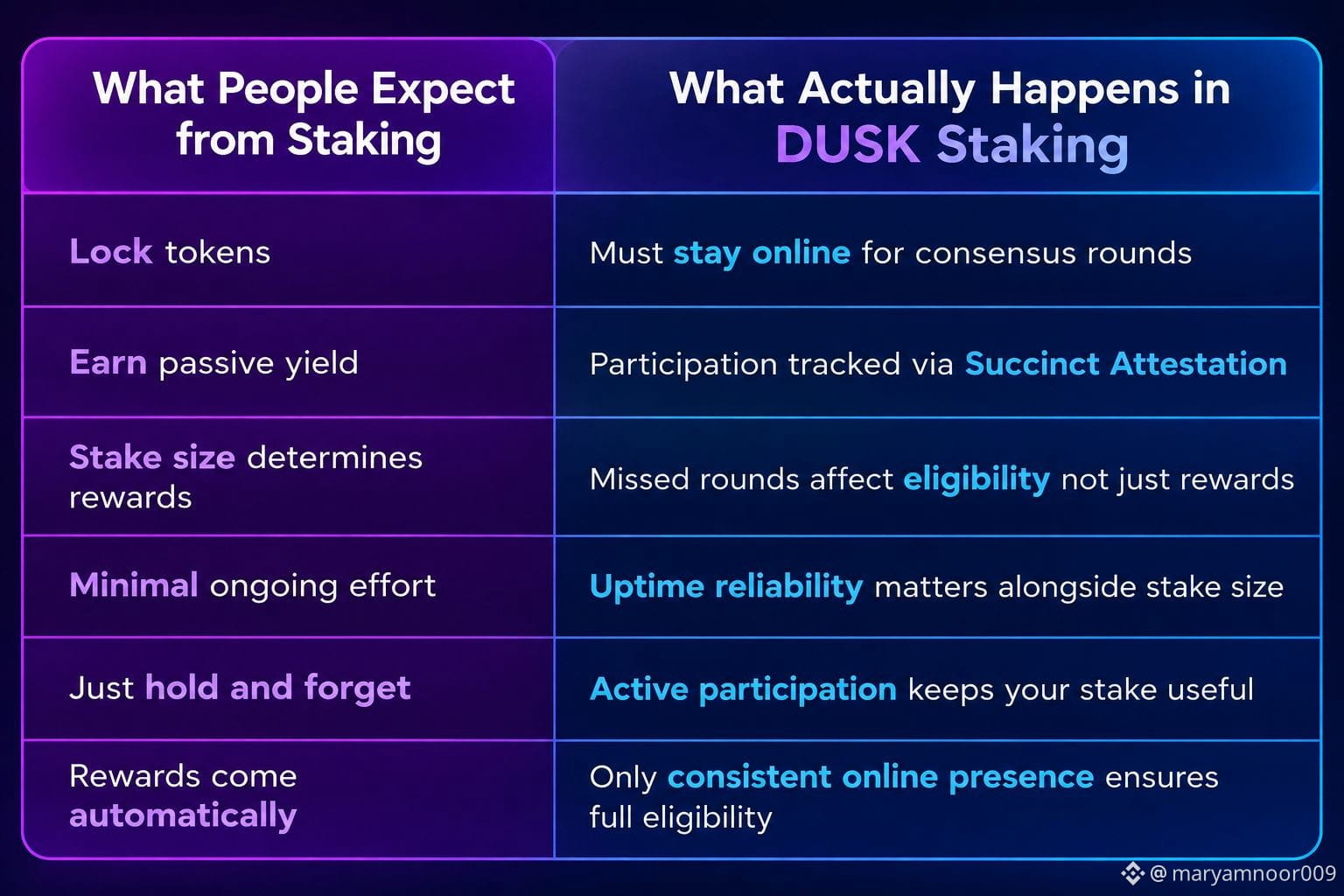
I kept staring at DUSK's staking dashboard trying to figure out why the minimum stake amount felt oddly specific, and it sent me down a small rabbit hole into how $DUSK ties provisioner eligibility to actual block participation rather than just locked capital. @Dusk , What stood out to me is that stakers aren't just parking tokens and collecting yield passively, the system expects nodes to stay online and actively participate in consensus rounds through the Succinct Attestation model, and missing participation windows has real consequences for eligibility, not just reduced rewards. That's a different design assumption than the "set it and forget it" staking narrative most people carry over from other chains. I checked a few provisioner addresses and noticed uptime consistency mattered more than stake size beyond the threshold, which quietly shifts the security model toward operational reliability instead of pure capital, #dusk concentration. It's a small mechanism but it changes who actually benefits from staking here, someone with a smaller stake running a well maintained node versus someone with a large stake and inconsistent uptime. I'm still not sure how this plays out once stake distribution grows unevenly across provisioners, and whether the participation requirement stays meaningful at scale or becomes a formality most nodes just automate around.

Đăng
Tuyên bố miễn trừ trách nhiệm: Nội dung bao gồm cả quan điểm của bên thứ ba, không phải lời khuyên. Có thể sử dụng nội dung do Binance Ai đưa ra nhưng không được đảm bảo. Xem Điều khoản & Điều kiện.