
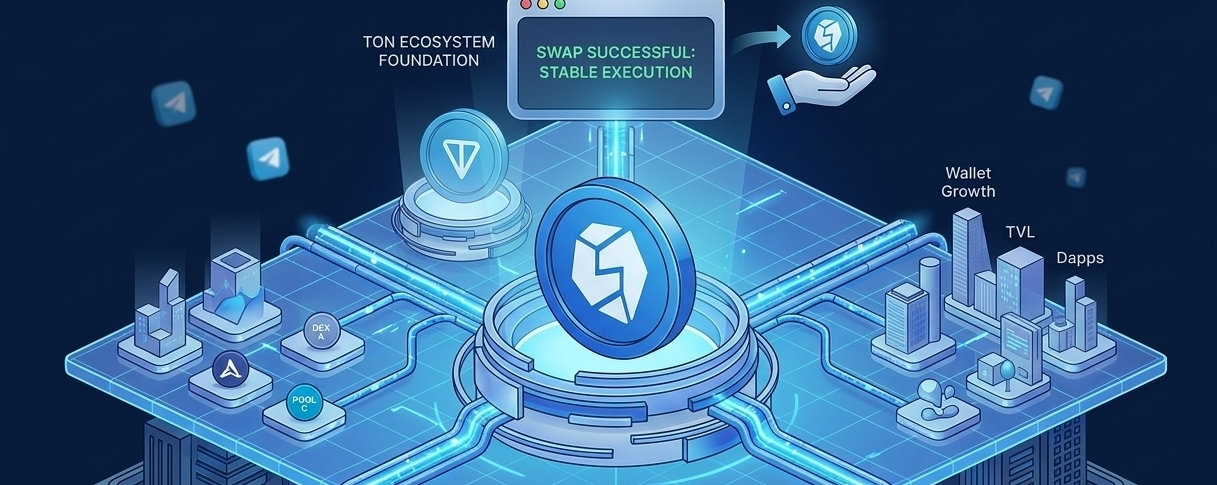
The strongest financial systems are rarely defined by the features users notice. They are defined by the infrastructure users never have to think about.
When people evaluate a blockchain ecosystem, they usually begin with numbers.
How many wallets have been created?
How much value is locked?
How many transactions are processed each day?
These metrics matter because they provide a visible picture of ecosystem activity. They show whether adoption is accelerating, capital is entering, and applications are attracting users.
But they reveal very little about something even more important.
Whether the ecosystem is actually prepared to support long term adoption.
Growth can be measured in statistics.
Sustainability is measured in infrastructure.
This distinction is becoming increasingly important for the TON ecosystem.
With Telegram acting as a gateway to blockchain applications, TON is entering a very different stage of adoption from many earlier Layer 1 ecosystems. Millions of potential users already understand how to navigate Telegram. What they expect next is not another lesson in blockchain mechanics.
They expect products that simply work.
They expect transactions to complete without unnecessary delays.
They expect trading to feel predictable.
They expect financial applications to behave with the same reliability as the digital products they already use every day.
That expectation fundamentally changes how DeFi infrastructure must be built.
The Next Wave Of Users Will Judge Experience, Not Architecture
Crypto natives often enjoy understanding technical systems.
They discuss consensus models, execution environments, liquidity pools, and routing mechanisms because these subjects have become part of the culture.
Mainstream users behave differently.
Most people entering blockchain through Telegram are unlikely to study Automated Market Makers or liquidity aggregation protocols before making their first swap.
They will never ask how routing algorithms determine execution paths.
They will not compare liquidity sources across multiple protocols.
Instead, they will ask much simpler questions.
Did my transaction succeed?
Was the price fair?
Did everything feel fast?
Can I trust this application the next time I use it?
These questions appear simple on the surface.
In reality, they are infrastructure questions.
Every smooth transaction depends on systems operating invisibly beneath the interface.
The quality of the experience is determined long before the user presses the swap button.
“Good infrastructure is invisible by design. Users remember friction long after they forget features.”
That is why infrastructure deserves far more attention than it usually receives.
Liquidity Is Not Just About Size
Liquidity is one of the most misunderstood concepts in decentralized finance.
Many people assume liquidity simply means having enough assets available for trading.
While depth certainly matters, modern DeFi faces a more complex challenge.
Liquidity fragmentation.
As ecosystems expand, liquidity naturally spreads across different pools, protocols, and execution environments.
This growth is healthy because it encourages innovation and competition.
But it also creates inefficiency.
The same asset may exist in multiple liquidity pools, each offering different pricing, different depth, and different execution quality.
As a result, two users making nearly identical trades can receive noticeably different outcomes.
One receives efficient execution.
The other experiences unnecessary slippage.
One benefits from optimal routing.
The other unknowingly trades through an inefficient path.
Neither user understands why.
From their perspective, the application simply feels inconsistent.
This inconsistency gradually erodes confidence.
Users rarely investigate liquidity architecture.
They simply remember whether an application felt reliable.
That psychological reality makes liquidity infrastructure one of the most important layers inside every growing DeFi ecosystem.
Why Aggregation Matters More As TON Scales
As TON continues expanding, solving liquidity fragmentation becomes increasingly important.
This is where liquidity aggregation changes the conversation.
Rather than treating every liquidity pool as an isolated destination, aggregation systems intelligently search across multiple sources to identify more efficient execution paths.
The objective is not simply enabling transactions.
It is improving how transactions are executed.
Butter routing.
More consistent pricing.
Lower slippage.
Improved capital efficiency.
More reliable execution during periods of high demand.
These improvements often remain invisible.
Most users never realize an aggregation layer prevented poor execution.
They simply experience a transaction that feels smooth.
Ironically, the best infrastructure is usually the least noticeable.
Its success is measured by the absence of problems rather than the presence of visible features.
This is one of the reasons why infrastructure becomes increasingly valuable as ecosystems mature.
Early growth depends on attracting users.
Long term growth depends on keeping their experience consistently reliable.
STON.fi And The Shift Toward Infrastructure First Thinking
This broader industry trend helps explain why STON.fi is becoming increasingly interesting within the TON ecosystem.
Rather than positioning itself solely as another decentralized exchange, the protocol appears to be investing in infrastructure that improves execution quality beneath the user interface.
Its ocus on liquidity aggregation reflects a broader understanding of where DeFi is heading.
As ecosystems become larger, users care less about how many liquidity pools exist.
They care whether their transactions execute efficiently every single time.
Aggregation helps reduce fragmentation.
Intelligent routing helps improve execution quality.
Efficient liquidity discovery helps create more predictable outcomes.
These are not features designed to generate headlines.
They are systems designed to strengthen the foundation of the ecosystem itself.
That distinction becomes increasingly important as adoption grows.
Because infrastructure scales differently from narratives.
Narratives attract attention.
Infrastructure retains users.
The Future Of TON Depends On More Than Speed
Blockchain discussions often revolve around throughput and transaction speed.
These metrics remain important.
But they are only part of the equation.
A network capable of processing transactions rapidly can still deliver a poor user experience if execution quality remains inconsistent.
Sustainable adoption requires more.
Reliable liquidity.
Predictable execution.
Stable routing.
Consistent user experience.
Infrastructure capable of supporting increasing demand without compromising performance.
As Telegram continues introducing more users to blockchain technology, these requirements become even more important.
Mainstream adoption does not happen because users understand every technical component.
It happens because they never need to.
The strongest blockchain ecosystems will likely be the ones that hide complexity behind dependable infrastructure.
Users will remember simplicity.
Developers will appreciate reliability.
The ecosystem will benefit from stronger long term participation.
History rarely remembers the systems that generated the loudest excitement. It remembers the systems that quietly became impossible to replace.
This is why liquidity infrastructure deserves more attention than short term market narratives.
As TON continues evolving, protocols strengthening the foundation of decentralized finance may contribute just as much to ecosystem growth as the applications users interact with directly.
Sustainable adoption is rarely built on excitement alone.
It is built on infrastructure that continues creating value long after the headlines disappear.
The question is no longer whether TON can attract millions of users through Telegram.
The more important question is whether the ecosystem's infrastructure will be ready when those users arrive.
What do you think will define the next phase of TON DeFi?
Will new applications drive adoption, or will the protocols quietly improving liquidity, execution, and infrastructure become the real foundation of long term growth?