Play-to-earn was supposed to change gaming.
For a moment, it actually looked like it would.
The idea was simple.
Players spend time in a game, and instead of that time being lost, they earn something back.
Ownership, rewards, value — all of it sounded like a natural evolution.
But things didn’t last.
The biggest issue wasn’t visible at first, but once it started, it spread everywhere. Bots.
As soon as reward systems became predictable, they became exploitable.
It stopped being about playing the game and started becoming about extracting value from it.
Automated scripts, farming setups, multi-account abuse — all of it became normal.
And when that happens, the system slowly breaks.
Rewards get drained faster than expected.
Tokens lose value.
Real players feel like they are competing against machines instead of people.
And eventually, the experience itself stops being enjoyable.
This is exactly the cycle that repeated across most play-to-earn ecosystems.
What’s interesting about @Pixels is that it didn’t just try to ignore this problem.
It actually went through it.
The team experienced these issues in real conditions, not just in theory.
They saw how players behaved, how bots adapted, and how reward systems failed when they were too open.
Instead of abandoning the idea, they started refining it.
Stacked is a result of that process.
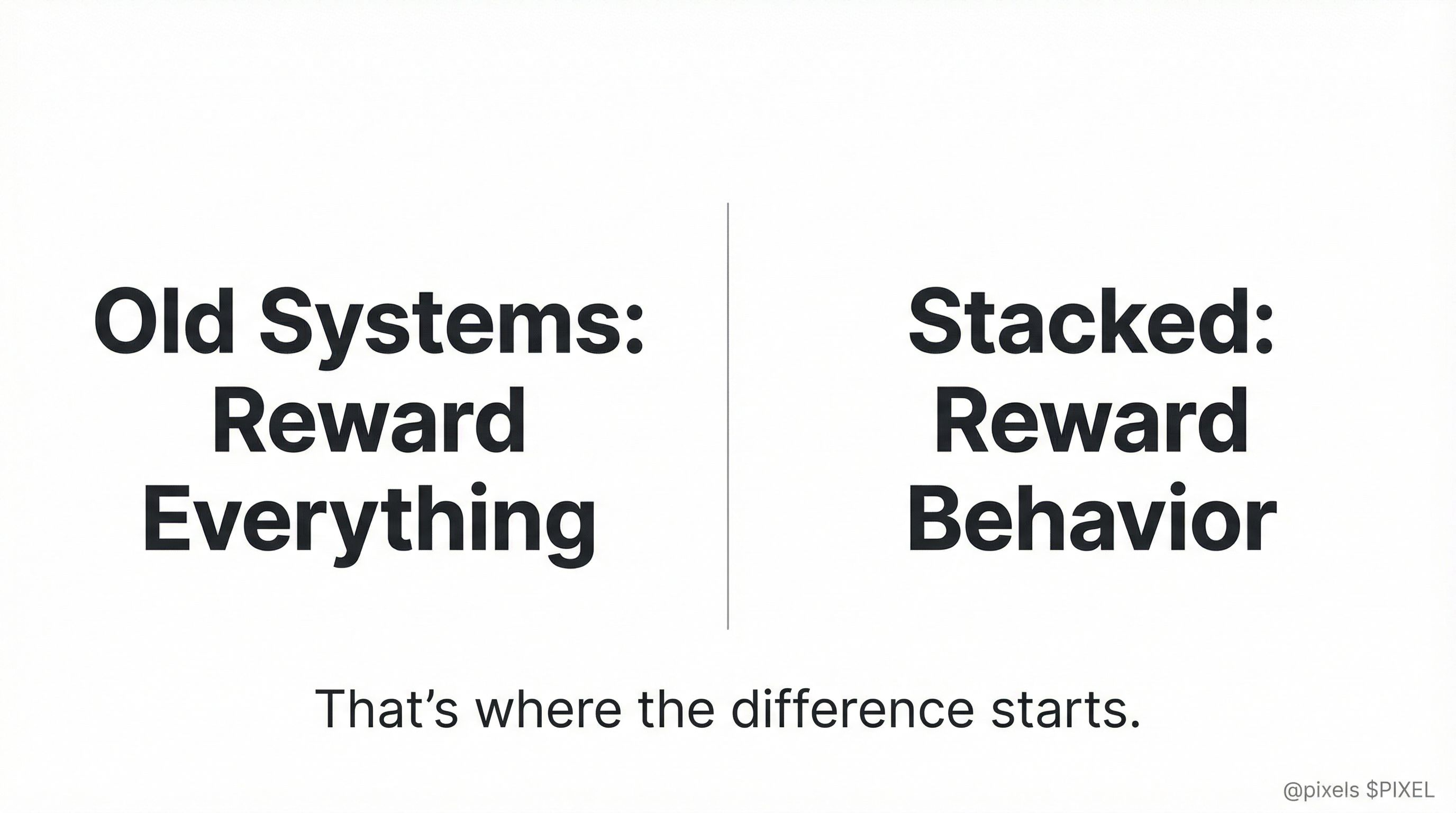
The key difference is simple, but important — rewards are no longer treated as something that should be distributed equally.
They are treated as something that should be distributed intelligently.
Not every player interacts with a game in the same way.
Some players contribute long-term value.
Some are consistent.
Some engage deeply.
And some are only there to extract rewards and leave.
If a system doesn’t recognize that difference, it eventually collapses.
Stacked focuses on that distinction.
Instead of rewarding activity alone, it looks at behavior.
It tries to understand which players are actually contributing to the ecosystem in a meaningful way.
And then it aligns rewards with that behavior.
This naturally reduces the effectiveness of bots.
Because bots rely on predictability.
They rely on systems where inputs and outputs are fixed.
Once rewards become behavior-based instead of action-based, automation becomes much harder.
And that changes the balance of the system.
Another important shift here is how rewards are viewed.
In older systems, rewards were often treated as something separate from gameplay.
Players would grind tasks just for the sake of earning tokens, even if those tasks didn’t add much value to the game itself.
This created a disconnect.
Stacked tries to close that gap.
Rewards are tied more closely to meaningful actions.
Not idle time, not repetitive farming, but actual engagement.
This makes the system feel less like a job and more like part of the game.
$PIXEL also fits into this evolving structure in a different way.
Instead of being limited to a single use case, it starts becoming part of a broader system. As more experiences connect to the same reward infrastructure, the role of the token naturally expands.
This creates a more flexible environment compared to traditional single-game economies.
What stands out here is that this approach doesn’t depend on assumptions.
It comes from actual usage, actual data, and actual iteration.
The problems with play-to-earn were real.
But so are the lessons that came from those problems.
And right now, @undefined seems to be one of the few projects actually building on those lessons instead of repeating the same mistakes.