

The DYM community has suffered a lot from VCs locking up their positions to get staking rewards.
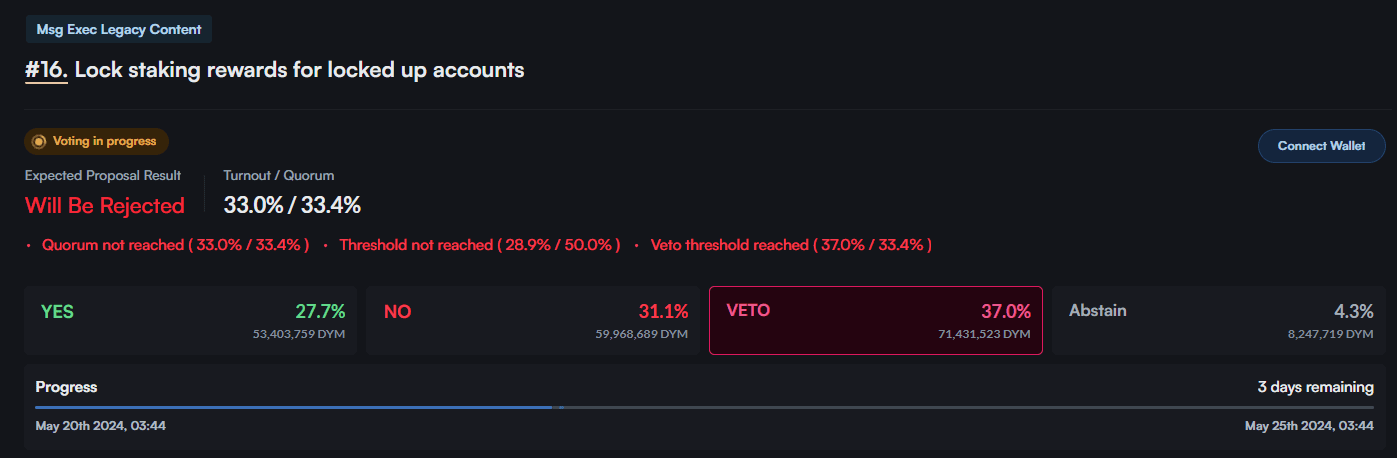
On May 20, the DYM community initiated Proposal No. 16, requiring code modifications to lock VC accounts so that they cannot transfer the staking reward tokens they received.
As of now, 53.4 million DYM (27.7% of the total votes) have voted in favor, and 71.43 million DYM (37% of the total votes) have voted against, and the proposal will be rejected.
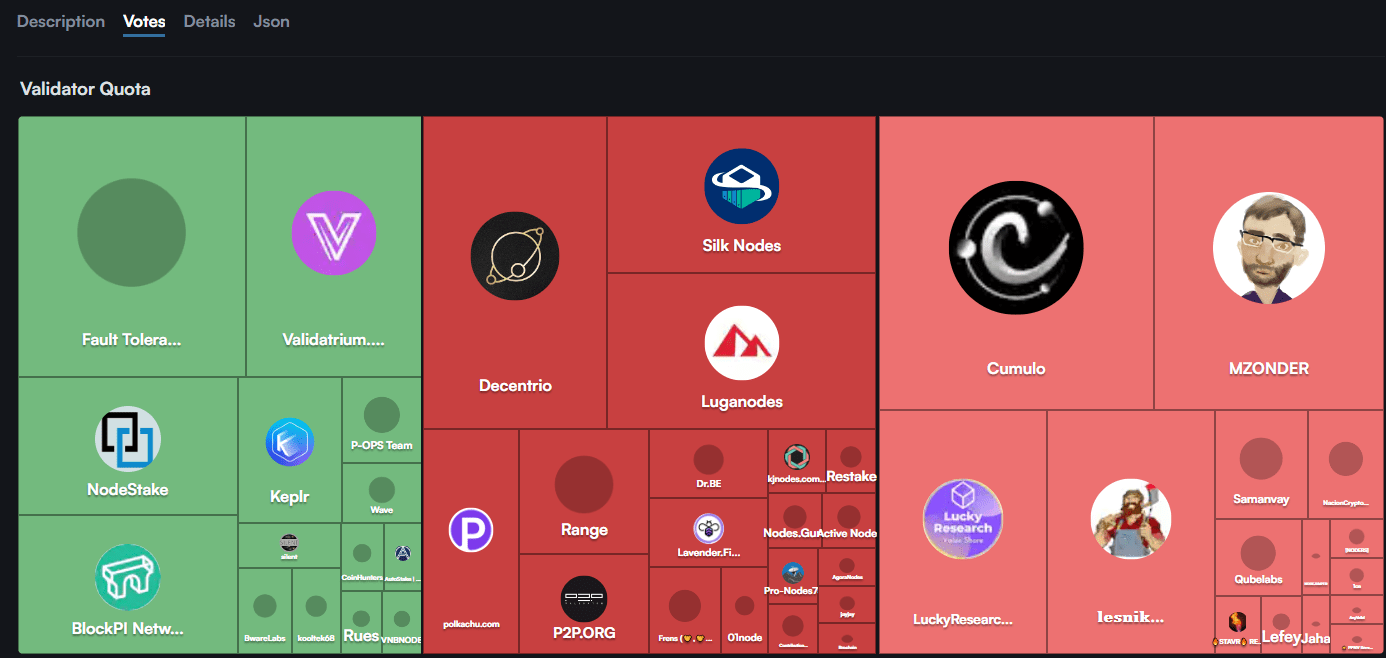
The proposal will end at 3:44 on the 25th. At present, it seems that the probability of passing is very small. Of course, it is not ruled out that it will pass in the end like Atom Proposal 848. However, the tokens pledged by VCs still have governance voting rights, so in fact, as long as VCs are not happy, the vote will definitely not pass.
The current node ticket types are as follows:
Interestingly, many Cosmos community members are extremely averse to the concept of Proposal 16, because Proposal 16, initiated by Juno, which was once very popular in the Cosmos ecosystem, can be regarded as one of the landmark events in the entire history of blockchain proposals.
Cursed Proposal 16: Hunting down whales that betray the community
Juno's Proposal No. 16 was aimed at reducing the number of Juno tokens held by a whale address that held more than 3 million Junos (worth $120 million at the time) to 50,000. The reason was that this whale obtained Juno tokens far exceeding the upper limit of the address requirement (50,000) through multi-address ATOM staking and then pooled them.
The Juno community discovered this behavior and launched Proposal 4 to confiscate 90% of the whale's Juno. The whale then explained that it was a Japanese Crypto fund that managed Atom assets for many clients, and said that it was optimistic about Juno and would not do anything bad in Juno. The community rejected Proposal 4, and the whale account also pledged its 2.5 million Junos.
But in the following months, the whales continued to sell off their Juno staked rewards (about 9.6% of the entire Juno network), causing panic in the community and launching the most controversial Proposal 16 in the history of DAO governance, reducing the total 3 million Juno in the whales' 52 accounts to 50,000.
This famous proposal to kill the big investors in the history of blockchain ended with an unprecedented 98.58% voting participation rate and 40.85% approval rate. Even though the whale apologized frantically in the community and tried to gain sympathy from the community by saying that he could not explain to the fund investors, it was still executed in the end.
Even so, the farce still refused to end hastily. On May 6, the team was supposed to transfer most of the JUNO tokens held by the whale to the community-controlled "Unity" contract. However, Asano, who was responsible for executing the operation, copied the wrong address, resulting in the funds being transferred to an uncontrolled black hole address, and none of Juno's more than 120 validators found that the transfer address was wrong. In the end, the Juno community launched Community Proposal No. 21, which plans to upgrade by rewriting Juno's ledger and allocate the funds from the uncontrolled address to the "Unity" contract, and Juno's farce finally ended.
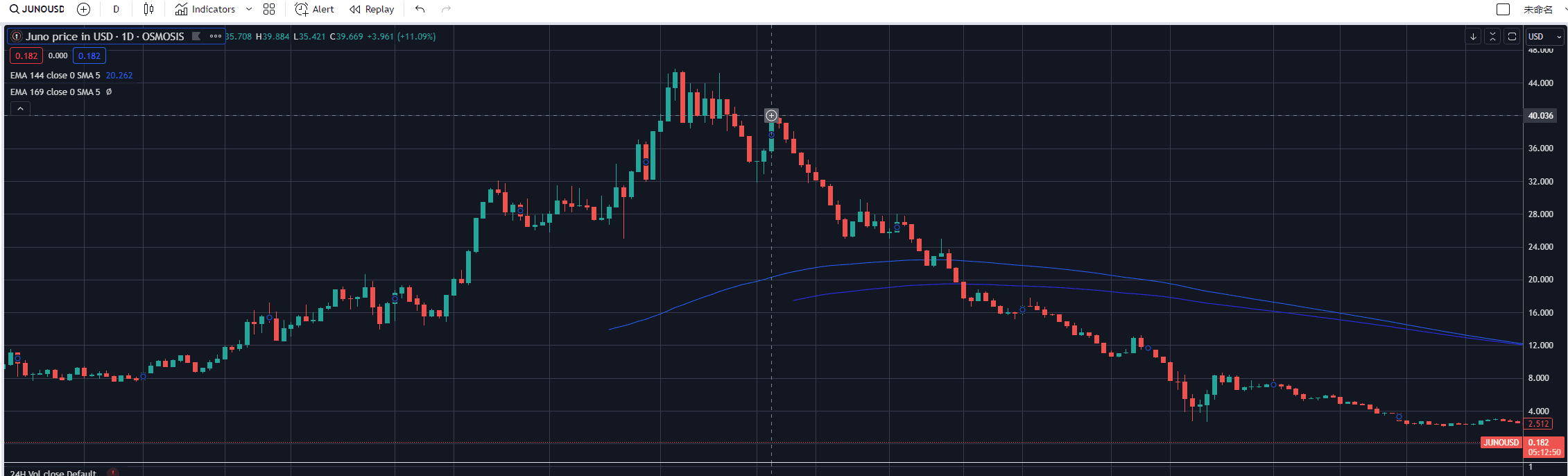
A lot of information can be read from Juno's candlestick chart. A few days before the proposal was passed on March 16, Juno started to rebound, reaching a peak of nearly 40 US dollars on the day the proposal was passed. From then on, Juno began an endless decline.
Lessons from the past and lessons for the future
Perhaps because the alt season has been delayed, many voices in the market have begun to criticize VCs, believing that the low-cost chips obtained by VCs have put pressure on the market and caused prices to continue to fall. In particular, the VC behavior of DYM/Saga/Celestia, the three emerging Cosmos ecosystems, is that the unlocked tokens can still be pledged and get staking rewards, and the staking income can be sold at any time. In addition, the performance of these three tokens has been falling since they were launched, which is similar to the original Juno.
Proposals are the governance edge of the protocol to expand its territory, and also the sword of Damocles hanging over our heads. Fighting the local tyrants and dividing the land can certainly bring short-term benefits to the community and reduce selling pressure, but the impact it brings is something that few people can notice at the time. Even though the developer team realized the problem and advocated that the community vote against Proposal 16 and proposed a better way to deal with the whales, the community's joint efforts were unstoppable. The truth of "Not your keys, not your coins" on the Juno chain was broken, and the loss of confidence caused was irreversible.
Although the cursed Proposal 16 will most likely be rejected, the implicit rule that VC's locked tokens can still obtain freely transferable staking rewards does create an unexpected selling pressure on the market and has an impact on prices. Inflation pressure has always been a problem faced by all Tendermint chains.
I think that DYM Proposal 16 should not be passed arbitrarily, but should continue to be discussed, and the selling pressure caused by VCs' locked tokens should be brought to the table and presented with on-chain data and behavior, calling on the community to adopt more sophisticated designs to protect and pay attention to the interests of DYM Holders.
$DYM $ATOM


