
After the signing of the U.S. Bitcoin strategic reserve executive order, President Trump requested the Treasury Secretary to submit an assessment report on the legal and investment feasibility of the plan within 60 days, with less than two weeks remaining before the deadline. The industry expects specific details to be announced in the coming weeks, which could lead to a "black swan" event.
According to the Bitcoin strategic reserve signed by Trump, it involves transferring confiscated federal funds into reserves, with no new tokens being purchased.
This has disappointed the cryptocurrency market, meaning that the emergence of the U.S. Bitcoin strategic reserve cannot boost future purchase volumes, at most only suppressing the U.S. government's sell-off.
However, there is a special case in the executive order, which allows Trump to discuss a plan with the U.S. Department of Commerce and the Treasury without using taxpayer funds, meaning that the U.S. still has the opportunity to buy new Bitcoins.
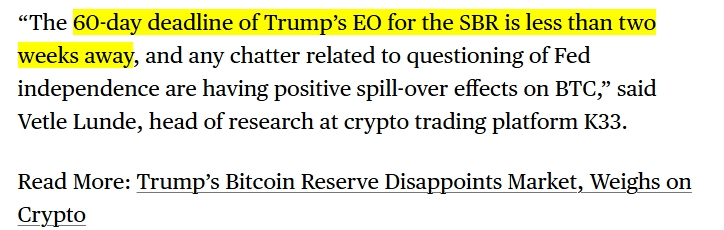
Bloomberg cited Vetle Lunde, research director at the crypto trading platform K33, who stated: "There are less than two weeks left before the 60-day deadline for Trump's executive order on Bitcoin strategic reserves, and any comments questioning the independence of the Federal Reserve will have a positive spillover effect on Bitcoin."
As Trump hinted at a de-escalation of the tariff trade war and dropped plans to dismiss Federal Reserve Chairman Powell, Bitcoin experienced a surge, rising above $93,000.
Bitcoin has surpassed $90,000 for the first time since early March, sparking optimism that this largest cryptocurrency has finally broken free from its long-standing trend of moving in tandem with U.S. tech stocks.
After Trump announced comprehensive tariffs on geopolitical allies and competitors, risk assets experienced a sell-off, but Bitcoin has rebounded nearly 23% from its low on April 7. As a result, Bitcoin's trading performance has begun to resemble gold more closely—gold being the standout asset in a market affected by tariff uncertainties.
Richard Galvin, co-founder of Sydney-based crypto hedge fund DACM, stated: "If Bitcoin's trading performance continues to resemble gold rather than tech stocks, the decoupling rhetoric will intensify."
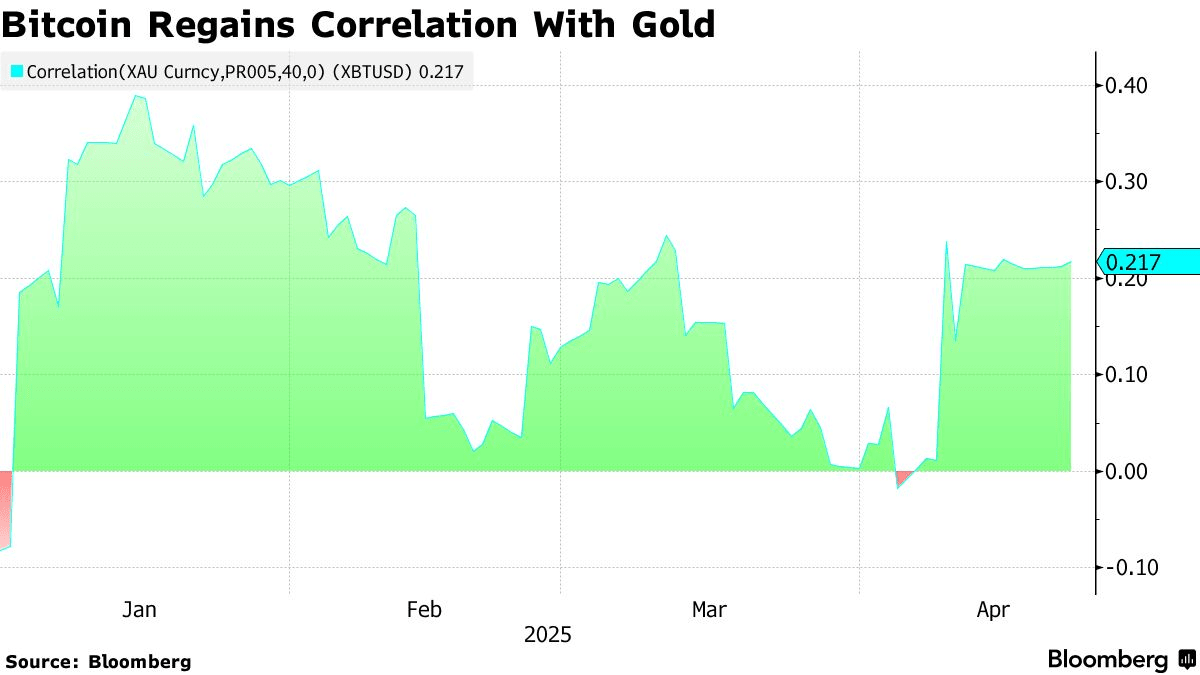
Decoupling from U.S. risk assets—largely due to the plummeting dollar—has provided some breathing room for cryptocurrency bulls, especially after Trump failed to generate the rebound many had anticipated in his first three months in office. Even after the rise in April, Bitcoin's trading price is still about 16% lower than the record of over $109,000 set on the day Trump returned to the White House in January.
Augustine Fan, a partner at the cryptocurrency trading platform SignalPlus, stated: "One of the consequences of decoupling among major powers could be a re-evaluation of Bitcoin as a long-term store of value. Over the past year, we have criticized Bitcoin as a leveraged alternative to Nasdaq, but it has finally started to show some signs of decoupling."
There has been new demand for long positions in both the Bitcoin futures and options markets. A positive signal is that the Bitcoin basis (the difference between spot and futures prices) has risen to a three-month high on the Chicago Mercantile Exchange (CME), while open interest has also increased moderately. According to data compiled by CoinGlass, the liquidation volume of bearish bets in cryptocurrency has increased over the past 24 hours.
Lunde added: "We're seeing early healthy signs of the market willing to add long positions again."
However, the offshore perpetual futures market is sending different signals. So-called perpetual contracts have long been a popular choice for investors betting on crypto assets outside the U.S. These contracts have no expiration date and provide cash flow in the form of funding rates. Negative funding rates indicate a prevailing bearish sentiment.
"In the past few days, the number of open contracts has surged. The nominal open interest has skyrocketed by 8.4% in the last 36 hours, while the financing rate has hovered in negative territory, indicating a slight aggressiveness among shorts," Lunde stated.
