
I don’t agree with this view. Let’s first take a look at the rumors that are circulating wildly in the group. See the picture below.
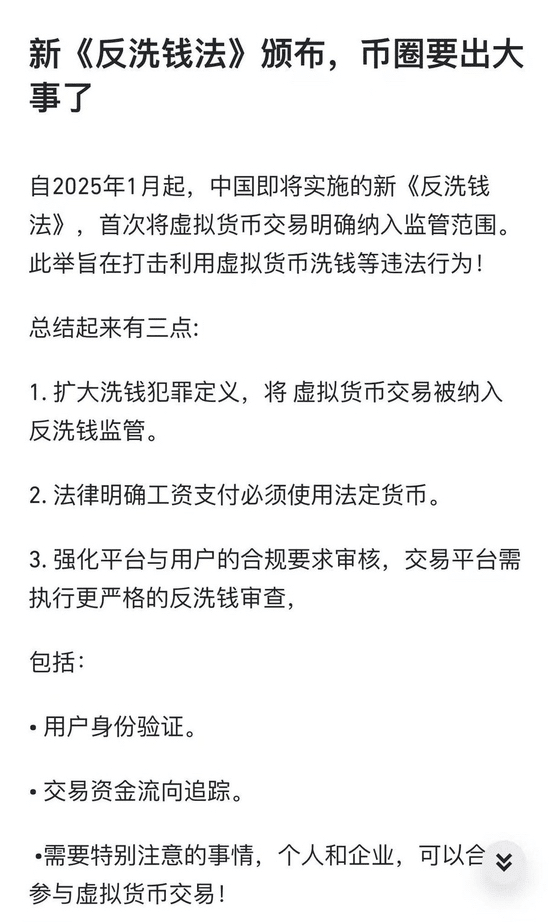
I will talk about what I think are the reasons for the decline later. First of all, this popular statement and the understanding of the (Anti-Money Laundering Law) are both wrong.
First of all, the (Anti-Money Laundering Law) was promulgated on November 8, which was a month ago. Even if it had an impact on the currency market, it would have been reflected in the price a month ago.
And I think the new (Anti-Money Laundering Law) has no impact on the currency market, because on September 4, 2017, the policy required that virtual currency exchanges be registered and operated in China, so all exchanges went overseas, registered overseas, and operated in China.
Until the policy on September 24, 2021, foreign exchanges were not allowed to operate domestically, were not allowed to provide services to domestic citizens, and domestic individuals or institutions were not allowed to provide cooperative services or employment for foreign exchanges. Banks were not allowed to provide payment and settlement services for virtual currency transactions. As a result, domestic virtual currency exchanges have been completely eliminated, and there are no more exchanges in the country.
The author's understanding of the anti-money laundering law in the picture is that the domestic authorities require virtual currency exchanges to strengthen KYC and anti-money laundering measures. This is very illogical; there are no exchanges operating domestically anymore, so what qualification does the domestic policy have to make such a request?
With this question in mind, I read the anti-money laundering law in full, and it does not mention virtual currency exchanges at all. The author of this article is completely talking nonsense.