
#usdtves
usdtves
422 views
106 Discussing
Hot
Latest

·
--
See translation
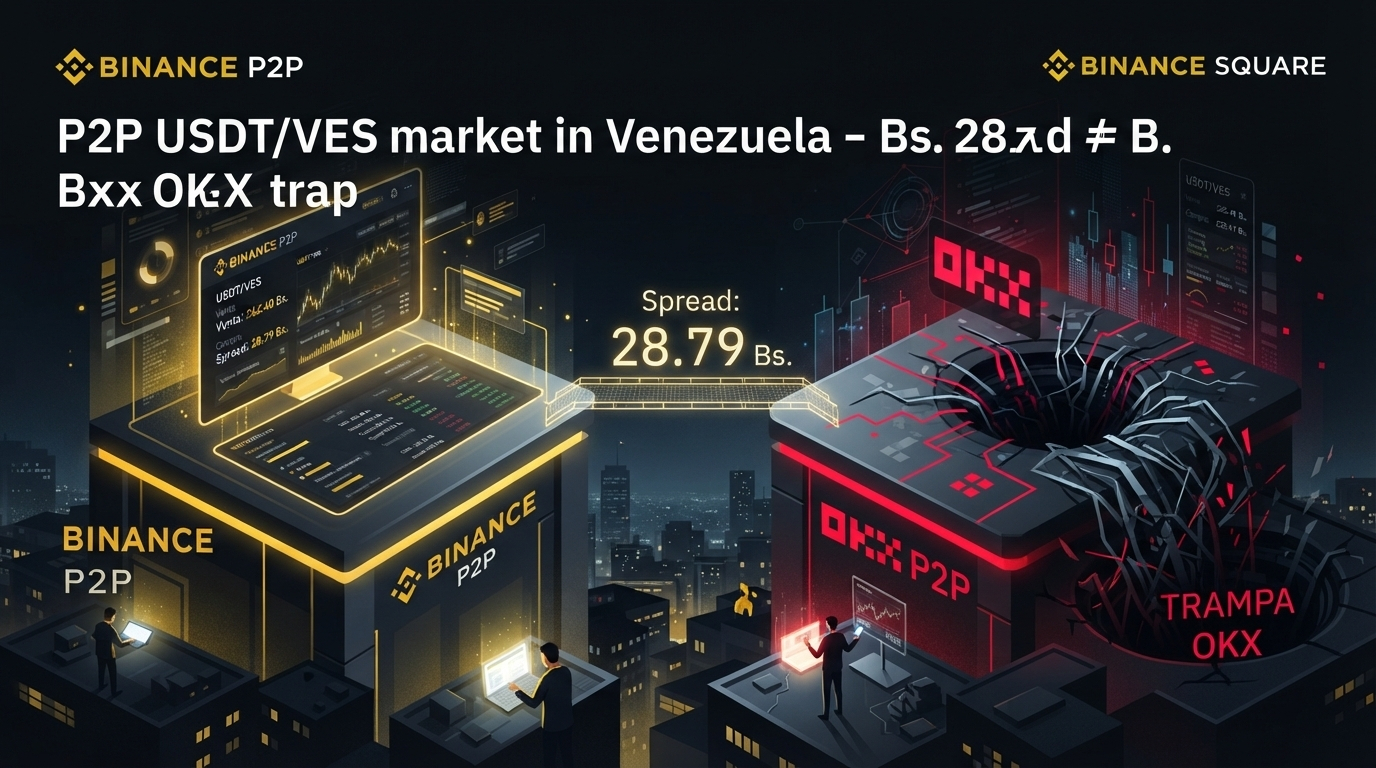
P2P USDT/VES hoy: spread de Bs. 28,79 y la trampa de OKX## P2P USDT/VES hoy: spread de Bs. 28,79 y la trampa de otras plataformas
**Fecha:** jueves, 10 de septiembre de 2026 · **Datos en vivo del Radar P2P:** compra Bs. 979.84 · venta Bs. 951.06 · BCV Bs. N/A · prima N/A%
El mercado P2P de USDT/VES arranca este jueves 10 de septiembre con un spread promedio de Bs. 28,79 entre compra (Bs. 979,84) y venta (Bs. 951,06), equivalente a casi 3% de costo ida y vuelta. Sin tasa BCV publicada en el radar, el P2P opera como referencia única y eso se nota en la dispersión entre exchanges.
### Notas de comercio P2P: análisis del día
Binance marca Bs. 961,73 de compra y Bs. 958,90 de venta, un diferencial de apenas Bs. 2,83: es el libro más profundo y el único con precios realmente convergentes, así que sigue siendo la plaza natural para cerrar volumen sin regalar margen. otras plataformas (Bs. 968,05 / 954,92) y otras plataformas (Bs. 974,17 / 939,35) se mueven en un rango intermedio, con otras plataformas ofreciendo la venta más atractiva del grupo (Bs. 939,35) para quien necesite líquido rápido, aunque con menos contrapartes activas. El dato que hay que leer con lupa es otras plataformas: Bs. 1015,42 de compra contra Bs. 796,84 de venta, un diferencial de Bs. 218 que no refleja mercado real, sino ofertas residuales, límites mal calibrados o anuncios de bajo monto que no aguantan volumen. Para el comerciante P2P venezolano la jugada hoy es clara: escalonar compras entre Bs. 961 y Bs. 968, vender en el rango de Bs. 954-959, y usar los picos de otras plataformas solo como referencia de arbitraje teórico, nunca como precio de cierre. Con un spread promedio de casi 3%, quien entra y sale sin planificar pierde aproximadamente Bs. 28,79 por USDT, así que conviene concentrar operaciones en una sola pata, revisar método de pago y banco receptor antes de liberar, y no perseguir el mejor precio si eso implica contraparte sin historial.
### Puntos clave
- Spread promedio de Bs. 28,79 (~3%), el verdadero costo de operar sin planificación.
- Binance es la plaza más eficiente: solo Bs. 2,83 entre compra y venta, ideal para volumen.
- otras plataformas distorsiona el promedio con Bs. 1015,42 / Bs. 796,84; diferencial de Bs. 218 no operable en volumen.
- otras plataformas ofrece la venta más baja del tablero (Bs. 939,35) para quien prioriza liquidez inmediata.
- Sin tasa BCV publicada, el P2P queda como referencia única: mayor dispersión entre exchanges.
### Mercado en vivo
binance: Bs. 961.73/958.90 | otras plataformas: Bs. 1015.42/796.84 | otras plataformas: Bs. 968.05/954.92 | otras plataformas: Bs. 974.17/939.35
_Análisis generado automáticamente por PitbullChain con datos en tiempo real. Contenido educativo, no es asesoría financiera._
📊 Tasas y análisis en vivo en pitbullchain.com
$USDT #USDTVES #P2PVenezuela #BinanceP2P #spreadUSDT #OKXP2P
P2P USDT/VES hoy: spread de Bs. 28,79 y la trampa de OKX
## P2P USDT/VES hoy: spread de Bs. 28,79 y la trampa de otras plataformas
**Fecha:** jueves, 10 de septiembre de 2026 · **Datos en vivo del Radar P2P:** compra Bs. 979.84 · venta Bs. 951.06 · BCV Bs. N/A · prima N/A%
El mercado P2P de USDT/VES arranca este jueves 10 de septiembre con un spread promedio de Bs. 28,79 entre compra (Bs. 979,84) y venta (Bs. 951,06), equivalente a casi 3% de costo ida y vuelta. Sin tasa BCV publicada en el radar, el P2P opera como referencia única y eso se nota en la dispersión entre exchanges.
### Notas de comercio P2P: análisis del día
Binance marca Bs. 961,73 de compra y Bs. 958,90 de venta, un diferencial de apenas Bs. 2,83: es el libro más profundo y el único con precios realmente convergentes, así que sigue siendo la plaza natural para cerrar volumen sin regalar margen. otras plataformas (Bs. 968,05 / 954,92) y otras plataformas (Bs. 974,17 / 939,35) se mueven en un rango intermedio, con otras plataformas ofreciendo la venta más atractiva del grupo (Bs. 939,35) para quien necesite líquido rápido, aunque con menos contrapartes activas. El dato que hay que leer con lupa es otras plataformas: Bs. 1015,42 de compra contra Bs. 796,84 de venta, un diferencial de Bs. 218 que no refleja mercado real, sino ofertas residuales, límites mal calibrados o anuncios de bajo monto que no aguantan volumen. Para el comerciante P2P venezolano la jugada hoy es clara: escalonar compras entre Bs. 961 y Bs. 968, vender en el rango de Bs. 954-959, y usar los picos de otras plataformas solo como referencia de arbitraje teórico, nunca como precio de cierre. Con un spread promedio de casi 3%, quien entra y sale sin planificar pierde aproximadamente Bs. 28,79 por USDT, así que conviene concentrar operaciones en una sola pata, revisar método de pago y banco receptor antes de liberar, y no perseguir el mejor precio si eso implica contraparte sin historial.
### Puntos clave
- Spread promedio de Bs. 28,79 (~3%), el verdadero costo de operar sin planificación.
- Binance es la plaza más eficiente: solo Bs. 2,83 entre compra y venta, ideal para volumen.
- otras plataformas distorsiona el promedio con Bs. 1015,42 / Bs. 796,84; diferencial de Bs. 218 no operable en volumen.
- otras plataformas ofrece la venta más baja del tablero (Bs. 939,35) para quien prioriza liquidez inmediata.
- Sin tasa BCV publicada, el P2P queda como referencia única: mayor dispersión entre exchanges.
### Mercado en vivo
binance: Bs. 961.73/958.90 | otras plataformas: Bs. 1015.42/796.84 | otras plataformas: Bs. 968.05/954.92 | otras plataformas: Bs. 974.17/939.35
_Análisis generado automáticamente por PitbullChain con datos en tiempo real. Contenido educativo, no es asesoría financiera._

📊 Tasas y análisis en vivo en pitbullchain.com
$USDT #USDTVES #P2PVenezuela #BinanceP2P #spreadUSDT #OKXP2P
**Fecha:** jueves, 10 de septiembre de 2026 · **Datos en vivo del Radar P2P:** compra Bs. 979.84 · venta Bs. 951.06 · BCV Bs. N/A · prima N/A%
El mercado P2P de USDT/VES arranca este jueves 10 de septiembre con un spread promedio de Bs. 28,79 entre compra (Bs. 979,84) y venta (Bs. 951,06), equivalente a casi 3% de costo ida y vuelta. Sin tasa BCV publicada en el radar, el P2P opera como referencia única y eso se nota en la dispersión entre exchanges.
### Notas de comercio P2P: análisis del día
Binance marca Bs. 961,73 de compra y Bs. 958,90 de venta, un diferencial de apenas Bs. 2,83: es el libro más profundo y el único con precios realmente convergentes, así que sigue siendo la plaza natural para cerrar volumen sin regalar margen. otras plataformas (Bs. 968,05 / 954,92) y otras plataformas (Bs. 974,17 / 939,35) se mueven en un rango intermedio, con otras plataformas ofreciendo la venta más atractiva del grupo (Bs. 939,35) para quien necesite líquido rápido, aunque con menos contrapartes activas. El dato que hay que leer con lupa es otras plataformas: Bs. 1015,42 de compra contra Bs. 796,84 de venta, un diferencial de Bs. 218 que no refleja mercado real, sino ofertas residuales, límites mal calibrados o anuncios de bajo monto que no aguantan volumen. Para el comerciante P2P venezolano la jugada hoy es clara: escalonar compras entre Bs. 961 y Bs. 968, vender en el rango de Bs. 954-959, y usar los picos de otras plataformas solo como referencia de arbitraje teórico, nunca como precio de cierre. Con un spread promedio de casi 3%, quien entra y sale sin planificar pierde aproximadamente Bs. 28,79 por USDT, así que conviene concentrar operaciones en una sola pata, revisar método de pago y banco receptor antes de liberar, y no perseguir el mejor precio si eso implica contraparte sin historial.
### Puntos clave
- Spread promedio de Bs. 28,79 (~3%), el verdadero costo de operar sin planificación.
- Binance es la plaza más eficiente: solo Bs. 2,83 entre compra y venta, ideal para volumen.
- otras plataformas distorsiona el promedio con Bs. 1015,42 / Bs. 796,84; diferencial de Bs. 218 no operable en volumen.
- otras plataformas ofrece la venta más baja del tablero (Bs. 939,35) para quien prioriza liquidez inmediata.
- Sin tasa BCV publicada, el P2P queda como referencia única: mayor dispersión entre exchanges.
### Mercado en vivo
binance: Bs. 961.73/958.90 | otras plataformas: Bs. 1015.42/796.84 | otras plataformas: Bs. 968.05/954.92 | otras plataformas: Bs. 974.17/939.35
_Análisis generado automáticamente por PitbullChain con datos en tiempo real. Contenido educativo, no es asesoría financiera._

📊 Tasas y análisis en vivo en pitbullchain.com
$USDT #USDTVES #P2PVenezuela #BinanceP2P #spreadUSDT #OKXP2P
·
--
Article
See translation
Doble spread del USDT/VES: el radar marca 5,60% y el libro 0,30%Radar P2P en vivo Captura: 10/9/2026, 6:00:16 a. m.
USDT/VES referencia Bs. 983.18
Compra USDT Bs. 983.18
Venta USDT Bs. 931.07
BCV Bs. 827.74
Prima vs BCV 18.78%
Spread P2P 5.60%
Ofertas observadas 180
Verificar datos actuales en Radar P2P
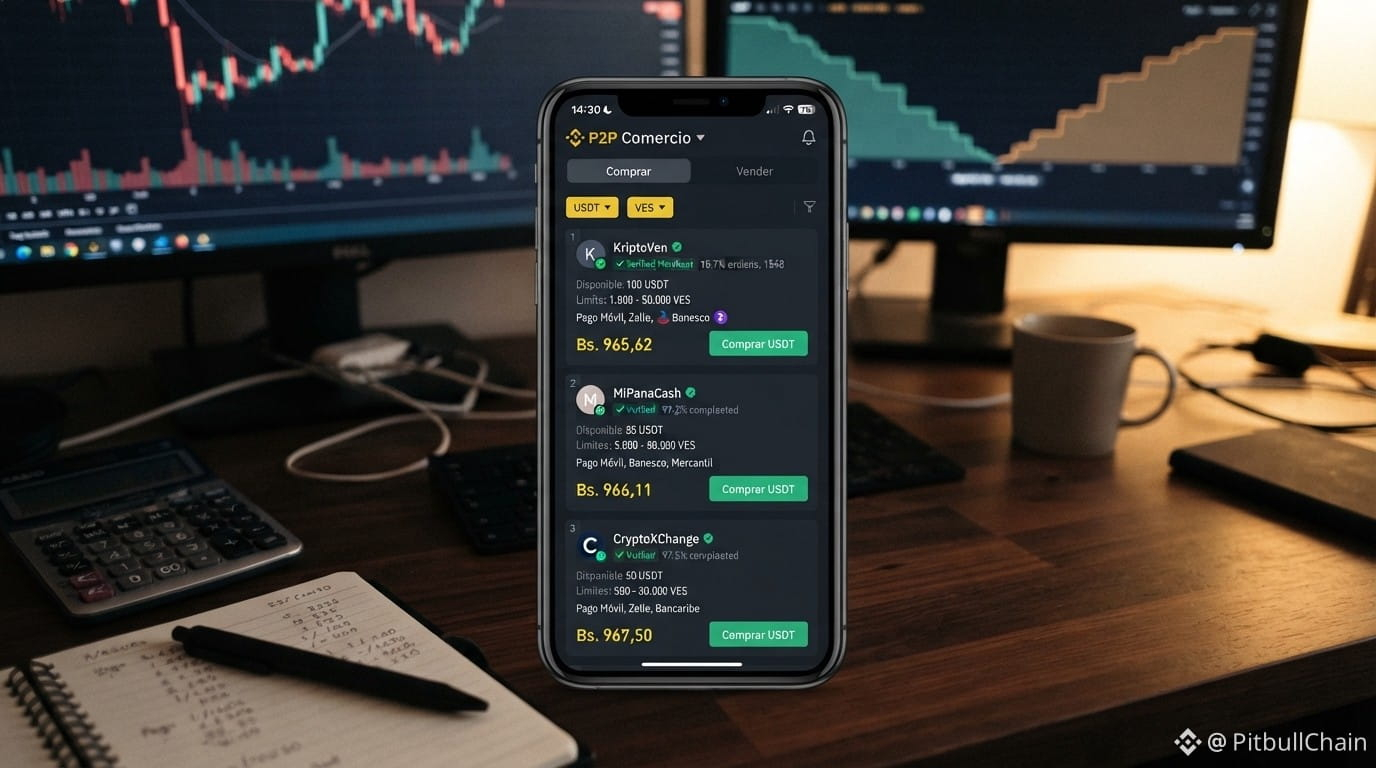
El 10 de septiembre de 2026, con captura de datos a las 10:00 (UTC), el radar P2P mostraba un spread de **₮52,11 para USDT/VES, equivalente a 5,60%**, con referencia de compra en ₮983,18 y de venta en ₮931,07. Cuarenta y tres segundos antes, el libro de órdenes agregado de Binance y otras plataformas registraba otra cosa: mejor ask en ₮964,00 y mejor bid en ₮961,10, es decir **₮2,90 entre puntas, un 0,30%**.
Son dos números correctos sobre el mismo mercado, pero miden cosas distintas. Este análisis separa hechos, cálculos e interpretación para que la decisión no se tome con el titular de spread alto, sino leyendo profundidad, bancos y límites.
## Qué mide cada cifra
Hecho: el radar P2P publica una referencia de compra y una de venta y calcula el diferencial entre ambas. Hecho: el libro de órdenes publica el mejor precio al que alguien está dispuesto a vender (ask) y el mejor precio al que alguien está dispuesto a comprar (bid) en un instante dado.
El spread del radar es una referencia agregada de anuncios. El spread del libro es ejecutable: son las dos puntas que, en teoría, se pueden cruzar en ese momento, con sus límites mínimos y máximos por anuncio. Cuando ambos coinciden, la lectura es simple; cuando no, el titular puede confundir.
## El spread del radar: ₮52,11 y 5,60%
El registro del radar indica compra en ₮983,18, venta en ₮931,07, spread de ₮52,11 y spreadPct de 5,5967%. Ese mismo panel reportaba 194 anuncios activos y una prima frente al BCV de 18,78%.
El dato es útil para ubicar el rango en el que se mueven las publicaciones del mercado, no para estimar el costo de una operación puntual. Un spread agregado alto puede convivir con un libro muy ajustado si el grueso de los anuncios se concentra lejos de la punta, o si el método de pago con mayor presencia tiene precios más dispersos.
## El spread del libro: ₮2,90 y 0,30%
En la captura de las 09:59:43 (UTC):
- **Mejor ask:** ₮964,00 en Binance, 2.281,84 USDT disponibles en un solo anuncio, bancos BANK y Banco de Venezuela, límite mínimo ₮228,18 y máximo ₮2.281,84.
- **Mejor bid:** ₮961,10 en Binance, 3.340,45 USDT, banco Banesco, límite mínimo ₮334,05 y máximo ₮3.340,45.
- **Precio medio:** ₮962,55.
Cálculo: cruzar esas dos puntas arroja un recorrido de ₮2,90 por USDT, que sobre los 2.281,84 USDT del mejor ask equivale a ₮6.617,34 antes de comisiones. Ese es el ancho real del libro en ese instante, y no tiene relación directa con el 5,60% del radar: la proporción entre ambos es de unas 18,7 veces.
## Por qué el 5,60% y el 0,30% no se contradicen
Interpretación, no hecho: el radar agrega referencias de compra y venta que no necesariamente pertenecen a la punta ejecutable del libro. Prueba aritmética de esa distancia: la referencia de compra del radar (₮983,18) queda ₮19,18 por encima del mejor ask del libro, un 1,99%; la referencia de venta (₮931,07) queda ₮30,03 por debajo del mejor bid, un 3,12%. Ninguno de esos dos extremos estaba disponible al momento de la captura con la profundidad registrada.
No tenemos documentada en este conjunto de datos la metodología exacta con la que el radar construye sus referencias, así que la explicación anterior es hipótesis razonable y no conclusión cerrada. Lo que sí es verificable es que el libro mostraba ₮2,90 entre puntas y el radar ₮52,11.
## Profundidad: 206.958 USDT en bids contra 129.524 USDT en asks
Hecho: el libro agregado tenía 206.958,79 USDT en bids repartidos en 31 anuncios y 129.524,50 USDT en asks en 28 anuncios. El desequilibrio calculado fue de 23,01% a favor de la demanda.
La distribución importa tanto como el total. Del lado comprador destaca un nivel de 82.633,46 USDT a ₮958,50 en tres anuncios de Binance y otras plataformas, con límite máximo de ₮74.675,87. Del lado vendedor, los bloques grandes aparecen más arriba: 23.521,71 USDT a ₮966,80 en Banesco y 15.938,33 USDT a ₮967,00.
Interpretación: hay más volumen esperando comprar que vendiendo, y buena parte de la oferta está por encima de ₮966. Eso no anticipa dirección; describe cómo está armado el libro a esa hora.
## Bancos: el diferencial cambia según el método de pago
Promedios por banco en la captura (no son precios ejecutables, son promedios de anuncios):
Banco o método Spread Prom. compra Prom. venta Anuncios Banco de Venezuela 0,73% ₮965,63 ₮958,62 18 BANK 0,74% ₮965,14 ₮958,07 9 Mercantil 0,80% ₮966,43 ₮958,75 5 Banesco 1,35% ₮969,34 ₮956,42 31 Pago Móvil 2,01% ₮971,50 ₮952,34 25 Otro método 2,07% ₮972,75 ₮953,04 19 Los métodos con menor diferencial son también los que aparecen en el top del libro: Banco de Venezuela, BANK y Mercantil sostienen el ask de ₮964,00 y los bids cercanos a ₮958,60. Pago Móvil y Otro método tienen más anuncios, pero con promedios más abiertos. Banesco concentra el mayor número de anuncios (31) con un diferencial intermedio.
## Contexto: BCV ₮827,74, paralelo ₮963,24 y prima de 18,78%
Referencias oficiales y paralelas de la misma captura: BCV en ₮827,7371; dólar paralelo en ₮963,24 (compra ₮962,53 / venta ₮963,95, spread de ₮1,42 o 0,15%).
Cálculos propios a partir de esos datos:
- La referencia de compra del radar (₮983,18) frente al BCV deja la prima en 18,78%, la cifra que ya reportaban análisis del 8 y 9 de septiembre para el mercado venezolano.
- El precio medio del libro (₮962,55) frente al BCV implica una prima de 16,29%.
- Ese mismo medio del libro queda 0,07% por debajo del dólar paralelo (₮963,24): el USDT en libro cotiza prácticamente a la par del paralelo.
El semáforo de mercado marcaba 71/100 en amarillo, con etiqueta de precaución moderada y datos frescos. El desglose es revelador: liquidez 95/100, disponibilidad de bancos 95/100 y spread 20/100. La señal de spread advertía precisamente sobre el diferencial elevado y recomendaba comparar precios antes de operar. La puntuación de profundidad, en 45/100, era la más baja después del spread, lo que sugiere que el ancho no es el único punto a vigilar.
## Checklist práctico antes de operar
- Lee el mejor ask y el mejor bid del libro, no solo el porcentaje del titular.
- Verifica el límite mínimo y máximo del anuncio: el mejor precio suele venir con topes que pueden no ajustarse a tu monto.
- Compara el diferencial promedio del banco o método que vas a usar; entre 0,73% y 2,07% hay casi tres veces de diferencia.
- Revisa la profundidad acumulada, no solo el primer nivel: hay bloques grandes varios pesos por encima del mejor ask.
- Confirma que el banco del anuncio coincida con el banco emisor de tu pago.
- Usa el semáforo como termómetro de contexto: spread 20/100 y profundidad 45/100 describen un mercado con punta ajustada pero distribución desigual.
Para dimensionar: según la referencia de venta del radar (₮931,07), 100 USDT equivalen a ₮93.106,96, y ₮1.000.000 permiten adquirir 1.074,03 USDT. Con el precio medio del libro, esas mismas conversiones cambian de forma sensible.
## Cierre
El doble spread del USDT/VES no es un error de datos: es la diferencia entre una referencia agregada de anuncios (5,60%) y el ancho ejecutable de la punta del libro (0,30%). Con prima de 18,78% frente al BCV, semáforo amarillo de 71/100 y desequilibrio de profundidad de 23,01% a favor de los bids, la lectura ordenada es: precio de punta, límites del anuncio, banco y profundidad, en ese orden.
Contenido educativo e informativo. No constituye asesoría financiera ni proyección de tendencia. Cifras correspondientes a la captura del 10 de septiembre de 2026, 10:00 (UTC); el libro de órdenes fue tomado a las 09:59:43 (UTC) del mismo día.
## Fuentes consultadas
- 委内瑞拉的 USDT P2P:相对 BCV 的溢价超过 18%,价差为 3.27% - Binance — 9/9/2026
- 今天USDT对BCV的溢价超过19%:点差与流动性分析 - Binance — 7/9/2026
- Precio del dólar BCV hoy 8 de septiembre: la cotización superó los 814 bolívares - elestimulo.com — 8/9/2026
- USDT P2P 达到 970 玻利瓦尔,并将其相对 BCV 的溢价扩大至 19.1% - Binance — 8/9/2026
## Verifica antes de operar
Consulta tasas, bancos y profundidad actualizada en las herramientas de PitbullChain.
Abrir herramientas P2P
**Aviso:** contenido educativo e informativo. No constituye asesoría financiera ni recomendación de compra o venta.

📊 Tasas y análisis en vivo en pitbullchain.com
$USDT #USDTVES #spreadP2P #librodeordenesUSDT #primafrentealBCV #BinanceP2PVenezuela
Doble spread del USDT/VES: el radar marca 5,60% y el libro 0,30%
Radar P2P en vivo Captura: 10/9/2026, 6:00:16 a. m.
USDT/VES referencia Bs. 983.18
Compra USDT Bs. 983.18
Venta USDT Bs. 931.07
BCV Bs. 827.74
Prima vs BCV 18.78%
Spread P2P 5.60%
Ofertas observadas 180
Verificar datos actuales en Radar P2P
El 10 de septiembre de 2026, con captura de datos a las 10:00 (UTC), el radar P2P mostraba un spread de **₮52,11 para USDT/VES, equivalente a 5,60%**, con referencia de compra en ₮983,18 y de venta en ₮931,07. Cuarenta y tres segundos antes, el libro de órdenes agregado de Binance y otras plataformas registraba otra cosa: mejor ask en ₮964,00 y mejor bid en ₮961,10, es decir **₮2,90 entre puntas, un 0,30%**.
Son dos números correctos sobre el mismo mercado, pero miden cosas distintas. Este análisis separa hechos, cálculos e interpretación para que la decisión no se tome con el titular de spread alto, sino leyendo profundidad, bancos y límites.
## Qué mide cada cifra
Hecho: el radar P2P publica una referencia de compra y una de venta y calcula el diferencial entre ambas. Hecho: el libro de órdenes publica el mejor precio al que alguien está dispuesto a vender (ask) y el mejor precio al que alguien está dispuesto a comprar (bid) en un instante dado.
El spread del radar es una referencia agregada de anuncios. El spread del libro es ejecutable: son las dos puntas que, en teoría, se pueden cruzar en ese momento, con sus límites mínimos y máximos por anuncio. Cuando ambos coinciden, la lectura es simple; cuando no, el titular puede confundir.
## El spread del radar: ₮52,11 y 5,60%
El registro del radar indica compra en ₮983,18, venta en ₮931,07, spread de ₮52,11 y spreadPct de 5,5967%. Ese mismo panel reportaba 194 anuncios activos y una prima frente al BCV de 18,78%.
El dato es útil para ubicar el rango en el que se mueven las publicaciones del mercado, no para estimar el costo de una operación puntual. Un spread agregado alto puede convivir con un libro muy ajustado si el grueso de los anuncios se concentra lejos de la punta, o si el método de pago con mayor presencia tiene precios más dispersos.
## El spread del libro: ₮2,90 y 0,30%
En la captura de las 09:59:43 (UTC):
- **Mejor ask:** ₮964,00 en Binance, 2.281,84 USDT disponibles en un solo anuncio, bancos BANK y Banco de Venezuela, límite mínimo ₮228,18 y máximo ₮2.281,84.
- **Mejor bid:** ₮961,10 en Binance, 3.340,45 USDT, banco Banesco, límite mínimo ₮334,05 y máximo ₮3.340,45.
- **Precio medio:** ₮962,55.
Cálculo: cruzar esas dos puntas arroja un recorrido de ₮2,90 por USDT, que sobre los 2.281,84 USDT del mejor ask equivale a ₮6.617,34 antes de comisiones. Ese es el ancho real del libro en ese instante, y no tiene relación directa con el 5,60% del radar: la proporción entre ambos es de unas 18,7 veces.
## Por qué el 5,60% y el 0,30% no se contradicen
Interpretación, no hecho: el radar agrega referencias de compra y venta que no necesariamente pertenecen a la punta ejecutable del libro. Prueba aritmética de esa distancia: la referencia de compra del radar (₮983,18) queda ₮19,18 por encima del mejor ask del libro, un 1,99%; la referencia de venta (₮931,07) queda ₮30,03 por debajo del mejor bid, un 3,12%. Ninguno de esos dos extremos estaba disponible al momento de la captura con la profundidad registrada.
No tenemos documentada en este conjunto de datos la metodología exacta con la que el radar construye sus referencias, así que la explicación anterior es hipótesis razonable y no conclusión cerrada. Lo que sí es verificable es que el libro mostraba ₮2,90 entre puntas y el radar ₮52,11.
## Profundidad: 206.958 USDT en bids contra 129.524 USDT en asks
Hecho: el libro agregado tenía 206.958,79 USDT en bids repartidos en 31 anuncios y 129.524,50 USDT en asks en 28 anuncios. El desequilibrio calculado fue de 23,01% a favor de la demanda.
La distribución importa tanto como el total. Del lado comprador destaca un nivel de 82.633,46 USDT a ₮958,50 en tres anuncios de Binance y otras plataformas, con límite máximo de ₮74.675,87. Del lado vendedor, los bloques grandes aparecen más arriba: 23.521,71 USDT a ₮966,80 en Banesco y 15.938,33 USDT a ₮967,00.
Interpretación: hay más volumen esperando comprar que vendiendo, y buena parte de la oferta está por encima de ₮966. Eso no anticipa dirección; describe cómo está armado el libro a esa hora.
## Bancos: el diferencial cambia según el método de pago
Promedios por banco en la captura (no son precios ejecutables, son promedios de anuncios):
Banco o método Spread Prom. compra Prom. venta Anuncios Banco de Venezuela 0,73% ₮965,63 ₮958,62 18 BANK 0,74% ₮965,14 ₮958,07 9 Mercantil 0,80% ₮966,43 ₮958,75 5 Banesco 1,35% ₮969,34 ₮956,42 31 Pago Móvil 2,01% ₮971,50 ₮952,34 25 Otro método 2,07% ₮972,75 ₮953,04 19 Los métodos con menor diferencial son también los que aparecen en el top del libro: Banco de Venezuela, BANK y Mercantil sostienen el ask de ₮964,00 y los bids cercanos a ₮958,60. Pago Móvil y Otro método tienen más anuncios, pero con promedios más abiertos. Banesco concentra el mayor número de anuncios (31) con un diferencial intermedio.
## Contexto: BCV ₮827,74, paralelo ₮963,24 y prima de 18,78%
Referencias oficiales y paralelas de la misma captura: BCV en ₮827,7371; dólar paralelo en ₮963,24 (compra ₮962,53 / venta ₮963,95, spread de ₮1,42 o 0,15%).
Cálculos propios a partir de esos datos:
- La referencia de compra del radar (₮983,18) frente al BCV deja la prima en 18,78%, la cifra que ya reportaban análisis del 8 y 9 de septiembre para el mercado venezolano.
- El precio medio del libro (₮962,55) frente al BCV implica una prima de 16,29%.
- Ese mismo medio del libro queda 0,07% por debajo del dólar paralelo (₮963,24): el USDT en libro cotiza prácticamente a la par del paralelo.
El semáforo de mercado marcaba 71/100 en amarillo, con etiqueta de precaución moderada y datos frescos. El desglose es revelador: liquidez 95/100, disponibilidad de bancos 95/100 y spread 20/100. La señal de spread advertía precisamente sobre el diferencial elevado y recomendaba comparar precios antes de operar. La puntuación de profundidad, en 45/100, era la más baja después del spread, lo que sugiere que el ancho no es el único punto a vigilar.
## Checklist práctico antes de operar
- Lee el mejor ask y el mejor bid del libro, no solo el porcentaje del titular.
- Verifica el límite mínimo y máximo del anuncio: el mejor precio suele venir con topes que pueden no ajustarse a tu monto.
- Compara el diferencial promedio del banco o método que vas a usar; entre 0,73% y 2,07% hay casi tres veces de diferencia.
- Revisa la profundidad acumulada, no solo el primer nivel: hay bloques grandes varios pesos por encima del mejor ask.
- Confirma que el banco del anuncio coincida con el banco emisor de tu pago.
- Usa el semáforo como termómetro de contexto: spread 20/100 y profundidad 45/100 describen un mercado con punta ajustada pero distribución desigual.
Para dimensionar: según la referencia de venta del radar (₮931,07), 100 USDT equivalen a ₮93.106,96, y ₮1.000.000 permiten adquirir 1.074,03 USDT. Con el precio medio del libro, esas mismas conversiones cambian de forma sensible.
## Cierre
El doble spread del USDT/VES no es un error de datos: es la diferencia entre una referencia agregada de anuncios (5,60%) y el ancho ejecutable de la punta del libro (0,30%). Con prima de 18,78% frente al BCV, semáforo amarillo de 71/100 y desequilibrio de profundidad de 23,01% a favor de los bids, la lectura ordenada es: precio de punta, límites del anuncio, banco y profundidad, en ese orden.
Contenido educativo e informativo. No constituye asesoría financiera ni proyección de tendencia. Cifras correspondientes a la captura del 10 de septiembre de 2026, 10:00 (UTC); el libro de órdenes fue tomado a las 09:59:43 (UTC) del mismo día.
## Fuentes consultadas
- 委内瑞拉的 USDT P2P:相对 BCV 的溢价超过 18%,价差为 3.27% - Binance — 9/9/2026
- 今天USDT对BCV的溢价超过19%:点差与流动性分析 - Binance — 7/9/2026
- Precio del dólar BCV hoy 8 de septiembre: la cotización superó los 814 bolívares - elestimulo.com — 8/9/2026
- USDT P2P 达到 970 玻利瓦尔,并将其相对 BCV 的溢价扩大至 19.1% - Binance — 8/9/2026
## Verifica antes de operar
Consulta tasas, bancos y profundidad actualizada en las herramientas de PitbullChain.
Abrir herramientas P2P
**Aviso:** contenido educativo e informativo. No constituye asesoría financiera ni recomendación de compra o venta.

📊 Tasas y análisis en vivo en pitbullchain.com
$USDT #USDTVES #spreadP2P #librodeordenesUSDT #primafrentealBCV #BinanceP2PVenezuela
USDT/VES referencia Bs. 983.18
Compra USDT Bs. 983.18
Venta USDT Bs. 931.07
BCV Bs. 827.74
Prima vs BCV 18.78%
Spread P2P 5.60%
Ofertas observadas 180
Verificar datos actuales en Radar P2P
El 10 de septiembre de 2026, con captura de datos a las 10:00 (UTC), el radar P2P mostraba un spread de **₮52,11 para USDT/VES, equivalente a 5,60%**, con referencia de compra en ₮983,18 y de venta en ₮931,07. Cuarenta y tres segundos antes, el libro de órdenes agregado de Binance y otras plataformas registraba otra cosa: mejor ask en ₮964,00 y mejor bid en ₮961,10, es decir **₮2,90 entre puntas, un 0,30%**.
Son dos números correctos sobre el mismo mercado, pero miden cosas distintas. Este análisis separa hechos, cálculos e interpretación para que la decisión no se tome con el titular de spread alto, sino leyendo profundidad, bancos y límites.
## Qué mide cada cifra
Hecho: el radar P2P publica una referencia de compra y una de venta y calcula el diferencial entre ambas. Hecho: el libro de órdenes publica el mejor precio al que alguien está dispuesto a vender (ask) y el mejor precio al que alguien está dispuesto a comprar (bid) en un instante dado.
El spread del radar es una referencia agregada de anuncios. El spread del libro es ejecutable: son las dos puntas que, en teoría, se pueden cruzar en ese momento, con sus límites mínimos y máximos por anuncio. Cuando ambos coinciden, la lectura es simple; cuando no, el titular puede confundir.
## El spread del radar: ₮52,11 y 5,60%
El registro del radar indica compra en ₮983,18, venta en ₮931,07, spread de ₮52,11 y spreadPct de 5,5967%. Ese mismo panel reportaba 194 anuncios activos y una prima frente al BCV de 18,78%.
El dato es útil para ubicar el rango en el que se mueven las publicaciones del mercado, no para estimar el costo de una operación puntual. Un spread agregado alto puede convivir con un libro muy ajustado si el grueso de los anuncios se concentra lejos de la punta, o si el método de pago con mayor presencia tiene precios más dispersos.
## El spread del libro: ₮2,90 y 0,30%
En la captura de las 09:59:43 (UTC):
- **Mejor ask:** ₮964,00 en Binance, 2.281,84 USDT disponibles en un solo anuncio, bancos BANK y Banco de Venezuela, límite mínimo ₮228,18 y máximo ₮2.281,84.
- **Mejor bid:** ₮961,10 en Binance, 3.340,45 USDT, banco Banesco, límite mínimo ₮334,05 y máximo ₮3.340,45.
- **Precio medio:** ₮962,55.
Cálculo: cruzar esas dos puntas arroja un recorrido de ₮2,90 por USDT, que sobre los 2.281,84 USDT del mejor ask equivale a ₮6.617,34 antes de comisiones. Ese es el ancho real del libro en ese instante, y no tiene relación directa con el 5,60% del radar: la proporción entre ambos es de unas 18,7 veces.
## Por qué el 5,60% y el 0,30% no se contradicen
Interpretación, no hecho: el radar agrega referencias de compra y venta que no necesariamente pertenecen a la punta ejecutable del libro. Prueba aritmética de esa distancia: la referencia de compra del radar (₮983,18) queda ₮19,18 por encima del mejor ask del libro, un 1,99%; la referencia de venta (₮931,07) queda ₮30,03 por debajo del mejor bid, un 3,12%. Ninguno de esos dos extremos estaba disponible al momento de la captura con la profundidad registrada.
No tenemos documentada en este conjunto de datos la metodología exacta con la que el radar construye sus referencias, así que la explicación anterior es hipótesis razonable y no conclusión cerrada. Lo que sí es verificable es que el libro mostraba ₮2,90 entre puntas y el radar ₮52,11.
## Profundidad: 206.958 USDT en bids contra 129.524 USDT en asks
Hecho: el libro agregado tenía 206.958,79 USDT en bids repartidos en 31 anuncios y 129.524,50 USDT en asks en 28 anuncios. El desequilibrio calculado fue de 23,01% a favor de la demanda.
La distribución importa tanto como el total. Del lado comprador destaca un nivel de 82.633,46 USDT a ₮958,50 en tres anuncios de Binance y otras plataformas, con límite máximo de ₮74.675,87. Del lado vendedor, los bloques grandes aparecen más arriba: 23.521,71 USDT a ₮966,80 en Banesco y 15.938,33 USDT a ₮967,00.
Interpretación: hay más volumen esperando comprar que vendiendo, y buena parte de la oferta está por encima de ₮966. Eso no anticipa dirección; describe cómo está armado el libro a esa hora.
## Bancos: el diferencial cambia según el método de pago
Promedios por banco en la captura (no son precios ejecutables, son promedios de anuncios):
Banco o método Spread Prom. compra Prom. venta Anuncios Banco de Venezuela 0,73% ₮965,63 ₮958,62 18 BANK 0,74% ₮965,14 ₮958,07 9 Mercantil 0,80% ₮966,43 ₮958,75 5 Banesco 1,35% ₮969,34 ₮956,42 31 Pago Móvil 2,01% ₮971,50 ₮952,34 25 Otro método 2,07% ₮972,75 ₮953,04 19 Los métodos con menor diferencial son también los que aparecen en el top del libro: Banco de Venezuela, BANK y Mercantil sostienen el ask de ₮964,00 y los bids cercanos a ₮958,60. Pago Móvil y Otro método tienen más anuncios, pero con promedios más abiertos. Banesco concentra el mayor número de anuncios (31) con un diferencial intermedio.
## Contexto: BCV ₮827,74, paralelo ₮963,24 y prima de 18,78%
Referencias oficiales y paralelas de la misma captura: BCV en ₮827,7371; dólar paralelo en ₮963,24 (compra ₮962,53 / venta ₮963,95, spread de ₮1,42 o 0,15%).
Cálculos propios a partir de esos datos:
- La referencia de compra del radar (₮983,18) frente al BCV deja la prima en 18,78%, la cifra que ya reportaban análisis del 8 y 9 de septiembre para el mercado venezolano.
- El precio medio del libro (₮962,55) frente al BCV implica una prima de 16,29%.
- Ese mismo medio del libro queda 0,07% por debajo del dólar paralelo (₮963,24): el USDT en libro cotiza prácticamente a la par del paralelo.
El semáforo de mercado marcaba 71/100 en amarillo, con etiqueta de precaución moderada y datos frescos. El desglose es revelador: liquidez 95/100, disponibilidad de bancos 95/100 y spread 20/100. La señal de spread advertía precisamente sobre el diferencial elevado y recomendaba comparar precios antes de operar. La puntuación de profundidad, en 45/100, era la más baja después del spread, lo que sugiere que el ancho no es el único punto a vigilar.
## Checklist práctico antes de operar
- Lee el mejor ask y el mejor bid del libro, no solo el porcentaje del titular.
- Verifica el límite mínimo y máximo del anuncio: el mejor precio suele venir con topes que pueden no ajustarse a tu monto.
- Compara el diferencial promedio del banco o método que vas a usar; entre 0,73% y 2,07% hay casi tres veces de diferencia.
- Revisa la profundidad acumulada, no solo el primer nivel: hay bloques grandes varios pesos por encima del mejor ask.
- Confirma que el banco del anuncio coincida con el banco emisor de tu pago.
- Usa el semáforo como termómetro de contexto: spread 20/100 y profundidad 45/100 describen un mercado con punta ajustada pero distribución desigual.
Para dimensionar: según la referencia de venta del radar (₮931,07), 100 USDT equivalen a ₮93.106,96, y ₮1.000.000 permiten adquirir 1.074,03 USDT. Con el precio medio del libro, esas mismas conversiones cambian de forma sensible.
## Cierre
El doble spread del USDT/VES no es un error de datos: es la diferencia entre una referencia agregada de anuncios (5,60%) y el ancho ejecutable de la punta del libro (0,30%). Con prima de 18,78% frente al BCV, semáforo amarillo de 71/100 y desequilibrio de profundidad de 23,01% a favor de los bids, la lectura ordenada es: precio de punta, límites del anuncio, banco y profundidad, en ese orden.
Contenido educativo e informativo. No constituye asesoría financiera ni proyección de tendencia. Cifras correspondientes a la captura del 10 de septiembre de 2026, 10:00 (UTC); el libro de órdenes fue tomado a las 09:59:43 (UTC) del mismo día.
## Fuentes consultadas
- 委内瑞拉的 USDT P2P:相对 BCV 的溢价超过 18%,价差为 3.27% - Binance — 9/9/2026
- 今天USDT对BCV的溢价超过19%:点差与流动性分析 - Binance — 7/9/2026
- Precio del dólar BCV hoy 8 de septiembre: la cotización superó los 814 bolívares - elestimulo.com — 8/9/2026
- USDT P2P 达到 970 玻利瓦尔,并将其相对 BCV 的溢价扩大至 19.1% - Binance — 8/9/2026
## Verifica antes de operar
Consulta tasas, bancos y profundidad actualizada en las herramientas de PitbullChain.
Abrir herramientas P2P
**Aviso:** contenido educativo e informativo. No constituye asesoría financiera ni recomendación de compra o venta.

📊 Tasas y análisis en vivo en pitbullchain.com
$USDT #USDTVES #spreadP2P #librodeordenesUSDT #primafrentealBCV #BinanceP2PVenezuela
6
·
--
Article
Double spread in P2P: 4.1% from the radar versus 0.08% real Live P2P Radar Capture: 10/9/2026, 12:00:18 a. m.
USDT/VES reference Bs. 976.35
Buy USDT Bs. 976.35
USDT sale Bs. 937.83
BCV Bs. 827.74
Premium vs BCV 17.95%
P2P spread 4.11%
Observed offers 186
Check current data in P2P Radar
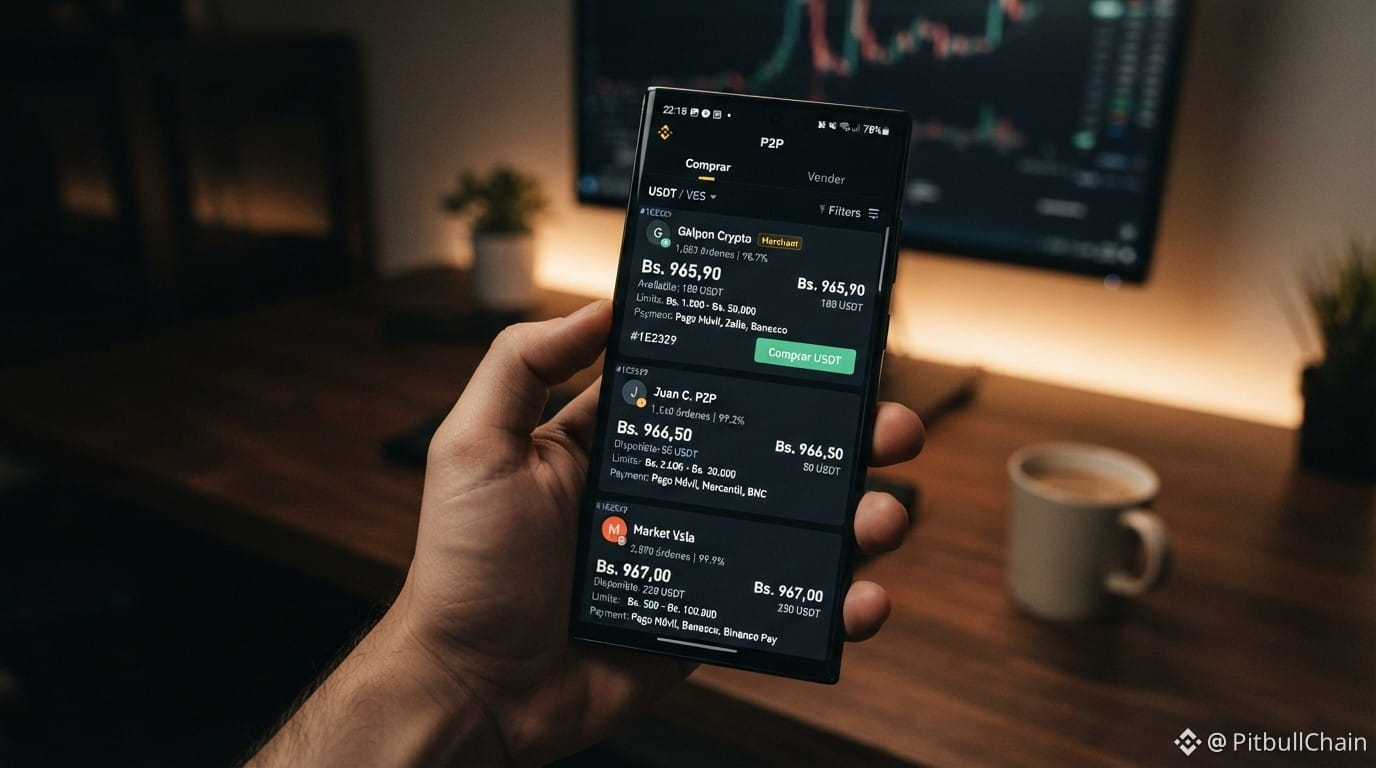
There is a difference that many traders don’t see until they have already sent the Mobile Payment: the **spread** shown in a headline is not the one you face when executing an order. In the capture from September 10, 2026, at 04:00 UTC, the aggregated radar showed a buy reference of **976.35 Bs/USDT** and a sell reference of **937.83 Bs/USDT**. The subtraction gives **38.52 bolívares**, equivalent to **4.107%**.
Double spread in P2P: 4.1% from the radar versus 0.08% real
Live P2P Radar Capture: 10/9/2026, 12:00:18 a. m.
USDT/VES reference Bs. 976.35
Buy USDT Bs. 976.35
USDT sale Bs. 937.83
BCV Bs. 827.74
Premium vs BCV 17.95%
P2P spread 4.11%
Observed offers 186
Check current data in P2P Radar
There is a difference that many traders don’t see until they have already sent the Mobile Payment: the **spread** shown in a headline is not the one you face when executing an order. In the capture from September 10, 2026, at 04:00 UTC, the aggregated radar showed a buy reference of **976.35 Bs/USDT** and a sell reference of **937.83 Bs/USDT**. The subtraction gives **38.52 bolívares**, equivalent to **4.107%**.
USDT/VES reference Bs. 976.35
Buy USDT Bs. 976.35
USDT sale Bs. 937.83
BCV Bs. 827.74
Premium vs BCV 17.95%
P2P spread 4.11%
Observed offers 186
Check current data in P2P Radar
There is a difference that many traders don’t see until they have already sent the Mobile Payment: the **spread** shown in a headline is not the one you face when executing an order. In the capture from September 10, 2026, at 04:00 UTC, the aggregated radar showed a buy reference of **976.35 Bs/USDT** and a sell reference of **937.83 Bs/USDT**. The subtraction gives **38.52 bolívares**, equivalent to **4.107%**.
2
·
--

Article
Oil for food: what does it imply for the dollar and P2P in Venezuela?The recent signing of energy agreements between Venezuela and the United States has been presented by the Government as a "historic turning point" that would not only revive the oil industry, but also boost food sovereignty. However, for those who participate in the P2P cryptocurrency market and depend on the parallel dollar, these statements raise a number of questions: will that windfall really reach the streets? How could it affect liquidity in bolívares and the exchange rate? At PitbullChain, we analyze what this scenario means for USDT users and for Venezuela’s digital economy.
Oil for food: what does it imply for the dollar and P2P in Venezuela?
The recent signing of energy agreements between Venezuela and the United States has been presented by the Government as a "historic turning point" that would not only revive the oil industry, but also boost food sovereignty. However, for those who participate in the P2P cryptocurrency market and depend on the parallel dollar, these statements raise a number of questions: will that windfall really reach the streets? How could it affect liquidity in bolívares and the exchange rate? At PitbullChain, we analyze what this scenario means for USDT users and for Venezuela’s digital economy.
7
·
--
Article
USDT/VES: 3.7% spread and 19% premium versus BCVThe USDT-to-bolívar (VES) market offers mixed signals: on the one hand, a high 3.7% spread that requires comparison before trading; on the other, broad liquidity across several banks and an active flow of offers exceeding 250 listings. This analysis breaks down the verified data as of September 6, 2026, so you have context, not buy or sell recommendations. What do the live numbers say? At the time of the capture, the average P2P price of USDT/VES on Radar P2P stood at 970.02 bolívars for buying and 935.25 for selling. That is a spread of 34.77 bolívars, equivalent to 3.72%. This margin is considerably wider than what was reported in other windows, which raises a yellow alert: the market traffic light shows a score of 71 out of 100, with a 'Moderate caution' status. For comparison purposes, the BCV dollar closed at 813.74 bolívars, while the parallel reference (based on Binance P2P) stood at 959.48. The USDT premium versus BCV reaches 19.2%, a level that reflects sustained demand for hard assets in the country. Market signals: positive liquidity, alarming spread The radar detects two main signals: Positive liquidity: there is sufficient volume in banks such as Banesco, Pago Móvil, Banco de Venezuela, and Mercantil. This reduces the risk that an order will not be executed. High spread: the difference between the best buy and sell price exceeds 3.5%. That means if you enter the market without comparing, you could lose a significant portion of the transaction value. The traffic-light metrics reinforce the diagnosis: the spread score is low (20), while liquidity, banking availability, and data freshness all exceed 90. The practical conclusion is that there is a market to trade, but it is not a time to do so blindly. What is happening in the order book? When analyzing the aggregated order book (Binance, other platforms, and other platforms), there is a significant imbalance: buy volume reaches 1,236,431 USDT, while sell volume is only 80,730 USDT. In other words, buying pressure is 87.7% greater than selling pressure. That explains why the buy price remains above 960 bolívars at several levels. The best prices to sell (bid) are concentrated at 963.50 bolívars per USDT, with amounts ranging from 6,781 USDT to large blocks of 529,480 USDT on other platforms. On the offer side (ask), the best price is around 919.59, though with smaller volumes and minimum-limit conditions. Also relevant is the distribution by bank: Banesco leads with 23 listings, followed by Pago Móvil (20) and Other method (19). The tightest spread is found with Pago Móvil (0.91%), making it an option to consider if you want to reduce exchange costs. Context: BCV and external references The BCV dollar remains at 813.74 bolívars, unchanged from the previous day, but the gap with both the parallel rate and USDT remains wide. Recent sources indicate that the official exchange rate surpassed 807 bolívars in early September (source 2). This divergence between the official and market exchange rates reflects inflationary and demand pressures that are not always reflected in time in the Central Bank’s rate. Additionally, interest in USDT as a safe haven is not new: reports from June 2026 already indicated that the bolívar crisis was driving demand for this digital currency on P2P platforms (source 4). The current scenario, with a 19% premium versus BCV, suggests that trend continues. Recommendations for trading with judgment Given this outlook, the suggested actions are not buy or sell decisions, but risk management: Compare prices across exchanges: the difference between the best bid and the best ask can exceed 40 bolívars. Use tools such as PitbullChain’s P2P calculator. Check the bank, reputation, and limits: not all payment methods offer the same protection. Review the counterparty’s history and the minimum and maximum limits before accepting an offer. Monitor the spread: if the spread widens above 4%, the trade may become unfavorable. Wait or look for better prices. Consider liquidity by bank: Banesco and Pago Móvil show good depth, but that does not guarantee that your specific transaction will execute at the posted price. Practical wrap-up In short, the USDT/VES market shows a high premium and a spread that calls for caution. Liquidity is sufficient to trade, but the asymmetry between buyers and sellers can generate sharp moves. Before any transaction, compare live data and adapt your strategy to your risk profile. This content is educational and informational. It does not constitute financial advice. The data comes from verified sources at the time of capture.
USDT/VES: 3.7% spread and 19% premium versus BCV
The USDT-to-bolívar (VES) market offers mixed signals: on the one hand, a high 3.7% spread that requires comparison before trading; on the other, broad liquidity across several banks and an active flow of offers exceeding 250 listings. This analysis breaks down the verified data as of September 6, 2026, so you have context, not buy or sell recommendations. What do the live numbers say? At the time of the capture, the average P2P price of USDT/VES on Radar P2P stood at 970.02 bolívars for buying and 935.25 for selling. That is a spread of 34.77 bolívars, equivalent to 3.72%. This margin is considerably wider than what was reported in other windows, which raises a yellow alert: the market traffic light shows a score of 71 out of 100, with a 'Moderate caution' status. For comparison purposes, the BCV dollar closed at 813.74 bolívars, while the parallel reference (based on Binance P2P) stood at 959.48. The USDT premium versus BCV reaches 19.2%, a level that reflects sustained demand for hard assets in the country. Market signals: positive liquidity, alarming spread The radar detects two main signals: Positive liquidity: there is sufficient volume in banks such as Banesco, Pago Móvil, Banco de Venezuela, and Mercantil. This reduces the risk that an order will not be executed. High spread: the difference between the best buy and sell price exceeds 3.5%. That means if you enter the market without comparing, you could lose a significant portion of the transaction value. The traffic-light metrics reinforce the diagnosis: the spread score is low (20), while liquidity, banking availability, and data freshness all exceed 90. The practical conclusion is that there is a market to trade, but it is not a time to do so blindly. What is happening in the order book? When analyzing the aggregated order book (Binance, other platforms, and other platforms), there is a significant imbalance: buy volume reaches 1,236,431 USDT, while sell volume is only 80,730 USDT. In other words, buying pressure is 87.7% greater than selling pressure. That explains why the buy price remains above 960 bolívars at several levels. The best prices to sell (bid) are concentrated at 963.50 bolívars per USDT, with amounts ranging from 6,781 USDT to large blocks of 529,480 USDT on other platforms. On the offer side (ask), the best price is around 919.59, though with smaller volumes and minimum-limit conditions. Also relevant is the distribution by bank: Banesco leads with 23 listings, followed by Pago Móvil (20) and Other method (19). The tightest spread is found with Pago Móvil (0.91%), making it an option to consider if you want to reduce exchange costs. Context: BCV and external references The BCV dollar remains at 813.74 bolívars, unchanged from the previous day, but the gap with both the parallel rate and USDT remains wide. Recent sources indicate that the official exchange rate surpassed 807 bolívars in early September (source 2). This divergence between the official and market exchange rates reflects inflationary and demand pressures that are not always reflected in time in the Central Bank’s rate. Additionally, interest in USDT as a safe haven is not new: reports from June 2026 already indicated that the bolívar crisis was driving demand for this digital currency on P2P platforms (source 4). The current scenario, with a 19% premium versus BCV, suggests that trend continues. Recommendations for trading with judgment Given this outlook, the suggested actions are not buy or sell decisions, but risk management: Compare prices across exchanges: the difference between the best bid and the best ask can exceed 40 bolívars. Use tools such as PitbullChain’s P2P calculator. Check the bank, reputation, and limits: not all payment methods offer the same protection. Review the counterparty’s history and the minimum and maximum limits before accepting an offer. Monitor the spread: if the spread widens above 4%, the trade may become unfavorable. Wait or look for better prices. Consider liquidity by bank: Banesco and Pago Móvil show good depth, but that does not guarantee that your specific transaction will execute at the posted price. Practical wrap-up In short, the USDT/VES market shows a high premium and a spread that calls for caution. Liquidity is sufficient to trade, but the asymmetry between buyers and sellers can generate sharp moves. Before any transaction, compare live data and adapt your strategy to your risk profile. This content is educational and informational. It does not constitute financial advice. The data comes from verified sources at the time of capture.
3
·
--
Wide spreads and uneven exchanges: Sunday P2P analysis## Wide spreads and uneven exchanges: Sunday P2P analysis
**Date:** Sunday, September 6, 2026 · **Live data from P2P Radar:** buy Bs. 987.34 · sell Bs. 939.09 · BCV Bs. N/A · premium N/A%
Today, Sunday, September 6, USDT/VES P2P trading is taking place with low liquidity and a marked dispersion of prices among the main exchanges. Without an official BCV rate, traders lack a clear reference, which deepens the usual weekend uncertainty.
Wide spreads and uneven exchanges: Sunday P2P analysis
## Wide spreads and uneven exchanges: Sunday P2P analysis
**Date:** Sunday, September 6, 2026 · **Live data from P2P Radar:** buy Bs. 987.34 · sell Bs. 939.09 · BCV Bs. N/A · premium N/A%
Today, Sunday, September 6, USDT/VES P2P trading is taking place with low liquidity and a marked dispersion of prices among the main exchanges. Without an official BCV rate, traders lack a clear reference, which deepens the usual weekend uncertainty.
**Date:** Sunday, September 6, 2026 · **Live data from P2P Radar:** buy Bs. 987.34 · sell Bs. 939.09 · BCV Bs. N/A · premium N/A%
Today, Sunday, September 6, USDT/VES P2P trading is taking place with low liquidity and a marked dispersion of prices among the main exchanges. Without an official BCV rate, traders lack a clear reference, which deepens the usual weekend uncertainty.
·
--
Article
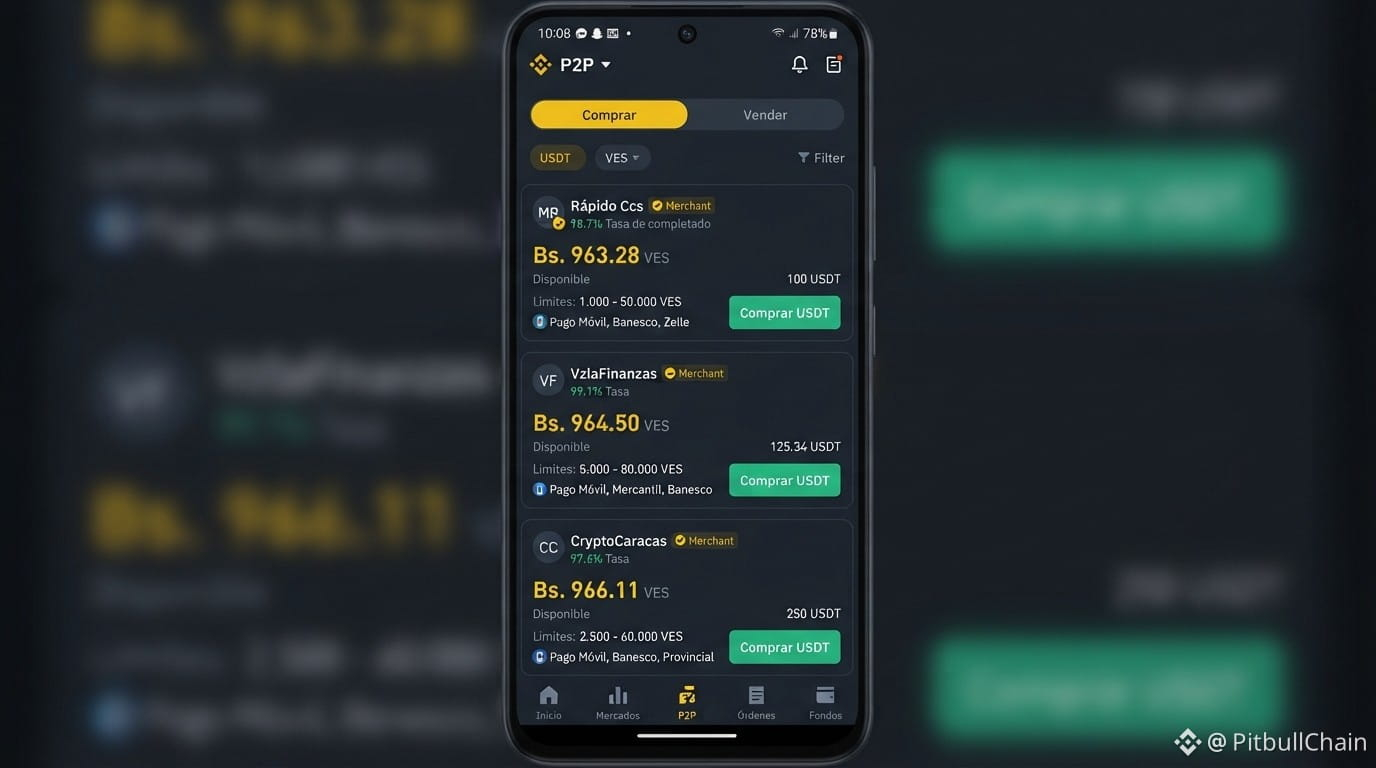
USDT/VES: 18.8% premium over the BCV and 4% spread mark the P2P sessionAs of the close of September 5, 2026, the USDT/VES P2P market presents conditions that require attention: a 18.8% premium versus the official rate and a spread above 4%. These indicators reflect sustained demand for the stablecoin and liquidity that, although broad, shows significant gaps between banks and platforms. In this analysis, we break down the figures and offer key points for navigating cautiously. Yellow light: moderate caution P2P Radar, the monitoring tool that consolidates data from Binance, other platforms, and other exchanges, assigned a score of 71 points and a yellow status to the market. This means the conditions are mixed: there is sufficient liquidity, but the spread is high and the order book depth is uneven. The system’s recommendation is clear: compare prices and verify banks and reputation before operating [1]. 18.8% premium over the BCV: What does it imply? The BCV set the official exchange rate at Bs. 813.74 per dollar, while the average USDT P2P buy rate stood at Bs. 966.68. This represents a 18.8% premium over the official value. This gap is not new, but its magnitude indicates pressure on the bolívar or difficulty accessing dollars at the official rate. The parallel dollar, for its part, was quoted at Bs. 964.3, very close to the USDT value, suggesting that the stablecoin market is aligned with non-official dynamics [2]. 4.08% spread: a cost to consider The spread between those buying and selling USDT was Bs. 37.88, equivalent to 4.08%. This difference is higher than the one reported in previous weeks; for example, a recent analysis indicated a spread of 2.86% [6]. The increase implies a higher cost for the end user and highlights the importance of comparing offers before operating. In the order book, the best ask price was Bs. 918.8, while the best bid price was Bs. 965, which gives a spread of 4.79% at that moment. Liquidity: 264 offers and a notable asymmetry According to P2P Radar, there were 264 active offers in the market, of which 166 were sell offers and 98 were buy offers. The depth on the buy side (USDT demand) was more than 886,000 USDT, while on the sell side it barely exceeded 58,000. This means there is more liquidity for those who want to sell USDT, but less for those who need to buy. These conditions are reflected in a positive liquidity signal but with spread warnings. Banks: Banesco leads in supply and spread Among the banks present in P2P, Banesco accounted for 30.4% of the listings (35 offers), with an average spread of just 0.7% between buying and selling. This makes it the most liquid bank with the most balanced conditions. It is followed by Pago Móvil, with 27 listings and a spread of 0.84%. In contrast, the opportunity detected by Radar for "Other method" showed a spread of 0.19%, a figure that may be attractive for those seeking to minimize costs, although the availability of that method on each exchange should be verified [7]. Differences between exchanges of up to 4.78% When comparing prices across platforms, it is observed that one platform offered USDT at Bs. 951.58 while another did so at Bs. 997.02. This 4.78% difference represents an arbitrage opportunity, but also a risk if fees and execution time are not considered. The practical lesson: always review several platforms before deciding, since the dispersion in prices is wide. Practical recommendations for this day Based on the P2P Radar data and the color status, these are the suggested actions for operating safely: Compare prices between exchanges and banks: the difference may exceed 4%. Verify the reputation and limits of the counterparty before any transaction. Calculate the net amount considering the spread and possible commissions. If you use a bank, consider Banesco or Pago Móvil for their liquidity and reduced spread. Avoid impulsive trades with offers too far from the average [3]. In summary, the USDT/VES market shows signs of strength in volume, but with a high transaction cost and a premium that is not easing against the BCV. The key is caution: compare, verify, and calculate. The data come from P2P Radar [1], Binance [6], and other sources mentioned [2][3][7].
USDT/VES: 18.8% premium over the BCV and 4% spread mark the P2P session
As of the close of September 5, 2026, the USDT/VES P2P market presents conditions that require attention: a 18.8% premium versus the official rate and a spread above 4%. These indicators reflect sustained demand for the stablecoin and liquidity that, although broad, shows significant gaps between banks and platforms. In this analysis, we break down the figures and offer key points for navigating cautiously. Yellow light: moderate caution P2P Radar, the monitoring tool that consolidates data from Binance, other platforms, and other exchanges, assigned a score of 71 points and a yellow status to the market. This means the conditions are mixed: there is sufficient liquidity, but the spread is high and the order book depth is uneven. The system’s recommendation is clear: compare prices and verify banks and reputation before operating [1]. 18.8% premium over the BCV: What does it imply? The BCV set the official exchange rate at Bs. 813.74 per dollar, while the average USDT P2P buy rate stood at Bs. 966.68. This represents a 18.8% premium over the official value. This gap is not new, but its magnitude indicates pressure on the bolívar or difficulty accessing dollars at the official rate. The parallel dollar, for its part, was quoted at Bs. 964.3, very close to the USDT value, suggesting that the stablecoin market is aligned with non-official dynamics [2]. 4.08% spread: a cost to consider The spread between those buying and selling USDT was Bs. 37.88, equivalent to 4.08%. This difference is higher than the one reported in previous weeks; for example, a recent analysis indicated a spread of 2.86% [6]. The increase implies a higher cost for the end user and highlights the importance of comparing offers before operating. In the order book, the best ask price was Bs. 918.8, while the best bid price was Bs. 965, which gives a spread of 4.79% at that moment. Liquidity: 264 offers and a notable asymmetry According to P2P Radar, there were 264 active offers in the market, of which 166 were sell offers and 98 were buy offers. The depth on the buy side (USDT demand) was more than 886,000 USDT, while on the sell side it barely exceeded 58,000. This means there is more liquidity for those who want to sell USDT, but less for those who need to buy. These conditions are reflected in a positive liquidity signal but with spread warnings. Banks: Banesco leads in supply and spread Among the banks present in P2P, Banesco accounted for 30.4% of the listings (35 offers), with an average spread of just 0.7% between buying and selling. This makes it the most liquid bank with the most balanced conditions. It is followed by Pago Móvil, with 27 listings and a spread of 0.84%. In contrast, the opportunity detected by Radar for "Other method" showed a spread of 0.19%, a figure that may be attractive for those seeking to minimize costs, although the availability of that method on each exchange should be verified [7]. Differences between exchanges of up to 4.78% When comparing prices across platforms, it is observed that one platform offered USDT at Bs. 951.58 while another did so at Bs. 997.02. This 4.78% difference represents an arbitrage opportunity, but also a risk if fees and execution time are not considered. The practical lesson: always review several platforms before deciding, since the dispersion in prices is wide. Practical recommendations for this day Based on the P2P Radar data and the color status, these are the suggested actions for operating safely: Compare prices between exchanges and banks: the difference may exceed 4%. Verify the reputation and limits of the counterparty before any transaction. Calculate the net amount considering the spread and possible commissions. If you use a bank, consider Banesco or Pago Móvil for their liquidity and reduced spread. Avoid impulsive trades with offers too far from the average [3]. In summary, the USDT/VES market shows signs of strength in volume, but with a high transaction cost and a premium that is not easing against the BCV. The key is caution: compare, verify, and calculate. The data come from P2P Radar [1], Binance [6], and other sources mentioned [2][3][7].
10
·
--
Article
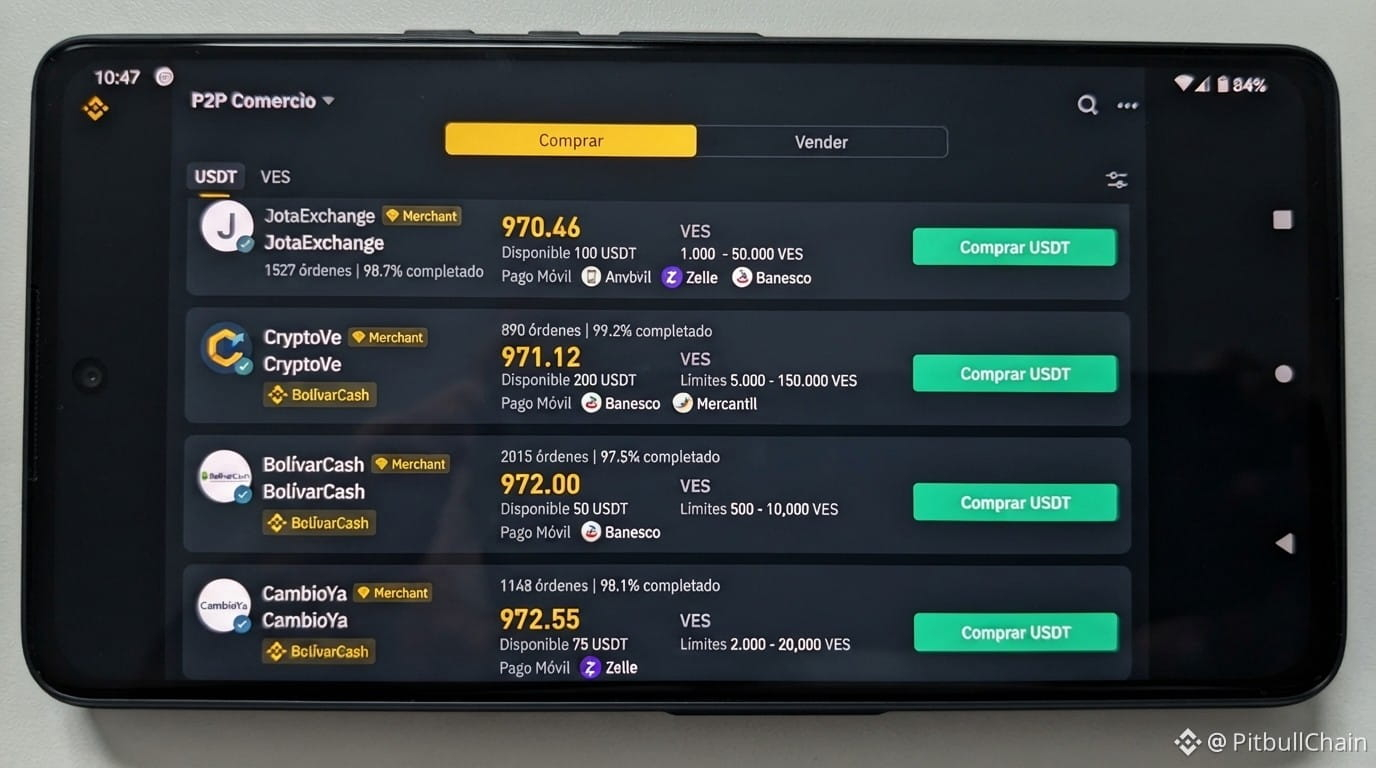
P2P Fragmentation: Binance and OKX Diverge 5.42% in USDT/VESThe Venezuelan P2P market is showing increasingly clear signs of fragmentation. On September 5, 2026, at 04:00 UTC, the P2P Radar added data from different platforms and found a wide spread of Bs. 40.06 (4.24%) between the average buy price (Bs. 984.34) and the sell price (Bs. 944.28). The main cause is not only volatility, but the distance between exchanges: Binance and other platforms showed a 5.42% divergence in USDT/VES. This analysis breaks down what this split means and how it affects the aggregate spread, with a focus on liquidity and banks. What the verified data say The P2P Radar snapshot recorded these values: Average buy price: Bs. 984.34 Average sell price: Bs. 944.28 Absolute spread: Bs. 40.06 Percentage spread: 4.24% Premium versus the BCV: 20.97% Active offers: 230 P2P signal light: yellow (69 points) The nearly 21% premium indicates that demand for hedging is still strong. However, the 4.24% spread does not reflect a single market, but rather a mix of realities: prices vary by platform, bank, and the liquidity level of each offer. Binance vs other platforms: a 5.42% gap The radar’s own opportunity detector classified a detected difference between exchanges as “high relevance.” According to that record, Binance was quoting USDT at Bs. 964.62, while other platforms were quoting it at Bs. 1,016.91. The absolute difference is Bs. 52.29 and the relative difference reaches 5.42%. This number far exceeds the healthy spread usually seen at the top of the consolidated order book. Looking at the order book, the best ask was Bs. 957.53 (other platforms) and the best bid was Bs. 965.70 (Binance). The effective spread between those best levels was only Bs. 8.17 (0.85%). In other words, the aggregate spread is much wider because it is “contaminated” by extreme offers, such as those from other platforms, which raise the buyer average. Liquidity and banks: the source of fragmentation Liquidity is not evenly distributed across platforms. The radar showed that 230 active offers give a high liquidity score (95), but actual depth varies by bank and by exchange. Banesco leads with 35 listings and a spread of 1.44% (Bs. 13.74). Banco de Venezuela, on the other hand, offers a much narrower spread: 0.57% (Bs. 5.52) with 16 listings. This suggests that exchanges with strong banking integration, such as Binance and its connection with Banco de Venezuela, can publish more competitive prices. other platforms, by contrast, appears to operate with other methods and entities, which adds a risk premium and a gap between buy and sell offers. Fragmentation is not a technical failure: it is a reflection of each community’s payment preferences. A buyer who can receive funds in Banco de Venezuela has more options and better prices than one limited to a bank with lower participation. How to read the aggregate spread The existence of a 5.42% divergence does not mean you can instantly buy cheap on Binance and sell expensive on other platforms. To execute such a move, you would need funds on both platforms, pass verification, wait for payment release, and assume counterparty risk. In addition, each offer’s minimum and maximum limits may prevent the trade from being profitable. What the divergence does indicate is that the market is not fully integrated. The aggregate spread is a sign of latent inefficiency. Instead of making decisions based only on an average, it is better to check the real order book, review the best prices by exchange, and compare bank availability. Practical recommendations In a yellow-light scenario, the smartest move is to do your homework before trading: Compare across exchanges: review buy and sell prices on Binance, other platforms, other platforms, and other platforms. Don’t rely on an average. Choose the bank with the best spread: Banco de Venezuela showed a 0.57% difference, while Banesco reaches 1.44%. That can mean tens of bolivars per USDT. Verify liquidity and depth: use the order book to see how many units are near the price, not just the best price. Check merchant limits and reputation: an offer may have a good price, but a low limit or a negative history. Calculate frictions: transfers, release time, and possible external fees can reduce a theoretical profit. Price fragmentation is a structural feature of a P2P market with high demand and uneven banking supply. Understanding it allows you to navigate the radar better and make decisions with contextual information, not just averages.
P2P Fragmentation: Binance and OKX Diverge 5.42% in USDT/VES
The Venezuelan P2P market is showing increasingly clear signs of fragmentation. On September 5, 2026, at 04:00 UTC, the P2P Radar added data from different platforms and found a wide spread of Bs. 40.06 (4.24%) between the average buy price (Bs. 984.34) and the sell price (Bs. 944.28). The main cause is not only volatility, but the distance between exchanges: Binance and other platforms showed a 5.42% divergence in USDT/VES. This analysis breaks down what this split means and how it affects the aggregate spread, with a focus on liquidity and banks. What the verified data say The P2P Radar snapshot recorded these values: Average buy price: Bs. 984.34 Average sell price: Bs. 944.28 Absolute spread: Bs. 40.06 Percentage spread: 4.24% Premium versus the BCV: 20.97% Active offers: 230 P2P signal light: yellow (69 points) The nearly 21% premium indicates that demand for hedging is still strong. However, the 4.24% spread does not reflect a single market, but rather a mix of realities: prices vary by platform, bank, and the liquidity level of each offer. Binance vs other platforms: a 5.42% gap The radar’s own opportunity detector classified a detected difference between exchanges as “high relevance.” According to that record, Binance was quoting USDT at Bs. 964.62, while other platforms were quoting it at Bs. 1,016.91. The absolute difference is Bs. 52.29 and the relative difference reaches 5.42%. This number far exceeds the healthy spread usually seen at the top of the consolidated order book. Looking at the order book, the best ask was Bs. 957.53 (other platforms) and the best bid was Bs. 965.70 (Binance). The effective spread between those best levels was only Bs. 8.17 (0.85%). In other words, the aggregate spread is much wider because it is “contaminated” by extreme offers, such as those from other platforms, which raise the buyer average. Liquidity and banks: the source of fragmentation Liquidity is not evenly distributed across platforms. The radar showed that 230 active offers give a high liquidity score (95), but actual depth varies by bank and by exchange. Banesco leads with 35 listings and a spread of 1.44% (Bs. 13.74). Banco de Venezuela, on the other hand, offers a much narrower spread: 0.57% (Bs. 5.52) with 16 listings. This suggests that exchanges with strong banking integration, such as Binance and its connection with Banco de Venezuela, can publish more competitive prices. other platforms, by contrast, appears to operate with other methods and entities, which adds a risk premium and a gap between buy and sell offers. Fragmentation is not a technical failure: it is a reflection of each community’s payment preferences. A buyer who can receive funds in Banco de Venezuela has more options and better prices than one limited to a bank with lower participation. How to read the aggregate spread The existence of a 5.42% divergence does not mean you can instantly buy cheap on Binance and sell expensive on other platforms. To execute such a move, you would need funds on both platforms, pass verification, wait for payment release, and assume counterparty risk. In addition, each offer’s minimum and maximum limits may prevent the trade from being profitable. What the divergence does indicate is that the market is not fully integrated. The aggregate spread is a sign of latent inefficiency. Instead of making decisions based only on an average, it is better to check the real order book, review the best prices by exchange, and compare bank availability. Practical recommendations In a yellow-light scenario, the smartest move is to do your homework before trading: Compare across exchanges: review buy and sell prices on Binance, other platforms, other platforms, and other platforms. Don’t rely on an average. Choose the bank with the best spread: Banco de Venezuela showed a 0.57% difference, while Banesco reaches 1.44%. That can mean tens of bolivars per USDT. Verify liquidity and depth: use the order book to see how many units are near the price, not just the best price. Check merchant limits and reputation: an offer may have a good price, but a low limit or a negative history. Calculate frictions: transfers, release time, and possible external fees can reduce a theoretical profit. Price fragmentation is a structural feature of a P2P market with high demand and uneven banking supply. Understanding it allows you to navigate the radar better and make decisions with contextual information, not just averages.
10
·
--
Article
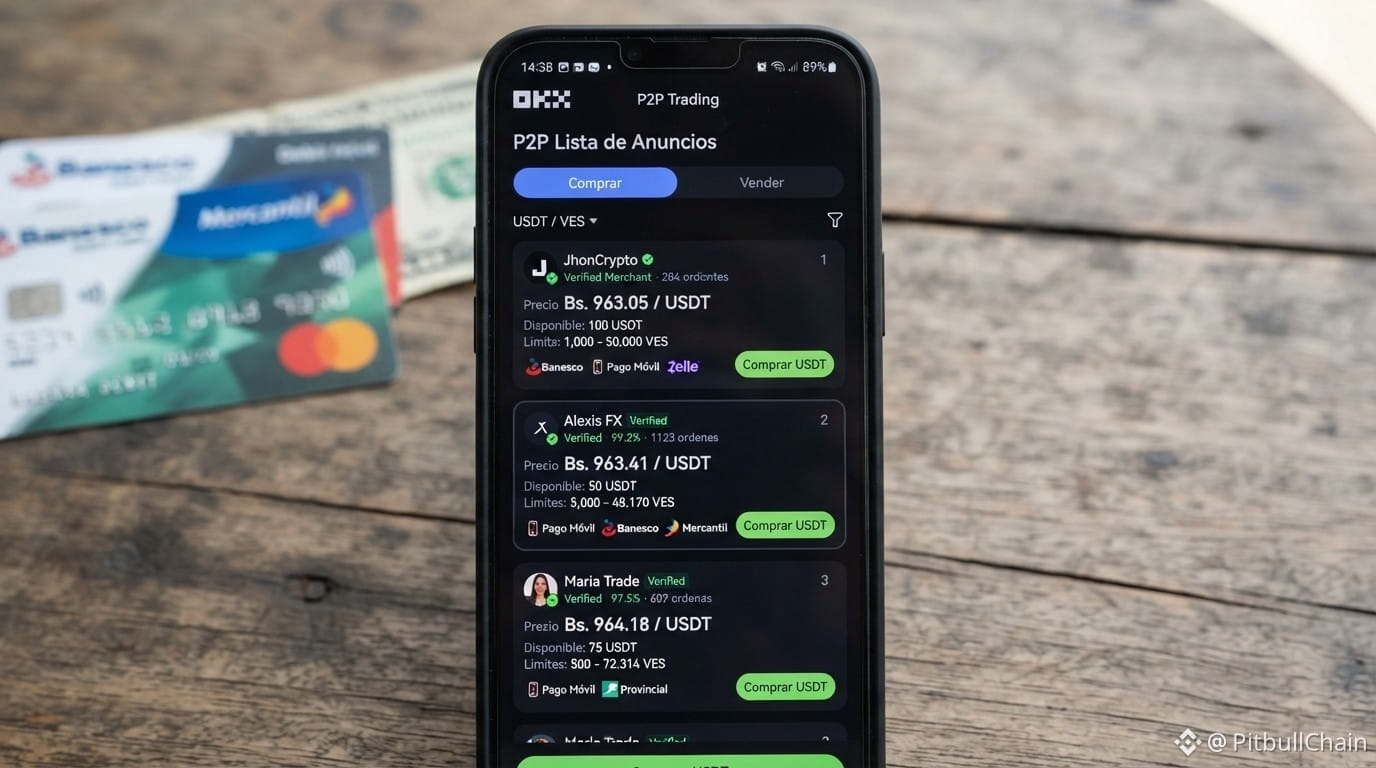
USDT/VES spread of 2.63% and 19.5% premium versus the BCV: how it impacts P2P operationsEditorial note: At the close of September 4, 2026, at 20:00 UTC, Radar P2P captured a USDT buy rate of 965.1204 VES and a sell rate of 940.3531 VES. The spread between the two is 24.77 VES (2.63%). The BCV quotes 807.3862 VES/USD, while the parallel dollar — according to the Binance aggregator — stands at 963.66 VES. In that context, the USDT premium versus the official rate reaches 19.54%. The Venezuelan P2P market is experiencing a session of high friction. Although aggregate liquidity is sufficient, Radar's traffic light shows a yellow state with 69 points: mixed production. The spread is high and the premium versus the BCV remains at levels that condition every operation. Session radiography: numbers that matter The USDT/VES reference rate in P2P is 965.12 VES. If a user wants to sell their USDT, they receive an average of 940.35 VES per unit; if they want to buy them, they pay 965.12 VES. That gap of 24.77 VES is equivalent to 2.63%, measured on the sell side. The BCV official exchange rate is 807.3862 VES/USD. The gap with the P2P buy rate is 157.73 VES, which represents a premium of 19.54%. The parallel dollar (963.66 VES) is quoted only 1.4 VES below the P2P buy rate, suggesting a convergence between the informal and crypto markets at this moment. Order book depth shows an imbalance: buy volume (USDT that merchants want to acquire) is 1,276,296 USDT, while sell volume is 116,454 USDT. That imbalance of 83.28% explains part of the bullish pressure seen in recent hours. 19.54% premium versus the BCV: a persistent abyss The premium is the indicator that obsesses traders. It is the difference between what the state considers the dollar to be worth and what the market actually pays for a dollar-denominated asset like USDT. With accumulated inflation that remains elevated and restrictive exchange controls, the BCV official rate has lagged behind. Although the BCV raised its quote in recent days to above 807 VES, the P2P market moves according to its own logic. The 19.54% premium is not new: sector sources had already warned of gaps of up to 22.67% in previous days, according to Binance reports. For a Venezuelan who receives remittances in USDT or needs to convert savings into VES for local expenses, this premium represents a real opportunity cost. But it also opens an arbitrage window for those who have access to bolívares at the official rate (loans, supplier payments) and seek refuge in the crypto asset. These types of operations, however, are not automatic: they involve liquidity risk, banking hours, and transfer limits. 2.63% spread: why does it seem small but feel uncomfortable? In liquid markets for major pairs, a 2.63% spread would be considered huge. In the Venezuelan P2P market, with restrictions on the use of the official dollar and fragmentation of payment methods, a spread of that magnitude generates warning signs. First, the spread makes entry and exit operations more expensive. If an arbitrage trader buys USDT at 965.12 VES and then tries to sell them immediately, they will receive 940.35 VES: they lose 2.63% in a single round trip. Only a favorable price movement could offset that friction. Second, a wide spread usually reflects high inventory costs for market makers. Whoever places USDT for sale at 940 VES is assuming that the bolívar will depreciate before they buy back; whoever places a buy offer at 965 VES needs the price to keep rising or for real demand to sustain that level. That game of expectations inflates recorded liquidity, but it also increases intraday volatility. Radar's traffic light assigns a score of only 20 to the spread (scale from 0 to 100, where 100 is optimal). Liquidity, in contrast, gets 95 points. That combination is unusual: there are enough offers, but they are spread across a price range that is too wide. Banesco and Pago Móvil: liquidity drivers with tight spreads Bank-level analysis reveals counterintuitive behavior. Banesco concentrates 25.4% of market listings, with an average buy price of 963.46 VES and a sell price of 955.67 VES. Its spread is just 7.79 VES (0.82%). Pago Móvil, meanwhile, accounts for 22.1% of listings, with average prices of 963.96 VES (buy) and 954.07 VES (sell). The spread is 9.89 VES (1.04%). These two methods, along with Other method (17.2%), Provincial, BBVA Banco, and Banco de Venezuela, account for most of the liquidity. However, the aggregated spread of 2.63% is wider than that of these individual banks. The reason lies in the tails of the order book: there are offers with unusually low prices (for example, 915.42 VES) and others with high prices (966 VES) that distort the global statistic. For the average trader, the practical lesson is clear: the spread varies depending on the bank and the type of transfer. Operating with Banesco or Pago Móvil may involve less friction than the market average suggests. That is key to calculating the real cost of converting between VES and USDT. Implications for P2P operations All of this information translates into three concrete points for market participants: The premium versus the BCV discourages operating at the official rate: although the parallel rate is close to P2P, the BCV rate remains a reference for regulated goods and services prices. That distance creates an artificial floor for the USDT price. The spread by bank matters more than the global spread: if the traffic light indicates caution, the sensible thing is to compare prices within the banking network that will be used. Banesco and Pago Móvil offer differentials below 1.1%. Liquidity is sufficient to trade medium-sized amounts: with more than 1.2 million dollars in buy offers and more than 116,000 in sell offers, there is room for transactions of up to about 10,000 USDT without the price slipping too much, but larger orders concentrate the risk. The traffic light also recommends verifying the counterparty's reputation and checking bank limits before committing. The availability of Pago Móvil is high, but there may be daily caps that affect larger operations. Closing: the mirror of two speeds The USDT/VES market of September 2026 is a reflection of the real Venezuelan economy: an official dollar that does not function as a reference, a parallel rate that is approaching crypto, and repressed demand for dollarized assets. The 19.54% premium is not a transitory anomaly; it is a structural consequence of exchange-rate policy. The 2.63% spread is a reminder that P2P operations are neither free nor automatic. Every buy or sell decision must incorporate that cost. The good news is that there is granular information — by bank, by method, and by order book level — to make more informed decisions. At PitbullChain we will continue monitoring these metrics so that the Venezuelan market has clear references. The next time you see a USDT listing at 965 VES, remember: the spread and the premium are not decorations, they are the heart of the business.
USDT/VES spread of 2.63% and 19.5% premium versus the BCV: how it impacts P2P operations
Editorial note: At the close of September 4, 2026, at 20:00 UTC, Radar P2P captured a USDT buy rate of 965.1204 VES and a sell rate of 940.3531 VES. The spread between the two is 24.77 VES (2.63%). The BCV quotes 807.3862 VES/USD, while the parallel dollar — according to the Binance aggregator — stands at 963.66 VES. In that context, the USDT premium versus the official rate reaches 19.54%. The Venezuelan P2P market is experiencing a session of high friction. Although aggregate liquidity is sufficient, Radar's traffic light shows a yellow state with 69 points: mixed production. The spread is high and the premium versus the BCV remains at levels that condition every operation. Session radiography: numbers that matter The USDT/VES reference rate in P2P is 965.12 VES. If a user wants to sell their USDT, they receive an average of 940.35 VES per unit; if they want to buy them, they pay 965.12 VES. That gap of 24.77 VES is equivalent to 2.63%, measured on the sell side. The BCV official exchange rate is 807.3862 VES/USD. The gap with the P2P buy rate is 157.73 VES, which represents a premium of 19.54%. The parallel dollar (963.66 VES) is quoted only 1.4 VES below the P2P buy rate, suggesting a convergence between the informal and crypto markets at this moment. Order book depth shows an imbalance: buy volume (USDT that merchants want to acquire) is 1,276,296 USDT, while sell volume is 116,454 USDT. That imbalance of 83.28% explains part of the bullish pressure seen in recent hours. 19.54% premium versus the BCV: a persistent abyss The premium is the indicator that obsesses traders. It is the difference between what the state considers the dollar to be worth and what the market actually pays for a dollar-denominated asset like USDT. With accumulated inflation that remains elevated and restrictive exchange controls, the BCV official rate has lagged behind. Although the BCV raised its quote in recent days to above 807 VES, the P2P market moves according to its own logic. The 19.54% premium is not new: sector sources had already warned of gaps of up to 22.67% in previous days, according to Binance reports. For a Venezuelan who receives remittances in USDT or needs to convert savings into VES for local expenses, this premium represents a real opportunity cost. But it also opens an arbitrage window for those who have access to bolívares at the official rate (loans, supplier payments) and seek refuge in the crypto asset. These types of operations, however, are not automatic: they involve liquidity risk, banking hours, and transfer limits. 2.63% spread: why does it seem small but feel uncomfortable? In liquid markets for major pairs, a 2.63% spread would be considered huge. In the Venezuelan P2P market, with restrictions on the use of the official dollar and fragmentation of payment methods, a spread of that magnitude generates warning signs. First, the spread makes entry and exit operations more expensive. If an arbitrage trader buys USDT at 965.12 VES and then tries to sell them immediately, they will receive 940.35 VES: they lose 2.63% in a single round trip. Only a favorable price movement could offset that friction. Second, a wide spread usually reflects high inventory costs for market makers. Whoever places USDT for sale at 940 VES is assuming that the bolívar will depreciate before they buy back; whoever places a buy offer at 965 VES needs the price to keep rising or for real demand to sustain that level. That game of expectations inflates recorded liquidity, but it also increases intraday volatility. Radar's traffic light assigns a score of only 20 to the spread (scale from 0 to 100, where 100 is optimal). Liquidity, in contrast, gets 95 points. That combination is unusual: there are enough offers, but they are spread across a price range that is too wide. Banesco and Pago Móvil: liquidity drivers with tight spreads Bank-level analysis reveals counterintuitive behavior. Banesco concentrates 25.4% of market listings, with an average buy price of 963.46 VES and a sell price of 955.67 VES. Its spread is just 7.79 VES (0.82%). Pago Móvil, meanwhile, accounts for 22.1% of listings, with average prices of 963.96 VES (buy) and 954.07 VES (sell). The spread is 9.89 VES (1.04%). These two methods, along with Other method (17.2%), Provincial, BBVA Banco, and Banco de Venezuela, account for most of the liquidity. However, the aggregated spread of 2.63% is wider than that of these individual banks. The reason lies in the tails of the order book: there are offers with unusually low prices (for example, 915.42 VES) and others with high prices (966 VES) that distort the global statistic. For the average trader, the practical lesson is clear: the spread varies depending on the bank and the type of transfer. Operating with Banesco or Pago Móvil may involve less friction than the market average suggests. That is key to calculating the real cost of converting between VES and USDT. Implications for P2P operations All of this information translates into three concrete points for market participants: The premium versus the BCV discourages operating at the official rate: although the parallel rate is close to P2P, the BCV rate remains a reference for regulated goods and services prices. That distance creates an artificial floor for the USDT price. The spread by bank matters more than the global spread: if the traffic light indicates caution, the sensible thing is to compare prices within the banking network that will be used. Banesco and Pago Móvil offer differentials below 1.1%. Liquidity is sufficient to trade medium-sized amounts: with more than 1.2 million dollars in buy offers and more than 116,000 in sell offers, there is room for transactions of up to about 10,000 USDT without the price slipping too much, but larger orders concentrate the risk. The traffic light also recommends verifying the counterparty's reputation and checking bank limits before committing. The availability of Pago Móvil is high, but there may be daily caps that affect larger operations. Closing: the mirror of two speeds The USDT/VES market of September 2026 is a reflection of the real Venezuelan economy: an official dollar that does not function as a reference, a parallel rate that is approaching crypto, and repressed demand for dollarized assets. The 19.54% premium is not a transitory anomaly; it is a structural consequence of exchange-rate policy. The 2.63% spread is a reminder that P2P operations are neither free nor automatic. Every buy or sell decision must incorporate that cost. The good news is that there is granular information — by bank, by method, and by order book level — to make more informed decisions. At PitbullChain we will continue monitoring these metrics so that the Venezuelan market has clear references. The next time you see a USDT listing at 965 VES, remember: the spread and the premium are not decorations, they are the heart of the business.
6
·
--
🐶 PitbullChain active 24/7 | 💸 USDT/VES trading in real-time | 📈 High liquidity and orders executed instantly
👉 https://pitbullchain.com/p2p
#PitbullChain #P2PVenezuela #USDTVES
🐶 PitbullChain active 24/7 | 💸 USDT/VES trading in real-time | 📈 High liquidity and orders executed instantly
👉 https://pitbullchain.com/p2p
#PitbullChain #P2PVenezuela #USDTVES
👉 https://pitbullchain.com/p2p
#PitbullChain #P2PVenezuela #USDTVES
6
·
--
Article
Delcy: 91% of income goes to payroll and social protectionDelcy Rodríguez returned to sit down with the labor and business world. At Wednesday’s meeting, the acting president also released a figure that deserves more analysis than a headline: according to her reading, nine out of every ten bolívares that enter the country are committed to paying labor demands and to the social protection system. That is to say, the fiscal space for anything else is, on paper, minimal.
For a portal like ours, where we track the pulse of the P2P market and the parallel exchange rate every day, that statement is not a simple announcement of management: it is a signal of how much currency remains available to support the bolívar and how tight liquidity could become in the coming months.
Delcy: 91% of income goes to payroll and social protection
Delcy Rodríguez returned to sit down with the labor and business world. At Wednesday’s meeting, the acting president also released a figure that deserves more analysis than a headline: according to her reading, nine out of every ten bolívares that enter the country are committed to paying labor demands and to the social protection system. That is to say, the fiscal space for anything else is, on paper, minimal.
For a portal like ours, where we track the pulse of the P2P market and the parallel exchange rate every day, that statement is not a simple announcement of management: it is a signal of how much currency remains available to support the bolívar and how tight liquidity could become in the coming months.
For a portal like ours, where we track the pulse of the P2P market and the parallel exchange rate every day, that statement is not a simple announcement of management: it is a signal of how much currency remains available to support the bolívar and how tight liquidity could become in the coming months.
16
·
--
BCV without official rate: impact on the P2P premium and strategies for Sep 9## BCV without official rate: impact on the P2P premium and strategies for Sep 9
**Date:** Wednesday, September 9, 2026 · **Live data from the P2P Radar:** buy Bs. 975.07 · sell Bs. 940.72 · BCV Bs. N/A · premium N/A%
This Wednesday, September 9, the Venezuelan P2P market kicks off with an unusual signal: the BCV has not published its official rate, leaving the exchange rate without an anchor and increasing volatility. With a USDT buy at Bs. 975.07 and a sell at Bs. 940.72, the Bs. 34.35 spread is higher than usual, reflecting uncertainty among traders.
BCV without official rate: impact on the P2P premium and strategies for Sep 9
## BCV without official rate: impact on the P2P premium and strategies for Sep 9
**Date:** Wednesday, September 9, 2026 · **Live data from the P2P Radar:** buy Bs. 975.07 · sell Bs. 940.72 · BCV Bs. N/A · premium N/A%
This Wednesday, September 9, the Venezuelan P2P market kicks off with an unusual signal: the BCV has not published its official rate, leaving the exchange rate without an anchor and increasing volatility. With a USDT buy at Bs. 975.07 and a sell at Bs. 940.72, the Bs. 34.35 spread is higher than usual, reflecting uncertainty among traders.
**Date:** Wednesday, September 9, 2026 · **Live data from the P2P Radar:** buy Bs. 975.07 · sell Bs. 940.72 · BCV Bs. N/A · premium N/A%
This Wednesday, September 9, the Venezuelan P2P market kicks off with an unusual signal: the BCV has not published its official rate, leaving the exchange rate without an anchor and increasing volatility. With a USDT buy at Bs. 975.07 and a sell at Bs. 940.72, the Bs. 34.35 spread is higher than usual, reflecting uncertainty among traders.
16
·
--
Spread of 41.66 Bs in P2P: how to trade today## Spread of 41.66 Bs in P2P: how to trade today
**Date:** Wednesday, September 9, 2026 · **Live P2P Radar data:** buy Bs. 971.03 · sell Bs. 929.37 · BCV Bs. N/A · premium N/A%
The P2P USDT/VES market started the day with an unusually wide gap between the buy (Bs. 971.03) and the sell (Bs. 929.37). This difference reflects the lack of an official reference from the BCV (no publication) and uneven liquidity across platforms, with other platforms showing the most volatile end.
Spread of 41.66 Bs in P2P: how to trade today
## Spread of 41.66 Bs in P2P: how to trade today
**Date:** Wednesday, September 9, 2026 · **Live P2P Radar data:** buy Bs. 971.03 · sell Bs. 929.37 · BCV Bs. N/A · premium N/A%
The P2P USDT/VES market started the day with an unusually wide gap between the buy (Bs. 971.03) and the sell (Bs. 929.37). This difference reflects the lack of an official reference from the BCV (no publication) and uneven liquidity across platforms, with other platforms showing the most volatile end.
**Date:** Wednesday, September 9, 2026 · **Live P2P Radar data:** buy Bs. 971.03 · sell Bs. 929.37 · BCV Bs. N/A · premium N/A%
The P2P USDT/VES market started the day with an unusually wide gap between the buy (Bs. 971.03) and the sell (Bs. 929.37). This difference reflects the lack of an official reference from the BCV (no publication) and uneven liquidity across platforms, with other platforms showing the most volatile end.
5
·
--
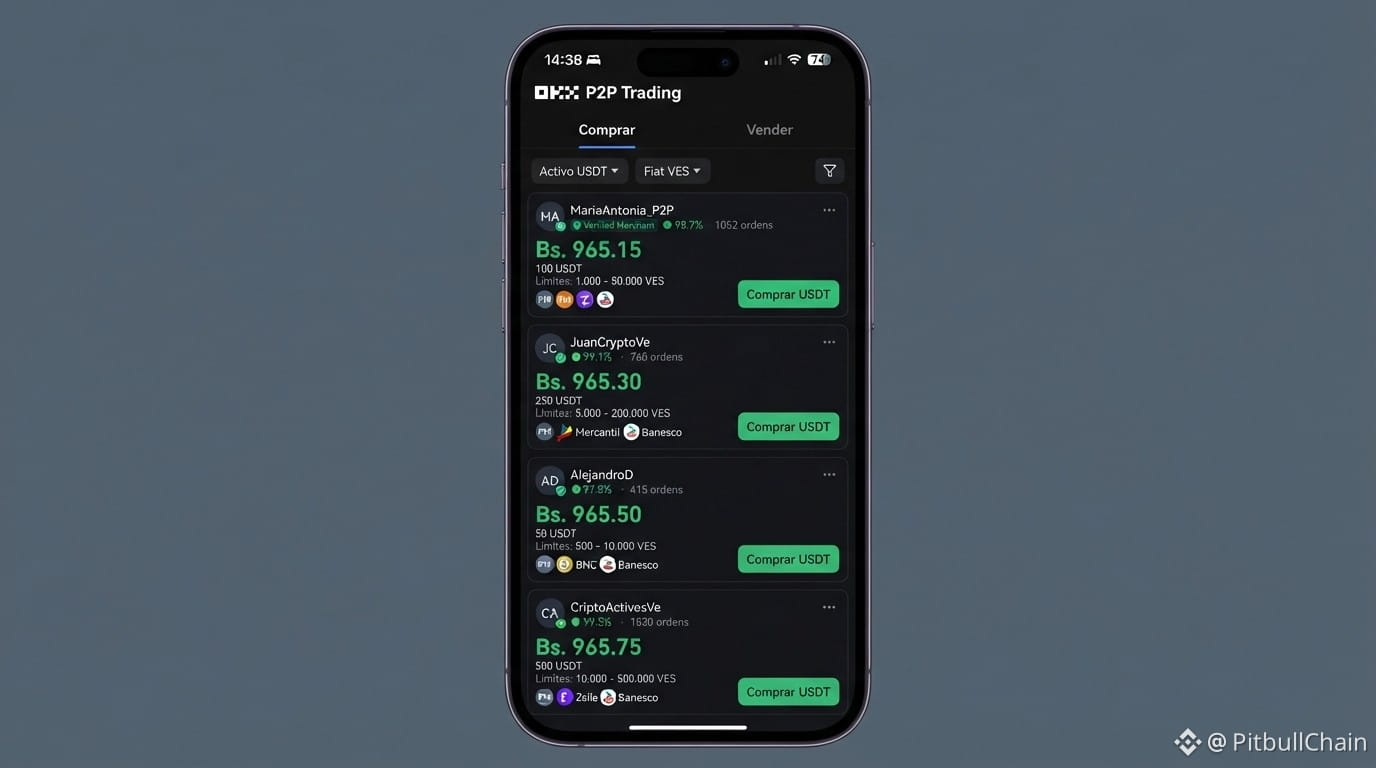
Article
86% imbalance in P2P USDT/VES: buy orders exceed US$1 million Live P2P Radar Capture: 9/9/2026, 12:00:17 p. m.
USDT/VES reference Bs. 968.02
Buy USDT Bs. 968.02
Sell USDT Bs. 938.52
BCV Bs. 820.10
Premium vs BCV 18.04%
P2P Spread 3.14%
Observed offers 99
Verify current data in P2P Radar
The dynamics of the digital FX market in Venezuela show a strong asymmetry in its operational depth. According to the consolidated data from Radar P2P on platforms such as Binance, other platforms and other platforms, the accumulated buy intention in the order book (_order book_) reached **US$ 1.003.085,29** distributed across 38 offers, compared with a placed sell volume of just **US$ 75.651,33** in 44 ads. This disparity represents a structural imbalance of **85.97%** in favor of demand for bolívares for stable cryptoassets.
86% imbalance in P2P USDT/VES: buy orders exceed US$1 million
Live P2P Radar Capture: 9/9/2026, 12:00:17 p. m.
USDT/VES reference Bs. 968.02
Buy USDT Bs. 968.02
Sell USDT Bs. 938.52
BCV Bs. 820.10
Premium vs BCV 18.04%
P2P Spread 3.14%
Observed offers 99
Verify current data in P2P Radar
The dynamics of the digital FX market in Venezuela show a strong asymmetry in its operational depth. According to the consolidated data from Radar P2P on platforms such as Binance, other platforms and other platforms, the accumulated buy intention in the order book (_order book_) reached **US$ 1.003.085,29** distributed across 38 offers, compared with a placed sell volume of just **US$ 75.651,33** in 44 ads. This disparity represents a structural imbalance of **85.97%** in favor of demand for bolívares for stable cryptoassets.
USDT/VES reference Bs. 968.02
Buy USDT Bs. 968.02
Sell USDT Bs. 938.52
BCV Bs. 820.10
Premium vs BCV 18.04%
P2P Spread 3.14%
Observed offers 99
Verify current data in P2P Radar
The dynamics of the digital FX market in Venezuela show a strong asymmetry in its operational depth. According to the consolidated data from Radar P2P on platforms such as Binance, other platforms and other platforms, the accumulated buy intention in the order book (_order book_) reached **US$ 1.003.085,29** distributed across 38 offers, compared with a placed sell volume of just **US$ 75.651,33** in 44 ads. This disparity represents a structural imbalance of **85.97%** in favor of demand for bolívares for stable cryptoassets.
5
·
--
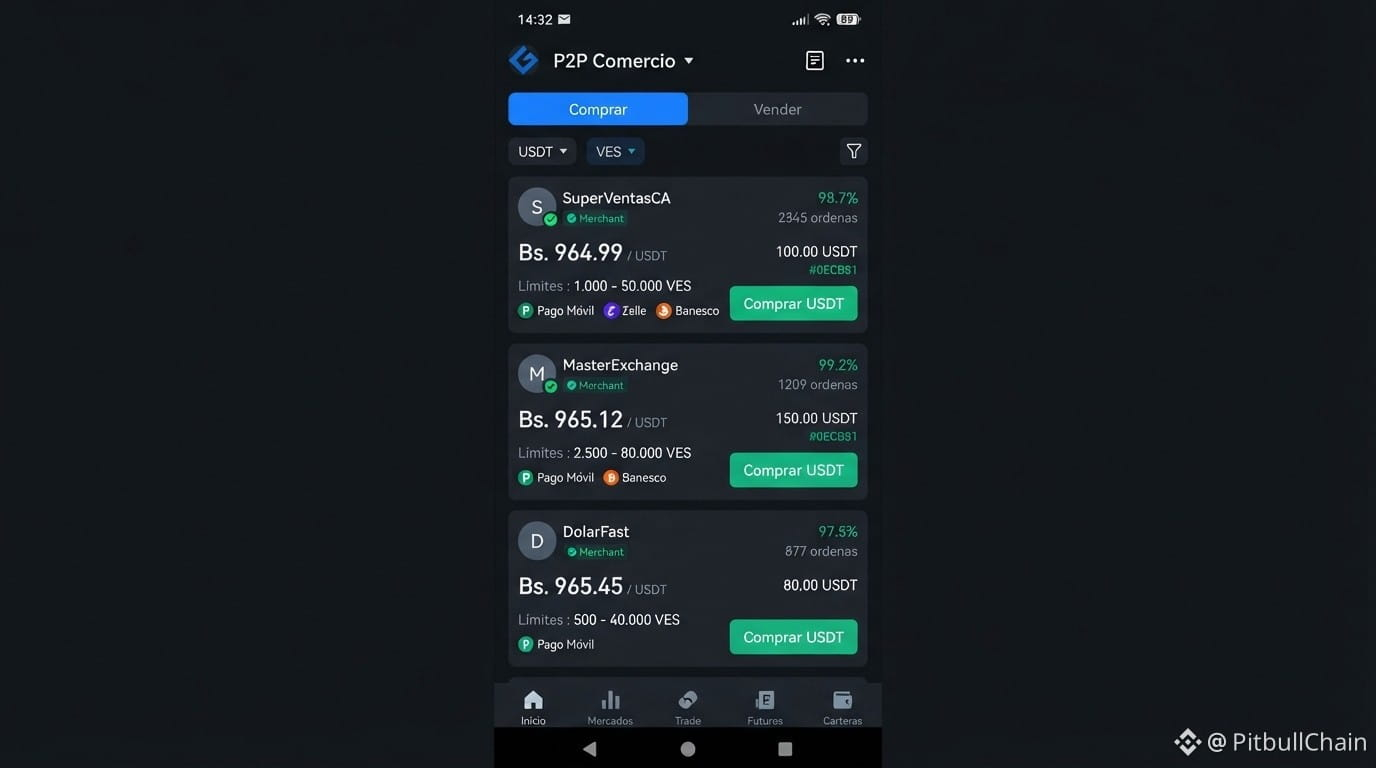
Article
P2P Comparison: Binance, Bybit, and MEXC vs BCV – liquidity and spread Live P2P Radar Capture: 9/9/2026, 10:28:13 a.m.
USDT/VES reference Bs. 968.16
Buy USDT Bs. 968.16
USDT Sale Bs. 940.73
BCV Bs. 820.10
Premium vs BCV 18.05%
P2P Spread 2.92%
Offers observed 98
Check current data in P2P Radar
The Venezuelan P2P market remains the main way to exchange bolívares for cryptocurrencies. On this September 9th, PitbullChain’s P2P Radar captured data on Binance, other platforms, and other platforms, and compared it with the BCV reference rate. Here is the objective analysis of liquidity, spread, and the availability of payment methods on each platform.
P2P Comparison: Binance, Bybit, and MEXC vs BCV – liquidity and spread
Live P2P Radar Capture: 9/9/2026, 10:28:13 a.m.
USDT/VES reference Bs. 968.16
Buy USDT Bs. 968.16
USDT Sale Bs. 940.73
BCV Bs. 820.10
Premium vs BCV 18.05%
P2P Spread 2.92%
Offers observed 98
Check current data in P2P Radar
The Venezuelan P2P market remains the main way to exchange bolívares for cryptocurrencies. On this September 9th, PitbullChain’s P2P Radar captured data on Binance, other platforms, and other platforms, and compared it with the BCV reference rate. Here is the objective analysis of liquidity, spread, and the availability of payment methods on each platform.
USDT/VES reference Bs. 968.16
Buy USDT Bs. 968.16
USDT Sale Bs. 940.73
BCV Bs. 820.10
Premium vs BCV 18.05%
P2P Spread 2.92%
Offers observed 98
Check current data in P2P Radar
The Venezuelan P2P market remains the main way to exchange bolívares for cryptocurrencies. On this September 9th, PitbullChain’s P2P Radar captured data on Binance, other platforms, and other platforms, and compared it with the BCV reference rate. Here is the objective analysis of liquidity, spread, and the availability of payment methods on each platform.
2
·
--
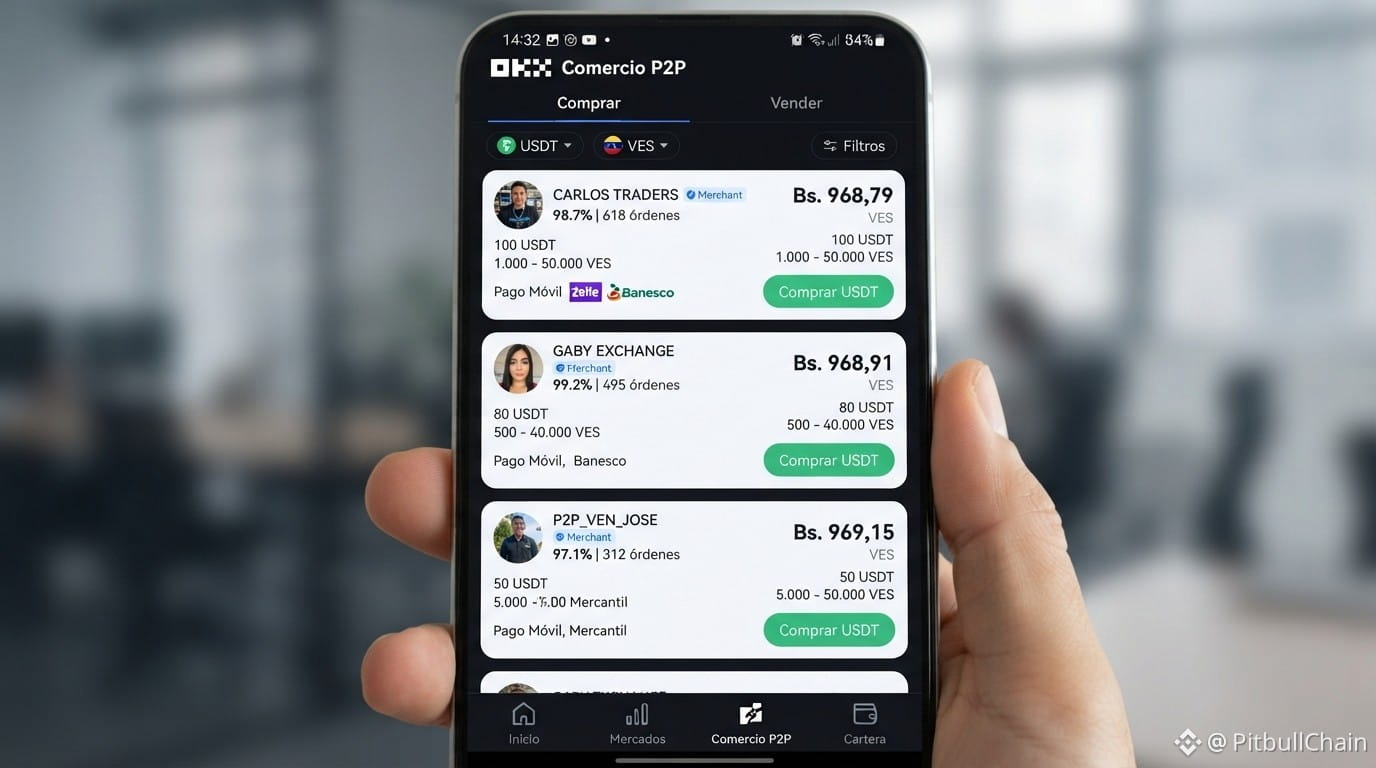
Article
Binance P2P in Venezuela: 6.4% Spread and 20.9% gap vs BCV Live P2P Radar Capture: 9/9/2026, 2:00:16 a. m.
USDT/VES reference Bs. 991.68
Buy USDT Bs. 991.68
Sell USDT Bs. 932.01
BCV Bs. 820.10
Premium vs BCV 20.92%
P2P Spread 6.40%
Offers observed 177
Check current data on Radar P2P
The exchange dynamic between bolívares and stablecoins in the Venezuelan market continues to show signs of adjustment in operating margins. Recent peer-to-peer (P2P) ecosystem records reflect a general spread of 6.40% at the extreme ends of the USDT quotation prices versus the bolívar (VES), placing the buy price at 991.68 VES and the sell rate at 932.01 VES per unit, with a gap of 59.67 VES between both sides of the market.
Binance P2P in Venezuela: 6.4% Spread and 20.9% gap vs BCV
Live P2P Radar Capture: 9/9/2026, 2:00:16 a. m.
USDT/VES reference Bs. 991.68
Buy USDT Bs. 991.68
Sell USDT Bs. 932.01
BCV Bs. 820.10
Premium vs BCV 20.92%
P2P Spread 6.40%
Offers observed 177
Check current data on Radar P2P
The exchange dynamic between bolívares and stablecoins in the Venezuelan market continues to show signs of adjustment in operating margins. Recent peer-to-peer (P2P) ecosystem records reflect a general spread of 6.40% at the extreme ends of the USDT quotation prices versus the bolívar (VES), placing the buy price at 991.68 VES and the sell rate at 932.01 VES per unit, with a gap of 59.67 VES between both sides of the market.
USDT/VES reference Bs. 991.68
Buy USDT Bs. 991.68
Sell USDT Bs. 932.01
BCV Bs. 820.10
Premium vs BCV 20.92%
P2P Spread 6.40%
Offers observed 177
Check current data on Radar P2P
The exchange dynamic between bolívares and stablecoins in the Venezuelan market continues to show signs of adjustment in operating margins. Recent peer-to-peer (P2P) ecosystem records reflect a general spread of 6.40% at the extreme ends of the USDT quotation prices versus the bolívar (VES), placing the buy price at 991.68 VES and the sell rate at 932.01 VES per unit, with a gap of 59.67 VES between both sides of the market.
8
·
--
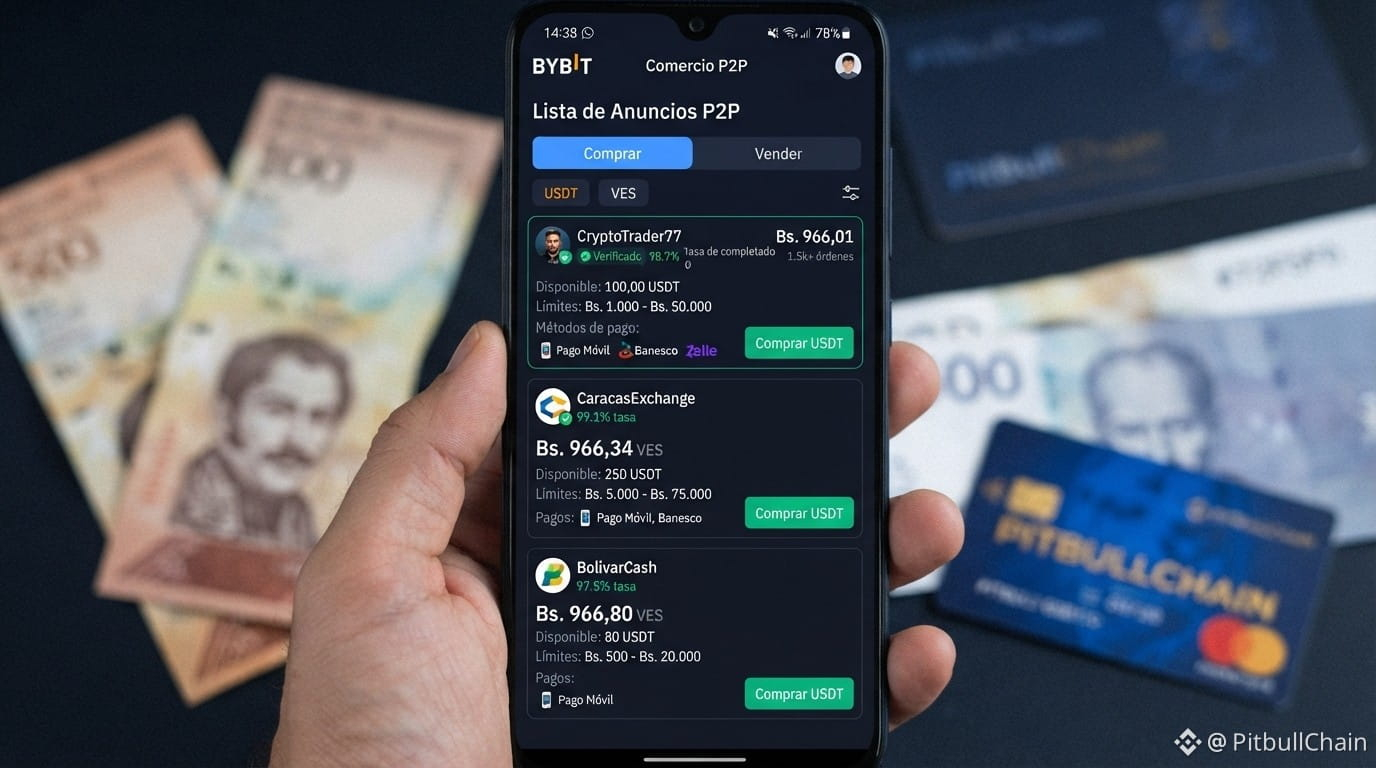
Article
USDT Premium over the BCV dollar: a guide to trading P2P in Venezuela Live P2P Radar Capture: 8/9/2026, 8:00:17 p. m.
USDT/VES reference Bs. 973.64
Buy USDT Bs. 973.64
USDT Sell USDT Bs. 943.51
BCV Bs. 820.10
Premium vs BCV 18.72%
P2P Spread 3.19%
Observed offers 230
Check current data in Radar P2P
If you trade in the Venezuelan P2P market, you’ve probably noticed that the USDT price in bolívares almost always exceeds that of the official dollar published by BCV. This difference has a name: **USDT premium**. Understanding it isn’t an academic luxury: it helps you decide when to buy, when to sell, and to avoid mistakes that cost money.
USDT Premium over the BCV dollar: a guide to trading P2P in Venezuela
Live P2P Radar Capture: 8/9/2026, 8:00:17 p. m.
USDT/VES reference Bs. 973.64
Buy USDT Bs. 973.64
USDT Sell USDT Bs. 943.51
BCV Bs. 820.10
Premium vs BCV 18.72%
P2P Spread 3.19%
Observed offers 230
Check current data in Radar P2P
If you trade in the Venezuelan P2P market, you’ve probably noticed that the USDT price in bolívares almost always exceeds that of the official dollar published by BCV. This difference has a name: **USDT premium**. Understanding it isn’t an academic luxury: it helps you decide when to buy, when to sell, and to avoid mistakes that cost money.
USDT/VES reference Bs. 973.64
Buy USDT Bs. 973.64
USDT Sell USDT Bs. 943.51
BCV Bs. 820.10
Premium vs BCV 18.72%
P2P Spread 3.19%
Observed offers 230
Check current data in Radar P2P
If you trade in the Venezuelan P2P market, you’ve probably noticed that the USDT price in bolívares almost always exceeds that of the official dollar published by BCV. This difference has a name: **USDT premium**. Understanding it isn’t an academic luxury: it helps you decide when to buy, when to sell, and to avoid mistakes that cost money.
42
·
--
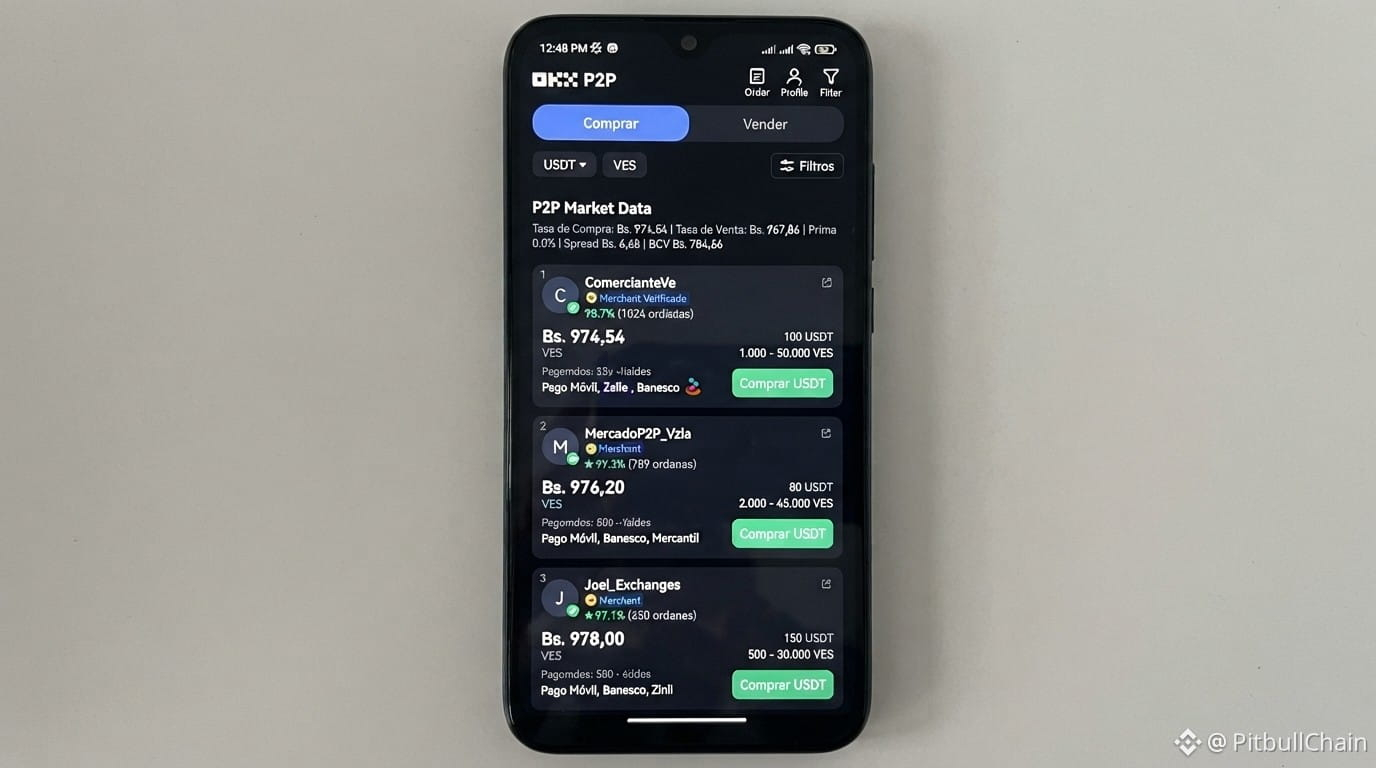
Article
7% spread and high liquidity on Binance P2P: USDT/VES breakdownBinance’s P2P market for the USDT/VES pair starts on September 8, 2026, with a spread of around 7% between the buy and sell prices of the cryptocurrency, according to Radar P2P’s real-time screenshots. This price difference, together with liquidity exceeding 190 active offers, creates a scenario in which users must operate with special attention to the fees and payment methods available. The verified data at the time of analysis shows that the buy price of USDT is Bs. 997,71, while the sell price is Bs. 932,79. The gap between these two values is Bs. 64,92, representing a percentage spread of 6,96%. This figure is far above the 0,41% spread observed when looking only at the best offers in the order book, indicating a notable dispersion of prices across different listings. What does a 7% spread in the USDT/VES pair mean? The spread is the difference between the highest price a buyer is willing to pay and the lowest price a seller is willing to accept for an asset. In a P2P context, a high spread often reflects market inefficiencies, segmentation by banks, or differences in trading limits. With a spread of almost 7%, a user who buys and sells USDT immediately would lose about 7% of the value of their trade, not counting commissions. This level of spread is considerably higher than what is seen in markets with more competition or with less intervention from official interest rates. In practice, for anyone who needs to exchange bolívares for USDT, the most relevant reference is the buy rate; whereas for anyone seeking liquidity, the sell rate determines how many bolívares they will receive. That difference of nearly Bs. 65 per USDT forces traders to compare offers before accepting a quote.
Liquidity above 200 offers: what does it mean for the trader? According to Radar P2P’s semaphore data, the market shows 198 active offers at the time of the capture, although opportunity analysis speaks of 208 offers in total. The platform reports a purchase volume of over 401,000 USDT and a sell volume of approximately 114,000 USDT at the analyzed depth levels. This high liquidity is a positive sign in terms of execution capacity, but it also poses a challenge: with so many offers, prices can vary significantly depending on the bank and the payment method chosen. The order book shows that the best buy offers cluster around Bs. 968, while the sell offers start at Bs. 972, leaving an intraday spread of just 0,41%. However, this contrasts with the market’s weighted rate, demonstrating that the prices shown at the top of the order book do not necessarily reflect the reality of all transactions.
BCV and P2P: a difference that exceeds 20% The official exchange rate from BCV was Bs. 814,69 per dollar for the same date. By comparison, the effective USDT buy rate in Binance P2P (Bs. 997,71) implies a 22,46% premium over the official dollar. This gap is consistent with the dynamics historically seen in the Venezuelan market, where P2P moves based on real supply and demand, while the BCV rate responds to economic policy criteria. Personal calculations based on Radar data show that, by bringing Bs. 1.000.000 to the P2P market, a user could obtain approximately 1.002 USDT if they place themselves at rates close to the average buy rate. This kind of conversion, however, depends on the available offers and the bank selected. Recent reports, such as the one by Ecoanalítica cited by BeInCrypto, estimate that Venezuela transacts around $44 million per day in USDT via Binance P2P, reinforcing the relevance of this market as a channel to access foreign currency.
The role of banks in the P2P market The segmented analysis by banking entities shows significant differences in terms of spread and liquidity. Banco de Venezuela, for example, has a spread of 0,81% with 15 active offers, making it one of the most efficient options to trade. Banesco, on the other hand, concentrates 19,3% of liquidity and has a spread of 2,35%, although with a higher number of available listings. The list of dominant banks includes Banesco, Mercantil, Banco de Venezuela, and Pago Móvil as common payment methods. The availability of these payment methods has increased after the official inclusion of Banco de Venezuela, Banco del Tesoro, and BDT as direct options in Binance P2P—an update that, according to sources in the sector, expands possibilities for those who prefer to trade without intermediaries.
Yellow semaphore: caution before trading The Radar P2P indicator assigns a score of 65 out of 100 to the market, with a status it calls “Moderate caution.” Among the alerts detected, a high spread is mentioned, which is the main risk factor. Although liquidity scores and bank availability are high, volatility and price differences across exchanges suggest the market has not yet found an equilibrium point. In this phase, it is recommended that users verify the trader’s reputation, compare prices among the different offers and banks, and review the maximum and minimum trading limits. It is also useful to consult tools such as a bank comparison tool or the order book to avoid executing trades at unfavorable rates.
Sources and methodology This analysis is based on live data captured by Radar P2P on September 8, 2026, including the order book, liquidity indicators, and bank information. The figures from BCV correspond to the official value published for the same date. The following reference sources were used to contextualize volume and market trends: BeInCrypto: Venezuela transacts $44 million per day in USDT via Binance P2P, estimates Ecoanalítica (July 2026) Finanzas Digital: Binance P2P market reaches levels close to BCV’s foreign exchange sales (July 2026). The presented figures are for informational and educational purposes. They do not constitute financial advice or a recommendation to buy or sell.
7% spread and high liquidity on Binance P2P: USDT/VES breakdown
Binance’s P2P market for the USDT/VES pair starts on September 8, 2026, with a spread of around 7% between the buy and sell prices of the cryptocurrency, according to Radar P2P’s real-time screenshots. This price difference, together with liquidity exceeding 190 active offers, creates a scenario in which users must operate with special attention to the fees and payment methods available. The verified data at the time of analysis shows that the buy price of USDT is Bs. 997,71, while the sell price is Bs. 932,79. The gap between these two values is Bs. 64,92, representing a percentage spread of 6,96%. This figure is far above the 0,41% spread observed when looking only at the best offers in the order book, indicating a notable dispersion of prices across different listings. What does a 7% spread in the USDT/VES pair mean? The spread is the difference between the highest price a buyer is willing to pay and the lowest price a seller is willing to accept for an asset. In a P2P context, a high spread often reflects market inefficiencies, segmentation by banks, or differences in trading limits. With a spread of almost 7%, a user who buys and sells USDT immediately would lose about 7% of the value of their trade, not counting commissions. This level of spread is considerably higher than what is seen in markets with more competition or with less intervention from official interest rates. In practice, for anyone who needs to exchange bolívares for USDT, the most relevant reference is the buy rate; whereas for anyone seeking liquidity, the sell rate determines how many bolívares they will receive. That difference of nearly Bs. 65 per USDT forces traders to compare offers before accepting a quote.
Liquidity above 200 offers: what does it mean for the trader? According to Radar P2P’s semaphore data, the market shows 198 active offers at the time of the capture, although opportunity analysis speaks of 208 offers in total. The platform reports a purchase volume of over 401,000 USDT and a sell volume of approximately 114,000 USDT at the analyzed depth levels. This high liquidity is a positive sign in terms of execution capacity, but it also poses a challenge: with so many offers, prices can vary significantly depending on the bank and the payment method chosen. The order book shows that the best buy offers cluster around Bs. 968, while the sell offers start at Bs. 972, leaving an intraday spread of just 0,41%. However, this contrasts with the market’s weighted rate, demonstrating that the prices shown at the top of the order book do not necessarily reflect the reality of all transactions.
BCV and P2P: a difference that exceeds 20% The official exchange rate from BCV was Bs. 814,69 per dollar for the same date. By comparison, the effective USDT buy rate in Binance P2P (Bs. 997,71) implies a 22,46% premium over the official dollar. This gap is consistent with the dynamics historically seen in the Venezuelan market, where P2P moves based on real supply and demand, while the BCV rate responds to economic policy criteria. Personal calculations based on Radar data show that, by bringing Bs. 1.000.000 to the P2P market, a user could obtain approximately 1.002 USDT if they place themselves at rates close to the average buy rate. This kind of conversion, however, depends on the available offers and the bank selected. Recent reports, such as the one by Ecoanalítica cited by BeInCrypto, estimate that Venezuela transacts around $44 million per day in USDT via Binance P2P, reinforcing the relevance of this market as a channel to access foreign currency.
The role of banks in the P2P market The segmented analysis by banking entities shows significant differences in terms of spread and liquidity. Banco de Venezuela, for example, has a spread of 0,81% with 15 active offers, making it one of the most efficient options to trade. Banesco, on the other hand, concentrates 19,3% of liquidity and has a spread of 2,35%, although with a higher number of available listings. The list of dominant banks includes Banesco, Mercantil, Banco de Venezuela, and Pago Móvil as common payment methods. The availability of these payment methods has increased after the official inclusion of Banco de Venezuela, Banco del Tesoro, and BDT as direct options in Binance P2P—an update that, according to sources in the sector, expands possibilities for those who prefer to trade without intermediaries.
Yellow semaphore: caution before trading The Radar P2P indicator assigns a score of 65 out of 100 to the market, with a status it calls “Moderate caution.” Among the alerts detected, a high spread is mentioned, which is the main risk factor. Although liquidity scores and bank availability are high, volatility and price differences across exchanges suggest the market has not yet found an equilibrium point. In this phase, it is recommended that users verify the trader’s reputation, compare prices among the different offers and banks, and review the maximum and minimum trading limits. It is also useful to consult tools such as a bank comparison tool or the order book to avoid executing trades at unfavorable rates.
Sources and methodology This analysis is based on live data captured by Radar P2P on September 8, 2026, including the order book, liquidity indicators, and bank information. The figures from BCV correspond to the official value published for the same date. The following reference sources were used to contextualize volume and market trends: BeInCrypto: Venezuela transacts $44 million per day in USDT via Binance P2P, estimates Ecoanalítica (July 2026) Finanzas Digital: Binance P2P market reaches levels close to BCV’s foreign exchange sales (July 2026). The presented figures are for informational and educational purposes. They do not constitute financial advice or a recommendation to buy or sell.
Liquidity above 200 offers: what does it mean for the trader? According to Radar P2P’s semaphore data, the market shows 198 active offers at the time of the capture, although opportunity analysis speaks of 208 offers in total. The platform reports a purchase volume of over 401,000 USDT and a sell volume of approximately 114,000 USDT at the analyzed depth levels. This high liquidity is a positive sign in terms of execution capacity, but it also poses a challenge: with so many offers, prices can vary significantly depending on the bank and the payment method chosen. The order book shows that the best buy offers cluster around Bs. 968, while the sell offers start at Bs. 972, leaving an intraday spread of just 0,41%. However, this contrasts with the market’s weighted rate, demonstrating that the prices shown at the top of the order book do not necessarily reflect the reality of all transactions.
BCV and P2P: a difference that exceeds 20% The official exchange rate from BCV was Bs. 814,69 per dollar for the same date. By comparison, the effective USDT buy rate in Binance P2P (Bs. 997,71) implies a 22,46% premium over the official dollar. This gap is consistent with the dynamics historically seen in the Venezuelan market, where P2P moves based on real supply and demand, while the BCV rate responds to economic policy criteria. Personal calculations based on Radar data show that, by bringing Bs. 1.000.000 to the P2P market, a user could obtain approximately 1.002 USDT if they place themselves at rates close to the average buy rate. This kind of conversion, however, depends on the available offers and the bank selected. Recent reports, such as the one by Ecoanalítica cited by BeInCrypto, estimate that Venezuela transacts around $44 million per day in USDT via Binance P2P, reinforcing the relevance of this market as a channel to access foreign currency.
The role of banks in the P2P market The segmented analysis by banking entities shows significant differences in terms of spread and liquidity. Banco de Venezuela, for example, has a spread of 0,81% with 15 active offers, making it one of the most efficient options to trade. Banesco, on the other hand, concentrates 19,3% of liquidity and has a spread of 2,35%, although with a higher number of available listings. The list of dominant banks includes Banesco, Mercantil, Banco de Venezuela, and Pago Móvil as common payment methods. The availability of these payment methods has increased after the official inclusion of Banco de Venezuela, Banco del Tesoro, and BDT as direct options in Binance P2P—an update that, according to sources in the sector, expands possibilities for those who prefer to trade without intermediaries.
Yellow semaphore: caution before trading The Radar P2P indicator assigns a score of 65 out of 100 to the market, with a status it calls “Moderate caution.” Among the alerts detected, a high spread is mentioned, which is the main risk factor. Although liquidity scores and bank availability are high, volatility and price differences across exchanges suggest the market has not yet found an equilibrium point. In this phase, it is recommended that users verify the trader’s reputation, compare prices among the different offers and banks, and review the maximum and minimum trading limits. It is also useful to consult tools such as a bank comparison tool or the order book to avoid executing trades at unfavorable rates.
Sources and methodology This analysis is based on live data captured by Radar P2P on September 8, 2026, including the order book, liquidity indicators, and bank information. The figures from BCV correspond to the official value published for the same date. The following reference sources were used to contextualize volume and market trends: BeInCrypto: Venezuela transacts $44 million per day in USDT via Binance P2P, estimates Ecoanalítica (July 2026) Finanzas Digital: Binance P2P market reaches levels close to BCV’s foreign exchange sales (July 2026). The presented figures are for informational and educational purposes. They do not constitute financial advice or a recommendation to buy or sell.
4
·
--
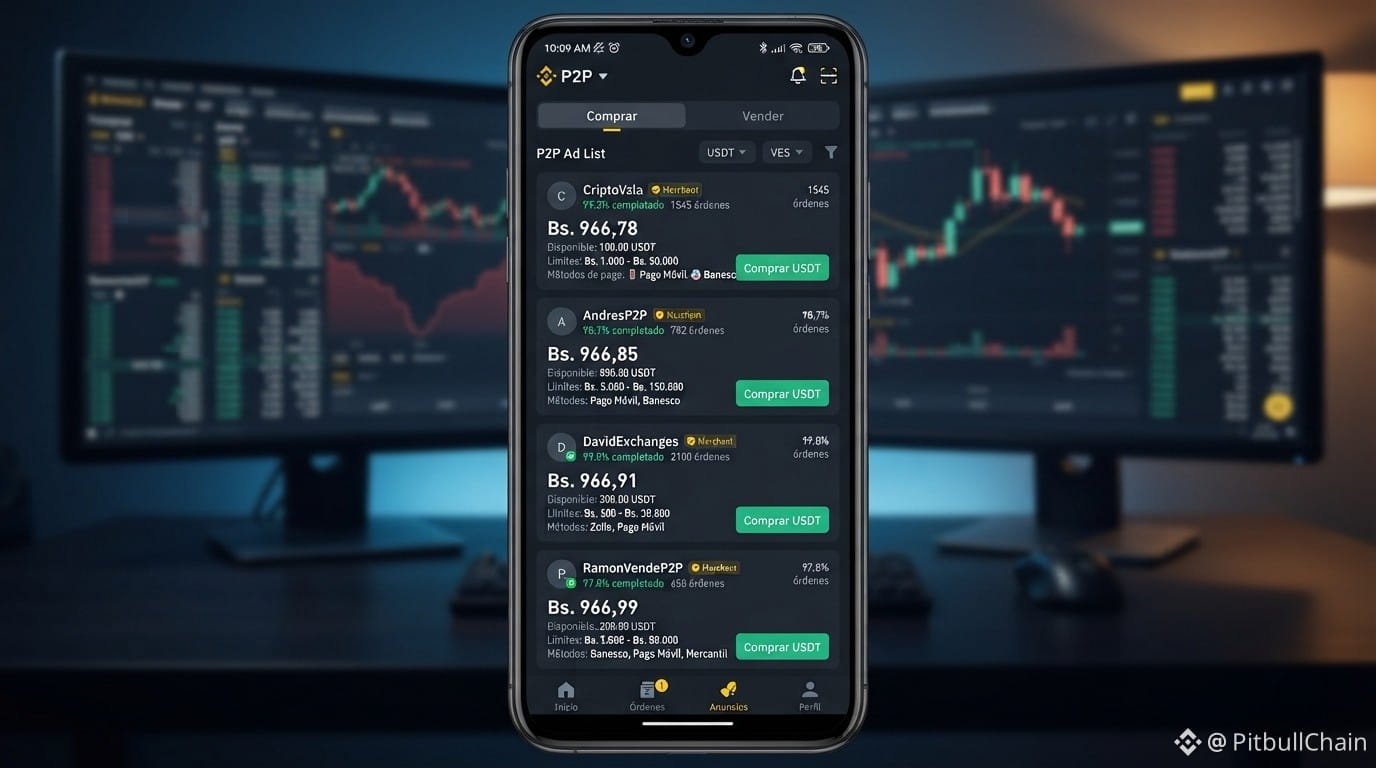
Article
P2P Comparison in Venezuela: Spread and Liquidity on Binance, Bybit, and MEXCThe peer-to-peer (P2P) exchange ecosystem in Venezuela maintains a constant dynamic of adjustment in response to the official exchange rate and the quotes from the parallel market. As of September 7, 2026, data recorded by specialized monitors shows an average USDT buy rate of 969.27 VES and an average sell rate of 941.08 VES, consolidating an overall differential or spread of 2.99% (28.20 VES). When this quote is compared with the official rate of the Central Bank of Venezuela (BCV), set at 813.74 VES per dollar, the P2P market premium stands at 19.11%. Liquidity outlook and order book depth The order distribution reveals clear structural differences depending on the evaluated platform. In the consolidated sample of 98 active listings split between buy and sell, total buy volume is 630,809.98 USDT versus a sell offer of 57,765.17 USDT, creating a depth imbalance of 83.22% in favor of demand. Binance and other platforms concentrate bids with greater backing from institutional capital and verified traders: Binance: Maintains the highest density at levels close to the mid price (950.27 VES). On the buy side (bid), it concentrates high-volume orders ranging from 963.30 VES to 981.90 VES, highlighting blocks above 92,000 USDT at the 964.00 VES level distributed across national entities. other platforms: Provides relevant depth in the mid and lower areas of the book, recording accumulated bids around 960.00 VES with more than 310,000 USDT available across multiple trader listings. other platforms: Shows presence in the first lines of sell (ask) quotes with initial prices between 918.65 VES and 955.45 VES, although with smaller and more fragmented lot sizes, generally below 1,500 USDT per order. Price differential (spread) by platform The market signal indicator stands at 69 points out of 100 with a yellow status (moderate caution). This rating directly reflects the overall spread of 2.99%, which requires users to review quotes in detail before executing transfers. Practically speaking, when settling 100 USDT at the average sell rate of 941.08 VES, 94,107.71 bolívares are obtained. To buy 1,000 USDT at the average buy rate of 969.27 VES, 969,273.70 bolívares are required, while one million bolívares is equivalent to approximately 1,062.61 USDT under current conditions. At the combined order book level, the best ask recorded was 918.65 VES and the best bid was 981.90 VES. This extreme range represents a gross spread of 6.44% between the book extremes, caused mainly by atypical offers on platforms with fewer market-maker participants. Behavior by payment methods and domestic banking The liquidity of the Venezuelan P2P market remains strongly anchored to traditional banking and immediate interbank payment systems. The breakdown of participation and margins by banking entity shows the following figures: Bank of Venezuela: Leads participation with 21.5% of the total monitored liquidity and 23 active listings. Its average buy price is 967.16 VES and its sell price is 963.64 VES, offering the tightest spread in the banking market at just 0.37% (3.52 VES). Banesco: Accounts for 18.7% of liquidity with 20 active listings between Binance and other platforms. It records an average buy price of 967.42 VES and a sell price of 960.26 VES, for a spread of 0.75% (7.16 VES) and an operational efficiency score of 91 points. Pago Móvil: Concentrates 14.0% of liquidity on platforms like other platforms, with an average buy rate of 966.77 VES and a sell rate of 959.85 VES, averaging a differential of 0.72% (6.92 VES). Other entities: Bancamiga, BBVA Provincial, and Banplus participate complementarily, with presence in specific orders of intermediate volume and sell quotes ranging from 967.00 VES to 969.07 VES. Operational considerations for the local user The quantitative analysis shows that the choice of exchange and payment method directly affects the final transaction cost. While Binance and other platforms offer higher capital density and narrower spreads in entities such as Banco de Venezuela and Banesco, other platforms show wider differentials subject to lower turnover of listings. Market participants are advised to verify the trader’s reputation, check the minimum and maximum limits of each order against the balance to be transacted, and monitor the gap versus the BCV dollar rate before confirming any operation in bolívares.
P2P Comparison in Venezuela: Spread and Liquidity on Binance, Bybit, and MEXC
The peer-to-peer (P2P) exchange ecosystem in Venezuela maintains a constant dynamic of adjustment in response to the official exchange rate and the quotes from the parallel market. As of September 7, 2026, data recorded by specialized monitors shows an average USDT buy rate of 969.27 VES and an average sell rate of 941.08 VES, consolidating an overall differential or spread of 2.99% (28.20 VES). When this quote is compared with the official rate of the Central Bank of Venezuela (BCV), set at 813.74 VES per dollar, the P2P market premium stands at 19.11%. Liquidity outlook and order book depth The order distribution reveals clear structural differences depending on the evaluated platform. In the consolidated sample of 98 active listings split between buy and sell, total buy volume is 630,809.98 USDT versus a sell offer of 57,765.17 USDT, creating a depth imbalance of 83.22% in favor of demand. Binance and other platforms concentrate bids with greater backing from institutional capital and verified traders: Binance: Maintains the highest density at levels close to the mid price (950.27 VES). On the buy side (bid), it concentrates high-volume orders ranging from 963.30 VES to 981.90 VES, highlighting blocks above 92,000 USDT at the 964.00 VES level distributed across national entities. other platforms: Provides relevant depth in the mid and lower areas of the book, recording accumulated bids around 960.00 VES with more than 310,000 USDT available across multiple trader listings. other platforms: Shows presence in the first lines of sell (ask) quotes with initial prices between 918.65 VES and 955.45 VES, although with smaller and more fragmented lot sizes, generally below 1,500 USDT per order. Price differential (spread) by platform The market signal indicator stands at 69 points out of 100 with a yellow status (moderate caution). This rating directly reflects the overall spread of 2.99%, which requires users to review quotes in detail before executing transfers. Practically speaking, when settling 100 USDT at the average sell rate of 941.08 VES, 94,107.71 bolívares are obtained. To buy 1,000 USDT at the average buy rate of 969.27 VES, 969,273.70 bolívares are required, while one million bolívares is equivalent to approximately 1,062.61 USDT under current conditions. At the combined order book level, the best ask recorded was 918.65 VES and the best bid was 981.90 VES. This extreme range represents a gross spread of 6.44% between the book extremes, caused mainly by atypical offers on platforms with fewer market-maker participants. Behavior by payment methods and domestic banking The liquidity of the Venezuelan P2P market remains strongly anchored to traditional banking and immediate interbank payment systems. The breakdown of participation and margins by banking entity shows the following figures: Bank of Venezuela: Leads participation with 21.5% of the total monitored liquidity and 23 active listings. Its average buy price is 967.16 VES and its sell price is 963.64 VES, offering the tightest spread in the banking market at just 0.37% (3.52 VES). Banesco: Accounts for 18.7% of liquidity with 20 active listings between Binance and other platforms. It records an average buy price of 967.42 VES and a sell price of 960.26 VES, for a spread of 0.75% (7.16 VES) and an operational efficiency score of 91 points. Pago Móvil: Concentrates 14.0% of liquidity on platforms like other platforms, with an average buy rate of 966.77 VES and a sell rate of 959.85 VES, averaging a differential of 0.72% (6.92 VES). Other entities: Bancamiga, BBVA Provincial, and Banplus participate complementarily, with presence in specific orders of intermediate volume and sell quotes ranging from 967.00 VES to 969.07 VES. Operational considerations for the local user The quantitative analysis shows that the choice of exchange and payment method directly affects the final transaction cost. While Binance and other platforms offer higher capital density and narrower spreads in entities such as Banco de Venezuela and Banesco, other platforms show wider differentials subject to lower turnover of listings. Market participants are advised to verify the trader’s reputation, check the minimum and maximum limits of each order against the balance to be transacted, and monitor the gap versus the BCV dollar rate before confirming any operation in bolívares.
8
·
--
BCV Intervention and P2P: Wide Spread and Strategies for Today## BCV intervention and P2P: wide spread and strategies for today
**Date:** Monday, September 7, 2026 · **Live data from the P2P Radar:** buy Bs. 971.67 · sell Bs. 931.20 · BCV Bs. N/A · premium N/A%
Today, Monday September 7, the week starts with no official BCV rate published, in a context where FX interventions are still the main anchor for the market. The USDT P2P shows a spread of Bs. 40.47 with buys at Bs. 971.67 and sells at Bs. 931.20, indicating low depth.
BCV Intervention and P2P: Wide Spread and Strategies for Today
## BCV intervention and P2P: wide spread and strategies for today
**Date:** Monday, September 7, 2026 · **Live data from the P2P Radar:** buy Bs. 971.67 · sell Bs. 931.20 · BCV Bs. N/A · premium N/A%
Today, Monday September 7, the week starts with no official BCV rate published, in a context where FX interventions are still the main anchor for the market. The USDT P2P shows a spread of Bs. 40.47 with buys at Bs. 971.67 and sells at Bs. 931.20, indicating low depth.
**Date:** Monday, September 7, 2026 · **Live data from the P2P Radar:** buy Bs. 971.67 · sell Bs. 931.20 · BCV Bs. N/A · premium N/A%
Today, Monday September 7, the week starts with no official BCV rate published, in a context where FX interventions are still the main anchor for the market. The USDT P2P shows a spread of Bs. 40.47 with buys at Bs. 971.67 and sells at Bs. 931.20, indicating low depth.
1
Log in to explore more content
Join global crypto users on Binance Square
⚡️ Get latest and useful information about crypto.
💬 Trusted by the world’s largest crypto exchange.
👍 Discover real insights from verified creators.
Email / Phone number
Trending Topics
1
#AppleDebutsFoldablePhone
51,215 views
1,006 Discussing
2
#TSMCAugustRevenueUp53.3%YoY
12,563 views
364 Discussing
3
#IranSaysReadyToEscalateWarWithUS
16,139 views
363 Discussing
4
#EUExtendsCentralContactPointToCASPs
15,539 views
397 Discussing
5
#US10YTreasuryYieldHitsHighestSinceNov2023
39,571 views
616 Discussing
6
#USTreasuryToBuyBackUpTo$6BLongDatedDebt
22,413 views
187 Discussing
7
#BitcoinSurpasses$79K
77,158 views
297 Discussing
8
#BrentCrudeTops$100
136,502 views
426 Discussing
9
#USADPWeeklyEmploymentRises12000
130,310 views
1,556 Discussing
10
#BankOfAmericaGroupPilotsUSBDCStablecoin
95,100 views
1,217 Discussing