
#semaforop2p
semaforop2p
47 views
9 Discussing
Hot
Latest
·
--
Article
See translation
Semáforo P2P en amarillo: spread de 3,19 % en USDT/VES y qué verificarRadar P2P en vivo Captura: 15/9/2026, 10:00:14 p. m.
USDT/VES referencia Bs. 967.84
Compra USDT Bs. 967.84
Venta USDT Bs. 937.91
BCV Bs. 846.51
Prima vs BCV 14.33%
Spread P2P 3.19%
Ofertas observadas 211
Verificar datos actuales en Radar P2P
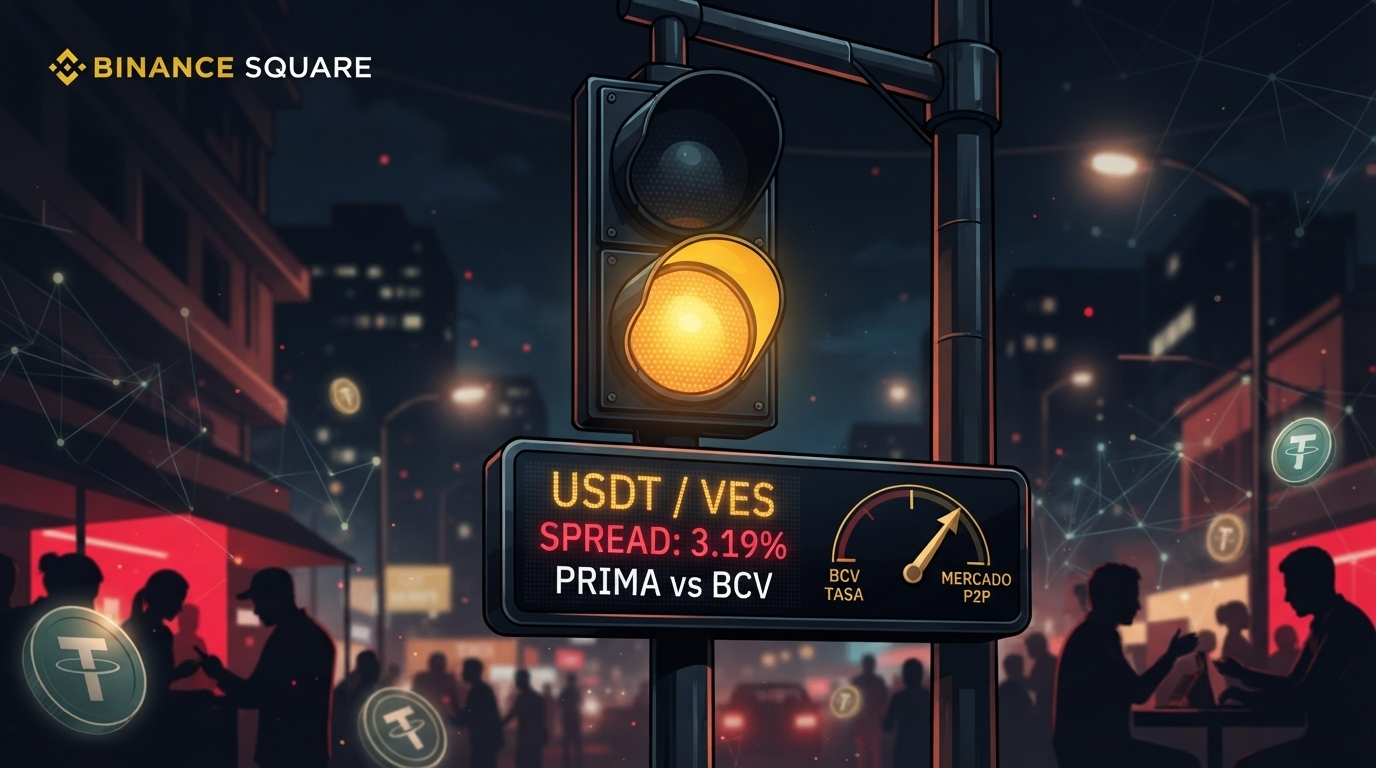
El Radar P2P de PitbullChain capturó el mercado de **USDT/VES** el 16 de septiembre de 2026 a las 02:00 UTC —22:00 del 15 de septiembre en Venezuela— con el **semáforo P2P en amarillo**: 71 puntos sobre 100, etiqueta «precaución moderada» y dato fresco, con 0 minutos de antigüedad. La cifra que llama la atención es el contraste entre el **spread P2P** agregado, que marca **3,19 %**, y el spread del **order book USDT**, que se queda en **0,08 %**. No es una contradicción: son dos mediciones distintas sobre universos distintos.
## Qué dicen los datos en vivo
- **USDT P2P (Radar):** compra en 967,8449 Bs y venta en 937,9135 Bs. Diferencia: 29,93 Bs, equivalente a 3,19 %.
- **Semáforo:** 71/100, estado amarillo, «precaución moderada». La métrica de spread es la más castigada (20/100); liquidez y disponibilidad de bancos marcan 95/100 cada una.
- **Tasa BCV:** 846,5131 Bs por dólar, actualizada en la misma marca de tiempo que el resto del tablero.
- **Dólar paralelo:** 957,82 Bs (compra 956,94 / venta 958,70), con un spread propio de apenas 0,18 %.
- **Order book:** mejor ask 958,81 Bs, mejor bid 958,00 Bs, precio medio 958,40 Bs y spread de 0,81 Bs (0,08 %).
- **Conversiones del módulo:** 100 USDT a la tasa de venta reportada equivalen a 93.791,35 Bs; 1.000.000 Bs equivalen a 1.066,2 USDT.
Un dato que conviene tratar con cuidado: el campo de variación reporta +14,33 %, un valor que coincide casi exactamente con la prima vs BCV (14,32 %). Sin serie histórica en la captura no es posible confirmar qué ventana mide ese cambio. Queda como dato a verificar, no como conclusión.
## Por qué 3,19 % y 0,08 % no se contradicen
El spread del order book mide la distancia entre la mejor punta de compra y la mejor punta de venta entre los anuncios más competitivos del mercado. Es el precio más afilado que hay disponible en ese instante: 958,81 Bs para quien compra y 958,00 Bs para quien vende.
El spread agregado, en cambio, promedia lo que publican los comerciantes minoristas, incluidos anuncios con precios fuera de rango y ofertas de poca profundidad. Ese promedio es el que aparece en el semáforo y el que explica el 3,19 %.
La traducción operativa es concreta. Vender al mejor bid del book (958,00 Bs) en lugar de hacerlo a la tasa de venta agregada (938,05 Bs) representa una diferencia de 2,13 %. Del otro lado, comprar en el mejor ask (958,81 Bs) en vez de la tasa de compra agregada (967,71 Bs) representa 0,93 %. Dicho de otro modo: **la dispersión está en las ofertas minoristas, no en el mejor precio disponible**.
## Banco por banco: dónde está la dispersión
El comparador de bancos agrupa los anuncios según la entidad que aceptan. La muestra suma 118 anuncios clasificados, con conteos pequeños en varios casos, así que conviene leerla como una fotografía del momento y no como una tendencia.
Banco Anuncios Compra prom. Venta prom. Spread % Liquidez relativa Score
Banesco 30 961,27 953,10 0,86 % 24,8 % 97
Pago Móvil 27 961,10 950,49 1,12 % 22,3 % 82
Otro método 19 963,08 949,79 1,40 % 15,7 % 67
Banco de Venezuela 15 960,33 955,67 0,49 % 12,4 % 64
BANK 12 960,25 955,70 0,48 % 9,9 % 59
Mercantil 7 960,67 955,52 0,54 % 5,8 % 50
BNC 5 sin lado de compra 956,32 n/d 4,1 % 48
Provincial 3 sin lado de compra 955,98 n/d 2,5 % 45
Cuatro entidades concentran la parte más estrecha del mercado: **Banesco (0,86 %)**, **Banco de Venezuela (0,49 %)**, **BANK (0,48 %)** y **Mercantil (0,54 %)** muestran spreads por debajo de 0,9 %. En contraste, Pago Móvil (1,12 %) y «Otro método» (1,40 %) cargan la mayor parte de la dispersión, aunque Pago Móvil tiene buena participación con 22,3 % de la liquidez relativa.
Hay dos casos particulares: **BNC** y **Provincial** solo muestran lado de venta en la muestra capturada, con precios promedio de 956,32 y 955,98 Bs respectivamente. Al no tener lado de compra, no se les puede calcular spread y aparecen como «n/d». Eso no significa que no haya demanda contra esos bancos, solo que la muestra recogida no la refleja.
## Prima vs BCV: 14,33 % y de dónde sale el 12,56 %
Con la tasa BCV en 846,5131 Bs, la prima calculada sobre el precio de compra del P2P (967,8449 Bs) es de **14,33 %**. Si se calcula sobre la tasa de venta (937,9135 Bs), baja a 10,81 %. Y si se calcula sobre el punto medio entre ambos, sube a **12,56 %**.
Ese 12,56 % es justamente el número que reporta uno de los módulos de oportunidades del sistema. La diferencia no es un error de mercado: es la misma foto con una base de cálculo distinta. Cuando compare una prima, revise siempre cuál de los tres precios se usó. Para referencia, el dólar paralelo (957,82 Bs) implica una prima de 13,15 % frente al BCV.
## Liquidez y profundidad: lo que sostiene el amarillo
- El Radar P2P contabiliza **231 ofertas activas** (96 de compra y 135 de venta). El order book lista 211 anuncios y 70 niveles agregados: 37 del lado comprador y 33 del vendedor.
- La profundidad medida es de **493.127,26 USDT** en el lado de compra y **124.485,27 USDT** en el de venta, con un desbalance de 59,69 % hacia los compradores. Es decir, hay casi cuatro veces más volumen declarado buscando comprar que vendiendo.
- La mejor punta del lado de venta (958,00 Bs) soporta solo 4.217,81 USDT en un único anuncio, mientras el grueso de la profundidad compradora se reparte en 956,50 Bs (65.949,73 USDT) y 956,00 Bs (50.582,62 USDT).
- Del lado de venta, el nivel de 959,80 Bs acumula 19.848,50 USDT en 3 anuncios, y más arriba aparece un bloque de 20.000 USDT en 960,24 Bs.
- Los límites de las ofertas vistas van desde 6,81 USDT hasta 100.000 USDT, así que hay tamaño para distintos perfiles.
Este es el motivo del amarillo y no del rojo: la liquidez y la disponibilidad de bancos puntúan 95/100, la salud de los exchanges 95/100 y la frescura del dato 100/100. Lo que hunde el promedio es el spread, con 20/100, más una volatilidad en 80/100 y señales externas en 60/100.
## Lista de verificación antes de operar
- **Confirme la hora del dato.** La captura usada aquí es del 16 de septiembre de 2026, 02:00 UTC. En un mercado que se mueve, un dato de hace horas ya no sirve.
- **Compare el precio de la oferta con el order book.** Si el anuncio está muy por encima del mejor ask, o muy por debajo del mejor bid, hay margen de negociación o de buscar otra contraparte.
- **Revise el banco y el método de pago.** Banesco, Banco de Venezuela, BANK y Mercantil muestran los spreads más cerrados en esta muestra; Pago Móvil y «Otro método» son los más amplios.
- **Valide el monto recibido antes de liberar.** Confirme que el abono llegó a su cuenta, no solo el pantallazo de la transferencia.
- **Chequee reputación y órdenes completadas** del comerciante, además de su tiempo de respuesta.
- **Lea los límites mínimo y máximo** de cada anuncio: hay ofertas desde menos de 7 USDT y hasta 100.000 USDT de techo.
- **Desconfíe de canales externos.** La Asociación Bancaria ha advertido repetidamente sobre cuentas y canales falsos usados para pedir dinero; ningún comerciante serio necesita que usted salga del exchange para «verificar» su cuenta.
- **No opere con prisa.** Un spread de 3,19 % no obliga a moverse rápido; obliga a comparar.
## Contexto externo y límites de esta lectura
El ruido informativo de las últimas semanas no explica este spread. En el plano macro, la banca de inversión enfrió el optimismo sobre un eventual acuerdo petrolero entre Estados Unidos y Venezuela, y UBS advirtió por riesgos legales y políticos en ese terreno. Son piezas de contexto, no causas del movimiento puntual del P2P.
También conviene decir lo que este análisis no hace: no proyecta precios, no estima hacia dónde va la tasa y no compara períodos anteriores, porque la captura no trae serie histórica. Lo que sí puede afirmarse con los datos en mano es dónde está la dispersión: en las ofertas minoristas y en el lado de venta de los bancos más pequeños.
## Cierre práctico
El **semáforo P2P en amarillo** no es una señal de alarma ni una predicción. Es un recordatorio de que el mercado tiene profundidad suficiente pero precios poco alineados entre sí. Antes de mover bolívares, revise la tasa BCV vigente, compare su banco con el comparador, mire el order book para saber cuál es el mejor precio realmente disponible y confirme la hora del dato que está usando. Si el precio de la oferta se aleja mucho del mejor bid o del mejor ask, hay espacio para buscar mejor.
_Información educativa e informativa. No constituye asesoría financiera._
## Fuentes consultadas
- Acuerdo petrolero entre EE.UU. y Venezuela: UBS alerta por tres riesgos legales y políticos - bloomberglinea.com — 31/8/2026
- La banca de inversión enfría el optimismo de Trump: el petróleo venezolano no bajará el precio - EL PAÍS — 2/9/2026
- Asociación Bancaria alerta sobre falsos canales de recaudación y ofrece pautas para donar con seguridad - bancaynegocios.com — 26/6/2026
- Asociación Bancaria alerta sobre fraudes financieros bajo la fachada de ayuda humanitaria - Finanzas Digital — 26/6/2026
## Verifica antes de operar
Consulta tasas, bancos y profundidad actualizada en las herramientas de PitbullChain.
Abrir herramientas P2P
**Aviso:** contenido educativo e informativo. No constituye asesoría financiera ni recomendación de compra o venta.
📊 Tasas y análisis en vivo en https://pitbullchain.com
$USDT #USDTVES #spreadP2P #semaforoP2P #primavsBCV #tasaBCV
Semáforo P2P en amarillo: spread de 3,19 % en USDT/VES y qué verificar
Radar P2P en vivo Captura: 15/9/2026, 10:00:14 p. m.
USDT/VES referencia Bs. 967.84
Compra USDT Bs. 967.84
Venta USDT Bs. 937.91
BCV Bs. 846.51
Prima vs BCV 14.33%
Spread P2P 3.19%
Ofertas observadas 211
Verificar datos actuales en Radar P2P
El Radar P2P de PitbullChain capturó el mercado de **USDT/VES** el 16 de septiembre de 2026 a las 02:00 UTC —22:00 del 15 de septiembre en Venezuela— con el **semáforo P2P en amarillo**: 71 puntos sobre 100, etiqueta «precaución moderada» y dato fresco, con 0 minutos de antigüedad. La cifra que llama la atención es el contraste entre el **spread P2P** agregado, que marca **3,19 %**, y el spread del **order book USDT**, que se queda en **0,08 %**. No es una contradicción: son dos mediciones distintas sobre universos distintos.
## Qué dicen los datos en vivo
- **USDT P2P (Radar):** compra en 967,8449 Bs y venta en 937,9135 Bs. Diferencia: 29,93 Bs, equivalente a 3,19 %.
- **Semáforo:** 71/100, estado amarillo, «precaución moderada». La métrica de spread es la más castigada (20/100); liquidez y disponibilidad de bancos marcan 95/100 cada una.
- **Tasa BCV:** 846,5131 Bs por dólar, actualizada en la misma marca de tiempo que el resto del tablero.
- **Dólar paralelo:** 957,82 Bs (compra 956,94 / venta 958,70), con un spread propio de apenas 0,18 %.
- **Order book:** mejor ask 958,81 Bs, mejor bid 958,00 Bs, precio medio 958,40 Bs y spread de 0,81 Bs (0,08 %).
- **Conversiones del módulo:** 100 USDT a la tasa de venta reportada equivalen a 93.791,35 Bs; 1.000.000 Bs equivalen a 1.066,2 USDT.
Un dato que conviene tratar con cuidado: el campo de variación reporta +14,33 %, un valor que coincide casi exactamente con la prima vs BCV (14,32 %). Sin serie histórica en la captura no es posible confirmar qué ventana mide ese cambio. Queda como dato a verificar, no como conclusión.
## Por qué 3,19 % y 0,08 % no se contradicen
El spread del order book mide la distancia entre la mejor punta de compra y la mejor punta de venta entre los anuncios más competitivos del mercado. Es el precio más afilado que hay disponible en ese instante: 958,81 Bs para quien compra y 958,00 Bs para quien vende.
El spread agregado, en cambio, promedia lo que publican los comerciantes minoristas, incluidos anuncios con precios fuera de rango y ofertas de poca profundidad. Ese promedio es el que aparece en el semáforo y el que explica el 3,19 %.
La traducción operativa es concreta. Vender al mejor bid del book (958,00 Bs) en lugar de hacerlo a la tasa de venta agregada (938,05 Bs) representa una diferencia de 2,13 %. Del otro lado, comprar en el mejor ask (958,81 Bs) en vez de la tasa de compra agregada (967,71 Bs) representa 0,93 %. Dicho de otro modo: **la dispersión está en las ofertas minoristas, no en el mejor precio disponible**.
## Banco por banco: dónde está la dispersión
El comparador de bancos agrupa los anuncios según la entidad que aceptan. La muestra suma 118 anuncios clasificados, con conteos pequeños en varios casos, así que conviene leerla como una fotografía del momento y no como una tendencia.
Banco Anuncios Compra prom. Venta prom. Spread % Liquidez relativa Score
Banesco 30 961,27 953,10 0,86 % 24,8 % 97
Pago Móvil 27 961,10 950,49 1,12 % 22,3 % 82
Otro método 19 963,08 949,79 1,40 % 15,7 % 67
Banco de Venezuela 15 960,33 955,67 0,49 % 12,4 % 64
BANK 12 960,25 955,70 0,48 % 9,9 % 59
Mercantil 7 960,67 955,52 0,54 % 5,8 % 50
BNC 5 sin lado de compra 956,32 n/d 4,1 % 48
Provincial 3 sin lado de compra 955,98 n/d 2,5 % 45
Cuatro entidades concentran la parte más estrecha del mercado: **Banesco (0,86 %)**, **Banco de Venezuela (0,49 %)**, **BANK (0,48 %)** y **Mercantil (0,54 %)** muestran spreads por debajo de 0,9 %. En contraste, Pago Móvil (1,12 %) y «Otro método» (1,40 %) cargan la mayor parte de la dispersión, aunque Pago Móvil tiene buena participación con 22,3 % de la liquidez relativa.
Hay dos casos particulares: **BNC** y **Provincial** solo muestran lado de venta en la muestra capturada, con precios promedio de 956,32 y 955,98 Bs respectivamente. Al no tener lado de compra, no se les puede calcular spread y aparecen como «n/d». Eso no significa que no haya demanda contra esos bancos, solo que la muestra recogida no la refleja.
## Prima vs BCV: 14,33 % y de dónde sale el 12,56 %
Con la tasa BCV en 846,5131 Bs, la prima calculada sobre el precio de compra del P2P (967,8449 Bs) es de **14,33 %**. Si se calcula sobre la tasa de venta (937,9135 Bs), baja a 10,81 %. Y si se calcula sobre el punto medio entre ambos, sube a **12,56 %**.
Ese 12,56 % es justamente el número que reporta uno de los módulos de oportunidades del sistema. La diferencia no es un error de mercado: es la misma foto con una base de cálculo distinta. Cuando compare una prima, revise siempre cuál de los tres precios se usó. Para referencia, el dólar paralelo (957,82 Bs) implica una prima de 13,15 % frente al BCV.
## Liquidez y profundidad: lo que sostiene el amarillo
- El Radar P2P contabiliza **231 ofertas activas** (96 de compra y 135 de venta). El order book lista 211 anuncios y 70 niveles agregados: 37 del lado comprador y 33 del vendedor.
- La profundidad medida es de **493.127,26 USDT** en el lado de compra y **124.485,27 USDT** en el de venta, con un desbalance de 59,69 % hacia los compradores. Es decir, hay casi cuatro veces más volumen declarado buscando comprar que vendiendo.
- La mejor punta del lado de venta (958,00 Bs) soporta solo 4.217,81 USDT en un único anuncio, mientras el grueso de la profundidad compradora se reparte en 956,50 Bs (65.949,73 USDT) y 956,00 Bs (50.582,62 USDT).
- Del lado de venta, el nivel de 959,80 Bs acumula 19.848,50 USDT en 3 anuncios, y más arriba aparece un bloque de 20.000 USDT en 960,24 Bs.
- Los límites de las ofertas vistas van desde 6,81 USDT hasta 100.000 USDT, así que hay tamaño para distintos perfiles.
Este es el motivo del amarillo y no del rojo: la liquidez y la disponibilidad de bancos puntúan 95/100, la salud de los exchanges 95/100 y la frescura del dato 100/100. Lo que hunde el promedio es el spread, con 20/100, más una volatilidad en 80/100 y señales externas en 60/100.
## Lista de verificación antes de operar
- **Confirme la hora del dato.** La captura usada aquí es del 16 de septiembre de 2026, 02:00 UTC. En un mercado que se mueve, un dato de hace horas ya no sirve.
- **Compare el precio de la oferta con el order book.** Si el anuncio está muy por encima del mejor ask, o muy por debajo del mejor bid, hay margen de negociación o de buscar otra contraparte.
- **Revise el banco y el método de pago.** Banesco, Banco de Venezuela, BANK y Mercantil muestran los spreads más cerrados en esta muestra; Pago Móvil y «Otro método» son los más amplios.
- **Valide el monto recibido antes de liberar.** Confirme que el abono llegó a su cuenta, no solo el pantallazo de la transferencia.
- **Chequee reputación y órdenes completadas** del comerciante, además de su tiempo de respuesta.
- **Lea los límites mínimo y máximo** de cada anuncio: hay ofertas desde menos de 7 USDT y hasta 100.000 USDT de techo.
- **Desconfíe de canales externos.** La Asociación Bancaria ha advertido repetidamente sobre cuentas y canales falsos usados para pedir dinero; ningún comerciante serio necesita que usted salga del exchange para «verificar» su cuenta.
- **No opere con prisa.** Un spread de 3,19 % no obliga a moverse rápido; obliga a comparar.
## Contexto externo y límites de esta lectura
El ruido informativo de las últimas semanas no explica este spread. En el plano macro, la banca de inversión enfrió el optimismo sobre un eventual acuerdo petrolero entre Estados Unidos y Venezuela, y UBS advirtió por riesgos legales y políticos en ese terreno. Son piezas de contexto, no causas del movimiento puntual del P2P.
También conviene decir lo que este análisis no hace: no proyecta precios, no estima hacia dónde va la tasa y no compara períodos anteriores, porque la captura no trae serie histórica. Lo que sí puede afirmarse con los datos en mano es dónde está la dispersión: en las ofertas minoristas y en el lado de venta de los bancos más pequeños.
## Cierre práctico
El **semáforo P2P en amarillo** no es una señal de alarma ni una predicción. Es un recordatorio de que el mercado tiene profundidad suficiente pero precios poco alineados entre sí. Antes de mover bolívares, revise la tasa BCV vigente, compare su banco con el comparador, mire el order book para saber cuál es el mejor precio realmente disponible y confirme la hora del dato que está usando. Si el precio de la oferta se aleja mucho del mejor bid o del mejor ask, hay espacio para buscar mejor.
_Información educativa e informativa. No constituye asesoría financiera._
## Fuentes consultadas
- Acuerdo petrolero entre EE.UU. y Venezuela: UBS alerta por tres riesgos legales y políticos - bloomberglinea.com — 31/8/2026
- La banca de inversión enfría el optimismo de Trump: el petróleo venezolano no bajará el precio - EL PAÍS — 2/9/2026
- Asociación Bancaria alerta sobre falsos canales de recaudación y ofrece pautas para donar con seguridad - bancaynegocios.com — 26/6/2026
- Asociación Bancaria alerta sobre fraudes financieros bajo la fachada de ayuda humanitaria - Finanzas Digital — 26/6/2026
## Verifica antes de operar
Consulta tasas, bancos y profundidad actualizada en las herramientas de PitbullChain.
Abrir herramientas P2P
**Aviso:** contenido educativo e informativo. No constituye asesoría financiera ni recomendación de compra o venta.

📊 Tasas y análisis en vivo en https://pitbullchain.com
$USDT #USDTVES #spreadP2P #semaforoP2P #primavsBCV #tasaBCV
USDT/VES referencia Bs. 967.84
Compra USDT Bs. 967.84
Venta USDT Bs. 937.91
BCV Bs. 846.51
Prima vs BCV 14.33%
Spread P2P 3.19%
Ofertas observadas 211
Verificar datos actuales en Radar P2P
El Radar P2P de PitbullChain capturó el mercado de **USDT/VES** el 16 de septiembre de 2026 a las 02:00 UTC —22:00 del 15 de septiembre en Venezuela— con el **semáforo P2P en amarillo**: 71 puntos sobre 100, etiqueta «precaución moderada» y dato fresco, con 0 minutos de antigüedad. La cifra que llama la atención es el contraste entre el **spread P2P** agregado, que marca **3,19 %**, y el spread del **order book USDT**, que se queda en **0,08 %**. No es una contradicción: son dos mediciones distintas sobre universos distintos.
## Qué dicen los datos en vivo
- **USDT P2P (Radar):** compra en 967,8449 Bs y venta en 937,9135 Bs. Diferencia: 29,93 Bs, equivalente a 3,19 %.
- **Semáforo:** 71/100, estado amarillo, «precaución moderada». La métrica de spread es la más castigada (20/100); liquidez y disponibilidad de bancos marcan 95/100 cada una.
- **Tasa BCV:** 846,5131 Bs por dólar, actualizada en la misma marca de tiempo que el resto del tablero.
- **Dólar paralelo:** 957,82 Bs (compra 956,94 / venta 958,70), con un spread propio de apenas 0,18 %.
- **Order book:** mejor ask 958,81 Bs, mejor bid 958,00 Bs, precio medio 958,40 Bs y spread de 0,81 Bs (0,08 %).
- **Conversiones del módulo:** 100 USDT a la tasa de venta reportada equivalen a 93.791,35 Bs; 1.000.000 Bs equivalen a 1.066,2 USDT.
Un dato que conviene tratar con cuidado: el campo de variación reporta +14,33 %, un valor que coincide casi exactamente con la prima vs BCV (14,32 %). Sin serie histórica en la captura no es posible confirmar qué ventana mide ese cambio. Queda como dato a verificar, no como conclusión.
## Por qué 3,19 % y 0,08 % no se contradicen
El spread del order book mide la distancia entre la mejor punta de compra y la mejor punta de venta entre los anuncios más competitivos del mercado. Es el precio más afilado que hay disponible en ese instante: 958,81 Bs para quien compra y 958,00 Bs para quien vende.
El spread agregado, en cambio, promedia lo que publican los comerciantes minoristas, incluidos anuncios con precios fuera de rango y ofertas de poca profundidad. Ese promedio es el que aparece en el semáforo y el que explica el 3,19 %.
La traducción operativa es concreta. Vender al mejor bid del book (958,00 Bs) en lugar de hacerlo a la tasa de venta agregada (938,05 Bs) representa una diferencia de 2,13 %. Del otro lado, comprar en el mejor ask (958,81 Bs) en vez de la tasa de compra agregada (967,71 Bs) representa 0,93 %. Dicho de otro modo: **la dispersión está en las ofertas minoristas, no en el mejor precio disponible**.
## Banco por banco: dónde está la dispersión
El comparador de bancos agrupa los anuncios según la entidad que aceptan. La muestra suma 118 anuncios clasificados, con conteos pequeños en varios casos, así que conviene leerla como una fotografía del momento y no como una tendencia.
Banco Anuncios Compra prom. Venta prom. Spread % Liquidez relativa Score
Banesco 30 961,27 953,10 0,86 % 24,8 % 97
Pago Móvil 27 961,10 950,49 1,12 % 22,3 % 82
Otro método 19 963,08 949,79 1,40 % 15,7 % 67
Banco de Venezuela 15 960,33 955,67 0,49 % 12,4 % 64
BANK 12 960,25 955,70 0,48 % 9,9 % 59
Mercantil 7 960,67 955,52 0,54 % 5,8 % 50
BNC 5 sin lado de compra 956,32 n/d 4,1 % 48
Provincial 3 sin lado de compra 955,98 n/d 2,5 % 45
Cuatro entidades concentran la parte más estrecha del mercado: **Banesco (0,86 %)**, **Banco de Venezuela (0,49 %)**, **BANK (0,48 %)** y **Mercantil (0,54 %)** muestran spreads por debajo de 0,9 %. En contraste, Pago Móvil (1,12 %) y «Otro método» (1,40 %) cargan la mayor parte de la dispersión, aunque Pago Móvil tiene buena participación con 22,3 % de la liquidez relativa.
Hay dos casos particulares: **BNC** y **Provincial** solo muestran lado de venta en la muestra capturada, con precios promedio de 956,32 y 955,98 Bs respectivamente. Al no tener lado de compra, no se les puede calcular spread y aparecen como «n/d». Eso no significa que no haya demanda contra esos bancos, solo que la muestra recogida no la refleja.
## Prima vs BCV: 14,33 % y de dónde sale el 12,56 %
Con la tasa BCV en 846,5131 Bs, la prima calculada sobre el precio de compra del P2P (967,8449 Bs) es de **14,33 %**. Si se calcula sobre la tasa de venta (937,9135 Bs), baja a 10,81 %. Y si se calcula sobre el punto medio entre ambos, sube a **12,56 %**.
Ese 12,56 % es justamente el número que reporta uno de los módulos de oportunidades del sistema. La diferencia no es un error de mercado: es la misma foto con una base de cálculo distinta. Cuando compare una prima, revise siempre cuál de los tres precios se usó. Para referencia, el dólar paralelo (957,82 Bs) implica una prima de 13,15 % frente al BCV.
## Liquidez y profundidad: lo que sostiene el amarillo
- El Radar P2P contabiliza **231 ofertas activas** (96 de compra y 135 de venta). El order book lista 211 anuncios y 70 niveles agregados: 37 del lado comprador y 33 del vendedor.
- La profundidad medida es de **493.127,26 USDT** en el lado de compra y **124.485,27 USDT** en el de venta, con un desbalance de 59,69 % hacia los compradores. Es decir, hay casi cuatro veces más volumen declarado buscando comprar que vendiendo.
- La mejor punta del lado de venta (958,00 Bs) soporta solo 4.217,81 USDT en un único anuncio, mientras el grueso de la profundidad compradora se reparte en 956,50 Bs (65.949,73 USDT) y 956,00 Bs (50.582,62 USDT).
- Del lado de venta, el nivel de 959,80 Bs acumula 19.848,50 USDT en 3 anuncios, y más arriba aparece un bloque de 20.000 USDT en 960,24 Bs.
- Los límites de las ofertas vistas van desde 6,81 USDT hasta 100.000 USDT, así que hay tamaño para distintos perfiles.
Este es el motivo del amarillo y no del rojo: la liquidez y la disponibilidad de bancos puntúan 95/100, la salud de los exchanges 95/100 y la frescura del dato 100/100. Lo que hunde el promedio es el spread, con 20/100, más una volatilidad en 80/100 y señales externas en 60/100.
## Lista de verificación antes de operar
- **Confirme la hora del dato.** La captura usada aquí es del 16 de septiembre de 2026, 02:00 UTC. En un mercado que se mueve, un dato de hace horas ya no sirve.
- **Compare el precio de la oferta con el order book.** Si el anuncio está muy por encima del mejor ask, o muy por debajo del mejor bid, hay margen de negociación o de buscar otra contraparte.
- **Revise el banco y el método de pago.** Banesco, Banco de Venezuela, BANK y Mercantil muestran los spreads más cerrados en esta muestra; Pago Móvil y «Otro método» son los más amplios.
- **Valide el monto recibido antes de liberar.** Confirme que el abono llegó a su cuenta, no solo el pantallazo de la transferencia.
- **Chequee reputación y órdenes completadas** del comerciante, además de su tiempo de respuesta.
- **Lea los límites mínimo y máximo** de cada anuncio: hay ofertas desde menos de 7 USDT y hasta 100.000 USDT de techo.
- **Desconfíe de canales externos.** La Asociación Bancaria ha advertido repetidamente sobre cuentas y canales falsos usados para pedir dinero; ningún comerciante serio necesita que usted salga del exchange para «verificar» su cuenta.
- **No opere con prisa.** Un spread de 3,19 % no obliga a moverse rápido; obliga a comparar.
## Contexto externo y límites de esta lectura
El ruido informativo de las últimas semanas no explica este spread. En el plano macro, la banca de inversión enfrió el optimismo sobre un eventual acuerdo petrolero entre Estados Unidos y Venezuela, y UBS advirtió por riesgos legales y políticos en ese terreno. Son piezas de contexto, no causas del movimiento puntual del P2P.
También conviene decir lo que este análisis no hace: no proyecta precios, no estima hacia dónde va la tasa y no compara períodos anteriores, porque la captura no trae serie histórica. Lo que sí puede afirmarse con los datos en mano es dónde está la dispersión: en las ofertas minoristas y en el lado de venta de los bancos más pequeños.
## Cierre práctico
El **semáforo P2P en amarillo** no es una señal de alarma ni una predicción. Es un recordatorio de que el mercado tiene profundidad suficiente pero precios poco alineados entre sí. Antes de mover bolívares, revise la tasa BCV vigente, compare su banco con el comparador, mire el order book para saber cuál es el mejor precio realmente disponible y confirme la hora del dato que está usando. Si el precio de la oferta se aleja mucho del mejor bid o del mejor ask, hay espacio para buscar mejor.
_Información educativa e informativa. No constituye asesoría financiera._
## Fuentes consultadas
- Acuerdo petrolero entre EE.UU. y Venezuela: UBS alerta por tres riesgos legales y políticos - bloomberglinea.com — 31/8/2026
- La banca de inversión enfría el optimismo de Trump: el petróleo venezolano no bajará el precio - EL PAÍS — 2/9/2026
- Asociación Bancaria alerta sobre falsos canales de recaudación y ofrece pautas para donar con seguridad - bancaynegocios.com — 26/6/2026
- Asociación Bancaria alerta sobre fraudes financieros bajo la fachada de ayuda humanitaria - Finanzas Digital — 26/6/2026
## Verifica antes de operar
Consulta tasas, bancos y profundidad actualizada en las herramientas de PitbullChain.
Abrir herramientas P2P
**Aviso:** contenido educativo e informativo. No constituye asesoría financiera ni recomendación de compra o venta.

📊 Tasas y análisis en vivo en https://pitbullchain.com
$USDT #USDTVES #spreadP2P #semaforoP2P #primavsBCV #tasaBCV
6
·
--
Article
P2P traffic light is yellow: USDT/VES spread reaches 8.59% with 157 ads Live P2P Radar Capture: 15/9/2026, 6:00:14 a. m.
USDT/VES reference Bs. 990.12
Buy USDT Bs. 990.12
USDT Sale Bs. 911.81
BCV Bs. 842.21
Premium vs BCV 17.56%
P2P Spread 8.59%
Offers observed 148
Check current data on P2P Radar
**Capture time:** September 15, 2026, 10:00 UTC (06:00 in Venezuela). All prices in this note correspond to that moment. The P2P market does not close and moves minute by minute: a reading at a different time may produce different figures.
The P2P USDT/VES traffic light turned **yellow**, with the label "Moderate caution" and a score of **69 out of 100**. The system summary is explicit: "The market shows mixed conditions. Review spread, liquidity, and bank before deciding." The day's contradiction is stated in one line: there is plenty of liquidity, but the spread between buy and sell is high.
P2P traffic light is yellow: USDT/VES spread reaches 8.59% with 157 ads
Live P2P Radar Capture: 15/9/2026, 6:00:14 a. m.
USDT/VES reference Bs. 990.12
Buy USDT Bs. 990.12
USDT Sale Bs. 911.81
BCV Bs. 842.21
Premium vs BCV 17.56%
P2P Spread 8.59%
Offers observed 148
Check current data on P2P Radar
**Capture time:** September 15, 2026, 10:00 UTC (06:00 in Venezuela). All prices in this note correspond to that moment. The P2P market does not close and moves minute by minute: a reading at a different time may produce different figures.
The P2P USDT/VES traffic light turned **yellow**, with the label "Moderate caution" and a score of **69 out of 100**. The system summary is explicit: "The market shows mixed conditions. Review spread, liquidity, and bank before deciding." The day's contradiction is stated in one line: there is plenty of liquidity, but the spread between buy and sell is high.
USDT/VES reference Bs. 990.12
Buy USDT Bs. 990.12
USDT Sale Bs. 911.81
BCV Bs. 842.21
Premium vs BCV 17.56%
P2P Spread 8.59%
Offers observed 148
Check current data on P2P Radar
**Capture time:** September 15, 2026, 10:00 UTC (06:00 in Venezuela). All prices in this note correspond to that moment. The P2P market does not close and moves minute by minute: a reading at a different time may produce different figures.
The P2P USDT/VES traffic light turned **yellow**, with the label "Moderate caution" and a score of **69 out of 100**. The system summary is explicit: "The market shows mixed conditions. Review spread, liquidity, and bank before deciding." The day's contradiction is stated in one line: there is plenty of liquidity, but the spread between buy and sell is high.
4
·
--
Article
How to detect rented accounts in P2P: verification protocol Live P2P Radar Capture: 31/8/2026, 12:00:10 p. m.
USDT/VES reference Bs. 940.49
Buy USDT Bs. 940.49
USDT Sale Bs. 908.24
BCV Bs. 794.99
Premium vs BCV 18.3%
P2P Spread 3.55%
Observed offers 231
Check current data on P2P Radar
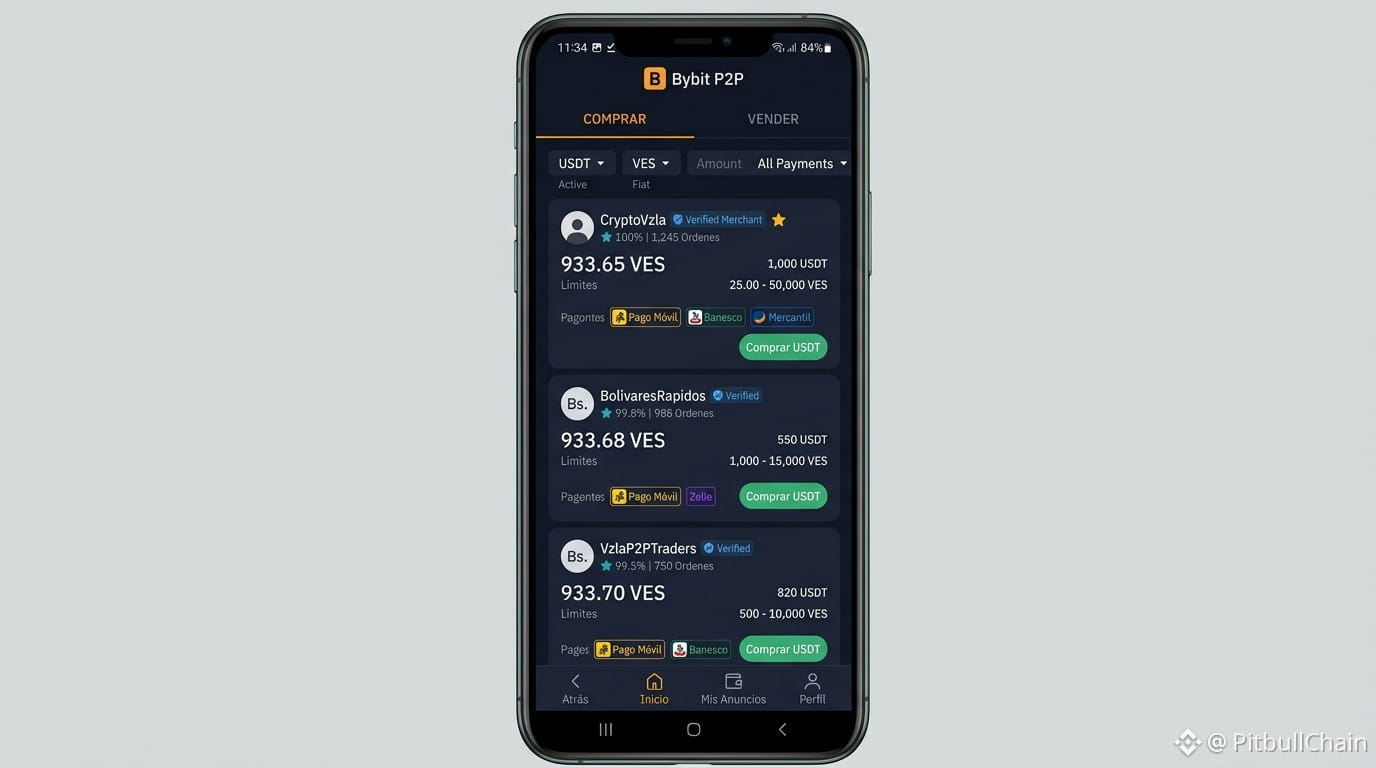
Binance has issued an alert about a new type of fraud in Venezuela: the "Account Rental Trap". In this tutorial, we show you how to use PitbullChain's P2P semaphore to verify merchants and reduce the risk of falling for this scam. We use live market data so you can see the protocol in action.
How to detect rented accounts in P2P: verification protocol
Live P2P Radar Capture: 31/8/2026, 12:00:10 p. m.
USDT/VES reference Bs. 940.49
Buy USDT Bs. 940.49
USDT Sale Bs. 908.24
BCV Bs. 794.99
Premium vs BCV 18.3%
P2P Spread 3.55%
Observed offers 231
Check current data on P2P Radar
Binance has issued an alert about a new type of fraud in Venezuela: the "Account Rental Trap". In this tutorial, we show you how to use PitbullChain's P2P semaphore to verify merchants and reduce the risk of falling for this scam. We use live market data so you can see the protocol in action.
USDT/VES reference Bs. 940.49
Buy USDT Bs. 940.49
USDT Sale Bs. 908.24
BCV Bs. 794.99
Premium vs BCV 18.3%
P2P Spread 3.55%
Observed offers 231
Check current data on P2P Radar
Binance has issued an alert about a new type of fraud in Venezuela: the "Account Rental Trap". In this tutorial, we show you how to use PitbullChain's P2P semaphore to verify merchants and reduce the risk of falling for this scam. We use live market data so you can see the protocol in action.
11
·
--
Article
USDT/VES Spread in P2P reaches 6.82% and BCV premium 21% Live P2P Radar Capture: 7/9/2026, 4:00:14 a. m.
USDT/VES reference Bs. 986.68
Buy USDT Bs. 986.68
Sell USDT Bs. 923.68
BCV Bs. 813.74
Premium vs BCV 21.25%
P2P Spread 6.82%
Offers observed 87
Verify current data on P2P Radar
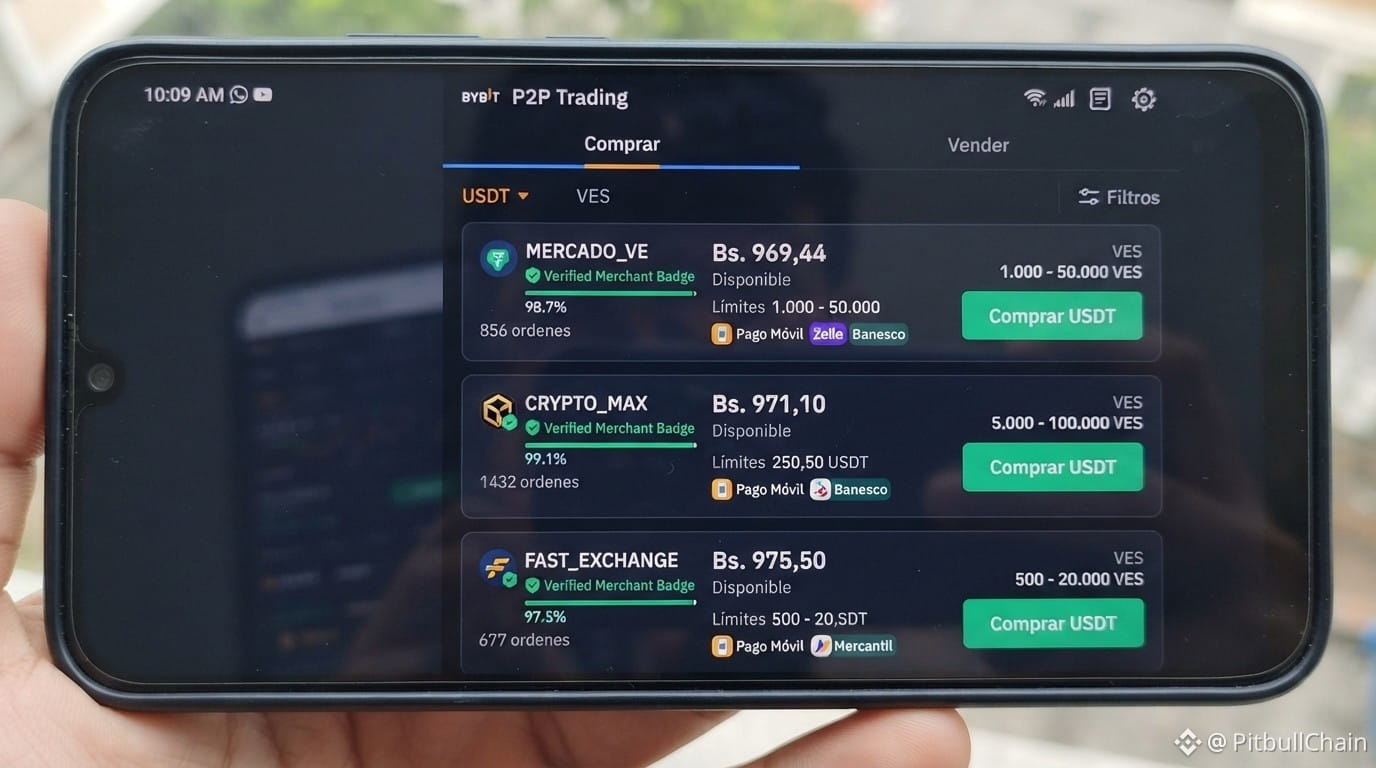
On September 7, 2026, the P2P market for USDT against bolívares (USDT/VES) shows a spread of 6.82%, according to live data from PitbullChain’s P2P Radar. The purchase price is Bs. 986.68, while the sale price is Bs. 923.68. The premium over the BCV dollar amounts to 21.25%. These figures reflect a tension between the high available liquidity and the pronounced price differences between platforms.
USDT/VES Spread in P2P reaches 6.82% and BCV premium 21%
Live P2P Radar Capture: 7/9/2026, 4:00:14 a. m.
USDT/VES reference Bs. 986.68
Buy USDT Bs. 986.68
Sell USDT Bs. 923.68
BCV Bs. 813.74
Premium vs BCV 21.25%
P2P Spread 6.82%
Offers observed 87
Verify current data on P2P Radar
On September 7, 2026, the P2P market for USDT against bolívares (USDT/VES) shows a spread of 6.82%, according to live data from PitbullChain’s P2P Radar. The purchase price is Bs. 986.68, while the sale price is Bs. 923.68. The premium over the BCV dollar amounts to 21.25%. These figures reflect a tension between the high available liquidity and the pronounced price differences between platforms.
USDT/VES reference Bs. 986.68
Buy USDT Bs. 986.68
Sell USDT Bs. 923.68
BCV Bs. 813.74
Premium vs BCV 21.25%
P2P Spread 6.82%
Offers observed 87
Verify current data on P2P Radar
On September 7, 2026, the P2P market for USDT against bolívares (USDT/VES) shows a spread of 6.82%, according to live data from PitbullChain’s P2P Radar. The purchase price is Bs. 986.68, while the sale price is Bs. 923.68. The premium over the BCV dollar amounts to 21.25%. These figures reflect a tension between the high available liquidity and the pronounced price differences between platforms.
1
2
·
--
Article
USDT/VES P2P: book with 0.19% spread and 54.5% buying pressure Live P2P Radar Capture: 13/9/2026, 2:00:14 a. m.
USDT/VES reference Bs. 981.56
Buy USDT Bs. 981.56
USDT Sale Bs. 926.58
BCV Bs. 842.21
Premium vs BCV 16.55%
P2P Spread 5.93%
Offers observed 177
Check current data in P2P Radar
## Same time, two readings from the same market
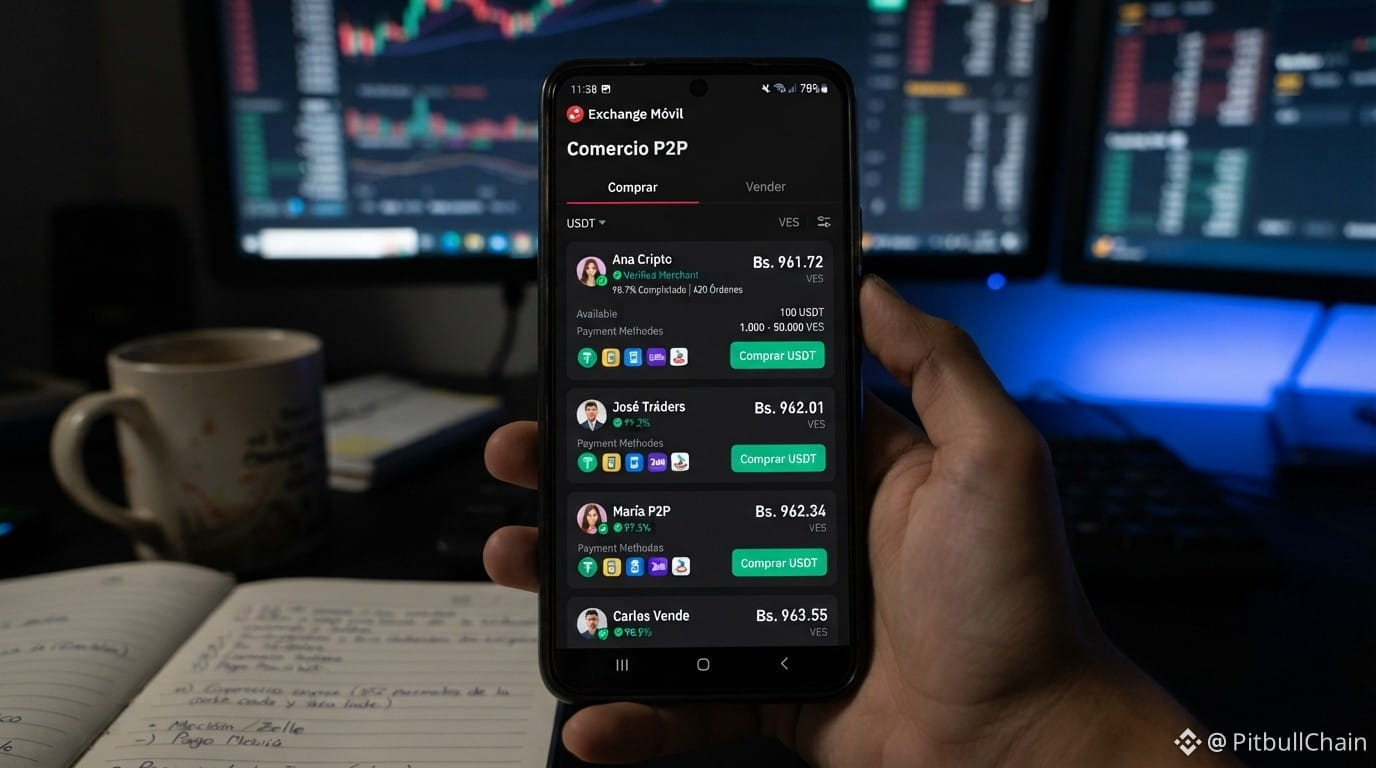
**Fact checked.** On Saturday, September 13, 2026, at 2:00 a.m. in Venezuela (06:00 UTC), the PitbullChain radar captured two photos of the USDT/VES market that at first glance appear contradictory.
USDT/VES P2P: book with 0.19% spread and 54.5% buying pressure
Live P2P Radar Capture: 13/9/2026, 2:00:14 a. m.
USDT/VES reference Bs. 981.56
Buy USDT Bs. 981.56
USDT Sale Bs. 926.58
BCV Bs. 842.21
Premium vs BCV 16.55%
P2P Spread 5.93%
Offers observed 177
Check current data in P2P Radar
## Same time, two readings from the same market
**Fact checked.** On Saturday, September 13, 2026, at 2:00 a.m. in Venezuela (06:00 UTC), the PitbullChain radar captured two photos of the USDT/VES market that at first glance appear contradictory.
USDT/VES reference Bs. 981.56
Buy USDT Bs. 981.56
USDT Sale Bs. 926.58
BCV Bs. 842.21
Premium vs BCV 16.55%
P2P Spread 5.93%
Offers observed 177
Check current data in P2P Radar
## Same time, two readings from the same market
**Fact checked.** On Saturday, September 13, 2026, at 2:00 a.m. in Venezuela (06:00 UTC), the PitbullChain radar captured two photos of the USDT/VES market that at first glance appear contradictory.
7
·
--
Article
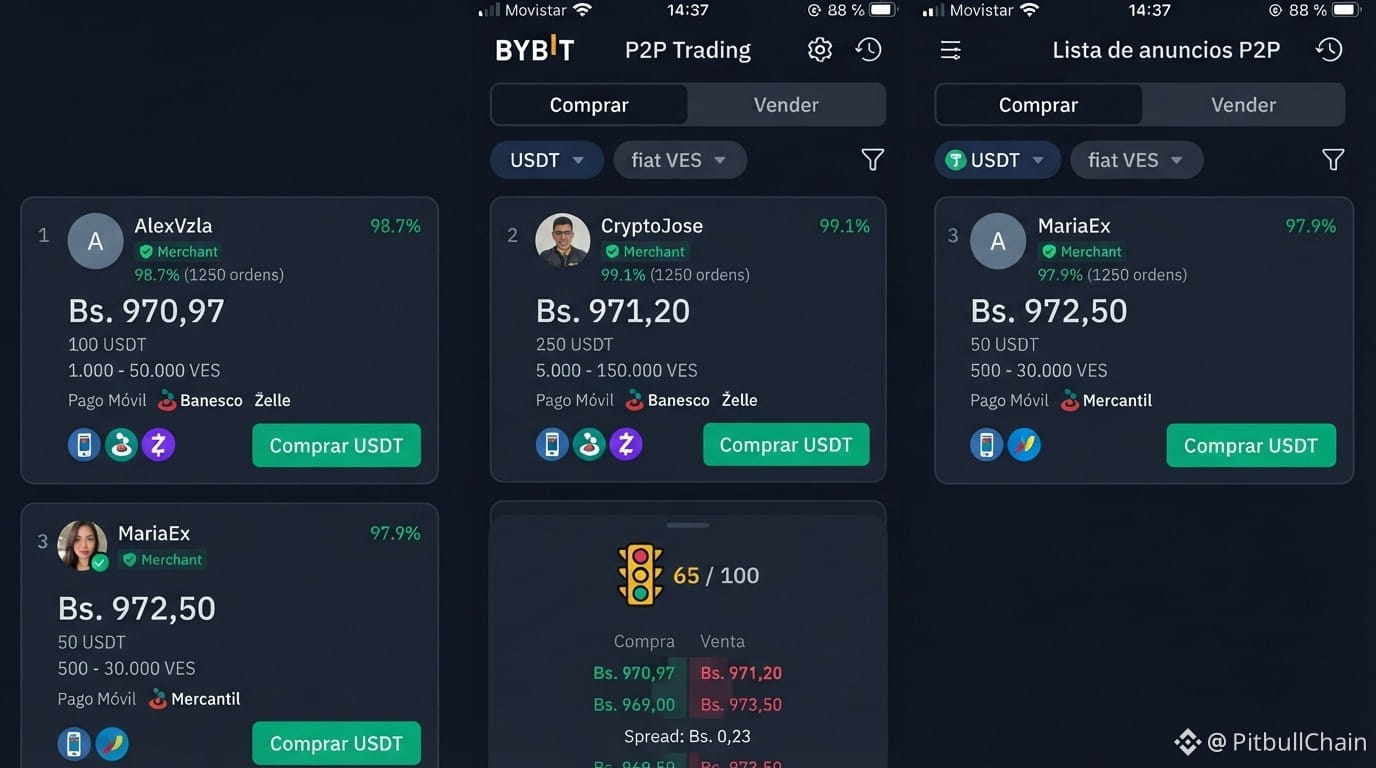
How to avoid overpaying in P2P: interpret the spread and the traffic lightBinance’s P2P market moves more than $44 million per day in Venezuela, according to Ecoanalítica [2]. With that volume, opportunities to overpay also grow if you don’t interpret the indicators correctly. In this tutorial, we’ll show you how to use PitbullChain to read the real spread, the traffic light, and the order book before buying USDT. What is the spread and why it makes you pay more In the P2P market, there are always two prices: the buy price (what you pay for USDT) and the sell price (what you receive when you sell). The difference between those prices is called the spread. When the spread is high, it means supply and demand are not aligned and you could be paying a significant markup. According to data captured on September 8, 2026, PitbullChain’s P2P Radar shows an average price to buy USDT of 977.09 bolívares, while the average price to sell is 943.36 bolívares. The spread is 33.72 bolívares, equivalent to 3.57%. That means that if you buy at the average price, you’re paying almost 4% more than the market is willing to pay you for the same asset. P2P traffic light: moderate caution signal The PitbullChain traffic light summarizes the market status on a scale from green to red. Today it’s yellow with a score of 65/100. The label is “Moderate caution.” The system checks spread, liquidity, depth, and the exchanges’ health. In the details, you’ll see that liquidity is good (95/100), but the spread only gets 20/100, indicating there’s a wide price difference between buy and sell. Depth is 45/100, and volatility is 40/100. In this context, the automated recommendation is clear: compare prices across exchanges and check the bank, reputation, and limits. Step by step: how to calculate the real spread with PitbullChain Don’t rely only on the P2P Radar average. Follow these steps to find the fair price before you trade. 1. Open the P2P Order Book. There you’ll find the buy and sell offers on Binance and other platforms in real time. On September 8, the best ask (the price at which someone sells you USDT) is 968.40 bolívares, with availability on other platforms. The best bid (the price at which someone buys your USDT) is 968.02 on Binance. This real spread is only 0.04%. 2. Filter by bank. If your bank is Banesco, the Bank Comparator shows an average purchase price of 972.49, while Banco de Venezuela is 970.73. Although it’s not the only variable, it helps you rule out inflated offers. 3. Use the P2P Calculator. Enter the amount of USDT you want to buy and you’ll see the total in bolívares using the updated rate. For example, 100 USDT at the best ask of 968.40 cost 96,840 bolívares. If you took the Radar average (977.09), you’d pay 97,709 bolívares. That is, 869 bolívares in overpricing for only 100 USDT. 4. Cross-check with the traffic light. When the traffic light is yellow, don’t take the first offer you see. Check whether the seller has enough completed trades and whether their negotiation range covers the amount you need. Practical case using data from September 8, 2026 The live data captured at midnight (UTC) shows that the Order Book has more than 149,000 USDT in sell offers and more than 296,000 USDT in buy offers. Buy volume is double the sell volume, which can push the price up. However, there’s an offer on other platforms at 968.40 with a maximum limit of 109.86 USDT. If your trade is small, that could be an efficient option. If you need a larger amount, the next offer on Binance is 969.90 with a limit of 2,298 USDT, paid with Mercantil. As you move up the book, you’ll notice the price increases. That’s why book depth is key: don’t only look at the best price—also check how many USDT are available at that price and what the minimum and maximum limits are. The traffic light shows a high average spread of 3.57%, but the real spread at the best level is only 0.04%. The difference comes from the fact that the P2P Radar groups all active listings, including those with prices outside the range or payment methods with low liquidity. The conclusion is clear: use the radar as a reference, but decide with the order book. Common mistakes that make you pay more Buying the first listing that appears. Featured advertising usually has the highest price because it includes commissions or markup. Always check at least the first three offers in the order book. Ignoring the payment method. If the seller only accepts Pago Móvil and you have Banesco, the offer with the best price might not be available to you. The Bank Comparator shows which options are viable. Not checking the limits. An offer may show an attractive price, but if the minimum limit is 500 USDT and you only need 50, you’ll waste time and might end up in a negotiation that doesn’t fit your needs. Trading during periods of high volatility. With the traffic light in yellow, prices can change quickly. If you see the spread widen more than usual, wait for it to stabilize or place a limit order. Conclusion: the fair price exists—you just have to find it Venezuela’s P2P market is deep but uneven. Tools like PitbullChain’s Order Book, Calculator, and Bank Comparator help you reduce overpricing and trade with more information. This isn’t about guessing the future—it’s about acting on data. Remember: the information shown here is educational and does not constitute financial advice. Any P2P transaction involves risks, and you are responsible for verifying the reputation of the counterparties and complying with the applicable foreign exchange regulations in the country.
How to avoid overpaying in P2P: interpret the spread and the traffic light
Binance’s P2P market moves more than $44 million per day in Venezuela, according to Ecoanalítica [2]. With that volume, opportunities to overpay also grow if you don’t interpret the indicators correctly. In this tutorial, we’ll show you how to use PitbullChain to read the real spread, the traffic light, and the order book before buying USDT. What is the spread and why it makes you pay more In the P2P market, there are always two prices: the buy price (what you pay for USDT) and the sell price (what you receive when you sell). The difference between those prices is called the spread. When the spread is high, it means supply and demand are not aligned and you could be paying a significant markup. According to data captured on September 8, 2026, PitbullChain’s P2P Radar shows an average price to buy USDT of 977.09 bolívares, while the average price to sell is 943.36 bolívares. The spread is 33.72 bolívares, equivalent to 3.57%. That means that if you buy at the average price, you’re paying almost 4% more than the market is willing to pay you for the same asset. P2P traffic light: moderate caution signal The PitbullChain traffic light summarizes the market status on a scale from green to red. Today it’s yellow with a score of 65/100. The label is “Moderate caution.” The system checks spread, liquidity, depth, and the exchanges’ health. In the details, you’ll see that liquidity is good (95/100), but the spread only gets 20/100, indicating there’s a wide price difference between buy and sell. Depth is 45/100, and volatility is 40/100. In this context, the automated recommendation is clear: compare prices across exchanges and check the bank, reputation, and limits. Step by step: how to calculate the real spread with PitbullChain Don’t rely only on the P2P Radar average. Follow these steps to find the fair price before you trade. 1. Open the P2P Order Book. There you’ll find the buy and sell offers on Binance and other platforms in real time. On September 8, the best ask (the price at which someone sells you USDT) is 968.40 bolívares, with availability on other platforms. The best bid (the price at which someone buys your USDT) is 968.02 on Binance. This real spread is only 0.04%. 2. Filter by bank. If your bank is Banesco, the Bank Comparator shows an average purchase price of 972.49, while Banco de Venezuela is 970.73. Although it’s not the only variable, it helps you rule out inflated offers. 3. Use the P2P Calculator. Enter the amount of USDT you want to buy and you’ll see the total in bolívares using the updated rate. For example, 100 USDT at the best ask of 968.40 cost 96,840 bolívares. If you took the Radar average (977.09), you’d pay 97,709 bolívares. That is, 869 bolívares in overpricing for only 100 USDT. 4. Cross-check with the traffic light. When the traffic light is yellow, don’t take the first offer you see. Check whether the seller has enough completed trades and whether their negotiation range covers the amount you need. Practical case using data from September 8, 2026 The live data captured at midnight (UTC) shows that the Order Book has more than 149,000 USDT in sell offers and more than 296,000 USDT in buy offers. Buy volume is double the sell volume, which can push the price up. However, there’s an offer on other platforms at 968.40 with a maximum limit of 109.86 USDT. If your trade is small, that could be an efficient option. If you need a larger amount, the next offer on Binance is 969.90 with a limit of 2,298 USDT, paid with Mercantil. As you move up the book, you’ll notice the price increases. That’s why book depth is key: don’t only look at the best price—also check how many USDT are available at that price and what the minimum and maximum limits are. The traffic light shows a high average spread of 3.57%, but the real spread at the best level is only 0.04%. The difference comes from the fact that the P2P Radar groups all active listings, including those with prices outside the range or payment methods with low liquidity. The conclusion is clear: use the radar as a reference, but decide with the order book. Common mistakes that make you pay more Buying the first listing that appears. Featured advertising usually has the highest price because it includes commissions or markup. Always check at least the first three offers in the order book. Ignoring the payment method. If the seller only accepts Pago Móvil and you have Banesco, the offer with the best price might not be available to you. The Bank Comparator shows which options are viable. Not checking the limits. An offer may show an attractive price, but if the minimum limit is 500 USDT and you only need 50, you’ll waste time and might end up in a negotiation that doesn’t fit your needs. Trading during periods of high volatility. With the traffic light in yellow, prices can change quickly. If you see the spread widen more than usual, wait for it to stabilize or place a limit order. Conclusion: the fair price exists—you just have to find it Venezuela’s P2P market is deep but uneven. Tools like PitbullChain’s Order Book, Calculator, and Bank Comparator help you reduce overpricing and trade with more information. This isn’t about guessing the future—it’s about acting on data. Remember: the information shown here is educational and does not constitute financial advice. Any P2P transaction involves risks, and you are responsible for verifying the reputation of the counterparties and complying with the applicable foreign exchange regulations in the country.
84
·
--
Article
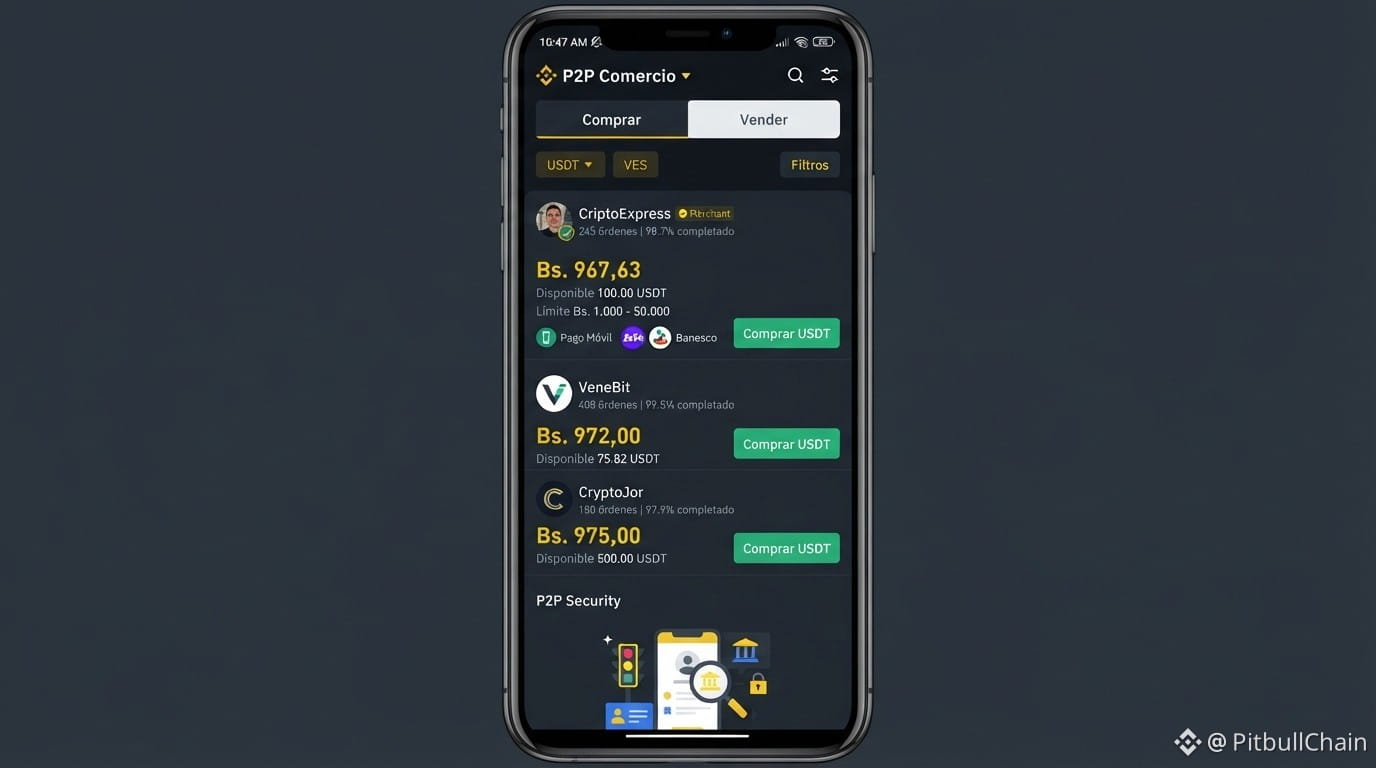
P2P Traffic Light: 7 steps to avoid fraud when buying USDTThe Venezuelan P2P market is still one of the most-used ways to buy USDT with bolivars, but it’s also a place where scams disguise themselves as attractive offers. The P2P Traffic Light scored 71 points in yellow for the USDT/VES pair on September 7, 2026 at 10:00 UTC, with a spread of 6.32% and an average buy price of Bs. 984.25. This represents a moderately cautious scenario: there is liquidity, but also risks you can reduce by following these 7 practical steps. 1. Read the P2P traffic light before clicking the buy button The P2P traffic light isn’t just for show. It’s a tool that summarizes market health with a score. At the time of the capture, it was yellow with a score of 71/100. That means conditions are mixed: review the details before you trade. Liquidity: high, with 196 active offers. Spread: high, which encourages price comparison. Volatility: low, according to internal metrics. 2. Don’t get caught by the high spread: compare it in the order book A 6.32% spread means there’s a noticeable gap between the buy and sell prices of USDT. Today, the radar shows the user can buy at Bs. 984.25 and sell at Bs. 925.72. If you only look at the first listing, you can lose more than Bs. 58 per USDT. The order book shows an even greater disparity between exchanges: based on live data, there’s a 6.64% difference between Binance’s price and the price on other platforms. Don’t buy without comparing at least three levels of the order book. 3. Filter merchants by completion rate and verification A merchant’s reputation is everything in P2P. Platforms show the completion rate percentage, account age, and number of completed trades. In a deal with a high spread, look for a merchant with at least 95% completion and more than 100 completed trades. Be suspicious of newly created offers or prices far above or below the average. 4. Review the order book: look for depth and avoid anchor prices The order book doesn’t only show prices—it shows depth. According to the P2P Radar data, there is strong buying pressure: the volume of buy orders reaches 1,137,555 USDT, while sales barely reach 103,888 USDT, a 83.26% imbalance. This means demand is high, which can push prices upward. Before buying, check whether the offer you choose has enough volume behind it for the amount you need, and avoid anchor prices that only aim to attract beginners. 5. Choose a bank with a low spread and a solid reputation in the comparator PitbullChain’s bank comparator shows that today there are significant differences between payment methods. Banesco accounts for 25.9% of the listings with an average spread of 2.18%, while Banco de Venezuela has a lower spread (0.95%) but lower liquidity. If the merchant asks you for an unusual bank or one with little presence in the comparator, stop. The dominant banks today are: Pago Móvil, Banesco, Banco de Venezuela, and Mercantil. 6. Protect your transfer: ask for exact details and verify account ownership When buying USDT, you’re the one who transfers the bolivars. That’s why bank transfers are the most sensitive point. Make sure the ownership of the bank account matches the merchant’s name. If they send you the details through another communication channel outside the platform, that’s a red flag. Also watch out for “account renting”: Binance has warned that many scams use third-party accounts to receive the money. [2] Don’t make the transfer to an account holder you can’t verify. 7. Never complete the transaction outside the platform Binance P2P security is based on the idea that the chat, payment details, and USDT custody are all kept within the platform. If, for any reason, the merchant insists on moving you to Telegram, WhatsApp, or an external website, cut off the communication. In Venezuela, P2P regulation is part of the legal crypto ecosystem, but the relative anonymity of these markets is also used by scammers. [1] Keep all evidence inside the exchange and use the dispute system if something goes wrong. Practical conclusions Buying USDT with a high spread isn’t a mistake by itself, but it requires extra review. Today, with the traffic light in yellow, the golden rule is: be skeptical of the “perfect” offer and use the tools at your disposal—P2P Traffic Light, Order Book, and Bank Comparator—to verify every step. This article is for informational purposes only and does not constitute financial advice. The figures come from the capture made on September 7, 2026 at 10:00 UTC.
P2P Traffic Light: 7 steps to avoid fraud when buying USDT
The Venezuelan P2P market is still one of the most-used ways to buy USDT with bolivars, but it’s also a place where scams disguise themselves as attractive offers. The P2P Traffic Light scored 71 points in yellow for the USDT/VES pair on September 7, 2026 at 10:00 UTC, with a spread of 6.32% and an average buy price of Bs. 984.25. This represents a moderately cautious scenario: there is liquidity, but also risks you can reduce by following these 7 practical steps. 1. Read the P2P traffic light before clicking the buy button The P2P traffic light isn’t just for show. It’s a tool that summarizes market health with a score. At the time of the capture, it was yellow with a score of 71/100. That means conditions are mixed: review the details before you trade. Liquidity: high, with 196 active offers. Spread: high, which encourages price comparison. Volatility: low, according to internal metrics. 2. Don’t get caught by the high spread: compare it in the order book A 6.32% spread means there’s a noticeable gap between the buy and sell prices of USDT. Today, the radar shows the user can buy at Bs. 984.25 and sell at Bs. 925.72. If you only look at the first listing, you can lose more than Bs. 58 per USDT. The order book shows an even greater disparity between exchanges: based on live data, there’s a 6.64% difference between Binance’s price and the price on other platforms. Don’t buy without comparing at least three levels of the order book. 3. Filter merchants by completion rate and verification A merchant’s reputation is everything in P2P. Platforms show the completion rate percentage, account age, and number of completed trades. In a deal with a high spread, look for a merchant with at least 95% completion and more than 100 completed trades. Be suspicious of newly created offers or prices far above or below the average. 4. Review the order book: look for depth and avoid anchor prices The order book doesn’t only show prices—it shows depth. According to the P2P Radar data, there is strong buying pressure: the volume of buy orders reaches 1,137,555 USDT, while sales barely reach 103,888 USDT, a 83.26% imbalance. This means demand is high, which can push prices upward. Before buying, check whether the offer you choose has enough volume behind it for the amount you need, and avoid anchor prices that only aim to attract beginners. 5. Choose a bank with a low spread and a solid reputation in the comparator PitbullChain’s bank comparator shows that today there are significant differences between payment methods. Banesco accounts for 25.9% of the listings with an average spread of 2.18%, while Banco de Venezuela has a lower spread (0.95%) but lower liquidity. If the merchant asks you for an unusual bank or one with little presence in the comparator, stop. The dominant banks today are: Pago Móvil, Banesco, Banco de Venezuela, and Mercantil. 6. Protect your transfer: ask for exact details and verify account ownership When buying USDT, you’re the one who transfers the bolivars. That’s why bank transfers are the most sensitive point. Make sure the ownership of the bank account matches the merchant’s name. If they send you the details through another communication channel outside the platform, that’s a red flag. Also watch out for “account renting”: Binance has warned that many scams use third-party accounts to receive the money. [2] Don’t make the transfer to an account holder you can’t verify. 7. Never complete the transaction outside the platform Binance P2P security is based on the idea that the chat, payment details, and USDT custody are all kept within the platform. If, for any reason, the merchant insists on moving you to Telegram, WhatsApp, or an external website, cut off the communication. In Venezuela, P2P regulation is part of the legal crypto ecosystem, but the relative anonymity of these markets is also used by scammers. [1] Keep all evidence inside the exchange and use the dispute system if something goes wrong. Practical conclusions Buying USDT with a high spread isn’t a mistake by itself, but it requires extra review. Today, with the traffic light in yellow, the golden rule is: be skeptical of the “perfect” offer and use the tools at your disposal—P2P Traffic Light, Order Book, and Bank Comparator—to verify every step. This article is for informational purposes only and does not constitute financial advice. The figures come from the capture made on September 7, 2026 at 10:00 UTC.
43
·
--
Article
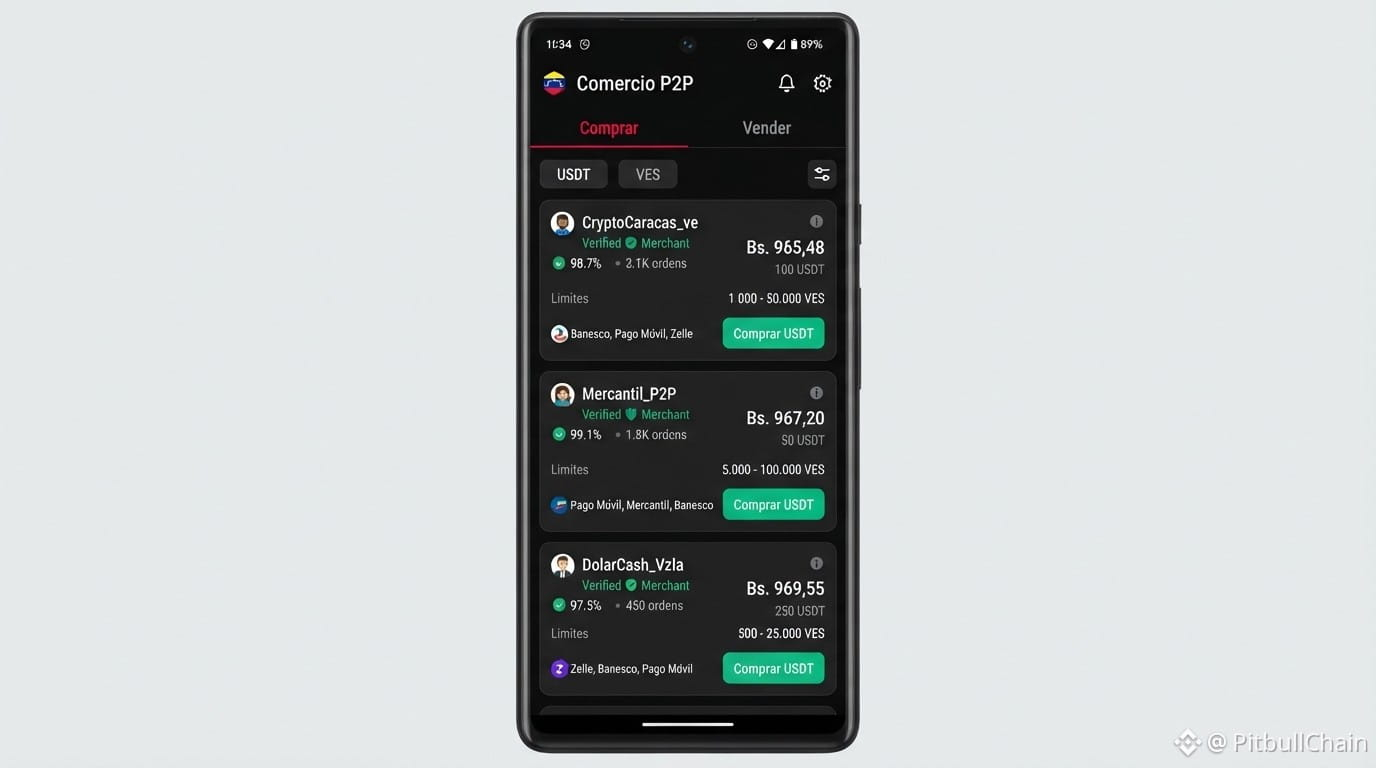
Yellow light in P2P: 5 steps to avoid fraud when buying USDTOn the afternoon of September 5, 2026, the PitbullChain radar detected that the USDT/VES P2P market was operating in yellow light: a score of 71/100, with a high spread (28.99 Bs, 3.09%) and a premium of 18.99% versus the BCV (813.74 Bs/USD). This does not mean trading is prohibited; rather, it means you should be more cautious. Here we present a 5-step protocol to reduce fraud risk when buying USDT, based on PitbullChain data. Step 1: Interpret the spread as a warning sign The spread is the difference between the USDT buy price and sell price. At the time of the capture, the spread was 28.99 Bs (3.09%), a value that PitbullChain considers high. A high spread usually indicates low liquidity or an imbalance between supply and demand, and is fertile ground for manipulated prices. With the average buy price at 968.33 Bs and the average sell price at 939.33 Bs, if an offer is to buy USDT 'too cheaply' compared with its surroundings, be suspicious. Use the PitbullChain calculator and compare at least three prices before starting a transaction. Step 2: Filter by recognized and liquid banks The type of bank matters just as much as the price. In the radar data, the banks with the most activity are Banesco (26 ads, 24.1% liquidity), Pago Móvil (24 ads, 22.2%), and Banco de Venezuela (15 ads, 13.9%). The traffic light itself includes a bank availability score of 95 points, meaning there are good options today. In your P2P exchange, filter only those banks that appear as dominant in the PitbullChain comparator and avoid those that do not appear or have very little activity. A counterparty that asks you to pay to an uncommon bank or by a disallowed method is a red flag. Step 3: Review the order book depth Depth shows how many orders exist at different prices. In the order book capture at 16:00 (UTC), there were 30 sell offers (USDT sellers) and 32 buy offers (buyers). Buy volume was 1,337,677 USDT versus only 63,072 USDT in sell volume; an imbalance of 90.99%. This means there is a lot of demand for USDT, but few reliable sell listings. Under these conditions, do not take the first offer you see; wait until there are several options in the range you are looking for. The 'best price' option on Binance or other platforms can be dangerous if it is not backed by a good reputation (next step). Step 4: Validate the counterparty's reputation Before buying, go to the seller's profile and check four things: order completion rate (it should be above 98%), age of the account (more than 6 months is a good sign), total number of transactions (if fewer than 50, ask for more proof), and recent comments (look for complaints such as 'payment not released' or 'another account'). In PitbullChain's traffic light, the reputation score can also be seen in the details for each bank; for example, Banesco and Pago Móvil have scores of 98 and 84 respectively, but you should always cross-check that information with the specific user. If the seller pressures you to 'mark as paid' before you receive the transfer, it is almost certainly fraud. In Binance P2P, never release USDT without confirming that the payment has arrived in your account. Step 5: Set transaction limits and make a test purchase Do not start with large amounts. Set a maximum limit per transaction in your P2P account (for example, 100 USDT) and a test transaction of 10 USDT to validate the process. In PitbullChain you can see the minimum and maximum for each listing in the order book; many offers from banks like Banesco have very high limits (for example, 5,183 USDT), but that does not mean they are safe to use from the start. The verification protocol recommended by PitbullChain suggests always operating within your means and with a planned margin for error. If the spread is high (greater than 3%), you are not required to buy; you can wait for the market to turn green. Closing: Data for action (not advice) The current traffic light (71/100, yellow) calls for extra verification. We compared Binance P2P data (average sell price 964.5 Bs) with data from other platforms (and other platforms), and the differences do not exceed 1% in most cases. Liquidity is sufficient, but depth is imbalanced. Remember: PitbullChain information is educational and does not constitute financial advice. Always verify the data in real time at https://pitbullchain.com and act according to your own judgment. With these 5 steps, you reduce the attack surface for scammers.
Yellow light in P2P: 5 steps to avoid fraud when buying USDT
On the afternoon of September 5, 2026, the PitbullChain radar detected that the USDT/VES P2P market was operating in yellow light: a score of 71/100, with a high spread (28.99 Bs, 3.09%) and a premium of 18.99% versus the BCV (813.74 Bs/USD). This does not mean trading is prohibited; rather, it means you should be more cautious. Here we present a 5-step protocol to reduce fraud risk when buying USDT, based on PitbullChain data. Step 1: Interpret the spread as a warning sign The spread is the difference between the USDT buy price and sell price. At the time of the capture, the spread was 28.99 Bs (3.09%), a value that PitbullChain considers high. A high spread usually indicates low liquidity or an imbalance between supply and demand, and is fertile ground for manipulated prices. With the average buy price at 968.33 Bs and the average sell price at 939.33 Bs, if an offer is to buy USDT 'too cheaply' compared with its surroundings, be suspicious. Use the PitbullChain calculator and compare at least three prices before starting a transaction. Step 2: Filter by recognized and liquid banks The type of bank matters just as much as the price. In the radar data, the banks with the most activity are Banesco (26 ads, 24.1% liquidity), Pago Móvil (24 ads, 22.2%), and Banco de Venezuela (15 ads, 13.9%). The traffic light itself includes a bank availability score of 95 points, meaning there are good options today. In your P2P exchange, filter only those banks that appear as dominant in the PitbullChain comparator and avoid those that do not appear or have very little activity. A counterparty that asks you to pay to an uncommon bank or by a disallowed method is a red flag. Step 3: Review the order book depth Depth shows how many orders exist at different prices. In the order book capture at 16:00 (UTC), there were 30 sell offers (USDT sellers) and 32 buy offers (buyers). Buy volume was 1,337,677 USDT versus only 63,072 USDT in sell volume; an imbalance of 90.99%. This means there is a lot of demand for USDT, but few reliable sell listings. Under these conditions, do not take the first offer you see; wait until there are several options in the range you are looking for. The 'best price' option on Binance or other platforms can be dangerous if it is not backed by a good reputation (next step). Step 4: Validate the counterparty's reputation Before buying, go to the seller's profile and check four things: order completion rate (it should be above 98%), age of the account (more than 6 months is a good sign), total number of transactions (if fewer than 50, ask for more proof), and recent comments (look for complaints such as 'payment not released' or 'another account'). In PitbullChain's traffic light, the reputation score can also be seen in the details for each bank; for example, Banesco and Pago Móvil have scores of 98 and 84 respectively, but you should always cross-check that information with the specific user. If the seller pressures you to 'mark as paid' before you receive the transfer, it is almost certainly fraud. In Binance P2P, never release USDT without confirming that the payment has arrived in your account. Step 5: Set transaction limits and make a test purchase Do not start with large amounts. Set a maximum limit per transaction in your P2P account (for example, 100 USDT) and a test transaction of 10 USDT to validate the process. In PitbullChain you can see the minimum and maximum for each listing in the order book; many offers from banks like Banesco have very high limits (for example, 5,183 USDT), but that does not mean they are safe to use from the start. The verification protocol recommended by PitbullChain suggests always operating within your means and with a planned margin for error. If the spread is high (greater than 3%), you are not required to buy; you can wait for the market to turn green. Closing: Data for action (not advice) The current traffic light (71/100, yellow) calls for extra verification. We compared Binance P2P data (average sell price 964.5 Bs) with data from other platforms (and other platforms), and the differences do not exceed 1% in most cases. Liquidity is sufficient, but depth is imbalanced. Remember: PitbullChain information is educational and does not constitute financial advice. Always verify the data in real time at https://pitbullchain.com and act according to your own judgment. With these 5 steps, you reduce the attack surface for scammers.
15
Log in to explore more content
Join global crypto users on Binance Square
⚡️ Get latest and useful information about crypto.
💬 Trusted by the world’s largest crypto exchange.
👍 Discover real insights from verified creators.
Email / Phone number
Trending Topics
1
#FedRateWatch
654,634 views
3,059 Discussing
2
#EthereumFallsBelow$2400
167 views
29 Discussing
3
#USSenateBlocksClarityAct
1,145 views
78 Discussing
4
#BitcoinSlidesTo$76000
27,331 views
134 Discussing
5
#BitcoinReboundsTo$79K
63,998 views
410 Discussing
6
#StrategyMarketCapPassesFord
47,162 views
742 Discussing
7
#ClarityActOddsHalveOnPolymarket
77,197 views
632 Discussing
8
#US30YTreasuryYieldTops5.40%
40,628 views
413 Discussing
9
#BessentEndorsesFinalClarityActDraft
63,004 views
791 Discussing
10
#ZamaOpens16ConfidentialMorphoVaults
22,162 views
386 Discussing