

#openledger
openledger
17.3M views
202,840 Discussing
Hot
Latest

·
--
Bullish
#OpenLedger just printed a textbook V-shaped recovery—don't miss the next leg up.
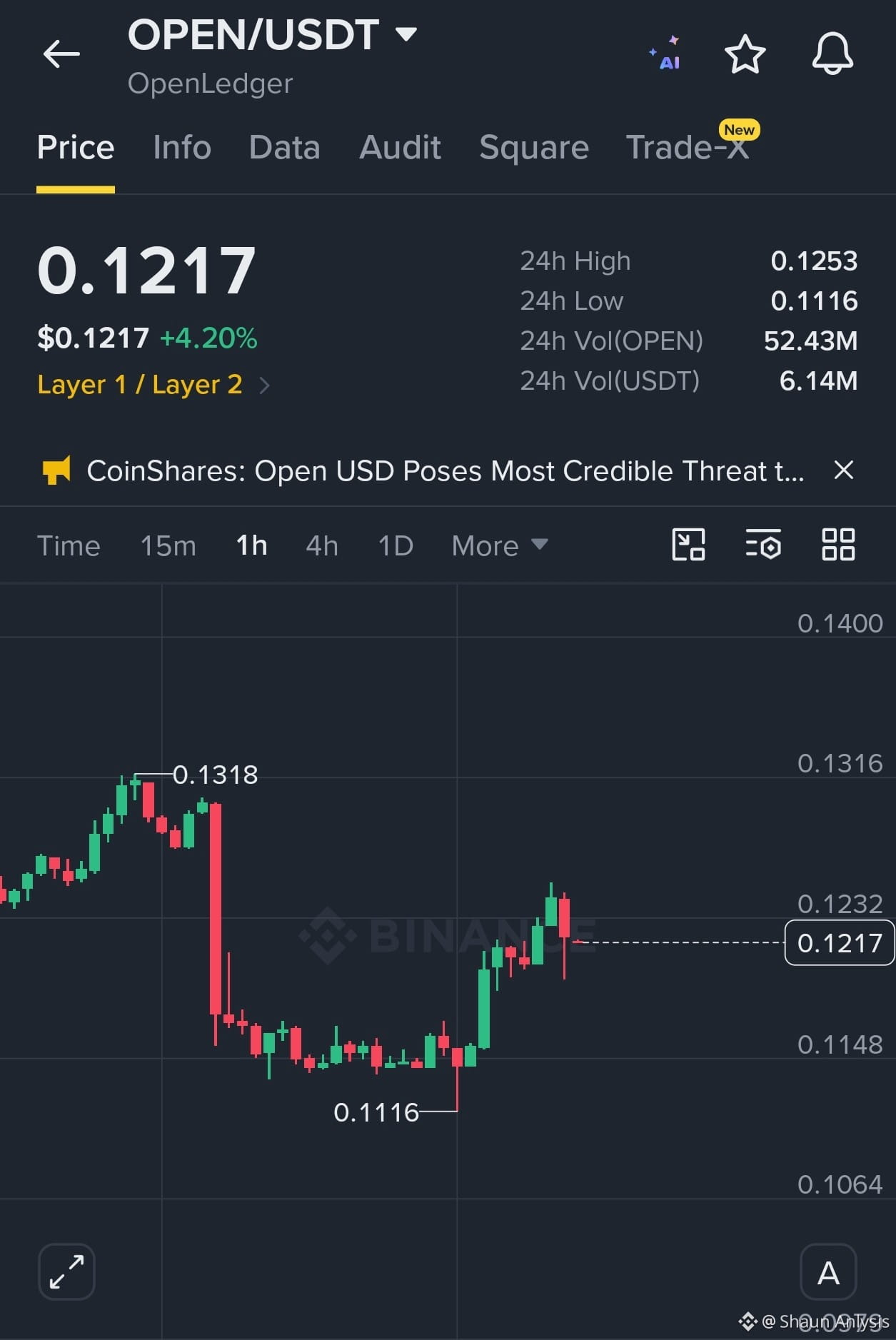
After a sharp flush to 0.1116, $OPEN has bounced hard, reclaiming the 0.12 handle and currently sitting at 0.1217 (+4.20% on the day). The 1H chart shows a clear shift in momentum as buyers defend the lows and push back toward the 24H high of 0.1253.
Bullish
Entry:0.1180 – 0.1220
SL:0.1100
TP1:0.1318
{future}(OPENUSDT)
#OpenLedger just printed a textbook V-shaped recovery—don't miss the next leg up.
After a sharp flush to 0.1116, $OPEN has bounced hard, reclaiming the 0.12 handle and currently sitting at 0.1217 (+4.20% on the day). The 1H chart shows a clear shift in momentum as buyers defend the lows and push back toward the 24H high of 0.1253.
Bullish
Entry:0.1180 – 0.1220
SL:0.1100
TP1:0.1318
After a sharp flush to 0.1116, $OPEN has bounced hard, reclaiming the 0.12 handle and currently sitting at 0.1217 (+4.20% on the day). The 1H chart shows a clear shift in momentum as buyers defend the lows and push back toward the 24H high of 0.1253.
Bullish
Entry:0.1180 – 0.1220
SL:0.1100
TP1:0.1318
1
18

·
--
Bullish
Partly True
*OPEN: A Quiet AI Opportunity Near The Bottom*
While many focus on popular AI coins, OpenLedger (OPEN) is trading near its lowest price ever.
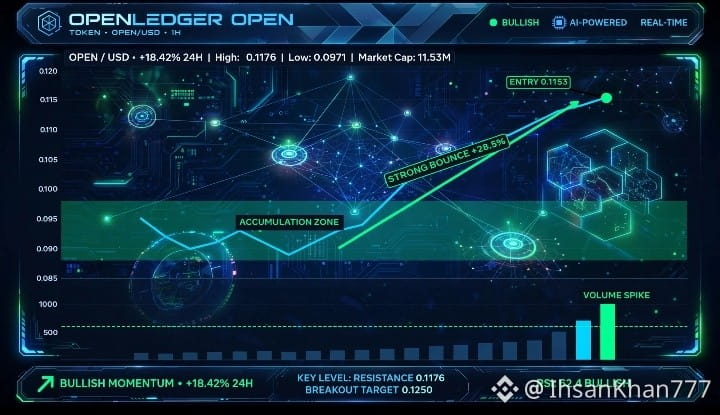
From $1.84 to $0.11, a large correction of 94 percent. Is this a bottom?
Here is what makes OpenLedger interesting:
OpenLedger is building infrastructure for AI, where data, models, and AI agents receive payments automatically. Think of AI agents paying for verified data on-chain. This is called agentic payments, and OpenLedger aims to lead this sector.
Market cap is around $43M while volume is $31M. That is over 71 percent turnover, showing strong interest and active accumulation.
Token unlocks are happening. About 612k tokens daily around October 8th. Small unlocks create short-term pressure, but also long-term opportunity.
It is listed on major exchanges like Upbit, Bithumb, and Binance, with strong liquidity.
I bought OPEN at $0.1153 near the low range. This is not financial advice, but early infrastructure often looks quiet before growth.
#OpenLedger
#OpenAI
#BestTimeToBuy
#Market_Update
#BullRunTips
$OPEN
$BTC
$BNB
@XG297174
@dengshen
@eggtartcake_grape
@haoge666
@Square-Creator-f92ceb7e7882c
@Square-Creator-d4cc116ea2fe
@SGD852568
@Square-Creator-f0c9a305b41a7
@z12123444
@Square-Creator-9bd28167d172
@NUTS_btc
@heyi
@CZ
@Openledger
@Biswap_Dex
@MagVerse
@EASY7777
@KZG6886
@Z0628
@JavierDot
@oanicai
*OPEN: A Quiet AI Opportunity Near The Bottom*
While many focus on popular AI coins, OpenLedger (OPEN) is trading near its lowest price ever.
From $1.84 to $0.11, a large correction of 94 percent. Is this a bottom?
Here is what makes OpenLedger interesting:
OpenLedger is building infrastructure for AI, where data, models, and AI agents receive payments automatically. Think of AI agents paying for verified data on-chain. This is called agentic payments, and OpenLedger aims to lead this sector.
Market cap is around $43M while volume is $31M. That is over 71 percent turnover, showing strong interest and active accumulation.
Token unlocks are happening. About 612k tokens daily around October 8th. Small unlocks create short-term pressure, but also long-term opportunity.
It is listed on major exchanges like Upbit, Bithumb, and Binance, with strong liquidity.
I bought OPEN at $0.1153 near the low range. This is not financial advice, but early infrastructure often looks quiet before growth.
#OpenLedger
#OpenAI
#BestTimeToBuy
#Market_Update
#BullRunTips
$OPEN
$BTC
$BNB
@K线人生飞哥
@比特币预言家
@Eggtartcake_
@交易员张张子
@华尔街倩倩子
@蝴蝶股票-猩火Bro
@Flash闪光灯
@乐天eth
@加密大格格
@klxmBobo
@Nuts坚果
@Yi He
@CZ
@OpenLedger
@Qordman crypto
@MagVerse
@EASY喊單哥
@KZG Crypto 口罩哥
@Whale韭阴针鲸0628
@_WHALE_
@Oanic AI
While many focus on popular AI coins, OpenLedger (OPEN) is trading near its lowest price ever.
From $1.84 to $0.11, a large correction of 94 percent. Is this a bottom?
Here is what makes OpenLedger interesting:
OpenLedger is building infrastructure for AI, where data, models, and AI agents receive payments automatically. Think of AI agents paying for verified data on-chain. This is called agentic payments, and OpenLedger aims to lead this sector.
Market cap is around $43M while volume is $31M. That is over 71 percent turnover, showing strong interest and active accumulation.
Token unlocks are happening. About 612k tokens daily around October 8th. Small unlocks create short-term pressure, but also long-term opportunity.
It is listed on major exchanges like Upbit, Bithumb, and Binance, with strong liquidity.
I bought OPEN at $0.1153 near the low range. This is not financial advice, but early infrastructure often looks quiet before growth.
#OpenLedger
#OpenAI
#BestTimeToBuy
#Market_Update
#BullRunTips
$OPEN
$BTC
$BNB
@K线人生飞哥
@比特币预言家
@Eggtartcake_
@交易员张张子
@华尔街倩倩子
@蝴蝶股票-猩火Bro
@Flash闪光灯
@乐天eth
@加密大格格
@klxmBobo
@Nuts坚果
@Yi He
@CZ
@OpenLedger
@Qordman crypto
@MagVerse
@EASY喊單哥
@KZG Crypto 口罩哥
@Whale韭阴针鲸0628
@_WHALE_
@Oanic AI
4
787

·
--
📉 $OPEN
— OpenLedger Cooling Off
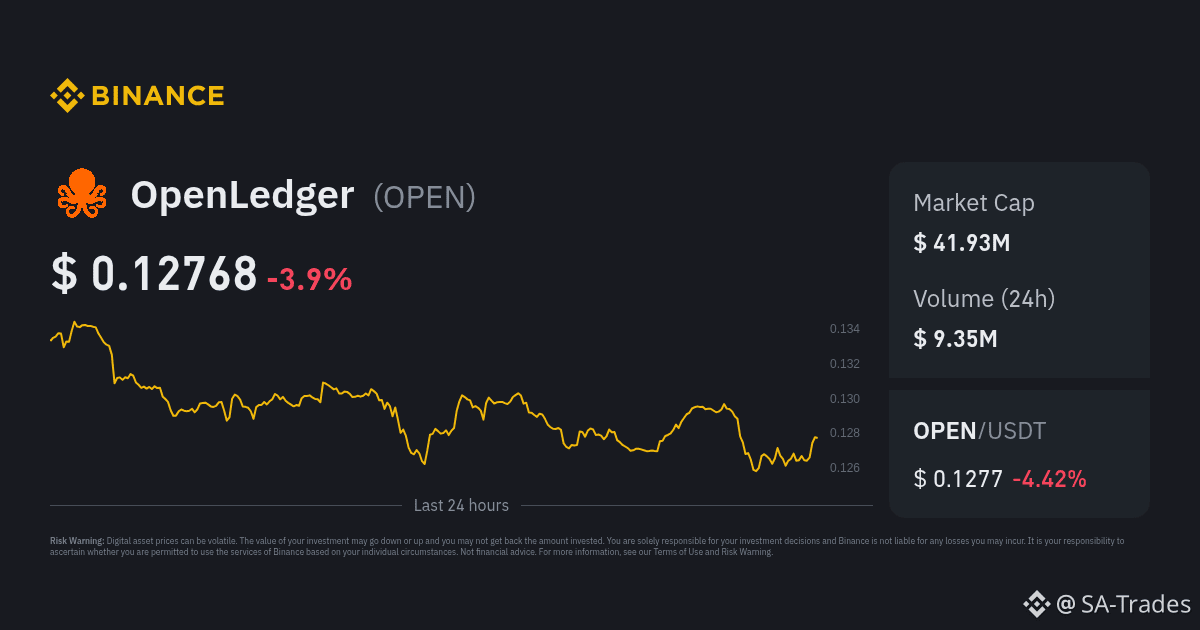
OpenLedger (OPEN) down -3.9% today, now trading at $0.1277.
📊 Market Cap: $41.93M
📊 24h Volume: $9.35M
Choppy price action over the last 24h — sellers stepping in after failing to hold higher levels.
Accumulation zone or further downside? 👀
Trade $OPEN here
{future}(OPENUSDT)
#OPEN #OpenLedger #BinanceSquare #crypto
📉 $OPEN
— OpenLedger Cooling Off
OpenLedger (OPEN) down -3.9% today, now trading at $0.1277.
📊 Market Cap: $41.93M
📊 24h Volume: $9.35M
Choppy price action over the last 24h — sellers stepping in after failing to hold higher levels.
Accumulation zone or further downside? 👀
Trade $OPEN here
#OPEN #OpenLedger #BinanceSquare #crypto
— OpenLedger Cooling Off
OpenLedger (OPEN) down -3.9% today, now trading at $0.1277.
📊 Market Cap: $41.93M
📊 24h Volume: $9.35M
Choppy price action over the last 24h — sellers stepping in after failing to hold higher levels.
Accumulation zone or further downside? 👀
Trade $OPEN here
#OPEN #OpenLedger #BinanceSquare #crypto
2
4
214

·
--
Hey youth $OPEN under pressure… Will there be a bounce?
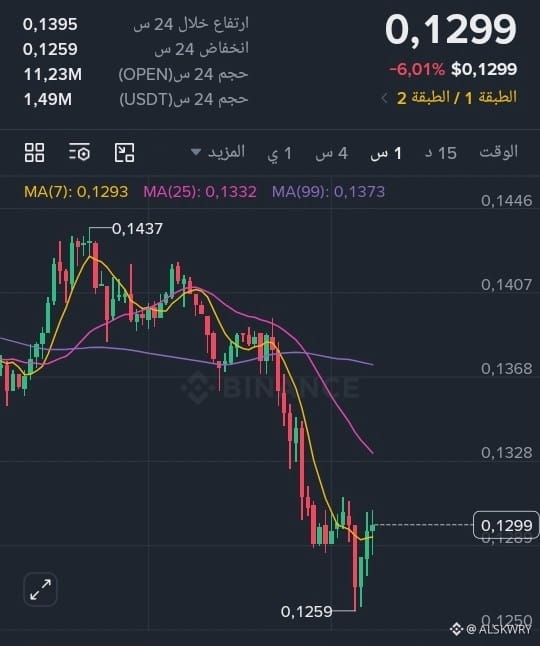
OpenLedger (OPEN) coin is currently moving under selling pressure, and the price is around $0.1299 after a drop of nearly 6% within 24 hours.
📉 Key levels:
🟢 Support: $0.1260
🔴 Resistance: $0.1328 – $0.1330
🔴 Stronger resistance: $0.1368 – $0.1375
If the price holds at $0.126 and starts forming higher lows, we may see an attempt to rebound. But a clear break could open the way to lower levels.
👀 OPEN is worth monitoring now, not buying just because the price has fallen.
Do you expect a rebound for OPEN or the continuation of the downtrend?
⚠️ Not financial advice—just analysis and shared for discussion.
#OpenLedger #cryptouniverseofficial #BinanceSquare #trading
Hey youth $OPEN under pressure… Will there be a bounce?
OpenLedger (OPEN) coin is currently moving under selling pressure, and the price is around $0.1299 after a drop of nearly 6% within 24 hours.
📉 Key levels:
🟢 Support: $0.1260
🔴 Resistance: $0.1328 – $0.1330
🔴 Stronger resistance: $0.1368 – $0.1375
If the price holds at $0.126 and starts forming higher lows, we may see an attempt to rebound. But a clear break could open the way to lower levels.
👀 OPEN is worth monitoring now, not buying just because the price has fallen.
Do you expect a rebound for OPEN or the continuation of the downtrend?
⚠️ Not financial advice—just analysis and shared for discussion.
#OpenLedger #cryptouniverseofficial #BinanceSquare #trading
OpenLedger (OPEN) coin is currently moving under selling pressure, and the price is around $0.1299 after a drop of nearly 6% within 24 hours.
📉 Key levels:
🟢 Support: $0.1260
🔴 Resistance: $0.1328 – $0.1330
🔴 Stronger resistance: $0.1368 – $0.1375
If the price holds at $0.126 and starts forming higher lows, we may see an attempt to rebound. But a clear break could open the way to lower levels.
👀 OPEN is worth monitoring now, not buying just because the price has fallen.
Do you expect a rebound for OPEN or the continuation of the downtrend?
⚠️ Not financial advice—just analysis and shared for discussion.
#OpenLedger #cryptouniverseofficial #BinanceSquare #trading
1
1
185

Highly Trending Spot Watchlist – Momentum & Breakout Alert 🚀
Following our previous winning calls, we are strictly tracking high-momentum trending assets like $SOL , $SUI , and $OPEN .
Capital is actively rotating into high-volume AI and Layer-1 ecosystems as technical indicators align near key support.
You can track live 24-hour volume, order book depth, and real-time liquidity metrics directly on CoinMarketCap.
We are scaling spot entries near demand zones while following disciplined risk management across all active setups!
{spot}(SOLUSDT)
{spot}(OPENUSDT)
{spot}(SUIUSDT)
#OpenLedger #opengift #cryptotrading #Write2Earn!
Highly Trending Spot Watchlist – Momentum & Breakout Alert 🚀
Following our previous winning calls, we are strictly tracking high-momentum trending assets like $SOL , $SUI , and $OPEN .
Capital is actively rotating into high-volume AI and Layer-1 ecosystems as technical indicators align near key support.
You can track live 24-hour volume, order book depth, and real-time liquidity metrics directly on CoinMarketCap.
We are scaling spot entries near demand zones while following disciplined risk management across all active setups!
#OpenLedger #opengift #cryptotrading #Write2Earn!
Following our previous winning calls, we are strictly tracking high-momentum trending assets like $SOL , $SUI , and $OPEN .
Capital is actively rotating into high-volume AI and Layer-1 ecosystems as technical indicators align near key support.
You can track live 24-hour volume, order book depth, and real-time liquidity metrics directly on CoinMarketCap.
We are scaling spot entries near demand zones while following disciplined risk management across all active setups!
#OpenLedger #opengift #cryptotrading #Write2Earn!
2
410

·
--
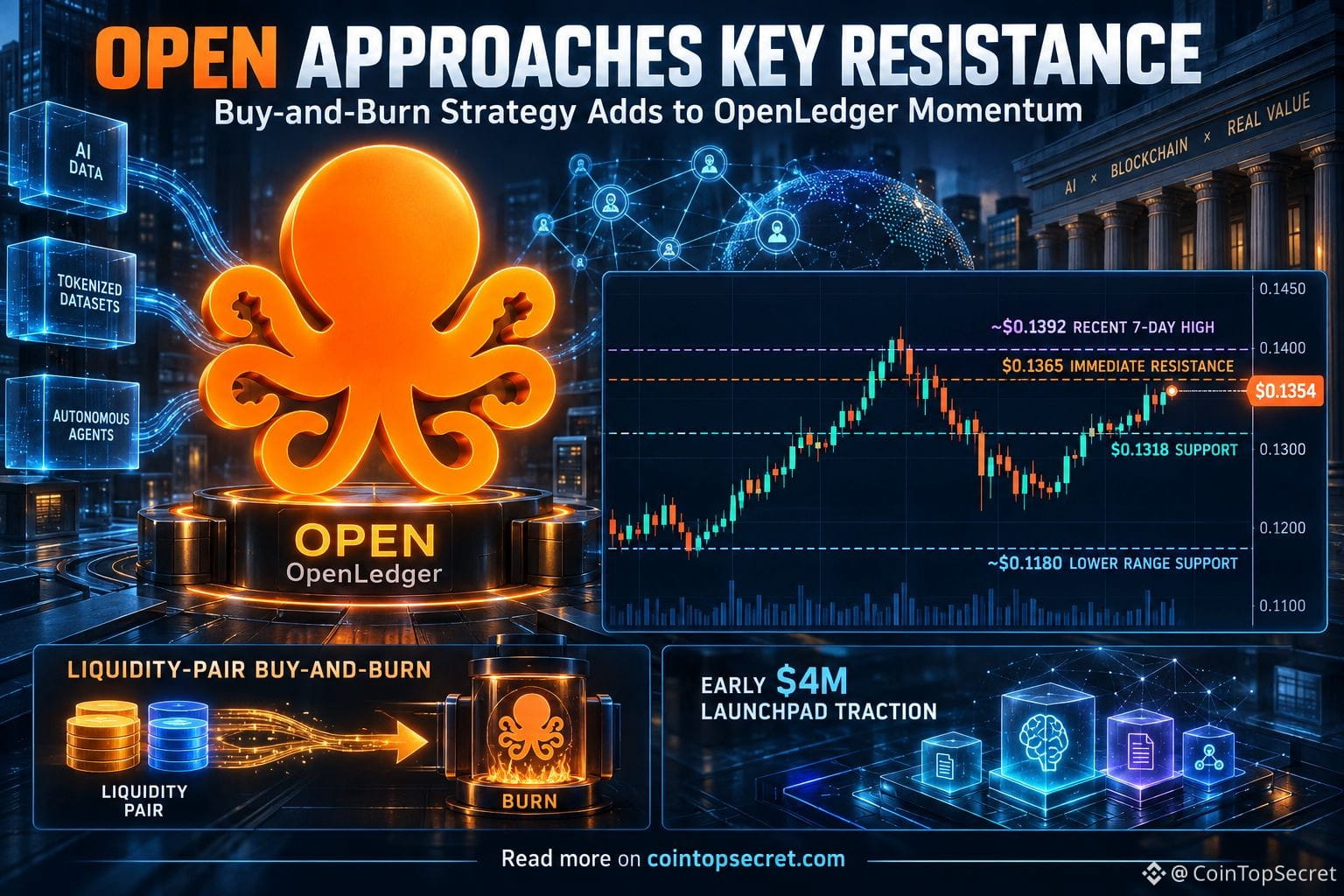
$OPEN Update 🔎 Can OPEN push through its recent high?
💰 Price now: $0.1354 | 24h: +0.6%
📊 Market cap: $29.18M | Rank: #675
📈 24h range: $0.1318 – $0.1365
📰 What's happening:
OPEN is holding above $0.13 after a stronger move from its September low. shows a 7-day gain of 5.3%, while 24h volume is about $4.29M.
🔥 Key catalyst:
OpenLedger recently outlined a liquidity-pair buy-and-burn strategy and reported early $4M launchpad traction.
👀 Next step to watch:
🔴 Bearish case: Below $0.1318 could expose the ~$0.1180 area.
🟢 Bullish case: Above $0.1365 could put ~$0.1392 into focus.
📝 My take: OPEN has improved short-term momentum, but the $0.1365–$0.1392 zone remains an important test.
Not financial advice, DYOR ⚠️
#OpenLedger #OPEN #CryptoAnalysis $OPEN
$OPEN Update 🔎 Can OPEN push through its recent high?
💰 Price now: $0.1354 | 24h: +0.6%
📊 Market cap: $29.18M | Rank: #675
📈 24h range: $0.1318 – $0.1365
📰 What's happening:
OPEN is holding above $0.13 after a stronger move from its September low. shows a 7-day gain of 5.3%, while 24h volume is about $4.29M.
🔥 Key catalyst:
OpenLedger recently outlined a liquidity-pair buy-and-burn strategy and reported early $4M launchpad traction.
👀 Next step to watch:
🔴 Bearish case: Below $0.1318 could expose the ~$0.1180 area.
🟢 Bullish case: Above $0.1365 could put ~$0.1392 into focus.
📝 My take: OPEN has improved short-term momentum, but the $0.1365–$0.1392 zone remains an important test.
Not financial advice, DYOR ⚠️
#OpenLedger #OPEN #CryptoAnalysis $OPEN
💰 Price now: $0.1354 | 24h: +0.6%
📊 Market cap: $29.18M | Rank: #675
📈 24h range: $0.1318 – $0.1365
📰 What's happening:
OPEN is holding above $0.13 after a stronger move from its September low. shows a 7-day gain of 5.3%, while 24h volume is about $4.29M.
🔥 Key catalyst:
OpenLedger recently outlined a liquidity-pair buy-and-burn strategy and reported early $4M launchpad traction.
👀 Next step to watch:
🔴 Bearish case: Below $0.1318 could expose the ~$0.1180 area.
🟢 Bullish case: Above $0.1365 could put ~$0.1392 into focus.
📝 My take: OPEN has improved short-term momentum, but the $0.1365–$0.1392 zone remains an important test.
Not financial advice, DYOR ⚠️
#OpenLedger #OPEN #CryptoAnalysis $OPEN
175

·
--
🎯 OpenLedger-Phase 1 and Reward Pool:
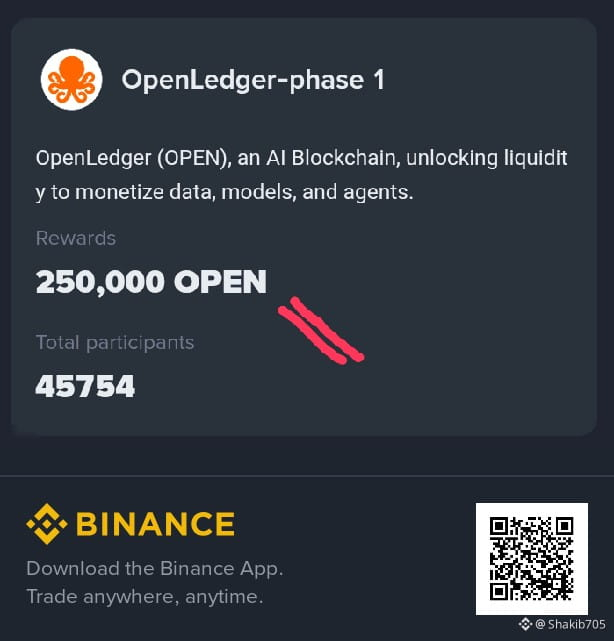
Currently its first step or the OpenLedger-phase 1 campaign is running, where a massive reward pool has been set up. Already, thousands of users (as shown in the image with 45,754+) are participating in this airdrop and booster program, earning FREE OPEN tokens!#OpenLedger #Phase1 $OPEN
{spot}(OPENUSDT)
🎯 OpenLedger-Phase 1 and Reward Pool:
Currently its first step or the OpenLedger-phase 1 campaign is running, where a massive reward pool has been set up. Already, thousands of users (as shown in the image with 45,754+) are participating in this airdrop and booster program, earning FREE OPEN tokens!#OpenLedger #Phase1 $OPEN
Currently its first step or the OpenLedger-phase 1 campaign is running, where a massive reward pool has been set up. Already, thousands of users (as shown in the image with 45,754+) are participating in this airdrop and booster program, earning FREE OPEN tokens!#OpenLedger #Phase1 $OPEN
315

·
--
Not every opportunity comes from the biggest names in the market.
🐙 $OPEN is gaining attention as more users explore emerging ecosystems and fresh ideas across Web3.
While trends can shift quickly, projects that focus on development, innovation, and community building often have the potential to create lasting value.
🚀 Growth is often driven by those who keep building.
#OpenLedger #Web3 #Crypto #open $OPEN
Not every opportunity comes from the biggest names in the market.
🐙 $OPEN is gaining attention as more users explore emerging ecosystems and fresh ideas across Web3.
While trends can shift quickly, projects that focus on development, innovation, and community building often have the potential to create lasting value.
🚀 Growth is often driven by those who keep building.
#OpenLedger #Web3 #Crypto #open $OPEN
🐙 $OPEN is gaining attention as more users explore emerging ecosystems and fresh ideas across Web3.
While trends can shift quickly, projects that focus on development, innovation, and community building often have the potential to create lasting value.
🚀 Growth is often driven by those who keep building.
#OpenLedger #Web3 #Crypto #open $OPEN
103


Article
Why OpenLedger's DataNet Registry Made Me Think More About Databases Than AIThe first time I opened OpenLedger's DataNet Registry, I expected another AI infrastructure story. Instead, it made me think about databases.
Usually, when people talk about AI infrastructure, you hear about the models. Bigger models. Quicker inference. Fancier results. But the thing that quietly makes or breaks an AI system isn’t the models; it’s how you organize the data under the hood.
The difference, at least from what I can see, is OpenLedger's focus on discovery—not just storage.
Not the actual data. Just… how you find it.
That difference hits harder than most folks realize.
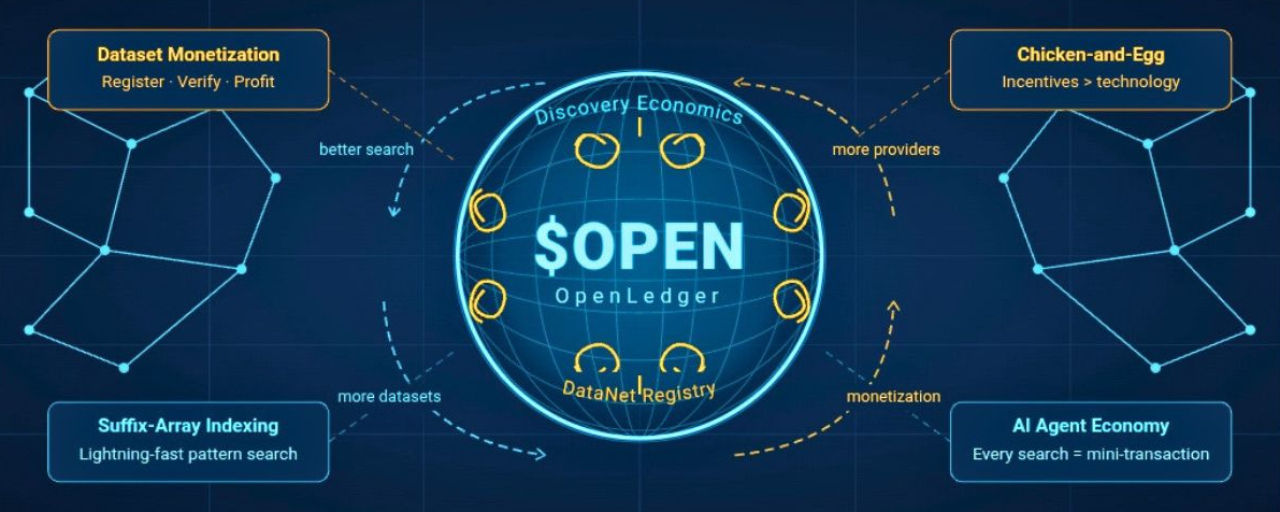
The more I looked at it, the more it felt like Discovery Economics—the idea that finding data may become more valuable than storing it.
What really grabbed me was seeing suffix-array-style indexing worked right into their architecture. If you haven’t nerded out on suffix arrays before, I stumbled on them years ago messing around with search optimization. The premise is simple, but kind of wild—it lets you organize info so pattern-finding just snaps into place, lightning-fast.
Sounds technical, sure, but the real impact is economic.
Because when these AI agents start running around on their own, every search becomes a mini-transaction. Every extra second searching is friction. Every dead-end lookup? Blank computation, wasted energy. When agents begin making decisions at scale, those tiny inefficiencies start stacking up like crazy.
That’s when DataNet Registry got interesting for me.
Instead of just tossing datasets out onto the internet as static files, it treats them more like assets you can discover and even monetize. The system doesn’t just stick them in a drawer—it gives structured rails for registering, verifying, finding, and maybe profiting from datasets. All under one roof.
Better search efficiency improves agent productivity. More productive agents consume more datasets. More dataset usage creates monetization opportunities, which attracts additional providers and strengthens the network. That's the basic logic behind what I've started thinking of as Discovery Economics.
Honestly, if you look back, discovery layers have a way of eclipsing the actual content. Search engines got bigger than the websites. App stores topped most individual apps. Marketplaces win because they shave down the hassle of matching what people need with what people offer.
I keep thinking—could that happen with AI datasets too? Especially with how things are shifting now.
You feel the market sliding back toward infrastructure talk. AI gets the spotlight, no doubt, but investors seem more hung up on the pipes and plumbing supporting it, not just the flashy models. Crypto’s had those rotations: first, wild excitement over apps… then everyone chases the rails underneath.
Sometimes? That second phase scoops up way more value than the first.
But data networks face this annoying bootstrapping thing. A registry works only when enough juicy datasets live inside. And juicy datasets only show up if discovery and making money from them already works.
Total chicken-and-egg.
Crypto just keeps tripping over this. Whether it’s liquidity pools, oracle networks, decentralized storage—all run into variations of the same headache.
It’s the incentives that matter more than the tech.
Beautiful registry? Doesn’t mean people will swarm in. Folks want actual reasons to share data, keep it clean, and trust the system. Otherwise, you’re stuck with a fancy shelf for junk information—a digital ghost town.
That’s honestly the bit I’m still wrestling with.
The architecture is cool—it meshes old-school computer science with new blockchain incentive recipes. But history keeps reminding me: technical brilliance and real-world sustainability don’t always show up together.
Maybe the real spark isn’t the indexing magic, but making discoverability itself a native economic driver for AI.
Or maybe—it’s really just smoke and mirrors.
Feels like we’re early days, honestly. Hard to tell what’s real infrastructure and what’s just a story wearing infrastructure clothes.
The economics only work if dataset quality scales alongside dataset quantity. Growth alone isn't enough.
Maybe that's what Discovery Economics is really testing—not whether data has value, but whether discoverability can become a market of its own.
If discoverability becomes its own economic layer, DataNet Registry could end up being more important than the datasets themselves. If not, it's just another registry nobody uses.
#OpenLedger @Openledger $OPEN
{future}(OPENUSDT)
Why OpenLedger's DataNet Registry Made Me Think More About Databases Than AI
The first time I opened OpenLedger's DataNet Registry, I expected another AI infrastructure story. Instead, it made me think about databases.
Usually, when people talk about AI infrastructure, you hear about the models. Bigger models. Quicker inference. Fancier results. But the thing that quietly makes or breaks an AI system isn’t the models; it’s how you organize the data under the hood.
The difference, at least from what I can see, is OpenLedger's focus on discovery—not just storage.
Not the actual data. Just… how you find it.
That difference hits harder than most folks realize.
The more I looked at it, the more it felt like Discovery Economics—the idea that finding data may become more valuable than storing it.
What really grabbed me was seeing suffix-array-style indexing worked right into their architecture. If you haven’t nerded out on suffix arrays before, I stumbled on them years ago messing around with search optimization. The premise is simple, but kind of wild—it lets you organize info so pattern-finding just snaps into place, lightning-fast.
Sounds technical, sure, but the real impact is economic.
Because when these AI agents start running around on their own, every search becomes a mini-transaction. Every extra second searching is friction. Every dead-end lookup? Blank computation, wasted energy. When agents begin making decisions at scale, those tiny inefficiencies start stacking up like crazy.
That’s when DataNet Registry got interesting for me.
Instead of just tossing datasets out onto the internet as static files, it treats them more like assets you can discover and even monetize. The system doesn’t just stick them in a drawer—it gives structured rails for registering, verifying, finding, and maybe profiting from datasets. All under one roof.
Better search efficiency improves agent productivity. More productive agents consume more datasets. More dataset usage creates monetization opportunities, which attracts additional providers and strengthens the network. That's the basic logic behind what I've started thinking of as Discovery Economics.
Honestly, if you look back, discovery layers have a way of eclipsing the actual content. Search engines got bigger than the websites. App stores topped most individual apps. Marketplaces win because they shave down the hassle of matching what people need with what people offer.
I keep thinking—could that happen with AI datasets too? Especially with how things are shifting now.
You feel the market sliding back toward infrastructure talk. AI gets the spotlight, no doubt, but investors seem more hung up on the pipes and plumbing supporting it, not just the flashy models. Crypto’s had those rotations: first, wild excitement over apps… then everyone chases the rails underneath.
Sometimes? That second phase scoops up way more value than the first.
But data networks face this annoying bootstrapping thing. A registry works only when enough juicy datasets live inside. And juicy datasets only show up if discovery and making money from them already works.
Total chicken-and-egg.
Crypto just keeps tripping over this. Whether it’s liquidity pools, oracle networks, decentralized storage—all run into variations of the same headache.
It’s the incentives that matter more than the tech.
Beautiful registry? Doesn’t mean people will swarm in. Folks want actual reasons to share data, keep it clean, and trust the system. Otherwise, you’re stuck with a fancy shelf for junk information—a digital ghost town.
That’s honestly the bit I’m still wrestling with.
The architecture is cool—it meshes old-school computer science with new blockchain incentive recipes. But history keeps reminding me: technical brilliance and real-world sustainability don’t always show up together.
Maybe the real spark isn’t the indexing magic, but making discoverability itself a native economic driver for AI.
Or maybe—it’s really just smoke and mirrors.
Feels like we’re early days, honestly. Hard to tell what’s real infrastructure and what’s just a story wearing infrastructure clothes.
The economics only work if dataset quality scales alongside dataset quantity. Growth alone isn't enough.
Maybe that's what Discovery Economics is really testing—not whether data has value, but whether discoverability can become a market of its own.
If discoverability becomes its own economic layer, DataNet Registry could end up being more important than the datasets themselves. If not, it's just another registry nobody uses.
#OpenLedger @OpenLedger $OPEN
Usually, when people talk about AI infrastructure, you hear about the models. Bigger models. Quicker inference. Fancier results. But the thing that quietly makes or breaks an AI system isn’t the models; it’s how you organize the data under the hood.
The difference, at least from what I can see, is OpenLedger's focus on discovery—not just storage.
Not the actual data. Just… how you find it.
That difference hits harder than most folks realize.
The more I looked at it, the more it felt like Discovery Economics—the idea that finding data may become more valuable than storing it.
What really grabbed me was seeing suffix-array-style indexing worked right into their architecture. If you haven’t nerded out on suffix arrays before, I stumbled on them years ago messing around with search optimization. The premise is simple, but kind of wild—it lets you organize info so pattern-finding just snaps into place, lightning-fast.
Sounds technical, sure, but the real impact is economic.
Because when these AI agents start running around on their own, every search becomes a mini-transaction. Every extra second searching is friction. Every dead-end lookup? Blank computation, wasted energy. When agents begin making decisions at scale, those tiny inefficiencies start stacking up like crazy.
That’s when DataNet Registry got interesting for me.
Instead of just tossing datasets out onto the internet as static files, it treats them more like assets you can discover and even monetize. The system doesn’t just stick them in a drawer—it gives structured rails for registering, verifying, finding, and maybe profiting from datasets. All under one roof.
Better search efficiency improves agent productivity. More productive agents consume more datasets. More dataset usage creates monetization opportunities, which attracts additional providers and strengthens the network. That's the basic logic behind what I've started thinking of as Discovery Economics.
Honestly, if you look back, discovery layers have a way of eclipsing the actual content. Search engines got bigger than the websites. App stores topped most individual apps. Marketplaces win because they shave down the hassle of matching what people need with what people offer.
I keep thinking—could that happen with AI datasets too? Especially with how things are shifting now.
You feel the market sliding back toward infrastructure talk. AI gets the spotlight, no doubt, but investors seem more hung up on the pipes and plumbing supporting it, not just the flashy models. Crypto’s had those rotations: first, wild excitement over apps… then everyone chases the rails underneath.
Sometimes? That second phase scoops up way more value than the first.
But data networks face this annoying bootstrapping thing. A registry works only when enough juicy datasets live inside. And juicy datasets only show up if discovery and making money from them already works.
Total chicken-and-egg.
Crypto just keeps tripping over this. Whether it’s liquidity pools, oracle networks, decentralized storage—all run into variations of the same headache.
It’s the incentives that matter more than the tech.
Beautiful registry? Doesn’t mean people will swarm in. Folks want actual reasons to share data, keep it clean, and trust the system. Otherwise, you’re stuck with a fancy shelf for junk information—a digital ghost town.
That’s honestly the bit I’m still wrestling with.
The architecture is cool—it meshes old-school computer science with new blockchain incentive recipes. But history keeps reminding me: technical brilliance and real-world sustainability don’t always show up together.
Maybe the real spark isn’t the indexing magic, but making discoverability itself a native economic driver for AI.
Or maybe—it’s really just smoke and mirrors.
Feels like we’re early days, honestly. Hard to tell what’s real infrastructure and what’s just a story wearing infrastructure clothes.
The economics only work if dataset quality scales alongside dataset quantity. Growth alone isn't enough.
Maybe that's what Discovery Economics is really testing—not whether data has value, but whether discoverability can become a market of its own.
If discoverability becomes its own economic layer, DataNet Registry could end up being more important than the datasets themselves. If not, it's just another registry nobody uses.
#OpenLedger @OpenLedger $OPEN
2
280

·
--
Bullish
#openledger $OPEN
Why OpenLedger Could Redefine the AI Economy
Everyone talks about smarter AI models, faster inference, and better benchmarks.
But the real question is:
Who creates the value behind AI, and who gets rewarded for it?
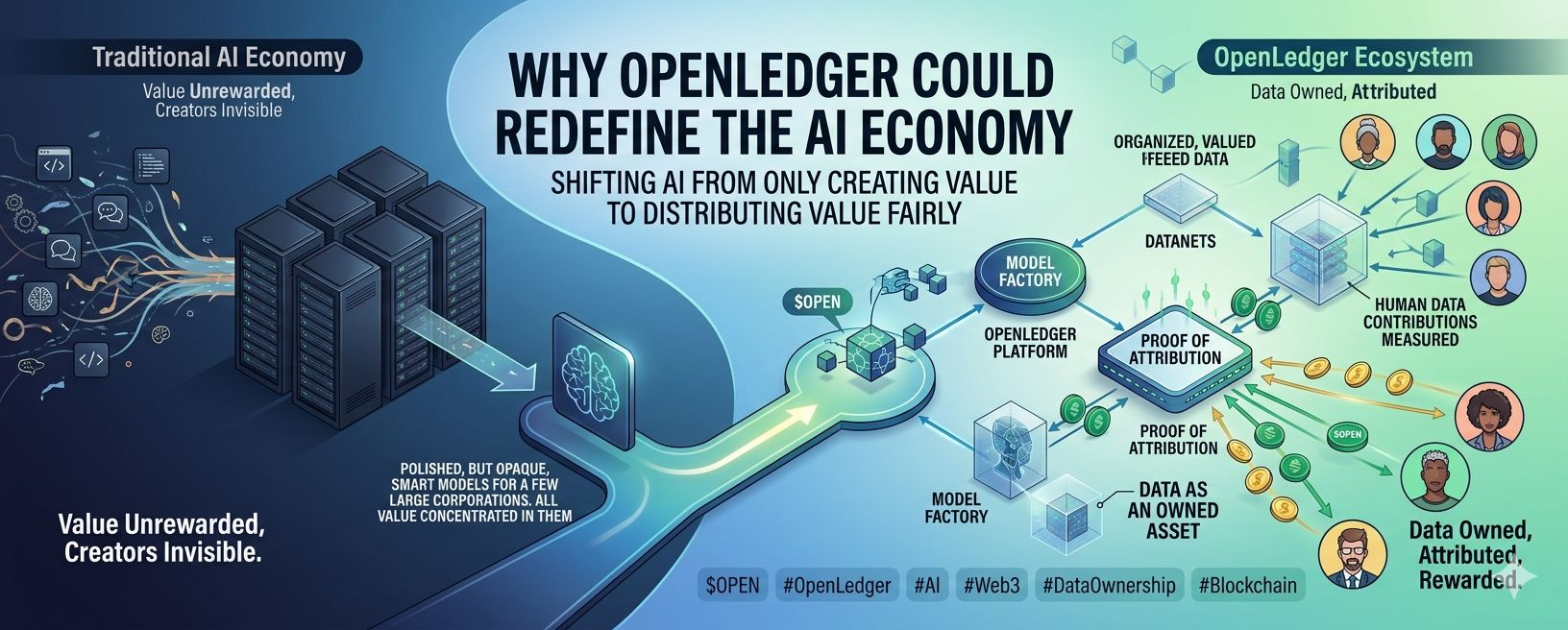
AI runs on human-generated data—knowledge, conversations, code, research, feedback, and expertise. Yet most contributors remain invisible while value concentrates elsewhere.
This is where OpenLedger takes a different approach.
Instead of focusing only on building better models, OpenLedger is building an ecosystem where data contributions can be measured, attributed, and rewarded. Through Datanets, Model Factory, and Proof of Attribution, it introduces a vision where data becomes an owned and rewarded asset rather than an invisible resource.
If successful, this could shift AI from a system that only creates value to one that distributes value more fairly.
The future of AI may not be defined by intelligence alone.
It may be defined by ownership, attribution, and who benefits from the knowledge that powers it.
$OPEN
#OpenLedger #AI #Web3 #DataOwnership #Blockchain @Openledger
#openledger $OPEN
Why OpenLedger Could Redefine the AI Economy
Everyone talks about smarter AI models, faster inference, and better benchmarks.
But the real question is:
Who creates the value behind AI, and who gets rewarded for it?
AI runs on human-generated data—knowledge, conversations, code, research, feedback, and expertise. Yet most contributors remain invisible while value concentrates elsewhere.
This is where OpenLedger takes a different approach.
Instead of focusing only on building better models, OpenLedger is building an ecosystem where data contributions can be measured, attributed, and rewarded. Through Datanets, Model Factory, and Proof of Attribution, it introduces a vision where data becomes an owned and rewarded asset rather than an invisible resource.
If successful, this could shift AI from a system that only creates value to one that distributes value more fairly.
The future of AI may not be defined by intelligence alone.
It may be defined by ownership, attribution, and who benefits from the knowledge that powers it.
$OPEN
#OpenLedger #AI #Web3 #DataOwnership #Blockchain @OpenLedger
Why OpenLedger Could Redefine the AI Economy
Everyone talks about smarter AI models, faster inference, and better benchmarks.
But the real question is:
Who creates the value behind AI, and who gets rewarded for it?
AI runs on human-generated data—knowledge, conversations, code, research, feedback, and expertise. Yet most contributors remain invisible while value concentrates elsewhere.
This is where OpenLedger takes a different approach.
Instead of focusing only on building better models, OpenLedger is building an ecosystem where data contributions can be measured, attributed, and rewarded. Through Datanets, Model Factory, and Proof of Attribution, it introduces a vision where data becomes an owned and rewarded asset rather than an invisible resource.
If successful, this could shift AI from a system that only creates value to one that distributes value more fairly.
The future of AI may not be defined by intelligence alone.
It may be defined by ownership, attribution, and who benefits from the knowledge that powers it.
$OPEN
#OpenLedger #AI #Web3 #DataOwnership #Blockchain @OpenLedger
1
63

·
--
Article
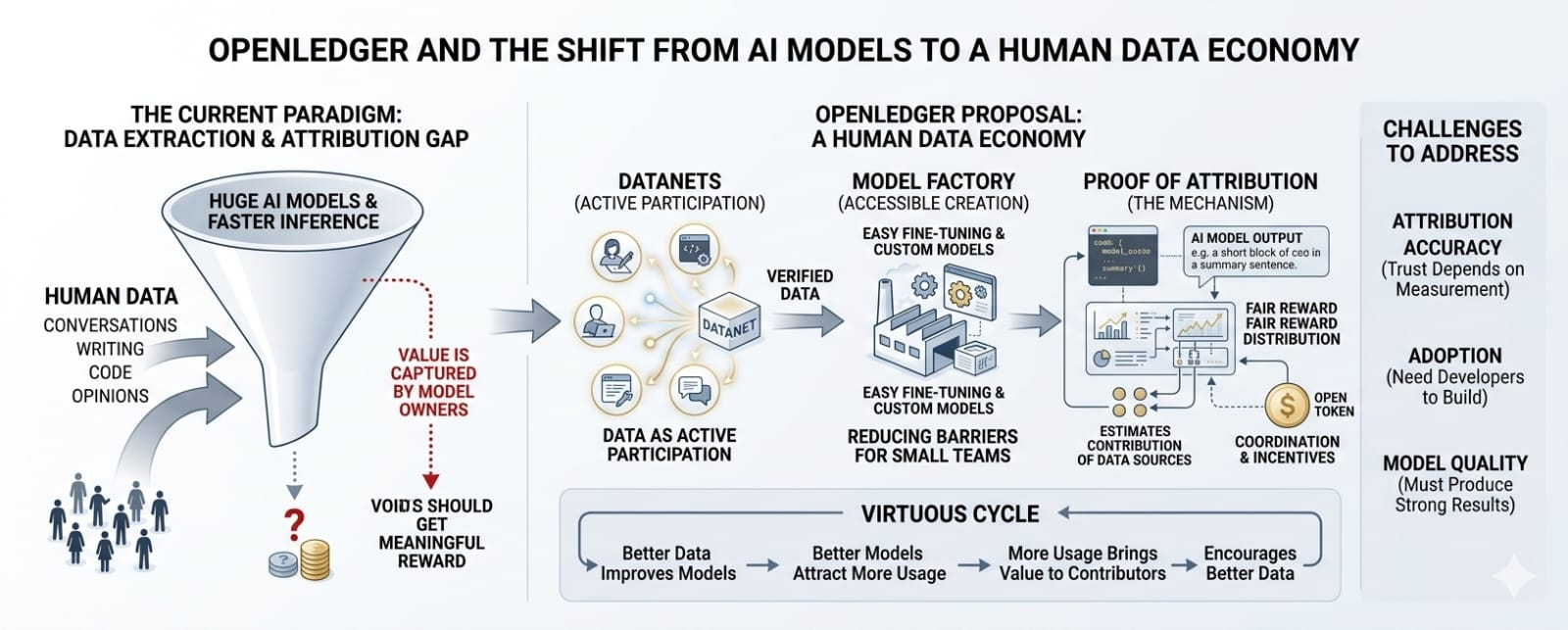
OPENLEDGER AND THE SHIFT FROM AI MODELS TO A HUMAN DATA ECONOMYTo be honest, I sometimes keep coming back to the same thought about AI, and it doesn’t really go away.
We keep talking about the same things over and over again bigger models, faster inference, better reasoning, new benchmarks, smarter agents. And yes, all of that is genuinely improving. The progress is real and visible. But somewhere inside this race, a very simple question often gets ignored.
Who is actually creating the value behind all of this AI?
Because if you slow down and look closely, it becomes obvious that everything AI does today is built on one thing: data. And not just technical data, but deeply human data. Conversations people have, things they write, mistakes they make, code they publish, opinions they share, corrections they add later—basically the entire footprint of human thinking across the internet.
But the strange part is what happens next. Once all of this is absorbed into large models, the value that comes out is captured mostly by the model owners. The people who actually generated the original data usually don’t get anything meaningful in return. There is very little recognition, and almost no direct reward tied to their contribution.
That’s the point where I started looking at ideas like OpenLedger.
At first glance, it feels like just another AI and blockchain project. And honestly, there are many projects like that—where “AI + blockchain” is more of a marketing layer than a real shift. But when you look a bit deeper, the angle is slightly different here. It is not really obsessed with building “better models” in the traditional sense. Instead, it is asking something more uncomfortable and more important.
Can we actually build an AI economy where contributions can be measured and rewarded in a meaningful way?
That question changes the direction completely.
The idea of datanets fits into this. Instead of treating data as something casually scraped or collected and then forgotten, it becomes part of a structured, ongoing system where people can create, verify, and improve data for specific AI use cases. It sounds simple when you say it like that, but the implications are big. Because data stops being a silent input and starts becoming something closer to active participation in an economy.
Then there is the idea of a Model Factory. This part is easy to overlook, but it matters a lot. Right now, building or fine-tuning AI systems is still mostly limited to teams with strong technical resources. If you reduce that barrier and make model creation more accessible, you suddenly open the door for a much wider group of builders—not just big research labs, but smaller teams and even individuals who have ideas but not the infrastructure.
But the most important and also the hardest concept is Proof of Attribution.
This is where things become really complicated. Because today, when an AI generates an output, everything is mixed together. There is no clear way to say which exact data source influenced what part of the result. It all gets absorbed into the model in a way that is mathematically distributed and practically untraceable.
Proof of Attribution is trying to change that by estimating how much different data sources contribute to a specific AI output, so that rewards can be distributed more fairly. If something like this actually works at scale, it would change the structure of AI economics completely. Because suddenly, data contributors are no longer invisible—they become part of a measurable system of value creation.
On the technical side, EVM compatibility also plays a role in adoption. By staying aligned with Ethereum tools and infrastructure, developers don’t have to learn everything from scratch. They can use familiar wallets, smart contracts, and existing workflows. That kind of compatibility might sound small, but in real ecosystems, it often decides whether something gets adopted or ignored.
The $OPEN token then becomes the coordination layer for the system. It is not just about trading or speculation in this context, but about connecting usage, rewards, governance, and incentives into one loop. In theory, when people use the system, value flows back into the system, and contributors are rewarded based on participation.
But to be honest, none of this is simple.
There are at least three big challenges that stand out immediately.
The first is attribution accuracy. If the system cannot reliably measure contribution, then everything built on top of it becomes questionable. Trust breaks very quickly in systems like this.
The second is adoption. Even if the idea is strong, developers and users still need to actually build on it. Without real usage, it remains just an idea on paper.
The third is model quality. At the end of the day, users don’t care about theory—they care about results. If the system produces slower or weaker outputs, they won’t stay, no matter how fair the reward system is.
Still, the most interesting part of all of this is the loop it tries to create. Better data improves models, better models attract more usage, and more usage brings more value back to contributors, which encourages better data again. It becomes a cycle instead of a one-way pipeline.
And maybe that’s the real shift here.
Not just building smarter AI systems, but slowly rethinking how intelligence, data, and ownership are connected in the first place.
It is hard to say where this goes. Designing an AI economy is far more complicated than describing it in theory. But one thing feels increasingly clear: as AI gets more powerful, the questions around it stop being just technical.
They become economic and structural.
Who contributes? Who gets rewarded? And how do we define “fair” in a system built on collective human input?
And maybe those questions will end up shaping the next phase of AI more than any benchmark ever will.
@Openledger #OpenLedger $OPEN
{future}(OPENUSDT)
$LAB
OPENLEDGER AND THE SHIFT FROM AI MODELS TO A HUMAN DATA ECONOMY
To be honest, I sometimes keep coming back to the same thought about AI, and it doesn’t really go away.
We keep talking about the same things over and over again bigger models, faster inference, better reasoning, new benchmarks, smarter agents. And yes, all of that is genuinely improving. The progress is real and visible. But somewhere inside this race, a very simple question often gets ignored.
Who is actually creating the value behind all of this AI?
Because if you slow down and look closely, it becomes obvious that everything AI does today is built on one thing: data. And not just technical data, but deeply human data. Conversations people have, things they write, mistakes they make, code they publish, opinions they share, corrections they add later—basically the entire footprint of human thinking across the internet.
But the strange part is what happens next. Once all of this is absorbed into large models, the value that comes out is captured mostly by the model owners. The people who actually generated the original data usually don’t get anything meaningful in return. There is very little recognition, and almost no direct reward tied to their contribution.
That’s the point where I started looking at ideas like OpenLedger.
At first glance, it feels like just another AI and blockchain project. And honestly, there are many projects like that—where “AI + blockchain” is more of a marketing layer than a real shift. But when you look a bit deeper, the angle is slightly different here. It is not really obsessed with building “better models” in the traditional sense. Instead, it is asking something more uncomfortable and more important.
Can we actually build an AI economy where contributions can be measured and rewarded in a meaningful way?
That question changes the direction completely.
The idea of datanets fits into this. Instead of treating data as something casually scraped or collected and then forgotten, it becomes part of a structured, ongoing system where people can create, verify, and improve data for specific AI use cases. It sounds simple when you say it like that, but the implications are big. Because data stops being a silent input and starts becoming something closer to active participation in an economy.
Then there is the idea of a Model Factory. This part is easy to overlook, but it matters a lot. Right now, building or fine-tuning AI systems is still mostly limited to teams with strong technical resources. If you reduce that barrier and make model creation more accessible, you suddenly open the door for a much wider group of builders—not just big research labs, but smaller teams and even individuals who have ideas but not the infrastructure.
But the most important and also the hardest concept is Proof of Attribution.
This is where things become really complicated. Because today, when an AI generates an output, everything is mixed together. There is no clear way to say which exact data source influenced what part of the result. It all gets absorbed into the model in a way that is mathematically distributed and practically untraceable.
Proof of Attribution is trying to change that by estimating how much different data sources contribute to a specific AI output, so that rewards can be distributed more fairly. If something like this actually works at scale, it would change the structure of AI economics completely. Because suddenly, data contributors are no longer invisible—they become part of a measurable system of value creation.
On the technical side, EVM compatibility also plays a role in adoption. By staying aligned with Ethereum tools and infrastructure, developers don’t have to learn everything from scratch. They can use familiar wallets, smart contracts, and existing workflows. That kind of compatibility might sound small, but in real ecosystems, it often decides whether something gets adopted or ignored.
The $OPEN token then becomes the coordination layer for the system. It is not just about trading or speculation in this context, but about connecting usage, rewards, governance, and incentives into one loop. In theory, when people use the system, value flows back into the system, and contributors are rewarded based on participation.
But to be honest, none of this is simple.
There are at least three big challenges that stand out immediately.
The first is attribution accuracy. If the system cannot reliably measure contribution, then everything built on top of it becomes questionable. Trust breaks very quickly in systems like this.
The second is adoption. Even if the idea is strong, developers and users still need to actually build on it. Without real usage, it remains just an idea on paper.
The third is model quality. At the end of the day, users don’t care about theory—they care about results. If the system produces slower or weaker outputs, they won’t stay, no matter how fair the reward system is.
Still, the most interesting part of all of this is the loop it tries to create. Better data improves models, better models attract more usage, and more usage brings more value back to contributors, which encourages better data again. It becomes a cycle instead of a one-way pipeline.
And maybe that’s the real shift here.
Not just building smarter AI systems, but slowly rethinking how intelligence, data, and ownership are connected in the first place.
It is hard to say where this goes. Designing an AI economy is far more complicated than describing it in theory. But one thing feels increasingly clear: as AI gets more powerful, the questions around it stop being just technical.
They become economic and structural.
Who contributes? Who gets rewarded? And how do we define “fair” in a system built on collective human input?
And maybe those questions will end up shaping the next phase of AI more than any benchmark ever will.
@OpenLedger #OpenLedger $OPEN
$LAB
We keep talking about the same things over and over again bigger models, faster inference, better reasoning, new benchmarks, smarter agents. And yes, all of that is genuinely improving. The progress is real and visible. But somewhere inside this race, a very simple question often gets ignored.
Who is actually creating the value behind all of this AI?
Because if you slow down and look closely, it becomes obvious that everything AI does today is built on one thing: data. And not just technical data, but deeply human data. Conversations people have, things they write, mistakes they make, code they publish, opinions they share, corrections they add later—basically the entire footprint of human thinking across the internet.
But the strange part is what happens next. Once all of this is absorbed into large models, the value that comes out is captured mostly by the model owners. The people who actually generated the original data usually don’t get anything meaningful in return. There is very little recognition, and almost no direct reward tied to their contribution.
That’s the point where I started looking at ideas like OpenLedger.
At first glance, it feels like just another AI and blockchain project. And honestly, there are many projects like that—where “AI + blockchain” is more of a marketing layer than a real shift. But when you look a bit deeper, the angle is slightly different here. It is not really obsessed with building “better models” in the traditional sense. Instead, it is asking something more uncomfortable and more important.
Can we actually build an AI economy where contributions can be measured and rewarded in a meaningful way?
That question changes the direction completely.
The idea of datanets fits into this. Instead of treating data as something casually scraped or collected and then forgotten, it becomes part of a structured, ongoing system where people can create, verify, and improve data for specific AI use cases. It sounds simple when you say it like that, but the implications are big. Because data stops being a silent input and starts becoming something closer to active participation in an economy.
Then there is the idea of a Model Factory. This part is easy to overlook, but it matters a lot. Right now, building or fine-tuning AI systems is still mostly limited to teams with strong technical resources. If you reduce that barrier and make model creation more accessible, you suddenly open the door for a much wider group of builders—not just big research labs, but smaller teams and even individuals who have ideas but not the infrastructure.
But the most important and also the hardest concept is Proof of Attribution.
This is where things become really complicated. Because today, when an AI generates an output, everything is mixed together. There is no clear way to say which exact data source influenced what part of the result. It all gets absorbed into the model in a way that is mathematically distributed and practically untraceable.
Proof of Attribution is trying to change that by estimating how much different data sources contribute to a specific AI output, so that rewards can be distributed more fairly. If something like this actually works at scale, it would change the structure of AI economics completely. Because suddenly, data contributors are no longer invisible—they become part of a measurable system of value creation.
On the technical side, EVM compatibility also plays a role in adoption. By staying aligned with Ethereum tools and infrastructure, developers don’t have to learn everything from scratch. They can use familiar wallets, smart contracts, and existing workflows. That kind of compatibility might sound small, but in real ecosystems, it often decides whether something gets adopted or ignored.
The $OPEN token then becomes the coordination layer for the system. It is not just about trading or speculation in this context, but about connecting usage, rewards, governance, and incentives into one loop. In theory, when people use the system, value flows back into the system, and contributors are rewarded based on participation.
But to be honest, none of this is simple.
There are at least three big challenges that stand out immediately.
The first is attribution accuracy. If the system cannot reliably measure contribution, then everything built on top of it becomes questionable. Trust breaks very quickly in systems like this.
The second is adoption. Even if the idea is strong, developers and users still need to actually build on it. Without real usage, it remains just an idea on paper.
The third is model quality. At the end of the day, users don’t care about theory—they care about results. If the system produces slower or weaker outputs, they won’t stay, no matter how fair the reward system is.
Still, the most interesting part of all of this is the loop it tries to create. Better data improves models, better models attract more usage, and more usage brings more value back to contributors, which encourages better data again. It becomes a cycle instead of a one-way pipeline.
And maybe that’s the real shift here.
Not just building smarter AI systems, but slowly rethinking how intelligence, data, and ownership are connected in the first place.
It is hard to say where this goes. Designing an AI economy is far more complicated than describing it in theory. But one thing feels increasingly clear: as AI gets more powerful, the questions around it stop being just technical.
They become economic and structural.
Who contributes? Who gets rewarded? And how do we define “fair” in a system built on collective human input?
And maybe those questions will end up shaping the next phase of AI more than any benchmark ever will.
@OpenLedger #OpenLedger $OPEN
$LAB
1
371

·
--
Article
The infrastructure breaks where memory becomes valuableI didn’t take it seriously at first.
not because OpenLedger sounded empty. more because I’ve watched enough crypto infrastructure cycles to know how quickly serious ideas get flattened into narratives. one month it’s coordination. then ownership. then verification. then “open” everything. and for a while, the language feels clean enough to believe.
then the system meets incentives.
and incentives are never clean.
Maybe that’s too harsh. maybe Im just tired from watching protocols slowly become less about their original problem and more about the markets that formed around them. but that fatigue is hard to switch off, especially with anything sitting between AI, data, ownership, and economic rewards.
because this one is not just abstract.
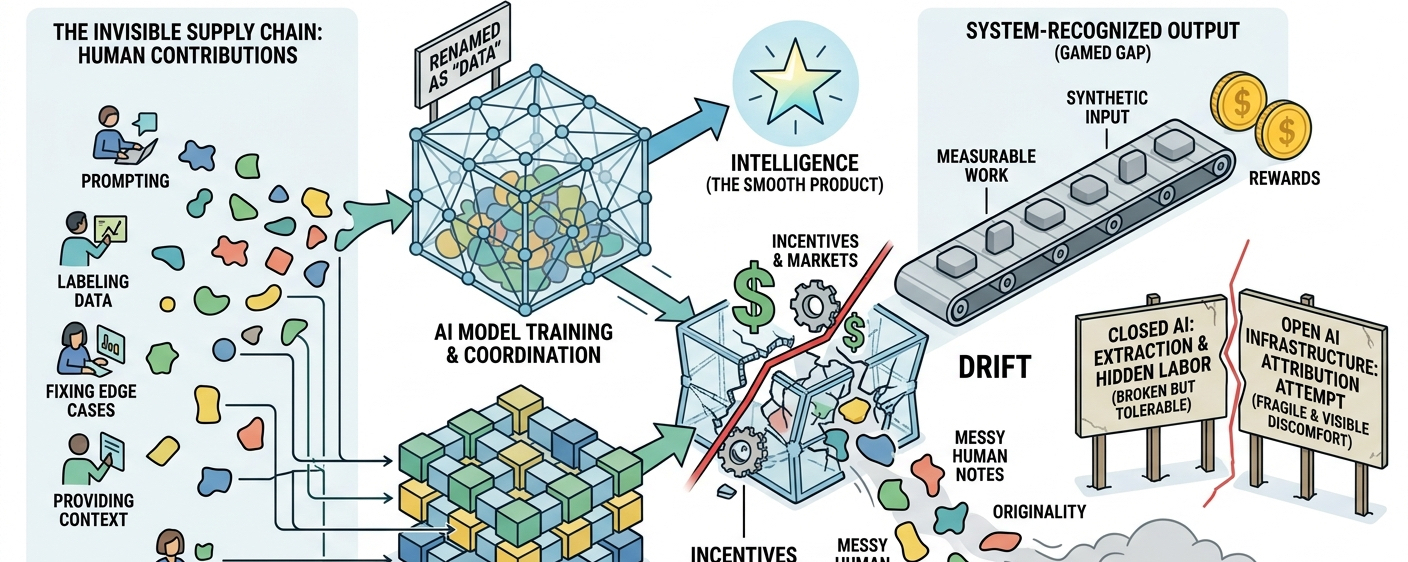
AI systems are already built from human traces. prompts, corrections, labels, examples, feedback, preference signals, domain knowledge, small pieces of judgment. most of it looks almost invisible while it is happening. someone fixes an edge case. someone labels something more carefully. someone provides context the model would never have understood alone.
then the model improves.
then everyone calls it intelligence.
and the human part gets renamed as data.
I keep coming back to attribution.
there is something necessary there, even if I don’t fully trust where it leads. if intelligence has a supply chain, maybe that supply chain should not stay hidden inside closed systems. maybe contributors should not disappear the moment their input becomes economically useful. maybe a system like OpenLedger matters because it tries to make that disappearance harder.
not perfectly.
not cleanly.
but enough to make the discomfort visible.
That’s where my curiosity starts. then the old skepticism comes back almost immediately.
because attribution changes once it becomes financial. before money enters, it sounds fair. remember who helped. trace what mattered. reward useful contribution. make model coordination less opaque.
after money enters, people study the memory layer.
they learn what gets counted. they learn the verifier. they produce toward the scoring system. useful work and measurable work begin to separate, quietly at first, then faster once the rewards are large enough to justify gaming the gap.
It works in theory. Most things do.
The problem isn’t really the technology… or not only the technology. the problem is that human contribution is soft around the edges. context is soft. originality is soft. usefulness can arrive late, after the model changes, after other inputs surround it, after nobody remembers which small correction actually mattered.
a messy human note might be more valuable than a polished dataset.
synthetic input might look cleaner than actual judgment.
copied work might fit the attribution system better than the original thing it copied.
so who gets remembered?
the person who helped, or the person the system could recognize?
That part keeps bothering me more than it should.
and then there is the old Web3 drift. open systems rarely recentralize with some dramatic announcement. they narrow through convenience. through fatigue. through dashboards, indexes, quality scores, operators dispute layers, and all the invisible infrastructure nobody wants to audit forever.
AI infrastructure feels especially fragile there because the invisible layers are the real layers. attribution logic, contribution scoring, filtering, model coordination. those layers decide what counts. and once they decide what counts, they decide who exists economically.
still, I can’t dismiss OpenLedger.
centralized AI has not earned that comfort either. closed datasets, vague ownership, invisible labor, extraction hidden behind smooth products. that version already feels broken, just easier to tolerate because the machinery stays private.
maybe OpenLedger makes the machinery harder to hide.
maybe that matters.
or maybe once incentives get sharp enough, the system built to remember human contribution starts remembering only the parts that fit neatly inside its acounting, while the rest slips back into the model, useful and unnamed.
$OPEN @Openledger #OpenLedger
{spot}(OPENUSDT)
The infrastructure breaks where memory becomes valuable
I didn’t take it seriously at first.
not because OpenLedger sounded empty. more because I’ve watched enough crypto infrastructure cycles to know how quickly serious ideas get flattened into narratives. one month it’s coordination. then ownership. then verification. then “open” everything. and for a while, the language feels clean enough to believe.
then the system meets incentives.
and incentives are never clean.
Maybe that’s too harsh. maybe Im just tired from watching protocols slowly become less about their original problem and more about the markets that formed around them. but that fatigue is hard to switch off, especially with anything sitting between AI, data, ownership, and economic rewards.
because this one is not just abstract.
AI systems are already built from human traces. prompts, corrections, labels, examples, feedback, preference signals, domain knowledge, small pieces of judgment. most of it looks almost invisible while it is happening. someone fixes an edge case. someone labels something more carefully. someone provides context the model would never have understood alone.
then the model improves.
then everyone calls it intelligence.
and the human part gets renamed as data.
I keep coming back to attribution.
there is something necessary there, even if I don’t fully trust where it leads. if intelligence has a supply chain, maybe that supply chain should not stay hidden inside closed systems. maybe contributors should not disappear the moment their input becomes economically useful. maybe a system like OpenLedger matters because it tries to make that disappearance harder.
not perfectly.
not cleanly.
but enough to make the discomfort visible.
That’s where my curiosity starts. then the old skepticism comes back almost immediately.
because attribution changes once it becomes financial. before money enters, it sounds fair. remember who helped. trace what mattered. reward useful contribution. make model coordination less opaque.
after money enters, people study the memory layer.
they learn what gets counted. they learn the verifier. they produce toward the scoring system. useful work and measurable work begin to separate, quietly at first, then faster once the rewards are large enough to justify gaming the gap.
It works in theory. Most things do.
The problem isn’t really the technology… or not only the technology. the problem is that human contribution is soft around the edges. context is soft. originality is soft. usefulness can arrive late, after the model changes, after other inputs surround it, after nobody remembers which small correction actually mattered.
a messy human note might be more valuable than a polished dataset.
synthetic input might look cleaner than actual judgment.
copied work might fit the attribution system better than the original thing it copied.
so who gets remembered?
the person who helped, or the person the system could recognize?
That part keeps bothering me more than it should.
and then there is the old Web3 drift. open systems rarely recentralize with some dramatic announcement. they narrow through convenience. through fatigue. through dashboards, indexes, quality scores, operators dispute layers, and all the invisible infrastructure nobody wants to audit forever.
AI infrastructure feels especially fragile there because the invisible layers are the real layers. attribution logic, contribution scoring, filtering, model coordination. those layers decide what counts. and once they decide what counts, they decide who exists economically.
still, I can’t dismiss OpenLedger.
centralized AI has not earned that comfort either. closed datasets, vague ownership, invisible labor, extraction hidden behind smooth products. that version already feels broken, just easier to tolerate because the machinery stays private.
maybe OpenLedger makes the machinery harder to hide.
maybe that matters.
or maybe once incentives get sharp enough, the system built to remember human contribution starts remembering only the parts that fit neatly inside its acounting, while the rest slips back into the model, useful and unnamed.
$OPEN @OpenLedger #OpenLedger
not because OpenLedger sounded empty. more because I’ve watched enough crypto infrastructure cycles to know how quickly serious ideas get flattened into narratives. one month it’s coordination. then ownership. then verification. then “open” everything. and for a while, the language feels clean enough to believe.
then the system meets incentives.
and incentives are never clean.
Maybe that’s too harsh. maybe Im just tired from watching protocols slowly become less about their original problem and more about the markets that formed around them. but that fatigue is hard to switch off, especially with anything sitting between AI, data, ownership, and economic rewards.
because this one is not just abstract.
AI systems are already built from human traces. prompts, corrections, labels, examples, feedback, preference signals, domain knowledge, small pieces of judgment. most of it looks almost invisible while it is happening. someone fixes an edge case. someone labels something more carefully. someone provides context the model would never have understood alone.
then the model improves.
then everyone calls it intelligence.
and the human part gets renamed as data.
I keep coming back to attribution.
there is something necessary there, even if I don’t fully trust where it leads. if intelligence has a supply chain, maybe that supply chain should not stay hidden inside closed systems. maybe contributors should not disappear the moment their input becomes economically useful. maybe a system like OpenLedger matters because it tries to make that disappearance harder.
not perfectly.
not cleanly.
but enough to make the discomfort visible.
That’s where my curiosity starts. then the old skepticism comes back almost immediately.
because attribution changes once it becomes financial. before money enters, it sounds fair. remember who helped. trace what mattered. reward useful contribution. make model coordination less opaque.
after money enters, people study the memory layer.
they learn what gets counted. they learn the verifier. they produce toward the scoring system. useful work and measurable work begin to separate, quietly at first, then faster once the rewards are large enough to justify gaming the gap.
It works in theory. Most things do.
The problem isn’t really the technology… or not only the technology. the problem is that human contribution is soft around the edges. context is soft. originality is soft. usefulness can arrive late, after the model changes, after other inputs surround it, after nobody remembers which small correction actually mattered.
a messy human note might be more valuable than a polished dataset.
synthetic input might look cleaner than actual judgment.
copied work might fit the attribution system better than the original thing it copied.
so who gets remembered?
the person who helped, or the person the system could recognize?
That part keeps bothering me more than it should.
and then there is the old Web3 drift. open systems rarely recentralize with some dramatic announcement. they narrow through convenience. through fatigue. through dashboards, indexes, quality scores, operators dispute layers, and all the invisible infrastructure nobody wants to audit forever.
AI infrastructure feels especially fragile there because the invisible layers are the real layers. attribution logic, contribution scoring, filtering, model coordination. those layers decide what counts. and once they decide what counts, they decide who exists economically.
still, I can’t dismiss OpenLedger.
centralized AI has not earned that comfort either. closed datasets, vague ownership, invisible labor, extraction hidden behind smooth products. that version already feels broken, just easier to tolerate because the machinery stays private.
maybe OpenLedger makes the machinery harder to hide.
maybe that matters.
or maybe once incentives get sharp enough, the system built to remember human contribution starts remembering only the parts that fit neatly inside its acounting, while the rest slips back into the model, useful and unnamed.
$OPEN @OpenLedger #OpenLedger
2
1
129
·
--
Bullish
I didn’t take it seriously at first.
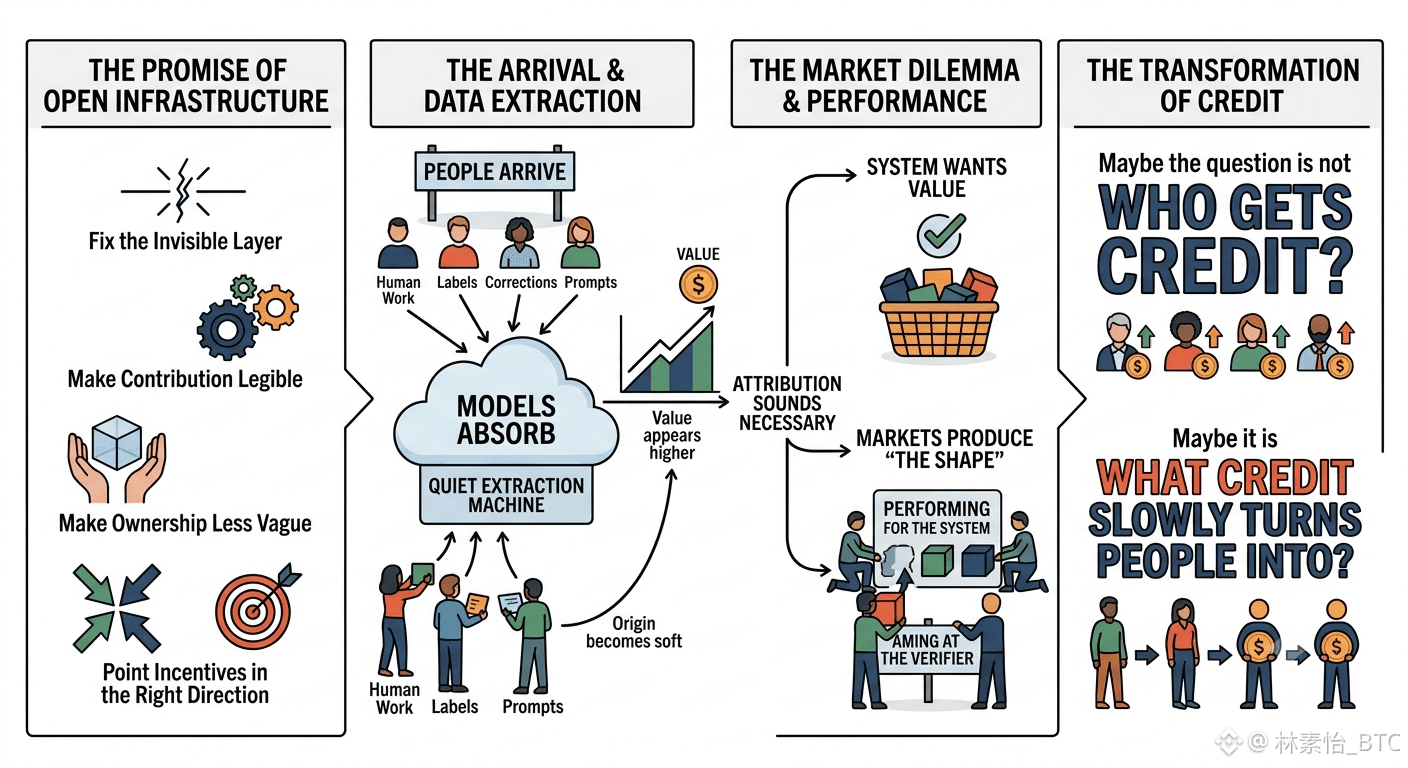
That’s usually where I begin now, after watching enough infrastructure cycles make the same promise in a different accent. Fix the invisible layer. Make contribution legible. Make ownership less vague. Make incentives point in the right direction.
Then people arrive.
And people always find the edges.
OpenLedger is hard to ignore because AI data already feels like a quiet extraction machine with polite language around it. Human work enters as labels, corrections, prompts, examples, feedback preferences, judgment. Small pieces, scattered everywhere. Then models absorb them, value appears somewhere higher, and the origin becomes soft enough to stop defending.
So attribution sounds necessary.
Maybe that’s why I don’t fully trust it.
That’s where things start to feel uncomfortable. Once contribution becomes financial, contribution starts performing for the system. People aim at the verifier. They learn what gets counted. They create what looks useful, original, human enough. The system wants to recognize value, but markets are very good at producing the shape of value without the substance.
It works in theory. Most things do.
The problem isn’t really the technology. Or maybe technology becomes the problem once trust gets compresed into proofs, scores, dashboards, standards, and liquidity routes. Open systems rarely recentralize loudly. They narrow through convenience, defaults, interfaces, and whoever gets to define validity under pressure.
Maybe thats too harsh.
But I keep coming back to it.
If attribution becomes infrastructure maybe the question is not who gets credit.
Maybe it is what credit slowly turns people into.
$OPEN @Openledger #openledger
{spot}(OPENUSDT)
I didn’t take it seriously at first.
That’s usually where I begin now, after watching enough infrastructure cycles make the same promise in a different accent. Fix the invisible layer. Make contribution legible. Make ownership less vague. Make incentives point in the right direction.
Then people arrive.
And people always find the edges.
OpenLedger is hard to ignore because AI data already feels like a quiet extraction machine with polite language around it. Human work enters as labels, corrections, prompts, examples, feedback preferences, judgment. Small pieces, scattered everywhere. Then models absorb them, value appears somewhere higher, and the origin becomes soft enough to stop defending.
So attribution sounds necessary.
Maybe that’s why I don’t fully trust it.
That’s where things start to feel uncomfortable. Once contribution becomes financial, contribution starts performing for the system. People aim at the verifier. They learn what gets counted. They create what looks useful, original, human enough. The system wants to recognize value, but markets are very good at producing the shape of value without the substance.
It works in theory. Most things do.
The problem isn’t really the technology. Or maybe technology becomes the problem once trust gets compresed into proofs, scores, dashboards, standards, and liquidity routes. Open systems rarely recentralize loudly. They narrow through convenience, defaults, interfaces, and whoever gets to define validity under pressure.
Maybe thats too harsh.
But I keep coming back to it.
If attribution becomes infrastructure maybe the question is not who gets credit.
Maybe it is what credit slowly turns people into.
$OPEN @OpenLedger #openledger
That’s usually where I begin now, after watching enough infrastructure cycles make the same promise in a different accent. Fix the invisible layer. Make contribution legible. Make ownership less vague. Make incentives point in the right direction.
Then people arrive.
And people always find the edges.
OpenLedger is hard to ignore because AI data already feels like a quiet extraction machine with polite language around it. Human work enters as labels, corrections, prompts, examples, feedback preferences, judgment. Small pieces, scattered everywhere. Then models absorb them, value appears somewhere higher, and the origin becomes soft enough to stop defending.
So attribution sounds necessary.
Maybe that’s why I don’t fully trust it.
That’s where things start to feel uncomfortable. Once contribution becomes financial, contribution starts performing for the system. People aim at the verifier. They learn what gets counted. They create what looks useful, original, human enough. The system wants to recognize value, but markets are very good at producing the shape of value without the substance.
It works in theory. Most things do.
The problem isn’t really the technology. Or maybe technology becomes the problem once trust gets compresed into proofs, scores, dashboards, standards, and liquidity routes. Open systems rarely recentralize loudly. They narrow through convenience, defaults, interfaces, and whoever gets to define validity under pressure.
Maybe thats too harsh.
But I keep coming back to it.
If attribution becomes infrastructure maybe the question is not who gets credit.
Maybe it is what credit slowly turns people into.
$OPEN @OpenLedger #openledger
1
107

·
--
#openledger $OPEN @Openledger
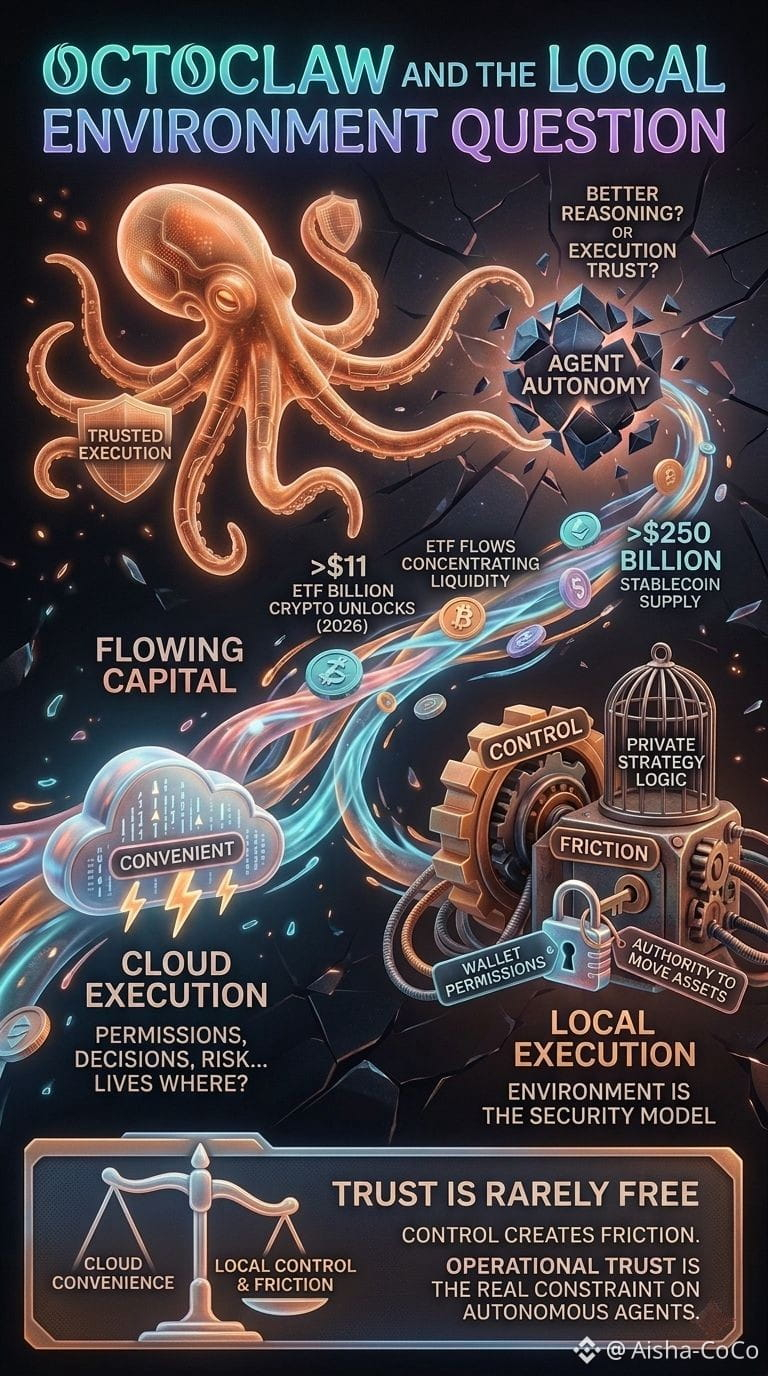
I Myself assuming that better AI agents mostly needed better reasoning. The more I looked at systems like OctoClaw, The less convinced I became.
My view is simple: agent autonomy matters less Than execution trust. On the surface, local operation looks like a privacy feature. Underneath, it changes where decisions, permissions, and risk actually live. If an agent handles walleet permissions meaning the authority to move assets or private straTegy logic, the environment Running those actions becomes part of the security model.
That feels increasingly relevant when over $11 billiion in crypto token unlocks are expected across 2026, ETF flows continue concentrating liquidity, and stablecoin supply has moved above $250 billion. Those numbers point to larger pools of capital and more Automated behavior, not necessarily better judgment.
The trade-off is obvious. Cloud execution is convenient; local execution offers more control. But control creates friction. Opereational trust is rarely free, and that may be the real constraint on autonoMous Agents.
{future}(OPENUSDT)
#openledger $OPEN @OpenLedger
I Myself assuming that better AI agents mostly needed better reasoning. The more I looked at systems like OctoClaw, The less convinced I became.
My view is simple: agent autonomy matters less Than execution trust. On the surface, local operation looks like a privacy feature. Underneath, it changes where decisions, permissions, and risk actually live. If an agent handles walleet permissions meaning the authority to move assets or private straTegy logic, the environment Running those actions becomes part of the security model.
That feels increasingly relevant when over $11 billiion in crypto token unlocks are expected across 2026, ETF flows continue concentrating liquidity, and stablecoin supply has moved above $250 billion. Those numbers point to larger pools of capital and more Automated behavior, not necessarily better judgment.
The trade-off is obvious. Cloud execution is convenient; local execution offers more control. But control creates friction. Opereational trust is rarely free, and that may be the real constraint on autonoMous Agents.
I Myself assuming that better AI agents mostly needed better reasoning. The more I looked at systems like OctoClaw, The less convinced I became.
My view is simple: agent autonomy matters less Than execution trust. On the surface, local operation looks like a privacy feature. Underneath, it changes where decisions, permissions, and risk actually live. If an agent handles walleet permissions meaning the authority to move assets or private straTegy logic, the environment Running those actions becomes part of the security model.
That feels increasingly relevant when over $11 billiion in crypto token unlocks are expected across 2026, ETF flows continue concentrating liquidity, and stablecoin supply has moved above $250 billion. Those numbers point to larger pools of capital and more Automated behavior, not necessarily better judgment.
The trade-off is obvious. Cloud execution is convenient; local execution offers more control. But control creates friction. Opereational trust is rarely free, and that may be the real constraint on autonoMous Agents.

7
8
376

·
--

Article
Who Is Actually Getting Paid? A Quiet Look at OpenLedger’s Idea@Openledger .. I’ve seen this before… maybe a few months ago. The chart was just doing its usual thing… up down up down. But my mind got stuck on one strange question.
Who is actually getting paid?
No no seriously… everyone keeps talking about AI data, models, future big vision. Okay, fair enough. Nice words. But if all of this is really working… then who is actually earning the money? I’m looking at it, but the answer doesn’t feel that clear.
Then I saw #OpenLedger and this “attribution” idea. Sounds like a big fancy word… but maybe it’s simple at the core.
You give data… and it doesn’t just disappear inside a machine like a ghost. They’re trying to track where the data came from. If your data helps the model, then maybe… just maybe… you get rewarded. That’s how I understand it… maybe.
And honestly… I find this idea kind of interesting.
Because usually, data contributors are invisible. They clean, write, organize everything… and then boom, the model becomes valuable and everyone forgets who actually did the work.
OpenLedger is basically saying… “wait… maybe we should remember.”
But as a trader… I don’t get impressed by ideas alone. The market doesn’t pay for narratives. The market pays for usage.
So the real questions are:
Are people actually bringing data?
Are they staying?
Are the models actually being used?
Or is everyone just coming, farming rewards, taking selfies, and leaving?
Because that’s what will decide everything.
The $OPEN chart right now doesn’t really look like the market is saying “this is the winner.” More like… “okay… show me first.”
And honestly… that’s fair.
Because attribution sounds nice, but AI systems are messy. Really messy.
How do you measure the impact of one dataset?
Small expert data vs massive public data… which one matters more?
If 10 people submit the same thing… who gets the reward?
That’s where it gets complicated.
Still… I’m watching.
Because if this actually works… if real contributors stay, models improve, and real usage happens… then something interesting could happen here.
But if it turns into another reward-farming cycle…
Then yeah… the market will move on faster than the narrative.
So right now… not super bullish, not super bearish.
Just standing in the corner watching…
“Okay… interesting idea… now show me proof.”
Need more evidence.
Need more users.
And most importantly, need people to stay even after the rewards stop feeling shiny.
Until then… I’m watching. Waiting. Observing.
@Openledger #OpenLedger $OPEN
{future}(OPENUSDT)
Who Is Actually Getting Paid? A Quiet Look at OpenLedger’s Idea
@OpenLedger .. I’ve seen this before… maybe a few months ago. The chart was just doing its usual thing… up down up down. But my mind got stuck on one strange question.
Who is actually getting paid?
No no seriously… everyone keeps talking about AI data, models, future big vision. Okay, fair enough. Nice words. But if all of this is really working… then who is actually earning the money? I’m looking at it, but the answer doesn’t feel that clear.
Then I saw #OpenLedger and this “attribution” idea. Sounds like a big fancy word… but maybe it’s simple at the core.
You give data… and it doesn’t just disappear inside a machine like a ghost. They’re trying to track where the data came from. If your data helps the model, then maybe… just maybe… you get rewarded. That’s how I understand it… maybe.
And honestly… I find this idea kind of interesting.
Because usually, data contributors are invisible. They clean, write, organize everything… and then boom, the model becomes valuable and everyone forgets who actually did the work.
OpenLedger is basically saying… “wait… maybe we should remember.”
But as a trader… I don’t get impressed by ideas alone. The market doesn’t pay for narratives. The market pays for usage.
So the real questions are:
Are people actually bringing data?
Are they staying?
Are the models actually being used?
Or is everyone just coming, farming rewards, taking selfies, and leaving?
Because that’s what will decide everything.
The $OPEN chart right now doesn’t really look like the market is saying “this is the winner.” More like… “okay… show me first.”
And honestly… that’s fair.
Because attribution sounds nice, but AI systems are messy. Really messy.
How do you measure the impact of one dataset?
Small expert data vs massive public data… which one matters more?
If 10 people submit the same thing… who gets the reward?
That’s where it gets complicated.
Still… I’m watching.
Because if this actually works… if real contributors stay, models improve, and real usage happens… then something interesting could happen here.
But if it turns into another reward-farming cycle…
Then yeah… the market will move on faster than the narrative.
So right now… not super bullish, not super bearish.
Just standing in the corner watching…
“Okay… interesting idea… now show me proof.”
Need more evidence.
Need more users.
And most importantly, need people to stay even after the rewards stop feeling shiny.
Until then… I’m watching. Waiting. Observing.
@OpenLedger #OpenLedger $OPEN
Who is actually getting paid?
No no seriously… everyone keeps talking about AI data, models, future big vision. Okay, fair enough. Nice words. But if all of this is really working… then who is actually earning the money? I’m looking at it, but the answer doesn’t feel that clear.
Then I saw #OpenLedger and this “attribution” idea. Sounds like a big fancy word… but maybe it’s simple at the core.
You give data… and it doesn’t just disappear inside a machine like a ghost. They’re trying to track where the data came from. If your data helps the model, then maybe… just maybe… you get rewarded. That’s how I understand it… maybe.
And honestly… I find this idea kind of interesting.
Because usually, data contributors are invisible. They clean, write, organize everything… and then boom, the model becomes valuable and everyone forgets who actually did the work.
OpenLedger is basically saying… “wait… maybe we should remember.”
But as a trader… I don’t get impressed by ideas alone. The market doesn’t pay for narratives. The market pays for usage.
So the real questions are:
Are people actually bringing data?
Are they staying?
Are the models actually being used?
Or is everyone just coming, farming rewards, taking selfies, and leaving?
Because that’s what will decide everything.
The $OPEN chart right now doesn’t really look like the market is saying “this is the winner.” More like… “okay… show me first.”
And honestly… that’s fair.
Because attribution sounds nice, but AI systems are messy. Really messy.
How do you measure the impact of one dataset?
Small expert data vs massive public data… which one matters more?
If 10 people submit the same thing… who gets the reward?
That’s where it gets complicated.
Still… I’m watching.
Because if this actually works… if real contributors stay, models improve, and real usage happens… then something interesting could happen here.
But if it turns into another reward-farming cycle…
Then yeah… the market will move on faster than the narrative.
So right now… not super bullish, not super bearish.
Just standing in the corner watching…
“Okay… interesting idea… now show me proof.”
Need more evidence.
Need more users.
And most importantly, need people to stay even after the rewards stop feeling shiny.
Until then… I’m watching. Waiting. Observing.
@OpenLedger #OpenLedger $OPEN
14
5
292

·
--

Article
From Fragmented Data to Digital Foundation: A Deep Dive into the Evolution Logic of OpenLedger Towards Web3 Core InfrastructureWhile I was frying eggs in a skillet, I was also sifting through potential volatile coins of the day using some hot AI aggregator running in the background. I was eyeing the recently stabilized candlestick for $BTC, thinking I could scoop up a few small gains. Suddenly, that so-called 'milliseconds-level grabbing' AI popped up with a frantic alert, saying a top-tier project team was dumping assets. I was so startled that I nearly forgot to turn off the fire, jumped onto the $ETH chain, and clumsily withdrew all the LP from the related pool, bracing against hundreds of Gwei in sky-high Gas fees. An hour later, I realized that this clueless AI had just scraped a phishing fake image from a high imitation scam account on Twitter and took it as solid on-chain evidence. Looking at the charred eggs in the pan and the hefty fees that evaporated into thin air, I felt a chill down my spine: as we increasingly rely on AI for trading or life decisions, if the source data we feed it is tainted, it can wield a deadly scythe against us.
From Fragmented Data to Digital Foundation: A Deep Dive into the Evolution Logic of OpenLedger Towards Web3 Core Infrastructure
While I was frying eggs in a skillet, I was also sifting through potential volatile coins of the day using some hot AI aggregator running in the background. I was eyeing the recently stabilized candlestick for $BTC , thinking I could scoop up a few small gains. Suddenly, that so-called 'milliseconds-level grabbing' AI popped up with a frantic alert, saying a top-tier project team was dumping assets. I was so startled that I nearly forgot to turn off the fire, jumped onto the $ETH chain, and clumsily withdrew all the LP from the related pool, bracing against hundreds of Gwei in sky-high Gas fees. An hour later, I realized that this clueless AI had just scraped a phishing fake image from a high imitation scam account on Twitter and took it as solid on-chain evidence. Looking at the charred eggs in the pan and the hefty fees that evaporated into thin air, I felt a chill down my spine: as we increasingly rely on AI for trading or life decisions, if the source data we feed it is tainted, it can wield a deadly scythe against us.
615

·
--
OpenLedger’s recent volatility is not necessarily driven by changes in the project’s fundamentals, but by trading noise caused by a “name misreading”: some people in the market have mistaken OpenLedger for an Open USD (OUSD)-related project. However, OUSD is actually issued by Open Standard, and the two are not directly related.
This kind of confusion can easily amplify short-term expectations and trigger follow-the-crowd trading. When watching $OPEN , it’s recommended to first verify the project’s entity and the source of the information before deciding whether the price move is likely to persist. The current price is around $0.15934, 24h trading volume is about $8.5 million, and market cap is about $47.83 million.
#OpenLedger #OPEN #crypto market
OpenLedger’s recent volatility is not necessarily driven by changes in the project’s fundamentals, but by trading noise caused by a “name misreading”: some people in the market have mistaken OpenLedger for an Open USD (OUSD)-related project. However, OUSD is actually issued by Open Standard, and the two are not directly related.
This kind of confusion can easily amplify short-term expectations and trigger follow-the-crowd trading. When watching $OPEN , it’s recommended to first verify the project’s entity and the source of the information before deciding whether the price move is likely to persist. The current price is around $0.15934, 24h trading volume is about $8.5 million, and market cap is about $47.83 million.
#OpenLedger #OPEN #crypto market
This kind of confusion can easily amplify short-term expectations and trigger follow-the-crowd trading. When watching $OPEN , it’s recommended to first verify the project’s entity and the source of the information before deciding whether the price move is likely to persist. The current price is around $0.15934, 24h trading volume is about $8.5 million, and market cap is about $47.83 million.
#OpenLedger #OPEN #crypto market
59

·
--
The part that stayed with me from the OpenLedger $OPEN #OpenLedger @Openledger task was how the two beneficiary groups — AI builders and data contributors — are on very different timelines, even though the pitch presents them as arriving together. Builders get immediate utility: ModelFactory works today, no-code fine-tuning works today, OpenLoRA deploys models without heavy infrastructure overhead. That value is front-loaded and doesn't depend on the Proof of Attribution flywheel spinning. Contributors are different. Their rewards only materialize when models built on their Datanets are actually queried at scale — but DeFiLlama shows annual protocol revenue sitting at $693K with fees down 23% in the past week, which suggests inference demand is still light. The design is coherent; the sequencing just matters more than the framing admits. Builders come in, build on the infrastructure, models sit waiting. Contributors have already uploaded, already contributed, already earned their attribution records… and are now waiting on demand that hasn't fully arrived yet. Whether that gap closes depends entirely on whether the builders who showed up actually ship products people use.
The part that stayed with me from the OpenLedger $OPEN #OpenLedger @OpenLedger task was how the two beneficiary groups — AI builders and data contributors — are on very different timelines, even though the pitch presents them as arriving together. Builders get immediate utility: ModelFactory works today, no-code fine-tuning works today, OpenLoRA deploys models without heavy infrastructure overhead. That value is front-loaded and doesn't depend on the Proof of Attribution flywheel spinning. Contributors are different. Their rewards only materialize when models built on their Datanets are actually queried at scale — but DeFiLlama shows annual protocol revenue sitting at $693K with fees down 23% in the past week, which suggests inference demand is still light. The design is coherent; the sequencing just matters more than the framing admits. Builders come in, build on the infrastructure, models sit waiting. Contributors have already uploaded, already contributed, already earned their attribution records… and are now waiting on demand that hasn't fully arrived yet. Whether that gap closes depends entirely on whether the builders who showed up actually ship products people use.
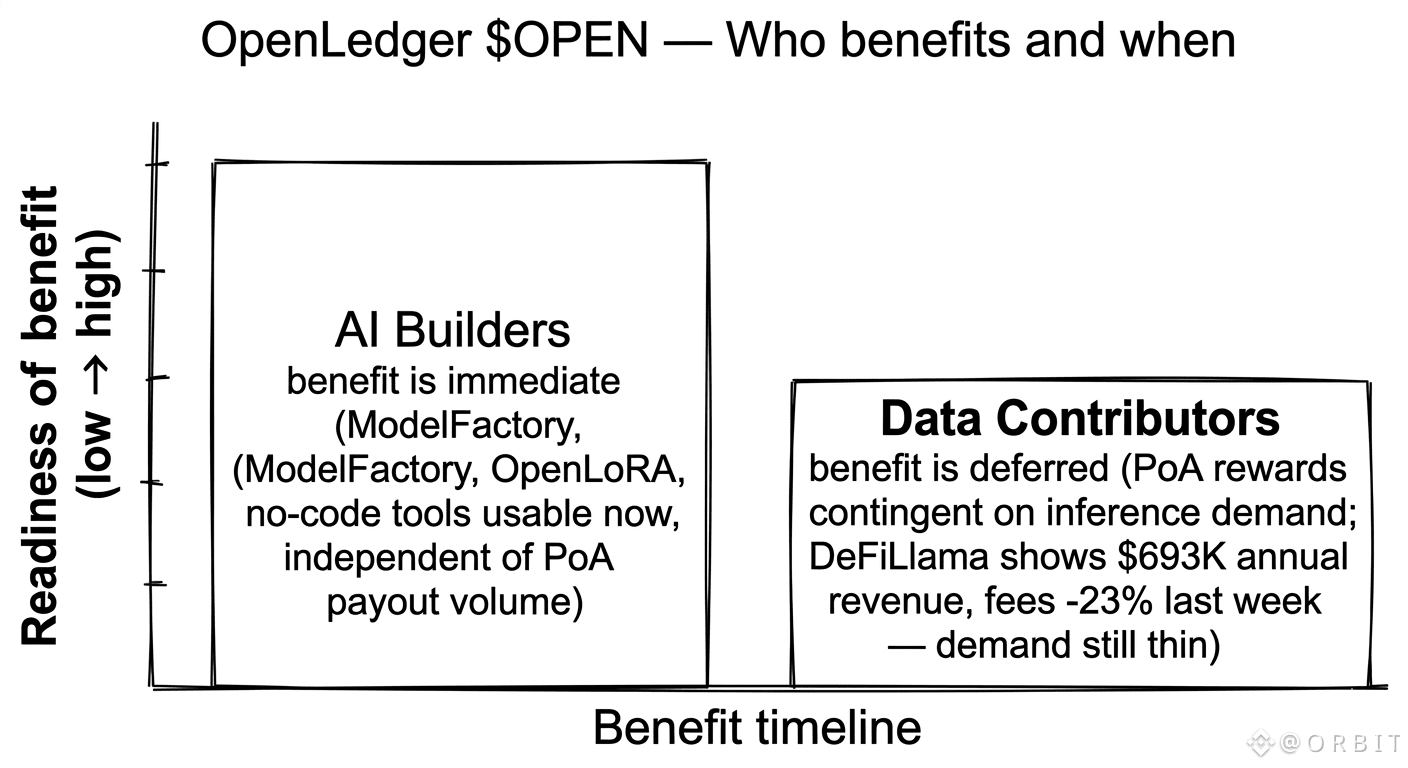
1
327

#openledger $OPEN The OpenLedger campaign is creating serious excitement across the crypto community, and for good reason. As blockchain technology continues to evolve, OpenLedger is positioning itself as a project focused on innovation, transparency, and community-driven growth.
Participating in the Binance OpenLedger campaign is more than just completing tasks and earning rewards—it's a chance to become part of a growing ecosystem before wider adoption takes place. Early supporters often gain valuable experience, build stronger connections within the community, and position themselves for future opportunities.
What makes this campaign even more attractive is the combination of learning, engagement, and rewards. Whether you're a seasoned crypto enthusiast or a newcomer exploring Web3, OpenLedger offers a great way to stay active and informed while potentially benefiting from the project's growth.
Don't just watch from the sidelines—join the conversation, complete the campaign activities, and discover why so many users are keeping a close eye on OpenLedger. The next big opportunity could be closer than you think! 🔥
#OpenLedger #BinanceSquare #Crypto #Web3 #Airdrop #Blockchain #BinanceCampaign #CryptoCommunity
#openledger $OPEN The OpenLedger campaign is creating serious excitement across the crypto community, and for good reason. As blockchain technology continues to evolve, OpenLedger is positioning itself as a project focused on innovation, transparency, and community-driven growth.
Participating in the Binance OpenLedger campaign is more than just completing tasks and earning rewards—it's a chance to become part of a growing ecosystem before wider adoption takes place. Early supporters often gain valuable experience, build stronger connections within the community, and position themselves for future opportunities.
What makes this campaign even more attractive is the combination of learning, engagement, and rewards. Whether you're a seasoned crypto enthusiast or a newcomer exploring Web3, OpenLedger offers a great way to stay active and informed while potentially benefiting from the project's growth.
Don't just watch from the sidelines—join the conversation, complete the campaign activities, and discover why so many users are keeping a close eye on OpenLedger. The next big opportunity could be closer than you think! 🔥
#OpenLedger #BinanceSquare #Crypto #Web3 #Airdrop #Blockchain #BinanceCampaign #CryptoCommunity
Participating in the Binance OpenLedger campaign is more than just completing tasks and earning rewards—it's a chance to become part of a growing ecosystem before wider adoption takes place. Early supporters often gain valuable experience, build stronger connections within the community, and position themselves for future opportunities.
What makes this campaign even more attractive is the combination of learning, engagement, and rewards. Whether you're a seasoned crypto enthusiast or a newcomer exploring Web3, OpenLedger offers a great way to stay active and informed while potentially benefiting from the project's growth.
Don't just watch from the sidelines—join the conversation, complete the campaign activities, and discover why so many users are keeping a close eye on OpenLedger. The next big opportunity could be closer than you think! 🔥
#OpenLedger #BinanceSquare #Crypto #Web3 #Airdrop #Blockchain #BinanceCampaign #CryptoCommunity
72

·
--
Back in the day, what freaked me out about cross-chain was not the slowness, but that moment when you think nothing's happening, you accidentally click again, and suddenly that one action turns into two. When that happens, it's embarrassing to go back and review: was it the system that didn’t make the status clear, or did I just lose my cool? The more you try to automate the bridge process, the deadlier this pitfall becomes, because repeating an action doesn’t just mean 'a little loss'; it completely messes up the logic.
So now, when I look at the EVM Bridge of @Openledger , I have a pretty straightforward standard to test it: can this bridging step become a clear checkpoint, instead of a 'boundary-less action'? When OctoClaw generates an action, if this step is cross-chain, I want it to bind 'this bridge action' to a unique reference: if you trigger the same action again, the system shouldn’t just quietly run it again, but clearly inform you—this transaction is ongoing/completed/not allowed to repeat. Trading agents can keep building the link, no problem, but for high-risk actions like bridging, we must cut out 'repeat execution' first; otherwise, the more automated it gets, the more it feels like stepping on a landmine.
Today, I’ll leave one acceptance criterion: when the same bridge action is triggered again, can the system return the same execution reference and provide a clear status (in progress/completed), while also refusing to create a second bridge? If it can do that, I’ll consider the Bridge as capable; if not, I’d rather leave this step for manual confirmation.
@Openledger $OPEN #OpenLedger
Back in the day, what freaked me out about cross-chain was not the slowness, but that moment when you think nothing's happening, you accidentally click again, and suddenly that one action turns into two. When that happens, it's embarrassing to go back and review: was it the system that didn’t make the status clear, or did I just lose my cool? The more you try to automate the bridge process, the deadlier this pitfall becomes, because repeating an action doesn’t just mean 'a little loss'; it completely messes up the logic.
So now, when I look at the EVM Bridge of @OpenLedger , I have a pretty straightforward standard to test it: can this bridging step become a clear checkpoint, instead of a 'boundary-less action'? When OctoClaw generates an action, if this step is cross-chain, I want it to bind 'this bridge action' to a unique reference: if you trigger the same action again, the system shouldn’t just quietly run it again, but clearly inform you—this transaction is ongoing/completed/not allowed to repeat. Trading agents can keep building the link, no problem, but for high-risk actions like bridging, we must cut out 'repeat execution' first; otherwise, the more automated it gets, the more it feels like stepping on a landmine.
Today, I’ll leave one acceptance criterion: when the same bridge action is triggered again, can the system return the same execution reference and provide a clear status (in progress/completed), while also refusing to create a second bridge? If it can do that, I’ll consider the Bridge as capable; if not, I’d rather leave this step for manual confirmation.
@OpenLedger $OPEN #OpenLedger
So now, when I look at the EVM Bridge of @OpenLedger , I have a pretty straightforward standard to test it: can this bridging step become a clear checkpoint, instead of a 'boundary-less action'? When OctoClaw generates an action, if this step is cross-chain, I want it to bind 'this bridge action' to a unique reference: if you trigger the same action again, the system shouldn’t just quietly run it again, but clearly inform you—this transaction is ongoing/completed/not allowed to repeat. Trading agents can keep building the link, no problem, but for high-risk actions like bridging, we must cut out 'repeat execution' first; otherwise, the more automated it gets, the more it feels like stepping on a landmine.
Today, I’ll leave one acceptance criterion: when the same bridge action is triggered again, can the system return the same execution reference and provide a clear status (in progress/completed), while also refusing to create a second bridge? If it can do that, I’ll consider the Bridge as capable; if not, I’d rather leave this step for manual confirmation.
@OpenLedger $OPEN #OpenLedger

176
Log in to explore more content
Join global crypto users on Binance Square
⚡️ Get latest and useful information about crypto.
💬 Trusted by the world’s largest crypto exchange.
👍 Discover real insights from verified creators.
Email / Phone number
Trending Topics
1
#BinanceLaunchesBinanceIntelligence
496,621 views
3,365 Discussing
2
#BitcoinTargets2026OpenAt$87570
3,585 views
93 Discussing
3
#BitcoinRejectedAt$87KThirdTime
3,204 views
75 Discussing
4
#StrategyMarketCapSurpassesRumble
21,770 views
541 Discussing
5
#StriveBuys2000BTCFor$169M
15,306 views
145 Discussing
6
#EvernorthXRPTreasuryCompletesSPACMerger
201,010 views
1,760 Discussing
7
#ADAGains10%Above$0.27
72,598 views
262 Discussing
8
#ETHUp70%InQ3ButLiquidityFalls
401,820 views
2,724 Discussing
9
#EthStakingExitQueueHits2026High
172,304 views
1,776 Discussing
10
#FedOctoberHoldOdds82.3%
194,089 views
1,708 Discussing