

#seastock
seastock
13,556 views
264 Discussing
Hot
Latest

·
--
Article
From Crypto to Stocks: Expand Your Investment Journey with Binance@BinanceBurmese
#SEAstock
#SEABstock
As digital asset ecosystems evolve, cryptocurrency investors are increasingly seeking strategies to diversify their financial holdings and reduce concentrated market volatility. While crypto assets provide innovative financial utilities, high-growth potential, and decentralized mechanics, integrating traditional financial instruments—such as US Stocks—offers a powerful way to stabilize long-term portfolio growth. Binance provides an exceptional platform for global investors to seamlessly bridge the gap between blockchain-based investments and traditional equity markets through resources, trading tools, and educational frameworks like BStocks. Transitioning from crypto to stocks is not merely about spreading risk; it represents a foundational shift toward building comprehensive, resilient, and multi-asset wealth.
Understanding the fundamental mechanics that separate traditional stock markets from cryptocurrency markets is essential for any modern investor seeking a balanced asset structure. The cryptocurrency market operates continuously—24 hours a day, 7 days a week, 365 days a year—leading to intense price volatility over short timeframes. Conversely, traditional US stock markets operate within standard business hours on weekdays. Stocks generally exhibit less extreme intraday price swings compared to lower-cap crypto tokens, providing a calmer investment environment for conservative asset allocators.
Furthermore, crypto assets often derive value from protocol utility, network activity, adoption rates, and general market sentiment. In contrast, corporate stocks reflect direct ownership in established real-world corporations. Their valuations depend on audited revenues, quarterly earnings reports, corporate management strategies, and physical or intellectual property. Additionally, crypto assets generate passive yield through staking, lending, or liquidity provisioning. Traditional stocks provide income through dividend payments—a portion of company profits distributed directly to shareholders on a regular, predictable schedule. By combining both asset classes into a unified investment model, investors can capture the high-growth potential of digital finance while maintaining the steady, audited stability of traditional corporations.
If you are ready to transition your mindset from pure crypto trading to stock market investing, follow a disciplined beginner framework:
Master Fundamental Terminology: Familiarize yourself with key financial metrics such as Market Capitalization, Price-to-Earnings (P/E) Ratio, Dividend Yield, Earnings Per Share (EPS), and Debt-to-Equity ratios.
Monitor Global Macroeconomic News: Keep track of major economic announcements, including Federal Reserve interest rate policy changes, Consumer Price Index (CPI) inflation metrics, and major corporate earnings releases.
Utilize Binance Square Educational Hubs: Explore guided articles, market insights, and community discussions directly on Binance Square to learn how equities, tokenized assets, and broad financial markets interact.
Implement Disciplined Portfolio Sizing: Avoid over-concentrating capital into a single stock or token. Allocate capital across diverse sectors—such as technology, healthcare, energy, and consumer goods—to insulate yourself against sudden sector-specific downturns.
In this context, BStocks serve as a vital link connecting Web3 users with global equity markets directly within the Binance ecosystem. Acquiring full shares of top-tier US corporations like Apple, Microsoft, or Nvidia can require substantial upfront capital. BStocks frameworks enable fractional share exposure, allowing investors to purchase small fractions of high-value stock shares according to their budget limits starting from small amounts. Rather than managing disparate accounts across traditional brokers, users can analyze, track, and manage their multi-asset trajectory directly within the Binance interface. This integration provides enhanced liquidity and convenience, making it easy for Web3 users to reallocate profits between crypto assets and traditional equity markets in just a few clicks. However, thorough fundamental analysis (DYOR) is just as necessary in stock markets as it is in crypto. Always review corporate debt levels, quarterly guidance, competitive moat, and market positioning before committing capital.
Beginning a financial journey in cryptocurrency teaches valuable lessons in chart reading, risk assessment, and market timing. However, learning about stock market fundamentals through Binance opens up a deeper perspective on global macroeconomic cycles. Allocating capital across both digital assets and equities balances overall portfolio volatility while building lasting financial discipline. Combining tech-forward crypto exposure with time-tested equity investments creates a robust financial foundation for long-term wealth accumulation. Expanding your investment perspective from cryptocurrency to US Stocks represents a meaningful milestone in financial maturity. Leverage the power of Binance Square to access high-quality educational content, stay informed on market updates, and take calculated steps toward multi-asset investment success today.Thank You.
$TSMB
From Crypto to Stocks: Expand Your Investment Journey with Binance
@Binance Burmese
#SEAstock
#SEABstock
As digital asset ecosystems evolve, cryptocurrency investors are increasingly seeking strategies to diversify their financial holdings and reduce concentrated market volatility. While crypto assets provide innovative financial utilities, high-growth potential, and decentralized mechanics, integrating traditional financial instruments—such as US Stocks—offers a powerful way to stabilize long-term portfolio growth. Binance provides an exceptional platform for global investors to seamlessly bridge the gap between blockchain-based investments and traditional equity markets through resources, trading tools, and educational frameworks like BStocks. Transitioning from crypto to stocks is not merely about spreading risk; it represents a foundational shift toward building comprehensive, resilient, and multi-asset wealth.
Understanding the fundamental mechanics that separate traditional stock markets from cryptocurrency markets is essential for any modern investor seeking a balanced asset structure. The cryptocurrency market operates continuously—24 hours a day, 7 days a week, 365 days a year—leading to intense price volatility over short timeframes. Conversely, traditional US stock markets operate within standard business hours on weekdays. Stocks generally exhibit less extreme intraday price swings compared to lower-cap crypto tokens, providing a calmer investment environment for conservative asset allocators.
Furthermore, crypto assets often derive value from protocol utility, network activity, adoption rates, and general market sentiment. In contrast, corporate stocks reflect direct ownership in established real-world corporations. Their valuations depend on audited revenues, quarterly earnings reports, corporate management strategies, and physical or intellectual property. Additionally, crypto assets generate passive yield through staking, lending, or liquidity provisioning. Traditional stocks provide income through dividend payments—a portion of company profits distributed directly to shareholders on a regular, predictable schedule. By combining both asset classes into a unified investment model, investors can capture the high-growth potential of digital finance while maintaining the steady, audited stability of traditional corporations.
If you are ready to transition your mindset from pure crypto trading to stock market investing, follow a disciplined beginner framework:
Master Fundamental Terminology: Familiarize yourself with key financial metrics such as Market Capitalization, Price-to-Earnings (P/E) Ratio, Dividend Yield, Earnings Per Share (EPS), and Debt-to-Equity ratios.
Monitor Global Macroeconomic News: Keep track of major economic announcements, including Federal Reserve interest rate policy changes, Consumer Price Index (CPI) inflation metrics, and major corporate earnings releases.
Utilize Binance Square Educational Hubs: Explore guided articles, market insights, and community discussions directly on Binance Square to learn how equities, tokenized assets, and broad financial markets interact.
Implement Disciplined Portfolio Sizing: Avoid over-concentrating capital into a single stock or token. Allocate capital across diverse sectors—such as technology, healthcare, energy, and consumer goods—to insulate yourself against sudden sector-specific downturns.
In this context, BStocks serve as a vital link connecting Web3 users with global equity markets directly within the Binance ecosystem. Acquiring full shares of top-tier US corporations like Apple, Microsoft, or Nvidia can require substantial upfront capital. BStocks frameworks enable fractional share exposure, allowing investors to purchase small fractions of high-value stock shares according to their budget limits starting from small amounts. Rather than managing disparate accounts across traditional brokers, users can analyze, track, and manage their multi-asset trajectory directly within the Binance interface. This integration provides enhanced liquidity and convenience, making it easy for Web3 users to reallocate profits between crypto assets and traditional equity markets in just a few clicks. However, thorough fundamental analysis (DYOR) is just as necessary in stock markets as it is in crypto. Always review corporate debt levels, quarterly guidance, competitive moat, and market positioning before committing capital.
Beginning a financial journey in cryptocurrency teaches valuable lessons in chart reading, risk assessment, and market timing. However, learning about stock market fundamentals through Binance opens up a deeper perspective on global macroeconomic cycles. Allocating capital across both digital assets and equities balances overall portfolio volatility while building lasting financial discipline. Combining tech-forward crypto exposure with time-tested equity investments creates a robust financial foundation for long-term wealth accumulation. Expanding your investment perspective from cryptocurrency to US Stocks represents a meaningful milestone in financial maturity. Leverage the power of Binance Square to access high-quality educational content, stay informed on market updates, and take calculated steps toward multi-asset investment success today.Thank You.
$TSMB
#SEAstock
#SEABstock
As digital asset ecosystems evolve, cryptocurrency investors are increasingly seeking strategies to diversify their financial holdings and reduce concentrated market volatility. While crypto assets provide innovative financial utilities, high-growth potential, and decentralized mechanics, integrating traditional financial instruments—such as US Stocks—offers a powerful way to stabilize long-term portfolio growth. Binance provides an exceptional platform for global investors to seamlessly bridge the gap between blockchain-based investments and traditional equity markets through resources, trading tools, and educational frameworks like BStocks. Transitioning from crypto to stocks is not merely about spreading risk; it represents a foundational shift toward building comprehensive, resilient, and multi-asset wealth.
Understanding the fundamental mechanics that separate traditional stock markets from cryptocurrency markets is essential for any modern investor seeking a balanced asset structure. The cryptocurrency market operates continuously—24 hours a day, 7 days a week, 365 days a year—leading to intense price volatility over short timeframes. Conversely, traditional US stock markets operate within standard business hours on weekdays. Stocks generally exhibit less extreme intraday price swings compared to lower-cap crypto tokens, providing a calmer investment environment for conservative asset allocators.
Furthermore, crypto assets often derive value from protocol utility, network activity, adoption rates, and general market sentiment. In contrast, corporate stocks reflect direct ownership in established real-world corporations. Their valuations depend on audited revenues, quarterly earnings reports, corporate management strategies, and physical or intellectual property. Additionally, crypto assets generate passive yield through staking, lending, or liquidity provisioning. Traditional stocks provide income through dividend payments—a portion of company profits distributed directly to shareholders on a regular, predictable schedule. By combining both asset classes into a unified investment model, investors can capture the high-growth potential of digital finance while maintaining the steady, audited stability of traditional corporations.
If you are ready to transition your mindset from pure crypto trading to stock market investing, follow a disciplined beginner framework:
Master Fundamental Terminology: Familiarize yourself with key financial metrics such as Market Capitalization, Price-to-Earnings (P/E) Ratio, Dividend Yield, Earnings Per Share (EPS), and Debt-to-Equity ratios.
Monitor Global Macroeconomic News: Keep track of major economic announcements, including Federal Reserve interest rate policy changes, Consumer Price Index (CPI) inflation metrics, and major corporate earnings releases.
Utilize Binance Square Educational Hubs: Explore guided articles, market insights, and community discussions directly on Binance Square to learn how equities, tokenized assets, and broad financial markets interact.
Implement Disciplined Portfolio Sizing: Avoid over-concentrating capital into a single stock or token. Allocate capital across diverse sectors—such as technology, healthcare, energy, and consumer goods—to insulate yourself against sudden sector-specific downturns.
In this context, BStocks serve as a vital link connecting Web3 users with global equity markets directly within the Binance ecosystem. Acquiring full shares of top-tier US corporations like Apple, Microsoft, or Nvidia can require substantial upfront capital. BStocks frameworks enable fractional share exposure, allowing investors to purchase small fractions of high-value stock shares according to their budget limits starting from small amounts. Rather than managing disparate accounts across traditional brokers, users can analyze, track, and manage their multi-asset trajectory directly within the Binance interface. This integration provides enhanced liquidity and convenience, making it easy for Web3 users to reallocate profits between crypto assets and traditional equity markets in just a few clicks. However, thorough fundamental analysis (DYOR) is just as necessary in stock markets as it is in crypto. Always review corporate debt levels, quarterly guidance, competitive moat, and market positioning before committing capital.
Beginning a financial journey in cryptocurrency teaches valuable lessons in chart reading, risk assessment, and market timing. However, learning about stock market fundamentals through Binance opens up a deeper perspective on global macroeconomic cycles. Allocating capital across both digital assets and equities balances overall portfolio volatility while building lasting financial discipline. Combining tech-forward crypto exposure with time-tested equity investments creates a robust financial foundation for long-term wealth accumulation. Expanding your investment perspective from cryptocurrency to US Stocks represents a meaningful milestone in financial maturity. Leverage the power of Binance Square to access high-quality educational content, stay informed on market updates, and take calculated steps toward multi-asset investment success today.Thank You.
$TSMB
Than-Than:
good
7
1
6
182

·
--

Article
Are you afraid of Crypto’s volatility? How do you balance with BStocks?Are you afraid of Crypto’s volatility? How do you balance with BStocks?
Every trader and every investor operating in the Crypto market must face thrilling opportunities along with extremely harsh price volatility. While the Crypto market teaches you fast decision-making, market sentiment analysis, and Risk Management, long-term financial stability depends greatly on asset allocation through Portfolio Diversification.
Are you afraid of Crypto’s volatility? How do you balance with BStocks?
Are you afraid of Crypto’s volatility? How do you balance with BStocks?
Every trader and every investor operating in the Crypto market must face thrilling opportunities along with extremely harsh price volatility. While the Crypto market teaches you fast decision-making, market sentiment analysis, and Risk Management, long-term financial stability depends greatly on asset allocation through Portfolio Diversification.
Every trader and every investor operating in the Crypto market must face thrilling opportunities along with extremely harsh price volatility. While the Crypto market teaches you fast decision-making, market sentiment analysis, and Risk Management, long-term financial stability depends greatly on asset allocation through Portfolio Diversification.
Ricky8:
Wow 👏
41
1
40
93

Article
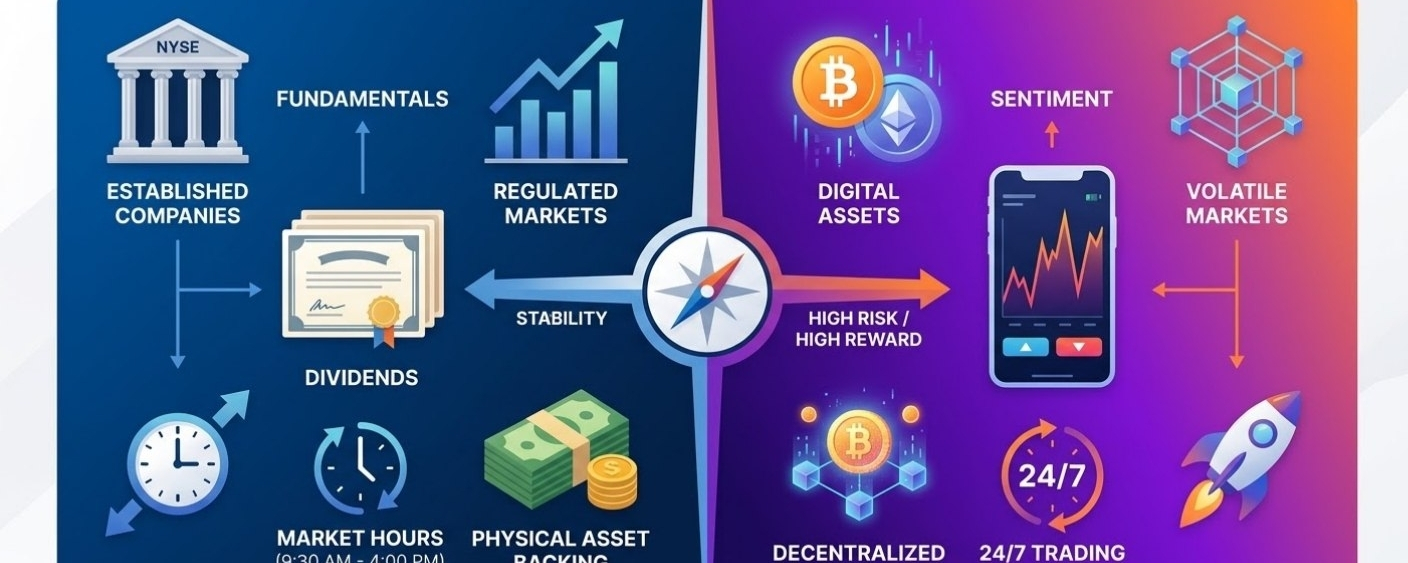
Comparing traditional Stock Trading and Crypto TradingFor me , I choose stock trading
Finding My Rhythm: Why I’ll Always Keep Stocks at the Center of My Portfolio
When I first started trying to make my money work for me, I quickly realized that trading isn’t just about numbers on a screen it’s about lifestyle. You don't just pick an asset class; you pick a routine, a stress level, and a way of seeing the world.
Right now, if you talk to five different people about investing, you’ll get pulled in completely opposite directions. You have the crypto crowd promising wild 24/7 gains, and you have the traditional stock market traders talking about slow, steady compounding. After spending time watching both worlds move, I’ve realized that while crypto gets all the noise and hype, traditional stock trading is where I actually find my footing.
For me, the biggest appeal of stock trading comes down to one word: substance.
When I buy a share of a stock, I’m not just holding a bundle of code or a speculative token hoping someone else buys it for more tomorrow. I’m buying a real slice of a real business. When I hold shares in companies like Apple, Microsoft, or a broad index, there are actual factories, employees, supply chains, and earnings reports behind those tickers. If the price fluctuates, I can look at quarterly earnings or balance sheets to understand why. That gives me an anchor. It turns trading from a guessing game into a calculated strategy built on fundamental business health.
Then there’s the daily psychological reality. Stock markets have opening and closing bells.
That might sound like an old-school detail, but as someone trying to balance trading with a normal life, those market hours are a blessing. The market opens, the battle happens, and at the end of the day, the bell rings. It stops. You get to step away, eat dinner with your family, and actually sleep through the night.
Contrast that with the crypto market, which never sleeps. It runs 24 hours a day, 7 days a week, 365 days a year. I’ve watched crypto traders check their phones at 3:00 AM on a Sunday, sweating over a sudden 15% drop caused by a midnight tweet or a liquidation cascade. That isn’t freedom to me it’s an endless loop of anxiety. I prefer a market that respects human boundaries.
There’s also the safety net to consider. In the stock market, you’re operating inside a legal framework built over a century to protect retail investors. Brokers are strictly regulated, investor protection schemes exist, and companies are legally required to be transparent about their finances. If a reputable brokerage encounters trouble, my underlying stocks are still mine. In the unregulated corners of crypto, a bad exchange interface or a lost key can mean your money vanishes into thin air with zero recourse.
Don't get me wrong I understand the thrill of crypto, and I get why people like to gamble a small percentage of play money on high-volatility assets. But when it comes to building serious, lasting wealth, traditional stocks remain the undisputed heavy lifter in my financial strategy.
Stock trading allows you to participate in global economic growth, collect passive income through dividends, and compound your wealth without burning out your mental health. It’s a marathon, not a sprint, and that’s precisely why it works. Crypto might be an interesting side experiment, but the stock market is where real, sustainable portfolios are built.
#SEAstock
#SEABstock
@BinanceBurmese
Comparing traditional Stock Trading and Crypto Trading
For me , I choose stock trading
Finding My Rhythm: Why I’ll Always Keep Stocks at the Center of My Portfolio
When I first started trying to make my money work for me, I quickly realized that trading isn’t just about numbers on a screen it’s about lifestyle. You don't just pick an asset class; you pick a routine, a stress level, and a way of seeing the world.
Right now, if you talk to five different people about investing, you’ll get pulled in completely opposite directions. You have the crypto crowd promising wild 24/7 gains, and you have the traditional stock market traders talking about slow, steady compounding. After spending time watching both worlds move, I’ve realized that while crypto gets all the noise and hype, traditional stock trading is where I actually find my footing.
For me, the biggest appeal of stock trading comes down to one word: substance.
When I buy a share of a stock, I’m not just holding a bundle of code or a speculative token hoping someone else buys it for more tomorrow. I’m buying a real slice of a real business. When I hold shares in companies like Apple, Microsoft, or a broad index, there are actual factories, employees, supply chains, and earnings reports behind those tickers. If the price fluctuates, I can look at quarterly earnings or balance sheets to understand why. That gives me an anchor. It turns trading from a guessing game into a calculated strategy built on fundamental business health.
Then there’s the daily psychological reality. Stock markets have opening and closing bells.
That might sound like an old-school detail, but as someone trying to balance trading with a normal life, those market hours are a blessing. The market opens, the battle happens, and at the end of the day, the bell rings. It stops. You get to step away, eat dinner with your family, and actually sleep through the night.
Contrast that with the crypto market, which never sleeps. It runs 24 hours a day, 7 days a week, 365 days a year. I’ve watched crypto traders check their phones at 3:00 AM on a Sunday, sweating over a sudden 15% drop caused by a midnight tweet or a liquidation cascade. That isn’t freedom to me it’s an endless loop of anxiety. I prefer a market that respects human boundaries.
There’s also the safety net to consider. In the stock market, you’re operating inside a legal framework built over a century to protect retail investors. Brokers are strictly regulated, investor protection schemes exist, and companies are legally required to be transparent about their finances. If a reputable brokerage encounters trouble, my underlying stocks are still mine. In the unregulated corners of crypto, a bad exchange interface or a lost key can mean your money vanishes into thin air with zero recourse.
Don't get me wrong I understand the thrill of crypto, and I get why people like to gamble a small percentage of play money on high-volatility assets. But when it comes to building serious, lasting wealth, traditional stocks remain the undisputed heavy lifter in my financial strategy.
Stock trading allows you to participate in global economic growth, collect passive income through dividends, and compound your wealth without burning out your mental health. It’s a marathon, not a sprint, and that’s precisely why it works. Crypto might be an interesting side experiment, but the stock market is where real, sustainable portfolios are built.
#SEAstock
#SEABstock
@Binance Burmese
Finding My Rhythm: Why I’ll Always Keep Stocks at the Center of My Portfolio
When I first started trying to make my money work for me, I quickly realized that trading isn’t just about numbers on a screen it’s about lifestyle. You don't just pick an asset class; you pick a routine, a stress level, and a way of seeing the world.
Right now, if you talk to five different people about investing, you’ll get pulled in completely opposite directions. You have the crypto crowd promising wild 24/7 gains, and you have the traditional stock market traders talking about slow, steady compounding. After spending time watching both worlds move, I’ve realized that while crypto gets all the noise and hype, traditional stock trading is where I actually find my footing.
For me, the biggest appeal of stock trading comes down to one word: substance.
When I buy a share of a stock, I’m not just holding a bundle of code or a speculative token hoping someone else buys it for more tomorrow. I’m buying a real slice of a real business. When I hold shares in companies like Apple, Microsoft, or a broad index, there are actual factories, employees, supply chains, and earnings reports behind those tickers. If the price fluctuates, I can look at quarterly earnings or balance sheets to understand why. That gives me an anchor. It turns trading from a guessing game into a calculated strategy built on fundamental business health.
Then there’s the daily psychological reality. Stock markets have opening and closing bells.
That might sound like an old-school detail, but as someone trying to balance trading with a normal life, those market hours are a blessing. The market opens, the battle happens, and at the end of the day, the bell rings. It stops. You get to step away, eat dinner with your family, and actually sleep through the night.
Contrast that with the crypto market, which never sleeps. It runs 24 hours a day, 7 days a week, 365 days a year. I’ve watched crypto traders check their phones at 3:00 AM on a Sunday, sweating over a sudden 15% drop caused by a midnight tweet or a liquidation cascade. That isn’t freedom to me it’s an endless loop of anxiety. I prefer a market that respects human boundaries.
There’s also the safety net to consider. In the stock market, you’re operating inside a legal framework built over a century to protect retail investors. Brokers are strictly regulated, investor protection schemes exist, and companies are legally required to be transparent about their finances. If a reputable brokerage encounters trouble, my underlying stocks are still mine. In the unregulated corners of crypto, a bad exchange interface or a lost key can mean your money vanishes into thin air with zero recourse.
Don't get me wrong I understand the thrill of crypto, and I get why people like to gamble a small percentage of play money on high-volatility assets. But when it comes to building serious, lasting wealth, traditional stocks remain the undisputed heavy lifter in my financial strategy.
Stock trading allows you to participate in global economic growth, collect passive income through dividends, and compound your wealth without burning out your mental health. It’s a marathon, not a sprint, and that’s precisely why it works. Crypto might be an interesting side experiment, but the stock market is where real, sustainable portfolios are built.
#SEAstock
#SEABstock
@Binance Burmese
FiloCL:
@BiBi Analyze coins mentioned in the content
4
1
4
84

·
--

Article
US Stock Market News .... Key Drivers Every Investor Should WatchIf you’ve opened your portfolio app over the last few weeks, you’ve probably felt like you're riding a roller coaster without a seatbelt. One day tech stocks are surging to fresh high points, and the next day a single economic report sends the entire market into a sudden dip.
When you're trying to keep up with US stock market news, it's easy to get buried under mountains of financial jargon, numbers, and endless ticker symbols. But behind all the noise, the market is usually responding to a few very specific, high-impact events.
Here is a breakdown of the big market drivers moving US stocks right now, what they mean for major companies, and how everyday investors can make sense of it all.
1. The Fed and Interest Rate Decisions
Nothing moves the stock market faster than news coming out of the Federal Reserve. When the Fed lowers interest rates, borrowing money becomes cheaper for both businesses and consumers. This generally acts like fuel for stock prices especially fast-growing tech stocks that rely on heavy borrowing to expand.
Conversely, when interest rates remain high to fight inflation, companies face higher costs, consumer spending cools down, and stock growth slows.
Why it matters to you: High interest rates mean companies might see lower profit margins, which can pull down stock prices in the short term. However, it also creates opportunities to buy high-quality companies at a discount if you are investing for the long haul.
2. Big Tech Earnings Reports
Companies like Microsoft, Apple, Nvidia, Alphabet, and Amazon hold massive weight in major stock indices like the S&P 500 and the Nasdaq. When these heavyweights report quarterly earnings, their performance single-handedly pulls the broader market up or down.
Right now, market attention is hyper-focused on Artificial Intelligence (AI) monetization. Investors no longer just want to hear that a company is building AI; they want to see actual revenue coming in from those investments.
Why it matters to you: Even if you don't own individual tech stocks, if you own an S&P 500 index fund, your portfolio's performance is heavily tied to how these tech giants perform every quarter.
3. Economic Indicators: Inflation & Jobs Data
Two monthly updates regularly shake up stock prices:
The Consumer Price Index (CPI): Shows whether inflation is cooling down or heating back up.
Jobs Reports: Shows whether the US economy is staying strong or slowing down too quickly.
When inflation shows signs of cooling while employment stays steady, markets often rally on hopes of a "soft landing"—a scenario where inflation comes down without triggering a recession.
How to Navigate the Noise as an Investor
When major market news hits, it’s easy to react emotionally and make quick decisions, like panic-selling during a dip or chasing a stock that’s already skyrocketed. Here are three simple rules to keep your cool:
Focus on the Signal, Ignore the Daily Noise: Daily stock fluctuations are just noise. Unless a company’s fundamental business model has broken down, short-term drops are rarely a reason to sell.
Diversify Across Sectors: If tech stocks pull back, defensive sectors like consumer staples (everyday goods) or healthcare often hold steady or gain ground.
Keep a Long-Term Perspective: Historically, the US stock market has trended upward over multi-year periods despite short-term pullbacks, recessions, and news headlines.
Staying informed doesn't mean you need to watch market charts 24/7. Focus on the core economic events, keep your strategy steady, and let time work in your favor.
#SEAstock #SEABstock @BinanceBurmese
US Stock Market News .... Key Drivers Every Investor Should Watch
If you’ve opened your portfolio app over the last few weeks, you’ve probably felt like you're riding a roller coaster without a seatbelt. One day tech stocks are surging to fresh high points, and the next day a single economic report sends the entire market into a sudden dip.
When you're trying to keep up with US stock market news, it's easy to get buried under mountains of financial jargon, numbers, and endless ticker symbols. But behind all the noise, the market is usually responding to a few very specific, high-impact events.
Here is a breakdown of the big market drivers moving US stocks right now, what they mean for major companies, and how everyday investors can make sense of it all.
1. The Fed and Interest Rate Decisions
Nothing moves the stock market faster than news coming out of the Federal Reserve. When the Fed lowers interest rates, borrowing money becomes cheaper for both businesses and consumers. This generally acts like fuel for stock prices especially fast-growing tech stocks that rely on heavy borrowing to expand.
Conversely, when interest rates remain high to fight inflation, companies face higher costs, consumer spending cools down, and stock growth slows.
Why it matters to you: High interest rates mean companies might see lower profit margins, which can pull down stock prices in the short term. However, it also creates opportunities to buy high-quality companies at a discount if you are investing for the long haul.
2. Big Tech Earnings Reports
Companies like Microsoft, Apple, Nvidia, Alphabet, and Amazon hold massive weight in major stock indices like the S&P 500 and the Nasdaq. When these heavyweights report quarterly earnings, their performance single-handedly pulls the broader market up or down.
Right now, market attention is hyper-focused on Artificial Intelligence (AI) monetization. Investors no longer just want to hear that a company is building AI; they want to see actual revenue coming in from those investments.
Why it matters to you: Even if you don't own individual tech stocks, if you own an S&P 500 index fund, your portfolio's performance is heavily tied to how these tech giants perform every quarter.
3. Economic Indicators: Inflation & Jobs Data
Two monthly updates regularly shake up stock prices:
The Consumer Price Index (CPI): Shows whether inflation is cooling down or heating back up.
Jobs Reports: Shows whether the US economy is staying strong or slowing down too quickly.
When inflation shows signs of cooling while employment stays steady, markets often rally on hopes of a "soft landing"—a scenario where inflation comes down without triggering a recession.
How to Navigate the Noise as an Investor
When major market news hits, it’s easy to react emotionally and make quick decisions, like panic-selling during a dip or chasing a stock that’s already skyrocketed. Here are three simple rules to keep your cool:
Focus on the Signal, Ignore the Daily Noise: Daily stock fluctuations are just noise. Unless a company’s fundamental business model has broken down, short-term drops are rarely a reason to sell.
Diversify Across Sectors: If tech stocks pull back, defensive sectors like consumer staples (everyday goods) or healthcare often hold steady or gain ground.
Keep a Long-Term Perspective: Historically, the US stock market has trended upward over multi-year periods despite short-term pullbacks, recessions, and news headlines.
Staying informed doesn't mean you need to watch market charts 24/7. Focus on the core economic events, keep your strategy steady, and let time work in your favor.
#SEAstock #SEABstock @Binance Burmese
When you're trying to keep up with US stock market news, it's easy to get buried under mountains of financial jargon, numbers, and endless ticker symbols. But behind all the noise, the market is usually responding to a few very specific, high-impact events.
Here is a breakdown of the big market drivers moving US stocks right now, what they mean for major companies, and how everyday investors can make sense of it all.
1. The Fed and Interest Rate Decisions
Nothing moves the stock market faster than news coming out of the Federal Reserve. When the Fed lowers interest rates, borrowing money becomes cheaper for both businesses and consumers. This generally acts like fuel for stock prices especially fast-growing tech stocks that rely on heavy borrowing to expand.
Conversely, when interest rates remain high to fight inflation, companies face higher costs, consumer spending cools down, and stock growth slows.
Why it matters to you: High interest rates mean companies might see lower profit margins, which can pull down stock prices in the short term. However, it also creates opportunities to buy high-quality companies at a discount if you are investing for the long haul.
2. Big Tech Earnings Reports
Companies like Microsoft, Apple, Nvidia, Alphabet, and Amazon hold massive weight in major stock indices like the S&P 500 and the Nasdaq. When these heavyweights report quarterly earnings, their performance single-handedly pulls the broader market up or down.
Right now, market attention is hyper-focused on Artificial Intelligence (AI) monetization. Investors no longer just want to hear that a company is building AI; they want to see actual revenue coming in from those investments.
Why it matters to you: Even if you don't own individual tech stocks, if you own an S&P 500 index fund, your portfolio's performance is heavily tied to how these tech giants perform every quarter.
3. Economic Indicators: Inflation & Jobs Data
Two monthly updates regularly shake up stock prices:
The Consumer Price Index (CPI): Shows whether inflation is cooling down or heating back up.
Jobs Reports: Shows whether the US economy is staying strong or slowing down too quickly.
When inflation shows signs of cooling while employment stays steady, markets often rally on hopes of a "soft landing"—a scenario where inflation comes down without triggering a recession.
How to Navigate the Noise as an Investor
When major market news hits, it’s easy to react emotionally and make quick decisions, like panic-selling during a dip or chasing a stock that’s already skyrocketed. Here are three simple rules to keep your cool:
Focus on the Signal, Ignore the Daily Noise: Daily stock fluctuations are just noise. Unless a company’s fundamental business model has broken down, short-term drops are rarely a reason to sell.
Diversify Across Sectors: If tech stocks pull back, defensive sectors like consumer staples (everyday goods) or healthcare often hold steady or gain ground.
Keep a Long-Term Perspective: Historically, the US stock market has trended upward over multi-year periods despite short-term pullbacks, recessions, and news headlines.
Staying informed doesn't mean you need to watch market charts 24/7. Focus on the core economic events, keep your strategy steady, and let time work in your favor.
#SEAstock #SEABstock @Binance Burmese
FiloCL:
Stock market news is really handful for investor , they run with news, and base fundamental
1
1
2
238

·
--
Article
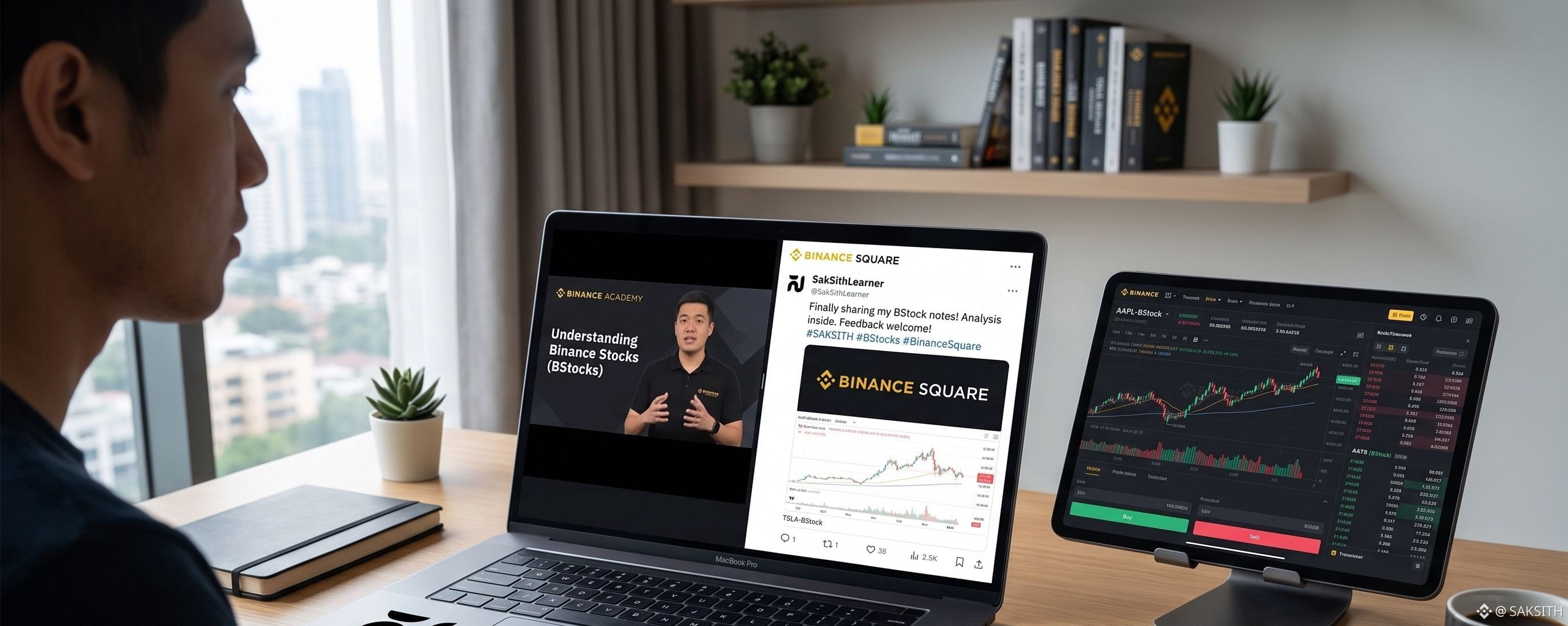
My experience learning about Binance Stocks/BStocksI have gained a great deal of knowledge and experience from learning with Binance Stocks and BStocks. Easy to investment and provides significant risk protection before we begin investing in stocks.
Understand more about Binance Stocks and BStocks
📝 🤳 Gen Z Investing Stocks and BStocks
Binance now can trade over 7,000 US-listed stocks and ETFs directly on Binance, starting with as little as $5, using stablecoins like USDT or USDC. Binance integrates stock trading into its app, so we can manage both crypto and equities in one place with 24/5 market access.
✅ Start Trading Now: Download the Binance App
1. Verify Account (KYC Required)
A fully verified Binance account is mandatory before accessing stock trading.
2. Update to the Latest Binance App (Pro Version)
The stock trading feature only appears in the latest version.
3. Fund in Wallet with Stablecoins
Supported currencies: USDT, USDC, USD1, BNB.
4. Navigate to Stocks/bStocks in the App
Tap Trade → Stocks or Market → TradFi → Stocks or Spot/bStocks.
5. Choose Stock/bStocks or ETF
Search by company name (e.g., NVDA, AAPL, GOOGL, TSLA,...) or ETF ticker (e.g., SPY, QQQ,...).
Fractional shares available from $5 minimum investment.
6. Place Order
Select Buy, enter the amount, and confirm.
Proceeds from sales are credited back in USDT or USDC.
🔶 Binance is the largest global cryptocurrency exchange by trading volume, serving over 300 million registered users worldwide.
🔶 Binance Exchange the World 🌎
Thanks you for visiting article SAKSITH: Learn • Share • Connect
👉 Learn more: Follow Binance Khmer 🇰🇭
@Binance_Square_Official @BinanceKhmer #SEABstock #SEAstock
$NVDAB $AAPLB $GOOGL.US
My experience learning about Binance Stocks/BStocks
I have gained a great deal of knowledge and experience from learning with Binance Stocks and BStocks. Easy to investment and provides significant risk protection before we begin investing in stocks.
Understand more about Binance Stocks and BStocks
📝 🤳 Gen Z Investing Stocks and BStocks
Binance now can trade over 7,000 US-listed stocks and ETFs directly on Binance, starting with as little as $5, using stablecoins like USDT or USDC. Binance integrates stock trading into its app, so we can manage both crypto and equities in one place with 24/5 market access.
✅ Start Trading Now: Download the Binance App
1. Verify Account (KYC Required)
A fully verified Binance account is mandatory before accessing stock trading.
2. Update to the Latest Binance App (Pro Version)
The stock trading feature only appears in the latest version.
3. Fund in Wallet with Stablecoins
Supported currencies: USDT, USDC, USD1, BNB.
4. Navigate to Stocks/bStocks in the App
Tap Trade → Stocks or Market → TradFi → Stocks or Spot/bStocks.
5. Choose Stock/bStocks or ETF
Search by company name (e.g., NVDA, AAPL, GOOGL, TSLA,...) or ETF ticker (e.g., SPY, QQQ,...).
Fractional shares available from $5 minimum investment.
6. Place Order
Select Buy, enter the amount, and confirm.
Proceeds from sales are credited back in USDT or USDC.
🔶 Binance is the largest global cryptocurrency exchange by trading volume, serving over 300 million registered users worldwide.
🔶 Binance Exchange the World 🌎
Thanks you for visiting article SAKSITH: Learn • Share • Connect
👉 Learn more: Follow Binance Khmer 🇰🇭
@Binance Square Official @Binance Khmer #SEABstock #SEAstock
$NVDAB $AAPLB $GOOGL.US
Understand more about Binance Stocks and BStocks
📝 🤳 Gen Z Investing Stocks and BStocks
Binance now can trade over 7,000 US-listed stocks and ETFs directly on Binance, starting with as little as $5, using stablecoins like USDT or USDC. Binance integrates stock trading into its app, so we can manage both crypto and equities in one place with 24/5 market access.
✅ Start Trading Now: Download the Binance App
1. Verify Account (KYC Required)
A fully verified Binance account is mandatory before accessing stock trading.
2. Update to the Latest Binance App (Pro Version)
The stock trading feature only appears in the latest version.
3. Fund in Wallet with Stablecoins
Supported currencies: USDT, USDC, USD1, BNB.
4. Navigate to Stocks/bStocks in the App
Tap Trade → Stocks or Market → TradFi → Stocks or Spot/bStocks.
5. Choose Stock/bStocks or ETF
Search by company name (e.g., NVDA, AAPL, GOOGL, TSLA,...) or ETF ticker (e.g., SPY, QQQ,...).
Fractional shares available from $5 minimum investment.
6. Place Order
Select Buy, enter the amount, and confirm.
Proceeds from sales are credited back in USDT or USDC.
🔶 Binance is the largest global cryptocurrency exchange by trading volume, serving over 300 million registered users worldwide.
🔶 Binance Exchange the World 🌎
Thanks you for visiting article SAKSITH: Learn • Share • Connect
👉 Learn more: Follow Binance Khmer 🇰🇭
@Binance Square Official @Binance Khmer #SEABstock #SEAstock
$NVDAB $AAPLB $GOOGL.US
1
124


Article
Final Day Reflection: Essential Rules Before Trading Stocks & BStocks on BinanceAs the Stocks & BStocks campaign reaches its final day, it is the perfect moment to reflect on our learning journey and reinforce the foundational rules of smart investing. Transitioning between cryptocurrency and traditional equity exposure—or balancing both through BStocks—opens immense opportunities, but lasting success always depends on execution discipline and risk control.
Before placing your next trade or building your long-term position, keep these core principles at the center of your strategy:
1. Build Real Valuation Literacy
Never allocate capital solely based on social media hype or green candles.
* Analyze the Business Behind the Ticker: For equities, price growth is fundamentally backed by real balance sheets, quarterly revenue expansion, and Earnings Per Share (EPS).
* Watch Valuation Benchmarks: Understand key ratios like Price-to-Earnings (P/E) to gauge whether an asset is overextended or attractively priced relative to its sector peers.2. Respect Macroeconomic Cycles
Traditional stock performance does not happen in a vacuum—it moves with broader economic currents:
* Interest Rate Direction: Track the Federal Reserve’s monetary stance closely, as interest rate adjustments dictate market liquidity and corporate borrowing costs.
* Inflation Trends: Benchmark data such as the Consumer Price Index (CPI) directly impacts consumer sentiment, corporate margins, and central bank decisions.
3. Maintain Uncompromising Risk Management
Capital preservation must always remain your highest priority:
* Asset Allocation & Diversification: Avoid the dangerous trap of all-in trades; spread risk across complementary sectors and uncorrelated asset classes.
* Dollar-Cost Averaging (DCA): Systematic, disciplined entries help eliminate emotional market timing and neutralize the pain of short-term volatility.
* Predefined Risk Limits: Decide your risk tolerance, position sizing, and invalidation points before entering any position.
4. Master Trading Psychology & Eliminate FOMO
The biggest risk to any portfolio is rarely the market itself—it is emotional impulsiveness. Overcome the Fear of Missing Out (FOMO), exercise patience during drawdowns, and stick to your researched plan throughout volatile market cycles.
Closing Thoughts
The conclusion of this campaign is just the beginning of a wiser, more versatile investment journey! Blending the dynamism of crypto with the stability of equities through Binance BStocks equips you to thrive across diverse market conditions. Keep learning, protect your
Capital and invest with purpose
Follow @BinanceKhmer for ongoing educational content, market updates, and community insights!
@Binance_Square_Official @BinanceKhmer
#SEABstock #SEAstock
Final Day Reflection: Essential Rules Before Trading Stocks & BStocks on Binance
As the Stocks & BStocks campaign reaches its final day, it is the perfect moment to reflect on our learning journey and reinforce the foundational rules of smart investing. Transitioning between cryptocurrency and traditional equity exposure—or balancing both through BStocks—opens immense opportunities, but lasting success always depends on execution discipline and risk control.
Before placing your next trade or building your long-term position, keep these core principles at the center of your strategy:
1. Build Real Valuation Literacy
Never allocate capital solely based on social media hype or green candles.
* Analyze the Business Behind the Ticker: For equities, price growth is fundamentally backed by real balance sheets, quarterly revenue expansion, and Earnings Per Share (EPS).
* Watch Valuation Benchmarks: Understand key ratios like Price-to-Earnings (P/E) to gauge whether an asset is overextended or attractively priced relative to its sector peers.2. Respect Macroeconomic Cycles
Traditional stock performance does not happen in a vacuum—it moves with broader economic currents:
* Interest Rate Direction: Track the Federal Reserve’s monetary stance closely, as interest rate adjustments dictate market liquidity and corporate borrowing costs.
* Inflation Trends: Benchmark data such as the Consumer Price Index (CPI) directly impacts consumer sentiment, corporate margins, and central bank decisions.
3. Maintain Uncompromising Risk Management
Capital preservation must always remain your highest priority:
* Asset Allocation & Diversification: Avoid the dangerous trap of all-in trades; spread risk across complementary sectors and uncorrelated asset classes.
* Dollar-Cost Averaging (DCA): Systematic, disciplined entries help eliminate emotional market timing and neutralize the pain of short-term volatility.
* Predefined Risk Limits: Decide your risk tolerance, position sizing, and invalidation points before entering any position.
4. Master Trading Psychology & Eliminate FOMO
The biggest risk to any portfolio is rarely the market itself—it is emotional impulsiveness. Overcome the Fear of Missing Out (FOMO), exercise patience during drawdowns, and stick to your researched plan throughout volatile market cycles.
Closing Thoughts
The conclusion of this campaign is just the beginning of a wiser, more versatile investment journey! Blending the dynamism of crypto with the stability of equities through Binance BStocks equips you to thrive across diverse market conditions. Keep learning, protect your
Capital and invest with purpose
Follow @Binance Khmer for ongoing educational content, market updates, and community insights!
@Binance Square Official @Binance Khmer
#SEABstock #SEAstock
Before placing your next trade or building your long-term position, keep these core principles at the center of your strategy:
1. Build Real Valuation Literacy
Never allocate capital solely based on social media hype or green candles.
* Analyze the Business Behind the Ticker: For equities, price growth is fundamentally backed by real balance sheets, quarterly revenue expansion, and Earnings Per Share (EPS).
* Watch Valuation Benchmarks: Understand key ratios like Price-to-Earnings (P/E) to gauge whether an asset is overextended or attractively priced relative to its sector peers.2. Respect Macroeconomic Cycles
Traditional stock performance does not happen in a vacuum—it moves with broader economic currents:
* Interest Rate Direction: Track the Federal Reserve’s monetary stance closely, as interest rate adjustments dictate market liquidity and corporate borrowing costs.
* Inflation Trends: Benchmark data such as the Consumer Price Index (CPI) directly impacts consumer sentiment, corporate margins, and central bank decisions.
3. Maintain Uncompromising Risk Management
Capital preservation must always remain your highest priority:
* Asset Allocation & Diversification: Avoid the dangerous trap of all-in trades; spread risk across complementary sectors and uncorrelated asset classes.
* Dollar-Cost Averaging (DCA): Systematic, disciplined entries help eliminate emotional market timing and neutralize the pain of short-term volatility.
* Predefined Risk Limits: Decide your risk tolerance, position sizing, and invalidation points before entering any position.
4. Master Trading Psychology & Eliminate FOMO
The biggest risk to any portfolio is rarely the market itself—it is emotional impulsiveness. Overcome the Fear of Missing Out (FOMO), exercise patience during drawdowns, and stick to your researched plan throughout volatile market cycles.
Closing Thoughts
The conclusion of this campaign is just the beginning of a wiser, more versatile investment journey! Blending the dynamism of crypto with the stability of equities through Binance BStocks equips you to thrive across diverse market conditions. Keep learning, protect your
Capital and invest with purpose
Follow @Binance Khmer for ongoing educational content, market updates, and community insights!
@Binance Square Official @Binance Khmer
#SEABstock #SEAstock
115

Building Better Market Knowledge with Crypto & BStocksThe more I learn about financial markets, the more I realize that successful investing starts with understanding, not simply following trends.
Crypto introduced many people to digital assets, blockchain technology, and a global market. But there is also a lot to learn from traditional financial markets and stocks.
BStocks can be an interesting way for Binance users to explore stock-related exposure within the Binance ecosystem.
Before getting started, there are several things worth understanding:
🔹 Research the company
Look at its business model, revenue, earnings, industry, competition, and future plans.
🔹 Understand market movements
Prices can change because of earnings reports, interest rates, inflation, economic data, company announcements, and investor sentiment.
🔹 Know the risks
Both crypto and stock-related products can experience price fluctuations. No investment is guaranteed to make a profit.
🔹 Avoid emotional decisions
Fear and excitement can influence decisions. Having a research-based approach can help you think more carefully.
🔹 Keep learning
Financial markets constantly change. Continuing to learn can be just as important as making an investment decision.
For me, the most important principle is simple:
Learn first. Research carefully. Understand the risks. Then make your own decision. 📚
Whether you're interested in Crypto, Stocks, or BStocks, building financial knowledge can help you better understand the opportunities and risks in different markets.
🚀 Keep learning. Keep researching. Keep growing.
What are you currently learning about?
🔶 Crypto
📈 Stocks
🌍 BStocks
@BinanceBurmese
#Binance #BinanceSquare #BStocks #SEABstock #SEAstock
⚠️ Disclaimer: This content is for educational purposes only and is not financial or investment advice. Investing involves risk, including possible loss of capital. Always conduct your own research and review the latest official product information before making any investment decision.
Building Better Market Knowledge with Crypto & BStocks
The more I learn about financial markets, the more I realize that successful investing starts with understanding, not simply following trends.
Crypto introduced many people to digital assets, blockchain technology, and a global market. But there is also a lot to learn from traditional financial markets and stocks.
BStocks can be an interesting way for Binance users to explore stock-related exposure within the Binance ecosystem.
Before getting started, there are several things worth understanding:
🔹 Research the company
Look at its business model, revenue, earnings, industry, competition, and future plans.
🔹 Understand market movements
Prices can change because of earnings reports, interest rates, inflation, economic data, company announcements, and investor sentiment.
🔹 Know the risks
Both crypto and stock-related products can experience price fluctuations. No investment is guaranteed to make a profit.
🔹 Avoid emotional decisions
Fear and excitement can influence decisions. Having a research-based approach can help you think more carefully.
🔹 Keep learning
Financial markets constantly change. Continuing to learn can be just as important as making an investment decision.
For me, the most important principle is simple:
Learn first. Research carefully. Understand the risks. Then make your own decision. 📚
Whether you're interested in Crypto, Stocks, or BStocks, building financial knowledge can help you better understand the opportunities and risks in different markets.
🚀 Keep learning. Keep researching. Keep growing.
What are you currently learning about?
🔶 Crypto
📈 Stocks
🌍 BStocks
@Binance Burmese
#Binance #BinanceSquare #BStocks #SEABstock #SEAstock
⚠️ Disclaimer: This content is for educational purposes only and is not financial or investment advice. Investing involves risk, including possible loss of capital. Always conduct your own research and review the latest official product information before making any investment decision.
Crypto introduced many people to digital assets, blockchain technology, and a global market. But there is also a lot to learn from traditional financial markets and stocks.
BStocks can be an interesting way for Binance users to explore stock-related exposure within the Binance ecosystem.
Before getting started, there are several things worth understanding:
🔹 Research the company
Look at its business model, revenue, earnings, industry, competition, and future plans.
🔹 Understand market movements
Prices can change because of earnings reports, interest rates, inflation, economic data, company announcements, and investor sentiment.
🔹 Know the risks
Both crypto and stock-related products can experience price fluctuations. No investment is guaranteed to make a profit.
🔹 Avoid emotional decisions
Fear and excitement can influence decisions. Having a research-based approach can help you think more carefully.
🔹 Keep learning
Financial markets constantly change. Continuing to learn can be just as important as making an investment decision.
For me, the most important principle is simple:
Learn first. Research carefully. Understand the risks. Then make your own decision. 📚
Whether you're interested in Crypto, Stocks, or BStocks, building financial knowledge can help you better understand the opportunities and risks in different markets.
🚀 Keep learning. Keep researching. Keep growing.
What are you currently learning about?
🔶 Crypto
📈 Stocks
🌍 BStocks
@Binance Burmese
#Binance #BinanceSquare #BStocks #SEABstock #SEAstock
⚠️ Disclaimer: This content is for educational purposes only and is not financial or investment advice. Investing involves risk, including possible loss of capital. Always conduct your own research and review the latest official product information before making any investment decision.
1
100
·
--

Article
🔶 📝 Comparison between traditional stock trading and crypto tradingTraditional stock trading and Crypto trading differ fundamentally in regulation, trading hours, volatility and ownership structure.
----------------------------------------------
👉 Traditional stock trading: Stocks ownership shares in companies (Stocks) represent company equity and trade during fixed market hours Limited: 9:30 AM - 4:00 PM (Mon-Fri), Exchanges: Centralized Regulated (e.g., NYSE) Regulation: Strict oversight (SEC, FINRA in US) with mandatory disclosures, Volatility: Generally lower, tied to company performance and macroeconomics, Income Sources: Dividends, capital appreciation and share buybacks, Custody: Stocks held via brokers or custodians, Liquidity: Deep, especially in large cap stocks, and Tax Treatment: are clear frameworks (capital gains and dividends).
👉 Crypto trading: Crypto assets are digital tokens on Blockchain (Coins, Tokens), Market open 24/7/365 trading, Exchanges: Centralized & Decentralized (e.g., BINANCE, DEX) Regulation: Varies by jurisdiction, evolving frameworks and lighter regulation, Volatility: Higher, driven by supply or demand, sentiment and network adoption, Income Sources: Staking, lending, liquidity provision and price appreciation, Custody: Crypto can be self custodied (seed phrase or private keys) or Exchange held, Liquidity: Varies, major coins (BTC, ETH, BNB) liquid, smaller tokens less so.
✅ Cryptos are risks than Stocks:
✍️ Crypto Risks: Exchange hacks, rug pulls projects, regulatory crackdowns and extreme volatility.
✍️ Stock Risks: Earnings disappointments, recessions, corporate scandals but generally less extreme.
✅ Stock trading and Crypto trading:
✍️ Stock is value stability, regulation and long term wealth building.
✍️ Crypto is seek high risks high rewards opportunities and are comfortable with constant market monitoring.
Thanks you for visiting article SAKSITH: Learn • Share • Connect
👉 Learn more: Follow Binance Khmer 🇰🇭
@Binance_Square_Official @BinanceKhmer #SEABstock #SEAstock
$NVDAB $AAPLB $GOOGL.US
🔶 📝 Comparison between traditional stock trading and crypto trading
Traditional stock trading and Crypto trading differ fundamentally in regulation, trading hours, volatility and ownership structure.
----------------------------------------------
👉 Traditional stock trading: Stocks ownership shares in companies (Stocks) represent company equity and trade during fixed market hours Limited: 9:30 AM - 4:00 PM (Mon-Fri), Exchanges: Centralized Regulated (e.g., NYSE) Regulation: Strict oversight (SEC, FINRA in US) with mandatory disclosures, Volatility: Generally lower, tied to company performance and macroeconomics, Income Sources: Dividends, capital appreciation and share buybacks, Custody: Stocks held via brokers or custodians, Liquidity: Deep, especially in large cap stocks, and Tax Treatment: are clear frameworks (capital gains and dividends).
👉 Crypto trading: Crypto assets are digital tokens on Blockchain (Coins, Tokens), Market open 24/7/365 trading, Exchanges: Centralized & Decentralized (e.g., BINANCE, DEX) Regulation: Varies by jurisdiction, evolving frameworks and lighter regulation, Volatility: Higher, driven by supply or demand, sentiment and network adoption, Income Sources: Staking, lending, liquidity provision and price appreciation, Custody: Crypto can be self custodied (seed phrase or private keys) or Exchange held, Liquidity: Varies, major coins (BTC, ETH, BNB) liquid, smaller tokens less so.
✅ Cryptos are risks than Stocks:
✍️ Crypto Risks: Exchange hacks, rug pulls projects, regulatory crackdowns and extreme volatility.
✍️ Stock Risks: Earnings disappointments, recessions, corporate scandals but generally less extreme.
✅ Stock trading and Crypto trading:
✍️ Stock is value stability, regulation and long term wealth building.
✍️ Crypto is seek high risks high rewards opportunities and are comfortable with constant market monitoring.
Thanks you for visiting article SAKSITH: Learn • Share • Connect
👉 Learn more: Follow Binance Khmer 🇰🇭
@Binance Square Official @Binance Khmer #SEABstock #SEAstock
$NVDAB $AAPLB $GOOGL.US
----------------------------------------------
👉 Traditional stock trading: Stocks ownership shares in companies (Stocks) represent company equity and trade during fixed market hours Limited: 9:30 AM - 4:00 PM (Mon-Fri), Exchanges: Centralized Regulated (e.g., NYSE) Regulation: Strict oversight (SEC, FINRA in US) with mandatory disclosures, Volatility: Generally lower, tied to company performance and macroeconomics, Income Sources: Dividends, capital appreciation and share buybacks, Custody: Stocks held via brokers or custodians, Liquidity: Deep, especially in large cap stocks, and Tax Treatment: are clear frameworks (capital gains and dividends).
👉 Crypto trading: Crypto assets are digital tokens on Blockchain (Coins, Tokens), Market open 24/7/365 trading, Exchanges: Centralized & Decentralized (e.g., BINANCE, DEX) Regulation: Varies by jurisdiction, evolving frameworks and lighter regulation, Volatility: Higher, driven by supply or demand, sentiment and network adoption, Income Sources: Staking, lending, liquidity provision and price appreciation, Custody: Crypto can be self custodied (seed phrase or private keys) or Exchange held, Liquidity: Varies, major coins (BTC, ETH, BNB) liquid, smaller tokens less so.
✅ Cryptos are risks than Stocks:
✍️ Crypto Risks: Exchange hacks, rug pulls projects, regulatory crackdowns and extreme volatility.
✍️ Stock Risks: Earnings disappointments, recessions, corporate scandals but generally less extreme.
✅ Stock trading and Crypto trading:
✍️ Stock is value stability, regulation and long term wealth building.
✍️ Crypto is seek high risks high rewards opportunities and are comfortable with constant market monitoring.
Thanks you for visiting article SAKSITH: Learn • Share • Connect
👉 Learn more: Follow Binance Khmer 🇰🇭
@Binance Square Official @Binance Khmer #SEABstock #SEAstock
$NVDAB $AAPLB $GOOGL.US
1
193

@BinanceBurmeseSEABstockOption 1: Focus on BStocks vs. Traditional Stocks (Recommended)
Title: What is BStocks? Why It is More Attractive Than Traditional Stocks for Modern Investors
The global financial landscape is evolving at an unprecedented pace. The intersection of cryptocurrency and traditional equities has given rise to a groundbreaking concept: BStocks (Tokenized Stocks). This innovative asset class bridges the gap between decentralized finance (DeFi) and Wall Street, offering retail investors unique opportunities that were previously out of reach. In this article, we will explore what BStocks are, how they differ from traditional stocks, and why they represent a massive leap forward for investors.
Understanding Traditional Stocks
Traditional stocks represent fractional ownership in a corporation. When you buy a share of Apple, Microsoft, or Tesla, you own a piece of that business. To invest in traditional stocks, individuals must open an account with a centralized stockbroker, navigate regional compliance laws, and trade strictly within local stock exchange operating hours. For global investors outside the United States, accessing US equities often involves hefty cross-border fees and complicated foreign currency conversions.
Enter BStocks: What Are They?
BStocks are tokenized representations of traditional shares backed by real-world securities. Using blockchain technology, a single share of a company is locked in a secure custody account, and equivalent digital tokens are minted on the blockchain. This process brings traditional equities directly into the crypto ecosystem. Instead of dealing with traditional brokers, you can buy, sell, and hold these tokenized stocks on crypto platforms like Binance using stablecoins.
Key Advantages of BStocks Over Traditional Stocks
Fractional Share Ownership
High-performing stocks like Tesla, Amazon, or Berkshire Hathaway often trade at hundreds or thousands of dollars per single share. This high barrier to entry prevents small retail investors from building a diversified portfolio. BStocks solve this problem by allowing fractional ownership. You do not need to buy a whole share; you can buy a tiny fraction (e.g., $5 or $10 worth of a stock) using your crypto balance. This democratizes investing for everyone.
24/7 Global Trading Hours
Traditional stock markets operate on rigid schedules—usually 9:30 AM to 4:00 PM, Monday through Friday, excluding public holidays. If major news breaks over the weekend, investors are stuck waiting for the market to open. BStocks change the game by mirroring the crypto market's 24/7 nature. You can trade your favorite tokenized equities anytime, day or night, from anywhere in the world.
Instant Liquidity and Seamless Integration
For crypto users, shifting capital into traditional stocks usually requires withdrawing funds to a bank account, waiting days for settlement, and paying transfer fees. With BStocks, your capital stays within the crypto ecosystem. You can instantly swap stablecoins like USDT for BStocks in seconds. This hyper-liquidity allows you to react instantly to macroeconomic shifts.
Conclusion
In summary, asset diversification is the ultimate strategy for wealth preservation. Keeping all your capital in one basket is highly risky. BStocks offer an elegant solution by providing crypto users with seamless, affordable, and flexible access to the world's most lucrative stock markets. As blockchain technology continues to mature, tokenized assets like BStocks are poised to become the standard for modern wealth management.
@BinanceBurmese e#SEAstock
#SEABstock
@BinanceBurmese
SEABstockOption 1: Focus on BStocks vs. Traditional Stocks (Recommended)
Title: What is BStocks? Why It is More Attractive Than Traditional Stocks for Modern Investors
The global financial landscape is evolving at an unprecedented pace. The intersection of cryptocurrency and traditional equities has given rise to a groundbreaking concept: BStocks (Tokenized Stocks). This innovative asset class bridges the gap between decentralized finance (DeFi) and Wall Street, offering retail investors unique opportunities that were previously out of reach. In this article, we will explore what BStocks are, how they differ from traditional stocks, and why they represent a massive leap forward for investors.
Understanding Traditional Stocks
Traditional stocks represent fractional ownership in a corporation. When you buy a share of Apple, Microsoft, or Tesla, you own a piece of that business. To invest in traditional stocks, individuals must open an account with a centralized stockbroker, navigate regional compliance laws, and trade strictly within local stock exchange operating hours. For global investors outside the United States, accessing US equities often involves hefty cross-border fees and complicated foreign currency conversions.
Enter BStocks: What Are They?
BStocks are tokenized representations of traditional shares backed by real-world securities. Using blockchain technology, a single share of a company is locked in a secure custody account, and equivalent digital tokens are minted on the blockchain. This process brings traditional equities directly into the crypto ecosystem. Instead of dealing with traditional brokers, you can buy, sell, and hold these tokenized stocks on crypto platforms like Binance using stablecoins.
Key Advantages of BStocks Over Traditional Stocks
Fractional Share Ownership
High-performing stocks like Tesla, Amazon, or Berkshire Hathaway often trade at hundreds or thousands of dollars per single share. This high barrier to entry prevents small retail investors from building a diversified portfolio. BStocks solve this problem by allowing fractional ownership. You do not need to buy a whole share; you can buy a tiny fraction (e.g., $5 or $10 worth of a stock) using your crypto balance. This democratizes investing for everyone.
24/7 Global Trading Hours
Traditional stock markets operate on rigid schedules—usually 9:30 AM to 4:00 PM, Monday through Friday, excluding public holidays. If major news breaks over the weekend, investors are stuck waiting for the market to open. BStocks change the game by mirroring the crypto market's 24/7 nature. You can trade your favorite tokenized equities anytime, day or night, from anywhere in the world.
Instant Liquidity and Seamless Integration
For crypto users, shifting capital into traditional stocks usually requires withdrawing funds to a bank account, waiting days for settlement, and paying transfer fees. With BStocks, your capital stays within the crypto ecosystem. You can instantly swap stablecoins like USDT for BStocks in seconds. This hyper-liquidity allows you to react instantly to macroeconomic shifts.
Conclusion
In summary, asset diversification is the ultimate strategy for wealth preservation. Keeping all your capital in one basket is highly risky. BStocks offer an elegant solution by providing crypto users with seamless, affordable, and flexible access to the world's most lucrative stock markets. As blockchain technology continues to mature, tokenized assets like BStocks are poised to become the standard for modern wealth management.
@Binance Burmese e#SEAstock
#SEABstock
Title: What is BStocks? Why It is More Attractive Than Traditional Stocks for Modern Investors
The global financial landscape is evolving at an unprecedented pace. The intersection of cryptocurrency and traditional equities has given rise to a groundbreaking concept: BStocks (Tokenized Stocks). This innovative asset class bridges the gap between decentralized finance (DeFi) and Wall Street, offering retail investors unique opportunities that were previously out of reach. In this article, we will explore what BStocks are, how they differ from traditional stocks, and why they represent a massive leap forward for investors.
Understanding Traditional Stocks
Traditional stocks represent fractional ownership in a corporation. When you buy a share of Apple, Microsoft, or Tesla, you own a piece of that business. To invest in traditional stocks, individuals must open an account with a centralized stockbroker, navigate regional compliance laws, and trade strictly within local stock exchange operating hours. For global investors outside the United States, accessing US equities often involves hefty cross-border fees and complicated foreign currency conversions.
Enter BStocks: What Are They?
BStocks are tokenized representations of traditional shares backed by real-world securities. Using blockchain technology, a single share of a company is locked in a secure custody account, and equivalent digital tokens are minted on the blockchain. This process brings traditional equities directly into the crypto ecosystem. Instead of dealing with traditional brokers, you can buy, sell, and hold these tokenized stocks on crypto platforms like Binance using stablecoins.
Key Advantages of BStocks Over Traditional Stocks
Fractional Share Ownership
High-performing stocks like Tesla, Amazon, or Berkshire Hathaway often trade at hundreds or thousands of dollars per single share. This high barrier to entry prevents small retail investors from building a diversified portfolio. BStocks solve this problem by allowing fractional ownership. You do not need to buy a whole share; you can buy a tiny fraction (e.g., $5 or $10 worth of a stock) using your crypto balance. This democratizes investing for everyone.
24/7 Global Trading Hours
Traditional stock markets operate on rigid schedules—usually 9:30 AM to 4:00 PM, Monday through Friday, excluding public holidays. If major news breaks over the weekend, investors are stuck waiting for the market to open. BStocks change the game by mirroring the crypto market's 24/7 nature. You can trade your favorite tokenized equities anytime, day or night, from anywhere in the world.
Instant Liquidity and Seamless Integration
For crypto users, shifting capital into traditional stocks usually requires withdrawing funds to a bank account, waiting days for settlement, and paying transfer fees. With BStocks, your capital stays within the crypto ecosystem. You can instantly swap stablecoins like USDT for BStocks in seconds. This hyper-liquidity allows you to react instantly to macroeconomic shifts.
Conclusion
In summary, asset diversification is the ultimate strategy for wealth preservation. Keeping all your capital in one basket is highly risky. BStocks offer an elegant solution by providing crypto users with seamless, affordable, and flexible access to the world's most lucrative stock markets. As blockchain technology continues to mature, tokenized assets like BStocks are poised to become the standard for modern wealth management.
@Binance Burmese e#SEAstock
#SEABstock
1
123

·
--
Stocks Vs Crypto 🔥 How I Look at the Differences, Risks, and Real OpportunitiesLate night thought on market dynamics, If you’ve spent any time looking at order books or reading community discussions lately, you know the debate never stops. On one side, traditional stock traders call crypto pure speculative hype. On the other, crypto natives look at traditional equities as slow, outdated relics.
When you strip away the social media noise and focus purely on market structure, both asset classes serve very distinct purposes. Understanding how they actually function and how to manage risk across both is what keeps a portfolio alive long term.
What Are We Actually Holding?
For me, the key difference always comes down to business equity versus network utility.
When you buy a stock, you are acquiring fractional ownership in an actual corporate balance sheet. Your thesis is tied to revenues, real world assets, profit margins, and quarterly earnings. The regulatory frameworks are mature, and corporate governance is structured.
Even with derivative equity products and tokenized stock offerings like BStocks, you are interacting directly with the price action and market movement of those underlying real world assets, giving you seamless flexibility right inside modern trading environments.
Crypto operates on an entirely different engine. You aren't buying corporate equity; you're holding a native digital asset within a decentralized blockchain framework. Some tokens act as digital stores of value, while others function as protocol gasoline needed to power smart contracts and DeFi applications. The price isn't reacting to quarterly financial reports it’s moving based on liquidity flows, network adoption, order book depth, and technological traction.
Risk Profiles❣️
Controlled Movements vs. 24/7 Volatility
Risk management is where the gap becomes most obvious. Every asset carries risk, but they demand completely different execution strategies:
Stock Market Structure: Equities move based on macro trends, interest rates, and earnings cycles. While individual stocks certainly carry downside risk, major stock markets operate with set trading hours, deep institutional liquidity, and circuit breakers designed to prevent sudden market panics.
Crypto Market Dynamics: Crypto never sleeps. It runs 24/7 with zero market pauses. Driven by constant global retail liquidity and fast shifting market sentiment, intra-day swings of 10% or more are standard. Trading this market requires ironclad stop-loss execution, strict position sizing, and zero emotional bias otherwise, sudden drawdowns will wipe you out before you can react.
Where I See the Opportunities
Why Equities Belong in the Picture, Compounding and structural stability. History shows that traditional equity markets reflect long-term macroeconomic growth. Combined with steady dividend payouts, stocks offer reliable capital preservation and predictable compounding over long timeframes.
Why Crypto Can't Be Ignored.... Asymmetric upside and market innovation. Crypto gives you front-row exposure to next generation financial infrastructure, tokenized real world assets, and fast-moving volatility. For disciplined traders, that continuous market activity creates trade setups you rarely find in slower-moving traditional markets.
My Strategy Takeaway
I don't view this as Stocks vs. Crypto, I view it as choosing the right tool for the right job.
Equities and tokenized stock products form the baseline foundation: structured, steady, and built to survive long term market weather. Crypto is the high performance engine: capable of rapid acceleration, but demanding intense risk discipline and constant focus.
Position sizing is everything. Protect your capital, respect the stop loss, and never over-leverage a position regardless of how clean the setup looks.
#SEAstock #SEABstock @BinanceBurmese
Stocks Vs Crypto 🔥 How I Look at the Differences, Risks, and Real Opportunities
Late night thought on market dynamics, If you’ve spent any time looking at order books or reading community discussions lately, you know the debate never stops. On one side, traditional stock traders call crypto pure speculative hype. On the other, crypto natives look at traditional equities as slow, outdated relics.
When you strip away the social media noise and focus purely on market structure, both asset classes serve very distinct purposes. Understanding how they actually function and how to manage risk across both is what keeps a portfolio alive long term.
What Are We Actually Holding?
For me, the key difference always comes down to business equity versus network utility.
When you buy a stock, you are acquiring fractional ownership in an actual corporate balance sheet. Your thesis is tied to revenues, real world assets, profit margins, and quarterly earnings. The regulatory frameworks are mature, and corporate governance is structured.
Even with derivative equity products and tokenized stock offerings like BStocks, you are interacting directly with the price action and market movement of those underlying real world assets, giving you seamless flexibility right inside modern trading environments.
Crypto operates on an entirely different engine. You aren't buying corporate equity; you're holding a native digital asset within a decentralized blockchain framework. Some tokens act as digital stores of value, while others function as protocol gasoline needed to power smart contracts and DeFi applications. The price isn't reacting to quarterly financial reports it’s moving based on liquidity flows, network adoption, order book depth, and technological traction.
Risk Profiles❣️
Controlled Movements vs. 24/7 Volatility
Risk management is where the gap becomes most obvious. Every asset carries risk, but they demand completely different execution strategies:
Stock Market Structure: Equities move based on macro trends, interest rates, and earnings cycles. While individual stocks certainly carry downside risk, major stock markets operate with set trading hours, deep institutional liquidity, and circuit breakers designed to prevent sudden market panics.
Crypto Market Dynamics: Crypto never sleeps. It runs 24/7 with zero market pauses. Driven by constant global retail liquidity and fast shifting market sentiment, intra-day swings of 10% or more are standard. Trading this market requires ironclad stop-loss execution, strict position sizing, and zero emotional bias otherwise, sudden drawdowns will wipe you out before you can react.
Where I See the Opportunities
Why Equities Belong in the Picture, Compounding and structural stability. History shows that traditional equity markets reflect long-term macroeconomic growth. Combined with steady dividend payouts, stocks offer reliable capital preservation and predictable compounding over long timeframes.
Why Crypto Can't Be Ignored.... Asymmetric upside and market innovation. Crypto gives you front-row exposure to next generation financial infrastructure, tokenized real world assets, and fast-moving volatility. For disciplined traders, that continuous market activity creates trade setups you rarely find in slower-moving traditional markets.
My Strategy Takeaway
I don't view this as Stocks vs. Crypto, I view it as choosing the right tool for the right job.
Equities and tokenized stock products form the baseline foundation: structured, steady, and built to survive long term market weather. Crypto is the high performance engine: capable of rapid acceleration, but demanding intense risk discipline and constant focus.
Position sizing is everything. Protect your capital, respect the stop loss, and never over-leverage a position regardless of how clean the setup looks.
#SEAstock #SEABstock @Binance Burmese
When you strip away the social media noise and focus purely on market structure, both asset classes serve very distinct purposes. Understanding how they actually function and how to manage risk across both is what keeps a portfolio alive long term.
What Are We Actually Holding?
For me, the key difference always comes down to business equity versus network utility.
When you buy a stock, you are acquiring fractional ownership in an actual corporate balance sheet. Your thesis is tied to revenues, real world assets, profit margins, and quarterly earnings. The regulatory frameworks are mature, and corporate governance is structured.
Even with derivative equity products and tokenized stock offerings like BStocks, you are interacting directly with the price action and market movement of those underlying real world assets, giving you seamless flexibility right inside modern trading environments.
Crypto operates on an entirely different engine. You aren't buying corporate equity; you're holding a native digital asset within a decentralized blockchain framework. Some tokens act as digital stores of value, while others function as protocol gasoline needed to power smart contracts and DeFi applications. The price isn't reacting to quarterly financial reports it’s moving based on liquidity flows, network adoption, order book depth, and technological traction.
Risk Profiles❣️
Controlled Movements vs. 24/7 Volatility
Risk management is where the gap becomes most obvious. Every asset carries risk, but they demand completely different execution strategies:
Stock Market Structure: Equities move based on macro trends, interest rates, and earnings cycles. While individual stocks certainly carry downside risk, major stock markets operate with set trading hours, deep institutional liquidity, and circuit breakers designed to prevent sudden market panics.
Crypto Market Dynamics: Crypto never sleeps. It runs 24/7 with zero market pauses. Driven by constant global retail liquidity and fast shifting market sentiment, intra-day swings of 10% or more are standard. Trading this market requires ironclad stop-loss execution, strict position sizing, and zero emotional bias otherwise, sudden drawdowns will wipe you out before you can react.
Where I See the Opportunities
Why Equities Belong in the Picture, Compounding and structural stability. History shows that traditional equity markets reflect long-term macroeconomic growth. Combined with steady dividend payouts, stocks offer reliable capital preservation and predictable compounding over long timeframes.
Why Crypto Can't Be Ignored.... Asymmetric upside and market innovation. Crypto gives you front-row exposure to next generation financial infrastructure, tokenized real world assets, and fast-moving volatility. For disciplined traders, that continuous market activity creates trade setups you rarely find in slower-moving traditional markets.
My Strategy Takeaway
I don't view this as Stocks vs. Crypto, I view it as choosing the right tool for the right job.
Equities and tokenized stock products form the baseline foundation: structured, steady, and built to survive long term market weather. Crypto is the high performance engine: capable of rapid acceleration, but demanding intense risk discipline and constant focus.
Position sizing is everything. Protect your capital, respect the stop loss, and never over-leverage a position regardless of how clean the setup looks.
#SEAstock #SEABstock @Binance Burmese
OnyXL:
@BiBi Summarize this content
3
1
5
383

·
--
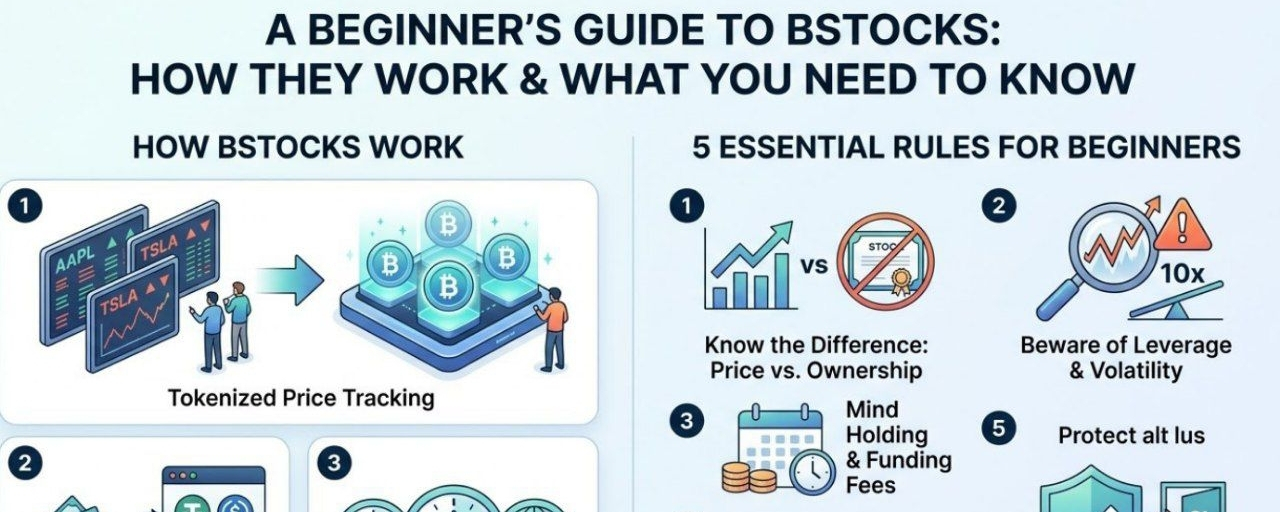
Article
A Beginner’s Guide to BStocks ! How They Work & What You Need to KnowIf you’ve spent any time on crypto exchanges lately, you’ve probably noticed the line between traditional stocks and crypto getting a lot blurrier. Enter BStocks tokenized stock futures and equity derivatives that let you trade market giants like Tesla, Nvidia, or Apple right from your crypto wallet.
If waiting for Wall Street opening bells feels outdated, or if setting up a traditional brokerage account feels like a headache, BStocks offer a smooth alternative. But before you jump in with real capital, here is a breakdown of how they work, why traders use them, and the essential rules every beginner should follow.
What Exactly Are BStocks?
At their core, BStocks are tokenized contracts that track the real-time price of public stocks.
When you trade a BStock, you are not buying actual equity or physical shares in the company. You don’t get voting rights, and you won't show up on the company's official list of shareholders. Instead, you are trading a crypto-collateralized position that mirrors the price action of that stock.
Think of it like trading crypto perpetual futures, but instead of tracking Bitcoin, the underlying asset is an equity listed on the stock market.
How Do They Work Behind the Scenes?
* Crypto Collateral: Instead of needing USD or traditional bank transfers, you back your trades using stablecoins like USDT or USDC.
* Extended Trading Access: Wall Street operates on rigid hours (9:30 AM to 4:00 PM EST). BStocks leverage tokenized structures to give you broader trading access, making it easier to react to news or earnings releases as they happen.
√Fractional Positions: Buying a single full share of a top tech stock can be pricey. Tokenization lets you buy fractions of a share, so you can build a balanced portfolio with whatever budget you have.
√ Leverage Options: Platforms often offer margin or leverage on BStocks. This can boost your gains on smaller price moves, but it also increases your risk if the market turns against you.
5 Essential Rules for Beginners
1. Price Action vs. Company Ownership
Always remember that you are trading price movements, not owning the business. Because you don't hold physical shares, dividend payments depend on the specific derivative setup often reflected as price adjustments or synthetic distributions, so check the product terms before holding long-term.
2. Watch Out for Earnings Volatility
If you are used to crypto, high leverage might feel normal. But stock earnings reports and macroeconomic announcements can trigger sudden price gaps. Combining high leverage with stock volatility is the fastest way to get liquidated.
3. Mind the Holding and Funding Fees
Since BStocks function as perpetual or derivative contracts, holding a position open over time incurs small periodic funding fees. If you plan to swing trade or hold for several days, keep an eye on these costs so they don't eat into your profits.
4. Pay Attention to Order Book Liquidity
Tokenized stocks don't always have the exact same order book depth as the NYSE or NASDAQ. Check the bid ask spread before hitting buy or sell to avoid losing money to slippage on market orders.
5. Protect Your Capital First
Never open a BStock trade without a plan. Place a clear Stop-Loss (SL) to cap your risk if the market dumps, and take partial profits (TP) along the way instead of waiting for an unrealistic target.
Final Takeaway
BStocks are a handy bridge between traditional finance and crypto. They let you capitalize on stock market trends without having to cash out to fiat or leave your favorite exchange platform. Just remember to treat them with respect: start small, keep your leverage low, and always stick to your risk management strategy.
#SEAstock #SEABstock @BinanceBurmese
A Beginner’s Guide to BStocks ! How They Work & What You Need to Know
If you’ve spent any time on crypto exchanges lately, you’ve probably noticed the line between traditional stocks and crypto getting a lot blurrier. Enter BStocks tokenized stock futures and equity derivatives that let you trade market giants like Tesla, Nvidia, or Apple right from your crypto wallet.
If waiting for Wall Street opening bells feels outdated, or if setting up a traditional brokerage account feels like a headache, BStocks offer a smooth alternative. But before you jump in with real capital, here is a breakdown of how they work, why traders use them, and the essential rules every beginner should follow.
What Exactly Are BStocks?
At their core, BStocks are tokenized contracts that track the real-time price of public stocks.
When you trade a BStock, you are not buying actual equity or physical shares in the company. You don’t get voting rights, and you won't show up on the company's official list of shareholders. Instead, you are trading a crypto-collateralized position that mirrors the price action of that stock.
Think of it like trading crypto perpetual futures, but instead of tracking Bitcoin, the underlying asset is an equity listed on the stock market.
How Do They Work Behind the Scenes?
* Crypto Collateral: Instead of needing USD or traditional bank transfers, you back your trades using stablecoins like USDT or USDC.
* Extended Trading Access: Wall Street operates on rigid hours (9:30 AM to 4:00 PM EST). BStocks leverage tokenized structures to give you broader trading access, making it easier to react to news or earnings releases as they happen.
√Fractional Positions: Buying a single full share of a top tech stock can be pricey. Tokenization lets you buy fractions of a share, so you can build a balanced portfolio with whatever budget you have.
√ Leverage Options: Platforms often offer margin or leverage on BStocks. This can boost your gains on smaller price moves, but it also increases your risk if the market turns against you.
5 Essential Rules for Beginners
1. Price Action vs. Company Ownership
Always remember that you are trading price movements, not owning the business. Because you don't hold physical shares, dividend payments depend on the specific derivative setup often reflected as price adjustments or synthetic distributions, so check the product terms before holding long-term.
2. Watch Out for Earnings Volatility
If you are used to crypto, high leverage might feel normal. But stock earnings reports and macroeconomic announcements can trigger sudden price gaps. Combining high leverage with stock volatility is the fastest way to get liquidated.
3. Mind the Holding and Funding Fees
Since BStocks function as perpetual or derivative contracts, holding a position open over time incurs small periodic funding fees. If you plan to swing trade or hold for several days, keep an eye on these costs so they don't eat into your profits.
4. Pay Attention to Order Book Liquidity
Tokenized stocks don't always have the exact same order book depth as the NYSE or NASDAQ. Check the bid ask spread before hitting buy or sell to avoid losing money to slippage on market orders.
5. Protect Your Capital First
Never open a BStock trade without a plan. Place a clear Stop-Loss (SL) to cap your risk if the market dumps, and take partial profits (TP) along the way instead of waiting for an unrealistic target.
Final Takeaway
BStocks are a handy bridge between traditional finance and crypto. They let you capitalize on stock market trends without having to cash out to fiat or leave your favorite exchange platform. Just remember to treat them with respect: start small, keep your leverage low, and always stick to your risk management strategy.
#SEAstock #SEABstock @Binance Burmese
If waiting for Wall Street opening bells feels outdated, or if setting up a traditional brokerage account feels like a headache, BStocks offer a smooth alternative. But before you jump in with real capital, here is a breakdown of how they work, why traders use them, and the essential rules every beginner should follow.
What Exactly Are BStocks?
At their core, BStocks are tokenized contracts that track the real-time price of public stocks.
When you trade a BStock, you are not buying actual equity or physical shares in the company. You don’t get voting rights, and you won't show up on the company's official list of shareholders. Instead, you are trading a crypto-collateralized position that mirrors the price action of that stock.
Think of it like trading crypto perpetual futures, but instead of tracking Bitcoin, the underlying asset is an equity listed on the stock market.
How Do They Work Behind the Scenes?
* Crypto Collateral: Instead of needing USD or traditional bank transfers, you back your trades using stablecoins like USDT or USDC.
* Extended Trading Access: Wall Street operates on rigid hours (9:30 AM to 4:00 PM EST). BStocks leverage tokenized structures to give you broader trading access, making it easier to react to news or earnings releases as they happen.
√Fractional Positions: Buying a single full share of a top tech stock can be pricey. Tokenization lets you buy fractions of a share, so you can build a balanced portfolio with whatever budget you have.
√ Leverage Options: Platforms often offer margin or leverage on BStocks. This can boost your gains on smaller price moves, but it also increases your risk if the market turns against you.
5 Essential Rules for Beginners
1. Price Action vs. Company Ownership
Always remember that you are trading price movements, not owning the business. Because you don't hold physical shares, dividend payments depend on the specific derivative setup often reflected as price adjustments or synthetic distributions, so check the product terms before holding long-term.
2. Watch Out for Earnings Volatility
If you are used to crypto, high leverage might feel normal. But stock earnings reports and macroeconomic announcements can trigger sudden price gaps. Combining high leverage with stock volatility is the fastest way to get liquidated.
3. Mind the Holding and Funding Fees
Since BStocks function as perpetual or derivative contracts, holding a position open over time incurs small periodic funding fees. If you plan to swing trade or hold for several days, keep an eye on these costs so they don't eat into your profits.
4. Pay Attention to Order Book Liquidity
Tokenized stocks don't always have the exact same order book depth as the NYSE or NASDAQ. Check the bid ask spread before hitting buy or sell to avoid losing money to slippage on market orders.
5. Protect Your Capital First
Never open a BStock trade without a plan. Place a clear Stop-Loss (SL) to cap your risk if the market dumps, and take partial profits (TP) along the way instead of waiting for an unrealistic target.
Final Takeaway
BStocks are a handy bridge between traditional finance and crypto. They let you capitalize on stock market trends without having to cash out to fiat or leave your favorite exchange platform. Just remember to treat them with respect: start small, keep your leverage low, and always stick to your risk management strategy.
#SEAstock #SEABstock @Binance Burmese
FiloCL:
thank you sharing with easy way
1
2
3
431

·
--
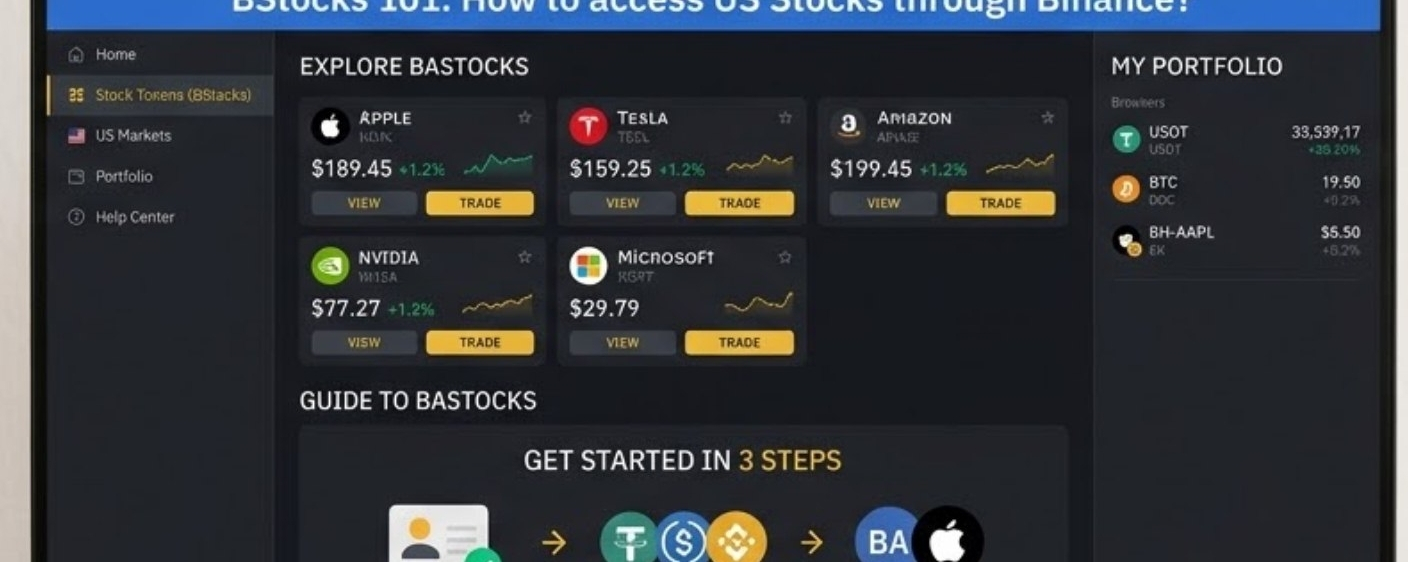
Article
BStocks 101: How to Access US Stocks through BinanceEver wished you could grab a quick piece of Apple, Tesla, or Nvidia without having to open a traditional brokerage account, fill out endless paperwork, or deal with strict international banking boundaries?
If you’ve been hanging around the crypto space for any length of time, you’ve probably heard of BStocks—Binance’s take on bridging Wall Street and Web3. While the way we trade stock tokens on crypto platforms has evolved over time, the core dream remains the same: buying and selling real-world assets with the same speed, flexibility, and 24/7 convenience you get with crypto.
Let’s break down what BStocks (and tokenized US equities) are all about, how the process works in plain English, and how you can get exposure to US stocks using your Binance wallet.
First Off: What Exactly Is a Stock Token?
In simple terms, a stock token is a digital asset whose value is directly tied to a real-world company’s share price.
Think of it like buying a digital gift card for a store, except the value of that gift card goes up or down depending on how well the company performs.
No Need to Buy Whole Shares: Stock price sitting at $800? No problem. With tokenized assets, you can put in $10 or $20 and buy a fraction of a share.
No Traditional Broker Hurdles: You don’t have to wait days for international bank transfers to clear just to buy a tech stock.
Crypto Convenience: You hold, trade, or settle everything using familiar stablecoins like USDT or BUSD.
The Reality Check: How Does It Work Today?
Back in 2021, Binance directly hosted native stock tokens on its centralized exchange. However, due to global financial regulations, direct stock token trading on the main centralized exchange was paused.
So, how do crypto users get US stock exposure through Binance today?
The answer lies in Web3 wallets, DeFi integration, and synthetic tokenized asset platforms accessible through the Binance Web3 ecosystem. Users hold their funds on Binance, connect to compliant DeFi protocols or partner tokenized stock platforms (like Backed Finance or similar decentralized stock pools), and swap their stablecoins for stock-pegged tokens.
Step-by-Step: Getting US Stock Exposure via Your Binance Funds
If you want to move your crypto into US stock exposure using Binance as your primary hub, here is the straightforward path to do it:
Step 1: Set Up and Verify Your Binance Account
Before doing anything, make sure your primary Binance account is fully verified through standard Know Your Customer (KYC) identity checks. This unlocks account funding and secure withdrawals.
Step 2: Load Up on Stablecoins
Acquire a liquid stablecoin such as USDT or USDC. You can do this via peer-to-peer (P2P) trading, direct credit card purchases, or by converting existing crypto holdings on Binance.
Step 3: Activate Your Binance Web3 Wallet
Inside the official Binance app, switch over to the Web3 Wallet tab. This non-custodial wallet links directly with your main Binance account, letting you seamlessly transfer funds into decentralized finance (DeFi) spaces.
Step 4: Connect to a Tokenized Stock Protocol
Through the Web3 wallet browser, access reputable synthetic asset or tokenized real-world asset (RWA) platforms that offer US stock-backed tokens (such as Apple, Tesla, or S&P 500 index tokens).
Step 5: Execute the Swap
Choose the stock token you want to buy, enter the amount of stablecoins you wish to spend, and confirm the transaction. The tokens will land directly in your Web3 wallet.
What You Need to Watch Out For (The Risks)
While trading stock tokens feels fast and futuristic, it’s not without a few catches:
Market Hours vs. Crypto Hours: Crypto trades 24/7, but standard US stock markets only operate during regular US business hours. Prices on stock tokens usually update live when Wall Street is open, but liquidity can slow down over the weekend.
#SEABstock #SEAstock @BinanceBurmese
BStocks 101: How to Access US Stocks through Binance
Ever wished you could grab a quick piece of Apple, Tesla, or Nvidia without having to open a traditional brokerage account, fill out endless paperwork, or deal with strict international banking boundaries?
If you’ve been hanging around the crypto space for any length of time, you’ve probably heard of BStocks—Binance’s take on bridging Wall Street and Web3. While the way we trade stock tokens on crypto platforms has evolved over time, the core dream remains the same: buying and selling real-world assets with the same speed, flexibility, and 24/7 convenience you get with crypto.
Let’s break down what BStocks (and tokenized US equities) are all about, how the process works in plain English, and how you can get exposure to US stocks using your Binance wallet.
First Off: What Exactly Is a Stock Token?
In simple terms, a stock token is a digital asset whose value is directly tied to a real-world company’s share price.
Think of it like buying a digital gift card for a store, except the value of that gift card goes up or down depending on how well the company performs.
No Need to Buy Whole Shares: Stock price sitting at $800? No problem. With tokenized assets, you can put in $10 or $20 and buy a fraction of a share.
No Traditional Broker Hurdles: You don’t have to wait days for international bank transfers to clear just to buy a tech stock.
Crypto Convenience: You hold, trade, or settle everything using familiar stablecoins like USDT or BUSD.
The Reality Check: How Does It Work Today?
Back in 2021, Binance directly hosted native stock tokens on its centralized exchange. However, due to global financial regulations, direct stock token trading on the main centralized exchange was paused.
So, how do crypto users get US stock exposure through Binance today?
The answer lies in Web3 wallets, DeFi integration, and synthetic tokenized asset platforms accessible through the Binance Web3 ecosystem. Users hold their funds on Binance, connect to compliant DeFi protocols or partner tokenized stock platforms (like Backed Finance or similar decentralized stock pools), and swap their stablecoins for stock-pegged tokens.
Step-by-Step: Getting US Stock Exposure via Your Binance Funds
If you want to move your crypto into US stock exposure using Binance as your primary hub, here is the straightforward path to do it:
Step 1: Set Up and Verify Your Binance Account
Before doing anything, make sure your primary Binance account is fully verified through standard Know Your Customer (KYC) identity checks. This unlocks account funding and secure withdrawals.
Step 2: Load Up on Stablecoins
Acquire a liquid stablecoin such as USDT or USDC. You can do this via peer-to-peer (P2P) trading, direct credit card purchases, or by converting existing crypto holdings on Binance.
Step 3: Activate Your Binance Web3 Wallet
Inside the official Binance app, switch over to the Web3 Wallet tab. This non-custodial wallet links directly with your main Binance account, letting you seamlessly transfer funds into decentralized finance (DeFi) spaces.
Step 4: Connect to a Tokenized Stock Protocol
Through the Web3 wallet browser, access reputable synthetic asset or tokenized real-world asset (RWA) platforms that offer US stock-backed tokens (such as Apple, Tesla, or S&P 500 index tokens).
Step 5: Execute the Swap
Choose the stock token you want to buy, enter the amount of stablecoins you wish to spend, and confirm the transaction. The tokens will land directly in your Web3 wallet.
What You Need to Watch Out For (The Risks)
While trading stock tokens feels fast and futuristic, it’s not without a few catches:
Market Hours vs. Crypto Hours: Crypto trades 24/7, but standard US stock markets only operate during regular US business hours. Prices on stock tokens usually update live when Wall Street is open, but liquidity can slow down over the weekend.
#SEABstock #SEAstock @Binance Burmese
If you’ve been hanging around the crypto space for any length of time, you’ve probably heard of BStocks—Binance’s take on bridging Wall Street and Web3. While the way we trade stock tokens on crypto platforms has evolved over time, the core dream remains the same: buying and selling real-world assets with the same speed, flexibility, and 24/7 convenience you get with crypto.
Let’s break down what BStocks (and tokenized US equities) are all about, how the process works in plain English, and how you can get exposure to US stocks using your Binance wallet.
First Off: What Exactly Is a Stock Token?
In simple terms, a stock token is a digital asset whose value is directly tied to a real-world company’s share price.
Think of it like buying a digital gift card for a store, except the value of that gift card goes up or down depending on how well the company performs.
No Need to Buy Whole Shares: Stock price sitting at $800? No problem. With tokenized assets, you can put in $10 or $20 and buy a fraction of a share.
No Traditional Broker Hurdles: You don’t have to wait days for international bank transfers to clear just to buy a tech stock.
Crypto Convenience: You hold, trade, or settle everything using familiar stablecoins like USDT or BUSD.
The Reality Check: How Does It Work Today?
Back in 2021, Binance directly hosted native stock tokens on its centralized exchange. However, due to global financial regulations, direct stock token trading on the main centralized exchange was paused.
So, how do crypto users get US stock exposure through Binance today?
The answer lies in Web3 wallets, DeFi integration, and synthetic tokenized asset platforms accessible through the Binance Web3 ecosystem. Users hold their funds on Binance, connect to compliant DeFi protocols or partner tokenized stock platforms (like Backed Finance or similar decentralized stock pools), and swap their stablecoins for stock-pegged tokens.
Step-by-Step: Getting US Stock Exposure via Your Binance Funds
If you want to move your crypto into US stock exposure using Binance as your primary hub, here is the straightforward path to do it:
Step 1: Set Up and Verify Your Binance Account
Before doing anything, make sure your primary Binance account is fully verified through standard Know Your Customer (KYC) identity checks. This unlocks account funding and secure withdrawals.
Step 2: Load Up on Stablecoins
Acquire a liquid stablecoin such as USDT or USDC. You can do this via peer-to-peer (P2P) trading, direct credit card purchases, or by converting existing crypto holdings on Binance.
Step 3: Activate Your Binance Web3 Wallet
Inside the official Binance app, switch over to the Web3 Wallet tab. This non-custodial wallet links directly with your main Binance account, letting you seamlessly transfer funds into decentralized finance (DeFi) spaces.
Step 4: Connect to a Tokenized Stock Protocol
Through the Web3 wallet browser, access reputable synthetic asset or tokenized real-world asset (RWA) platforms that offer US stock-backed tokens (such as Apple, Tesla, or S&P 500 index tokens).
Step 5: Execute the Swap
Choose the stock token you want to buy, enter the amount of stablecoins you wish to spend, and confirm the transaction. The tokens will land directly in your Web3 wallet.
What You Need to Watch Out For (The Risks)
While trading stock tokens feels fast and futuristic, it’s not without a few catches:
Market Hours vs. Crypto Hours: Crypto trades 24/7, but standard US stock markets only operate during regular US business hours. Prices on stock tokens usually update live when Wall Street is open, but liquidity can slow down over the weekend.
#SEABstock #SEAstock @Binance Burmese
FiloCL:
good information for beginner those who doesknow how to start in there
1
2
324

·
--
Article
What Are BStocks and How Do They Work?BStocks allow crypto-native users to gain exposure to leading global companies directly within the familiar Binance ecosystem. Instead of setting up complex foreign brokerage accounts, executing overseas bank transfers, or dealing with currency conversion friction, BStocks provide a unified bridge.
Key benefits of BStocks include:
Fractional Ownership: You do not need thousands of dollars to buy expensive shares of leading companies. BStocks allow you to purchase fractional shares matching your specific budget.
Unified Asset Management: Manage your crypto holdings, stablecoins, and stock market exposure in one central application without constantly switching between multiple broker platforms.
Seamless Liquidity and Access: Effortlessly move between stablecoins and equity exposure whenever market conditions favor strategic rebalancing.
@BinanceBurmese #SEABstock #SEAstock
What Are BStocks and How Do They Work?
BStocks allow crypto-native users to gain exposure to leading global companies directly within the familiar Binance ecosystem. Instead of setting up complex foreign brokerage accounts, executing overseas bank transfers, or dealing with currency conversion friction, BStocks provide a unified bridge.
Key benefits of BStocks include:
Fractional Ownership: You do not need thousands of dollars to buy expensive shares of leading companies. BStocks allow you to purchase fractional shares matching your specific budget.
Unified Asset Management: Manage your crypto holdings, stablecoins, and stock market exposure in one central application without constantly switching between multiple broker platforms.
Seamless Liquidity and Access: Effortlessly move between stablecoins and equity exposure whenever market conditions favor strategic rebalancing.
@Binance Burmese #SEABstock #SEAstock
Key benefits of BStocks include:
Fractional Ownership: You do not need thousands of dollars to buy expensive shares of leading companies. BStocks allow you to purchase fractional shares matching your specific budget.
Unified Asset Management: Manage your crypto holdings, stablecoins, and stock market exposure in one central application without constantly switching between multiple broker platforms.
Seamless Liquidity and Access: Effortlessly move between stablecoins and equity exposure whenever market conditions favor strategic rebalancing.
@Binance Burmese #SEABstock #SEAstock
194
·
--
Article
Traditional Stocks vs. Crypto: Key Differences & OpportunitiesTo build a balanced, resilient portfolio, it is essential to understand how traditional stocks and cryptocurrencies behave and complement each other:
Market Hours and Volatility: While crypto markets operate 24/7 with high volatility, stock markets operate during structured exchange hours. Stock prices tend to react to macroeconomic data, interest rate decisions, and company earnings reports.
Valuation Metrics: Traditional equities are evaluated using established corporate fundamentals, such as price-to-earnings (P/E) ratios, revenue growth, cash flow statements, and profit margins. Crypto valuations often rely on network adoption, tokenomics, developer activity, and market sentiment.
Dividend Income: Traditional stocks frequently offer dividend payouts—regular distributions of company profits to shareholders—providing a predictable income stream alongside capital appreciation.
By holding both crypto and traditional stock exposure, investors can hedge against market-specific downturns. When crypto markets go through consolidation cycles, holding shares in established global tech or consumer giants can help preserve capital and stabilize overall portfolio returns.
@BinanceBurmese #SEABstock #SEAstock
Traditional Stocks vs. Crypto: Key Differences & Opportunities
To build a balanced, resilient portfolio, it is essential to understand how traditional stocks and cryptocurrencies behave and complement each other:
Market Hours and Volatility: While crypto markets operate 24/7 with high volatility, stock markets operate during structured exchange hours. Stock prices tend to react to macroeconomic data, interest rate decisions, and company earnings reports.
Valuation Metrics: Traditional equities are evaluated using established corporate fundamentals, such as price-to-earnings (P/E) ratios, revenue growth, cash flow statements, and profit margins. Crypto valuations often rely on network adoption, tokenomics, developer activity, and market sentiment.
Dividend Income: Traditional stocks frequently offer dividend payouts—regular distributions of company profits to shareholders—providing a predictable income stream alongside capital appreciation.
By holding both crypto and traditional stock exposure, investors can hedge against market-specific downturns. When crypto markets go through consolidation cycles, holding shares in established global tech or consumer giants can help preserve capital and stabilize overall portfolio returns.
@Binance Burmese #SEABstock #SEAstock
Market Hours and Volatility: While crypto markets operate 24/7 with high volatility, stock markets operate during structured exchange hours. Stock prices tend to react to macroeconomic data, interest rate decisions, and company earnings reports.
Valuation Metrics: Traditional equities are evaluated using established corporate fundamentals, such as price-to-earnings (P/E) ratios, revenue growth, cash flow statements, and profit margins. Crypto valuations often rely on network adoption, tokenomics, developer activity, and market sentiment.
Dividend Income: Traditional stocks frequently offer dividend payouts—regular distributions of company profits to shareholders—providing a predictable income stream alongside capital appreciation.
By holding both crypto and traditional stock exposure, investors can hedge against market-specific downturns. When crypto markets go through consolidation cycles, holding shares in established global tech or consumer giants can help preserve capital and stabilize overall portfolio returns.
@Binance Burmese #SEABstock #SEAstock
101

·
--
Article
From Crypto to US Stocks: How to Build a Resilient Portfolio Using BStocks on BinanceThe cryptocurrency market is famous for its rapid pace, high yield potential, and round-the-clock trading opportunities. However, experienced investors recognize that true financial growth is built on sustainability, stability, and strategic asset allocation. In the modern financial world, you no longer have to choose strictly between digital assets and traditional financial markets. Through Binance, expanding your investment horizons beyond crypto into traditional equities and BStocks has never been more accessible. A big thank you to @BinanceBurmese for hosting this educational initiative to empower our trading community!
In this article, we will break down the essential differences between traditional stocks and crypto, explore how BStocks bridge these two worlds, and provide a practical step-by-step checklist for beginners looking to start their stock investment journey.
@BinanceBurmese
#SEABstock #SEAstock
From Crypto to US Stocks: How to Build a Resilient Portfolio Using BStocks on Binance
The cryptocurrency market is famous for its rapid pace, high yield potential, and round-the-clock trading opportunities. However, experienced investors recognize that true financial growth is built on sustainability, stability, and strategic asset allocation. In the modern financial world, you no longer have to choose strictly between digital assets and traditional financial markets. Through Binance, expanding your investment horizons beyond crypto into traditional equities and BStocks has never been more accessible. A big thank you to @Binance Burmese for hosting this educational initiative to empower our trading community!
In this article, we will break down the essential differences between traditional stocks and crypto, explore how BStocks bridge these two worlds, and provide a practical step-by-step checklist for beginners looking to start their stock investment journey.
@Binance Burmese
#SEABstock #SEAstock
In this article, we will break down the essential differences between traditional stocks and crypto, explore how BStocks bridge these two worlds, and provide a practical step-by-step checklist for beginners looking to start their stock investment journey.
@Binance Burmese
#SEABstock #SEAstock
81

Article
Key US Stock Market Events: What Every Investor Needs to WatchNavigating the US equity markets requires more than just picking good companies—it demands an understanding of the major economic events that drive broader market momentum. For investors exploring equities and BStocks on Binance, knowing how to interpret these macro releases is essential for timing, risk control, and long-term capital preservation.
Here are the critical economic milestones every investor must follow and what they mean for your portfolio:
1. Federal Open Market Committee (FOMC) Rate Decisions
The Federal Reserve's benchmark interest rate decisions are among the most influential drivers of global market liquidity.
Rate Hikes: Higher interest rates increase borrowing costs for businesses and consumers, cooling economic growth and frequently putting downward pressure on high-growth tech valuations.
Rate Cuts: Lower borrowing costs stimulate business investment and increase market liquidity, historically providing tailwinds for equity assets.
2. Consumer Price Index (CPI) and Inflation Data
Inflation directly affects consumer purchasing power and corporate profit margins.
Elevated CPI Numbers: Persistent inflation signals to central banks that monetary policy needs to stay tight, which can trigger market corrections.
Cooling Inflation: When inflation indicators trend lower, markets anticipate looser monetary conditions, encouraging risk appetite across stocks and crypto alike.
3. Quarterly Earnings Seasons
Every three months, publicly traded US corporations release their earnings reports.
Beyond Revenue & EPS: While beating Wall Street's consensus on revenue and Earnings Per Share (EPS) is crucial, forward-looking guidance determines market reaction.
Market Opportunity: Strong financial execution reveals corporate quality, helping long-term investors identify resilient industry leaders.
4. Employment and Labor Market Reports (NFP)
Non-Farm Payrolls (NFP) and unemployment rate reports offer direct snapshots of economic health.
Strong Labor Data: Signals corporate resilience and ongoing consumer spending, though excessively tight labor conditions can fuel inflation fears.
Weakening Job Data: May foreshadow a potential economic slowdown, leading markets to price in economic recession risks.
Action Plan for Prudent Investors
Track the Economic Calendar: Plan portfolio adjustments around major economic announcements rather than entering positions impulsively.
Avoid Volatility Chasing (FOMO): Market spikes immediately following economic news are often noisy; allow the data to digest before executing trades.
Use Diversified Strategies: Dollar-cost averaging (DCA) into broad index exposure or diversified blue-chip assets via BStocks helps minimize single-event timing risks.
Final Thoughts
Market volatility created by macroeconomic events is not something to fear—it is an opportunity for well-prepared investors. Keep educating yourself, stay disciplined, and build your wealth with a clear strategy!
Follow @BinanceKhmer for daily updates, educational insights, and market analysis!
@Binance_Square_Official @BinanceKhmer
#SEABstock #SEAstock #KhmerSharing24h
Key US Stock Market Events: What Every Investor Needs to Watch
Navigating the US equity markets requires more than just picking good companies—it demands an understanding of the major economic events that drive broader market momentum. For investors exploring equities and BStocks on Binance, knowing how to interpret these macro releases is essential for timing, risk control, and long-term capital preservation.
Here are the critical economic milestones every investor must follow and what they mean for your portfolio:
1. Federal Open Market Committee (FOMC) Rate Decisions
The Federal Reserve's benchmark interest rate decisions are among the most influential drivers of global market liquidity.
Rate Hikes: Higher interest rates increase borrowing costs for businesses and consumers, cooling economic growth and frequently putting downward pressure on high-growth tech valuations.
Rate Cuts: Lower borrowing costs stimulate business investment and increase market liquidity, historically providing tailwinds for equity assets.
2. Consumer Price Index (CPI) and Inflation Data
Inflation directly affects consumer purchasing power and corporate profit margins.
Elevated CPI Numbers: Persistent inflation signals to central banks that monetary policy needs to stay tight, which can trigger market corrections.
Cooling Inflation: When inflation indicators trend lower, markets anticipate looser monetary conditions, encouraging risk appetite across stocks and crypto alike.
3. Quarterly Earnings Seasons
Every three months, publicly traded US corporations release their earnings reports.
Beyond Revenue & EPS: While beating Wall Street's consensus on revenue and Earnings Per Share (EPS) is crucial, forward-looking guidance determines market reaction.
Market Opportunity: Strong financial execution reveals corporate quality, helping long-term investors identify resilient industry leaders.
4. Employment and Labor Market Reports (NFP)
Non-Farm Payrolls (NFP) and unemployment rate reports offer direct snapshots of economic health.
Strong Labor Data: Signals corporate resilience and ongoing consumer spending, though excessively tight labor conditions can fuel inflation fears.
Weakening Job Data: May foreshadow a potential economic slowdown, leading markets to price in economic recession risks.
Action Plan for Prudent Investors
Track the Economic Calendar: Plan portfolio adjustments around major economic announcements rather than entering positions impulsively.
Avoid Volatility Chasing (FOMO): Market spikes immediately following economic news are often noisy; allow the data to digest before executing trades.
Use Diversified Strategies: Dollar-cost averaging (DCA) into broad index exposure or diversified blue-chip assets via BStocks helps minimize single-event timing risks.
Final Thoughts
Market volatility created by macroeconomic events is not something to fear—it is an opportunity for well-prepared investors. Keep educating yourself, stay disciplined, and build your wealth with a clear strategy!
Follow @Binance Khmer for daily updates, educational insights, and market analysis!
@Binance Square Official @Binance Khmer
#SEABstock #SEAstock #KhmerSharing24h
Here are the critical economic milestones every investor must follow and what they mean for your portfolio:
1. Federal Open Market Committee (FOMC) Rate Decisions
The Federal Reserve's benchmark interest rate decisions are among the most influential drivers of global market liquidity.
Rate Hikes: Higher interest rates increase borrowing costs for businesses and consumers, cooling economic growth and frequently putting downward pressure on high-growth tech valuations.
Rate Cuts: Lower borrowing costs stimulate business investment and increase market liquidity, historically providing tailwinds for equity assets.
2. Consumer Price Index (CPI) and Inflation Data
Inflation directly affects consumer purchasing power and corporate profit margins.
Elevated CPI Numbers: Persistent inflation signals to central banks that monetary policy needs to stay tight, which can trigger market corrections.
Cooling Inflation: When inflation indicators trend lower, markets anticipate looser monetary conditions, encouraging risk appetite across stocks and crypto alike.
3. Quarterly Earnings Seasons
Every three months, publicly traded US corporations release their earnings reports.
Beyond Revenue & EPS: While beating Wall Street's consensus on revenue and Earnings Per Share (EPS) is crucial, forward-looking guidance determines market reaction.
Market Opportunity: Strong financial execution reveals corporate quality, helping long-term investors identify resilient industry leaders.
4. Employment and Labor Market Reports (NFP)
Non-Farm Payrolls (NFP) and unemployment rate reports offer direct snapshots of economic health.
Strong Labor Data: Signals corporate resilience and ongoing consumer spending, though excessively tight labor conditions can fuel inflation fears.
Weakening Job Data: May foreshadow a potential economic slowdown, leading markets to price in economic recession risks.
Action Plan for Prudent Investors
Track the Economic Calendar: Plan portfolio adjustments around major economic announcements rather than entering positions impulsively.
Avoid Volatility Chasing (FOMO): Market spikes immediately following economic news are often noisy; allow the data to digest before executing trades.
Use Diversified Strategies: Dollar-cost averaging (DCA) into broad index exposure or diversified blue-chip assets via BStocks helps minimize single-event timing risks.
Final Thoughts
Market volatility created by macroeconomic events is not something to fear—it is an opportunity for well-prepared investors. Keep educating yourself, stay disciplined, and build your wealth with a clear strategy!
Follow @Binance Khmer for daily updates, educational insights, and market analysis!
@Binance Square Official @Binance Khmer
#SEABstock #SEAstock #KhmerSharing24h
88

·
--
SPCXB/USDT Technical Update 📊
The 4H timeframe highlights a macro structural drop from $154.88, with price establishing a key demand floor at $145.24.
On the 15m chart, price broke out of its micro-range at $145.52 and tested immediate resistance at $146.55 on surging volume, indicating short-term momentum.
📌 Key Technical Levels:
• Resistance: $147.40 / $150.77
• Support: $145.24
📈 Trade Setups:
Long Scalp: Look for entries on a pullback to $146.00 – $146.15. (SL: Below $145.20 | TP: $147.40, $149.00)
Short Strategy: Look for rejection signals around $147.00 – $147.40 targeting $145.25. (SL: Above $148.00)
💡 Note: The broader 4H structure remains bearish until $150.00 is reclaimed. Tight risk management is essential.
#BinanceSquare #CryptoTrading #SPCXB #TechnicalAnalysis #bStocks#SEAstock #SEABstock
SPCXB/USDT Technical Update 📊
The 4H timeframe highlights a macro structural drop from $154.88, with price establishing a key demand floor at $145.24.
On the 15m chart, price broke out of its micro-range at $145.52 and tested immediate resistance at $146.55 on surging volume, indicating short-term momentum.
📌 Key Technical Levels:
• Resistance: $147.40 / $150.77
• Support: $145.24
📈 Trade Setups:
Long Scalp: Look for entries on a pullback to $146.00 – $146.15. (SL: Below $145.20 | TP: $147.40, $149.00)
Short Strategy: Look for rejection signals around $147.00 – $147.40 targeting $145.25. (SL: Above $148.00)
💡 Note: The broader 4H structure remains bearish until $150.00 is reclaimed. Tight risk management is essential.
#BinanceSquare #CryptoTrading #SPCXB #TechnicalAnalysis #bStocks#SEAstock #SEABstock
The 4H timeframe highlights a macro structural drop from $154.88, with price establishing a key demand floor at $145.24.
On the 15m chart, price broke out of its micro-range at $145.52 and tested immediate resistance at $146.55 on surging volume, indicating short-term momentum.
📌 Key Technical Levels:
• Resistance: $147.40 / $150.77
• Support: $145.24
📈 Trade Setups:
Long Scalp: Look for entries on a pullback to $146.00 – $146.15. (SL: Below $145.20 | TP: $147.40, $149.00)
Short Strategy: Look for rejection signals around $147.00 – $147.40 targeting $145.25. (SL: Above $148.00)
💡 Note: The broader 4H structure remains bearish until $150.00 is reclaimed. Tight risk management is essential.
#BinanceSquare #CryptoTrading #SPCXB #TechnicalAnalysis #bStocks#SEAstock #SEABstock
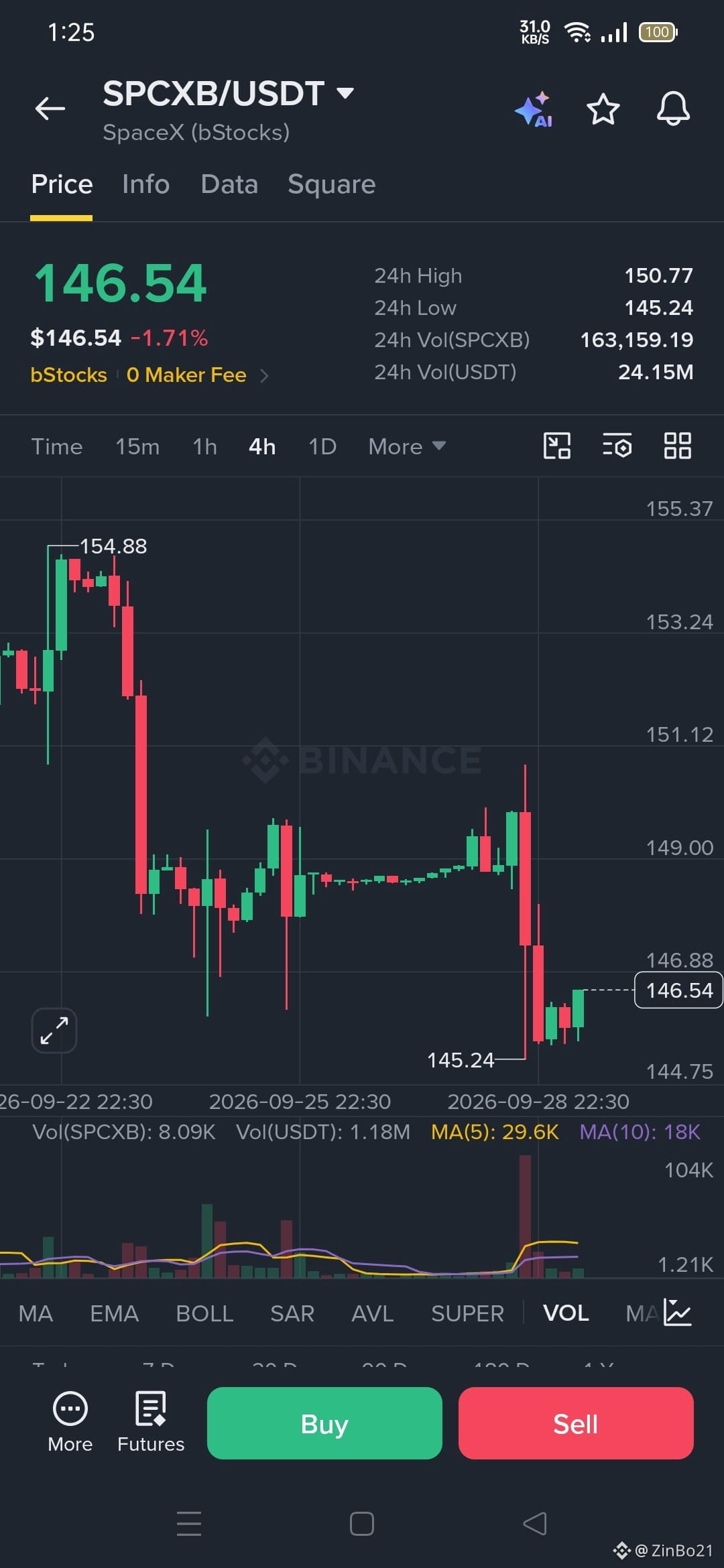
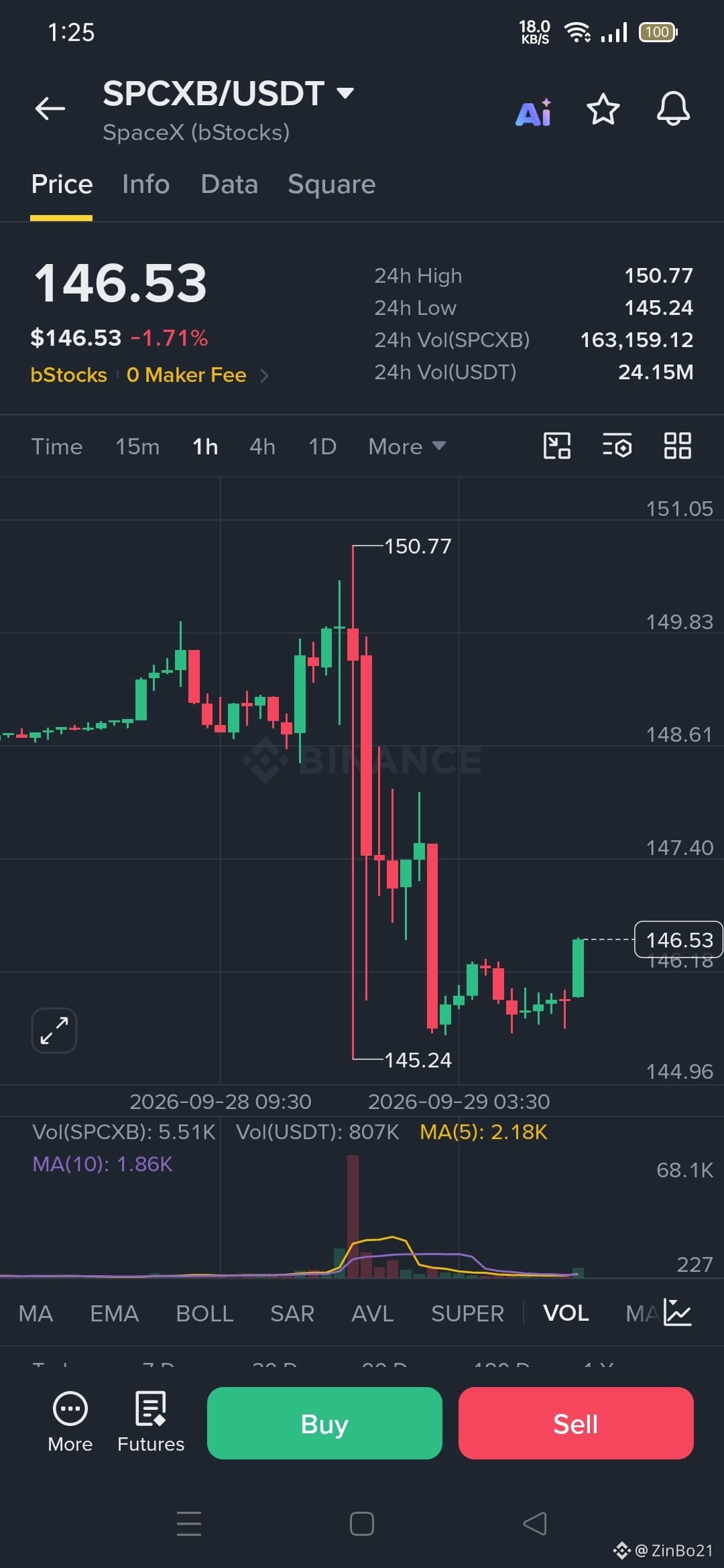
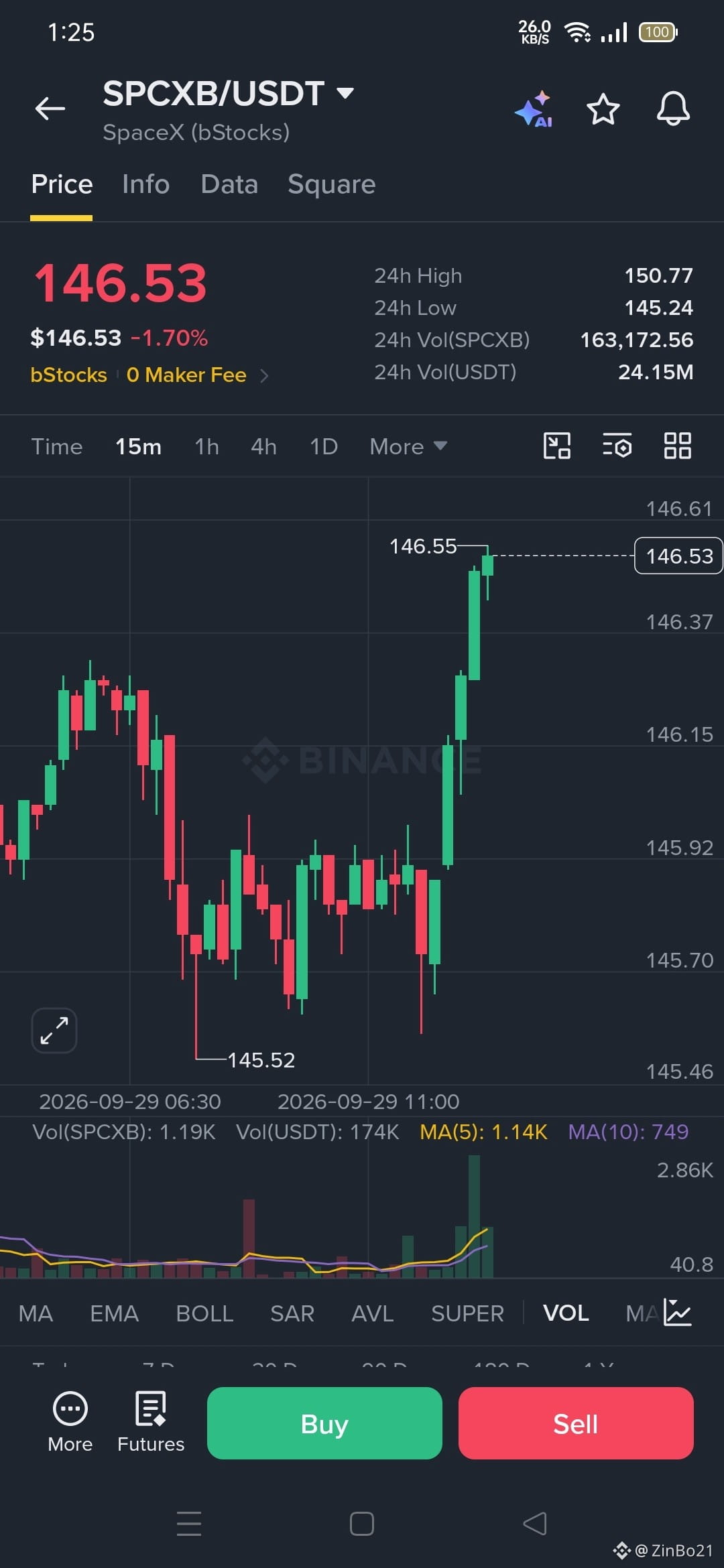
1
121
From Crypto to Stocks: Keep Learning, Keep GrowingThe financial market is bigger than any single asset class.
Many people first discover investing through cryptocurrency. As they continue learning, they may also become interested in stocks and other traditional financial markets.
I believe one of the most valuable skills for any market participant is continuous learning. 📚
🔹 Understand the asset
Before buying or trading anything, learn what the asset represents and how it works.
🔹 Research the market
Price movements can be affected by many factors, including economic data, company performance, market sentiment, liquidity, and global events.
🔹 Know the difference
Crypto and stocks have different structures and risks. Understanding those differences can help us approach each market with realistic expectations.
🔹 Think about risk
No market moves in only one direction. Potential returns always come with risk, and protecting capital is an important part of responsible investing.
🔹 DYOR
Don't make a decision just because something is trending. Check reliable information, compare different sources, and understand the risks before making your own decision.
For Binance users, learning about BStocks can also be an opportunity to expand their knowledge beyond crypto and become more familiar with traditional market concepts.
🚀 Learn more. Research more. Understand more.
The goal isn't to predict every market move.
The goal is to become a more informed market participant.
What are you learning about today? 👇
Crypto 🔶 | Stocks 📈 | BStocks 🌍
@BinanceBurmese
#Binance #BinanceSquare #BStocks #SEABstock #SEAstock
⚠️ Disclaimer: This post is for educational purposes only and is not financial or investment advice. All investments involve risk, including possible loss of capital. Always do your own research and review official product information before making investment decisions.
From Crypto to Stocks: Keep Learning, Keep Growing
The financial market is bigger than any single asset class.
Many people first discover investing through cryptocurrency. As they continue learning, they may also become interested in stocks and other traditional financial markets.
I believe one of the most valuable skills for any market participant is continuous learning. 📚
🔹 Understand the asset
Before buying or trading anything, learn what the asset represents and how it works.
🔹 Research the market
Price movements can be affected by many factors, including economic data, company performance, market sentiment, liquidity, and global events.
🔹 Know the difference
Crypto and stocks have different structures and risks. Understanding those differences can help us approach each market with realistic expectations.
🔹 Think about risk
No market moves in only one direction. Potential returns always come with risk, and protecting capital is an important part of responsible investing.
🔹 DYOR
Don't make a decision just because something is trending. Check reliable information, compare different sources, and understand the risks before making your own decision.
For Binance users, learning about BStocks can also be an opportunity to expand their knowledge beyond crypto and become more familiar with traditional market concepts.
🚀 Learn more. Research more. Understand more.
The goal isn't to predict every market move.
The goal is to become a more informed market participant.
What are you learning about today? 👇
Crypto 🔶 | Stocks 📈 | BStocks 🌍
@Binance Burmese
#Binance #BinanceSquare #BStocks #SEABstock #SEAstock
⚠️ Disclaimer: This post is for educational purposes only and is not financial or investment advice. All investments involve risk, including possible loss of capital. Always do your own research and review official product information before making investment decisions.
Many people first discover investing through cryptocurrency. As they continue learning, they may also become interested in stocks and other traditional financial markets.
I believe one of the most valuable skills for any market participant is continuous learning. 📚
🔹 Understand the asset
Before buying or trading anything, learn what the asset represents and how it works.
🔹 Research the market
Price movements can be affected by many factors, including economic data, company performance, market sentiment, liquidity, and global events.
🔹 Know the difference
Crypto and stocks have different structures and risks. Understanding those differences can help us approach each market with realistic expectations.
🔹 Think about risk
No market moves in only one direction. Potential returns always come with risk, and protecting capital is an important part of responsible investing.
🔹 DYOR
Don't make a decision just because something is trending. Check reliable information, compare different sources, and understand the risks before making your own decision.
For Binance users, learning about BStocks can also be an opportunity to expand their knowledge beyond crypto and become more familiar with traditional market concepts.
🚀 Learn more. Research more. Understand more.
The goal isn't to predict every market move.
The goal is to become a more informed market participant.
What are you learning about today? 👇
Crypto 🔶 | Stocks 📈 | BStocks 🌍
@Binance Burmese
#Binance #BinanceSquare #BStocks #SEABstock #SEAstock
⚠️ Disclaimer: This post is for educational purposes only and is not financial or investment advice. All investments involve risk, including possible loss of capital. Always do your own research and review official product information before making investment decisions.
1
80
·
--
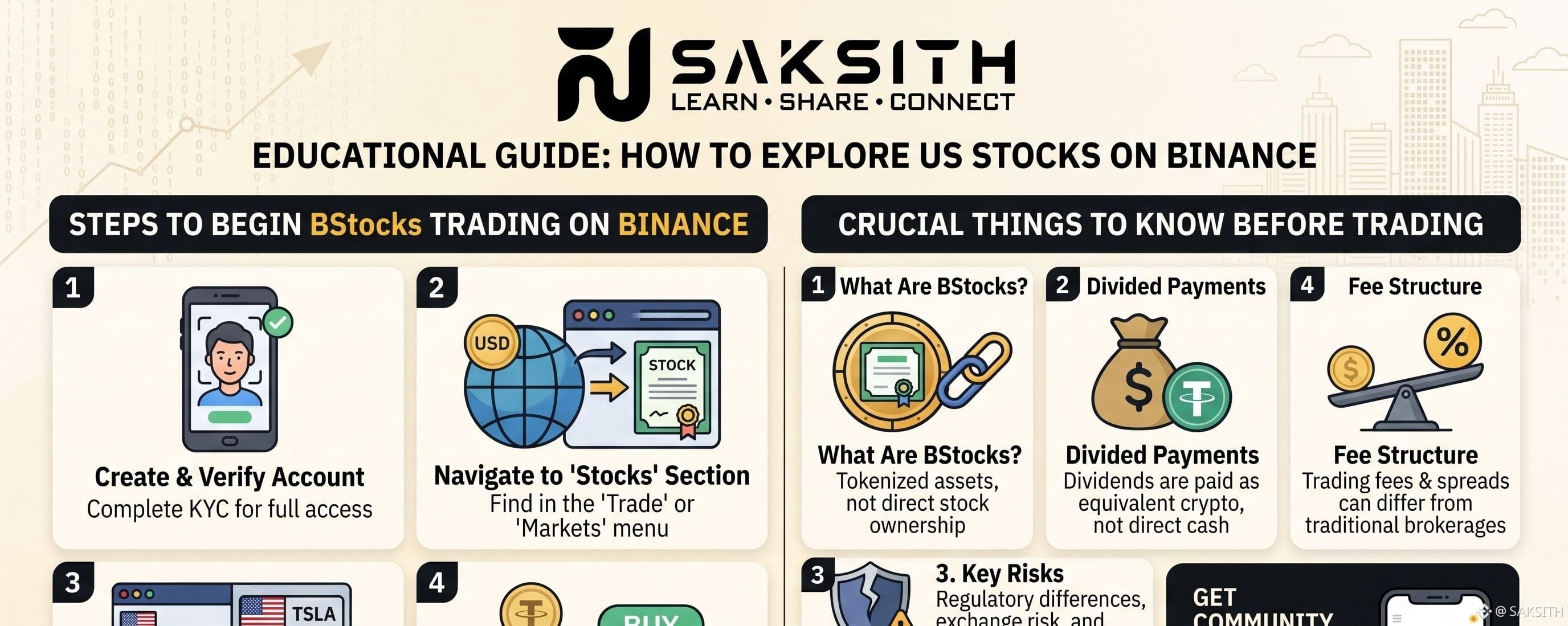
Article
🔶 📝 How to explore US Stocks through Binance Things to know before Trading Stocks or BStocks👉 How to explore US Stocks through Binance:
✍️ Binance Platform can trading Stocks and bStocks (tokenized). Direct stocks give beneficial ownership of real shares.
✍️ while bStocks are Binance Blockchain-Based tokens backed 1:1 by US Stocks shares held at a custodian, tradable 24/7.
✅ Trading Stocks or bStocks: Download the Binance App on App Store or Play Store, Create an account or sign in with existing account → go to Markets → TradFi → Stocks → US Stocks → Select Stocks → Buy & Sell or Trade bStocks → TradFi → Spot → bStocks → Select Stocks → Buy & Sell.
👉 Things to know before Trading Stocks or BStocks:
✍️ Stocks: Real shares ownership, US stocks services are for US users, can 9:30 AM - 4:00 PM (Mon-Fri) trading, get the dividend yield earn automatic dividend payouts straight to account, buy & sell over 7,000 US Stocks and ETFs.
✍️ bStocks: Not direct ownership, Binance's US stocks services are for non-US. users only, risks: market volatility, token liquidity, and regulatory changes can affect trading, Proof of Collateral page to verify backing of bStocks 1:1, Dividends are reinvested automatically in bStocks. can 24/7 trading, 0 commission fees.
Thanks you for visiting article SAKSITH: Learn • Share • Connect
👉 Learn more: Follow Binance Khmer 🇰🇭@Binance_Square_Official @BinanceKhmer #SEABstock #SEAstock
$NVDAB $AAPLB $GOOGL.US
{spot}(BNBUSDT)
🔶 📝 How to explore US Stocks through Binance Things to know before Trading Stocks or BStocks
👉 How to explore US Stocks through Binance:
✍️ Binance Platform can trading Stocks and bStocks (tokenized). Direct stocks give beneficial ownership of real shares.
✍️ while bStocks are Binance Blockchain-Based tokens backed 1:1 by US Stocks shares held at a custodian, tradable 24/7.
✅ Trading Stocks or bStocks: Download the Binance App on App Store or Play Store, Create an account or sign in with existing account → go to Markets → TradFi → Stocks → US Stocks → Select Stocks → Buy & Sell or Trade bStocks → TradFi → Spot → bStocks → Select Stocks → Buy & Sell.
👉 Things to know before Trading Stocks or BStocks:
✍️ Stocks: Real shares ownership, US stocks services are for US users, can 9:30 AM - 4:00 PM (Mon-Fri) trading, get the dividend yield earn automatic dividend payouts straight to account, buy & sell over 7,000 US Stocks and ETFs.
✍️ bStocks: Not direct ownership, Binance's US stocks services are for non-US. users only, risks: market volatility, token liquidity, and regulatory changes can affect trading, Proof of Collateral page to verify backing of bStocks 1:1, Dividends are reinvested automatically in bStocks. can 24/7 trading, 0 commission fees.
Thanks you for visiting article SAKSITH: Learn • Share • Connect
👉 Learn more: Follow Binance Khmer 🇰🇭@Binance Square Official @Binance Khmer #SEABstock #SEAstock
$NVDAB $AAPLB $GOOGL.US
✍️ Binance Platform can trading Stocks and bStocks (tokenized). Direct stocks give beneficial ownership of real shares.
✍️ while bStocks are Binance Blockchain-Based tokens backed 1:1 by US Stocks shares held at a custodian, tradable 24/7.
✅ Trading Stocks or bStocks: Download the Binance App on App Store or Play Store, Create an account or sign in with existing account → go to Markets → TradFi → Stocks → US Stocks → Select Stocks → Buy & Sell or Trade bStocks → TradFi → Spot → bStocks → Select Stocks → Buy & Sell.
👉 Things to know before Trading Stocks or BStocks:
✍️ Stocks: Real shares ownership, US stocks services are for US users, can 9:30 AM - 4:00 PM (Mon-Fri) trading, get the dividend yield earn automatic dividend payouts straight to account, buy & sell over 7,000 US Stocks and ETFs.
✍️ bStocks: Not direct ownership, Binance's US stocks services are for non-US. users only, risks: market volatility, token liquidity, and regulatory changes can affect trading, Proof of Collateral page to verify backing of bStocks 1:1, Dividends are reinvested automatically in bStocks. can 24/7 trading, 0 commission fees.
Thanks you for visiting article SAKSITH: Learn • Share • Connect
👉 Learn more: Follow Binance Khmer 🇰🇭@Binance Square Official @Binance Khmer #SEABstock #SEAstock
$NVDAB $AAPLB $GOOGL.US
1
145

·
--
Something is shifting on Wall Street.
Oil is climbing, Treasury yields are putting pressure on stocks, and investors are suddenly watching every inflation and jobs number a little more closely.
Why?
Because all of these pieces lead back to one big question: what happens with interest rates next?
At the same time, fresh earnings are giving us a reality check on AI demand, corporate growth and how strong the American consumer really is.
That makes the next few sessions important.
Watch oil. Watch bond yields. Watch the economic data. And most importantly, watch how the market reacts — because sometimes the reaction tells you more than the headline itself.
Wall Street isn't quiet right now.
It's waiting for the next trigger.
@BinanceLaotian #SEABstock #SEAstock
Something is shifting on Wall Street.
Oil is climbing, Treasury yields are putting pressure on stocks, and investors are suddenly watching every inflation and jobs number a little more closely.
Why?
Because all of these pieces lead back to one big question: what happens with interest rates next?
At the same time, fresh earnings are giving us a reality check on AI demand, corporate growth and how strong the American consumer really is.
That makes the next few sessions important.
Watch oil. Watch bond yields. Watch the economic data. And most importantly, watch how the market reacts — because sometimes the reaction tells you more than the headline itself.
Wall Street isn't quiet right now.
It's waiting for the next trigger.
@Binance Laotian #SEABstock #SEAstock
Oil is climbing, Treasury yields are putting pressure on stocks, and investors are suddenly watching every inflation and jobs number a little more closely.
Why?
Because all of these pieces lead back to one big question: what happens with interest rates next?
At the same time, fresh earnings are giving us a reality check on AI demand, corporate growth and how strong the American consumer really is.
That makes the next few sessions important.
Watch oil. Watch bond yields. Watch the economic data. And most importantly, watch how the market reacts — because sometimes the reaction tells you more than the headline itself.
Wall Street isn't quiet right now.
It's waiting for the next trigger.
@Binance Laotian #SEABstock #SEAstock

2
315
Log in to explore more content
Join global crypto users on Binance Square
⚡️ Get latest and useful information about crypto.
💬 Trusted by the world’s largest crypto exchange.
👍 Discover real insights from verified creators.
Email / Phone number
Trending Topics
1
#BitcoinClears$85200
15,195 views
235 Discussing
2
#AltcoinSeasonIndexHoldsAbove60For5Days
73,110 views
1,257 Discussing
3
#USADPAdds90000JobsInSeptember
33,167 views
701 Discussing
4
#USCorePCEEasesTo3%InAugust
23,765 views
526 Discussing
5
#KospiPostsWorstQuarterSince2020
16,276 views
503 Discussing
6
#SECToClarifyOnChainFundraisingRules
40,599 views
680 Discussing
7
#UKFCAOpensCryptoFirmAuthorization
39,554 views
571 Discussing
8
#JapanMOFStudyGroupOnTokenizedGovtBonds
22,503 views
430 Discussing
9
#QNTRises287%
109,396 views
932 Discussing
10
#TrumpRejectsAIRulesForVoluntaryAudits
62,559 views
807 Discussing