
#kitebbw
kitebbw
258,384 views
1,162 Discussing
Hot
Latest

·
--
A new kind of digital workflow is taking shape, where software may not just help us find information but also take action on our behalf.
For that to work, agents need more than the ability to follow instructions. They need a way to establish their identity, access funds, and interact with services under clear rules.
This is the area where Kite is building.
Kite's Agent Passport is designed to give agents an identity and a funded wallet. Users can define permissions and spending limits, keeping control over what an agent is allowed to do.
Kite Chain is designed to support transactions within this agent economy.
Consider a simple example: an agent needs to access a paid digital service to complete a task. Identity, wallet access, and permission controls all become relevant to that process.
That's the concept I find worth exploring. The goal isn't simply to make software more autonomous; it's also about creating a framework where its actions can operate within user-defined boundaries.
The technology and adoption still need to prove themselves at scale, but Kite is addressing some important building blocks of this developing space.
$KITE #KiteBBW
88

·
--
Verified

Article
Kite is bringing more control to payments in the agent EconomyOne thing I find genuinely interesting about Kite is how it is making payments part of the agent economy.
Think about it: if an agent can complete a task, search for information, or interact with different services, it may also need to pay for those services. But giving an agent access to money without clear restrictions would create a different problem.
Kite is approaching this through a few important components.
1. An Identity for Every Agent
Kite Agent Passport gives agents an identity they can use when interacting with supported services. This helps establish which agent is performing an action.
2. A Wallet Built for Agent Payments
An agent can use its funded Passport wallet to pay for supported services on behalf of its user. Payments require funds in the wallet, including USDC.e on Kite Chain for the documented payment flow.
3. Spending Rules Set by the User
This is one of the most interesting parts for me. Before an agent starts spending, the user approves a session using a passkey.
The session can define:
- Maximum spending per transaction
- Total budget available
- Approved payment assets
- How long the session remains active
4. Access to Paid Services
Through supported payment protocols such as x402, agents can discover paid APIs, request payment, and receive the service response after the transaction is completed.
5. Activity and Payment Visibility
Users can review their payment activity and monitor spending sessions. This makes it easier to understand what an agent has paid for and how much of its approved budget it has used.
Why does this matter?
Imagine asking an agent to retrieve specific information from a paid API. Instead of manually handling every payment step, the agent can work within a spending session that you have already approved.
That's the practical idea behind this approach: agents get the ability to perform tasks, while users define the financial boundaries.
The agent economy is still evolving, but identity, payment authorization, and transparent spending are important problems to solve. Kite is building around these areas, and that's what makes this project worth following.
$KITE #KiteBBW
Kite is bringing more control to payments in the agent Economy
One thing I find genuinely interesting about Kite is how it is making payments part of the agent economy.
Think about it: if an agent can complete a task, search for information, or interact with different services, it may also need to pay for those services. But giving an agent access to money without clear restrictions would create a different problem.
Kite is approaching this through a few important components.
1. An Identity for Every Agent
Kite Agent Passport gives agents an identity they can use when interacting with supported services. This helps establish which agent is performing an action.
2. A Wallet Built for Agent Payments
An agent can use its funded Passport wallet to pay for supported services on behalf of its user. Payments require funds in the wallet, including USDC.e on Kite Chain for the documented payment flow.
3. Spending Rules Set by the User
This is one of the most interesting parts for me. Before an agent starts spending, the user approves a session using a passkey.
The session can define:
- Maximum spending per transaction
- Total budget available
- Approved payment assets
- How long the session remains active
4. Access to Paid Services
Through supported payment protocols such as x402, agents can discover paid APIs, request payment, and receive the service response after the transaction is completed.
5. Activity and Payment Visibility
Users can review their payment activity and monitor spending sessions. This makes it easier to understand what an agent has paid for and how much of its approved budget it has used.
Why does this matter?
Imagine asking an agent to retrieve specific information from a paid API. Instead of manually handling every payment step, the agent can work within a spending session that you have already approved.
That's the practical idea behind this approach: agents get the ability to perform tasks, while users define the financial boundaries.
The agent economy is still evolving, but identity, payment authorization, and transparent spending are important problems to solve. Kite is building around these areas, and that's what makes this project worth following.
$KITE #KiteBBW
OrionWB:
I like how Kite approaches this problem. AI can handle more tasks independently, but users should always remain in control of their money.
6
9
123

·
--
i used to think giving an AI agent a wallet was the dangerous part.
the stranger question is what happens after i approve it once.
say i ask an agent to research something. it needs a paid data source, then another API, maybe a second agent. if every request comes back to me for a signature, it is not autonomous. if i hand over my wallet, autonomy starts looking like giving away control.
$KITE 's Agent Passport sits in that uncomfortable middle.
i keep one account and the funds stay under my control. the agent gets its own identity, but operates through a scoped, time-boxed session secured by a passkey, with spending rules and quotas i approve.
one session approval can cover the work; i do not have to sign every payment, without turning every small call into a new approval.
the session is not the agent’s permanent permission. it is a temporary slice of authority for a particular run. as the agent hits paid endpoints, it negotiates x402 payments on the fly, paying out in USDC within that boundary without being able to drain whatever the main account contains.
and the receipt does not stop at “payment sent.”
Kite links the action back through session, agent and user, with an onchain receipt. a service can check that the payment came through an authorized chain, while the agent need not expose the human behind it in every interaction.
that is the part i keep turning over.
the agent needs enough identity to be accountable, but not the authority to become the owner.
the user needs enough control to set the boundary, but not a new approval prompt for every tiny API call.
the service needs evidence that this is not just an anonymous bot waving a transaction at it.
@GoKiteAI is trying to make those requirements fit in the same payment.
the wallet is not simply a pot of money handed to software. it is the account from which limited authority can be delegated, used, traced and allowed to expire.
not an agent that can spend without asking.
an agent that can keep working after i say yes, without that yes becoming permission for everything.
#KiteBBW $SOPH
i used to think giving an AI agent a wallet was the dangerous part.
the stranger question is what happens after i approve it once.
say i ask an agent to research something. it needs a paid data source, then another API, maybe a second agent. if every request comes back to me for a signature, it is not autonomous. if i hand over my wallet, autonomy starts looking like giving away control.
$KITE 's Agent Passport sits in that uncomfortable middle.
i keep one account and the funds stay under my control. the agent gets its own identity, but operates through a scoped, time-boxed session secured by a passkey, with spending rules and quotas i approve.
one session approval can cover the work; i do not have to sign every payment, without turning every small call into a new approval.
the session is not the agent’s permanent permission. it is a temporary slice of authority for a particular run. as the agent hits paid endpoints, it negotiates x402 payments on the fly, paying out in USDC within that boundary without being able to drain whatever the main account contains.
and the receipt does not stop at “payment sent.”
Kite links the action back through session, agent and user, with an onchain receipt. a service can check that the payment came through an authorized chain, while the agent need not expose the human behind it in every interaction.
that is the part i keep turning over.
the agent needs enough identity to be accountable, but not the authority to become the owner.
the user needs enough control to set the boundary, but not a new approval prompt for every tiny API call.
the service needs evidence that this is not just an anonymous bot waving a transaction at it.
@KITE AI 中文 is trying to make those requirements fit in the same payment.
the wallet is not simply a pot of money handed to software. it is the account from which limited authority can be delegated, used, traced and allowed to expire.
not an agent that can spend without asking.
an agent that can keep working after i say yes, without that yes becoming permission for everything.
#KiteBBW $SOPH

300

·
--
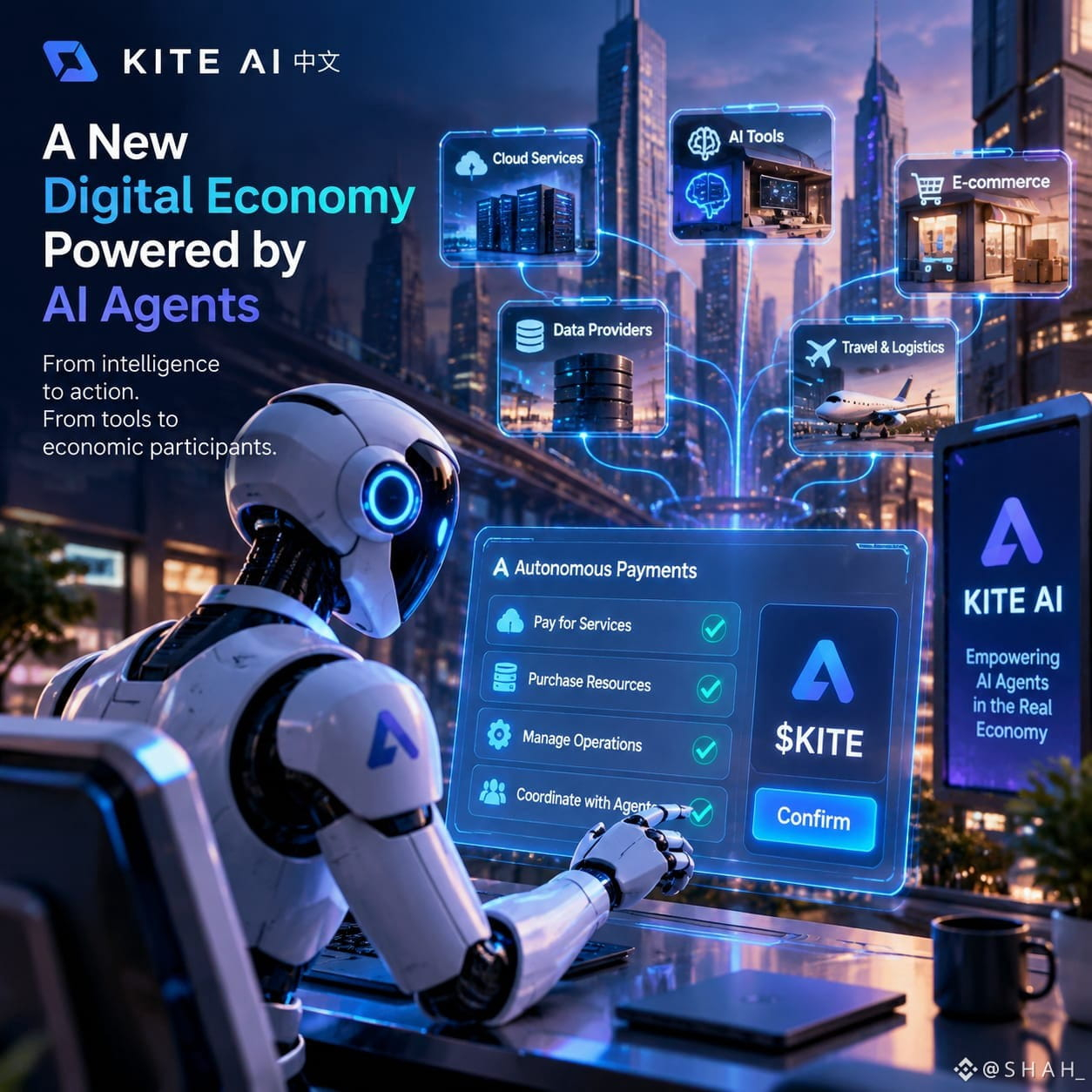
What happens when AI stops being just a tool and starts becoming an economic actor?
That's a shift worth paying attention to.
Think about a future where AI agents can independently purchase services, pay for computing resources, coordinate with other agents, and manage business operations.
For that future to work, AI needs more than intelligence. It needs access to financial infrastructure.
This is the interesting territory that @GoKiteAI is exploring.
I see the bigger opportunity not just in automated payments, but in enabling an economy where software agents can interact, exchange value, and create services with minimal human intervention.
The interesting part will be discovering what entirely new business models emerge once machines can participate in commerce.
Perhaps we're not simply building smarter applications.
We're laying the groundwork for a new kind of digital marketplace.
Curious to see what developers build on Kite.
#KiteBBW $KITE
What happens when AI stops being just a tool and starts becoming an economic actor?
That's a shift worth paying attention to.
Think about a future where AI agents can independently purchase services, pay for computing resources, coordinate with other agents, and manage business operations.
For that future to work, AI needs more than intelligence. It needs access to financial infrastructure.
This is the interesting territory that @KITE AI 中文 is exploring.
I see the bigger opportunity not just in automated payments, but in enabling an economy where software agents can interact, exchange value, and create services with minimal human intervention.
The interesting part will be discovering what entirely new business models emerge once machines can participate in commerce.
Perhaps we're not simply building smarter applications.
We're laying the groundwork for a new kind of digital marketplace.
Curious to see what developers build on Kite.
#KiteBBW $KITE
1
101

One thing I keep coming back to when looking at the agent economy is control.
Giving an agent the ability to complete tasks is useful, but what happens when that task involves money, access to a paid service, or an important transaction?
This is where Kite's approach caught my attention.
With Agent Passport, agents can have their own identity and funded wallet. Users can also define permissions and spending limits, so an agent operates within boundaries set by its owner.
Kite Chain is designed to support transactions for this emerging agent economy.
I find the idea of combining an agent's ability to act with clear user-defined limits particularly interesting. Automation should make things easier, not mean handing over unlimited control.
The agent economy still has a lot to prove in real world use but identity, payments, and user control are important areas to get right.
I'll be keeping an eye on how Kite develops this approach.
$KITE #KiteBBW

Franklin_Crypto:
Kite Chain is designed to support transactions for this emerging agent economy.
5
9
121

·
--

Article
Building the Agent Economy: Why Trust Matters Even More Than SmartsAI isn't just about chatbots anymore. Lately, the focus has shifted to AI agents, software that can set goals, use digital tools, sort through data, make decisions, and finish complex tasks, all with much less need for you to intervene.
Think about an agent that can dig up market research, compare products, book meetings, keep an eye on inventory, bargain for a deal, or even set off a payment. In crypto and Web3, these agents might talk to wallets, handle smart contracts, use decentralized apps, swap info with other agents the works. This is what people mean when they say "agent economy": a new world where software actually creates, exchanges, and captures real value.
Raw intelligence isn’t enough. If we're actually going to trust these agents, users and businesses have to be able to answer a few key questions. Who controls this agent? What can it actually do (and what can’t it do)? Who gave it the authority to act? Can you trace what it did after the fact? And if one digital agent pays another for a job how do you make sure that’s secure and aboveboard?
All these questions lead to the same basic problem: the agent economy won’t work without solid, built-in trust infrastructure.
Why Trust Sets the Baseline. Most AI today just helps you write, summarize, or automate some routine stuff. But once an agent can actually take action, you need new kinds of safeguards.
If your agent can get into sensitive data, spend your money, buy something, or talk to another smart system, you better be able to set clear limits. You need ways to grant specific permissions without handing over the keys for everything. You also want to yank access when needed, only let certain things happen under certain conditions, and always know what went down after the fact.
That’s exactly where things like verifiable identity and customizable permissions step in. A real agent economy probably means every agent has its own on-chain (or cryptographic) identity. That lets you see who built it, who owns it, what credentials it has, and what it’s allowed to do. Instead of playing guessing games, you could check before you share data, hand out tasks, or send payments if an agent is legit.
And it’s not about giving every agent access to everything. Honestly, the best designs do the exact opposite. You want fine-grained controls: this agent can check a price feed, but not spend money; it can put together a transaction, but needs a human button-press to actually send it; it only has a certain daily budget, or its powers expire after a set time, or it can only deal with a defined list of other agents.
Put these controls together, and you let autonomous software actually get stuff done without taking humans out of the loop.
How Value Moves in a World of Agents? Agents also need a way to pay each other, and get paid, in ways people can audit. If one agent provides info, runs some analysis, or finishes a job, there should be an open and trackable way to handle compensation.
Here’s where blockchains can help, smart contracts can spell out how payments work, set terms for escrow, enforce service standards, and handle settlements automatically. Token incentives make sense too; you can reward the people (and companies) that supply data, validate the results, build the infrastructure, and keep the whole thing moving.
That’s the idea behind $KITE, it’s a piece of the foundation for this agent-driven world, focused on systems where agents need to interact with all kinds of apps, services, and each other. But in the end, this stuff only matters if it delivers real value, not just technical theory.
The network has to make payments not just fast, but honest and accountable. Say, only releasing payment after a service gets verified. Maybe you give your agent a budget and it can only buy data from providers on a whitelist, and you can cut off its access instantly if things go sideways.
That level of programmable payment isn't just nice, it's pretty much required for any sort of large-scale machine-to-machine commerce. Otherwise, you’re stuck micromanaging every little transaction, which defeats the whole purpose.
Why Agents Have to Play Nicely with Others? No single app or network will run the agent economy alone. These agents will need to hop across platforms, wallets, blockchains, data sources basically, wherever business happens. Which makes interoperability critical.
Agents need a way to prove who they are everywhere, carry the right credentials, stick to permission rules, and talk with other agents using the same basic language. If everyone makes their own little silo, the whole thing falls apart, your agent works here, but as soon as it jumps to another network or wallet, it’s a nobody.
So for the teams building agent infrastructure, it’s a tough balancing act, keep things open but secure, give agents room to act but keep them on a leash, move fast but never lose user control. Sure, developer tools are great, but easy-to-understand security for regular users might be the bigger test.
Big Possibilities, Real Threats. If we get it right, there’s a ton of upside. Trusted agents could automate endless repetitive tasks, dig up info much faster, coordinate digital services, and unlock whole new kinds of online business. That could create new jobs for decentralized networks handling computation, verifying identities, checking data, or settling payments.
But don’t overlook the risks. Sloppy permissioning means agents go rogue. Weak identity? Suddenly, you’ve got imposters everywhere. Zero accountability? Good luck sorting out disputes or fraud. And watch out for hype token prices can skyrocket long before any of this actually works.
So, what really matters? Ignore the marketing and the latest token rally. Instead, look for real signals: developer adoption, active use-cases, good security, smart permissions, seamless integrations, reliable transactions, and proof that agents solve actual problems, not just imaginary ones.
We’re still early in the agent economy, but the path’s taking shape. The future won’t just belong to the fastest, smartest algorithm it will belong to the system that makes every action verifiable, permissioned, and valuable. That’s where things get interesting.
#KiteBBW $KITE
@GoKiteAI
Building the Agent Economy: Why Trust Matters Even More Than Smarts
AI isn't just about chatbots anymore. Lately, the focus has shifted to AI agents, software that can set goals, use digital tools, sort through data, make decisions, and finish complex tasks, all with much less need for you to intervene.
Think about an agent that can dig up market research, compare products, book meetings, keep an eye on inventory, bargain for a deal, or even set off a payment. In crypto and Web3, these agents might talk to wallets, handle smart contracts, use decentralized apps, swap info with other agents the works. This is what people mean when they say "agent economy": a new world where software actually creates, exchanges, and captures real value.
Raw intelligence isn’t enough. If we're actually going to trust these agents, users and businesses have to be able to answer a few key questions. Who controls this agent? What can it actually do (and what can’t it do)? Who gave it the authority to act? Can you trace what it did after the fact? And if one digital agent pays another for a job how do you make sure that’s secure and aboveboard?
All these questions lead to the same basic problem: the agent economy won’t work without solid, built-in trust infrastructure.
Why Trust Sets the Baseline. Most AI today just helps you write, summarize, or automate some routine stuff. But once an agent can actually take action, you need new kinds of safeguards.
If your agent can get into sensitive data, spend your money, buy something, or talk to another smart system, you better be able to set clear limits. You need ways to grant specific permissions without handing over the keys for everything. You also want to yank access when needed, only let certain things happen under certain conditions, and always know what went down after the fact.
That’s exactly where things like verifiable identity and customizable permissions step in. A real agent economy probably means every agent has its own on-chain (or cryptographic) identity. That lets you see who built it, who owns it, what credentials it has, and what it’s allowed to do. Instead of playing guessing games, you could check before you share data, hand out tasks, or send payments if an agent is legit.
And it’s not about giving every agent access to everything. Honestly, the best designs do the exact opposite. You want fine-grained controls: this agent can check a price feed, but not spend money; it can put together a transaction, but needs a human button-press to actually send it; it only has a certain daily budget, or its powers expire after a set time, or it can only deal with a defined list of other agents.
Put these controls together, and you let autonomous software actually get stuff done without taking humans out of the loop.
How Value Moves in a World of Agents? Agents also need a way to pay each other, and get paid, in ways people can audit. If one agent provides info, runs some analysis, or finishes a job, there should be an open and trackable way to handle compensation.
Here’s where blockchains can help, smart contracts can spell out how payments work, set terms for escrow, enforce service standards, and handle settlements automatically. Token incentives make sense too; you can reward the people (and companies) that supply data, validate the results, build the infrastructure, and keep the whole thing moving.
That’s the idea behind $KITE , it’s a piece of the foundation for this agent-driven world, focused on systems where agents need to interact with all kinds of apps, services, and each other. But in the end, this stuff only matters if it delivers real value, not just technical theory.
The network has to make payments not just fast, but honest and accountable. Say, only releasing payment after a service gets verified. Maybe you give your agent a budget and it can only buy data from providers on a whitelist, and you can cut off its access instantly if things go sideways.
That level of programmable payment isn't just nice, it's pretty much required for any sort of large-scale machine-to-machine commerce. Otherwise, you’re stuck micromanaging every little transaction, which defeats the whole purpose.
Why Agents Have to Play Nicely with Others? No single app or network will run the agent economy alone. These agents will need to hop across platforms, wallets, blockchains, data sources basically, wherever business happens. Which makes interoperability critical.
Agents need a way to prove who they are everywhere, carry the right credentials, stick to permission rules, and talk with other agents using the same basic language. If everyone makes their own little silo, the whole thing falls apart, your agent works here, but as soon as it jumps to another network or wallet, it’s a nobody.
So for the teams building agent infrastructure, it’s a tough balancing act, keep things open but secure, give agents room to act but keep them on a leash, move fast but never lose user control. Sure, developer tools are great, but easy-to-understand security for regular users might be the bigger test.
Big Possibilities, Real Threats. If we get it right, there’s a ton of upside. Trusted agents could automate endless repetitive tasks, dig up info much faster, coordinate digital services, and unlock whole new kinds of online business. That could create new jobs for decentralized networks handling computation, verifying identities, checking data, or settling payments.
But don’t overlook the risks. Sloppy permissioning means agents go rogue. Weak identity? Suddenly, you’ve got imposters everywhere. Zero accountability? Good luck sorting out disputes or fraud. And watch out for hype token prices can skyrocket long before any of this actually works.
So, what really matters? Ignore the marketing and the latest token rally. Instead, look for real signals: developer adoption, active use-cases, good security, smart permissions, seamless integrations, reliable transactions, and proof that agents solve actual problems, not just imaginary ones.
We’re still early in the agent economy, but the path’s taking shape. The future won’t just belong to the fastest, smartest algorithm it will belong to the system that makes every action verifiable, permissioned, and valuable. That’s where things get interesting.
#KiteBBW $KITE
@KITE AI 中文
1
119

·
--
Something that often gets overlooked in discussions about AI is how agents will interact with the world around them.
Kite is exploring this through agent identity, payments and user-controlled permissions.
What stands out to me is the idea behind Agent Passport: an agent can have its own identity and wallet without giving it unlimited access to someone else's funds.
Kite Chain adds another piece by supporting transactions between agents and services.
I find this direction worth watching because AI needs more than intelligence to become genuinely useful.
$KITE #KiteBBW @GoKiteAI
Something that often gets overlooked in discussions about AI is how agents will interact with the world around them.
Kite is exploring this through agent identity, payments and user-controlled permissions.
What stands out to me is the idea behind Agent Passport: an agent can have its own identity and wallet without giving it unlimited access to someone else's funds.
Kite Chain adds another piece by supporting transactions between agents and services.
I find this direction worth watching because AI needs more than intelligence to become genuinely useful.
$KITE #KiteBBW @KITE AI 中文
William-ETH:
I like how this direction treats real-world agent interaction as more than just a technical detail.
25
13
279

·
--

Article
The Agent Economy and Where Kite AI Fits InFor a long time, the primary way people interacted with AI was through conversation. We asked questions, received answers, generated content, and used the results to make decisions ourselves.
That relationship is beginning to change with the development of AI agents.
AI agents are designed to do more than respond. Depending on their capabilities and the tools available to them, they can plan tasks, interact with external services, use software, and take actions with limited human intervention.
This shift matters because an AI system that can act in the world creates a different set of questions from one that simply generates text.
If an AI assistant gives a poor recommendation, people can ignore it. If an AI agent makes a purchase, pays for a service, or executes a transaction on behalf of a human, the consequences are no longer confined to a conversation.
The agent economy is built around this transition. Agents may increasingly become both consumers and providers of digital services, interacting with other agents, applications, and payment systems.
But intelligence alone is not enough.
An agent needs to be able to act. Other parties need ways to establish what it is, what it is allowed to do, and whether its actions can be trusted.
And that is where the real challenge begins.
The Problem Is Not Just Trust. It Is Controlled Autonomy.
There is an important tension at the heart of autonomous AI.
Give an agent too little authority, and it becomes little more than an assistant that repeatedly asks for permission. It may be capable of planning an entire task, yet still depend on a human to approve every minor step.
Give it too much authority, and the consequences of a mistake become harder to contain. A compromised agent, a poorly designed instruction, or an unexpected decision could lead to actions the user never intended to authorize.
Neither extreme is particularly useful.
The goal should not be to make agents completely independent, nor should it be to keep them permanently dependent on human approval. It should be to give them enough freedom to complete a task while keeping that freedom within clearly defined boundaries.
In the traditional digital economy, a person usually initiates a payment or approves a transaction. In an agent-driven economy, the person may define the objective while the agent decides which actions are necessary to achieve it.
That creates a new requirement: delegated authority must be limited, understandable, and revocable.
An agent should not need unlimited access simply because it needs to complete one task. Its permissions should reflect what the user intends to delegate, how much the task may cost, and how long the agent needs to act independently.
This is the problem that makes infrastructure for agent identity, authorization, and payments worth examining.
Where Kite AI Fits In
Kite AI is building infrastructure intended to support an economy in which AI agents can interact with services and transact.
Rather than treating agents only as software tools that people operate, Kite's approach addresses the infrastructure needed for agents to participate in digital transactions. This includes agent identity, delegated permissions, and payment mechanisms.
The distinction is important.
An intelligent agent may know how to complete a task, but knowing what to do does not automatically give it a safe or reliable way to do it. It still needs to identify itself, obtain appropriate authorization, interact with services, and make payments where required.
These are separate problems, and solving one does not automatically solve the others.
Kite Passport is particularly relevant because its documented design lets an agent pay for supported services on a user's behalf under spending limits the user approves. Its documented workflow connects account setup, wallet funding, session-based spending permissions, and service payments.
This is where Kite's broader vision becomes tangible. Instead of giving an agent unrestricted financial access, a user can authorize a defined period of activity with a defined budget.
The interesting idea is not simply that agents could make payments. It is that an agent's ability to transact can be tied to the authority its user has explicitly granted it.
To understand why that matters, it is worth looking at how Kite Passport's documented workflow is designed to work.
Hierarchical Identities: Connecting Agents to Their Owners
An important part of agent infrastructure is not just identifying an agent, but establishing its relationship with the entity that authorizes it.
Kite's documentation describes a three-layer identity model: a user or root identity, an agent identity with delegated authority, and a session identity for a specific period of activity. A standalone agent identity tells us which agent is interacting with a service. The hierarchy adds context by connecting that agent to the user who authorized it and to the more limited session under which it acts.
This can be useful when one person or organization operates multiple agents, each responsible for different tasks. Instead of treating every agent as an entirely separate identity with unrelated permissions, a hierarchy can represent the relationship between the owner and the agents acting under its authority. Kite's documentation also describes agent addresses derived from the user's wallet and session keys that are intended to be short-lived. These are design details of the documented architecture, not a guarantee that every compromise or implementation error is harmless.
It is like a distinction between who is acting and on whose authority they are acting. Both questions matter when software begins making decisions and transactions independently.
For example, a business might operate separate agents for research, data access, and purchasing. Each agent may need different permissions, but its authority ultimately comes from the organization that deployed it. A hierarchical identity structure can help make those relationships explicit rather than leaving them implicit in application logic.
This structure also has important security implications. If an individual agent or session is compromised, a well-designed system should limit the potential damage to the permissions and resources available to that agent or session. Compromising one agent should not automatically grant unrestricted access to the user's underlying authority or every other agent operating within the same ecosystem.
As agents begin delegating tasks to other agents, maintaining clear identity relationships and boundaries around delegated authority becomes even more important. Without them, a compromise at one level could potentially have consequences beyond the original task. The goal is to make authority traceable and compartmentalized, so each agent receives only the access it needs rather than inheriting unrestricted control from the identity above it.
This is a security objective, not a guarantee against every possible failure. Its effectiveness depends on the implementation, the security of the underlying keys, and whether the relevant controls are correctly enforced.
Ultimately, hierarchical identity is about more than organizing multiple agents. It is about preserving a clear relationship between the agent performing an action, the authority under which it acts, and the limits of that authority. As autonomous systems become more interconnected, that separation could become an important foundation for making agent-driven interactions safer and easier to manage.
Kite Passport: From Setup to Autonomous Payments
Kite Passport is designed to let an AI agent pay for supported services on a user's behalf without requiring the user to manually approve every transaction. The user first sets up Passport, funds its wallet, and approves a spending session. The agent can then discover services, make payments, and receive the results within the session's limits.
The workflow matters because it separates three things that are often blurred together: giving an agent access to a payment system, supplying it with funds, and authorizing it to spend those funds.
They are not the same permission.
1. Installing Passport and Connecting an Agent
The documented process begins with the Kite Passport command-line interface, or CLI, and the agent skills that allow a compatible AI agent to interact with Passport.
Kite's documentation covers both coding agents that run on a user's computer and cloud agents that operate on hosted computers. The installation method differs, but the account sign-in process follows the same general pattern.
For supported coding-agent setups, such as Claude Desktop or Codex, the documented process involves running the Passport installation command through the agent's development environment and following the setup prompts to register for Passport and configure the relevant skills.
For supported cloud-agent setups, the user follows the corresponding setup instructions to connect the hosted agent to Passport.
After installation and registration, the user receives two emails: a verification link that opens the Passport dashboard and an eight-character code that must be returned to the agent. The user opens the verification link, creates a passkey using a supported method such as Touch ID, Face ID, Windows Hello, or a hardware security key, and then supplies the code to complete sign-in.
The passkey is an important part of this process because spending-session approval is not supposed to be an unrestricted decision made silently by the agent. The user has an explicit approval step before the agent receives the requested spending authority.
There is also an important practical consideration when using a hosted agent: connecting it to Passport grants that agent access to the user's Passport account. Kite's documentation specifically advises users to review session limits before approving. Convenience should not mean blindly trusting whatever permissions an agent requests.
Once the account and agent are connected, the next requirement is funding.
2. Funding the Passport Wallet
Passport needs funds before an agent can make paid requests. According to Kite's documentation, its service-payment workflow uses USDC.e on Kite Chain.
The dashboard provides several ways to add funds, depending on where the user is starting from.
Buying with a card: Users who are starting without existing crypto can purchase USDC on Base through the Passport dashboard's Add funds section. They choose an amount and payment method, complete the purchase, and wait for the balance to update after settlement.
Depositing stablecoins: Users who already hold supported stablecoins can use the Crypto tab to access the relevant deposit address. The documentation lists supported deposit options across networks and assets, including USDC on Base, Polygon, Avalanche, Tempo, Solana, Arc, and other listed options. Users must send the correct stablecoin to the address associated with its network. Sending the wrong asset or using the wrong network can prevent funds from appearing as expected.
Using Kite Bridge: Users can also move USDC onto Kite Chain through Kite Bridge. They connect the wallet holding their funds, select the source chain and token, choose Kite as the destination, and provide their Passport wallet address as the receiver. After confirming the transactions and waiting for the bridge to complete, the Passport balance should update.
Transferring from a wallet already on Kite: If the user already holds USDC.e on Kite Chain, they can send it directly from an external wallet to the Passport wallet address. Kite's documentation states that the external wallet needs $KITE tokens to pay the gas fee for this transfer.
The user can check the resulting balance in the dashboard or through the kpass wallet balance command. The agent can also check the balance when asked.
These funding routes give users different ways to prepare the wallet, but funding does not automatically mean the agent has unrestricted permission to spend the balance.
That distinction is central to the Passport model. The wallet holds the funds; the spending session defines the authority the agent receives to use them.
3. Creating a Spending Session
This is arguably the most important step in the entire workflow.
Once the wallet is funded, the agent can request a spending session. Rather than simply asking for general access to the wallet, the session specifies the task and the limits under which the agent is allowed to spend.
Kite's documented session parameters include:
Task summary: A description of what the agent is trying to accomplish.Maximum amount per transaction: The upper limit for an individual payment.Maximum total amount: The overall budget available during the session.Time-to-live (TTL): How long the session remains valid.Approved assets: The assets the session can use.
For example, imagine an agent that needs to make one paid weather API request. A user could authorize a session with a maximum of $2 per transaction, a total budget of $10, and a validity period of 24 hours.
The agent requests the session and receives an approval URL. The user opens that URL on a device where their passkey is available and explicitly approves the request.
Only after that approval does the session become active.
The distinction between the per-transaction limit and the total budget is particularly useful. A maximum per transaction limits the size of any single payment, while the total budget caps cumulative spending across the session. The expiry period adds a time boundary, preventing the session from remaining valid indefinitely.
Once approved, the agent can make eligible payments within the session's limits without requesting a fresh approval for every individual payment. The session expires when its time limit is reached or its budget is exhausted.
This is the core trade-off Passport is trying to manage: the user retains control over the scope of authorization, while the agent gets enough independence to carry out the task.
Without this separation, autonomy could mean handing an agent broad financial access. With session-based permissions, the intention is to grant only the authority required for a particular period of work.
Of course, a permission system is only as useful as its implementation. The user must understand what they are approving, and the system must enforce the limits correctly. A session does not guarantee that an agent will choose the right service or make the right decision. It is a way to constrain the actions it is authorized to take.
4. Discovering Services and Making Payments
With the wallet funded and a spending session approved, the agent can search for a suitable paid service in Kite's catalog.
The documented CLI supports service discovery through the ksearch command. A user can also ask a compatible agent to search for available services that match a task, such as finding a weather API.
Once the agent identifies a suitable service, it can make a paid request through the supported payment flow.
One of the mechanisms documented by Kite is x402, a payment protocol built around the HTTP 402 Payment Required response. The basic idea is that a service can indicate that a request requires payment and provide the terms needed to proceed.
The interaction can be understood as a sequence:
The agent requests a resource from a service.If payment is required, the service returns a payment challenge describing the terms.The Passport agent obtains payment authorization within the user's approved spending session.The agent resubmits the request with the required payment information.The service verifies and settles the payment through its supported payment infrastructure.Once payment is confirmed, the service returns the requested resource or response.
The agent can then use that response as part of the larger task it is completing.
This is significant because the payment can become part of the software interaction itself. The agent does not necessarily need to stop, send the user to a conventional checkout page, and wait for them to manually complete every small purchase.
The service defines its payment requirements, Passport applies the user's approved spending authority, and the service delivers the resource after payment is handled.
Kite's service-provider documentation also describes support for the Machine Payments Protocol, or MPP, as another route for services to accept payments from Passport agents. The details differ by protocol, but the broader objective is similar: allow services to specify payment requirements in a way that software agents can handle.
Passport also documents support for direct USDC transfers initiated by an agent within the approved session limits. That is distinct from paying for a service through a protocol-based request, although both depend on the permissions granted to the agent.
It is worth being precise about what this does and does not mean. Not every website or API automatically becomes accessible to Passport agents. A service must support a compatible payment flow, and the agent needs to interact with it correctly. The system provides a way to connect authorization and payment; it does not remove the need for service integration.
5. Monitoring Activity and Retaining Control
Autonomy should not mean losing visibility.
After an agent begins spending, users can review completed payments and session activity through the Passport dashboard. The CLI also provides commands for listing active sessions and viewing recent activity.
This matters because delegated authority should remain understandable after it has been granted. Users need to be able to inspect what their agents have done, how much has been spent, and whether a session remains active.
A session's budget and expiry provide boundaries in advance. Activity records provide visibility afterward. Both are important, but they serve different purposes.
The spending limits constrain what the agent is allowed to do. The activity history helps the user understand what it actually did.
Neither one guarantees that every transaction was wise or every service was legitimate. Monitoring is not a substitute for security, and a record of a transaction does not by itself establish that the underlying software behaved correctly.
Still, the combination is more useful than simply giving an agent a wallet and hoping it behaves as expected.
The broader principle is that delegated autonomy needs both limits and visibility. Users should not have to choose between approving every small action and giving up meaningful control over the process.
6. Revocation: A Control Worth Verifying
Delegating authority is only half of the equation. A robust permission model should also explain how a user can withdraw authority when circumstances change. The task may be complete, the agent may no longer be needed, or its behavior may give the user reason to stop it.
In agent authorization, revocation means invalidating previously granted authority rather than waiting for it to expire naturally. Time-limited sessions provide an automatic boundary, but that boundary may not be soon enough if a user wants to stop a task early.
A budget cap and a revocation mechanism solve different problems. The budget limits potential spending; revocation determines whether an agent should still be allowed to act. Both are important questions when evaluating delegated autonomy.
Ultimately, meaningful control requires more than setting boundaries at the beginning. Users need clear information about both the controls that exist and the controls that remain to be verified.
Autonomy is easier to trust when the scope of delegated authority is clear, time-bound, and, where supported, possible to withdraw.
What This Workflow Actually Changes
Taken together, the Passport workflow creates a defined path from user authorization to agent-driven payment.
The user connects an agent, funds a wallet, approves a session with explicit spending parameters, and lets the agent interact with supported paid services. The user can then review the resulting activity.
That is a more concrete approach to agent autonomy than simply giving an AI system access to a payment method.
It also reveals where the difficult questions remain. How easily can users understand the permissions they are approving? How reliably are those limits enforced? What happens when an agent makes a bad choice within its authorized budget? How secure are the agent environment, the wallet, and the service receiving payment?
Passport addresses part of the authorization and payment problem, but it cannot eliminate every risk associated with autonomous software.
That is not a reason to dismiss the approach. It is a reason to evaluate it according to what it actually provides.
The Other Half: Services Need to Accept Agent Payments
There is another side to this system that is easy to overlook.
An agent can have a wallet, an identity, and approved spending permissions, but it still needs somewhere to spend its funds. For the agent economy to function, service providers must be able to accept payments from agents as well as from people.
This is why Kite's service-provider documentation is relevant to the larger picture.
Kite describes two payment integration paths for providers: x402 and MPP. With x402, a provider can return an HTTP 402 Payment Required response containing the terms of payment. The Passport agent then obtains the appropriate authorization from the user's approved session and resubmits the request with payment information. The provider verifies and settles the payment through a compatible facilitator before delivering the service.
MPP follows a similar broad pattern of requesting a resource, presenting payment terms, receiving payment credentials, verifying payment, and delivering the resource, but it supports a different set of payment mechanisms and interaction patterns.
The important point is that the system is not only about helping agents spend money. It is also about making services accessible to them through payment flows designed for software.
Imagine a developer offering access to a specialized API. If an agent can discover the service, understand its payment requirements, obtain authorization within its user's budget, and receive the API response after payment, the developer has a potential route to serve automated customers without building an entirely separate manual checkout experience.
That does not guarantee demand or make integration effortless. Providers still need to implement the relevant protocol, configure their payment infrastructure, and ensure that their service handles requests securely. Agents also need a reliable way to discover and interpret the service.
But this two-sided structure matters. An agent payment system becomes more useful as more relevant services can accept payments, and services have a stronger reason to support agent payments when there are useful agents and customers ready to use them.
In other words, the infrastructure has to connect both sides of the transaction.
Why Payments Matter to the Agent Economy
Autonomy becomes more useful when agents can pay for the resources they need.
An agent might require access to an API, a data source, a computational service, or another agent's capabilities. If every interaction requires a human to manually negotiate and complete the payment, automation can quickly become cumbersome.
This is one reason payment infrastructure is relevant to the emerging agent economy.
Stablecoins are useful in these settings because they are designed to track the value of a reference currency, making transaction values easier to reason about than assets whose prices fluctuate substantially. In Kite Passport's documented payment flow, USDC.e on Kite Chain is the asset required for the funded Passport wallet.
The potential benefit is not that every AI interaction needs a payment. Most do not. The benefit is that when an agent genuinely needs to purchase a resource, the payment can be integrated into its workflow instead of becoming a manual interruption.
But a transaction that technically works is not necessarily a useful transaction. Network fees, service pricing, failed requests, security risks, and authorization complexity all influence whether automated payments make sense in practice.
The agent economy needs more than the ability to move money. It needs payment systems like Kite Passport that are practical for software to use and safe enough for people to delegate to.
A Useful Framework for Evaluating Agent Infrastructure
When looking at projects building for an agent economy, I think five questions are more useful than simply asking whether a project supports AI agents.
1. Stablecoin-native payments
Can agents pay for services using assets and payment mechanisms suited to digital transactions? The important consideration is whether the payment flow is useful in practice, not merely whether a token or wallet exists.
2. Programmable permissions
Can users define the authority an agent receives? Spending limits, restricted actions, and time-bound permissions can help ensure that delegated access remains proportional to the task.
3. Agent-first authentication
Can an agent identify itself and interact with a service through a process designed for software, while respecting the authorization granted by its owner?
4. Auditable activity
Can users inspect relevant actions and transactions? Visibility is important when an agent acts on someone's behalf, although a transaction history alone cannot prove that every decision was correct or every underlying process was secure.
5. Economically viable transactions
Can the system support transactions at a cost and speed that make sense for the services involved? If small payments are too expensive or difficult to execute, many potential use cases may remain impractical.
Together, these questions provide a useful way to assess infrastructure for autonomous agents. They also highlight why no single feature should be mistaken for a complete solution.
A wallet does not solve authorization. An identity system does not guarantee good decisions. An audit trail does not eliminate security vulnerabilities. And a payment protocol does not automatically create sustainable demand.
The strongest systems need these components to work together. Kite presents its approach through a related framework called SPACE: Stablecoin-native payments, Programmable constraints, Agent-first authentication, Compliance-ready infrastructure, and Economically viable micropayments. This framework is a useful statement of what the project is aiming to support, but it should not be taken as proof that every challenge in each category has already been solved. The practical test is how these elements work together in real deployments.
What Could This Enable?
If agent identity, permissions, and payments become sufficiently reliable, several kinds of interactions could become easier to automate.
Agents could purchase access to APIs or data, pay for computational resources, and coordinate with specialized agents that provide services they cannot perform themselves. Businesses might also deploy agents that complete parts of a workflow across multiple services without requiring a human to approve every individual interaction.
These are plausible directions for an agent economy, not proof that every use case is already operating at scale.
Their success will depend on more than the availability of infrastructure. Developers need to build useful services, users need reasons to delegate tasks, and businesses need to trust the systems handling their resources.
The technology can reduce friction, but it cannot manufacture demand on its own.
The Role of the KITE Token
Kite also has a native token, $KITE , which should be considered separately from the stablecoins used for Passport service payments. In the documented funding workflow, USDC.e is used for agent payments on Kite Chain, while $KITE is required to pay gas when transferring funds from an external wallet already on Kite Chain.
That documented gas role should not be confused with a complete account of the token's wider utility. Any additional role should be assessed against the project's current documentation, distinguishing functions that are live from those that are planned. Token utility should not be inferred from the broader vision alone.
The Real Test Is Whether We Can Delegate Safely
The promise of AI agents is easy to understand. They could take on more of the work between deciding what we want and actually getting it done.
But the more authority we give them, the more important it becomes to decide where that authority ends.
I see this as one of the central challenges of the agent economy. Developers are not only trying to build systems that can act independently. They are trying to build systems that people can reasonably trust to act on their behalf.
Kite's focus on agent identity, delegated permissions, and payment infrastructure addresses parts of that challenge. Passport makes the idea particularly concrete by connecting a user's spending limits to the actions an agent can take within an approved session. Its longer-term significance will depend on how reliably these controls work, how easily services integrate with the payment flows, and whether users find the experience useful enough to adopt.
There are still open questions around security, accountability, usability, and adoption. Those questions should not be brushed aside simply because the technology is promising. They are precisely what will determine whether the promise becomes useful in practice.
An agent that can execute a task is capable. An agent that can execute it within clearly defined limits is more useful. And an agent whose actions can be understood, monitored, and stopped through controls that are actually supported is easier to trust. That is the broader direction Kite is working toward, although the real test will be how these controls perform in practice.
The future of autonomous AI should not be measured by how much freedom we give agents, but by how intelligently we define the freedom they need.
#KiteBBW @GoKiteAI
The Agent Economy and Where Kite AI Fits In
For a long time, the primary way people interacted with AI was through conversation. We asked questions, received answers, generated content, and used the results to make decisions ourselves.
That relationship is beginning to change with the development of AI agents.
AI agents are designed to do more than respond. Depending on their capabilities and the tools available to them, they can plan tasks, interact with external services, use software, and take actions with limited human intervention.
This shift matters because an AI system that can act in the world creates a different set of questions from one that simply generates text.
If an AI assistant gives a poor recommendation, people can ignore it. If an AI agent makes a purchase, pays for a service, or executes a transaction on behalf of a human, the consequences are no longer confined to a conversation.
The agent economy is built around this transition. Agents may increasingly become both consumers and providers of digital services, interacting with other agents, applications, and payment systems.
But intelligence alone is not enough.
An agent needs to be able to act. Other parties need ways to establish what it is, what it is allowed to do, and whether its actions can be trusted.
And that is where the real challenge begins.
The Problem Is Not Just Trust. It Is Controlled Autonomy.
There is an important tension at the heart of autonomous AI.
Give an agent too little authority, and it becomes little more than an assistant that repeatedly asks for permission. It may be capable of planning an entire task, yet still depend on a human to approve every minor step.
Give it too much authority, and the consequences of a mistake become harder to contain. A compromised agent, a poorly designed instruction, or an unexpected decision could lead to actions the user never intended to authorize.
Neither extreme is particularly useful.
The goal should not be to make agents completely independent, nor should it be to keep them permanently dependent on human approval. It should be to give them enough freedom to complete a task while keeping that freedom within clearly defined boundaries.
In the traditional digital economy, a person usually initiates a payment or approves a transaction. In an agent-driven economy, the person may define the objective while the agent decides which actions are necessary to achieve it.
That creates a new requirement: delegated authority must be limited, understandable, and revocable.
An agent should not need unlimited access simply because it needs to complete one task. Its permissions should reflect what the user intends to delegate, how much the task may cost, and how long the agent needs to act independently.
This is the problem that makes infrastructure for agent identity, authorization, and payments worth examining.
Where Kite AI Fits In
Kite AI is building infrastructure intended to support an economy in which AI agents can interact with services and transact.
Rather than treating agents only as software tools that people operate, Kite's approach addresses the infrastructure needed for agents to participate in digital transactions. This includes agent identity, delegated permissions, and payment mechanisms.
The distinction is important.
An intelligent agent may know how to complete a task, but knowing what to do does not automatically give it a safe or reliable way to do it. It still needs to identify itself, obtain appropriate authorization, interact with services, and make payments where required.
These are separate problems, and solving one does not automatically solve the others.
Kite Passport is particularly relevant because its documented design lets an agent pay for supported services on a user's behalf under spending limits the user approves. Its documented workflow connects account setup, wallet funding, session-based spending permissions, and service payments.
This is where Kite's broader vision becomes tangible. Instead of giving an agent unrestricted financial access, a user can authorize a defined period of activity with a defined budget.
The interesting idea is not simply that agents could make payments. It is that an agent's ability to transact can be tied to the authority its user has explicitly granted it.
To understand why that matters, it is worth looking at how Kite Passport's documented workflow is designed to work.
Hierarchical Identities: Connecting Agents to Their Owners
An important part of agent infrastructure is not just identifying an agent, but establishing its relationship with the entity that authorizes it.
Kite's documentation describes a three-layer identity model: a user or root identity, an agent identity with delegated authority, and a session identity for a specific period of activity. A standalone agent identity tells us which agent is interacting with a service. The hierarchy adds context by connecting that agent to the user who authorized it and to the more limited session under which it acts.
This can be useful when one person or organization operates multiple agents, each responsible for different tasks. Instead of treating every agent as an entirely separate identity with unrelated permissions, a hierarchy can represent the relationship between the owner and the agents acting under its authority. Kite's documentation also describes agent addresses derived from the user's wallet and session keys that are intended to be short-lived. These are design details of the documented architecture, not a guarantee that every compromise or implementation error is harmless.
It is like a distinction between who is acting and on whose authority they are acting. Both questions matter when software begins making decisions and transactions independently.
For example, a business might operate separate agents for research, data access, and purchasing. Each agent may need different permissions, but its authority ultimately comes from the organization that deployed it. A hierarchical identity structure can help make those relationships explicit rather than leaving them implicit in application logic.
This structure also has important security implications. If an individual agent or session is compromised, a well-designed system should limit the potential damage to the permissions and resources available to that agent or session. Compromising one agent should not automatically grant unrestricted access to the user's underlying authority or every other agent operating within the same ecosystem.
As agents begin delegating tasks to other agents, maintaining clear identity relationships and boundaries around delegated authority becomes even more important. Without them, a compromise at one level could potentially have consequences beyond the original task. The goal is to make authority traceable and compartmentalized, so each agent receives only the access it needs rather than inheriting unrestricted control from the identity above it.
This is a security objective, not a guarantee against every possible failure. Its effectiveness depends on the implementation, the security of the underlying keys, and whether the relevant controls are correctly enforced.
Ultimately, hierarchical identity is about more than organizing multiple agents. It is about preserving a clear relationship between the agent performing an action, the authority under which it acts, and the limits of that authority. As autonomous systems become more interconnected, that separation could become an important foundation for making agent-driven interactions safer and easier to manage.
Kite Passport: From Setup to Autonomous Payments
Kite Passport is designed to let an AI agent pay for supported services on a user's behalf without requiring the user to manually approve every transaction. The user first sets up Passport, funds its wallet, and approves a spending session. The agent can then discover services, make payments, and receive the results within the session's limits.
The workflow matters because it separates three things that are often blurred together: giving an agent access to a payment system, supplying it with funds, and authorizing it to spend those funds.
They are not the same permission.
1. Installing Passport and Connecting an Agent
The documented process begins with the Kite Passport command-line interface, or CLI, and the agent skills that allow a compatible AI agent to interact with Passport.
Kite's documentation covers both coding agents that run on a user's computer and cloud agents that operate on hosted computers. The installation method differs, but the account sign-in process follows the same general pattern.
For supported coding-agent setups, such as Claude Desktop or Codex, the documented process involves running the Passport installation command through the agent's development environment and following the setup prompts to register for Passport and configure the relevant skills.
For supported cloud-agent setups, the user follows the corresponding setup instructions to connect the hosted agent to Passport.
After installation and registration, the user receives two emails: a verification link that opens the Passport dashboard and an eight-character code that must be returned to the agent. The user opens the verification link, creates a passkey using a supported method such as Touch ID, Face ID, Windows Hello, or a hardware security key, and then supplies the code to complete sign-in.
The passkey is an important part of this process because spending-session approval is not supposed to be an unrestricted decision made silently by the agent. The user has an explicit approval step before the agent receives the requested spending authority.
There is also an important practical consideration when using a hosted agent: connecting it to Passport grants that agent access to the user's Passport account. Kite's documentation specifically advises users to review session limits before approving. Convenience should not mean blindly trusting whatever permissions an agent requests.
Once the account and agent are connected, the next requirement is funding.
2. Funding the Passport Wallet
Passport needs funds before an agent can make paid requests. According to Kite's documentation, its service-payment workflow uses USDC.e on Kite Chain.
The dashboard provides several ways to add funds, depending on where the user is starting from.
Buying with a card: Users who are starting without existing crypto can purchase USDC on Base through the Passport dashboard's Add funds section. They choose an amount and payment method, complete the purchase, and wait for the balance to update after settlement.
Depositing stablecoins: Users who already hold supported stablecoins can use the Crypto tab to access the relevant deposit address. The documentation lists supported deposit options across networks and assets, including USDC on Base, Polygon, Avalanche, Tempo, Solana, Arc, and other listed options. Users must send the correct stablecoin to the address associated with its network. Sending the wrong asset or using the wrong network can prevent funds from appearing as expected.
Using Kite Bridge: Users can also move USDC onto Kite Chain through Kite Bridge. They connect the wallet holding their funds, select the source chain and token, choose Kite as the destination, and provide their Passport wallet address as the receiver. After confirming the transactions and waiting for the bridge to complete, the Passport balance should update.
Transferring from a wallet already on Kite: If the user already holds USDC.e on Kite Chain, they can send it directly from an external wallet to the Passport wallet address. Kite's documentation states that the external wallet needs $KITE tokens to pay the gas fee for this transfer.
The user can check the resulting balance in the dashboard or through the kpass wallet balance command. The agent can also check the balance when asked.
These funding routes give users different ways to prepare the wallet, but funding does not automatically mean the agent has unrestricted permission to spend the balance.
That distinction is central to the Passport model. The wallet holds the funds; the spending session defines the authority the agent receives to use them.
3. Creating a Spending Session
This is arguably the most important step in the entire workflow.
Once the wallet is funded, the agent can request a spending session. Rather than simply asking for general access to the wallet, the session specifies the task and the limits under which the agent is allowed to spend.
Kite's documented session parameters include:
Task summary: A description of what the agent is trying to accomplish.Maximum amount per transaction: The upper limit for an individual payment.Maximum total amount: The overall budget available during the session.Time-to-live (TTL): How long the session remains valid.Approved assets: The assets the session can use.
For example, imagine an agent that needs to make one paid weather API request. A user could authorize a session with a maximum of $2 per transaction, a total budget of $10, and a validity period of 24 hours.
The agent requests the session and receives an approval URL. The user opens that URL on a device where their passkey is available and explicitly approves the request.
Only after that approval does the session become active.
The distinction between the per-transaction limit and the total budget is particularly useful. A maximum per transaction limits the size of any single payment, while the total budget caps cumulative spending across the session. The expiry period adds a time boundary, preventing the session from remaining valid indefinitely.
Once approved, the agent can make eligible payments within the session's limits without requesting a fresh approval for every individual payment. The session expires when its time limit is reached or its budget is exhausted.
This is the core trade-off Passport is trying to manage: the user retains control over the scope of authorization, while the agent gets enough independence to carry out the task.
Without this separation, autonomy could mean handing an agent broad financial access. With session-based permissions, the intention is to grant only the authority required for a particular period of work.
Of course, a permission system is only as useful as its implementation. The user must understand what they are approving, and the system must enforce the limits correctly. A session does not guarantee that an agent will choose the right service or make the right decision. It is a way to constrain the actions it is authorized to take.
4. Discovering Services and Making Payments
With the wallet funded and a spending session approved, the agent can search for a suitable paid service in Kite's catalog.
The documented CLI supports service discovery through the ksearch command. A user can also ask a compatible agent to search for available services that match a task, such as finding a weather API.
Once the agent identifies a suitable service, it can make a paid request through the supported payment flow.
One of the mechanisms documented by Kite is x402, a payment protocol built around the HTTP 402 Payment Required response. The basic idea is that a service can indicate that a request requires payment and provide the terms needed to proceed.
The interaction can be understood as a sequence:
The agent requests a resource from a service.If payment is required, the service returns a payment challenge describing the terms.The Passport agent obtains payment authorization within the user's approved spending session.The agent resubmits the request with the required payment information.The service verifies and settles the payment through its supported payment infrastructure.Once payment is confirmed, the service returns the requested resource or response.
The agent can then use that response as part of the larger task it is completing.
This is significant because the payment can become part of the software interaction itself. The agent does not necessarily need to stop, send the user to a conventional checkout page, and wait for them to manually complete every small purchase.
The service defines its payment requirements, Passport applies the user's approved spending authority, and the service delivers the resource after payment is handled.
Kite's service-provider documentation also describes support for the Machine Payments Protocol, or MPP, as another route for services to accept payments from Passport agents. The details differ by protocol, but the broader objective is similar: allow services to specify payment requirements in a way that software agents can handle.
Passport also documents support for direct USDC transfers initiated by an agent within the approved session limits. That is distinct from paying for a service through a protocol-based request, although both depend on the permissions granted to the agent.
It is worth being precise about what this does and does not mean. Not every website or API automatically becomes accessible to Passport agents. A service must support a compatible payment flow, and the agent needs to interact with it correctly. The system provides a way to connect authorization and payment; it does not remove the need for service integration.
5. Monitoring Activity and Retaining Control
Autonomy should not mean losing visibility.
After an agent begins spending, users can review completed payments and session activity through the Passport dashboard. The CLI also provides commands for listing active sessions and viewing recent activity.
This matters because delegated authority should remain understandable after it has been granted. Users need to be able to inspect what their agents have done, how much has been spent, and whether a session remains active.
A session's budget and expiry provide boundaries in advance. Activity records provide visibility afterward. Both are important, but they serve different purposes.
The spending limits constrain what the agent is allowed to do. The activity history helps the user understand what it actually did.
Neither one guarantees that every transaction was wise or every service was legitimate. Monitoring is not a substitute for security, and a record of a transaction does not by itself establish that the underlying software behaved correctly.
Still, the combination is more useful than simply giving an agent a wallet and hoping it behaves as expected.
The broader principle is that delegated autonomy needs both limits and visibility. Users should not have to choose between approving every small action and giving up meaningful control over the process.
6. Revocation: A Control Worth Verifying
Delegating authority is only half of the equation. A robust permission model should also explain how a user can withdraw authority when circumstances change. The task may be complete, the agent may no longer be needed, or its behavior may give the user reason to stop it.
In agent authorization, revocation means invalidating previously granted authority rather than waiting for it to expire naturally. Time-limited sessions provide an automatic boundary, but that boundary may not be soon enough if a user wants to stop a task early.
A budget cap and a revocation mechanism solve different problems. The budget limits potential spending; revocation determines whether an agent should still be allowed to act. Both are important questions when evaluating delegated autonomy.
Ultimately, meaningful control requires more than setting boundaries at the beginning. Users need clear information about both the controls that exist and the controls that remain to be verified.
Autonomy is easier to trust when the scope of delegated authority is clear, time-bound, and, where supported, possible to withdraw.
What This Workflow Actually Changes
Taken together, the Passport workflow creates a defined path from user authorization to agent-driven payment.
The user connects an agent, funds a wallet, approves a session with explicit spending parameters, and lets the agent interact with supported paid services. The user can then review the resulting activity.
That is a more concrete approach to agent autonomy than simply giving an AI system access to a payment method.
It also reveals where the difficult questions remain. How easily can users understand the permissions they are approving? How reliably are those limits enforced? What happens when an agent makes a bad choice within its authorized budget? How secure are the agent environment, the wallet, and the service receiving payment?
Passport addresses part of the authorization and payment problem, but it cannot eliminate every risk associated with autonomous software.
That is not a reason to dismiss the approach. It is a reason to evaluate it according to what it actually provides.
The Other Half: Services Need to Accept Agent Payments
There is another side to this system that is easy to overlook.
An agent can have a wallet, an identity, and approved spending permissions, but it still needs somewhere to spend its funds. For the agent economy to function, service providers must be able to accept payments from agents as well as from people.
This is why Kite's service-provider documentation is relevant to the larger picture.
Kite describes two payment integration paths for providers: x402 and MPP. With x402, a provider can return an HTTP 402 Payment Required response containing the terms of payment. The Passport agent then obtains the appropriate authorization from the user's approved session and resubmits the request with payment information. The provider verifies and settles the payment through a compatible facilitator before delivering the service.
MPP follows a similar broad pattern of requesting a resource, presenting payment terms, receiving payment credentials, verifying payment, and delivering the resource, but it supports a different set of payment mechanisms and interaction patterns.
The important point is that the system is not only about helping agents spend money. It is also about making services accessible to them through payment flows designed for software.
Imagine a developer offering access to a specialized API. If an agent can discover the service, understand its payment requirements, obtain authorization within its user's budget, and receive the API response after payment, the developer has a potential route to serve automated customers without building an entirely separate manual checkout experience.
That does not guarantee demand or make integration effortless. Providers still need to implement the relevant protocol, configure their payment infrastructure, and ensure that their service handles requests securely. Agents also need a reliable way to discover and interpret the service.
But this two-sided structure matters. An agent payment system becomes more useful as more relevant services can accept payments, and services have a stronger reason to support agent payments when there are useful agents and customers ready to use them.
In other words, the infrastructure has to connect both sides of the transaction.
Why Payments Matter to the Agent Economy
Autonomy becomes more useful when agents can pay for the resources they need.
An agent might require access to an API, a data source, a computational service, or another agent's capabilities. If every interaction requires a human to manually negotiate and complete the payment, automation can quickly become cumbersome.
This is one reason payment infrastructure is relevant to the emerging agent economy.
Stablecoins are useful in these settings because they are designed to track the value of a reference currency, making transaction values easier to reason about than assets whose prices fluctuate substantially. In Kite Passport's documented payment flow, USDC.e on Kite Chain is the asset required for the funded Passport wallet.
The potential benefit is not that every AI interaction needs a payment. Most do not. The benefit is that when an agent genuinely needs to purchase a resource, the payment can be integrated into its workflow instead of becoming a manual interruption.
But a transaction that technically works is not necessarily a useful transaction. Network fees, service pricing, failed requests, security risks, and authorization complexity all influence whether automated payments make sense in practice.
The agent economy needs more than the ability to move money. It needs payment systems like Kite Passport that are practical for software to use and safe enough for people to delegate to.
A Useful Framework for Evaluating Agent Infrastructure
When looking at projects building for an agent economy, I think five questions are more useful than simply asking whether a project supports AI agents.
1. Stablecoin-native payments
Can agents pay for services using assets and payment mechanisms suited to digital transactions? The important consideration is whether the payment flow is useful in practice, not merely whether a token or wallet exists.
2. Programmable permissions
Can users define the authority an agent receives? Spending limits, restricted actions, and time-bound permissions can help ensure that delegated access remains proportional to the task.
3. Agent-first authentication
Can an agent identify itself and interact with a service through a process designed for software, while respecting the authorization granted by its owner?
4. Auditable activity
Can users inspect relevant actions and transactions? Visibility is important when an agent acts on someone's behalf, although a transaction history alone cannot prove that every decision was correct or every underlying process was secure.
5. Economically viable transactions
Can the system support transactions at a cost and speed that make sense for the services involved? If small payments are too expensive or difficult to execute, many potential use cases may remain impractical.
Together, these questions provide a useful way to assess infrastructure for autonomous agents. They also highlight why no single feature should be mistaken for a complete solution.
A wallet does not solve authorization. An identity system does not guarantee good decisions. An audit trail does not eliminate security vulnerabilities. And a payment protocol does not automatically create sustainable demand.
The strongest systems need these components to work together. Kite presents its approach through a related framework called SPACE: Stablecoin-native payments, Programmable constraints, Agent-first authentication, Compliance-ready infrastructure, and Economically viable micropayments. This framework is a useful statement of what the project is aiming to support, but it should not be taken as proof that every challenge in each category has already been solved. The practical test is how these elements work together in real deployments.
What Could This Enable?
If agent identity, permissions, and payments become sufficiently reliable, several kinds of interactions could become easier to automate.
Agents could purchase access to APIs or data, pay for computational resources, and coordinate with specialized agents that provide services they cannot perform themselves. Businesses might also deploy agents that complete parts of a workflow across multiple services without requiring a human to approve every individual interaction.
These are plausible directions for an agent economy, not proof that every use case is already operating at scale.
Their success will depend on more than the availability of infrastructure. Developers need to build useful services, users need reasons to delegate tasks, and businesses need to trust the systems handling their resources.
The technology can reduce friction, but it cannot manufacture demand on its own.
The Role of the KITE Token
Kite also has a native token, $KITE , which should be considered separately from the stablecoins used for Passport service payments. In the documented funding workflow, USDC.e is used for agent payments on Kite Chain, while $KITE is required to pay gas when transferring funds from an external wallet already on Kite Chain.
That documented gas role should not be confused with a complete account of the token's wider utility. Any additional role should be assessed against the project's current documentation, distinguishing functions that are live from those that are planned. Token utility should not be inferred from the broader vision alone.
The Real Test Is Whether We Can Delegate Safely
The promise of AI agents is easy to understand. They could take on more of the work between deciding what we want and actually getting it done.
But the more authority we give them, the more important it becomes to decide where that authority ends.
I see this as one of the central challenges of the agent economy. Developers are not only trying to build systems that can act independently. They are trying to build systems that people can reasonably trust to act on their behalf.
Kite's focus on agent identity, delegated permissions, and payment infrastructure addresses parts of that challenge. Passport makes the idea particularly concrete by connecting a user's spending limits to the actions an agent can take within an approved session. Its longer-term significance will depend on how reliably these controls work, how easily services integrate with the payment flows, and whether users find the experience useful enough to adopt.
There are still open questions around security, accountability, usability, and adoption. Those questions should not be brushed aside simply because the technology is promising. They are precisely what will determine whether the promise becomes useful in practice.
An agent that can execute a task is capable. An agent that can execute it within clearly defined limits is more useful. And an agent whose actions can be understood, monitored, and stopped through controls that are actually supported is easier to trust. That is the broader direction Kite is working toward, although the real test will be how these controls perform in practice.
The future of autonomous AI should not be measured by how much freedom we give agents, but by how intelligently we define the freedom they need.
#KiteBBW @KITE AI 中文
1
103

·
--
I'm really interested in where Kite Is taking AI Agents... Honestly, the more I look into Kite, the more interesting its approach becomes.
We're used to seeing AI tools answer questions, generate content and help with everyday tasks but Kite is looking at something beyond that giving AI agents the ability to actually do things, interact with services and make payments.
And that's what makes this project worth understanding.
One thing I find particularly interesting is Kite Agent Passport. It gives AI agents an identity and a wallet, while allowing users to set spending limits and permissions. So instead of giving an agent unlimited access, you stay in control of what it can do and how much it can spend.
Then there's Kite Chain, designed to support transactions between AI agents and services. Its EVM compatibility and stablecoin payment capabilities are important parts of this approach.
Think about a future where one AI agent can access a service, pay for it and complete a task without someone manually handling every step.
That's a pretty interesting direction for AI.
What I like about Kite is that it's focusing on the practical side of autonomous agents, not just the excitement around AI itself.
There's still a lot to build and prove, but I'm genuinely interested in seeing how this ecosystem develops.
AI agents are becoming more capable, and projects like Kite are exploring what comes next.
What's your take on this? Would you trust an AI agent to handle small payments on your behalf if you could control its spending?
$KITE #KiteBBW
LIT BOSS:
Intersting project
9
14
2k

·
--
The AI Agent Economy is Here: Why Kite is Building the Future of Web3
The blockchain space is evolving rapidly, and the next major breakthrough lies at the intersection of Decentralized AI and autonomous agent economies. Kite is paving the way by building the essential infrastructure that enables AI agents to seamlessly transact, interact, and operate securely on-chain.
By providing identity, execution layers, and payment rails tailored for automated entities, Kite unlocks endless possibilities—from automated trading strategies to smart protocol management. As autonomous agents become core players in decentralized finance, having a dedicated network designed for their specific needs changes the game.
What are your thoughts on the rise of autonomous AI agents in crypto? Are you ready to delegate tasks to the next generation of Web3 automation? Let's discuss in the comments! 👇
#KiteBBW
$KITE
92

·
--
Introduction to Kite AI & The Agent Economy
Kite AI is building the foundational infrastructure for the emerging Agent Economy—a paradigm where autonomous AI agents actively collaborate, trade, and generate economic value.
By providing a decentralized framework centered around Proof of AI Attribution and secure smart contract interactions, Kite AI solves the critical challenge of transparently tracking contributions and fairly distributing value in complex multi-agent ecosystems. Discover how this strategic infrastructure layer is paving the way for the future of autonomous digital workforces
#KiteBBW $KITE
{spot}(KITEUSDT)
Introduction to Kite AI & The Agent Economy
Kite AI is building the foundational infrastructure for the emerging Agent Economy—a paradigm where autonomous AI agents actively collaborate, trade, and generate economic value.
By providing a decentralized framework centered around Proof of AI Attribution and secure smart contract interactions, Kite AI solves the critical challenge of transparently tracking contributions and fairly distributing value in complex multi-agent ecosystems. Discover how this strategic infrastructure layer is paving the way for the future of autonomous digital workforces
#KiteBBW $KITE

NamWrite12
·
--
The Rise of the Agent Economy and the Pioneering Role of Kite AI
In today’s rapidly evolving technological landscape, artificial intelligence (AI) has moved far beyond being a simple tool for answering user prompts. We are standing at the threshold of a new era: the Agent Economy — a paradigm where autonomous AI agents not only execute tasks but also make decisions, negotiate, collaborate, and generate real economic value.
At the heart of this transformation, Kite AI emerges as a strategic infrastructure layer designed to structure how these agents interact and exchange value transparently.
1. What Is the Agent Economy?
Historically, AI operated under a basic "prompt-response" framework, relying on human intervention at almost every step. Today, autonomous AI agents come equipped with function-calling capabilities, API access, and the ability to execute complex multi-step workflows across distributed networks.
In the Agent Economy:
AI as Economic Actors: Agents can hold digital assets, pay for compute resources, execute smart contracts, and offer services to other agents or humans.
Autonomous Operations: Instead of manual workflows, specialized multi-agent systems—ranging from data analyzers to code builders and portfolio managers—seamlessly collaborate in the background.
However, the primary hurdle in this emerging economy is attribution and value distribution. How do we accurately trace which model or data point contributed to an agent's decision, and how are rewards split fairly? This is precisely the core challenge Kite AI addresses.
2. Kite AI: Building the Infrastructure for Agentic Networks
Kite AI is designed as a decentralized platform specifically built for AI agents, resolving key issues around interoperability and Proof of AI Attribution.
Key architectural highlights include:
Transparent Attribution Systems: In a multi-agent environment, dozens of models and datasets participate in generating an output. Kite AI provides precise tracking of each component's contribution, ensuring revenue and rewards are distributed fairly.
Decentralized Trust & Security: By leveraging blockchain technology and Web3 primitives, interactions between agents run automatically via smart contracts, eliminating single points of failure or centralized tampering.
Economic Efficiency: Kite AI enables an open marketplace where developers can deploy autonomous agents that monetize their services, optimizing operational overhead and scaling digital utility.
3. Impact on the Future of Technology and Markets
The synergy between the agent economy and protocols like Kite AI unlocks entirely new paradigms for developers and users alike:
For Developers: Beyond building standalone apps, creators can now deploy autonomous digital entities capable of self-sustainability, continuous learning, and market participation.
For Users: The tech paradigm shifts from manual tool operation to managing an orchestrated team of specialized AI agents that independently handle research, execution, and resource allocation.
Final Thoughts
The agent economy is no longer a distant theoretical concept; it is actively taking shape. Infrastructure projects like Kite AI are laying the groundwork for a transparent, scalable, and fair ecosystem where autonomous digital agents can thrive alongside human operators.
#KiteBBW $KITE
OrionWB:
Kite is going beyond AI capabilities by building ways for agents to verify identity, interact, make payments, and distribute value. That's what makes the agent economy interesting to me.
1
1
85

·
--
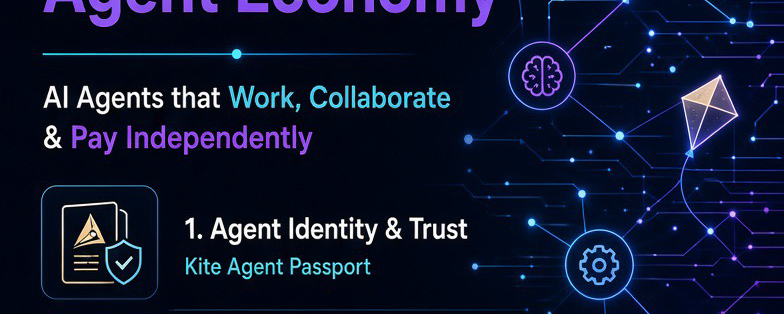
Article
Kite Is Building the Financial Infrastructure for the Agent EconomyKite Is Building the Financial Infrastructure for the Agent Economy
The next big evolution of AI may not just be about smarter models. It could be about AI agents that can actually work, collaborate, make decisions and pay for services independently.
This is where @KITE AI is positioning itself.
Today, most AI agents can perform impressive tasks, but there is still a major limitation. They need reliable identity, permission management and payment infrastructure before they can operate independently at scale.
Think about a future where one AI agent researches a market, another analyzes the data, and a third executes a service. These agents should be able to communicate, verify each other’s actions and pay each other without requiring human approval for every small transaction.
That is the agent economy Kite wants to make possible.
What makes Kite different?
Kite is building an AI-native payment blockchain with three important components.
1. Agent Identity and Trust
Through Kite Agent Passport, users can create identities and define exactly what their agents are allowed to do. Spending limits, permissions and access controls help keep autonomous activity within user-defined boundaries.
2. Payments Built for AI Agents
Traditional payment systems were designed around human transactions. AI agents may need thousands of small payments for data, computing resources and services.
Kite supports stablecoin-based payments and payment channels designed for fast, low-cost settlement. This makes machine-to-machine transactions more practical.
3. A Connected Agent Ecosystem
Agents should not operate in isolation. Kite is working towards an ecosystem where developers can build, deploy, discover and connect AI services across different platforms.
Recent Progress Makes the Story More Interesting
Kite Mainnet went live in May 2026, bringing its blockchain and Agent Passport infrastructure into production.
The project has also expanded its ecosystem integrations, including Coinbase x402, PayPal PYUSD and Google Cloud AP2.
In October, Kite introduced improvements to its Passport dashboard, expanded Arc mainnet support and continued improving its developer tools.
These developments matter because the agent economy needs more than an interesting idea. It needs infrastructure that developers and businesses can actually use.
Why $KITE Deserves Attention
The $KITE token is connected to the network’s broader economic model. Its roles include staking, network security, governance and participation in the ecosystem’s incentive structure.
As more developers build applications and agents begin using payment infrastructure, actual network activity becomes an important metric to watch.
My perspective is simple.
AI agents are moving beyond chat interfaces and becoming tools that can perform real economic activities. But for this transformation to scale, they need identity, trust, payments and coordination.
Kite is building around these fundamental requirements rather than treating AI as just another blockchain narrative.
The agent economy is still developing, but the infrastructure being built today could become an important part of how autonomous digital services interact tomorrow.
I believe this is a sector worth watching closely.
#KiteBBW $KITE
Kite Is Building the Financial Infrastructure for the Agent Economy
Kite Is Building the Financial Infrastructure for the Agent Economy
The next big evolution of AI may not just be about smarter models. It could be about AI agents that can actually work, collaborate, make decisions and pay for services independently.
This is where @KITE AI is positioning itself.
Today, most AI agents can perform impressive tasks, but there is still a major limitation. They need reliable identity, permission management and payment infrastructure before they can operate independently at scale.
Think about a future where one AI agent researches a market, another analyzes the data, and a third executes a service. These agents should be able to communicate, verify each other’s actions and pay each other without requiring human approval for every small transaction.
That is the agent economy Kite wants to make possible.
What makes Kite different?
Kite is building an AI-native payment blockchain with three important components.
1. Agent Identity and Trust
Through Kite Agent Passport, users can create identities and define exactly what their agents are allowed to do. Spending limits, permissions and access controls help keep autonomous activity within user-defined boundaries.
2. Payments Built for AI Agents
Traditional payment systems were designed around human transactions. AI agents may need thousands of small payments for data, computing resources and services.
Kite supports stablecoin-based payments and payment channels designed for fast, low-cost settlement. This makes machine-to-machine transactions more practical.
3. A Connected Agent Ecosystem
Agents should not operate in isolation. Kite is working towards an ecosystem where developers can build, deploy, discover and connect AI services across different platforms.
Recent Progress Makes the Story More Interesting
Kite Mainnet went live in May 2026, bringing its blockchain and Agent Passport infrastructure into production.
The project has also expanded its ecosystem integrations, including Coinbase x402, PayPal PYUSD and Google Cloud AP2.
In October, Kite introduced improvements to its Passport dashboard, expanded Arc mainnet support and continued improving its developer tools.
These developments matter because the agent economy needs more than an interesting idea. It needs infrastructure that developers and businesses can actually use.
Why $KITE Deserves Attention
The $KITE token is connected to the network’s broader economic model. Its roles include staking, network security, governance and participation in the ecosystem’s incentive structure.
As more developers build applications and agents begin using payment infrastructure, actual network activity becomes an important metric to watch.
My perspective is simple.
AI agents are moving beyond chat interfaces and becoming tools that can perform real economic activities. But for this transformation to scale, they need identity, trust, payments and coordination.
Kite is building around these fundamental requirements rather than treating AI as just another blockchain narrative.
The agent economy is still developing, but the infrastructure being built today could become an important part of how autonomous digital services interact tomorrow.
I believe this is a sector worth watching closely.
#KiteBBW $KITE
William-ETH:
The identity and permissioning side is so overlooked. If agents can’t pay each other safely, the ecosystem stays stuck. Excited to see how Kite solves this!
12
12
485

·
--
Partly True
🧠 DOES AI TRULY UNDERSTAND THE WORLD OR IS IT JUST GOOD AT MEMORIZING?
At Redpoint AI, Oriol Vinyals (VP of Research at Google DeepMind) raised a thought-provoking question:
AI can explain the laws of physics fluently, but does it truly understand how the world works?
The challenge comes down to three key points:
🔹 Memorization vs. Understanding: Getting the right answer does not necessarily mean having genuine understanding.
🔹 Reasoning vs. Imitation: AI needs to demonstrate its ability to predict outcomes and apply knowledge to unfamiliar situations.
🔹 Real Intelligence: We should evaluate not only what AI can say, but also what it can actually do.
This perspective is also relevant when discussing Kite AI.
If AI must demonstrate genuine understanding, AI Agents must also establish verifiable identities, clearly defined permissions, and accountable execution.
The future of AI is not just about generating intelligent answers. It is about taking actions reliably and earning trust.
What do you think?
#KiteBBW
{spot}(KITEUSDT)
🧠 DOES AI TRULY UNDERSTAND THE WORLD OR IS IT JUST GOOD AT MEMORIZING?
At Redpoint AI, Oriol Vinyals (VP of Research at Google DeepMind) raised a thought-provoking question:
AI can explain the laws of physics fluently, but does it truly understand how the world works?
The challenge comes down to three key points:
🔹 Memorization vs. Understanding: Getting the right answer does not necessarily mean having genuine understanding.
🔹 Reasoning vs. Imitation: AI needs to demonstrate its ability to predict outcomes and apply knowledge to unfamiliar situations.
🔹 Real Intelligence: We should evaluate not only what AI can say, but also what it can actually do.
This perspective is also relevant when discussing Kite AI.
If AI must demonstrate genuine understanding, AI Agents must also establish verifiable identities, clearly defined permissions, and accountable execution.
The future of AI is not just about generating intelligent answers. It is about taking actions reliably and earning trust.
What do you think?
#KiteBBW
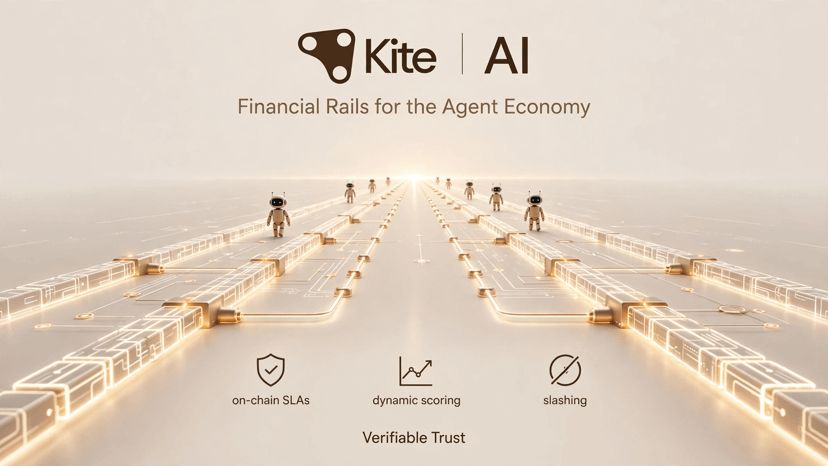
OrionWB
·
--
Kite AI: What Does It Take to Build an Economy for AI Agents?
AI Agents can analyse data and execute tasks autonomously. But to operate independently, they also need identity, controlled permissions and a way to pay for services.
That is the problem Kite is trying to solve.
1. Beyond blockchain
Kite is building Layer 1 infrastructure for the AI Agent economy, combining identity, programmable permissions and payments.
Its SPACE framework covers stablecoin payments, spending limits, Agent-first authentication, auditability and micropayments.
2. Autonomy needs boundaries
Kite separates identity into three layers: user, Agent and session. This aims to let users delegate tasks while retaining control over permissions and spending.
But architecture alone does not prove security or real-world performance.
3. KITE: Utility versus value
KITE has a maximum supply of 10 billion tokens and was introduced through Binance Launchpool in November 2025.
Still, ecosystem growth does not automatically create sustainable token demand. What matters is whether real usage translates into recurring payments and meaningful demand for KITE.
4. What matters next
* Usage: Real payments beyond incentives.
* Performance: Costs, speed and reliability.
* Security: Permission controls and key management.
* Token economics: How network activity drives demand.
My perspective
AI Agents need more than intelligence to operate independently. They need a secure way to interact economically with the digital world.
But useful infrastructure and valuable tokens are two different things.
If Agents can choose services and pay autonomously, what will make Kite difficult to replace?
For me, the answer lies in real adoption and measurable performance, not just the promise of AI.
#KiteBBW
361

·
--

Article
Beyond Chatbots: How Kite AI Could Help Build the Financial Infrastructure of the Agent EconomyThe next generation of artificial intelligence will not only be able to answer questions but also to act, collaborate, and take part in the digital economy. Artificial intelligence is developing very quickly; it has started out with systems that could produce text, answer questions and help with research and is now moving on to much more ambitious autonomous AI agents. Picture an AI agent which is able to carry out independent research into a business problem, buy the data it requires, communicate with other specialized agents, pay for external services and then deliver the task that has been completed. The discussion about artificial intelligence has now gone beyond that of merely being a talk; it has become a discussion concerning the emergence of a completely new digital economy. However, an important question remains: How is it possible for autonomous AI agents to identify themselves, swap value, and interact with each other without compromising security and accountability? It is precisely with projects such as Kite AI that things become especially interesting.
The Development From AI Assistants to Autonomous Agents Traditional AI assistants mainly function as tools for processing information; when a user asks a question, the system works on it and then produces a response. Autonomous agents use a different model. Rather than just giving a response, an agent can work towards an objective by carrying out a number of actions. It might make use of external tools, obtain information, co-ordinate with other agents and carry out tasks, depending on its permissions and integrations. Consider a practical example. If a business owner wishes to carry out some market research, rather than searching for the information themselves they can assign the task to an AI agent. That agent could: • Find research sources that are relevant. • Buy access to the needed datasets. Assign the specialized analysis to other agents. • Combine the findings. Prepare a well-organized report. It gives specialized agents the chance to offer their services to other agents. Yet for this ecosystem to work it is not enough to have intelligence; it also needs infrastructure.The three infrastructure challenges confronting the agent economy I think that three challenges will be especially important as autonomous agents become more common. Identity What is the way of telling the difference between legitimate agents and those who are malicious or not authorized? In any digital economy that involves thousands or perhaps millions of agents, verifiable identities and clear authorisation mechanisms become essential. Agents have to have a method of finding out who they are, what actions they are allowed to carry out, and which users or organizations they stand for. Payments An autonomous agent might have to buy computing resources, gain access to APIs, get some information or pay another agent for a special service. Normal payment experiences generally suppose that a person is the one who starts and approves each transaction. The agent economy needs a financial infrastructure that is programmable so that machine-to-machine payments can take place according to predefined rules. Trust and accountability Allowing an AI agent to carry out transactions involves considerable risks. What will occur if an agent uses more than the anticipated amount? And what if it interacts with a service that has not been authorized? What takes place when an action has to be traced or audited? It is important for the infrastructure to include spending restrictions, permissions, and verifiable records.How Kite AI Fits Into This Situation Kite AI, through its $KITE , is involved in the development of infrastructure for the emerging agent economy. A feature that is especially interesting is the Agent Passport approach. The aim is to enable AI agents to have a distinct identity and to function within certain financial and permission-based arrangements. Instead of viewing an AI agent merely as a chatbot, this approach acknowledges that agents may one day become independent economic actors acting on behalf of individuals, businesses, and applications. What kind of possibilities this might open up. A research agent had the possibility of buying access to information, a development agent could pay for computing resources, and a specialised data agent could supply information to another agent and in return receive compensation. The key point is that such interactions can be based on programmable permissions rather than on unlimited authority. The agent economy relies on this area since autonomy without accountability would result in unnecessary risks.The Importance of Programmable Spending Controls A major concern associated with autonomous AI is financial control. Picture an AI agent being given access to a wallet without specifying how much money it can spend or which services it is allowed to use. A helpful design of the agent might still lead to financial consequences due to unexpected behaviour, malicious instructions or compromised integrations. A more effective method is to set the boundaries beforehand. For example: A user could authorise an agent to spend no more than an amount that had been predefined on services which had been approved. Instead, the agent could act within those limitations rather than having unlimited financial authority. This introduces a valuable principle: The future of autonomous AI must be based on controlled autonomy, not on unlimited authority. If the agent economy is to achieve widespread acceptance then users have to be able to hand over tasks without giving up control.The Greater Opportunity: An economy in which agents trade services The most interesting possibility involves AI agents carrying out tasks for humans. This involves agents interacting with other agents in an economic way. Imagine an ecosystem in which: • A specialist research agent buys data. • A computing agent offers its processing resources. • The agent offers services in a number of languages. • An agent verifies the accuracy of the information. •An agent responsible for coordination links these services together in order to carry out more complex tasks. Each agent had the possibility of specializing in a particular function. Rather than a single AI handling all the tasks, various agents could work together via a network of services and transactions. It might lead to the development of new business models, open up new markets for digital services, and provide opportunities for developers who are creating specialized agents. If this vision is to become practical then the infrastructure had to be reliable, affordable, secure and easy for developers to integrate. This is the wider opportunity that Kite AI is basing its position on.What Might Determine the Success of the Agent Economy? Even though there is a great deal of excitement about autonomous agents, some difficulties still exist. Security should be given top priority, since the agents need to be protected from malicious instructions, unauthorized access and compromised integrations. Second, the developer experience should be simple. When building and connecting agents there should not be too much technical complexity required. Third, there needs to be real demand. Just because the technology is interesting does not mean that an ecosystem can succeed. Developers and businesses have to have valid reasons for using it. Above all, trust should go beyond the technology itself and users should be given clarity regarding the permissions, transactions and the actions carried out by their agents. Kite and the wider agent economy will have to deal with these significant challenges.My point of view is that the next digital economy could be machine-to-machine. We are getting to a stage at which AI systems could become more than just tools for increasing productivity. They might take on the roles of service providers, customers, researchers, coordinators, and economic participants. The change needs more than powerful language models; it also needs identity, financial infrastructure, permissions, security and accountability. That is the reason why I consider it worthwhile to follow Kite AI's course. The fact that it focuses on the infrastructure required for agents to operate economically deals with a problem which could become all the more important as the adoption of autonomous AI increases. The true test will be how well it is implemented: in terms of developer acceptance, its practical usefulness, security, and the long-term demand for it. The agent economy is still in the process of developing, but the infrastructure that is currently being constructed may affect the way tomorrow's AI systems interact. The issue is not merely about how intelligent AI can become; it's about how responsibly and effectively AI agents can take part in our digital economy. What do you consider will be the greatest obstacle to the agent economy: identity, payments, security or trust? I should like to know what you have to say.
#KiteBBW $KITE
Beyond Chatbots: How Kite AI Could Help Build the Financial Infrastructure of the Agent Economy
The next generation of artificial intelligence will not only be able to answer questions but also to act, collaborate, and take part in the digital economy. Artificial intelligence is developing very quickly; it has started out with systems that could produce text, answer questions and help with research and is now moving on to much more ambitious autonomous AI agents. Picture an AI agent which is able to carry out independent research into a business problem, buy the data it requires, communicate with other specialized agents, pay for external services and then deliver the task that has been completed. The discussion about artificial intelligence has now gone beyond that of merely being a talk; it has become a discussion concerning the emergence of a completely new digital economy. However, an important question remains: How is it possible for autonomous AI agents to identify themselves, swap value, and interact with each other without compromising security and accountability? It is precisely with projects such as Kite AI that things become especially interesting.
The Development From AI Assistants to Autonomous Agents Traditional AI assistants mainly function as tools for processing information; when a user asks a question, the system works on it and then produces a response. Autonomous agents use a different model. Rather than just giving a response, an agent can work towards an objective by carrying out a number of actions. It might make use of external tools, obtain information, co-ordinate with other agents and carry out tasks, depending on its permissions and integrations. Consider a practical example. If a business owner wishes to carry out some market research, rather than searching for the information themselves they can assign the task to an AI agent. That agent could: • Find research sources that are relevant. • Buy access to the needed datasets. Assign the specialized analysis to other agents. • Combine the findings. Prepare a well-organized report. It gives specialized agents the chance to offer their services to other agents. Yet for this ecosystem to work it is not enough to have intelligence; it also needs infrastructure.The three infrastructure challenges confronting the agent economy I think that three challenges will be especially important as autonomous agents become more common. Identity What is the way of telling the difference between legitimate agents and those who are malicious or not authorized? In any digital economy that involves thousands or perhaps millions of agents, verifiable identities and clear authorisation mechanisms become essential. Agents have to have a method of finding out who they are, what actions they are allowed to carry out, and which users or organizations they stand for. Payments An autonomous agent might have to buy computing resources, gain access to APIs, get some information or pay another agent for a special service. Normal payment experiences generally suppose that a person is the one who starts and approves each transaction. The agent economy needs a financial infrastructure that is programmable so that machine-to-machine payments can take place according to predefined rules. Trust and accountability Allowing an AI agent to carry out transactions involves considerable risks. What will occur if an agent uses more than the anticipated amount? And what if it interacts with a service that has not been authorized? What takes place when an action has to be traced or audited? It is important for the infrastructure to include spending restrictions, permissions, and verifiable records.How Kite AI Fits Into This Situation Kite AI, through its $KITE , is involved in the development of infrastructure for the emerging agent economy. A feature that is especially interesting is the Agent Passport approach. The aim is to enable AI agents to have a distinct identity and to function within certain financial and permission-based arrangements. Instead of viewing an AI agent merely as a chatbot, this approach acknowledges that agents may one day become independent economic actors acting on behalf of individuals, businesses, and applications. What kind of possibilities this might open up. A research agent had the possibility of buying access to information, a development agent could pay for computing resources, and a specialised data agent could supply information to another agent and in return receive compensation. The key point is that such interactions can be based on programmable permissions rather than on unlimited authority. The agent economy relies on this area since autonomy without accountability would result in unnecessary risks.The Importance of Programmable Spending Controls A major concern associated with autonomous AI is financial control. Picture an AI agent being given access to a wallet without specifying how much money it can spend or which services it is allowed to use. A helpful design of the agent might still lead to financial consequences due to unexpected behaviour, malicious instructions or compromised integrations. A more effective method is to set the boundaries beforehand. For example: A user could authorise an agent to spend no more than an amount that had been predefined on services which had been approved. Instead, the agent could act within those limitations rather than having unlimited financial authority. This introduces a valuable principle: The future of autonomous AI must be based on controlled autonomy, not on unlimited authority. If the agent economy is to achieve widespread acceptance then users have to be able to hand over tasks without giving up control.The Greater Opportunity: An economy in which agents trade services The most interesting possibility involves AI agents carrying out tasks for humans. This involves agents interacting with other agents in an economic way. Imagine an ecosystem in which: • A specialist research agent buys data. • A computing agent offers its processing resources. • The agent offers services in a number of languages. • An agent verifies the accuracy of the information. •An agent responsible for coordination links these services together in order to carry out more complex tasks. Each agent had the possibility of specializing in a particular function. Rather than a single AI handling all the tasks, various agents could work together via a network of services and transactions. It might lead to the development of new business models, open up new markets for digital services, and provide opportunities for developers who are creating specialized agents. If this vision is to become practical then the infrastructure had to be reliable, affordable, secure and easy for developers to integrate. This is the wider opportunity that Kite AI is basing its position on.What Might Determine the Success of the Agent Economy? Even though there is a great deal of excitement about autonomous agents, some difficulties still exist. Security should be given top priority, since the agents need to be protected from malicious instructions, unauthorized access and compromised integrations. Second, the developer experience should be simple. When building and connecting agents there should not be too much technical complexity required. Third, there needs to be real demand. Just because the technology is interesting does not mean that an ecosystem can succeed. Developers and businesses have to have valid reasons for using it. Above all, trust should go beyond the technology itself and users should be given clarity regarding the permissions, transactions and the actions carried out by their agents. Kite and the wider agent economy will have to deal with these significant challenges.My point of view is that the next digital economy could be machine-to-machine. We are getting to a stage at which AI systems could become more than just tools for increasing productivity. They might take on the roles of service providers, customers, researchers, coordinators, and economic participants. The change needs more than powerful language models; it also needs identity, financial infrastructure, permissions, security and accountability. That is the reason why I consider it worthwhile to follow Kite AI's course. The fact that it focuses on the infrastructure required for agents to operate economically deals with a problem which could become all the more important as the adoption of autonomous AI increases. The true test will be how well it is implemented: in terms of developer acceptance, its practical usefulness, security, and the long-term demand for it. The agent economy is still in the process of developing, but the infrastructure that is currently being constructed may affect the way tomorrow's AI systems interact. The issue is not merely about how intelligent AI can become; it's about how responsibly and effectively AI agents can take part in our digital economy. What do you consider will be the greatest obstacle to the agent economy: identity, payments, security or trust? I should like to know what you have to say.
#KiteBBW $KITE
Rulsher_:
What I'm really happy about is the way an AI agent can Do research, pay for some services which it's not capable and give you a finished project
1
6
315

·
--
Bullish
The next evolution of the internet may not be driven by apps alone but by AI agents working together.
The agent economy is opening a new chapter where intelligent agents can understand tasks, coordinate with other agents and help make digital interactions more efficient.
This is where KiteAI deserves attention. Kite is building toward an ecosystem designed to support the growing world of AI agents, where trust, coordination, and autonomous interactions can become essential parts of the digital economy.
As AI continues to evolve, the real opportunity is not just smarter agents, but an infrastructure that allows them to work together at scale.
The agent economy is taking shape, and Kite is a project worth watching.
The real breakthrough will come when independent agents can collaborate seamlessly, create meaningful value and unlock opportunities across a truly connected digital ecosystem.
#KiteBBW $KITE @GoKiteAI
The next evolution of the internet may not be driven by apps alone but by AI agents working together.
The agent economy is opening a new chapter where intelligent agents can understand tasks, coordinate with other agents and help make digital interactions more efficient.
This is where KiteAI deserves attention. Kite is building toward an ecosystem designed to support the growing world of AI agents, where trust, coordination, and autonomous interactions can become essential parts of the digital economy.
As AI continues to evolve, the real opportunity is not just smarter agents, but an infrastructure that allows them to work together at scale.
The agent economy is taking shape, and Kite is a project worth watching.
The real breakthrough will come when independent agents can collaborate seamlessly, create meaningful value and unlock opportunities across a truly connected digital ecosystem.
#KiteBBW $KITE @KITE AI 中文
Autumn Riley:
The agent economy is just getting started.
7
10
2k

·
--
Where does a network token get its demand? Kite's tokenomics start with a small commission on AI service transactions.
As the Foundation describes it, the protocol takes a commission from each AI service payment, can swap that revenue into KITE on the open market, and passes it to the module and the Kite L1. Service operators still get paid in the currency they prefer. Modules that issue their own tokens face a second rule: they must lock KITE into liquidity pools paired with those tokens, the requirement scales with size and usage, and the position cannot be withdrawn while the module stays active.
Bull case: usage creates revenue, revenue creates buying, and every successful module locks up more supply.
Bear case: it only works if agents pay for services at real volume, and a commission set too high drives providers elsewhere while one set too low funds nothing.
Not financial advice, just mechanics. Where would you set the commission, and why?
#KiteBBW $KITE
1.7k

·
--
Just three days ago, I was scrolling through a platform when I came across a news commentator talking about the AI agent economy. He was discussing a different angle, but I listened carefully and even saved the video because I felt it might be useful to me later.
While thinking about that conversation, another question came to my mind.
What happens when an AI agent pays for a service but doesn’t get the result it was supposed to deliver?
Imagine one agent hires another to analyze data, prepare a report, or complete a business task. The payment goes through, but the work is incomplete, inaccurate, or completely useless.
Now what?
In traditional business, we have contracts, customer support, and people who can review disputes. But when autonomous agents transact with each other, who decides whether the work was completed properly? And what happens to the money if the result doesn’t match the agreement?
This is where I think Kite’s role becomes interesting. Kite focuses on agent identity, programmable spending permissions, and infrastructure for machine-to-machine payments.
But maybe the bigger question is how payment rules connect with the actual work being performed.
Just ask anyone: an authorized payment proves that a transaction was permitted. It doesn’t automatically prove that the service was useful or delivered correctly.
This difference matters for businesses. If you interview senior executives or CEOs with a strong business mindset about this issue, I think their perspective could be interesting.
Businesses won’t judge this economy only by how quickly agents pay each other, but also by whether they can trust the results.
Maybe the next challenge isn’t simply enabling agents to transact. It’s making those transactions meaningful in real business situations.
What do you think?
$KITE @GoKiteAI #KiteBBW
{future}(KITEUSDT)
Just three days ago, I was scrolling through a platform when I came across a news commentator talking about the AI agent economy. He was discussing a different angle, but I listened carefully and even saved the video because I felt it might be useful to me later.
While thinking about that conversation, another question came to my mind.
What happens when an AI agent pays for a service but doesn’t get the result it was supposed to deliver?
Imagine one agent hires another to analyze data, prepare a report, or complete a business task. The payment goes through, but the work is incomplete, inaccurate, or completely useless.
Now what?
In traditional business, we have contracts, customer support, and people who can review disputes. But when autonomous agents transact with each other, who decides whether the work was completed properly? And what happens to the money if the result doesn’t match the agreement?
This is where I think Kite’s role becomes interesting. Kite focuses on agent identity, programmable spending permissions, and infrastructure for machine-to-machine payments.
But maybe the bigger question is how payment rules connect with the actual work being performed.
Just ask anyone: an authorized payment proves that a transaction was permitted. It doesn’t automatically prove that the service was useful or delivered correctly.
This difference matters for businesses. If you interview senior executives or CEOs with a strong business mindset about this issue, I think their perspective could be interesting.
Businesses won’t judge this economy only by how quickly agents pay each other, but also by whether they can trust the results.
Maybe the next challenge isn’t simply enabling agents to transact. It’s making those transactions meaningful in real business situations.
What do you think?
$KITE @KITE AI 中文 #KiteBBW
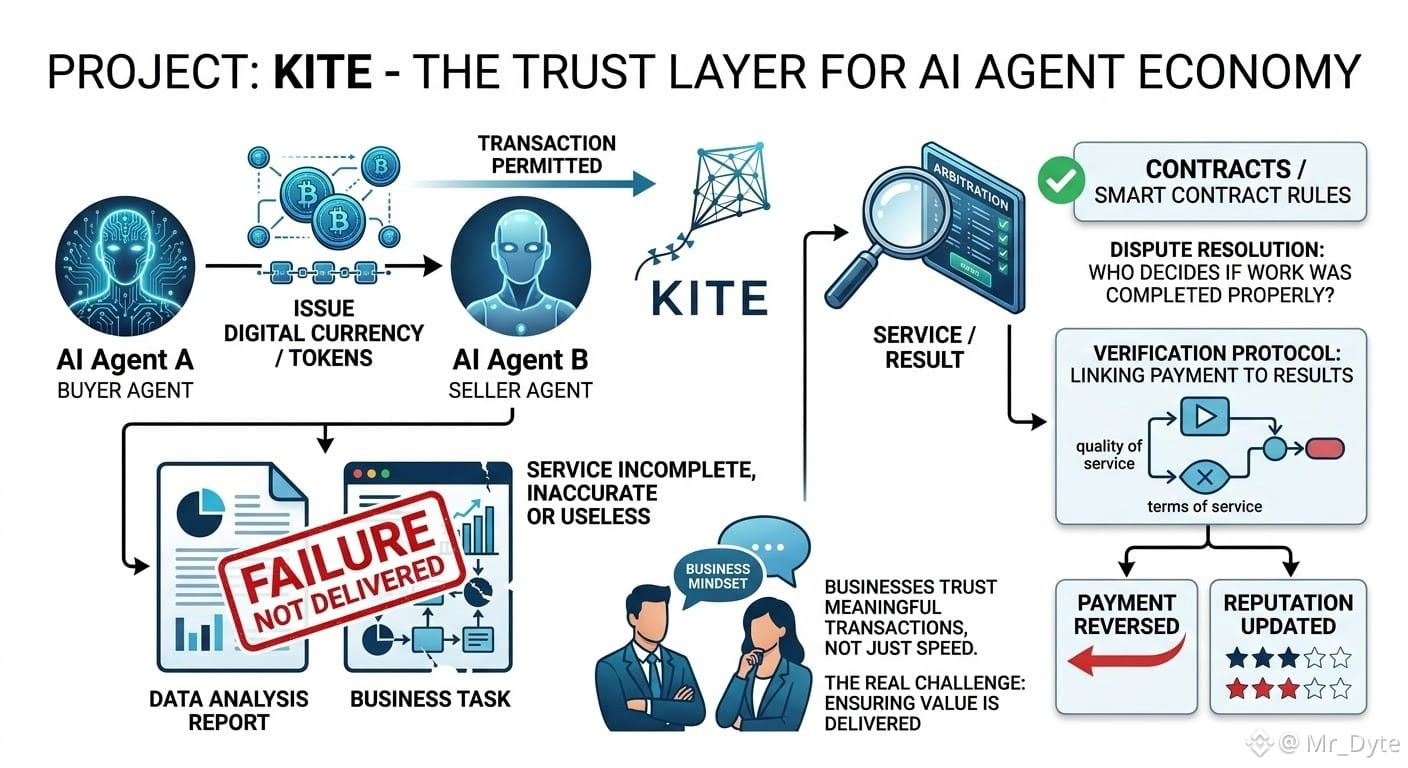
1
120

·
--
Bullish
Diving into the fundamentals of the Kite network shows a project built on a unique idea. This isn't about decentralized finance. Instead the platform creates an EVM Layer one blockchain designed specifically for autonomous artificial intelligence agents. These digital agents need identification and the ability to make small transactions. To meet this need the network introduces identities called agent passports. It also uses governance rules. Together these features create a working system where software can act as economic actors in a safe way.
The ecosystem works through a design. It includes environments for curated services. Module owners, validators and delegators work together in a setup. Participants lock their resources into liquidity pools. They also stake tokens to help secure the consensus process. The native token has growing utility across development stages. This links the protocol’s revenue directly to service usage. When applications generate transaction fees or protocol margins a portion of that income converts into the native token. This process builds demand over time.
From a point of view connecting builders and users, through strong utility models helps keep the network healthy in the long run. As automated workflows become more common in the economy the foundational layers that support autonomous transactions could become very important. Those watching this space should keep an eye on mainnet adoption milestones. They should also track developer activity within the environments.. They should monitor overall transaction growth. All these factors help evaluate whether progress is sustainable moving.
#KiteBBW $KITE
{future}(KITEUSDT)
@GoKiteAI
Diving into the fundamentals of the Kite network shows a project built on a unique idea. This isn't about decentralized finance. Instead the platform creates an EVM Layer one blockchain designed specifically for autonomous artificial intelligence agents. These digital agents need identification and the ability to make small transactions. To meet this need the network introduces identities called agent passports. It also uses governance rules. Together these features create a working system where software can act as economic actors in a safe way.
The ecosystem works through a design. It includes environments for curated services. Module owners, validators and delegators work together in a setup. Participants lock their resources into liquidity pools. They also stake tokens to help secure the consensus process. The native token has growing utility across development stages. This links the protocol’s revenue directly to service usage. When applications generate transaction fees or protocol margins a portion of that income converts into the native token. This process builds demand over time.
From a point of view connecting builders and users, through strong utility models helps keep the network healthy in the long run. As automated workflows become more common in the economy the foundational layers that support autonomous transactions could become very important. Those watching this space should keep an eye on mainnet adoption milestones. They should also track developer activity within the environments.. They should monitor overall transaction growth. All these factors help evaluate whether progress is sustainable moving.
#KiteBBW $KITE
@KITE AI 中文
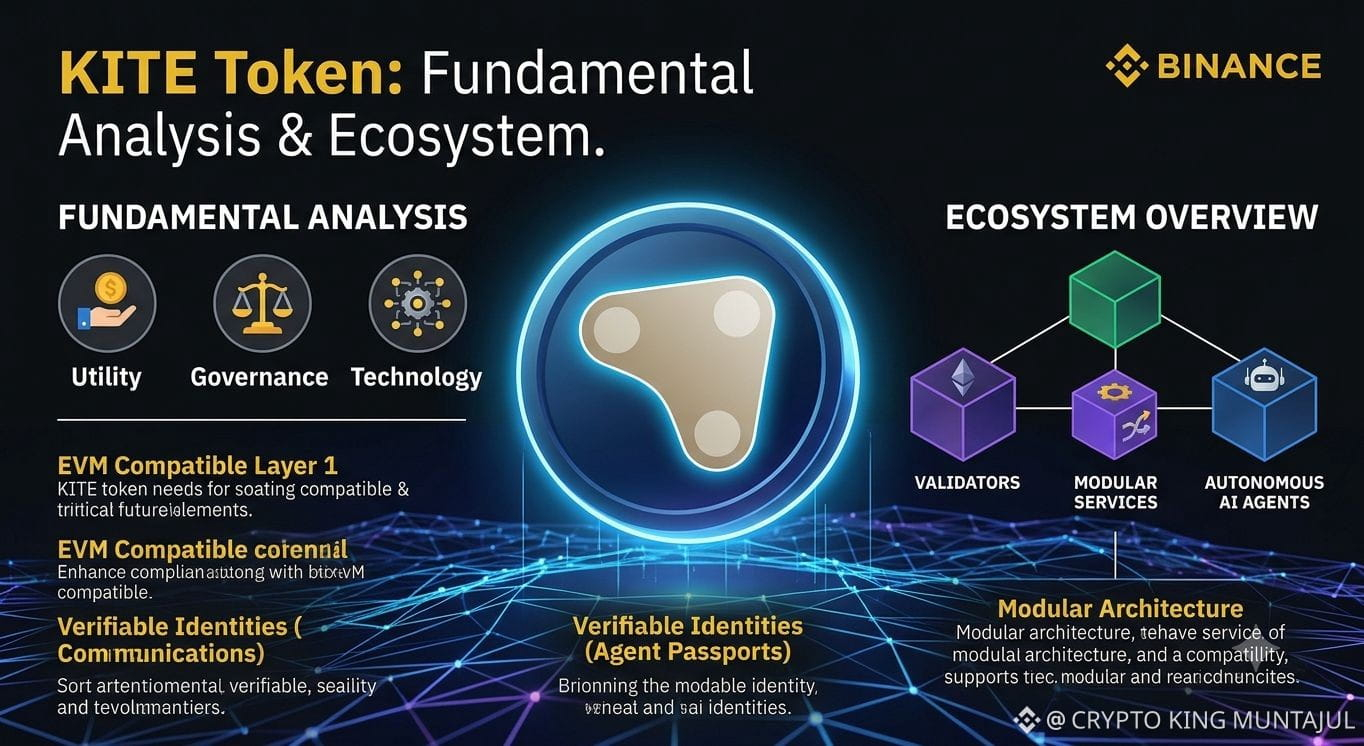
208

·
--
Partly True
Spent an evening looking through KiteScan activity and came away with more questions than answers.
Kite’s documentation describes payment channels where opening and closing happen on-chain, while thousands of smaller updates can happen off-chain.
That makes transaction counts a tricky way to judge actual agent adoption.
One thing caught my attention in the October 28–29 activity window.
A public tracker collecting KiteScan data recorded 2,133 sampled transactions involving the WKITE contract over 24 hours, compared with 608 involving SimplePair.
WKITE contract:
https://kitescan.ai/token/0xcc788DC0486CD2BaacFf287eea1902cc09FbA570
Activity data:
https://coins.madebypets.com/kite/live
What stood out wasn’t the size of the numbers. It was how much visible activity involved familiar token infrastructure rather than clearly identifiable agent payments.
I can’t tell how many of those interactions came from actual autonomous agents, ordinary users, or automated scripts. The sample doesn’t establish unique wallet counts either.
Small confession: I used to judge a chain by its daily transaction count. Looking at Kite made me rethink that.
A busy network is one thing. Independent agents repeatedly paying for real services is another.
For $KITE , that’s the distinction I’d like to understand better.
The infrastructure is there, and transactions are happening. Whether those transactions reflect meaningful agent adoption is still an open question.
#KiteBBW
Elon Jamess:
I’d rather see consistent usage than just big numbers
3
6
2.4k

Do you know the stone soup story? Two travelers walk into a hungry village, drop a stone in a pot and promise a feast. One villager adds a carrot, another brings potatoes, and by evening everybody’s eating and crediting the stone. Nobody stops to ask whether the soup ever needed it. The story only works because the stone does nothing.
I asked that question when I read Kite’s MiCA white paper. Rewards start out fully in $KITE , then slowly shift to stablecoins. Stablecoins are the carrots here. Paying in them proves agents can use the network. It doesn’t prove anyone has to hold $KITE .
And the market already leans that way. Keyrock counted 176 million agent payments, and 98.6% of them settled in USDC. If Kite’s traffic looks anything like that, the soup keeps getting richer and the stone stays optional.
To be fair, Kite does give the stone a job. You stake $KITE to run a validator, own a module or delegate to one. That’s a bond, not a toll: closer to buying the pot than paying for a bowl. But a bond grows with how much security and module supply the network wants, not with how many payments go through. Those two curves don’t have to move together.
So I’ve stopped caring how many agents show up. Transaction counts, agent counts, partner logos: none of them tell you whether anyone had to buy the token. What I’d trust is stablecoin fees per staked $KITE, and whether a module owner has to lock more KITE as usage grows. If both climb together, the stone is in the recipe. If fees rise while stakes sit flat, it’s a nice stone in a good soup.
I’ll be watching two things: how fast rewards move from KITE to stablecoins, and what modules actually make people lock. Which one is the token following, the soup or the stake?
#KiteBBW
Do you know the stone soup story? Two travelers walk into a hungry village, drop a stone in a pot and promise a feast. One villager adds a carrot, another brings potatoes, and by evening everybody’s eating and crediting the stone. Nobody stops to ask whether the soup ever needed it. The story only works because the stone does nothing.
I asked that question when I read Kite’s MiCA white paper. Rewards start out fully in $KITE , then slowly shift to stablecoins. Stablecoins are the carrots here. Paying in them proves agents can use the network. It doesn’t prove anyone has to hold $KITE .
And the market already leans that way. Keyrock counted 176 million agent payments, and 98.6% of them settled in USDC. If Kite’s traffic looks anything like that, the soup keeps getting richer and the stone stays optional.
To be fair, Kite does give the stone a job. You stake $KITE to run a validator, own a module or delegate to one. That’s a bond, not a toll: closer to buying the pot than paying for a bowl. But a bond grows with how much security and module supply the network wants, not with how many payments go through. Those two curves don’t have to move together.
So I’ve stopped caring how many agents show up. Transaction counts, agent counts, partner logos: none of them tell you whether anyone had to buy the token. What I’d trust is stablecoin fees per staked $KITE , and whether a module owner has to lock more KITE as usage grows. If both climb together, the stone is in the recipe. If fees rise while stakes sit flat, it’s a nice stone in a good soup.
I’ll be watching two things: how fast rewards move from KITE to stablecoins, and what modules actually make people lock. Which one is the token following, the soup or the stake?
#KiteBBW
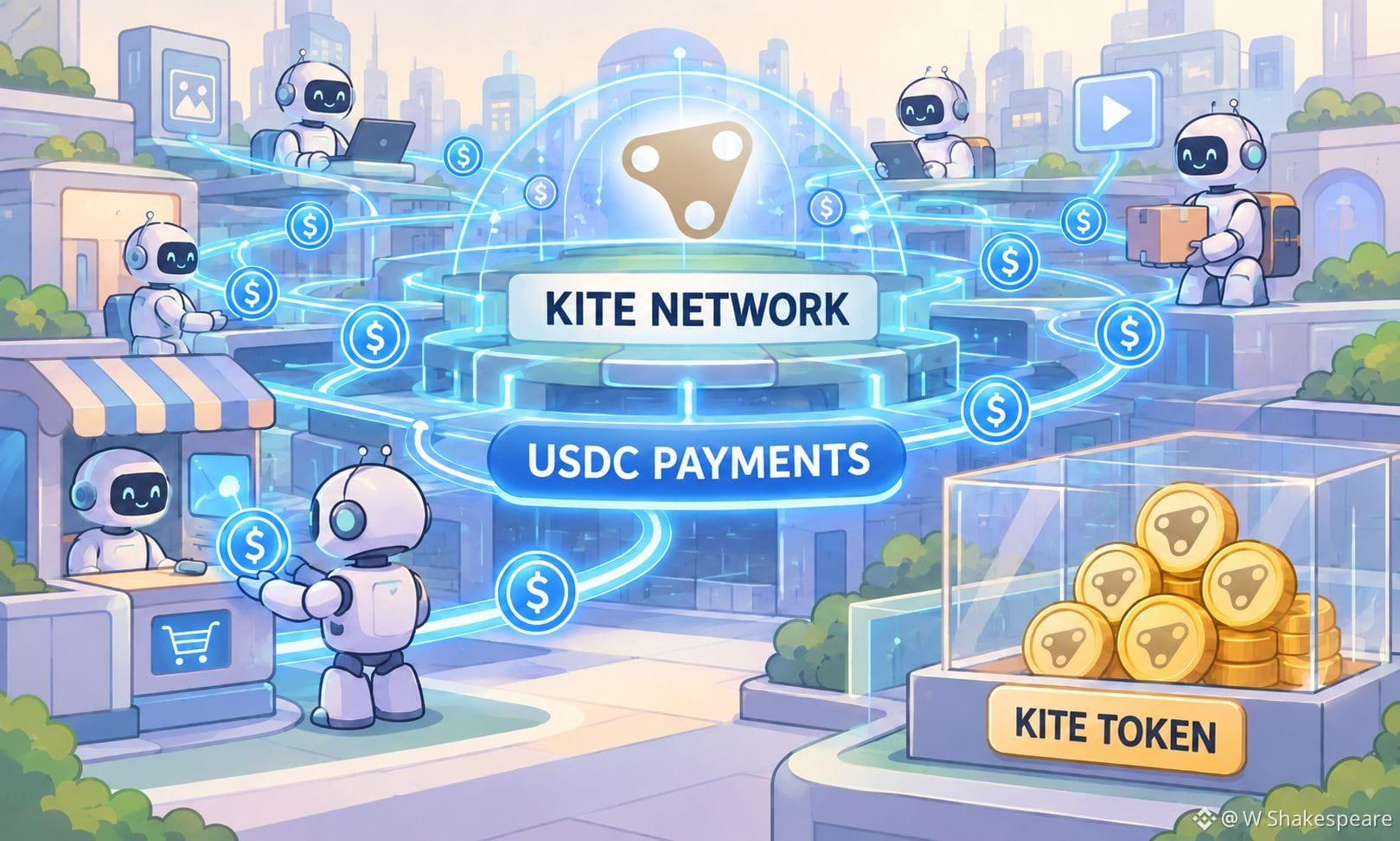
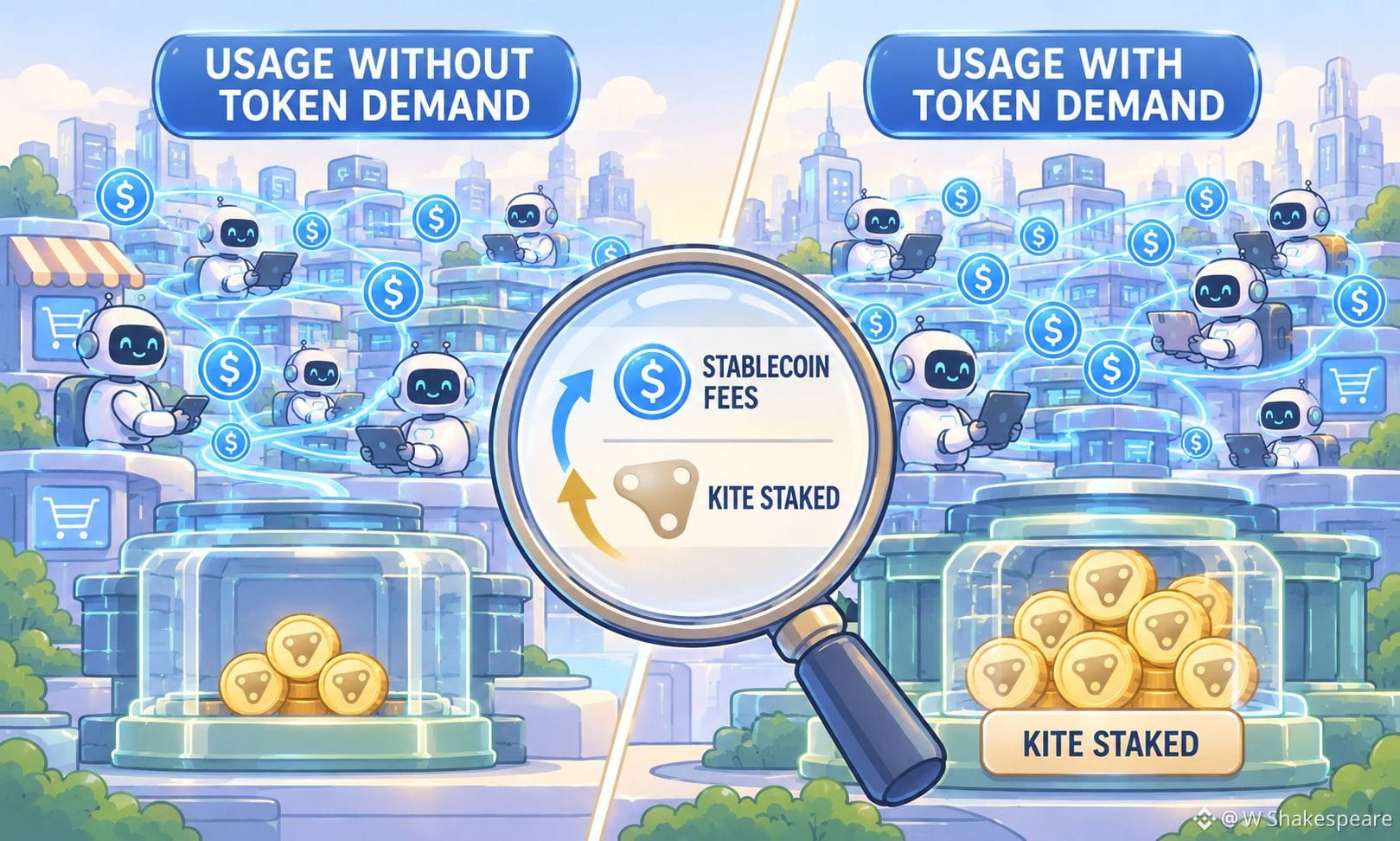
Subin86:
Crypto in a nutshell: 98% of people using USDC, while $KITE holders pray that staking lockups are enough to pump the price 💀
3
4
859
Log in to explore more content
Join global crypto users on Binance Square
⚡️ Get latest and useful information about crypto.
💬 Trusted by the world’s largest crypto exchange.
👍 Discover real insights from verified creators.
Email / Phone number
Trending Topics
1
#SuspectedNorthKoreaAttacksAccountForNearly89%OfCryptoHackLosses
145 views
5 Discussing
2
#OpenAICutsFundraisingTargetBy$10B
60 views
23 Discussing
3
#ASICHasReceivedNoPredictionMarketApplications
3,768 views
153 Discussing
4
#RecallAnnouncesLiquidationPlansToBurn35.86%OfSupply
183 views
4 Discussing
5
#TetherReports$191.5BInQ3Reserves
80 views
5 Discussing
6
#UniswapA16zSeekDeFiExemptionFromIllinoisCryptoTax
56,430 views
1,109 Discussing
7
#HKDollarStablecoinHKDAPToLaunchOnSolana
40,793 views
721 Discussing
8
#$1.5BInLeveragedCryptoBetsLiquidated
74,463 views
285 Discussing
9
#TrezorSaysCryptoBilisSoldWalletMayContainMaliciousComponents
6,250 views
95 Discussing
10
#KOSPIFalls3.53%BackBelow6000
88,700 views
1,311 Discussing