
#depin
depin
3.7M views
13,197 Discussing
Hot
Latest

·
--
📠 "𝗢𝗻𝗲 𝘀𝗶𝗴𝗻𝗮𝗹 𝗺𝗲𝗮𝗻𝘀 𝗻𝗼𝘁𝗵𝗶𝗻𝗴 𝗮𝗹𝗼𝗻𝗲, 𝗧𝗵𝗼𝘂𝘀𝗮𝗻𝗱𝘀 𝗼𝗳 𝘁𝗵𝗲𝗺 𝘁𝗼𝗴𝗲𝘁𝗵𝗲𝗿 𝗰𝗵𝗮𝗻𝗴𝗲 𝗲𝘃𝗲𝗿𝘆𝘁𝗵𝗶𝗻𝗴" 📠
Let's dive into the Derad's network insights below.👇
📶 𝗧𝗵𝗲 𝗦𝗶𝗴𝗻𝗮𝗹
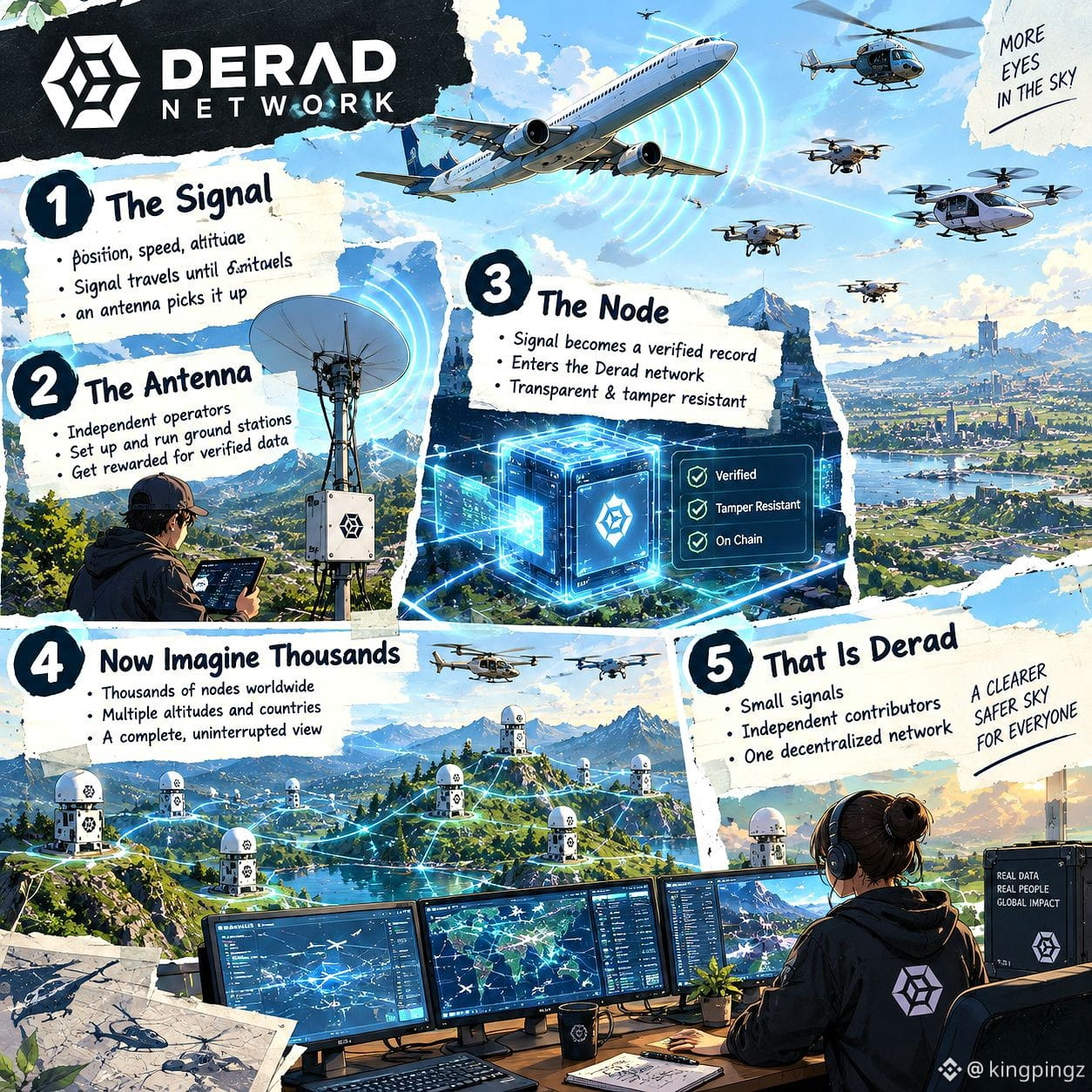
Every aircraft in the sky is constantly broadcasting its position, speed and altitude. That signal travels until an antenna picks it up and what happens next is where Derad completely changes the story of how aviation data gets handled.
📡 𝗧𝗵𝗲 𝗔𝗻𝘁𝗲𝗻𝗻𝗮
A single antenna receiving that signal is just a starting point. Derad puts that antenna in the hands of an independent operator who gets rewarded for capturing verified data and contributing it to a network that nobody owns and everyone can access.
🌐 𝗧𝗵𝗲 𝗡𝗼𝗱𝗲
Once captured the signal does not go into a corporate database locked behind a paywall. It enters the Derad network as a verified tamper resistant record that adds to a growing transparent picture of everything moving through the sky right now.
🖥️ 𝗡𝗼𝘄 𝗜𝗺𝗮𝗴𝗶𝗻𝗲 𝗧𝗵𝗼𝘂𝘀𝗮𝗻𝗱𝘀
One node is useful. Ten nodes are better. Thousands of nodes operating independently across different countries and altitudes create something no centralized system has ever managed, which is a truly complete and uninterrupted view of global airspace.
✈️ 𝗧𝗵𝗮𝘁 𝗜𝘀 𝗗𝗲𝗿𝗮𝗱
Small signals. Independent contributors. One decentralized network turning countless individual data points into the most transparent and accessible picture of the sky that aviation has ever had access to.
#AI #DePIN #Web3
📠 "𝗢𝗻𝗲 𝘀𝗶𝗴𝗻𝗮𝗹 𝗺𝗲𝗮𝗻𝘀 𝗻𝗼𝘁𝗵𝗶𝗻𝗴 𝗮𝗹𝗼𝗻𝗲, 𝗧𝗵𝗼𝘂𝘀𝗮𝗻𝗱𝘀 𝗼𝗳 𝘁𝗵𝗲𝗺 𝘁𝗼𝗴𝗲𝘁𝗵𝗲𝗿 𝗰𝗵𝗮𝗻𝗴𝗲 𝗲𝘃𝗲𝗿𝘆𝘁𝗵𝗶𝗻𝗴" 📠
Let's dive into the Derad's network insights below.👇
📶 𝗧𝗵𝗲 𝗦𝗶𝗴𝗻𝗮𝗹
Every aircraft in the sky is constantly broadcasting its position, speed and altitude. That signal travels until an antenna picks it up and what happens next is where Derad completely changes the story of how aviation data gets handled.
📡 𝗧𝗵𝗲 𝗔𝗻𝘁𝗲𝗻𝗻𝗮
A single antenna receiving that signal is just a starting point. Derad puts that antenna in the hands of an independent operator who gets rewarded for capturing verified data and contributing it to a network that nobody owns and everyone can access.
🌐 𝗧𝗵𝗲 𝗡𝗼𝗱𝗲
Once captured the signal does not go into a corporate database locked behind a paywall. It enters the Derad network as a verified tamper resistant record that adds to a growing transparent picture of everything moving through the sky right now.
🖥️ 𝗡𝗼𝘄 𝗜𝗺𝗮𝗴𝗶𝗻𝗲 𝗧𝗵𝗼𝘂𝘀𝗮𝗻𝗱𝘀
One node is useful. Ten nodes are better. Thousands of nodes operating independently across different countries and altitudes create something no centralized system has ever managed, which is a truly complete and uninterrupted view of global airspace.
✈️ 𝗧𝗵𝗮𝘁 𝗜𝘀 𝗗𝗲𝗿𝗮𝗱
Small signals. Independent contributors. One decentralized network turning countless individual data points into the most transparent and accessible picture of the sky that aviation has ever had access to.
#AI #DePIN #Web3
Let's dive into the Derad's network insights below.👇
📶 𝗧𝗵𝗲 𝗦𝗶𝗴𝗻𝗮𝗹
Every aircraft in the sky is constantly broadcasting its position, speed and altitude. That signal travels until an antenna picks it up and what happens next is where Derad completely changes the story of how aviation data gets handled.
📡 𝗧𝗵𝗲 𝗔𝗻𝘁𝗲𝗻𝗻𝗮
A single antenna receiving that signal is just a starting point. Derad puts that antenna in the hands of an independent operator who gets rewarded for capturing verified data and contributing it to a network that nobody owns and everyone can access.
🌐 𝗧𝗵𝗲 𝗡𝗼𝗱𝗲
Once captured the signal does not go into a corporate database locked behind a paywall. It enters the Derad network as a verified tamper resistant record that adds to a growing transparent picture of everything moving through the sky right now.
🖥️ 𝗡𝗼𝘄 𝗜𝗺𝗮𝗴𝗶𝗻𝗲 𝗧𝗵𝗼𝘂𝘀𝗮𝗻𝗱𝘀
One node is useful. Ten nodes are better. Thousands of nodes operating independently across different countries and altitudes create something no centralized system has ever managed, which is a truly complete and uninterrupted view of global airspace.
✈️ 𝗧𝗵𝗮𝘁 𝗜𝘀 𝗗𝗲𝗿𝗮𝗱
Small signals. Independent contributors. One decentralized network turning countless individual data points into the most transparent and accessible picture of the sky that aviation has ever had access to.
#AI #DePIN #Web3
1
32
·
--
✈️ "𝗜𝗻 𝗮𝘃𝗶𝗮𝘁𝗶𝗼𝗻 𝘄𝗵𝗮𝘁 𝘆𝗼𝘂 𝗰𝗮𝗻𝗻𝗼𝘁 𝘀𝗲𝗲 𝗰𝗮𝗻 𝗵𝘂𝗿𝘁 𝘆𝗼𝘂, 𝗗𝗲𝗿𝗮𝗱 𝗶𝘀 𝗺𝗮𝗸𝗶𝗻𝗴 𝘀𝘂𝗿𝗲 𝘁𝗵𝗲 𝘀𝗸𝘆 𝗵𝗮𝘀 𝗻𝗼 𝗵𝗶𝗱𝗱𝗲𝗻 𝗰𝗼𝗿𝗻𝗲𝗿𝘀" ✈️
Let's dive into the Derad's network insights below.👇
🛑 𝗕𝗹𝗶𝗻𝗱 𝗦𝗽𝗼𝘁𝘀 𝗞𝗶𝗹𝗹
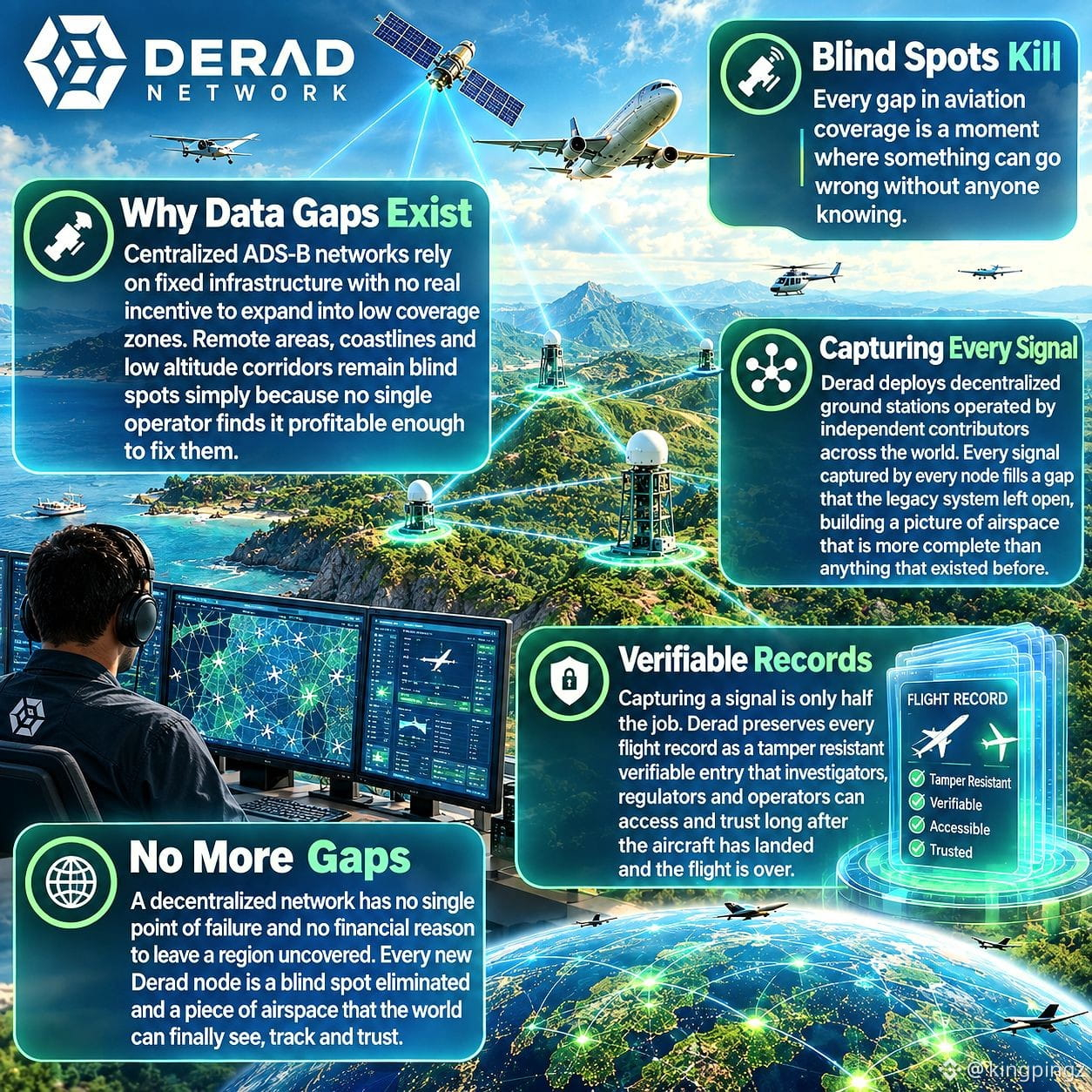
Every gap in aviation coverage is a moment where something can go wrong without anyone knowing. Missing signals mean missing context, and missing context in a shared airspace full of aircraft is not just inconvenient, it is genuinely dangerous.
📡 𝗪𝗵𝘆 𝗗𝗮𝘁𝗮 𝗚𝗮𝗽𝘀 𝗘𝘅𝗶𝘀𝘁
Centralized ADS-B networks rely on fixed infrastructure with no real incentive to expand into low coverage zones. Remote areas, coastlines and low altitude corridors remain blind spots simply because no single operator finds it profitable enough to fix them.
🛰️ 𝗖𝗮𝗽𝘁𝘂𝗿𝗶𝗻𝗴 𝗘𝘃𝗲𝗿𝘆 𝗦𝗶𝗴𝗻𝗮𝗹
Derad deploys decentralized ground stations operated by independent contributors across the world. Every signal captured by every node fills a gap that the legacy system left open, building a picture of airspace that is more complete than anything that existed before.
🖥️ 𝗩𝗲𝗿𝗶𝗳𝗶𝗮𝗯𝗹𝗲 𝗥𝗲𝗰𝗼𝗿𝗱𝘀
Capturing a signal is only half the job. Derad preserves every flight record as a tamper resistant verifiable entry that investigators, regulators and operators can access and trust long after the aircraft has landed and the flight is over.
🌐 𝗡𝗼 𝗠𝗼𝗿𝗲 𝗚𝗮𝗽𝘀
A decentralized network has no single point of failure and no financial reason to leave a region uncovered. Every new Derad node is a blind spot eliminated and a piece of airspace that the world can finally see, track and trust.
#AI #DePIN #Web3
✈️ "𝗜𝗻 𝗮𝘃𝗶𝗮𝘁𝗶𝗼𝗻 𝘄𝗵𝗮𝘁 𝘆𝗼𝘂 𝗰𝗮𝗻𝗻𝗼𝘁 𝘀𝗲𝗲 𝗰𝗮𝗻 𝗵𝘂𝗿𝘁 𝘆𝗼𝘂, 𝗗𝗲𝗿𝗮𝗱 𝗶𝘀 𝗺𝗮𝗸𝗶𝗻𝗴 𝘀𝘂𝗿𝗲 𝘁𝗵𝗲 𝘀𝗸𝘆 𝗵𝗮𝘀 𝗻𝗼 𝗵𝗶𝗱𝗱𝗲𝗻 𝗰𝗼𝗿𝗻𝗲𝗿𝘀" ✈️
Let's dive into the Derad's network insights below.👇
🛑 𝗕𝗹𝗶𝗻𝗱 𝗦𝗽𝗼𝘁𝘀 𝗞𝗶𝗹𝗹
Every gap in aviation coverage is a moment where something can go wrong without anyone knowing. Missing signals mean missing context, and missing context in a shared airspace full of aircraft is not just inconvenient, it is genuinely dangerous.
📡 𝗪𝗵𝘆 𝗗𝗮𝘁𝗮 𝗚𝗮𝗽𝘀 𝗘𝘅𝗶𝘀𝘁
Centralized ADS-B networks rely on fixed infrastructure with no real incentive to expand into low coverage zones. Remote areas, coastlines and low altitude corridors remain blind spots simply because no single operator finds it profitable enough to fix them.
🛰️ 𝗖𝗮𝗽𝘁𝘂𝗿𝗶𝗻𝗴 𝗘𝘃𝗲𝗿𝘆 𝗦𝗶𝗴𝗻𝗮𝗹
Derad deploys decentralized ground stations operated by independent contributors across the world. Every signal captured by every node fills a gap that the legacy system left open, building a picture of airspace that is more complete than anything that existed before.
🖥️ 𝗩𝗲𝗿𝗶𝗳𝗶𝗮𝗯𝗹𝗲 𝗥𝗲𝗰𝗼𝗿𝗱𝘀
Capturing a signal is only half the job. Derad preserves every flight record as a tamper resistant verifiable entry that investigators, regulators and operators can access and trust long after the aircraft has landed and the flight is over.
🌐 𝗡𝗼 𝗠𝗼𝗿𝗲 𝗚𝗮𝗽𝘀
A decentralized network has no single point of failure and no financial reason to leave a region uncovered. Every new Derad node is a blind spot eliminated and a piece of airspace that the world can finally see, track and trust.
#AI #DePIN #Web3
Let's dive into the Derad's network insights below.👇
🛑 𝗕𝗹𝗶𝗻𝗱 𝗦𝗽𝗼𝘁𝘀 𝗞𝗶𝗹𝗹
Every gap in aviation coverage is a moment where something can go wrong without anyone knowing. Missing signals mean missing context, and missing context in a shared airspace full of aircraft is not just inconvenient, it is genuinely dangerous.
📡 𝗪𝗵𝘆 𝗗𝗮𝘁𝗮 𝗚𝗮𝗽𝘀 𝗘𝘅𝗶𝘀𝘁
Centralized ADS-B networks rely on fixed infrastructure with no real incentive to expand into low coverage zones. Remote areas, coastlines and low altitude corridors remain blind spots simply because no single operator finds it profitable enough to fix them.
🛰️ 𝗖𝗮𝗽𝘁𝘂𝗿𝗶𝗻𝗴 𝗘𝘃𝗲𝗿𝘆 𝗦𝗶𝗴𝗻𝗮𝗹
Derad deploys decentralized ground stations operated by independent contributors across the world. Every signal captured by every node fills a gap that the legacy system left open, building a picture of airspace that is more complete than anything that existed before.
🖥️ 𝗩𝗲𝗿𝗶𝗳𝗶𝗮𝗯𝗹𝗲 𝗥𝗲𝗰𝗼𝗿𝗱𝘀
Capturing a signal is only half the job. Derad preserves every flight record as a tamper resistant verifiable entry that investigators, regulators and operators can access and trust long after the aircraft has landed and the flight is over.
🌐 𝗡𝗼 𝗠𝗼𝗿𝗲 𝗚𝗮𝗽𝘀
A decentralized network has no single point of failure and no financial reason to leave a region uncovered. Every new Derad node is a blind spot eliminated and a piece of airspace that the world can finally see, track and trust.
#AI #DePIN #Web3
1
44
·
--
👩💻 "𝗢𝗻𝗲 𝗽𝗲𝗿𝘀𝗼𝗻 𝗿𝘂𝗻𝘀 𝗮 𝗻𝗼𝗱𝗲 𝗮𝗻𝗱 𝘁𝗵𝗲 𝘄𝗼𝗿𝗹𝗱 𝘀𝗲𝗲𝘀 𝗯𝗲𝘁𝘁𝗲𝗿, 𝗧𝗵𝗮𝘁 𝗶𝘀 𝘄𝗵𝗮𝘁 𝗗𝗲𝗿𝗮𝗱 𝗶𝘀 𝗮𝗰𝘁𝘂𝗮𝗹𝗹𝘆 𝗯𝘂𝗶𝗹𝗱𝗶𝗻𝗴" 👩💻
Let's dive into the Derad's network insights below.👇
✈️ 𝗢𝗻𝗲 𝗡𝗲𝘁𝘄𝗼𝗿𝗸
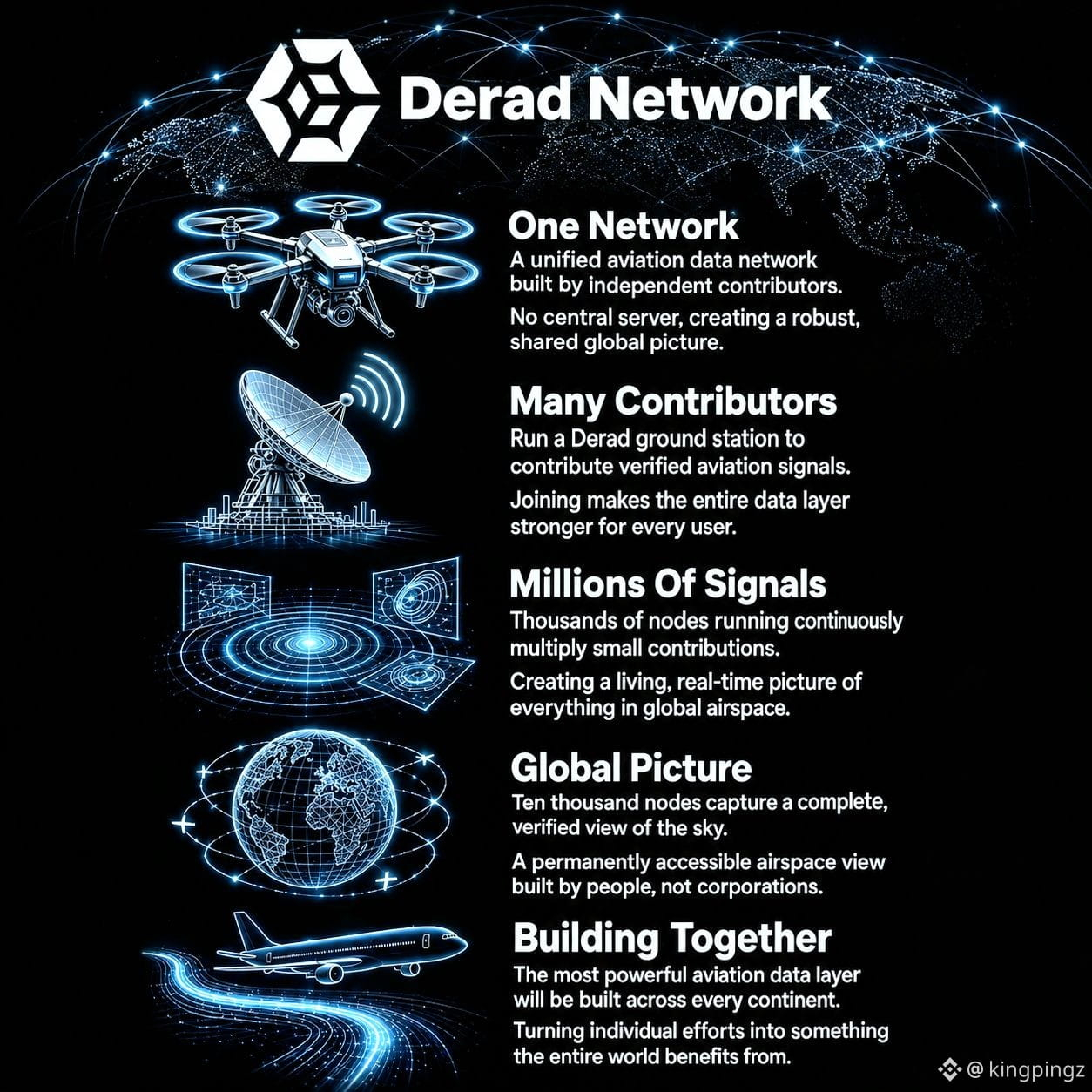
No single company, no central server and no single point of failure. Derad is one unified aviation data network built from the ground up by thousands of independent contributors each adding their piece to a much larger shared picture.
📡 𝗠𝗮𝗻𝘆 𝗖𝗼𝗻𝘁𝗿𝗶𝗯𝘂𝘁𝗼𝗿𝘀
Anyone anywhere can run a Derad ground station and start contributing real verified aviation signals to the network. The more people who join the stronger, wider and more reliable the entire data layer becomes for every user depending on it.
🛸 𝗠𝗶𝗹𝗹𝗶𝗼𝗻𝘀 𝗢𝗳 𝗦𝗶𝗴𝗻𝗮𝗹𝘀
Individual contributions sound small until you multiply them across thousands of nodes running continuously around the world. At that scale individual signals stop being data points and start becoming a living real time picture of everything moving through global airspace.
🖥️ 𝗚𝗹𝗼𝗯𝗮𝗹 𝗣𝗶𝗰𝘁𝘂𝗿𝗲
What one node captures is useful. What ten thousand nodes capture together is something no centralized network has ever been able to produce. A complete, verified and permanently accessible view of the sky built by people not corporations.
🌐 𝗕𝘂𝗶𝗹𝗱𝗶𝗻𝗴 𝗧𝗼𝗴𝗲𝘁𝗵𝗲𝗿
The most powerful aviation data layer in history will not be built by one company in one place. It will be built by contributors across every continent turning their individual effort into something the entire world benefits from.
#DePIN #AI #Web3
👩💻 "𝗢𝗻𝗲 𝗽𝗲𝗿𝘀𝗼𝗻 𝗿𝘂𝗻𝘀 𝗮 𝗻𝗼𝗱𝗲 𝗮𝗻𝗱 𝘁𝗵𝗲 𝘄𝗼𝗿𝗹𝗱 𝘀𝗲𝗲𝘀 𝗯𝗲𝘁𝘁𝗲𝗿, 𝗧𝗵𝗮𝘁 𝗶𝘀 𝘄𝗵𝗮𝘁 𝗗𝗲𝗿𝗮𝗱 𝗶𝘀 𝗮𝗰𝘁𝘂𝗮𝗹𝗹𝘆 𝗯𝘂𝗶𝗹𝗱𝗶𝗻𝗴" 👩💻
Let's dive into the Derad's network insights below.👇
✈️ 𝗢𝗻𝗲 𝗡𝗲𝘁𝘄𝗼𝗿𝗸
No single company, no central server and no single point of failure. Derad is one unified aviation data network built from the ground up by thousands of independent contributors each adding their piece to a much larger shared picture.
📡 𝗠𝗮𝗻𝘆 𝗖𝗼𝗻𝘁𝗿𝗶𝗯𝘂𝘁𝗼𝗿𝘀
Anyone anywhere can run a Derad ground station and start contributing real verified aviation signals to the network. The more people who join the stronger, wider and more reliable the entire data layer becomes for every user depending on it.
🛸 𝗠𝗶𝗹𝗹𝗶𝗼𝗻𝘀 𝗢𝗳 𝗦𝗶𝗴𝗻𝗮𝗹𝘀
Individual contributions sound small until you multiply them across thousands of nodes running continuously around the world. At that scale individual signals stop being data points and start becoming a living real time picture of everything moving through global airspace.
🖥️ 𝗚𝗹𝗼𝗯𝗮𝗹 𝗣𝗶𝗰𝘁𝘂𝗿𝗲
What one node captures is useful. What ten thousand nodes capture together is something no centralized network has ever been able to produce. A complete, verified and permanently accessible view of the sky built by people not corporations.
🌐 𝗕𝘂𝗶𝗹𝗱𝗶𝗻𝗴 𝗧𝗼𝗴𝗲𝘁𝗵𝗲𝗿
The most powerful aviation data layer in history will not be built by one company in one place. It will be built by contributors across every continent turning their individual effort into something the entire world benefits from.
#DePIN #AI #Web3
Let's dive into the Derad's network insights below.👇
✈️ 𝗢𝗻𝗲 𝗡𝗲𝘁𝘄𝗼𝗿𝗸
No single company, no central server and no single point of failure. Derad is one unified aviation data network built from the ground up by thousands of independent contributors each adding their piece to a much larger shared picture.
📡 𝗠𝗮𝗻𝘆 𝗖𝗼𝗻𝘁𝗿𝗶𝗯𝘂𝘁𝗼𝗿𝘀
Anyone anywhere can run a Derad ground station and start contributing real verified aviation signals to the network. The more people who join the stronger, wider and more reliable the entire data layer becomes for every user depending on it.
🛸 𝗠𝗶𝗹𝗹𝗶𝗼𝗻𝘀 𝗢𝗳 𝗦𝗶𝗴𝗻𝗮𝗹𝘀
Individual contributions sound small until you multiply them across thousands of nodes running continuously around the world. At that scale individual signals stop being data points and start becoming a living real time picture of everything moving through global airspace.
🖥️ 𝗚𝗹𝗼𝗯𝗮𝗹 𝗣𝗶𝗰𝘁𝘂𝗿𝗲
What one node captures is useful. What ten thousand nodes capture together is something no centralized network has ever been able to produce. A complete, verified and permanently accessible view of the sky built by people not corporations.
🌐 𝗕𝘂𝗶𝗹𝗱𝗶𝗻𝗴 𝗧𝗼𝗴𝗲𝘁𝗵𝗲𝗿
The most powerful aviation data layer in history will not be built by one company in one place. It will be built by contributors across every continent turning their individual effort into something the entire world benefits from.
#DePIN #AI #Web3
1
73

Verified
IO's Rally Isn't Hype — It's a Revenue-Backed Burn Playing Out
While most AI-crypto tokens are pumping purely on narrative, io.net (IO) is following a different script — one backed by actual revenue and a real token burn.
Under its Incentive Dynamics Engine (IDE), io.net has committed to permanently burning at least 50% of network revenue received in IO tokens, targeting roughly 12 million IO burned in the first year. That's not a marketing promise sitting on a roadmap — it's tied to money the network is already earning.
The revenue behind it is real: io.net signed an $8M enterprise contract that's generating close to $650K in monthly on-chain earnings. The company also says it's now the largest decentralized (DePIN) inference provider on OpenRouter, processing over 4 billion AI inference tokens daily.
Here's the part most traders are missing: this move is being driven by shrinking supply and real cash flow, not just attention. Most people are reading the chart and calling it hype, without checking whether there's an actual mechanism behind the price action.
What to watch next: upcoming burn reports and new enterprise deals in io.net's pipeline — these will show whether the revenue-backed model is durable or just a short-term catalyst.
#IOnet #TokenBurn #DePIN #AIcrypto
IO's Rally Isn't Hype — It's a Revenue-Backed Burn Playing Out
While most AI-crypto tokens are pumping purely on narrative, io.net (IO) is following a different script — one backed by actual revenue and a real token burn.
Under its Incentive Dynamics Engine (IDE), io.net has committed to permanently burning at least 50% of network revenue received in IO tokens, targeting roughly 12 million IO burned in the first year. That's not a marketing promise sitting on a roadmap — it's tied to money the network is already earning.
The revenue behind it is real: io.net signed an $8M enterprise contract that's generating close to $650K in monthly on-chain earnings. The company also says it's now the largest decentralized (DePIN) inference provider on OpenRouter, processing over 4 billion AI inference tokens daily.
Here's the part most traders are missing: this move is being driven by shrinking supply and real cash flow, not just attention. Most people are reading the chart and calling it hype, without checking whether there's an actual mechanism behind the price action.
What to watch next: upcoming burn reports and new enterprise deals in io.net's pipeline — these will show whether the revenue-backed model is durable or just a short-term catalyst.
#IOnet #TokenBurn #DePIN #AIcrypto
While most AI-crypto tokens are pumping purely on narrative, io.net (IO) is following a different script — one backed by actual revenue and a real token burn.
Under its Incentive Dynamics Engine (IDE), io.net has committed to permanently burning at least 50% of network revenue received in IO tokens, targeting roughly 12 million IO burned in the first year. That's not a marketing promise sitting on a roadmap — it's tied to money the network is already earning.
The revenue behind it is real: io.net signed an $8M enterprise contract that's generating close to $650K in monthly on-chain earnings. The company also says it's now the largest decentralized (DePIN) inference provider on OpenRouter, processing over 4 billion AI inference tokens daily.
Here's the part most traders are missing: this move is being driven by shrinking supply and real cash flow, not just attention. Most people are reading the chart and calling it hype, without checking whether there's an actual mechanism behind the price action.
What to watch next: upcoming burn reports and new enterprise deals in io.net's pipeline — these will show whether the revenue-backed model is durable or just a short-term catalyst.
#IOnet #TokenBurn #DePIN #AIcrypto
1
166

🚨 THE $1 TRILLION NARRATIVE: Why Whales Are Secretly Stacking DePIN Tokens! 🌐🔌
While retail traders are arguing over meme coins, traditional giants and crypto whales are quietly building real-world physical infrastructure on the blockchain.
Welcome to the DePIN (Decentralized Physical Infrastructure) Revolution. This is no longer just about digital numbers on a screen; it is about connecting real-world hardware—GPU computing, decentralized storage, wireless networks, and energy grids—directly to Web3.
If you want to catch the next wave of massive, sustainable portfolio growth, here is why DePIN is setting up to be the dominant sector of this cycle:
🤖 1. The Insane Demand for AI GPU Compute
AI models require astronomical computational power. Web3 DePIN protocols allow individuals and data centers to rent out idle GPU power worldwide at a fraction of the cost of traditional cloud providers. The revenue being generated here is REAL and continuous.
📡 2. Decentralized Telecom & Wireless Networks
From global 5G hotspots to decentralized mapping, everyday users are earning crypto rewards simply by operating physical nodes and hardware devices. This bridges the gap between Web3 protocols and real-world consumer utility.
💸 3. Real Protocol Revenue vs. Pure Hype
Unlike low-utility speculative tokens, top DePIN protocols generate actual dollar revenue from non-crypto businesses paying for storage, bandwidth, and computational processing. This creates a sustainable buyback and burn model for native tokens.
💡 THE STRATEGIC POSITIONING:
Stop putting 100% of your capital into pure speculation. Allocating a portion of your portfolio to battle-tested DePIN and AI-infrastructure protocols is how smart investors build hedge-protected, long-term wealth.
👇 LET'S DEBATE:
Are you holding any DePIN or AI Infrastructure tokens right now? Drop your top pick in the comments below, and let's evaluate its real-world revenue model together! 📊👇
#DePIN #AIcrypto #SmartMoney #BinanceSquare #CryptoTrends #Web3Utility #AltcoinGems
🚨 THE $1 TRILLION NARRATIVE: Why Whales Are Secretly Stacking DePIN Tokens! 🌐🔌
While retail traders are arguing over meme coins, traditional giants and crypto whales are quietly building real-world physical infrastructure on the blockchain.
Welcome to the DePIN (Decentralized Physical Infrastructure) Revolution. This is no longer just about digital numbers on a screen; it is about connecting real-world hardware—GPU computing, decentralized storage, wireless networks, and energy grids—directly to Web3.
If you want to catch the next wave of massive, sustainable portfolio growth, here is why DePIN is setting up to be the dominant sector of this cycle:
🤖 1. The Insane Demand for AI GPU Compute
AI models require astronomical computational power. Web3 DePIN protocols allow individuals and data centers to rent out idle GPU power worldwide at a fraction of the cost of traditional cloud providers. The revenue being generated here is REAL and continuous.
📡 2. Decentralized Telecom & Wireless Networks
From global 5G hotspots to decentralized mapping, everyday users are earning crypto rewards simply by operating physical nodes and hardware devices. This bridges the gap between Web3 protocols and real-world consumer utility.
💸 3. Real Protocol Revenue vs. Pure Hype
Unlike low-utility speculative tokens, top DePIN protocols generate actual dollar revenue from non-crypto businesses paying for storage, bandwidth, and computational processing. This creates a sustainable buyback and burn model for native tokens.
💡 THE STRATEGIC POSITIONING:
Stop putting 100% of your capital into pure speculation. Allocating a portion of your portfolio to battle-tested DePIN and AI-infrastructure protocols is how smart investors build hedge-protected, long-term wealth.
👇 LET'S DEBATE:
Are you holding any DePIN or AI Infrastructure tokens right now? Drop your top pick in the comments below, and let's evaluate its real-world revenue model together! 📊👇
#DePIN #AIcrypto #SmartMoney #BinanceSquare #CryptoTrends #Web3Utility #AltcoinGems
While retail traders are arguing over meme coins, traditional giants and crypto whales are quietly building real-world physical infrastructure on the blockchain.
Welcome to the DePIN (Decentralized Physical Infrastructure) Revolution. This is no longer just about digital numbers on a screen; it is about connecting real-world hardware—GPU computing, decentralized storage, wireless networks, and energy grids—directly to Web3.
If you want to catch the next wave of massive, sustainable portfolio growth, here is why DePIN is setting up to be the dominant sector of this cycle:
🤖 1. The Insane Demand for AI GPU Compute
AI models require astronomical computational power. Web3 DePIN protocols allow individuals and data centers to rent out idle GPU power worldwide at a fraction of the cost of traditional cloud providers. The revenue being generated here is REAL and continuous.
📡 2. Decentralized Telecom & Wireless Networks
From global 5G hotspots to decentralized mapping, everyday users are earning crypto rewards simply by operating physical nodes and hardware devices. This bridges the gap between Web3 protocols and real-world consumer utility.
💸 3. Real Protocol Revenue vs. Pure Hype
Unlike low-utility speculative tokens, top DePIN protocols generate actual dollar revenue from non-crypto businesses paying for storage, bandwidth, and computational processing. This creates a sustainable buyback and burn model for native tokens.
💡 THE STRATEGIC POSITIONING:
Stop putting 100% of your capital into pure speculation. Allocating a portion of your portfolio to battle-tested DePIN and AI-infrastructure protocols is how smart investors build hedge-protected, long-term wealth.
👇 LET'S DEBATE:
Are you holding any DePIN or AI Infrastructure tokens right now? Drop your top pick in the comments below, and let's evaluate its real-world revenue model together! 📊👇
#DePIN #AIcrypto #SmartMoney #BinanceSquare #CryptoTrends #Web3Utility #AltcoinGems
1
43

$CP (CP) The Decentralized AI Infrastructure Story. A new entrant is creating hype on Binance Alpha. Cluster Protocol (CP) is not a meme token. Cluster Protocol (CP) focuses on decentralized AI infrastructure and proof‑of‑compute. Cluster Protocol (CP) tries to combine blockchain with computation and AI models. AI drives demand for computing power. The million dollar question is: can decentralized networks capture a share of that demand?
Cluster Protocol (CP) has a market cap of $18.15 million. One point three seven six billion CP tokens are circulating. The maximum supply is five billion CP tokens.
The highest price Cluster Protocol (CP) has ever reached was about $0.199. This leaves plenty of room for gains.. Early‑stage assets can be very volatile. Here are some valuation scenarios. At $0.05 per token the diluted valuation is about $250 million. At $0.10 per token it is $500 million. At $0.20 per token it is $1 billion. At $0.50 per token it is about $2.5 billion. At $1.00 per token it is $5 billion. These numbers are scenarios. They are not price targets. To keep high valuations Cluster Protocol (CP) must have strong developer activity, useful development, active network usage, good liquidity and a lively ecosystem.
The easiest issues to address are clear. Cluster Protocol (CP) is an early‑stage crypto asset. Decentralized AI is a competitive field. The total supply of CP tokens is much larger, than the tokens that are currently circulating.. #Binance Alpha does not automatically mean a future Binance Spot listing.
The simple reason is that AI needs computing power. Decentralization is one option. Cluster Protocol (CP) wants to do both.. Technology alone is not enough. Adoption matters.
#CP #Cluster #Binance #DePIN
$CP (CP) The Decentralized AI Infrastructure Story. A new entrant is creating hype on Binance Alpha. Cluster Protocol (CP) is not a meme token. Cluster Protocol (CP) focuses on decentralized AI infrastructure and proof‑of‑compute. Cluster Protocol (CP) tries to combine blockchain with computation and AI models. AI drives demand for computing power. The million dollar question is: can decentralized networks capture a share of that demand?
Cluster Protocol (CP) has a market cap of $18.15 million. One point three seven six billion CP tokens are circulating. The maximum supply is five billion CP tokens.
The highest price Cluster Protocol (CP) has ever reached was about $0.199. This leaves plenty of room for gains.. Early‑stage assets can be very volatile. Here are some valuation scenarios. At $0.05 per token the diluted valuation is about $250 million. At $0.10 per token it is $500 million. At $0.20 per token it is $1 billion. At $0.50 per token it is about $2.5 billion. At $1.00 per token it is $5 billion. These numbers are scenarios. They are not price targets. To keep high valuations Cluster Protocol (CP) must have strong developer activity, useful development, active network usage, good liquidity and a lively ecosystem.
The easiest issues to address are clear. Cluster Protocol (CP) is an early‑stage crypto asset. Decentralized AI is a competitive field. The total supply of CP tokens is much larger, than the tokens that are currently circulating.. #Binance Alpha does not automatically mean a future Binance Spot listing.
The simple reason is that AI needs computing power. Decentralization is one option. Cluster Protocol (CP) wants to do both.. Technology alone is not enough. Adoption matters.
#CP #Cluster #Binance #DePIN
Cluster Protocol (CP) has a market cap of $18.15 million. One point three seven six billion CP tokens are circulating. The maximum supply is five billion CP tokens.
The highest price Cluster Protocol (CP) has ever reached was about $0.199. This leaves plenty of room for gains.. Early‑stage assets can be very volatile. Here are some valuation scenarios. At $0.05 per token the diluted valuation is about $250 million. At $0.10 per token it is $500 million. At $0.20 per token it is $1 billion. At $0.50 per token it is about $2.5 billion. At $1.00 per token it is $5 billion. These numbers are scenarios. They are not price targets. To keep high valuations Cluster Protocol (CP) must have strong developer activity, useful development, active network usage, good liquidity and a lively ecosystem.
The easiest issues to address are clear. Cluster Protocol (CP) is an early‑stage crypto asset. Decentralized AI is a competitive field. The total supply of CP tokens is much larger, than the tokens that are currently circulating.. #Binance Alpha does not automatically mean a future Binance Spot listing.
The simple reason is that AI needs computing power. Decentralization is one option. Cluster Protocol (CP) wants to do both.. Technology alone is not enough. Adoption matters.
#CP #Cluster #Binance #DePIN
542

·
--
Article
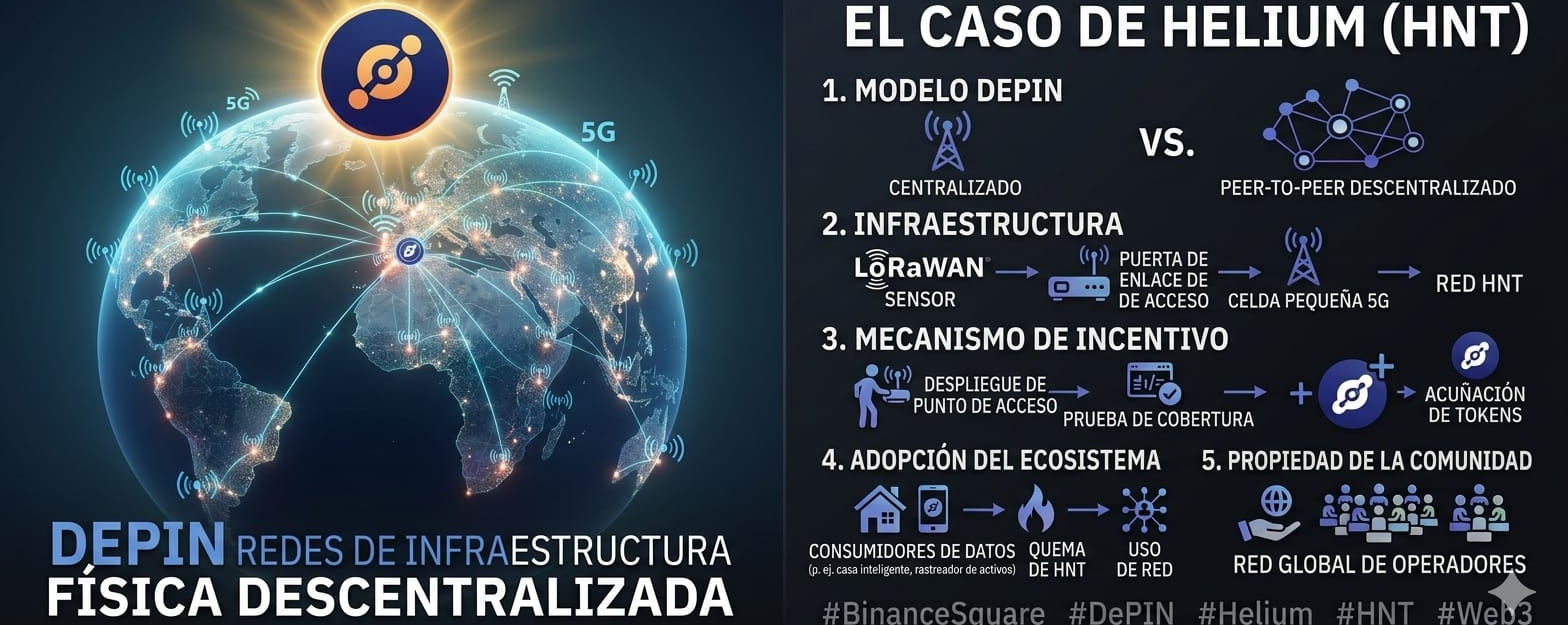
Decentralized Physical Infrastructure Networks (DePIN): The Helium (HNT) CaseThe DePIN model (Decentralized Physical Infrastructure Networks) represents a radical shift in how real-world infrastructure—such as telecommunications and connectivity—is deployed, financed, and scaled. Unlike the traditional model—dominated by large centralized corporations that concentrate investment and decision-making—the DePIN ecosystem leverages blockchain technology and cryptographic incentives to build global networks collaboratively and openly.
Decentralized Physical Infrastructure Networks (DePIN): The Helium (HNT) Case
The DePIN model (Decentralized Physical Infrastructure Networks) represents a radical shift in how real-world infrastructure—such as telecommunications and connectivity—is deployed, financed, and scaled. Unlike the traditional model—dominated by large centralized corporations that concentrate investment and decision-making—the DePIN ecosystem leverages blockchain technology and cryptographic incentives to build global networks collaboratively and openly.
2
118

·
--
$GLM in focus: How demand for resources changes the picture on the chartWhile retail traders are watching the minute charts, steady work is underway in decentralized computing networks (DePIN).
On the hourly chart of GLM/USDT, we saw another confirmation of how the market responds to fundamental events:
Confident breakout of the sliding move: Price rose to the $0.1190+ area, breaking from below upward across the 1H EMA 21 ($0.1154), EMA 50 ($0.1136), and the key EMA 200 ($0.1128).
$GLM in focus: How demand for resources changes the picture on the chart
While retail traders are watching the minute charts, steady work is underway in decentralized computing networks (DePIN).
On the hourly chart of GLM/USDT, we saw another confirmation of how the market responds to fundamental events:
Confident breakout of the sliding move: Price rose to the $0.1190+ area, breaking from below upward across the 1H EMA 21 ($0.1154), EMA 50 ($0.1136), and the key EMA 200 ($0.1128).
On the hourly chart of GLM/USDT, we saw another confirmation of how the market responds to fundamental events:
Confident breakout of the sliding move: Price rose to the $0.1190+ area, breaking from below upward across the 1H EMA 21 ($0.1154), EMA 50 ($0.1136), and the key EMA 200 ($0.1128).
1
92

·
--
The crypto market is constantly evolving, and smart investors are always on the lookout for projects that anchor decentralized finance with real-world utility. One such project quietly building its foundation is Standard Protocol, represented by the ticker STND. Let us dive into what makes this project stand out in the current market landscape.
Standard Protocol is positioning itself at the intersection of Decentralized Physical Infrastructure Networks (DePIN) and Web3 data standards. Originally known for its innovative approach to collateralized stablecoins and rebasing mechanisms, the project has expanded its vision. It now aims to solve a major bottleneck in Web3: the lack of standardized, reliable data and liquidity infrastructure across multi-chain ecosystems.
Why is STND gaining traction now? The answer lies in the massive narrative shift toward DePIN and Real-World Assets (RWA). Investors are moving away from pure speculation and demanding projects with tangible utility. Standard Protocol provides the framework for decentralized applications to secure, share, and value data assets. By doing so, it enables smoother cross-chain operations and reduces the fragmentation that often plagues DeFi.
From a market perspective, STND represents a lower-cap asset with high asymmetric upside, especially as the broader market looks for undervalued infrastructure plays. Its integration with major ecosystems like Polkadot and Ethereum gives it a solid technical runway. Additionally, its focus on community-driven governance ensures that the network adapts directly to user needs.
As we head into a highly selective market phase, infrastructure protocols like Standard are worth keeping on your watchlist. They might not grab daily headlines like meme coins, but they build the highways that the next bull run will ride on.
What are your thoughts on STND? Is DePIN the dominant narrative of this cycle? Let us know in the comments below.
#STND #DePIN #CryptoAnalysis
The crypto market is constantly evolving, and smart investors are always on the lookout for projects that anchor decentralized finance with real-world utility. One such project quietly building its foundation is Standard Protocol, represented by the ticker STND. Let us dive into what makes this project stand out in the current market landscape.
Standard Protocol is positioning itself at the intersection of Decentralized Physical Infrastructure Networks (DePIN) and Web3 data standards. Originally known for its innovative approach to collateralized stablecoins and rebasing mechanisms, the project has expanded its vision. It now aims to solve a major bottleneck in Web3: the lack of standardized, reliable data and liquidity infrastructure across multi-chain ecosystems.
Why is STND gaining traction now? The answer lies in the massive narrative shift toward DePIN and Real-World Assets (RWA). Investors are moving away from pure speculation and demanding projects with tangible utility. Standard Protocol provides the framework for decentralized applications to secure, share, and value data assets. By doing so, it enables smoother cross-chain operations and reduces the fragmentation that often plagues DeFi.
From a market perspective, STND represents a lower-cap asset with high asymmetric upside, especially as the broader market looks for undervalued infrastructure plays. Its integration with major ecosystems like Polkadot and Ethereum gives it a solid technical runway. Additionally, its focus on community-driven governance ensures that the network adapts directly to user needs.
As we head into a highly selective market phase, infrastructure protocols like Standard are worth keeping on your watchlist. They might not grab daily headlines like meme coins, but they build the highways that the next bull run will ride on.
What are your thoughts on STND? Is DePIN the dominant narrative of this cycle? Let us know in the comments below.
#STND #DePIN #CryptoAnalysis
Standard Protocol is positioning itself at the intersection of Decentralized Physical Infrastructure Networks (DePIN) and Web3 data standards. Originally known for its innovative approach to collateralized stablecoins and rebasing mechanisms, the project has expanded its vision. It now aims to solve a major bottleneck in Web3: the lack of standardized, reliable data and liquidity infrastructure across multi-chain ecosystems.
Why is STND gaining traction now? The answer lies in the massive narrative shift toward DePIN and Real-World Assets (RWA). Investors are moving away from pure speculation and demanding projects with tangible utility. Standard Protocol provides the framework for decentralized applications to secure, share, and value data assets. By doing so, it enables smoother cross-chain operations and reduces the fragmentation that often plagues DeFi.
From a market perspective, STND represents a lower-cap asset with high asymmetric upside, especially as the broader market looks for undervalued infrastructure plays. Its integration with major ecosystems like Polkadot and Ethereum gives it a solid technical runway. Additionally, its focus on community-driven governance ensures that the network adapts directly to user needs.
As we head into a highly selective market phase, infrastructure protocols like Standard are worth keeping on your watchlist. They might not grab daily headlines like meme coins, but they build the highways that the next bull run will ride on.
What are your thoughts on STND? Is DePIN the dominant narrative of this cycle? Let us know in the comments below.
#STND #DePIN #CryptoAnalysis
59

🚀 The 3 Crypto Narratives That Will Dominate the Market in 2026 (And How to Get Ready)The crypto market has changed the rules. It’s no longer enough to just follow the fleeting momentum of memecoins or wait for the Halving cycle to do all the heavy lifting. To build a solid portfolio and capture the biggest opportunities this year, the key is to identify where institutional capital is moving and where real technological development is happening.
If you want to position yourself ahead of most people, these are the three narratives that are defining the flow of money:
1. AI agents and DeAI (Decentralized Artificial Intelligence)
🚀 The 3 Crypto Narratives That Will Dominate the Market in 2026 (And How to Get Ready)
The crypto market has changed the rules. It’s no longer enough to just follow the fleeting momentum of memecoins or wait for the Halving cycle to do all the heavy lifting. To build a solid portfolio and capture the biggest opportunities this year, the key is to identify where institutional capital is moving and where real technological development is happening.
If you want to position yourself ahead of most people, these are the three narratives that are defining the flow of money:
1. AI agents and DeAI (Decentralized Artificial Intelligence)
If you want to position yourself ahead of most people, these are the three narratives that are defining the flow of money:
1. AI agents and DeAI (Decentralized Artificial Intelligence)
131

·
--

Article
The Alpha of Wall Street: Nokia, NVIDIA, and the DePIN Connection Everyone Ignores 🧠🌐Hello, Binance family! Today we’re going to connect the dots that most Wall Street investors aren’t seeing.
If you’ve been following the news, you probably saw the recent announcement from Wall St Engine about how Nokia ($NOK) and NVIDIA ($NVDA) are accelerating the adoption of AI-RAN (Artificial Intelligence in radio networks) for the future of 6G. The announcement mentions key global partners like NTT DOCOMO and T-Mobile.
At first glance, it looks like just another telecommunications story. But for the trained eye in Web3 and DePIN (Decentralized Physical Infrastructure Networks), there’s a huge "Alpha" hidden in plain sight.
The Alpha of Wall Street: Nokia, NVIDIA, and the DePIN Connection Everyone Ignores 🧠🌐
Hello, Binance family! Today we’re going to connect the dots that most Wall Street investors aren’t seeing.
If you’ve been following the news, you probably saw the recent announcement from Wall St Engine about how Nokia ($NOK) and NVIDIA ($NVDA ) are accelerating the adoption of AI-RAN (Artificial Intelligence in radio networks) for the future of 6G. The announcement mentions key global partners like NTT DOCOMO and T-Mobile.
At first glance, it looks like just another telecommunications story. But for the trained eye in Web3 and DePIN (Decentralized Physical Infrastructure Networks), there’s a huge "Alpha" hidden in plain sight.
If you’ve been following the news, you probably saw the recent announcement from Wall St Engine about how Nokia ($NOK) and NVIDIA ($NVDA ) are accelerating the adoption of AI-RAN (Artificial Intelligence in radio networks) for the future of 6G. The announcement mentions key global partners like NTT DOCOMO and T-Mobile.
At first glance, it looks like just another telecommunications story. But for the trained eye in Web3 and DePIN (Decentralized Physical Infrastructure Networks), there’s a huge "Alpha" hidden in plain sight.
159
·
--
$GLM DePIN and AI computing: what prospects does $GLM have?
While retail traders chase daily noise from memecoins, a global fundamental shift is gradually taking shape in the sector of decentralized computing infrastructure (DePIN).
Key growth drivers:
Global GPU/CPU shortage: The boom in neural networks and AI models has created an enormous shortage of computing power. Decentralized networks are the only affordable and scalable alternative to centralized cloud giants.
Institutional demand signals: Day-to-day spikes in Earn (periodically exceeding 40% APR) are a clear marker that large players lack free liquidity in the coin.
Accumulation on the higher timeframe: On the weekly chart, the coin is trading in the area of its historical base ($0.0850–$0.1000). Sellers have run out of steam, and the sell-side volume on exchanges has compressed.
Real bull cycles don’t start at the peak of universal FOMO, but during a phase of long, quiet consolidation. The DePIN sector remains one of the main narratives of the upcoming altseason.
What do you think: will DePIN become the main trend of this cycle or will it make way for other sectors? 👇
#GLM #DePIN #BinanceSquare #CryptoAnalysis
$GLM DePIN and AI computing: what prospects does $GLM have?
While retail traders chase daily noise from memecoins, a global fundamental shift is gradually taking shape in the sector of decentralized computing infrastructure (DePIN).
Key growth drivers:
Global GPU/CPU shortage: The boom in neural networks and AI models has created an enormous shortage of computing power. Decentralized networks are the only affordable and scalable alternative to centralized cloud giants.
Institutional demand signals: Day-to-day spikes in Earn (periodically exceeding 40% APR) are a clear marker that large players lack free liquidity in the coin.
Accumulation on the higher timeframe: On the weekly chart, the coin is trading in the area of its historical base ($0.0850–$0.1000). Sellers have run out of steam, and the sell-side volume on exchanges has compressed.
Real bull cycles don’t start at the peak of universal FOMO, but during a phase of long, quiet consolidation. The DePIN sector remains one of the main narratives of the upcoming altseason.
What do you think: will DePIN become the main trend of this cycle or will it make way for other sectors? 👇
#GLM #DePIN #BinanceSquare #CryptoAnalysis
While retail traders chase daily noise from memecoins, a global fundamental shift is gradually taking shape in the sector of decentralized computing infrastructure (DePIN).
Key growth drivers:
Global GPU/CPU shortage: The boom in neural networks and AI models has created an enormous shortage of computing power. Decentralized networks are the only affordable and scalable alternative to centralized cloud giants.
Institutional demand signals: Day-to-day spikes in Earn (periodically exceeding 40% APR) are a clear marker that large players lack free liquidity in the coin.
Accumulation on the higher timeframe: On the weekly chart, the coin is trading in the area of its historical base ($0.0850–$0.1000). Sellers have run out of steam, and the sell-side volume on exchanges has compressed.
Real bull cycles don’t start at the peak of universal FOMO, but during a phase of long, quiet consolidation. The DePIN sector remains one of the main narratives of the upcoming altseason.
What do you think: will DePIN become the main trend of this cycle or will it make way for other sectors? 👇
#GLM #DePIN #BinanceSquare #CryptoAnalysis
1
140

·
--
$RENDER
{future}(RENDERUSDT)
RENDER connects blockchain technology with decentralized GPU computing. The network is designed to help provide distributed computing resources for demanding digital workloads.
With AI and high-performance computing becoming major technology themes, decentralized GPU infrastructure has gained increasing attention across Web3.
#RENDER #AI #DePIN #BinanceSquare
$RENDER
RENDER connects blockchain technology with decentralized GPU computing. The network is designed to help provide distributed computing resources for demanding digital workloads.
With AI and high-performance computing becoming major technology themes, decentralized GPU infrastructure has gained increasing attention across Web3.
#RENDER #AI #DePIN #BinanceSquare
RENDER connects blockchain technology with decentralized GPU computing. The network is designed to help provide distributed computing resources for demanding digital workloads.
With AI and high-performance computing becoming major technology themes, decentralized GPU infrastructure has gained increasing attention across Web3.
#RENDER #AI #DePIN #BinanceSquare
1
69

·
--
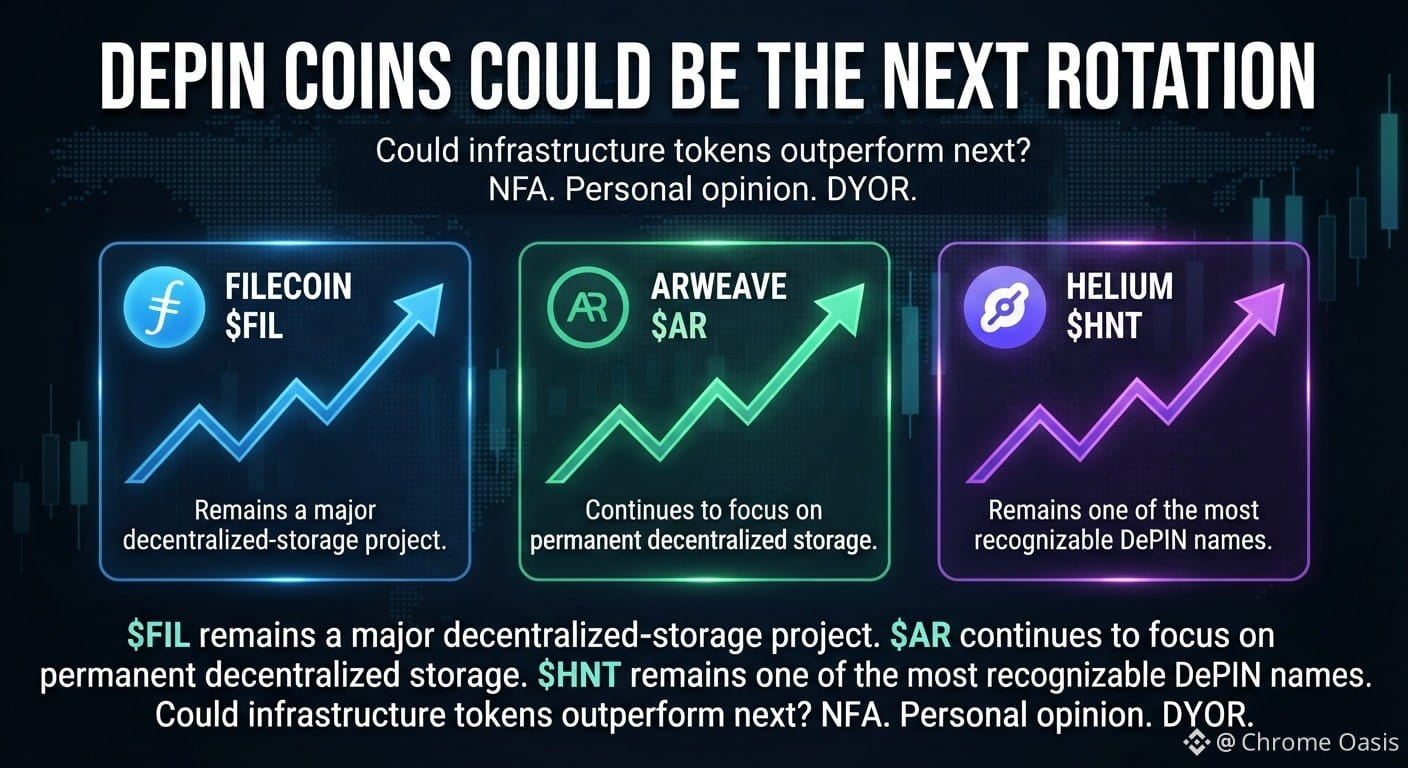
DEPIN COINS COULD BE THE NEXT ROTATION
$FIL remains a major decentralized-storage project.
$AR continues to focus on permanent decentralized storage.
$HNT remains one of the most recognizable DePIN names.
Could infrastructure tokens outperform next?
NFA. Personal opinion. DYOR.
#FIL #AR #HNT #DePIN #Crypto
DEPIN COINS COULD BE THE NEXT ROTATION
$FIL remains a major decentralized-storage project.
$AR continues to focus on permanent decentralized storage.
$HNT remains one of the most recognizable DePIN names.
Could infrastructure tokens outperform next?
NFA. Personal opinion. DYOR.
#FIL #AR #HNT #DePIN #Crypto
$FIL remains a major decentralized-storage project.
$AR continues to focus on permanent decentralized storage.
$HNT remains one of the most recognizable DePIN names.
Could infrastructure tokens outperform next?
NFA. Personal opinion. DYOR.
#FIL #AR #HNT #DePIN #Crypto
4
364
·
--
Bullish
$GLM DePIN and AI computing: what can be seen on the higher time frame $GLM?
While the local feed is clogged with noise around micro-movements, the higher charts show a completely different picture.
Facts from the higher time frame:
Global baseline: The coin is trading around $0.1160, right at the historical bottom block ($0.0850–$0.1000).
Testing key moving averages: The price has approached 1D EMA 21 ($0.1160) and is gradually compressing before 1D EMA 50 ($0.1520).
Neutral RSI: On the weekly interval, the oscillator wiped out all the overbought conditions from the previous impulse waves, forming a platform for new long-term accumulation.
Volatility compression: After the drop from local peaks, market supply is compressed, and volumes have fallen to minimums.
Real moves in alts with strong fundamentals (the DePIN/AI sector) are not prepared in a single day. Accumulation at the bottom is always a quiet and sticky process.
What do you think: will we see a breakout from this base this fall, or will accumulation take longer? 👇
#GLMUSDT #DePIN #BinanceSquareTalks #CryptoAnalysis #Trading #AI
$GLM DePIN and AI computing: what can be seen on the higher time frame $GLM ?
While the local feed is clogged with noise around micro-movements, the higher charts show a completely different picture.
Facts from the higher time frame:
Global baseline: The coin is trading around $0.1160, right at the historical bottom block ($0.0850–$0.1000).
Testing key moving averages: The price has approached 1D EMA 21 ($0.1160) and is gradually compressing before 1D EMA 50 ($0.1520).
Neutral RSI: On the weekly interval, the oscillator wiped out all the overbought conditions from the previous impulse waves, forming a platform for new long-term accumulation.
Volatility compression: After the drop from local peaks, market supply is compressed, and volumes have fallen to minimums.
Real moves in alts with strong fundamentals (the DePIN/AI sector) are not prepared in a single day. Accumulation at the bottom is always a quiet and sticky process.
What do you think: will we see a breakout from this base this fall, or will accumulation take longer? 👇
#GLMUSDT #DePIN #BinanceSquareTalks #CryptoAnalysis #Trading #AI
While the local feed is clogged with noise around micro-movements, the higher charts show a completely different picture.
Facts from the higher time frame:
Global baseline: The coin is trading around $0.1160, right at the historical bottom block ($0.0850–$0.1000).
Testing key moving averages: The price has approached 1D EMA 21 ($0.1160) and is gradually compressing before 1D EMA 50 ($0.1520).
Neutral RSI: On the weekly interval, the oscillator wiped out all the overbought conditions from the previous impulse waves, forming a platform for new long-term accumulation.
Volatility compression: After the drop from local peaks, market supply is compressed, and volumes have fallen to minimums.
Real moves in alts with strong fundamentals (the DePIN/AI sector) are not prepared in a single day. Accumulation at the bottom is always a quiet and sticky process.
What do you think: will we see a breakout from this base this fall, or will accumulation take longer? 👇
#GLMUSDT #DePIN #BinanceSquareTalks #CryptoAnalysis #Trading #AI
1
134

{alpha}(560xd955c9ba56fb1ab30e34766e252a97ccce3d31a6)
👀 Why is nobody talking about $XPIN ?
XPIN Network is building around the DePIN + AI narrative, and that combination is getting harder to ignore. 🔥
But here's the question:
Can XPIN turn the hype into real adoption and real utility? 🤔
I'm watching:
🌐 Network growth
🤖 AI integration
📈 Community activity
🚀 Ecosystem development
I'm not saying $XPIN will pump.
I'm saying this is a project worth watching closely. 👀
Have you researched XPIN yet, or is it still under your radar?
#XPIN #XPINNetwork #DePIN #AImodel #crypto
👀 Why is nobody talking about $XPIN ?
XPIN Network is building around the DePIN + AI narrative, and that combination is getting harder to ignore. 🔥
But here's the question:
Can XPIN turn the hype into real adoption and real utility? 🤔
I'm watching:
🌐 Network growth
🤖 AI integration
📈 Community activity
🚀 Ecosystem development
I'm not saying $XPIN will pump.
I'm saying this is a project worth watching closely. 👀
Have you researched XPIN yet, or is it still under your radar?
#XPIN #XPINNetwork #DePIN #AImodel #crypto
XPIN Network is building around the DePIN + AI narrative, and that combination is getting harder to ignore. 🔥
But here's the question:
Can XPIN turn the hype into real adoption and real utility? 🤔
I'm watching:
🌐 Network growth
🤖 AI integration
📈 Community activity
🚀 Ecosystem development
I'm not saying $XPIN will pump.
I'm saying this is a project worth watching closely. 👀
Have you researched XPIN yet, or is it still under your radar?
#XPIN #XPINNetwork #DePIN #AImodel #crypto
1
296

·
--
Who’s powering the AI behind the scenes? @fluence
One thing I find interesting about AI agents is that latency isn’t always caused by the model itself.
An agent can make multiple tool calls, retrieve state, run validations, update memory, and repeat the loop several times. A few milliseconds of CPU delay at each step might look insignificant on its own, but across the entire workflow, those delays can add up and push the request past its deadline.
This is where infrastructure becomes more important than it first appears.
For AI workloads, average performance is not always enough. The real problem can show up
especially when CPU contention causes small delays across many stages.
That makes dedicated compute an interesting option for workloads where predictable performance matters.
Fluence is approaching this from the decentralized compute side, giving developers access to dedicated CPU resources for workloads that need more consistent capacity.
I think this becomes increasingly relevant as AI agents move from simple experiments into production. When an agent is handling dozens of steps, shaving variability from each stage can have a much bigger impact on the final user experience.
The question I’m watching is simple: as agent workloads become more complex, will predictable compute become just as important as raw compute power?
https://fluence.ai/
#Fluence #AI #DePIN
Who’s powering the AI behind the scenes? @Fluence
One thing I find interesting about AI agents is that latency isn’t always caused by the model itself.
An agent can make multiple tool calls, retrieve state, run validations, update memory, and repeat the loop several times. A few milliseconds of CPU delay at each step might look insignificant on its own, but across the entire workflow, those delays can add up and push the request past its deadline.
This is where infrastructure becomes more important than it first appears.
For AI workloads, average performance is not always enough. The real problem can show up
especially when CPU contention causes small delays across many stages.
That makes dedicated compute an interesting option for workloads where predictable performance matters.
Fluence is approaching this from the decentralized compute side, giving developers access to dedicated CPU resources for workloads that need more consistent capacity.
I think this becomes increasingly relevant as AI agents move from simple experiments into production. When an agent is handling dozens of steps, shaving variability from each stage can have a much bigger impact on the final user experience.
The question I’m watching is simple: as agent workloads become more complex, will predictable compute become just as important as raw compute power?
https://fluence.ai/
#Fluence #AI #DePIN
One thing I find interesting about AI agents is that latency isn’t always caused by the model itself.
An agent can make multiple tool calls, retrieve state, run validations, update memory, and repeat the loop several times. A few milliseconds of CPU delay at each step might look insignificant on its own, but across the entire workflow, those delays can add up and push the request past its deadline.
This is where infrastructure becomes more important than it first appears.
For AI workloads, average performance is not always enough. The real problem can show up
especially when CPU contention causes small delays across many stages.
That makes dedicated compute an interesting option for workloads where predictable performance matters.
Fluence is approaching this from the decentralized compute side, giving developers access to dedicated CPU resources for workloads that need more consistent capacity.
I think this becomes increasingly relevant as AI agents move from simple experiments into production. When an agent is handling dozens of steps, shaving variability from each stage can have a much bigger impact on the final user experience.
The question I’m watching is simple: as agent workloads become more complex, will predictable compute become just as important as raw compute power?
https://fluence.ai/
#Fluence #AI #DePIN

33
·
--
@fluence VPC going live could be an important step for the Fluence ecosystem.
https://fluence.ai/
The new VPC infrastructure allows developers to run multiple VMs with private networking, security groups, controlled egress, optional public IPs, and cloud-init. In simple terms, it makes Fluence more suitable for running real applications with different services working together securely.
From an $FLT perspective, this is where I think things get interesting.
A new infrastructure feature does not automatically mean FLT price goes up. The bigger question is whether VPC helps Fluence attract more developers, workloads, and businesses.
If adoption grows, more compute could be deployed across the network, creating stronger underlying demand and potentially improving the fundamentals supporting FLT.
So I’m watching usage more than the announcement itself. If Fluence keeps adding practical infrastructure and those features translate into real network activity, I think that could become a positive catalyst for FLT over time.
For me, the thesis is simple: better infrastructure → more use cases → more network activity → potentially stronger FLT fundamentals.
#DePIN #AI #Web3
@Fluence VPC going live could be an important step for the Fluence ecosystem.
https://fluence.ai/
The new VPC infrastructure allows developers to run multiple VMs with private networking, security groups, controlled egress, optional public IPs, and cloud-init. In simple terms, it makes Fluence more suitable for running real applications with different services working together securely.
From an $FLT perspective, this is where I think things get interesting.
A new infrastructure feature does not automatically mean FLT price goes up. The bigger question is whether VPC helps Fluence attract more developers, workloads, and businesses.
If adoption grows, more compute could be deployed across the network, creating stronger underlying demand and potentially improving the fundamentals supporting FLT.
So I’m watching usage more than the announcement itself. If Fluence keeps adding practical infrastructure and those features translate into real network activity, I think that could become a positive catalyst for FLT over time.
For me, the thesis is simple: better infrastructure → more use cases → more network activity → potentially stronger FLT fundamentals.
#DePIN #AI #Web3
https://fluence.ai/
The new VPC infrastructure allows developers to run multiple VMs with private networking, security groups, controlled egress, optional public IPs, and cloud-init. In simple terms, it makes Fluence more suitable for running real applications with different services working together securely.
From an $FLT perspective, this is where I think things get interesting.
A new infrastructure feature does not automatically mean FLT price goes up. The bigger question is whether VPC helps Fluence attract more developers, workloads, and businesses.
If adoption grows, more compute could be deployed across the network, creating stronger underlying demand and potentially improving the fundamentals supporting FLT.
So I’m watching usage more than the announcement itself. If Fluence keeps adding practical infrastructure and those features translate into real network activity, I think that could become a positive catalyst for FLT over time.
For me, the thesis is simple: better infrastructure → more use cases → more network activity → potentially stronger FLT fundamentals.
#DePIN #AI #Web3

67
·
--
$GLM DePIN and AI computing: why the market ignores the shortage $GLM ?
While retail chases memecoins, a fundamental shift is ripening in decentralized infrastructure (DePIN).
Facts:
Earn over 40% APR: Daily spikes in yields — a sign that market makers are catastrophically short on liquidity.
Demand for compute power: Amid the AI boom, decentralized GPU/CPU are becoming a cheap alternative to cloud services.
Technique: After the impulse, the price doesn’t fall; instead, it unloads RSI at the key EMAs (50/200).
Real moves are formed in silence as the order books get squeezed before the second wave. And those who take profit via the system calmly wait for the resolution with cash.
Share your view: a lull before the breakout or a range-bound move? 👇
#GLM #DePIN #BinanceSquare #Crypto
$GLM DePIN and AI computing: why the market ignores the shortage $GLM ?
While retail chases memecoins, a fundamental shift is ripening in decentralized infrastructure (DePIN).
Facts:
Earn over 40% APR: Daily spikes in yields — a sign that market makers are catastrophically short on liquidity.
Demand for compute power: Amid the AI boom, decentralized GPU/CPU are becoming a cheap alternative to cloud services.
Technique: After the impulse, the price doesn’t fall; instead, it unloads RSI at the key EMAs (50/200).
Real moves are formed in silence as the order books get squeezed before the second wave. And those who take profit via the system calmly wait for the resolution with cash.
Share your view: a lull before the breakout or a range-bound move? 👇
#GLM #DePIN #BinanceSquare #Crypto
While retail chases memecoins, a fundamental shift is ripening in decentralized infrastructure (DePIN).
Facts:
Earn over 40% APR: Daily spikes in yields — a sign that market makers are catastrophically short on liquidity.
Demand for compute power: Amid the AI boom, decentralized GPU/CPU are becoming a cheap alternative to cloud services.
Technique: After the impulse, the price doesn’t fall; instead, it unloads RSI at the key EMAs (50/200).
Real moves are formed in silence as the order books get squeezed before the second wave. And those who take profit via the system calmly wait for the resolution with cash.
Share your view: a lull before the breakout or a range-bound move? 👇
#GLM #DePIN #BinanceSquare #Crypto
1
359

·
--
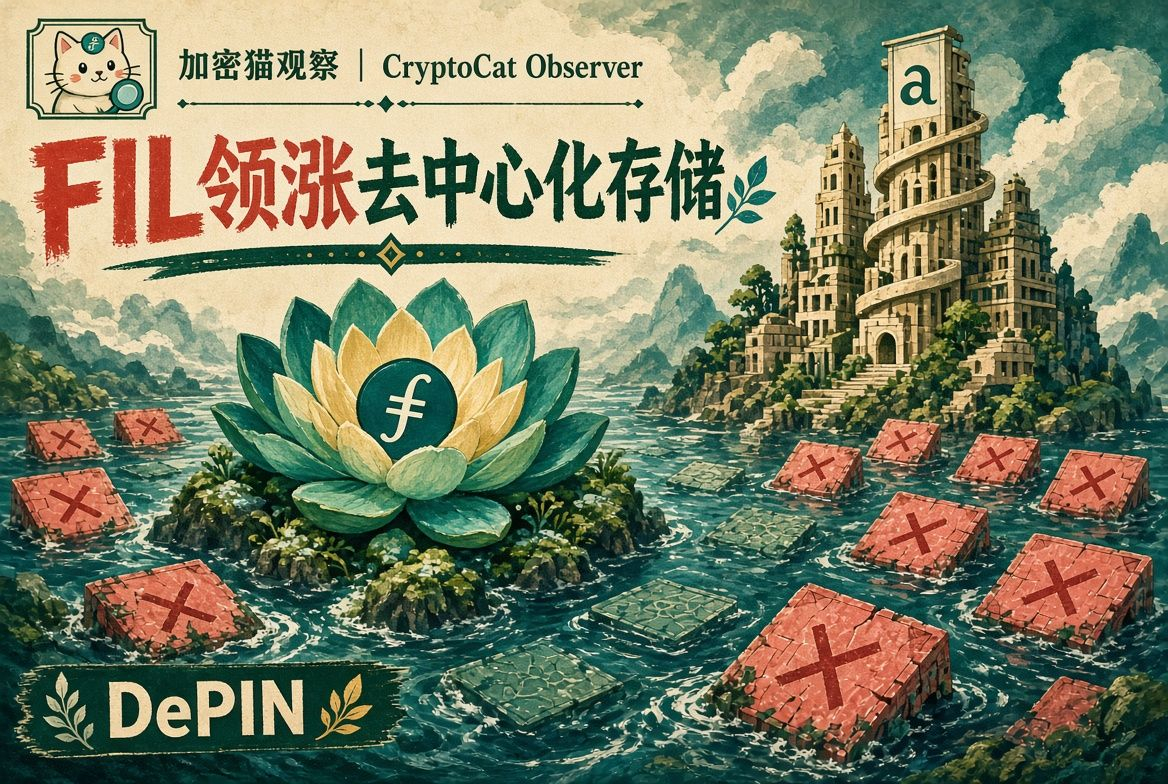
$FIL rises ahead of DePIN, while the storage sector strengthens against the trend
On September 14, most crypto sectors declined, with only DePIN and some Layer 2s moving against the tide: the DePIN sector rose about 3.49% over 24 hours. Among them, $FIL gained about 21.43%, and $AR rose about 9.41%. The decentralized storage sector’s market cap is about $2.87 billion, up about +5.6% over 24 hours. The market brief also indicates FIL, AR, and SKL led the rally, with FIL seeing increased trading volume.
On the narrative side, the market is focused on changes in Filecoin’s release schedule around Oct 15—whether it will bring additional issuance or significantly slow down (some analyses suggest the issuance rate may drop by about 75%). Combined with expectations for AI data archiving and permanent storage, funds are rotating from pressured mainstream coins into storage and DePIN beta.
It should be noted that some statistics show trading volume remains below the 30-day average; short-term volatility is high, and whether breakouts and holding above key resistance can be sustained still needs confirmation from both trading volume and the macro environment. Therefore, it’s not advisable to extrapolate based on a single day’s gains.
$FIL $AR
{spot}(FILUSDT)
#DePIN #Filecoin. #去中心化存储
This does not constitute investment advice
$FIL rises ahead of DePIN, while the storage sector strengthens against the trend
On September 14, most crypto sectors declined, with only DePIN and some Layer 2s moving against the tide: the DePIN sector rose about 3.49% over 24 hours. Among them, $FIL gained about 21.43%, and $AR rose about 9.41%. The decentralized storage sector’s market cap is about $2.87 billion, up about +5.6% over 24 hours. The market brief also indicates FIL, AR, and SKL led the rally, with FIL seeing increased trading volume.
On the narrative side, the market is focused on changes in Filecoin’s release schedule around Oct 15—whether it will bring additional issuance or significantly slow down (some analyses suggest the issuance rate may drop by about 75%). Combined with expectations for AI data archiving and permanent storage, funds are rotating from pressured mainstream coins into storage and DePIN beta.
It should be noted that some statistics show trading volume remains below the 30-day average; short-term volatility is high, and whether breakouts and holding above key resistance can be sustained still needs confirmation from both trading volume and the macro environment. Therefore, it’s not advisable to extrapolate based on a single day’s gains.
$FIL $AR
#DePIN #Filecoin. #去中心化存储
This does not constitute investment advice
On September 14, most crypto sectors declined, with only DePIN and some Layer 2s moving against the tide: the DePIN sector rose about 3.49% over 24 hours. Among them, $FIL gained about 21.43%, and $AR rose about 9.41%. The decentralized storage sector’s market cap is about $2.87 billion, up about +5.6% over 24 hours. The market brief also indicates FIL, AR, and SKL led the rally, with FIL seeing increased trading volume.
On the narrative side, the market is focused on changes in Filecoin’s release schedule around Oct 15—whether it will bring additional issuance or significantly slow down (some analyses suggest the issuance rate may drop by about 75%). Combined with expectations for AI data archiving and permanent storage, funds are rotating from pressured mainstream coins into storage and DePIN beta.
It should be noted that some statistics show trading volume remains below the 30-day average; short-term volatility is high, and whether breakouts and holding above key resistance can be sustained still needs confirmation from both trading volume and the macro environment. Therefore, it’s not advisable to extrapolate based on a single day’s gains.
$FIL $AR
#DePIN #Filecoin. #去中心化存储
This does not constitute investment advice
1
383
Log in to explore more content
Join global crypto users on Binance Square
⚡️ Get latest and useful information about crypto.
💬 Trusted by the world’s largest crypto exchange.
👍 Discover real insights from verified creators.
Email / Phone number
Trending Topics
1
#BTCBreaks80K
78,203 views
1,509 Discussing
2
#BuffettBecomesBerkshireChairmanEmeritus
19,405 views
526 Discussing
3
#ZcashSpotETFTops$230MMonthlyInflow
5,195 views
79 Discussing
4
#HYPEJumpsOver11%
71,594 views
1,098 Discussing
5
#ZcashDevelopersTargetNU7MainnetActivationNov5
32,500 views
542 Discussing
6
#BitcoinSpotETFsNetInflow$159M
27,763 views
103 Discussing
7
#HKMAPlansWholesaleCBDCByYearEnd
50,534 views
932 Discussing
8
#NEARSurges26%Past$3.45
22,701 views
148 Discussing
9
#BOJHikesRatesTo31YearHigh
87,344 views
1,328 Discussing
10
#EvernorthRaises$30MToBuyXRP
2,563 views
40 Discussing