

Erica 1
128 Публикации

Erica 1
Отправить жалобу
Заблокировать пользователя
Binance KOL | Crypto Analyst | #BTC Holder | #SOL and #ETH
0 подписок(и/а)
6 подписчиков(а)
13 понравилось
Посты
·
--
CryptoPunks снова по 50 ETH? 👀
Я иду против толпы в этом вопросе.
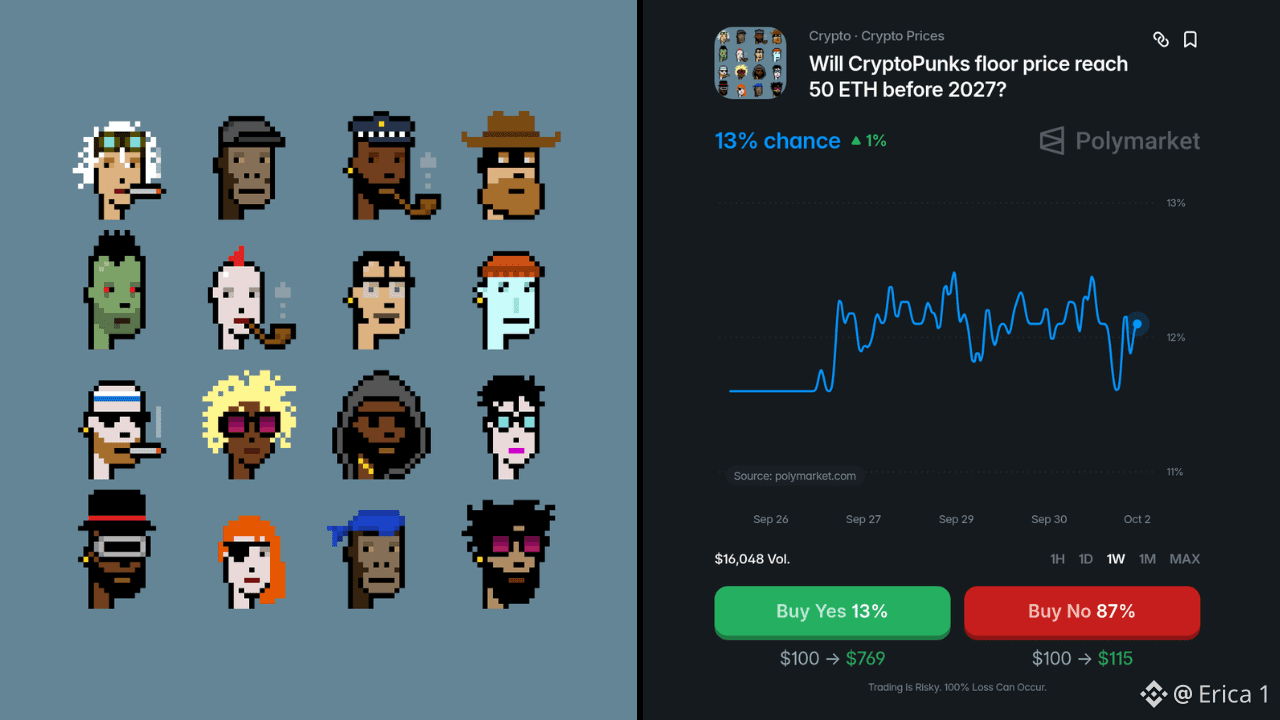
Только 13% трейдеров Polymarket сейчас считают, что пол CryptoPunks достигнет 50 ETH до 2027 года, но именно эта низкая вероятность делает YES для меня интересным.
NFT уже показывали, как быстро может вернуться настроение, когда ликвидность и внимание вновь поворачиваются в сторону сектора. Мне не нужна и полноценная NFT-мания. Если эти 13% начнут переоцениваться вверх, моя позиция станет более ценной еще до того, как станет известен окончательный результат.
На скриншоте — ставка в $100 в пользу моего сценария с потенциальной валовой выплатой $769, если исход будет верным.
Вот та часть Polymarket, которую, как мне кажется, люди недооценивают.
Я не покупаю Punk за 50 ETH. Я занимаю гораздо меньшую позицию относительно того, дойдет ли рынок туда.
И если я хочу вместо простого удержания пустить в дело немного $HYPE, это дает мне совершенно другой тип сделки.
#Altcoin Season#
CryptoPunks снова по 50 ETH? 👀
Я иду против толпы в этом вопросе.
Только 13% трейдеров Polymarket сейчас считают, что пол CryptoPunks достигнет 50 ETH до 2027 года, но именно эта низкая вероятность делает YES для меня интересным.
NFT уже показывали, как быстро может вернуться настроение, когда ликвидность и внимание вновь поворачиваются в сторону сектора. Мне не нужна и полноценная NFT-мания. Если эти 13% начнут переоцениваться вверх, моя позиция станет более ценной еще до того, как станет известен окончательный результат.
На скриншоте — ставка в $100 в пользу моего сценария с потенциальной валовой выплатой $769, если исход будет верным.
Вот та часть Polymarket, которую, как мне кажется, люди недооценивают.
Я не покупаю Punk за 50 ETH. Я занимаю гораздо меньшую позицию относительно того, дойдет ли рынок туда.
И если я хочу вместо простого удержания пустить в дело немного $HYPE, это дает мне совершенно другой тип сделки.
#Altcoin Season#
Я иду против толпы в этом вопросе.
Только 13% трейдеров Polymarket сейчас считают, что пол CryptoPunks достигнет 50 ETH до 2027 года, но именно эта низкая вероятность делает YES для меня интересным.
NFT уже показывали, как быстро может вернуться настроение, когда ликвидность и внимание вновь поворачиваются в сторону сектора. Мне не нужна и полноценная NFT-мания. Если эти 13% начнут переоцениваться вверх, моя позиция станет более ценной еще до того, как станет известен окончательный результат.
На скриншоте — ставка в $100 в пользу моего сценария с потенциальной валовой выплатой $769, если исход будет верным.
Вот та часть Polymarket, которую, как мне кажется, люди недооценивают.
Я не покупаю Punk за 50 ETH. Я занимаю гораздо меньшую позицию относительно того, дойдет ли рынок туда.
И если я хочу вместо простого удержания пустить в дело немного $HYPE, это дает мне совершенно другой тип сделки.
#Altcoin Season#
69
·
--
Дебаты о «убийце Solana» только что изменились 👀
Называть каждую быструю Layer 1 «убийцей Solana» стало одним из самых выдохшихся нарративов в крипто. $SOL занял своё место благодаря пользователям, приложениям и ликвидности. $SUI всегда имел сильную технологию, но одной технологии никогда не хватало, чтобы оправдать такое сравнение.
Данные пользователей наконец делают этот разговор интереснее.
Сообщается, что Sui обошёл NEAR, TON, Arbitrum и Injective по ежедневным активным пользователям.
Это не значит, что Sui обыграл Solana.
Это значит, что Sui начинает преодолевать первый барьер, который уничтожает большинство претендентов на Layer 1: добиться того, чтобы люди действительно начали пользоваться сетью.
Что делает для меня это особенно бычьим — тайминг. Sui уже показал огромную пропускную способность по транзакциям, пока его экосистема расширяется в DeFi, платежах, трейдинге, гейминге и потребительских приложениях.
Теперь показатели активности начинают подкреплять тезис об инфраструктуре.
Больше активных пользователей создают более сильную среду для разработчиков. Лучшие приложения могут привлечь больше ликвидности, а более глубокая ликвидность снова делает сеть более полезной.
Именно такой цикл превращает технически впечатляющую сеть в экономически важную.
Sui всё ещё нужно доказать, что эта активность носит устойчивый характер, и что пользователи продолжают возвращаться, не опираясь на временные стимулы.
Но то, что Sui уже превзошёл четыре признанные экосистемы по ежедневному участию, показывает, что разрыв сокращается гораздо быстрее, чем многие ожидали.
Я всё больше убеждён, что Sui не останется лишь спекулятивной альтернативой в гонке Layer 1. Она наращивает использование, необходимое, чтобы стать настоящим рыночным лидером.
#Altcoin Season# #DeFi
Дебаты о «убийце Solana» только что изменились 👀
Называть каждую быструю Layer 1 «убийцей Solana» стало одним из самых выдохшихся нарративов в крипто. $SOL занял своё место благодаря пользователям, приложениям и ликвидности. $SUI всегда имел сильную технологию, но одной технологии никогда не хватало, чтобы оправдать такое сравнение.
Данные пользователей наконец делают этот разговор интереснее.
Сообщается, что Sui обошёл NEAR, TON, Arbitrum и Injective по ежедневным активным пользователям.
Это не значит, что Sui обыграл Solana.
Это значит, что Sui начинает преодолевать первый барьер, который уничтожает большинство претендентов на Layer 1: добиться того, чтобы люди действительно начали пользоваться сетью.
Что делает для меня это особенно бычьим — тайминг. Sui уже показал огромную пропускную способность по транзакциям, пока его экосистема расширяется в DeFi, платежах, трейдинге, гейминге и потребительских приложениях.
Теперь показатели активности начинают подкреплять тезис об инфраструктуре.
Больше активных пользователей создают более сильную среду для разработчиков. Лучшие приложения могут привлечь больше ликвидности, а более глубокая ликвидность снова делает сеть более полезной.
Именно такой цикл превращает технически впечатляющую сеть в экономически важную.
Sui всё ещё нужно доказать, что эта активность носит устойчивый характер, и что пользователи продолжают возвращаться, не опираясь на временные стимулы.
Но то, что Sui уже превзошёл четыре признанные экосистемы по ежедневному участию, показывает, что разрыв сокращается гораздо быстрее, чем многие ожидали.
Я всё больше убеждён, что Sui не останется лишь спекулятивной альтернативой в гонке Layer 1. Она наращивает использование, необходимое, чтобы стать настоящим рыночным лидером.
#Altcoin Season# #DeFi
Называть каждую быструю Layer 1 «убийцей Solana» стало одним из самых выдохшихся нарративов в крипто. $SOL занял своё место благодаря пользователям, приложениям и ликвидности. $SUI всегда имел сильную технологию, но одной технологии никогда не хватало, чтобы оправдать такое сравнение.
Данные пользователей наконец делают этот разговор интереснее.
Сообщается, что Sui обошёл NEAR, TON, Arbitrum и Injective по ежедневным активным пользователям.
Это не значит, что Sui обыграл Solana.
Это значит, что Sui начинает преодолевать первый барьер, который уничтожает большинство претендентов на Layer 1: добиться того, чтобы люди действительно начали пользоваться сетью.
Что делает для меня это особенно бычьим — тайминг. Sui уже показал огромную пропускную способность по транзакциям, пока его экосистема расширяется в DeFi, платежах, трейдинге, гейминге и потребительских приложениях.
Теперь показатели активности начинают подкреплять тезис об инфраструктуре.
Больше активных пользователей создают более сильную среду для разработчиков. Лучшие приложения могут привлечь больше ликвидности, а более глубокая ликвидность снова делает сеть более полезной.
Именно такой цикл превращает технически впечатляющую сеть в экономически важную.
Sui всё ещё нужно доказать, что эта активность носит устойчивый характер, и что пользователи продолжают возвращаться, не опираясь на временные стимулы.
Но то, что Sui уже превзошёл четыре признанные экосистемы по ежедневному участию, показывает, что разрыв сокращается гораздо быстрее, чем многие ожидали.
Я всё больше убеждён, что Sui не останется лишь спекулятивной альтернативой в гонке Layer 1. Она наращивает использование, необходимое, чтобы стать настоящим рыночным лидером.
#Altcoin Season# #DeFi
73
·
--
Магазины начинают блокировать вашего агента 🛒
На прошлой неделе Amazon заблокировал торгового агента Meta, заявив, что сторонние приложения, которые совершают покупки от имени клиента, должны работать открыто и уважать решения платформы.
Это противостояние стоит наблюдения, потому что агент не может купить ничего без предоставления карты, адреса и достаточной истории, чтобы доказать, что он действует в интересах реального человека.
$FET с января разрешил агентам размещать заказы и оплачивать их за пользователей через ASI:One со стороны Visa, а растущая доля агентских платежей оседает на $SOL , где x402 переводы к концу августа превысили 35 миллионов.
Значит, «рельсы» существуют, а решают, что агент должен раскрыть, именно магазины.
Каждый мерчант, который говорит «да», в итоге получает ещё одну копию того, кто вы, а каждый, кто говорит «нет», делает это, потому что не может отличить агента от бота.
Arcium меняет то, что магазин должен получить: он разбивает всё, что представляет агент, на фрагменты между кластером узлов, где ни один узел не хранит читаемую копию, при этом кластер всё равно возвращает мерчанту «да» или «нет», которые ему нужны.
Этот ответ закрепляется на Solana как обычная публичная транзакция, так что у мерчанта остаётся запись о том, что проверка прошла, но без хранения материала за её пределами.
Уровень вычислений работает в Mainnet Alpha с 2 февраля, а Blackthorn, который это внедряет в AI-модели, пока не выпущен.
Агентные покупки продают как удобство, но на деле это вопрос раскрытия данных, и мой взгляд таков: всё сводится к тому, где агент может доказать свою подлинность, не передавая своего владельца.
#AI #Solana
Магазины начинают блокировать вашего агента 🛒
На прошлой неделе Amazon заблокировал торгового агента Meta, заявив, что сторонние приложения, которые совершают покупки от имени клиента, должны работать открыто и уважать решения платформы.
Это противостояние стоит наблюдения, потому что агент не может купить ничего без предоставления карты, адреса и достаточной истории, чтобы доказать, что он действует в интересах реального человека.
$FET с января разрешил агентам размещать заказы и оплачивать их за пользователей через ASI:One со стороны Visa, а растущая доля агентских платежей оседает на $SOL , где x402 переводы к концу августа превысили 35 миллионов.
Значит, «рельсы» существуют, а решают, что агент должен раскрыть, именно магазины.
Каждый мерчант, который говорит «да», в итоге получает ещё одну копию того, кто вы, а каждый, кто говорит «нет», делает это, потому что не может отличить агента от бота.
Arcium меняет то, что магазин должен получить: он разбивает всё, что представляет агент, на фрагменты между кластером узлов, где ни один узел не хранит читаемую копию, при этом кластер всё равно возвращает мерчанту «да» или «нет», которые ему нужны.
Этот ответ закрепляется на Solana как обычная публичная транзакция, так что у мерчанта остаётся запись о том, что проверка прошла, но без хранения материала за её пределами.
Уровень вычислений работает в Mainnet Alpha с 2 февраля, а Blackthorn, который это внедряет в AI-модели, пока не выпущен.
Агентные покупки продают как удобство, но на деле это вопрос раскрытия данных, и мой взгляд таков: всё сводится к тому, где агент может доказать свою подлинность, не передавая своего владельца.
#AI #Solana
На прошлой неделе Amazon заблокировал торгового агента Meta, заявив, что сторонние приложения, которые совершают покупки от имени клиента, должны работать открыто и уважать решения платформы.
Это противостояние стоит наблюдения, потому что агент не может купить ничего без предоставления карты, адреса и достаточной истории, чтобы доказать, что он действует в интересах реального человека.
$FET с января разрешил агентам размещать заказы и оплачивать их за пользователей через ASI:One со стороны Visa, а растущая доля агентских платежей оседает на $SOL , где x402 переводы к концу августа превысили 35 миллионов.
Значит, «рельсы» существуют, а решают, что агент должен раскрыть, именно магазины.
Каждый мерчант, который говорит «да», в итоге получает ещё одну копию того, кто вы, а каждый, кто говорит «нет», делает это, потому что не может отличить агента от бота.
Arcium меняет то, что магазин должен получить: он разбивает всё, что представляет агент, на фрагменты между кластером узлов, где ни один узел не хранит читаемую копию, при этом кластер всё равно возвращает мерчанту «да» или «нет», которые ему нужны.
Этот ответ закрепляется на Solana как обычная публичная транзакция, так что у мерчанта остаётся запись о том, что проверка прошла, но без хранения материала за её пределами.
Уровень вычислений работает в Mainnet Alpha с 2 февраля, а Blackthorn, который это внедряет в AI-модели, пока не выпущен.
Агентные покупки продают как удобство, но на деле это вопрос раскрытия данных, и мой взгляд таков: всё сводится к тому, где агент может доказать свою подлинность, не передавая своего владельца.
#AI #Solana
78
·
--
Рыночные данные становятся менее полезными с каждой миллисекундой ⚡
$2Z создан на основе простой истины: рыночная информация имеет срок годности.
$HYPE показывает, почему это важно, когда цены, ликвидность и стаканы постоянно меняются.
Фрагмент рыночных данных может быть полностью точным, когда он создаётся.Но если доставка до системы, которая на него реагирует, занимает слишком много времени, рынок уже мог измениться.
Поэтому доставка важна не меньше, чем сами данные.
DoubleZero Edge передаёт информацию, чувствительную ко времени, по специализированной сетевой инфраструктуре, созданной для высокопроизводительных систем.
Более качественные данные полезны.
Более свежие данные более пригодны для действий.
#DeFi #Trading
Рыночные данные становятся менее полезными с каждой миллисекундой ⚡
$2Z создан на основе простой истины: рыночная информация имеет срок годности.
$HYPE показывает, почему это важно, когда цены, ликвидность и стаканы постоянно меняются.
Фрагмент рыночных данных может быть полностью точным, когда он создаётся.Но если доставка до системы, которая на него реагирует, занимает слишком много времени, рынок уже мог измениться.
Поэтому доставка важна не меньше, чем сами данные.
DoubleZero Edge передаёт информацию, чувствительную ко времени, по специализированной сетевой инфраструктуре, созданной для высокопроизводительных систем.
Более качественные данные полезны.
Более свежие данные более пригодны для действий.
#DeFi #Trading
$2Z создан на основе простой истины: рыночная информация имеет срок годности.
$HYPE показывает, почему это важно, когда цены, ликвидность и стаканы постоянно меняются.
Фрагмент рыночных данных может быть полностью точным, когда он создаётся.Но если доставка до системы, которая на него реагирует, занимает слишком много времени, рынок уже мог измениться.
Поэтому доставка важна не меньше, чем сами данные.
DoubleZero Edge передаёт информацию, чувствительную ко времени, по специализированной сетевой инфраструктуре, созданной для высокопроизводительных систем.
Более качественные данные полезны.
Более свежие данные более пригодны для действий.
#DeFi #Trading
72
·
--
Спрос B3IQ обгоняет свою оценку 📊
$TAO и $VVV показывают, сколько ценности рынок уже приписывает разным сегментам AI-экономики.
TAO сейчас оценивается примерно в $3,6 млрд, тогда как VVV — около $1,37 млрд.
$B3 по-прежнему оценивается примерно в $38 млн.
Но B3IQ продала партии GPU с 8-значными цифрами за первые две недели, а B3 Labs с тех пор сообщила о более чем 9-значном спросе на развертывание.
Это означает, что B3 примерно в 1/36 оценке VVV и в 1/95 оценке TAO, в то время как B3IQ уже видит существенный спрос на физическую инфраструктуру, лежащую в основе AI.
Сравнение не идеально.
Спрос на развертывание — это не отражённая выручка, а капитализации токенов напрямую не оценивают лежащие в основе бизнесы.
Но разрыв становится интереснее, если B3IQ продолжит конвертировать этот спрос в развернутые машины, загрузку и повторяющийся доход от аренды.
TAO монетизирует машинный интеллект.
VVV монетизирует доступ к инференсу.
B3IQ строит вокруг владения GPU — теми самыми, которые в итоге всем нужны.
Если AI-вычисления будут становиться более крупным рынком, то этот разрыв в оценке стоит отслеживать. 🔥
#AI #Altcoin Season#
Спрос B3IQ обгоняет свою оценку 📊
$TAO и $VVV показывают, сколько ценности рынок уже приписывает разным сегментам AI-экономики.
TAO сейчас оценивается примерно в $3,6 млрд, тогда как VVV — около $1,37 млрд.
$B3 по-прежнему оценивается примерно в $38 млн.
Но B3IQ продала партии GPU с 8-значными цифрами за первые две недели, а B3 Labs с тех пор сообщила о более чем 9-значном спросе на развертывание.
Это означает, что B3 примерно в 1/36 оценке VVV и в 1/95 оценке TAO, в то время как B3IQ уже видит существенный спрос на физическую инфраструктуру, лежащую в основе AI.
Сравнение не идеально.
Спрос на развертывание — это не отражённая выручка, а капитализации токенов напрямую не оценивают лежащие в основе бизнесы.
Но разрыв становится интереснее, если B3IQ продолжит конвертировать этот спрос в развернутые машины, загрузку и повторяющийся доход от аренды.
TAO монетизирует машинный интеллект.
VVV монетизирует доступ к инференсу.
B3IQ строит вокруг владения GPU — теми самыми, которые в итоге всем нужны.
Если AI-вычисления будут становиться более крупным рынком, то этот разрыв в оценке стоит отслеживать. 🔥
#AI #Altcoin Season#
$TAO и $VVV показывают, сколько ценности рынок уже приписывает разным сегментам AI-экономики.
TAO сейчас оценивается примерно в $3,6 млрд, тогда как VVV — около $1,37 млрд.
$B3 по-прежнему оценивается примерно в $38 млн.
Но B3IQ продала партии GPU с 8-значными цифрами за первые две недели, а B3 Labs с тех пор сообщила о более чем 9-значном спросе на развертывание.
Это означает, что B3 примерно в 1/36 оценке VVV и в 1/95 оценке TAO, в то время как B3IQ уже видит существенный спрос на физическую инфраструктуру, лежащую в основе AI.
Сравнение не идеально.
Спрос на развертывание — это не отражённая выручка, а капитализации токенов напрямую не оценивают лежащие в основе бизнесы.
Но разрыв становится интереснее, если B3IQ продолжит конвертировать этот спрос в развернутые машины, загрузку и повторяющийся доход от аренды.
TAO монетизирует машинный интеллект.
VVV монетизирует доступ к инференсу.
B3IQ строит вокруг владения GPU — теми самыми, которые в итоге всем нужны.
Если AI-вычисления будут становиться более крупным рынком, то этот разрыв в оценке стоит отслеживать. 🔥
#AI #Altcoin Season#
47
·
--
Полночь — это не просто функция приватности для Cardano 🌙
Эта разница удивительно часто теряется.
NIGHT запущен как нативный актив Cardano, и у Midnight очевидна родословная и связи с экосистемой $ADA .
Но сама сеть позиционируется как собственный слой 1 и уровень приватности для Web3 — а не просто как приватная функция исполнения внутри Cardano.
Это меняет то, как я смотрю на возможность.
Цель не в том, чтобы сделать одну существующую экосистему чуть более приватной.
Нужно дать приложениям собственный базовый слой для принятия решения о том, что становится публичным, приватным и проверяемым.
Это помещает Midnight в гораздо более широкий разговор о сетях вроде $ZEC и другой приватной инфраструктуре, а не сводит её к ещё одному продукту Cardano.
Cardano — часть истории происхождения.
А реальный рынок, который Midnight пытается обслужить, гораздо больше, чем одна экосистема.
#Layer1 #Web3
Полночь — это не просто функция приватности для Cardano 🌙
Эта разница удивительно часто теряется.
NIGHT запущен как нативный актив Cardano, и у Midnight очевидна родословная и связи с экосистемой $ADA .
Но сама сеть позиционируется как собственный слой 1 и уровень приватности для Web3 — а не просто как приватная функция исполнения внутри Cardano.
Это меняет то, как я смотрю на возможность.
Цель не в том, чтобы сделать одну существующую экосистему чуть более приватной.
Нужно дать приложениям собственный базовый слой для принятия решения о том, что становится публичным, приватным и проверяемым.
Это помещает Midnight в гораздо более широкий разговор о сетях вроде $ZEC и другой приватной инфраструктуре, а не сводит её к ещё одному продукту Cardano.
Cardano — часть истории происхождения.
А реальный рынок, который Midnight пытается обслужить, гораздо больше, чем одна экосистема.
#Layer1 #Web3
Эта разница удивительно часто теряется.
NIGHT запущен как нативный актив Cardano, и у Midnight очевидна родословная и связи с экосистемой $ADA .
Но сама сеть позиционируется как собственный слой 1 и уровень приватности для Web3 — а не просто как приватная функция исполнения внутри Cardano.
Это меняет то, как я смотрю на возможность.
Цель не в том, чтобы сделать одну существующую экосистему чуть более приватной.
Нужно дать приложениям собственный базовый слой для принятия решения о том, что становится публичным, приватным и проверяемым.
Это помещает Midnight в гораздо более широкий разговор о сетях вроде $ZEC и другой приватной инфраструктуре, а не сводит её к ещё одному продукту Cardano.
Cardano — часть истории происхождения.
А реальный рынок, который Midnight пытается обслужить, гораздо больше, чем одна экосистема.
#Layer1 #Web3
51
·
--
Банки не могут сверить показания по мошенничеству 🕵️
INTERPOL оценивает глобальные потери от мошенничества примерно в $442B на 2025 год, и причина того, что эта цифра продолжает расти, не в том, что банкам не хватает данных.
Каждая сторона видит только своё. Тот счет, на который поступили деньги, то устройство, которое их открыло, и тот же шаблон, который на прошлой неделе сработал ещё в четырех учреждениях — всё это находится в отдельных системах, которые нельзя сопоставить без передачи данных клиентов.
Приложения на $SOL упираются в ту же стену, когда пытаются проверять контрагента: ведь солана-программа должна получить целый вход, прежде чем сможет на него реагировать.
Поэтому отрасль делится данными уже после потери — в отчетах и в ходе задержаний — вместо того, чтобы делать это заранее.
Arcium создан для версии, где две организации вычисляют вместе, и при этом ни одна из них не получает данные другой: каждая сторона передает «фрагменты» через кластер узлов, ни один узел не хранит читаемую копию, а кластер всё равно возвращает ответ — здесь это проверка того, появляется ли один и тот же шаблон с обеих сторон.
Этот ответ поступает на Solana как обычная публичная транзакция, так что надзорный орган может увидеть, какую проверку провели и когда.
Уровень вычислений работает на Mainnet Alpha с 2 февраля, на его базе создают пятнадцать команд.
Мошенничество возникает в разрывах между учреждениями, которым запрещено общаться друг с другом, и, на мой взгляд, закрыть эти разрывы, не перемещая данные, стоит больше, чем любой ИИ-модель, обученный на истории одного банка.
#AI #Solana
Банки не могут сверить показания по мошенничеству 🕵️
INTERPOL оценивает глобальные потери от мошенничества примерно в $442B на 2025 год, и причина того, что эта цифра продолжает расти, не в том, что банкам не хватает данных.
Каждая сторона видит только своё. Тот счет, на который поступили деньги, то устройство, которое их открыло, и тот же шаблон, который на прошлой неделе сработал ещё в четырех учреждениях — всё это находится в отдельных системах, которые нельзя сопоставить без передачи данных клиентов.
Приложения на $SOL упираются в ту же стену, когда пытаются проверять контрагента: ведь солана-программа должна получить целый вход, прежде чем сможет на него реагировать.
Поэтому отрасль делится данными уже после потери — в отчетах и в ходе задержаний — вместо того, чтобы делать это заранее.
Arcium создан для версии, где две организации вычисляют вместе, и при этом ни одна из них не получает данные другой: каждая сторона передает «фрагменты» через кластер узлов, ни один узел не хранит читаемую копию, а кластер всё равно возвращает ответ — здесь это проверка того, появляется ли один и тот же шаблон с обеих сторон.
Этот ответ поступает на Solana как обычная публичная транзакция, так что надзорный орган может увидеть, какую проверку провели и когда.
Уровень вычислений работает на Mainnet Alpha с 2 февраля, на его базе создают пятнадцать команд.
Мошенничество возникает в разрывах между учреждениями, которым запрещено общаться друг с другом, и, на мой взгляд, закрыть эти разрывы, не перемещая данные, стоит больше, чем любой ИИ-модель, обученный на истории одного банка.
#AI #Solana
INTERPOL оценивает глобальные потери от мошенничества примерно в $442B на 2025 год, и причина того, что эта цифра продолжает расти, не в том, что банкам не хватает данных.
Каждая сторона видит только своё. Тот счет, на который поступили деньги, то устройство, которое их открыло, и тот же шаблон, который на прошлой неделе сработал ещё в четырех учреждениях — всё это находится в отдельных системах, которые нельзя сопоставить без передачи данных клиентов.
Приложения на $SOL упираются в ту же стену, когда пытаются проверять контрагента: ведь солана-программа должна получить целый вход, прежде чем сможет на него реагировать.
Поэтому отрасль делится данными уже после потери — в отчетах и в ходе задержаний — вместо того, чтобы делать это заранее.
Arcium создан для версии, где две организации вычисляют вместе, и при этом ни одна из них не получает данные другой: каждая сторона передает «фрагменты» через кластер узлов, ни один узел не хранит читаемую копию, а кластер всё равно возвращает ответ — здесь это проверка того, появляется ли один и тот же шаблон с обеих сторон.
Этот ответ поступает на Solana как обычная публичная транзакция, так что надзорный орган может увидеть, какую проверку провели и когда.
Уровень вычислений работает на Mainnet Alpha с 2 февраля, на его базе создают пятнадцать команд.
Мошенничество возникает в разрывах между учреждениями, которым запрещено общаться друг с другом, и, на мой взгляд, закрыть эти разрывы, не перемещая данные, стоит больше, чем любой ИИ-модель, обученный на истории одного банка.
#AI #Solana
68
·
--
Золото: изменилась категория 🌍
На протяжении большей части моей инвестиционной жизни золото было невероятно простым.
Владеешь им.
Хранишь.
Ждёшь.
Токенизация уже изменила сторону хранения и передачи. Но продуктивное обеспечение меняет финансовую роль самого актива.
Теоriq Gold Vault принимает $XAUt и превращает эту обеспеченную золотом позицию в базу для стратегий, которые могут заимствовать стейблкоины в пределах заданных лимитов и размещать их там, где риск-корректированные спреды имеют смысл.
Золотая экспозиция остаётся якорем, а оборотный капитал делает что-то полезное.
И получившаяся позиция tqGOLD задумана как компонуемая сама по себе — потенциально пригодная в качестве залога, в паре с базовым активом или как ещё один слой доходности в DeFi.
Именно поэтому $PAXG и более широкая токенизированно-золотая категория становятся для меня гораздо интереснее.
Первая фаза была:
«Может ли физическое золото существовать в ончейне?»
Очевидно, да.
Вторая фаза —:
«Какую финансовую инфраструктуру можно построить вокруг этого золота, не превращая его в то, чего инвесторы никогда не хотели?»
Это гораздо более масштабный вопрос дизайна рынка.
#Altcoin Season#
Золото: изменилась категория 🌍
На протяжении большей части моей инвестиционной жизни золото было невероятно простым.
Владеешь им.
Хранишь.
Ждёшь.
Токенизация уже изменила сторону хранения и передачи. Но продуктивное обеспечение меняет финансовую роль самого актива.
Теоriq Gold Vault принимает $XAUt и превращает эту обеспеченную золотом позицию в базу для стратегий, которые могут заимствовать стейблкоины в пределах заданных лимитов и размещать их там, где риск-корректированные спреды имеют смысл.
Золотая экспозиция остаётся якорем, а оборотный капитал делает что-то полезное.
И получившаяся позиция tqGOLD задумана как компонуемая сама по себе — потенциально пригодная в качестве залога, в паре с базовым активом или как ещё один слой доходности в DeFi.
Именно поэтому $PAXG и более широкая токенизированно-золотая категория становятся для меня гораздо интереснее.
Первая фаза была:
«Может ли физическое золото существовать в ончейне?»
Очевидно, да.
Вторая фаза —:
«Какую финансовую инфраструктуру можно построить вокруг этого золота, не превращая его в то, чего инвесторы никогда не хотели?»
Это гораздо более масштабный вопрос дизайна рынка.
#Altcoin Season#
На протяжении большей части моей инвестиционной жизни золото было невероятно простым.
Владеешь им.
Хранишь.
Ждёшь.
Токенизация уже изменила сторону хранения и передачи. Но продуктивное обеспечение меняет финансовую роль самого актива.
Теоriq Gold Vault принимает $XAUt и превращает эту обеспеченную золотом позицию в базу для стратегий, которые могут заимствовать стейблкоины в пределах заданных лимитов и размещать их там, где риск-корректированные спреды имеют смысл.
Золотая экспозиция остаётся якорем, а оборотный капитал делает что-то полезное.
И получившаяся позиция tqGOLD задумана как компонуемая сама по себе — потенциально пригодная в качестве залога, в паре с базовым активом или как ещё один слой доходности в DeFi.
Именно поэтому $PAXG и более широкая токенизированно-золотая категория становятся для меня гораздо интереснее.
Первая фаза была:
«Может ли физическое золото существовать в ончейне?»
Очевидно, да.
Вторая фаза —:
«Какую финансовую инфраструктуру можно построить вокруг этого золота, не превращая его в то, чего инвесторы никогда не хотели?»
Это гораздо более масштабный вопрос дизайна рынка.
#Altcoin Season#
63
·
--
Активность SYN обгоняет свою оценку 📊
$UNI показывает, почему DeFi-активы часто оценивают по активности, которую генерируют их продукты. $SYN сейчас демонстрирует впечатляющее сравнение относительной стоимости.
Hypercall достиг примерно одной трети от недавнего семидневного объёма Derive по номиналу.
Согласно цифрам, которыми поделился Дункан Рюкассел, SYN всё ещё оценивается примерно в одну двенадцатую от DRV.
Эти соотношения означают, что Hypercall производит примерно в четыре раза больше недавнего объёма на единицу оценки стоимости токена.
Одного объёма недостаточно, чтобы полностью описать оценку. Важны удержание, выручка, ликвидность и начисление стоимости токена.
Сравнение становится всё более значимым, если Hypercall сохранит свой объём и будет внедрён предложенный механизм комиссии на buyback.
Рынок сейчас присваивает SYN заметно меньшую оценку, чем это подразумевает его относительная активность.
#Altcoin Season#
Активность SYN обгоняет свою оценку 📊
$UNI показывает, почему DeFi-активы часто оценивают по активности, которую генерируют их продукты. $SYN сейчас демонстрирует впечатляющее сравнение относительной стоимости.
Hypercall достиг примерно одной трети от недавнего семидневного объёма Derive по номиналу.
Согласно цифрам, которыми поделился Дункан Рюкассел, SYN всё ещё оценивается примерно в одну двенадцатую от DRV.
Эти соотношения означают, что Hypercall производит примерно в четыре раза больше недавнего объёма на единицу оценки стоимости токена.
Одного объёма недостаточно, чтобы полностью описать оценку. Важны удержание, выручка, ликвидность и начисление стоимости токена.
Сравнение становится всё более значимым, если Hypercall сохранит свой объём и будет внедрён предложенный механизм комиссии на buyback.
Рынок сейчас присваивает SYN заметно меньшую оценку, чем это подразумевает его относительная активность.
#Altcoin Season#
$UNI показывает, почему DeFi-активы часто оценивают по активности, которую генерируют их продукты. $SYN сейчас демонстрирует впечатляющее сравнение относительной стоимости.
Hypercall достиг примерно одной трети от недавнего семидневного объёма Derive по номиналу.
Согласно цифрам, которыми поделился Дункан Рюкассел, SYN всё ещё оценивается примерно в одну двенадцатую от DRV.
Эти соотношения означают, что Hypercall производит примерно в четыре раза больше недавнего объёма на единицу оценки стоимости токена.
Одного объёма недостаточно, чтобы полностью описать оценку. Важны удержание, выручка, ликвидность и начисление стоимости токена.
Сравнение становится всё более значимым, если Hypercall сохранит свой объём и будет внедрён предложенный механизм комиссии на buyback.
Рынок сейчас присваивает SYN заметно меньшую оценку, чем это подразумевает его относительная активность.
#Altcoin Season#
76
·
--
SYN создает мощный стек катализаторов 🚀
$AAVE показывает, как активность продукта и спрос на токены могут укреплять нарратив DeFi. У $SYN сейчас одновременно поступает несколько бычьих сигналов.
• SonicStrategy приобрела 500 000 SYN
• Hypercall превысил 200 млн USD дневного объема notional
• Его хеджирующий кошелек составлял 29,628% от частично-дневного объема S&P 500 perpetual TradeXYZ
• Hypercall достиг примерно одной трети последнего семидневного объема notional Derive
• SYN оставался около одной двенадцатой от заявленной оценки DRV
Покупка казначейством вводит новый класс покупателей.
Объем опционов демонстрирует реальное использование продукта.
Хеджинговая активность показывает, что Hypercall может добавлять объем сверх собственной площадки.
Относительная оценка оставляет рынку пространство для переоценки разрыва, если эти метрики сохранятся.
В период сезона альткоинов отдельные катализаторы привлекают внимание. Набор измеримых катализаторов может поддерживать его.
#Altcoin Season#
SYN создает мощный стек катализаторов 🚀
$AAVE показывает, как активность продукта и спрос на токены могут укреплять нарратив DeFi. У $SYN сейчас одновременно поступает несколько бычьих сигналов.
• SonicStrategy приобрела 500 000 SYN
• Hypercall превысил 200 млн USD дневного объема notional
• Его хеджирующий кошелек составлял 29,628% от частично-дневного объема S&P 500 perpetual TradeXYZ
• Hypercall достиг примерно одной трети последнего семидневного объема notional Derive
• SYN оставался около одной двенадцатой от заявленной оценки DRV
Покупка казначейством вводит новый класс покупателей.
Объем опционов демонстрирует реальное использование продукта.
Хеджинговая активность показывает, что Hypercall может добавлять объем сверх собственной площадки.
Относительная оценка оставляет рынку пространство для переоценки разрыва, если эти метрики сохранятся.
В период сезона альткоинов отдельные катализаторы привлекают внимание. Набор измеримых катализаторов может поддерживать его.
#Altcoin Season#
$AAVE показывает, как активность продукта и спрос на токены могут укреплять нарратив DeFi. У $SYN сейчас одновременно поступает несколько бычьих сигналов.
• SonicStrategy приобрела 500 000 SYN
• Hypercall превысил 200 млн USD дневного объема notional
• Его хеджирующий кошелек составлял 29,628% от частично-дневного объема S&P 500 perpetual TradeXYZ
• Hypercall достиг примерно одной трети последнего семидневного объема notional Derive
• SYN оставался около одной двенадцатой от заявленной оценки DRV
Покупка казначейством вводит новый класс покупателей.
Объем опционов демонстрирует реальное использование продукта.
Хеджинговая активность показывает, что Hypercall может добавлять объем сверх собственной площадки.
Относительная оценка оставляет рынку пространство для переоценки разрыва, если эти метрики сохранятся.
В период сезона альткоинов отдельные катализаторы привлекают внимание. Набор измеримых катализаторов может поддерживать его.
#Altcoin Season#
61
·
--
Единый опционный рынок для всего 🌐
$SYN стоит за расширением Hypercall в мир криптовалют и опционов на фондовые инструменты в экосистеме $HYPE .
Более масштабная возможность выходит за рамки добавления еще одной площадки для криптодеривативов.
Любой актив, поддерживаемый перпетуальным рынком Hyperliquid, потенциально может получить рынок опционов через Hypercall. Это дает пространство для того, чтобы криптовалюты, токенизированные акции и другие ончейн-активы использовали одну и ту же торговую инфраструктуру.
Дробные позиции и доступ через кошельки также могут привести эти рынки к трейдерам, которые исключены традиционными контрактными размерами или требованиями к счету.
Исполнение покажет, станет ли этот потенциал устойчивым объемом.
По мере расширения «сезона альткоинов» за пределы простой спотовой спекуляции опционы могут становиться все более важной частью ончейн-торговли.
#Altcoin Season#
Единый опционный рынок для всего 🌐
$SYN стоит за расширением Hypercall в мир криптовалют и опционов на фондовые инструменты в экосистеме $HYPE .
Более масштабная возможность выходит за рамки добавления еще одной площадки для криптодеривативов.
Любой актив, поддерживаемый перпетуальным рынком Hyperliquid, потенциально может получить рынок опционов через Hypercall. Это дает пространство для того, чтобы криптовалюты, токенизированные акции и другие ончейн-активы использовали одну и ту же торговую инфраструктуру.
Дробные позиции и доступ через кошельки также могут привести эти рынки к трейдерам, которые исключены традиционными контрактными размерами или требованиями к счету.
Исполнение покажет, станет ли этот потенциал устойчивым объемом.
По мере расширения «сезона альткоинов» за пределы простой спотовой спекуляции опционы могут становиться все более важной частью ончейн-торговли.
#Altcoin Season#
$SYN стоит за расширением Hypercall в мир криптовалют и опционов на фондовые инструменты в экосистеме $HYPE .
Более масштабная возможность выходит за рамки добавления еще одной площадки для криптодеривативов.
Любой актив, поддерживаемый перпетуальным рынком Hyperliquid, потенциально может получить рынок опционов через Hypercall. Это дает пространство для того, чтобы криптовалюты, токенизированные акции и другие ончейн-активы использовали одну и ту же торговую инфраструктуру.
Дробные позиции и доступ через кошельки также могут привести эти рынки к трейдерам, которые исключены традиционными контрактными размерами или требованиями к счету.
Исполнение покажет, станет ли этот потенциал устойчивым объемом.
По мере расширения «сезона альткоинов» за пределы простой спотовой спекуляции опционы могут становиться все более важной частью ончейн-торговли.
#Altcoin Season#
46
·
--
Самая большая торговая награда требует времени 👀
Трейдеры, которые следят за $HYPE и $ZEC, обычно каждую неделю оценивают всё одним числом — их PnL. Я думаю, что это игнорирует то, во что может вырасти стабильный торговый объём за несколько месяцев.
Поэтому я ставлю цель: к декабрю выполнить требование по кумулятивному объёму 10m на Aevo.
У Aevo запланирована распределённая награда в размере 808,800 USDC к концу года: для квалификации нужно 10m в кумулятивном подходящем объёме и активный стейк COMMANDER или LEGEND.
Но не каждый рынок даёт такой объём.
По опционным контрактам квалификация идёт, а бессрочный объём берётся из Perp Majors, выбранных на ту неделю.
Текущий список включает крипторынки вроде BTC, ETH, SOL, ZEC, NEAR, HYPE и LIT, а также выбранные бессрочные инструменты на акции.
Из-за этого еженедельный список важнее, чем кажется на первый взгляд.
Для меня он показывает, какие сделки действительно имеют значение 🔥
#Altcoin Season#
Самая большая торговая награда требует времени 👀
Трейдеры, которые следят за $HYPE и $ZEC, обычно каждую неделю оценивают всё одним числом — их PnL. Я думаю, что это игнорирует то, во что может вырасти стабильный торговый объём за несколько месяцев.
Поэтому я ставлю цель: к декабрю выполнить требование по кумулятивному объёму 10m на Aevo.
У Aevo запланирована распределённая награда в размере 808,800 USDC к концу года: для квалификации нужно 10m в кумулятивном подходящем объёме и активный стейк COMMANDER или LEGEND.
Но не каждый рынок даёт такой объём.
По опционным контрактам квалификация идёт, а бессрочный объём берётся из Perp Majors, выбранных на ту неделю.
Текущий список включает крипторынки вроде BTC, ETH, SOL, ZEC, NEAR, HYPE и LIT, а также выбранные бессрочные инструменты на акции.
Из-за этого еженедельный список важнее, чем кажется на первый взгляд.
Для меня он показывает, какие сделки действительно имеют значение 🔥
#Altcoin Season#
Трейдеры, которые следят за $HYPE и $ZEC, обычно каждую неделю оценивают всё одним числом — их PnL. Я думаю, что это игнорирует то, во что может вырасти стабильный торговый объём за несколько месяцев.
Поэтому я ставлю цель: к декабрю выполнить требование по кумулятивному объёму 10m на Aevo.
У Aevo запланирована распределённая награда в размере 808,800 USDC к концу года: для квалификации нужно 10m в кумулятивном подходящем объёме и активный стейк COMMANDER или LEGEND.
Но не каждый рынок даёт такой объём.
По опционным контрактам квалификация идёт, а бессрочный объём берётся из Perp Majors, выбранных на ту неделю.
Текущий список включает крипторынки вроде BTC, ETH, SOL, ZEC, NEAR, HYPE и LIT, а также выбранные бессрочные инструменты на акции.
Из-за этого еженедельный список важнее, чем кажется на первый взгляд.
Для меня он показывает, какие сделки действительно имеют значение 🔥
#Altcoin Season#
72
·
--
Лучшая инфраструктура обслуживает несколько рынков 🧱
Агентам ИИ вокруг $FET и игровым экономикам вокруг $IMX, похоже, нужны совершенно разные подходы к рынку.
Но если присмотреться внимательнее, обе стороны сталкиваются с одной и той же проблемой.
Агенту ИИ может потребоваться доказать, что он соблюдал лимиты расходов, прежде чем перемещать средства.
Конкурентная игра может нуждаться в том, чтобы доказать, что результат соответствует ее правилам, не раскрывая скрытые механики.
В каждом случае приложение генерирует доказательство и решает, какая информация должна оставаться приватной.
Недостающий элемент — независимая система, которая может надежно проверять это свидетельство.
zkVerify создан вокруг этой единственной узкоспециализированной задачи.
Его сеть проверяет отправленные доказательства и выдает результаты, которые могут использовать другие приложения или блокчейны.
Мне нравится в этой модели то, что спрос на верификацию может исходить из нескольких секторов.
Поэтому полезность VFY не ограничивается одной категорией потребителей или одним ZK-приложением.
Новые интеграции могут привносить совершенно разные типы доказательной активности на тот же слой проверки.
Риск исполнения — это внедрение, но доступные сценарии использования необычно широки.
Поэтому для меня VFY — один из самых интересных токенов «лопата и мешок» на рынке ZK-инфраструктуры.
#AI #Altcoin Season#
Лучшая инфраструктура обслуживает несколько рынков 🧱
Агентам ИИ вокруг $FET и игровым экономикам вокруг $IMX, похоже, нужны совершенно разные подходы к рынку.
Но если присмотреться внимательнее, обе стороны сталкиваются с одной и той же проблемой.
Агенту ИИ может потребоваться доказать, что он соблюдал лимиты расходов, прежде чем перемещать средства.
Конкурентная игра может нуждаться в том, чтобы доказать, что результат соответствует ее правилам, не раскрывая скрытые механики.
В каждом случае приложение генерирует доказательство и решает, какая информация должна оставаться приватной.
Недостающий элемент — независимая система, которая может надежно проверять это свидетельство.
zkVerify создан вокруг этой единственной узкоспециализированной задачи.
Его сеть проверяет отправленные доказательства и выдает результаты, которые могут использовать другие приложения или блокчейны.
Мне нравится в этой модели то, что спрос на верификацию может исходить из нескольких секторов.
Поэтому полезность VFY не ограничивается одной категорией потребителей или одним ZK-приложением.
Новые интеграции могут привносить совершенно разные типы доказательной активности на тот же слой проверки.
Риск исполнения — это внедрение, но доступные сценарии использования необычно широки.
Поэтому для меня VFY — один из самых интересных токенов «лопата и мешок» на рынке ZK-инфраструктуры.
#AI #Altcoin Season#
Агентам ИИ вокруг $FET и игровым экономикам вокруг $IMX, похоже, нужны совершенно разные подходы к рынку.
Но если присмотреться внимательнее, обе стороны сталкиваются с одной и той же проблемой.
Агенту ИИ может потребоваться доказать, что он соблюдал лимиты расходов, прежде чем перемещать средства.
Конкурентная игра может нуждаться в том, чтобы доказать, что результат соответствует ее правилам, не раскрывая скрытые механики.
В каждом случае приложение генерирует доказательство и решает, какая информация должна оставаться приватной.
Недостающий элемент — независимая система, которая может надежно проверять это свидетельство.
zkVerify создан вокруг этой единственной узкоспециализированной задачи.
Его сеть проверяет отправленные доказательства и выдает результаты, которые могут использовать другие приложения или блокчейны.
Мне нравится в этой модели то, что спрос на верификацию может исходить из нескольких секторов.
Поэтому полезность VFY не ограничивается одной категорией потребителей или одним ZK-приложением.
Новые интеграции могут привносить совершенно разные типы доказательной активности на тот же слой проверки.
Риск исполнения — это внедрение, но доступные сценарии использования необычно широки.
Поэтому для меня VFY — один из самых интересных токенов «лопата и мешок» на рынке ZK-инфраструктуры.
#AI #Altcoin Season#
64
·
--
Zora просто положила Уолл-стрит в карман 📱
$JUP стал главным направлением для пользователей, сжав сложную onchain-торговлю в один чистый интерфейс.
Следующий лидер в категории пойдет дальше.
Пользователи будут создавать и торговать рынки в разных экосистемах, не задумываясь о мостах, газовых маршрутах или о том, какая именно цепочка лежит под всем этим.
Крипто по-прежнему разбрасывает эти действия по launchpads, кошелькам, DEX и мостам.
|
Эта фрикция сдерживает внедрение со стороны потребителей. Продукт, который ее уберет, может стать стандартным интерфейсом для onchain-активности.
$ZORA только что встроила весь этот стек в свои iOS- и Android-приложения.
Теперь пользователи могут
• Создавать кастомные пары прямо с телефона
• Сочетать токены с мемами, мейджорами и токенизированными акциями
• Торговать в кроссчейне между Solana, BNB Chain, Robinhood Chain и Base
Это намного больше, чем просто очередная мобильная функция: по сути, Zora превращается в onchain-командный центр, который всегда с вами.
Теперь эта амбиция выглядит куда масштабнее с новым CEO.
Если команда сделает этот опыт действительно бесшовным, у Zora появится убедительный путь стать одним из главных потребительских направлений в крипто.
Я очень внимательно слежу за этим запуском.
#Altcoin Season#
Zora просто положила Уолл-стрит в карман 📱
$JUP стал главным направлением для пользователей, сжав сложную onchain-торговлю в один чистый интерфейс.
Следующий лидер в категории пойдет дальше.
Пользователи будут создавать и торговать рынки в разных экосистемах, не задумываясь о мостах, газовых маршрутах или о том, какая именно цепочка лежит под всем этим.
Крипто по-прежнему разбрасывает эти действия по launchpads, кошелькам, DEX и мостам.
|
Эта фрикция сдерживает внедрение со стороны потребителей. Продукт, который ее уберет, может стать стандартным интерфейсом для onchain-активности.
$ZORA только что встроила весь этот стек в свои iOS- и Android-приложения.
Теперь пользователи могут
• Создавать кастомные пары прямо с телефона
• Сочетать токены с мемами, мейджорами и токенизированными акциями
• Торговать в кроссчейне между Solana, BNB Chain, Robinhood Chain и Base
Это намного больше, чем просто очередная мобильная функция: по сути, Zora превращается в onchain-командный центр, который всегда с вами.
Теперь эта амбиция выглядит куда масштабнее с новым CEO.
Если команда сделает этот опыт действительно бесшовным, у Zora появится убедительный путь стать одним из главных потребительских направлений в крипто.
Я очень внимательно слежу за этим запуском.
#Altcoin Season#
$JUP стал главным направлением для пользователей, сжав сложную onchain-торговлю в один чистый интерфейс.
Следующий лидер в категории пойдет дальше.
Пользователи будут создавать и торговать рынки в разных экосистемах, не задумываясь о мостах, газовых маршрутах или о том, какая именно цепочка лежит под всем этим.
Крипто по-прежнему разбрасывает эти действия по launchpads, кошелькам, DEX и мостам.
|
Эта фрикция сдерживает внедрение со стороны потребителей. Продукт, который ее уберет, может стать стандартным интерфейсом для onchain-активности.
$ZORA только что встроила весь этот стек в свои iOS- и Android-приложения.
Теперь пользователи могут
• Создавать кастомные пары прямо с телефона
• Сочетать токены с мемами, мейджорами и токенизированными акциями
• Торговать в кроссчейне между Solana, BNB Chain, Robinhood Chain и Base
Это намного больше, чем просто очередная мобильная функция: по сути, Zora превращается в onchain-командный центр, который всегда с вами.
Теперь эта амбиция выглядит куда масштабнее с новым CEO.
Если команда сделает этот опыт действительно бесшовным, у Zora появится убедительный путь стать одним из главных потребительских направлений в крипто.
Я очень внимательно слежу за этим запуском.
#Altcoin Season#

46
·
--
$PYTH при $516M кажется слишком рано 📈
$ZEC предлагает приватность, доверие и внимание «сторонников твёрдых денег», которые смотрят на финансовую инфраструктуру под другим углом. XLM — это платежи, банковские рельсы и аудитория трансграничной ликвидности, которая уже понимает, почему надежные данные важны, когда финансы движутся через софт.
А теперь посмотрите на настройку Pyth.
Цена около $0.065.
Рыночная капитализация около $516M.
304K держателей.
Объем за 24ч вырос более чем на 23%.
И это объявление — не какая-то мелкая интеграция экосистемы.
Pyth была одобрена как внешний дистрибьютор для Nasdaq Basic через Pyth Data Marketplace.
Nasdaq Basic — это реальные рыночные данные по акциям США в режиме реального времени: лучший бид и оффер, связанный объем, последняя сделка, размер сделки и официальные цены открытия и закрытия.
Одобренные клиенты могут напрямую лицензировать у Nasdaq и получать эти данные через Pyth.
Именно такие ассоциации большинство криптоинфраструктурных проектов никогда не получает.
Pyth уже оценила $723.77B объема августовских RWA perp, покрыв 96.27% отслеживаемого рынка. Также в августе она пересекла $10.4M ARR, имея около $2.9M валового нового ARR.
Вот почему сценарий роста — это не просто «зелёная свеча».
Речь о том, что рыночная капитализация всё ещё выглядит небольшой по сравнению с категорией, в которую движется Pyth.
Метка Oracle на графике.
Бизнес по рыночным данным внутри продукта.
Этот разрыв — возможность 🚀
#Altcoin Season# #PYTH
$PYTH при $516M кажется слишком рано 📈
$ZEC предлагает приватность, доверие и внимание «сторонников твёрдых денег», которые смотрят на финансовую инфраструктуру под другим углом. XLM — это платежи, банковские рельсы и аудитория трансграничной ликвидности, которая уже понимает, почему надежные данные важны, когда финансы движутся через софт.
А теперь посмотрите на настройку Pyth.
Цена около $0.065.
Рыночная капитализация около $516M.
304K держателей.
Объем за 24ч вырос более чем на 23%.
И это объявление — не какая-то мелкая интеграция экосистемы.
Pyth была одобрена как внешний дистрибьютор для Nasdaq Basic через Pyth Data Marketplace.
Nasdaq Basic — это реальные рыночные данные по акциям США в режиме реального времени: лучший бид и оффер, связанный объем, последняя сделка, размер сделки и официальные цены открытия и закрытия.
Одобренные клиенты могут напрямую лицензировать у Nasdaq и получать эти данные через Pyth.
Именно такие ассоциации большинство криптоинфраструктурных проектов никогда не получает.
Pyth уже оценила $723.77B объема августовских RWA perp, покрыв 96.27% отслеживаемого рынка. Также в августе она пересекла $10.4M ARR, имея около $2.9M валового нового ARR.
Вот почему сценарий роста — это не просто «зелёная свеча».
Речь о том, что рыночная капитализация всё ещё выглядит небольшой по сравнению с категорией, в которую движется Pyth.
Метка Oracle на графике.
Бизнес по рыночным данным внутри продукта.
Этот разрыв — возможность 🚀
#Altcoin Season# #PYTH
$ZEC предлагает приватность, доверие и внимание «сторонников твёрдых денег», которые смотрят на финансовую инфраструктуру под другим углом. XLM — это платежи, банковские рельсы и аудитория трансграничной ликвидности, которая уже понимает, почему надежные данные важны, когда финансы движутся через софт.
А теперь посмотрите на настройку Pyth.
Цена около $0.065.
Рыночная капитализация около $516M.
304K держателей.
Объем за 24ч вырос более чем на 23%.
И это объявление — не какая-то мелкая интеграция экосистемы.
Pyth была одобрена как внешний дистрибьютор для Nasdaq Basic через Pyth Data Marketplace.
Nasdaq Basic — это реальные рыночные данные по акциям США в режиме реального времени: лучший бид и оффер, связанный объем, последняя сделка, размер сделки и официальные цены открытия и закрытия.
Одобренные клиенты могут напрямую лицензировать у Nasdaq и получать эти данные через Pyth.
Именно такие ассоциации большинство криптоинфраструктурных проектов никогда не получает.
Pyth уже оценила $723.77B объема августовских RWA perp, покрыв 96.27% отслеживаемого рынка. Также в августе она пересекла $10.4M ARR, имея около $2.9M валового нового ARR.
Вот почему сценарий роста — это не просто «зелёная свеча».
Речь о том, что рыночная капитализация всё ещё выглядит небольшой по сравнению с категорией, в которую движется Pyth.
Метка Oracle на графике.
Бизнес по рыночным данным внутри продукта.
Этот разрыв — возможность 🚀
#Altcoin Season# #PYTH
36
·
--
Кредит не «замораживается» 🏦
Это тот самый угол виртуального хранилища, который кажется мне наиболее логичным.
Вы одалживаете кому-то капитал при определённых условиях.
Но эти условия не «замораживаются» в тот же момент, когда кредит одобряют.
Обеспечение меняется. Цены двигаются. Позиции меняются. Заёмщики направляют капитал куда-то ещё.
Пространство и время создают виртуальные хранилища с учётом постоянного, криптографически подтверждённого мониторинга обеспечения на разных площадках — а не рассматривать исходную проверку обеспечения как конец процесса.
Это гораздо лучше подходит для институционального кредитования.
Особенно если такие платформы, как $ONDO, продолжают продвигать токенизированные активы всё глубже в ончейн‑финансы.
Кредит может длиться шесть месяцев.
Данные, которые его поддерживают, меняются каждый день.
Так почему же кредитор должен понимать позицию только по периодическим отчётам?
Для меня интересный продукт — это не только само хранилище.
Это живой обзор соглашения после того, как деньги ушли.
#Altcoin Season#
Кредит не «замораживается» 🏦
Это тот самый угол виртуального хранилища, который кажется мне наиболее логичным.
Вы одалживаете кому-то капитал при определённых условиях.
Но эти условия не «замораживаются» в тот же момент, когда кредит одобряют.
Обеспечение меняется. Цены двигаются. Позиции меняются. Заёмщики направляют капитал куда-то ещё.
Пространство и время создают виртуальные хранилища с учётом постоянного, криптографически подтверждённого мониторинга обеспечения на разных площадках — а не рассматривать исходную проверку обеспечения как конец процесса.
Это гораздо лучше подходит для институционального кредитования.
Особенно если такие платформы, как $ONDO, продолжают продвигать токенизированные активы всё глубже в ончейн‑финансы.
Кредит может длиться шесть месяцев.
Данные, которые его поддерживают, меняются каждый день.
Так почему же кредитор должен понимать позицию только по периодическим отчётам?
Для меня интересный продукт — это не только само хранилище.
Это живой обзор соглашения после того, как деньги ушли.
#Altcoin Season#
Это тот самый угол виртуального хранилища, который кажется мне наиболее логичным.
Вы одалживаете кому-то капитал при определённых условиях.
Но эти условия не «замораживаются» в тот же момент, когда кредит одобряют.
Обеспечение меняется. Цены двигаются. Позиции меняются. Заёмщики направляют капитал куда-то ещё.
Пространство и время создают виртуальные хранилища с учётом постоянного, криптографически подтверждённого мониторинга обеспечения на разных площадках — а не рассматривать исходную проверку обеспечения как конец процесса.
Это гораздо лучше подходит для институционального кредитования.
Особенно если такие платформы, как $ONDO, продолжают продвигать токенизированные активы всё глубже в ончейн‑финансы.
Кредит может длиться шесть месяцев.
Данные, которые его поддерживают, меняются каждый день.
Так почему же кредитор должен понимать позицию только по периодическим отчётам?
Для меня интересный продукт — это не только само хранилище.
Это живой обзор соглашения после того, как деньги ушли.
#Altcoin Season#
80
·
--
Токен-страницы теперь показывают, кто это запустил 🧾
$ENS сделал имена читаемыми onchain, а $PYTH — цены читаемыми. Репутация была недостающим полем, и Bankr просто добавил её на каждую страницу токена.
Каждый токен, запущенный через Bankr, теперь отображает оценку репутации основателя Ethos, работающую на базе Ethos Network.
Анонимные запуски здесь были по умолчанию годами. Это не заканчивается. Просто анонимность становится видимым выбором, а не предположением, которое вы автоматически несёте с собой в каждую покупку.
Вот почему мне это важно как показатель данных, а не как заголовок.
До сих пор, чтобы понять, кто развернул что-то, приходилось лезть в блок-эксплорер, смотреть историю кошелька и гадать. Это почти никто не делает за тридцать секунд до того, как нажимает «купить». Поле на странице меняет то, что возможно в эти тридцать секунд.
Не менее важно и то, чем счёт/оценка не является.
Репутация — это социальное подтверждение, а не аудит. Большое число не делает контракт безопасным, и разработчик без истории не является автоматически риском. Ей место рядом с блокировками ликвидности и верификацией контракта — как одно поле среди нескольких, никогда не как ответ само по себе.
За чем я действительно буду наблюдать, так это за сравнениями, которые теперь становятся возможными.
Начинают ли основатели выбирать эту опцию? И удерживают ли запуски с видимой привязкой личности ликвидность дольше, чем анонимные? Никому не удавалось измерить это чисто раньше, и это более интересный набор данных, чем любая отдельная оценка.
Само число не является целью. Важно то, что идентичность вообще отображается на странице, потому что теперь рынок может оценить разницу.
#DeFi #Base
Токен-страницы теперь показывают, кто это запустил 🧾
$ENS сделал имена читаемыми onchain, а $PYTH — цены читаемыми. Репутация была недостающим полем, и Bankr просто добавил её на каждую страницу токена.
Каждый токен, запущенный через Bankr, теперь отображает оценку репутации основателя Ethos, работающую на базе Ethos Network.
Анонимные запуски здесь были по умолчанию годами. Это не заканчивается. Просто анонимность становится видимым выбором, а не предположением, которое вы автоматически несёте с собой в каждую покупку.
Вот почему мне это важно как показатель данных, а не как заголовок.
До сих пор, чтобы понять, кто развернул что-то, приходилось лезть в блок-эксплорер, смотреть историю кошелька и гадать. Это почти никто не делает за тридцать секунд до того, как нажимает «купить». Поле на странице меняет то, что возможно в эти тридцать секунд.
Не менее важно и то, чем счёт/оценка не является.
Репутация — это социальное подтверждение, а не аудит. Большое число не делает контракт безопасным, и разработчик без истории не является автоматически риском. Ей место рядом с блокировками ликвидности и верификацией контракта — как одно поле среди нескольких, никогда не как ответ само по себе.
За чем я действительно буду наблюдать, так это за сравнениями, которые теперь становятся возможными.
Начинают ли основатели выбирать эту опцию? И удерживают ли запуски с видимой привязкой личности ликвидность дольше, чем анонимные? Никому не удавалось измерить это чисто раньше, и это более интересный набор данных, чем любая отдельная оценка.
Само число не является целью. Важно то, что идентичность вообще отображается на странице, потому что теперь рынок может оценить разницу.
#DeFi #Base
$ENS сделал имена читаемыми onchain, а $PYTH — цены читаемыми. Репутация была недостающим полем, и Bankr просто добавил её на каждую страницу токена.
Каждый токен, запущенный через Bankr, теперь отображает оценку репутации основателя Ethos, работающую на базе Ethos Network.
Анонимные запуски здесь были по умолчанию годами. Это не заканчивается. Просто анонимность становится видимым выбором, а не предположением, которое вы автоматически несёте с собой в каждую покупку.
Вот почему мне это важно как показатель данных, а не как заголовок.
До сих пор, чтобы понять, кто развернул что-то, приходилось лезть в блок-эксплорер, смотреть историю кошелька и гадать. Это почти никто не делает за тридцать секунд до того, как нажимает «купить». Поле на странице меняет то, что возможно в эти тридцать секунд.
Не менее важно и то, чем счёт/оценка не является.
Репутация — это социальное подтверждение, а не аудит. Большое число не делает контракт безопасным, и разработчик без истории не является автоматически риском. Ей место рядом с блокировками ликвидности и верификацией контракта — как одно поле среди нескольких, никогда не как ответ само по себе.
За чем я действительно буду наблюдать, так это за сравнениями, которые теперь становятся возможными.
Начинают ли основатели выбирать эту опцию? И удерживают ли запуски с видимой привязкой личности ликвидность дольше, чем анонимные? Никому не удавалось измерить это чисто раньше, и это более интересный набор данных, чем любая отдельная оценка.
Само число не является целью. Важно то, что идентичность вообще отображается на странице, потому что теперь рынок может оценить разницу.
#DeFi #Base
65
·
--
RWA перпы становятся реальным рынком 📊
С $HYPE в фокусе ончейн-перпетуалы и $ONDO делает токенизированные активы ключевым рыночным нарративом — RWA перпы становятся точкой, где встречаются обе темы.
Выпуск и капитализация сделали RWAs заметными, но торговый объем показывает, где пользователи действительно выбирают участие.
Это тот сигнал, который я отслеживаю по мере роста категории.
За последние 30 дней Injective зафиксировала $214,9 млн объема RWA-перпетов на своих ончейн-рынках.
Что особенно выделяется для меня: RWA-тезис Injective уже подкреплён измеряемой торговой активностью.
Для меня Injective становится экосистемой, где реальное действие вокруг RWA перпетуалов происходит 🔥
#Macro Insights#
RWA перпы становятся реальным рынком 📊
С $HYPE в фокусе ончейн-перпетуалы и $ONDO делает токенизированные активы ключевым рыночным нарративом — RWA перпы становятся точкой, где встречаются обе темы.
Выпуск и капитализация сделали RWAs заметными, но торговый объем показывает, где пользователи действительно выбирают участие.
Это тот сигнал, который я отслеживаю по мере роста категории.
За последние 30 дней Injective зафиксировала $214,9 млн объема RWA-перпетов на своих ончейн-рынках.
Что особенно выделяется для меня: RWA-тезис Injective уже подкреплён измеряемой торговой активностью.
Для меня Injective становится экосистемой, где реальное действие вокруг RWA перпетуалов происходит 🔥
#Macro Insights#
С $HYPE в фокусе ончейн-перпетуалы и $ONDO делает токенизированные активы ключевым рыночным нарративом — RWA перпы становятся точкой, где встречаются обе темы.
Выпуск и капитализация сделали RWAs заметными, но торговый объем показывает, где пользователи действительно выбирают участие.
Это тот сигнал, который я отслеживаю по мере роста категории.
За последние 30 дней Injective зафиксировала $214,9 млн объема RWA-перпетов на своих ончейн-рынках.
Что особенно выделяется для меня: RWA-тезис Injective уже подкреплён измеряемой торговой активностью.
Для меня Injective становится экосистемой, где реальное действие вокруг RWA перпетуалов происходит 🔥
#Macro Insights#
63
·
--
Ваш размер — это самая большая ваша цена 🐋
Каждый цикл приносит больше капитала, который нужно размещать в размере, и каждый, кто с этим сталкивался, знает: плата на экране — это не самая дорогая часть; самая дорогая — это то, что все остальные узнают, что вы на рынке.
Именно поэтому блоковые сделки в первую очередь перенесли на OTC-столы, и именно поэтому институциональные участники на $CC теперь проводят трансграничное интрадей-репо с Euroclear, LSEG и Societe Generale в сети, где каждая фирма видит только свою сторону сделки.
На $SOL инструменты работают быстрее, а аудитория DeFi больше, поэтому крупный покупатель в итоге дробит один ордер на десятки — и все равно его замечают.
OTC-стол решает проблему утечки, предлагая вам доверять столу: он не устраняет экспозицию, а перемещает её, потому что стол все равно видит каждый котировочный уровень и каждого клиента.
На экосистемной странице Arcium перечислен Undesk — конфиденциальный OTC-стол для Solana, и подход, описанный ниже, именно поэтому делает это больше, чем простой ребрендинг.
Котировки и ордера отправляются фрагментами по кластеру узлов: ни один узел не хранит читаемую копию ни одной стороны, а совпадение все равно выходит корректным — так стол может сопоставить покупателя и продавца, не читая, чего хотел каждый из них.
Заполненная сделка исполняется на Solana как обычная публичная транзакция, поэтому совпадение остается в записи после, и ничего не утекло до этого.
Сверка (matching) с «запечатыванием» сегодня запускается на Mainnet Alpha, в онлайне с 2 февраля, а «запечатывание» суммы перевода — это C-SPL, и оно еще не выпущено.
Размер всегда платил больше за видимость, и я бы присмотрелся к тому, откуда начнут оттягивать объем первые столы, которые не могут видеть собственный поток ордеров.
#DeFi #Solana
Ваш размер — это самая большая ваша цена 🐋
Каждый цикл приносит больше капитала, который нужно размещать в размере, и каждый, кто с этим сталкивался, знает: плата на экране — это не самая дорогая часть; самая дорогая — это то, что все остальные узнают, что вы на рынке.
Именно поэтому блоковые сделки в первую очередь перенесли на OTC-столы, и именно поэтому институциональные участники на $CC теперь проводят трансграничное интрадей-репо с Euroclear, LSEG и Societe Generale в сети, где каждая фирма видит только свою сторону сделки.
На $SOL инструменты работают быстрее, а аудитория DeFi больше, поэтому крупный покупатель в итоге дробит один ордер на десятки — и все равно его замечают.
OTC-стол решает проблему утечки, предлагая вам доверять столу: он не устраняет экспозицию, а перемещает её, потому что стол все равно видит каждый котировочный уровень и каждого клиента.
На экосистемной странице Arcium перечислен Undesk — конфиденциальный OTC-стол для Solana, и подход, описанный ниже, именно поэтому делает это больше, чем простой ребрендинг.
Котировки и ордера отправляются фрагментами по кластеру узлов: ни один узел не хранит читаемую копию ни одной стороны, а совпадение все равно выходит корректным — так стол может сопоставить покупателя и продавца, не читая, чего хотел каждый из них.
Заполненная сделка исполняется на Solana как обычная публичная транзакция, поэтому совпадение остается в записи после, и ничего не утекло до этого.
Сверка (matching) с «запечатыванием» сегодня запускается на Mainnet Alpha, в онлайне с 2 февраля, а «запечатывание» суммы перевода — это C-SPL, и оно еще не выпущено.
Размер всегда платил больше за видимость, и я бы присмотрелся к тому, откуда начнут оттягивать объем первые столы, которые не могут видеть собственный поток ордеров.
#DeFi #Solana
Каждый цикл приносит больше капитала, который нужно размещать в размере, и каждый, кто с этим сталкивался, знает: плата на экране — это не самая дорогая часть; самая дорогая — это то, что все остальные узнают, что вы на рынке.
Именно поэтому блоковые сделки в первую очередь перенесли на OTC-столы, и именно поэтому институциональные участники на $CC теперь проводят трансграничное интрадей-репо с Euroclear, LSEG и Societe Generale в сети, где каждая фирма видит только свою сторону сделки.
На $SOL инструменты работают быстрее, а аудитория DeFi больше, поэтому крупный покупатель в итоге дробит один ордер на десятки — и все равно его замечают.
OTC-стол решает проблему утечки, предлагая вам доверять столу: он не устраняет экспозицию, а перемещает её, потому что стол все равно видит каждый котировочный уровень и каждого клиента.
На экосистемной странице Arcium перечислен Undesk — конфиденциальный OTC-стол для Solana, и подход, описанный ниже, именно поэтому делает это больше, чем простой ребрендинг.
Котировки и ордера отправляются фрагментами по кластеру узлов: ни один узел не хранит читаемую копию ни одной стороны, а совпадение все равно выходит корректным — так стол может сопоставить покупателя и продавца, не читая, чего хотел каждый из них.
Заполненная сделка исполняется на Solana как обычная публичная транзакция, поэтому совпадение остается в записи после, и ничего не утекло до этого.
Сверка (matching) с «запечатыванием» сегодня запускается на Mainnet Alpha, в онлайне с 2 февраля, а «запечатывание» суммы перевода — это C-SPL, и оно еще не выпущено.
Размер всегда платил больше за видимость, и я бы присмотрелся к тому, откуда начнут оттягивать объем первые столы, которые не могут видеть собственный поток ордеров.
#DeFi #Solana
63
·
--
Следующая гонка ИИ — не модели 🤖
Платформы ИИ переходят от экспериментов с моделями к обслуживанию миллионов пользователей и агентами в режиме постоянной работы.
Этот сдвиг потребует физической инфраструктуры, способной обеспечивать инференс в масштабе.
$VVV уже фокусируется на этом будущем.
Недавно Venice преодолела отметку $100M в годовой выручке после привлечения $65M при оценке в $1B от Dragonfly, Coinbase Ventures, F-Prime и других. Компания говорит, что часть этого капитала пойдет на создание собственной вычислительной инфраструктуры и первого дата-центра, снижая зависимость от арендованных GPU.
$B3 сосредоточен на том, чтобы сделать модель владения доступной через B3IQ.
Продукт строится вокруг пяти основ.
• Выделенное оборудование NVIDIA
• Полный титул и root-доступ
• Хостинг на базе США
• Приватная либо генерирующая выручку мощность
• Физическая поставка каждый раз, когда владелец этого захочет
Владельцы B3IQ могут предоставлять незадействованные мощности по контрактам B3 на оффтейк и удерживать 85% от реализованной валовой выручки или полностью резервировать машину под собственные рабочие нагрузки.
Для разработчиков ИИ идея проста.
Даже если платформы инференса начинают владеть GPU за своими продуктами, физические вычисления становятся стратегической инфраструктурой.
Думаю, это делает B3 интересным уровнем для наблюдения, поскольку ИИ-инфраструктура переходит от того, что компании арендуют, к тому, что они все чаще хотят контролировать.
#AI #DePIN
Следующая гонка ИИ — не модели 🤖
Платформы ИИ переходят от экспериментов с моделями к обслуживанию миллионов пользователей и агентами в режиме постоянной работы.
Этот сдвиг потребует физической инфраструктуры, способной обеспечивать инференс в масштабе.
$VVV уже фокусируется на этом будущем.
Недавно Venice преодолела отметку $100M в годовой выручке после привлечения $65M при оценке в $1B от Dragonfly, Coinbase Ventures, F-Prime и других. Компания говорит, что часть этого капитала пойдет на создание собственной вычислительной инфраструктуры и первого дата-центра, снижая зависимость от арендованных GPU.
$B3 сосредоточен на том, чтобы сделать модель владения доступной через B3IQ.
Продукт строится вокруг пяти основ.
• Выделенное оборудование NVIDIA
• Полный титул и root-доступ
• Хостинг на базе США
• Приватная либо генерирующая выручку мощность
• Физическая поставка каждый раз, когда владелец этого захочет
Владельцы B3IQ могут предоставлять незадействованные мощности по контрактам B3 на оффтейк и удерживать 85% от реализованной валовой выручки или полностью резервировать машину под собственные рабочие нагрузки.
Для разработчиков ИИ идея проста.
Даже если платформы инференса начинают владеть GPU за своими продуктами, физические вычисления становятся стратегической инфраструктурой.
Думаю, это делает B3 интересным уровнем для наблюдения, поскольку ИИ-инфраструктура переходит от того, что компании арендуют, к тому, что они все чаще хотят контролировать.
#AI #DePIN
Платформы ИИ переходят от экспериментов с моделями к обслуживанию миллионов пользователей и агентами в режиме постоянной работы.
Этот сдвиг потребует физической инфраструктуры, способной обеспечивать инференс в масштабе.
$VVV уже фокусируется на этом будущем.
Недавно Venice преодолела отметку $100M в годовой выручке после привлечения $65M при оценке в $1B от Dragonfly, Coinbase Ventures, F-Prime и других. Компания говорит, что часть этого капитала пойдет на создание собственной вычислительной инфраструктуры и первого дата-центра, снижая зависимость от арендованных GPU.
$B3 сосредоточен на том, чтобы сделать модель владения доступной через B3IQ.
Продукт строится вокруг пяти основ.
• Выделенное оборудование NVIDIA
• Полный титул и root-доступ
• Хостинг на базе США
• Приватная либо генерирующая выручку мощность
• Физическая поставка каждый раз, когда владелец этого захочет
Владельцы B3IQ могут предоставлять незадействованные мощности по контрактам B3 на оффтейк и удерживать 85% от реализованной валовой выручки или полностью резервировать машину под собственные рабочие нагрузки.
Для разработчиков ИИ идея проста.
Даже если платформы инференса начинают владеть GPU за своими продуктами, физические вычисления становятся стратегической инфраструктурой.
Думаю, это делает B3 интересным уровнем для наблюдения, поскольку ИИ-инфраструктура переходит от того, что компании арендуют, к тому, что они все чаще хотят контролировать.
#AI #DePIN
62
Войдите, чтобы посмотреть больше материала
Присоединяйтесь к пользователям криптовалют по всему миру на Binance Square
⚡️ Получайте новейшую и полезную информацию о криптоактивах.
💬 Нам доверяет крупнейшая в мире криптобиржа.
👍 Получите достоверные аналитические данные от верифицированных создателей контента.
Эл. почта/номер телефона
В тренде
fomcотслеживание
Просмотров: 46,594
394 обсуждают
Когда все ждут FOMC я просто соблюдаю правило 2%
Сегодня все вокруг сходят с ума. ФРС, ставки, волатильность. Толпа гадает, куда полетит BTC. Кто-то заходит на всю котлету с плечом x50, чтобы «поймать движение».
А я в такие дни просто наблюдаю. Потому что знаю: в моменты новостей рынок убивает не только тех, кто угадал не то направление. Он убивает тех, кто рискует слишком много.
Если ты поставил на кон больше 2% от депозита, ты не трейдер. Ты игрок в казино, который надеется на удачу.
Мой совет на сегодня простой, не торгуй на новостях. Если уже в позиции проверь свои стопы. Если нет сиди в стороне. Рынок никуда не убежит.
А вы как переживаете FOMC? Сидите в стороне или ловите волатильность? Пишите в комментариях.
$BTC $ETH #fomcотслеживание #рискменеджмент #крипта #психология
KeylessMind
·Лайков: 1
·Просмотров: 695
ПротоколFOMC
Просмотров: 35,636
164 обсуждают
ZcashETFPostsFirstWeeklyOutflow$93.6M
Просмотров: 44,926
139 обсуждают