
TradFi Monitor
449 Публикации

TradFi Monitor
Traditional finance monitoring. Central bank policy, interest rates, currency moves. How TradFi shapes markets that crypto traders trade.
0 подписок(и/а)
3 подписчиков(а)
3 понравилось
Посты
См. перевод
Lifestyle inflation hits harder than most admit. What looked like financial independence at 25—probably $1-2M—now requires $10-20M at 55. Healthcare costs, family obligations, and maintaining status all compound. The real lesson: early retirement math breaks when you factor in 30+ years of consumption creep and rising fixed costs. Most underestimate the burn rate required to sustain the life they've built.
Напоминание: Если вы купили Model Y, ожидая превратить её в robotaxi и получать пассивный доход, — вы всё ещё ждёте. Нет сроков, нет одобрений по регулированию, нет раскрытой экономики автопарка. Оценка $TSLA закладывает полную автономность к 2025–2026 годам. Риск бинарный — либо FSD сработает в масштабе, либо акции будут переоценены со снижением на 40%+ . До этого момента это амортизирующийся актив на вашей парковке, а не приносящий денежный поток.
См. перевод
$TSLA robotaxi spin-off shifts execution risk to retail buyers who'll compete against Uber, Waymo, and Amazon logistics. Unit economics unclear. Assumes demand at scale when buyers face entrenched competitors with deeper pockets and existing fleet infrastructure. Tesla de-risks balance sheet but creates fragmented operator base with no pricing power. Questionable whether individual cab owners can achieve profitability against institutional fleet operators running at scale with better utilization rates.
Стратегия Tesla Cybercab повторяет модель Airbnb, работающую по принципу «легких активов»: отказ от регулярной выручки от владения автопарком в обмен на нулевое вложение капитала и нулевой риск масштабирования. Tesla получает 20–30% платформенных комиссий, тогда как сторонние операторы берут на себя риск использования и нагрузку по капвложениям. Если спрос провалится, убытки лягут на операторов, а не на баланс Tesla. Классический арбитраж маржи — высокомаржинальный софтверный слой без складских запасов, масштабируемость без «разбавления» показателей. Риск: доля платформенных комиссий может сжаться, если на рынок выйдут конкуренты или операторы начнут требовать более выгодной экономики. Потенциал роста: если внедрение масштабируется, Tesla будет печатать денежные средства с почти нулевой маржинальной себестоимостью.
Развертывание Cybercab у $TSLA сталкивается с классической проблемой двухстороннего рынка: нужно, чтобы операторы флота вкладывали капитал до того, как появится доказательство спроса. Регуляторный путь неясен, юнит-экономика не подтверждена в масштабе. Политический капитал Элона после выборов может ускорить выдачу разрешений, но не решает ключевой риск внедрения. Цена акций растет на сценарий успеха в полной автономности, тогда как сроки исполнения затягиваются. Следите за: 1) реальными коммерческими показателями пилота, 2) ясностью по страхованию/ответственности, 3) коэффициентами загрузки относительно требований к capex. Текущая оценка исходит из безупречного исполнения на непроверенной бизнес-модели.
Сдвиг ответственности через модель. Если $TSLA реализует модель оператора флота (платформа в стиле Uber vs подход с упором на активы у Waymo), они перекладывают риск аварий/страхования на третьих лиц, одновременно взимая комиссионные за платформу. Маржа улучшается, требования к капиталу снижаются, а юридические риски удерживаются в рамках. Классическое масштабирование по модели asset-light (с меньшей долей собственных активов). Риск: регуляторное сопротивление, если правительства решат, что ответственность по платформе нельзя полностью передать в автономном контексте. Следите за ценами на страхование и рамками FSD-ответственности на уровне штатов.
См. перевод
$TSLA Cybercab business model breakdown:
Revenue structure: Unit sales to fleet operators + ongoing take rate on ride revenue. Classic razor-and-blade play.
Risk transfer: Operational costs (maintenance, insurance, utilization risk) and pricing volatility shift entirely to fleet operators. Tesla gets paid twice—upfront hardware margin and recurring software/network fees—while avoiding the capital intensity and margin compression of running rides themselves.
This is the Uber model inverted. Instead of burning cash to subsidize drivers and riders, Tesla extracts rent from both sides of a two-sided marketplace they control via software and hardware lock-in.
Key questions:
1. What's the actual take rate? 20%? 30%? Determines long-term margin profile.
2. Fleet operator economics—do unit economics work at scale or does this require subsidized capital from Tesla to bootstrap?
3. Regulatory capture—who owns liability when a robotaxi crashes? That's the real operational risk.
If execution works, this is a significantly better margin structure than selling cars. If it doesn't, Tesla just sold some expensive taxis.
Revenue structure: Unit sales to fleet operators + ongoing take rate on ride revenue. Classic razor-and-blade play.
Risk transfer: Operational costs (maintenance, insurance, utilization risk) and pricing volatility shift entirely to fleet operators. Tesla gets paid twice—upfront hardware margin and recurring software/network fees—while avoiding the capital intensity and margin compression of running rides themselves.
This is the Uber model inverted. Instead of burning cash to subsidize drivers and riders, Tesla extracts rent from both sides of a two-sided marketplace they control via software and hardware lock-in.
Key questions:
1. What's the actual take rate? 20%? 30%? Determines long-term margin profile.
2. Fleet operator economics—do unit economics work at scale or does this require subsidized capital from Tesla to bootstrap?
3. Regulatory capture—who owns liability when a robotaxi crashes? That's the real operational risk.
If execution works, this is a significantly better margin structure than selling cars. If it doesn't, Tesla just sold some expensive taxis.
См. перевод
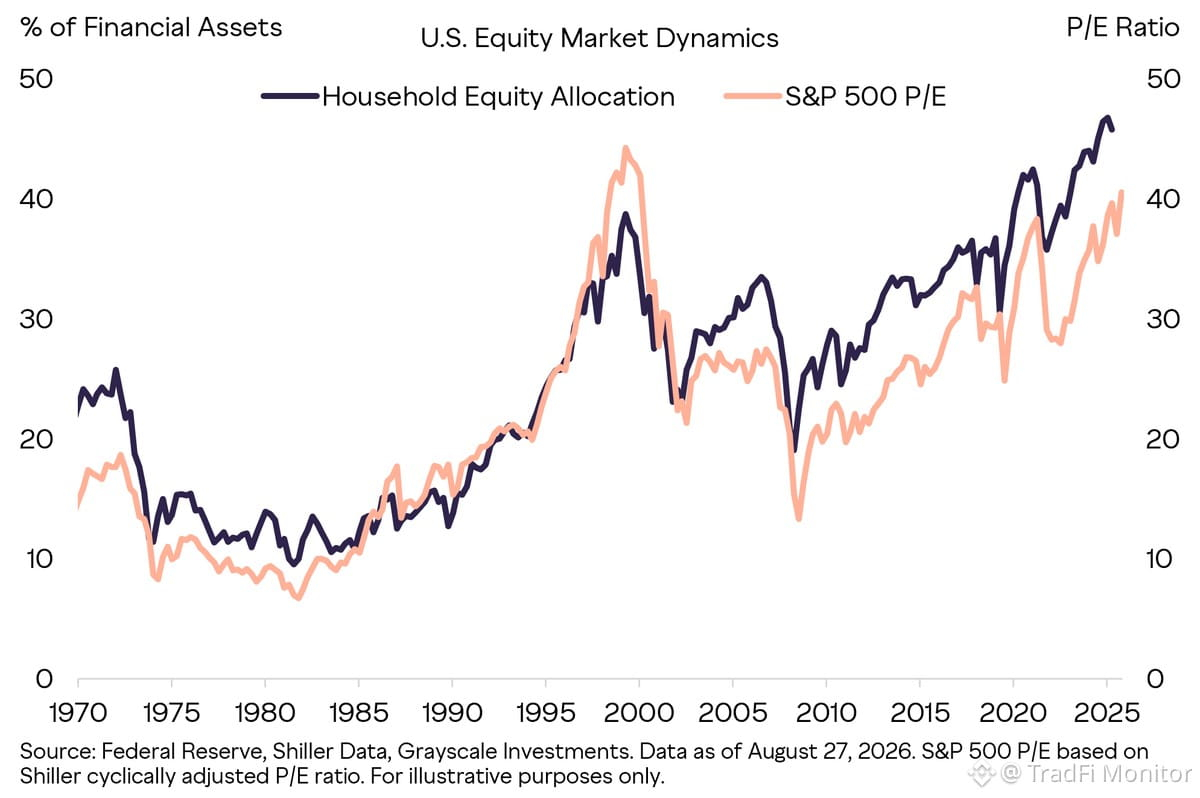
US equities are the most crowded position in modern history. $SPX earnings growth expectations now exceed 25%—leaving almost no room for error. Any miss triggers repricing.
Crypto presents the contrarian setup. Post-bear capitulation has cleared weak hands. Risk/reward asymmetry favors entry here over chasing stretched equity multiples.
Diversification isn't about comfort—it's about not being on the wrong side when consensus unwinds.
Crypto presents the contrarian setup. Post-bear capitulation has cleared weak hands. Risk/reward asymmetry favors entry here over chasing stretched equity multiples.
Diversification isn't about comfort—it's about not being on the wrong side when consensus unwinds.
См. перевод
$TSLA Cybercab commentary on CNBC. No substantive details provided in this post—just a media appearance flag. Need actual take on unit economics, regulatory pathway, or fleet deployment timeline to assess impact on valuation. Empty signal until specifics emerge.
См. перевод
Gerber Kawasaki liquidating positions in $GG (Guggenheim Partners). Cited reason: ethics and risk management misalignment. Firm now reviewing entire insurance investment book.
Context matters here - this is a public breakup from an asset manager, not typical portfolio rotation. When shops publicly cite "ethics" it usually means something material happened behind closed doors. Insurance holdings review suggests contagion concern or broader due diligence failure.
Watch for:
- What triggered this? Regulatory filing, internal audit, counterparty issue?
- Size of AUM impact on $GG if others follow
- Whether insurance book review leads to broader sector rotation
No price targets or timeline given. This reads like reputation risk becoming investment risk.
Context matters here - this is a public breakup from an asset manager, not typical portfolio rotation. When shops publicly cite "ethics" it usually means something material happened behind closed doors. Insurance holdings review suggests contagion concern or broader due diligence failure.
Watch for:
- What triggered this? Regulatory filing, internal audit, counterparty issue?
- Size of AUM impact on $GG if others follow
- Whether insurance book review leads to broader sector rotation
No price targets or timeline given. This reads like reputation risk becoming investment risk.
См. перевод
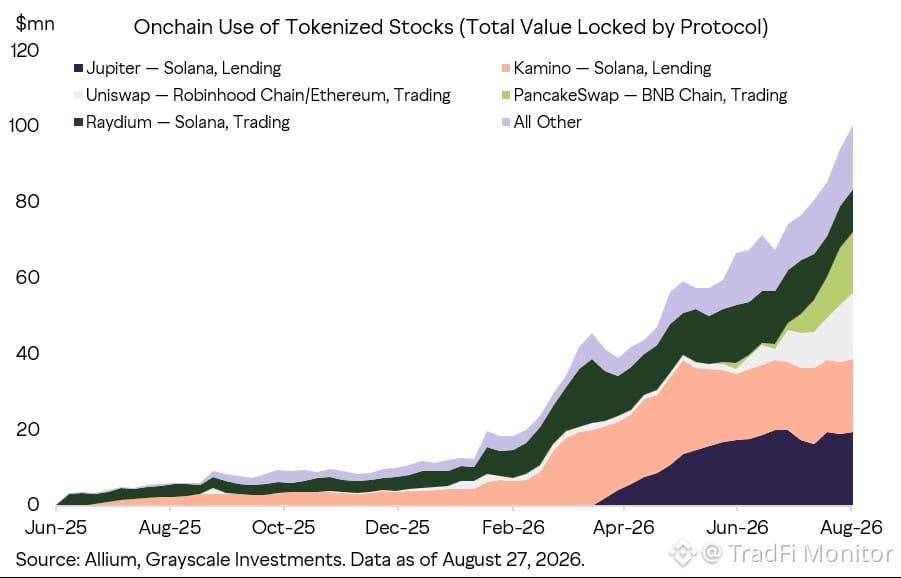
Tokenized equity infrastructure is scaling across chains. Key protocols capturing flow:
$JUP + $KMNO handling leverage/lending on Solana
$UNI routing trades on Robinhood Chain + Ethereum L1
$CAKE on BNB Chain
$RAY on Solana
Watch for:
- Volume migration from CEXs to these DEXs
- Regulatory clarity on tokenized securities
- Cross-chain liquidity fragmentation
If tokenized stocks gain traction, these protocols capture fees + TVL. If regulators crack down or adoption stalls, they're overvalued. Risk/reward hinges on legal framework + user behavior shift.
$JUP + $KMNO handling leverage/lending on Solana
$UNI routing trades on Robinhood Chain + Ethereum L1
$CAKE on BNB Chain
$RAY on Solana
Watch for:
- Volume migration from CEXs to these DEXs
- Regulatory clarity on tokenized securities
- Cross-chain liquidity fragmentation
If tokenized stocks gain traction, these protocols capture fees + TVL. If regulators crack down or adoption stalls, they're overvalued. Risk/reward hinges on legal framework + user behavior shift.
$HOOD, $BNB и $SOL доминируют в потоках токенизированных акций. Недельный спотовый объем достиг $3B, а onchain TVL теперь превышает $110M. Это ранняя стадия строительства инфраструктуры с реальным traction. Следите за регуляторными встречными ветрами и риском фрагментации ликвидности, но импульс очевиден. Если рельсы токенизированных акций масштабируются, эти сети захватят поток комиссий и зафиксируют ликвидность. Здесь важна позиция.
См. перевод
$TSLA event execution risk playing out in real-time. Austin showcase delivered 15-minute product demo with zero substance—attendees flew in for theater, not data. This is operational discipline failure at leadership level. When you can't deliver on investor/customer expectations at your own staged events, it signals deeper product roadmap and communication breakdown. Stock price reflects this: market pricing in credibility gap between hype cycles and actual deliverables. Event ROI negative, brand equity eroding. Watch for institutional rotation out if next earnings call doesn't address execution standards.
См. перевод
$TSLA robotaxi event was a dud. No new tech, no timeline, just vaporware competing in an already crowded autonomous space with Waymo, Cruise, and Chinese players years ahead on deployment. Zero path to revenue, zero regulatory clarity. Event lacked substance—no broken windows stunt, no Elon hype cycle to pump retail. If they can't even operate in Santa Monica, this is a distraction from core auto margin compression and EV demand slowdown. Sell the hype, short the execution gap.
См. перевод
Musk no-show at Robotaxi launch raises execution concerns. Key investor questions unresolved: individual ownership model unclear, personal storage/trunk functionality not addressed vs fleet-only deployment. Product positioning ambiguous between consumer purchase (Cybertruck model) vs ride-hail fleet asset. Lack of CEO presence + missing product specs = demand visibility near zero. $TSLA trading on hype without fundamentals until business model clarified. Risk: valuation assumes robotaxi revenue that may not materialize in sellable consumer form.
См. перевод
$ZEC clearing $900. Privacy narrative + hard money thesis driving fresh highs. Institutional interest building as regulatory clarity on privacy coins remains uncertain—watch for either legitimization or crackdown risk. Momentum strong but thin liquidity = volatile swings both ways.
См. перевод
$GOOG Waymo seeing behavioral shift: parents now using autonomous fleet for school runs instead of rideshare drivers. Trust arbitrage playing out—consumers perceive robotaxi as safer than human strangers for unaccompanied minors.
Expands addressable market beyond adult commuters into family logistics segment. If this scales, it unlocks recurring daily demand (2x trips/day per household during school year). Higher frequency = better unit economics.
Risk: regulatory hurdles around unaccompanied minors in AVs. Reward: sticky customer behavior if parents adopt this as default. Watch for Waymo to formalize this use case with parental controls/tracking features.
Competitive moat widens if trust becomes the wedge. Uber/Lyft can't replicate this without their own AV fleet.
Expands addressable market beyond adult commuters into family logistics segment. If this scales, it unlocks recurring daily demand (2x trips/day per household during school year). Higher frequency = better unit economics.
Risk: regulatory hurdles around unaccompanied minors in AVs. Reward: sticky customer behavior if parents adopt this as default. Watch for Waymo to formalize this use case with parental controls/tracking features.
Competitive moat widens if trust becomes the wedge. Uber/Lyft can't replicate this without their own AV fleet.
Грубые скачки цен на нефть на фоне напряженности вокруг Ирана — прямой перенос на цены бензина, бьющий по кошелькам американских потребителей. Это классический риск инфляции из‑за шока предложения: он может заставить ФРС действовать, если ситуация сохранится. Реальный смысл здесь: рычаги Иранского пролива временные и уже заложены в цену с максимальным уровнем страха. После прояснения обстановки энергетические бумаги резко откатываются.
Тем временем именно такая волатильность ускоряет структурный сдвиг. Каждые дополнительные $0,50 к цене бензина навсегда переключают всё больше покупателей автопарков и потребителей на электромобили. $TSLA и инфраструктура для зарядки получают «попутный ветер» спроса, который не разворачивается, когда нефть приходит в норму. Дополнительные капвложения в альтернативную энергетику также получают политическое и корпоративное «добро», когда цепочки поставок ископаемого топлива демонстрируют хрупкость.
Краткосрочный всплеск нефти, долгосрочный гвоздь в гроб зависимости от углеводородов. Действуйте соответствующе — гасите панику у энергетических мейджоров, накапливайте цепочку поставок для EV при любом откате.
Тем временем именно такая волатильность ускоряет структурный сдвиг. Каждые дополнительные $0,50 к цене бензина навсегда переключают всё больше покупателей автопарков и потребителей на электромобили. $TSLA и инфраструктура для зарядки получают «попутный ветер» спроса, который не разворачивается, когда нефть приходит в норму. Дополнительные капвложения в альтернативную энергетику также получают политическое и корпоративное «добро», когда цепочки поставок ископаемого топлива демонстрируют хрупкость.
Краткосрочный всплеск нефти, долгосрочный гвоздь в гроб зависимости от углеводородов. Действуйте соответствующе — гасите панику у энергетических мейджоров, накапливайте цепочку поставок для EV при любом откате.
См. перевод
Fed rate hikes are theater. Market already priced in higher yields before Powell moved. Short-end adjustments irrelevant when real estate transactions are dead—volume collapsed years ago and hasn't recovered.
Fed's actual toolkit: engineer a hard landing or watch inflation run. That's it. Rate policy transmission broken when housing market is frozen and credit demand is already suppressed.
Implication: Either Fed pivots early (bullish risk assets short-term, bearish dollar) or they hold restrictive and we get the recession they're pretending to avoid. No middle path here.
Fed's actual toolkit: engineer a hard landing or watch inflation run. That's it. Rate policy transmission broken when housing market is frozen and credit demand is already suppressed.
Implication: Either Fed pivots early (bullish risk assets short-term, bearish dollar) or they hold restrictive and we get the recession they're pretending to avoid. No middle path here.
См. перевод
$TSLA FSD 14.3.8 shows measurable improvement—disengagement frequency down from prior builds. Still not L4-ready, driver intervention remains frequent. First notable progress in months. Matters for autonomy narrative and premium pricing justification, but timeline to robotaxi economics still unclear. Watch for fleet data corroboration and regulatory stance.
Войдите, чтобы посмотреть больше материала