

After spending enough time in crypto, a clear pattern emerges: most so-called blue-chip altcoins eventually lose relevance or disappear entirely. Bitcoin stands apart. It is the only digital asset where long-term survival feels almost unquestionable, which is why it deserves a completely different approach. Treating Bitcoin like an ordinary trading vehicle is one of the biggest mistakes investors make.
Most people attempt to trade Bitcoin the same way they trade altcoins. They chase every dip, sell every bounce, and constantly try to time tops and bottoms. Over time, this leads to emotional fatigue and inconsistent results. Bitcoin rewards patience, not constant activity. The real opportunity lies in accumulation, not short-term speculation.
This strategy is not designed for active trading. It is meant for building long-term wealth. When Bitcoin is viewed through a multi-year or multi-decade lens, short-term price fluctuations become irrelevant. The focus shifts from predicting price to consistently increasing ownership. That mindset alone puts investors ahead of the majority of market participants.
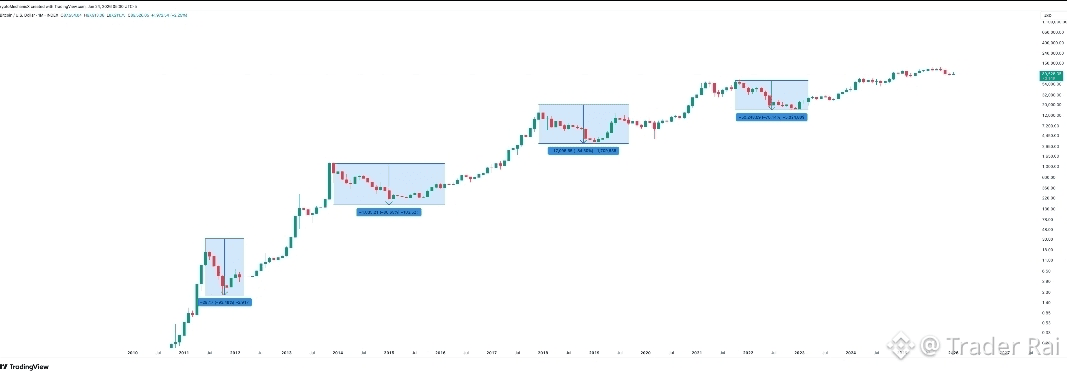
The foundation of long-term accumulation is dollar-cost averaging. Buying Bitcoin at fixed intervals removes emotion from the process and eliminates the need to predict market movements. Whether price is high or low becomes less important than consistency. Over time, this approach naturally smooths volatility and builds a meaningful position without stress.
For those willing to go a step further, understanding Bitcoin’s historical market cycles can improve accumulation timing. Bitcoin has consistently moved in four-year cycles, marked by strong bull markets followed by deep corrections. After major peaks, drawdowns of 70% to 90% have been common, while pullbacks of 30% to 50% frequently occur even within bull markets.
This does not mean waiting for extreme crashes before buying. Instead, it highlights that significant pullbacks often represent discounted opportunities. Historically, buying during periods of fear and heavy drawdowns has produced strong long-term results. Once declines exceed roughly 50%, the market often transitions into a broader bear phase where accumulation becomes even more attractive.
There are two practical ways to apply dollar-cost averaging. The first is buying strictly on predetermined time intervals, ignoring price completely. This method works exceptionally well for most people and requires minimal effort. The second approach involves increasing purchases during major market capitulation, when Bitcoin experiences sharp corrections and sentiment turns extremely negative.
If using the second method, focusing on high-timeframe charts is essential. Short-term noise only creates confusion. The best accumulation opportunities tend to appear when fear is widespread, price is deeply discounted, and confidence is at its lowest. These moments are uncomfortable, but they have historically been the most rewarding.
The strategy itself is simple, but execution is where most struggle. Buying during red markets feels emotionally difficult, even when logic says otherwise. Fear often peaks near opportunity. The goal is not to outsmart the market but to remain disciplined when emotions are highest.
Ultimately, accumulating Bitcoin is about consistency, patience, and time. Constant trading is unnecessary. Perfect timing is unrealistic. A clear plan, followed steadily over years, has proven far more effective than chasing short-term price movements. Bitcoin rewards those who stay focused long enough to let compounding and long-term adoption do the work.
