
Dusk Network is a privacy-first Layer-1 blockchain designed specifically for regulated finance, where confidentiality and compliance must coexist. Unlike most public blockchains that expose all transaction data by default, Dusk focuses on enabling real financial use cases—such as tokenized securities, institutional DeFi, and compliant payments—without revealing sensitive information to the entire world. The core idea is simple: financial markets need privacy, but they also need accountability. Dusk is built to support both at the protocol level.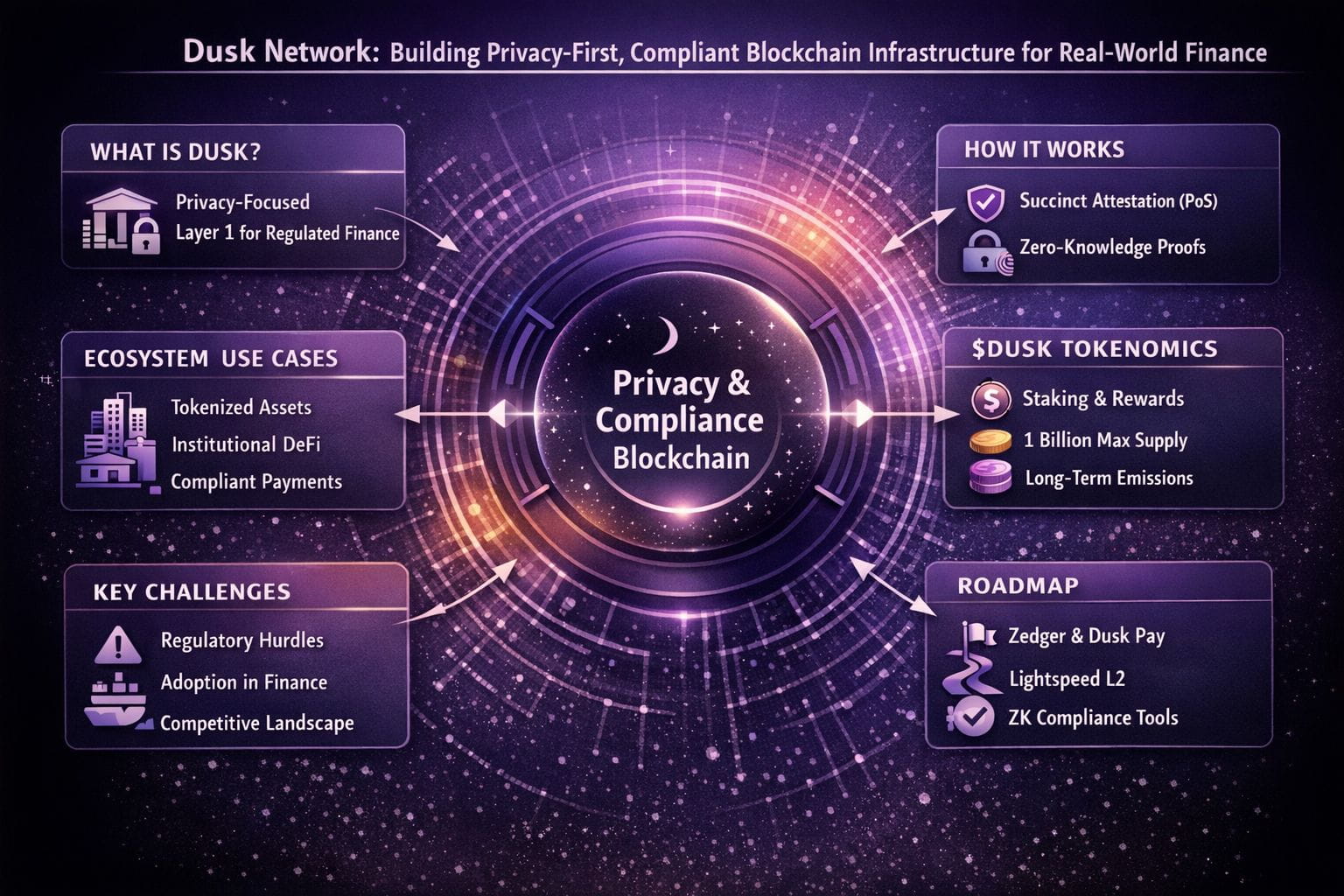
What makes Dusk important is the growing demand for real-world assets (RWAs) on-chain. Traditional finance suffers from slow settlement, high costs, and fragmented systems. Blockchains can fix this, but only if they meet regulatory requirements. Institutions cannot operate on fully transparent chains where balances, strategies, and counterparties are permanently public. Dusk addresses this by allowing confidential transactions with selective disclosure, meaning data can remain private while still being verifiable when regulators or auditors require access.
At a technical level, Dusk is structured as a modular blockchain. Its base layer, DuskDS, handles settlement, consensus, and data availability. On top of this, execution environments like DuskEVM and a WASM-based virtual machine allow developers to build applications using familiar tools while benefiting from privacy features. The network uses a proof-of-stake consensus mechanism called Succinct Attestation, which focuses on fast and deterministic finality. Once a block is ratified, it is final—making it suitable for financial settlement where certainty matters.
Privacy on Dusk is powered by zero-knowledge proofs and a dual transaction model. Applications can choose between public, account-based transactions and shielded, confidential transactions depending on their needs. This flexibility allows Dusk to support both open DeFi-style activity and private, regulated workflows on the same network.
The $DUSK token plays a central role in the ecosystem. It is used for staking, securing the network, paying transaction fees, and incentivizing validators. According to Dusk documentation, the initial supply is 500 million $DUSK, with another 500 million emitted gradually over 36 years, bringing the maximum supply to 1 billion. Emissions follow a long-term decay model designed to support early network security while reducing inflation over time. Staking requires a minimum amount of $DUSK and includes slashing mechanisms to maintain network integrity.
The Dusk ecosystem is heavily oriented toward real financial infrastructure. Key use cases include regulated asset issuance, on-chain settlement of securities, institutional DeFi, and compliant payment systems. Dusk has also outlined products such as Zedger for asset tokenization, Dusk Pay for compliant payments, and Lightspeed, an EVM-compatible layer designed to scale execution while settling back to the Dusk base layer.
Looking ahead, Dusk’s roadmap focuses on expanding staking features, rolling out asset tokenization tools, improving EVM interoperability, and deepening integrations with compliance and identity solutions. The long-term vision is to evolve into a decentralized market infrastructure where issuance, trading, and settlement can all happen on-chain in a compliant and privacy-preserving way.
Of course, challenges remain. Adoption in regulated markets is slow, competition in the RWA and privacy space is intense, and maintaining the balance between privacy and auditability is technically complex. Developer adoption and real-world usage will ultimately determine whether Dusk can scale beyond theory into production finance.
Still, Dusk stands out for tackling one of crypto’s hardest problems head-on: how to bring real finance on-chain without breaking the rules it must follow. That focus makes @dusk_foundation and the $DUSK ecosystem worth watching as blockchain infrastructure continues to mature.
