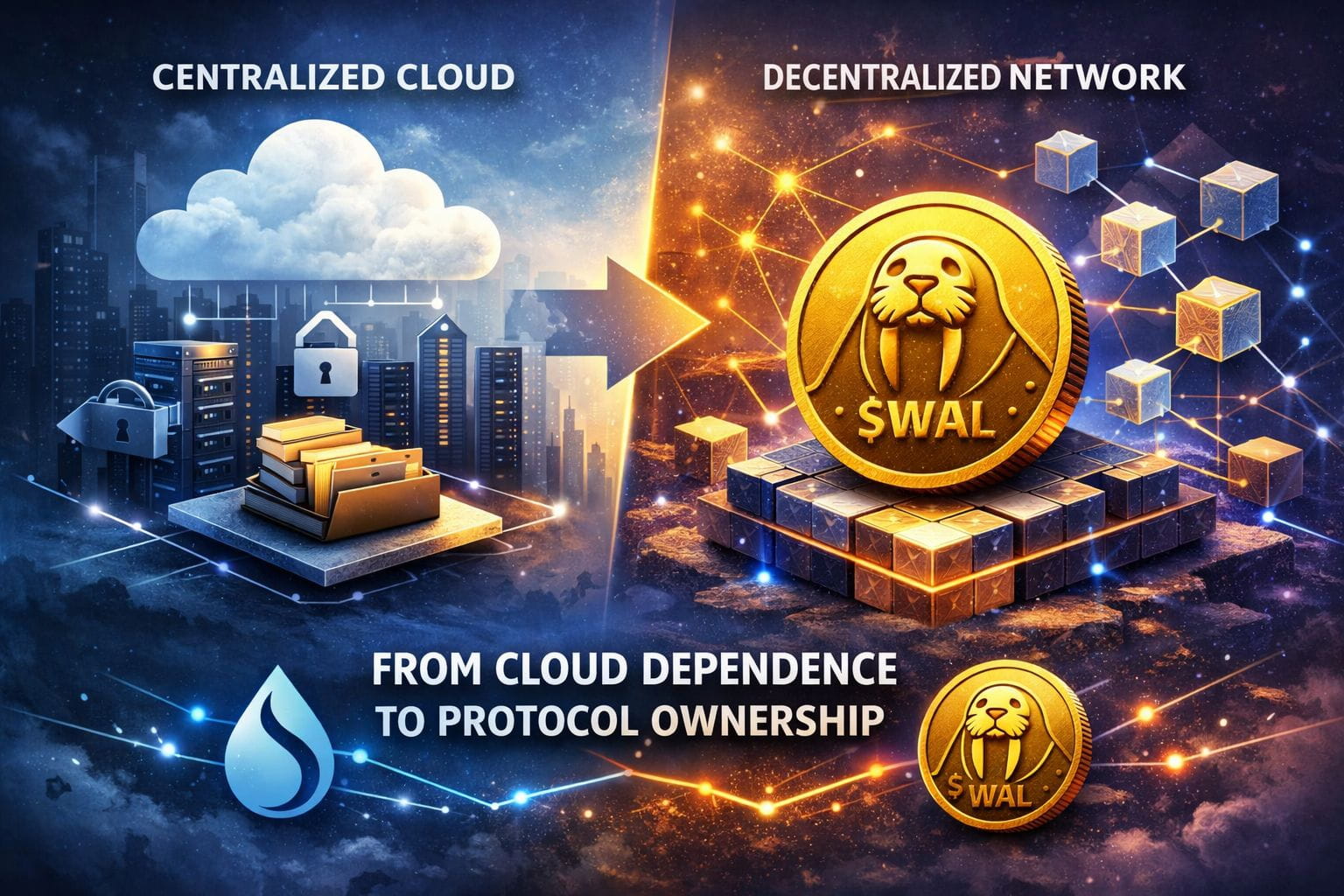
Web3 has been quietly outsourcing one of the most vital layers of the financial systems as it has been rebuilding them over a period of more than 10 years. Transactions moved on chain. Governance moved on chain. Assets moved on chain. However the data that renders these systems meaningful would frequently be in centralized clouds. Walrus exists because this contradiction has come to its end.
The very idea of decentralization fails as soon as the applications rely on the infrastructure, which can be censored, repriced, or canceled on a whim. This dependency was long accepted as there was no alternative solution. Decentralized storage lacked scalability, was not cost-effective, or it could not be easily fitted into actual production systems. Walrus does not want to re-write an old story. It reflects a change in the organization of Web3 in terms of ownership, responsibility, and control on the infrastructure level.
This change is significant in the present as Web3 is no longer in the experimental phase. There are no longer early adopters and speculative use cases defining the ecosystem. It is being increasingly influenced by real value, real data, and real user managing applications. In that regard, cloud reliance ceases being a luxury. It is a systemic risk.
Why the dependency on clouds silently demeans decentralization.
There are no other companies like the centralized cloud providers. They provide stability, stable prices and established equipment. It is exactly why Web3 has taken them on board. Control goes with efficiency. Access can be restricted. Availability can be redefined through jurisdictional pressure. Business incentives are subject to change in a night.
These risks are taken into consideration in the traditional software. They create a contradiction in the decentralized systems. In case the application logic is minimized but the data layer is not, the users are still relying on one middleman to maintain history and availability.
It is not a theoretical problem. NFTs have lost their worth due to loss of metadata. DAOs have had controversies as the records were not reliably retrievable. Applications have failed not due to the failure of blockchains, but due to the failure of off chain data pipelines.
Walrus is due to the fact that these failures cease to be edge cases. They are foregone conclusions of architectural short cuts. The price of such shortcuts qualifies as Web3 applications are becoming more mature.
Decentralized storage could no longer be symbolic.
The previous decentralized storage systems tended to be closer to ideological purity than to the reality of operation. Complete replication between nodes optimized redundancy at prohibitive costs. The integration became weak due to the complex retrieval mechanisms. Serious adoption was discouraged by performance tradeoffs.
Walrus does not treat storage as something symbolic. The erasure coding employed by the system is a viable answer to the cost issue. Information is disseminated and spread in a manner that will allow recovery without redundancy. This enables the network to stand and survive without the storage being overstretched to a point that is not economically viable.
This pragmatism is further supported by blob storage. Big data objects do not necessarily demand the execution layers to be huge or the developers to have to conform to unnatural design patterns. The outcome is a storage layer that can be relied upon by builders, as opposed to a layer that builders have to contend with.
Such a design is motivated by the way developers behave. Constructors give more attention to dependability and ease of use instead of ideological conformity. Walrus confronts them there, and does not demand of them the total sacrifice of decentralization.
Why it is more important to have protocol ownership than vendor trust.
Censorship risk is not the only issue of cloud dependence. It is about ownership. In case of rented infrastructure continuity is subject to incentives of the provider. With collective ownership of infrastructure, continuity is also shared.
Walrus is a shift in trusting the vendor to having ownership of the protocol. Walrus network is not governed by one party that can dictate the terms alone. It works under the economic incentives and protocol rules as opposed to service agreements.
This is the difference between the long the term systems. Web3 applications are created to outlive individual teams and companies. Organizational infrastructure based on commercial contracts creates vulnerability in structures that are supposed to be robust.
The key element in this transition is the $WAL token. It is not presented as an investment story. It serves as a coordination tool that brings storage providers, validators, and users to common outcomes. Availability, integrity, and performance are not implemented socially, but in an economical manner.
This model is aware that the failure of decentralized systems occurs when incentives become distorted. $WAL has been created to ensure that such distortion does not occur.
Why Sui transforms the possibility
Decentralized storage can only be feasible when the underlying blockchain is capable of doing it. The coordination overhead, the frequency of verification and the latency are all relevant. The previous efforts were limited by base layers that were incapable of ensuring effective large scale coordination.
The use of Walrus of Sui blockchain is due to its performance properties, which enable decentralized storage in practice. High throughput provides the ability to check regularly and without congestion. There is low latency enhancing data access responsiveness. These are not cosmetic properties. They have a direct influence on user experience and developer confidence.
In the absence of this base, Walrus would be limited in the same way that its predecessors had been. Through it, the protocol is able to concentrate on reliability, instead of compromising.
This integration does not concern branding. It is regarding architectural fit. Walrus is a solution to the fact that the underlying environment is finally able to provide what decentralized storage needs to scale.
Privacy as a requirement, not a characteristic
With Web3 becoming more enterprise and institutional, privacy becomes not a favor but a necessity. The majority of exposure is done in data storage. Ledgers of the public are transparent in nature. Storage should not be.
Walrus introduces privacy as a part of its design by fragmenting and reassembling data. Information that is sensitive is not revealed by default. The protocol logic that controls access is platform discretionary.
This strategy is explained by the actual adoption limitations. Businesses will not keep confidential data in places where privacy is not mandatory. People will never have confidence in systems that consider privacy as an add on.
Walrus considers privacy as infrastructure hygiene. This is not an advertising job. It is an acknowledgment of the way in which adoption takes place.
The importance of this issue at the moment.
Timing matters. Walrus is not early. It is reacting to the already accrued pressure. Blockchains in the form of modules produce enormous volumes of data. Rollups rely on the availability of data. Distributed storage is needed with AI driven applications, which do not need a centralized choke point.
Simultaneously, regulatory review is growing. Using centralized providers brings in a complexity of jurisdiction which the decentralized protocols cannot necessarily accommodate. This exposure is minimized by neutral infrastructure.
Walrus is at the cross-point of these pressures. It is dealing with an issue that is more pronounced with an increase in adoption. The lack of concern about decentralized storage was possible in times of low stakes. It is no longer viable.
Experimentation to durability
Web3 is reaching a stage where sustainability is more important than innovation. Systems will be anticipated to maintain, develop and endure stress. The infrastructure decisions of today will determine the failure of tomorrow.
Walrus is an indicator of a change in priorities. It implies that the ecosystem is ready to put efforts in unglamorous layers since they define results. Storage is not an exciting thing, yet it is fundamental.
With the emphasis on pragmatic decentralization over stories, the account of @walrusprotocol is more reflective of the current state of the art about what Web3 needs to achieve. The WAL token is pegged to a system that is meant to coordinate incentives in the long term, rather than increase speculation.
What Walrus is finally all about
Walrus is not the assertion that clouds are evil or that the decentralization is pure. It is a claim regarding accountability. In case Web3 purports to decrease the dependency on intermediaries, it should do so all through the stack.
The final significant dependency that is to be taken seriously is storage. Walrus does not purport to resolve all the problems. It is a solution to one that was too long neglected.
With the growing number of decentralized systems, it will cease being whether storage can be decentralized, and instead, it will be whether it must be. According to Walrus, the answer is already obvious.
This is the reason Walrus is important today. Not as a story, but infrastructure.