


hello my dear cryptopm binance square family, today in this article we will talk about APRO
APRO Oracle did not come to fight the usual oracle war of “who has more feeds” or “who updates faster.” It came from a question most of the industry quietly avoids because it is uncomfortable: what happens when smart contracts no longer just need numbers, but meaning.
For a long time, the oracle problem was simple. Get the BTC price. Trigger a liquidation. Settle a synthetic. That phase is mostly solved, and the dominant oracle networks are genuinely good at it. But crypto is no longer locked inside leveraged trading loops. It is moving into insurance, real-world assets, automated compliance, AI-driven agents, and governance systems that respond to events outside the chain. These systems don’t just need data. They need interpretation. That is the shift APRO is built around.
Most traditional oracle designs treat the off-chain world like hostile territory. Pull in the smallest possible data point, reduce it to a clean feed, decentralize it, and hope redundancy protects you. That approach worked when smart contracts were simple financial machines. It starts breaking down when a contract needs to understand whether a legal ruling is valid, whether a weather event qualifies as an insurance trigger, or whether an AI model’s output should be trusted before it moves real capital. APRO is not trying to make blockchains smarter. It is trying to make the bridge between blockchains and reality less blind.
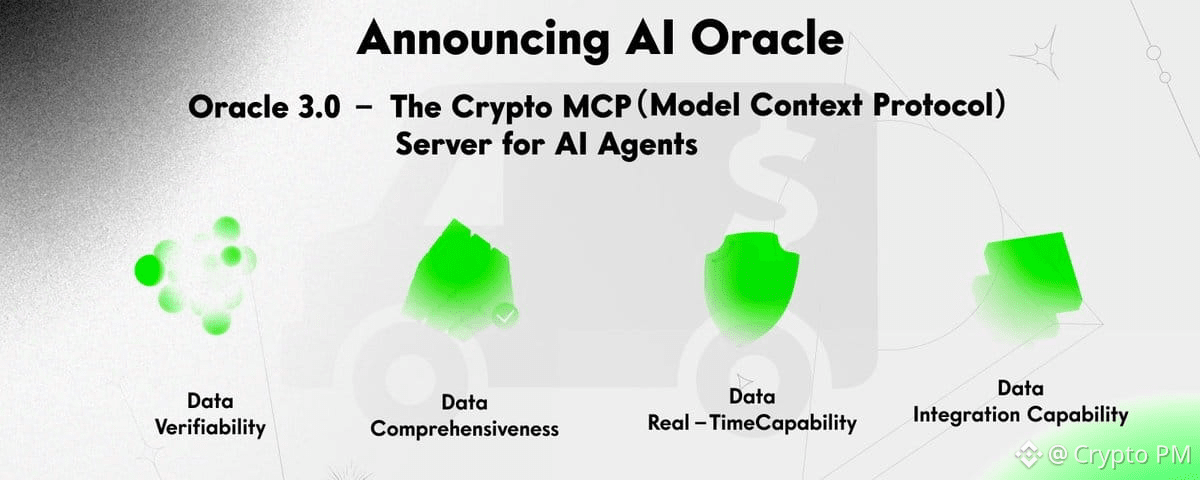
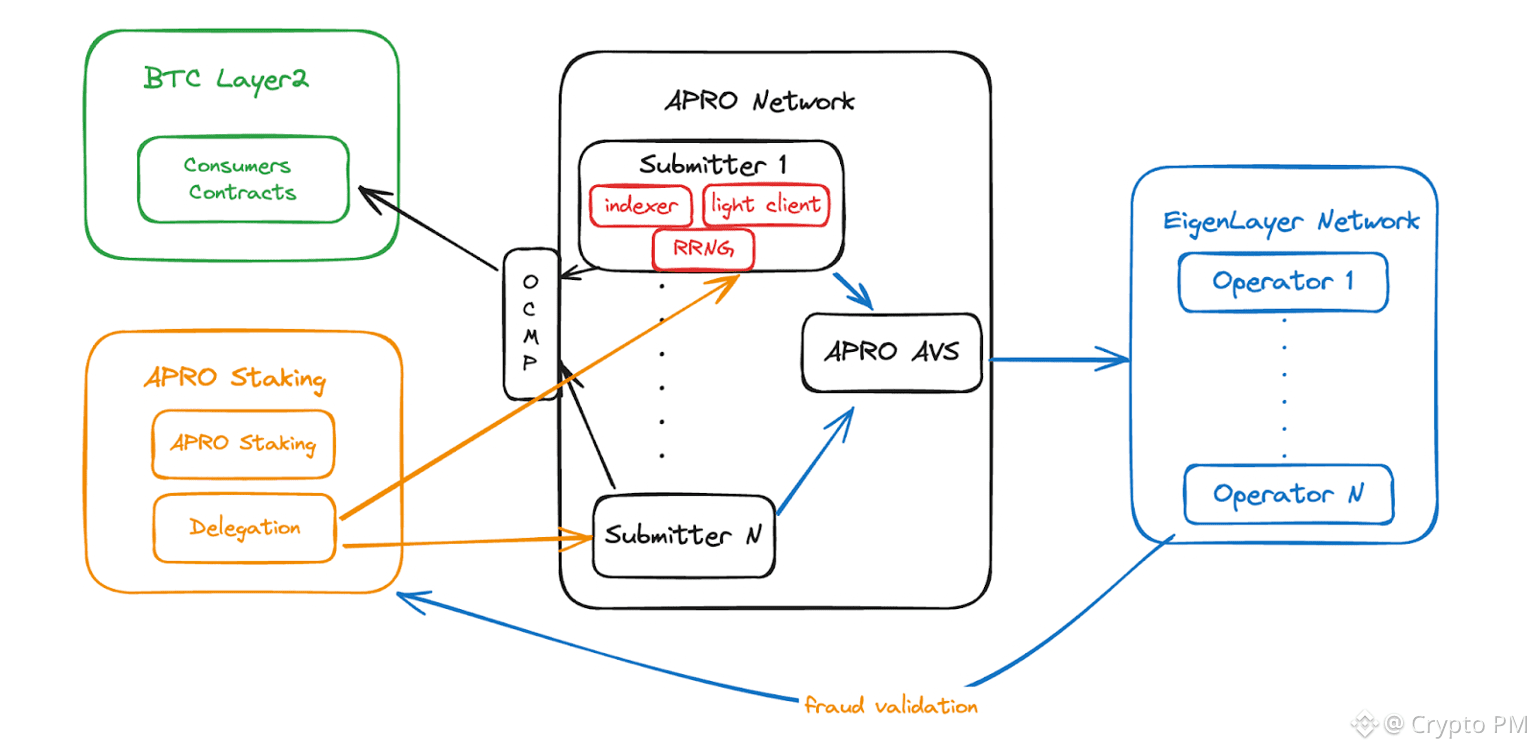
You can see this philosophy clearly in its architecture. APRO does not force all intelligence on-chain just to sound pure. It splits the system into two layers. Off-chain nodes do the messy work: ingesting raw data, running AI-based verification, classifying context, and challenging each other’s conclusions. On-chain contracts then verify that this process happened correctly, anchoring the result in cryptographic proof. This matters because correctness is contextual. A price is not just a number if it was formed during abnormal liquidity or sourced from compromised markets. Context is the difference between a fair outcome and a protocol failure.
This is also why APRO’s Data Push and Data Pull model is not just a developer feature, but an economic design choice. Some data is systemic and time-critical. Prices, collateral values, funding rates. If these stall, the system breaks. That data must flow continuously. Other data is episodic. A court decision, a game result, an AI inference. That data should be fetched only when a contract explicitly asks for it. Treating everything as equally urgent is wasteful and dangerous. APRO separates these realities instead of pretending one model fits all.
The use of AI in APRO is often dismissed as marketing by people who haven’t thought through the scale problem. When a network supports dozens of chains and thousands of data streams, the bottleneck is no longer cryptography. It is interpretation. Human-curated rules do not scale to real-world asset markets or autonomous agent systems. APRO’s AI layer is not there to replace trust with a black box. It is there to compress trust. By filtering noise, flagging anomalies, and learning the fingerprints of manipulation, it raises the cost of attack. Corrupting the oracle becomes harder not because of slogans, but because reality stops behaving quietly when someone tries to bend it.
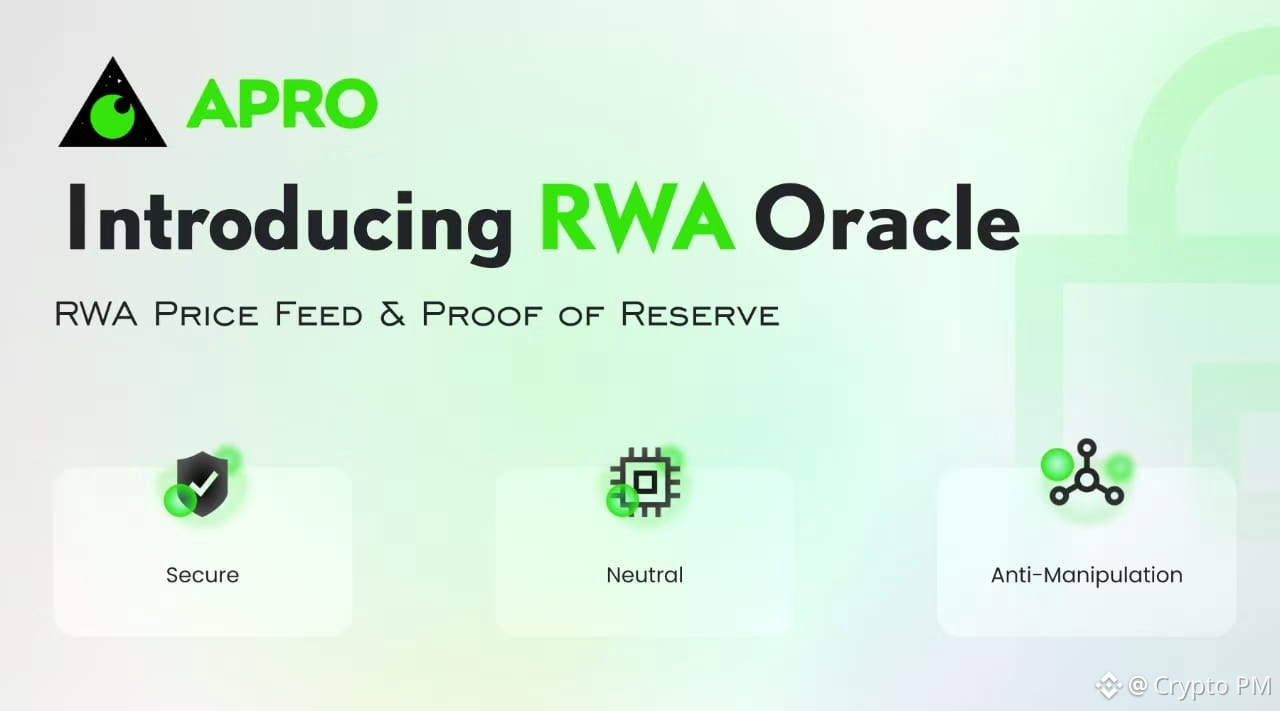
This design choice becomes especially important as crypto moves toward real-world assets. Tokenizing a bond is easy. Tokenizing the behavior of a bond is not. Its value depends on interest rates, regulation, issuer health, and macro events that cannot be flattened into a single feed. APRO’s support for broader asset classes hints at a future where smart contracts respond to composite realities, not isolated metrics. That future does not belong to the fastest oracle. It belongs to the one that can defend its outputs under scrutiny.
The AT token sits at the center of this system, but not as speculative fuel. It acts as an economic filter. Nodes stake AT to earn the right to be believed. The more they stake, the more credibility they buy, and the more they lose if their data is challenged and found wrong. Reputation is no longer social. It is capitalized. This shifts oracle security away from abstract decentralization metrics and toward a real market for accuracy.
What matters most is the behavior this encourages downstream. When protocols trust their data layer to handle context, they can design tighter systems. Lending protocols can reduce overly conservative buffers. Prediction markets can ask harder questions without being trivially gamed. AI agents can act on verified signals without turning every decision into a liability. This is how you reduce the hidden fear premium that quietly weakens on-chain systems today.
Even APRO’s multi-chain expansion looks different when viewed through this lens. Supporting many chains is not just distribution. It is epistemic. When the same event is observed across chains with different latency and behavior, discrepancies become signals. Divergence itself becomes data. That feedback loop is impossible in siloed oracle models that treat each chain as an isolated client.
The oracle sector spent years chasing the idea that decentralization alone guarantees truth. It does not. It guarantees redundancy. Truth requires judgment, and judgment requires systems that can weigh evidence, detect context, and evolve as reality changes. APRO is not trying to replace existing oracles overnight. It is quietly redefining what an oracle is supposed to do.
If the next phase of crypto really is about stitching finance, AI, and real-world assets into a coherent on-chain fabric, then the infrastructure that interprets reality will matter more than the infrastructure that merely reports it. APRO’s bet is simple and risky: blockchains are ready to stop asking only what happened, and start asking why it happened. That is a much harder problem. But it is also the one that actually needs solving.

