
 Look, I've been covering technology long enough to remember when cloud computing was supposed to change everything, when social networks were going to democratize information, when NFTs were going to reinvent ownership, and when hundreds of blockchain startups promised to eliminate middlemen forever.
Most of them hit the same wall.
Reality.
That's why whenever a project starts talking about creating a new economy around AI, data, models, and autonomous agents, my first instinct isn't excitement. It's caution.
OpenLedger is one of the latest projects attempting to position itself at the intersection of two industries that attract enormous amounts of speculation: artificial intelligence and cryptocurrency.
On paper, the pitch sounds reasonable.
Artificial intelligence needs data. Data creators deserve compensation. Blockchain technology can coordinate incentives. Everyone gets rewarded.
Simple.
Maybe a little too simple.
The core problem OpenLedger claims to solve is real. That's important to acknowledge from the start.
Artificial intelligence companies need huge amounts of data. Not just any data, but specialized information that is accurate, constantly updated, and useful for training models. Meanwhile, individuals and organizations that create valuable information often receive little or no compensation when AI systems benefit from their work.
There is a genuine imbalance here.
The people generating valuable information are frequently disconnected from the companies extracting value from it.
That's the problem.
The question is whether OpenLedger actually solves it.
Or whether it simply inserts another layer between the people creating data and the people using it.
I've seen this movie before.
Every few years, somebody arrives claiming they've discovered a marketplace solution for information. Sometimes it's a data exchange. Sometimes it's a content platform. Sometimes it's a decentralized network.
The details change.
The ending often doesn't.
Because information is not oil.
It's not gold.
It's not real estate.
You can copy it infinitely.
The moment somebody downloads a dataset, trains a model, extracts patterns, or incorporates knowledge into an AI system, things become messy.
Who deserves payment?
For how long?
How much?
What if thousands of people contributed?
What if the data was partially derived from somewhere else?
What if ownership is disputed?
These aren't technical problems.
They're legal, economic, and human problems.
Blockchain doesn't magically solve them.
It records them.
That's an important distinction.
The marketing language around OpenLedger often creates the impression that blockchain technology somehow transforms data into a tradable asset class. But data has been tradable for decades.
Companies buy and sell information every day.
The difficult part isn't facilitating transactions.
The difficult part is determining value.
Let's be honest.
Most datasets are worthless.
Some are useful.
A tiny fraction are extremely valuable.
The challenge isn't creating a marketplace where data can be listed.
The challenge is figuring out which data is actually worth buying.
That requires judgment.
Judgment requires expertise.
Expertise requires people.
And people are expensive.
This is where things become interesting.
And concerning.
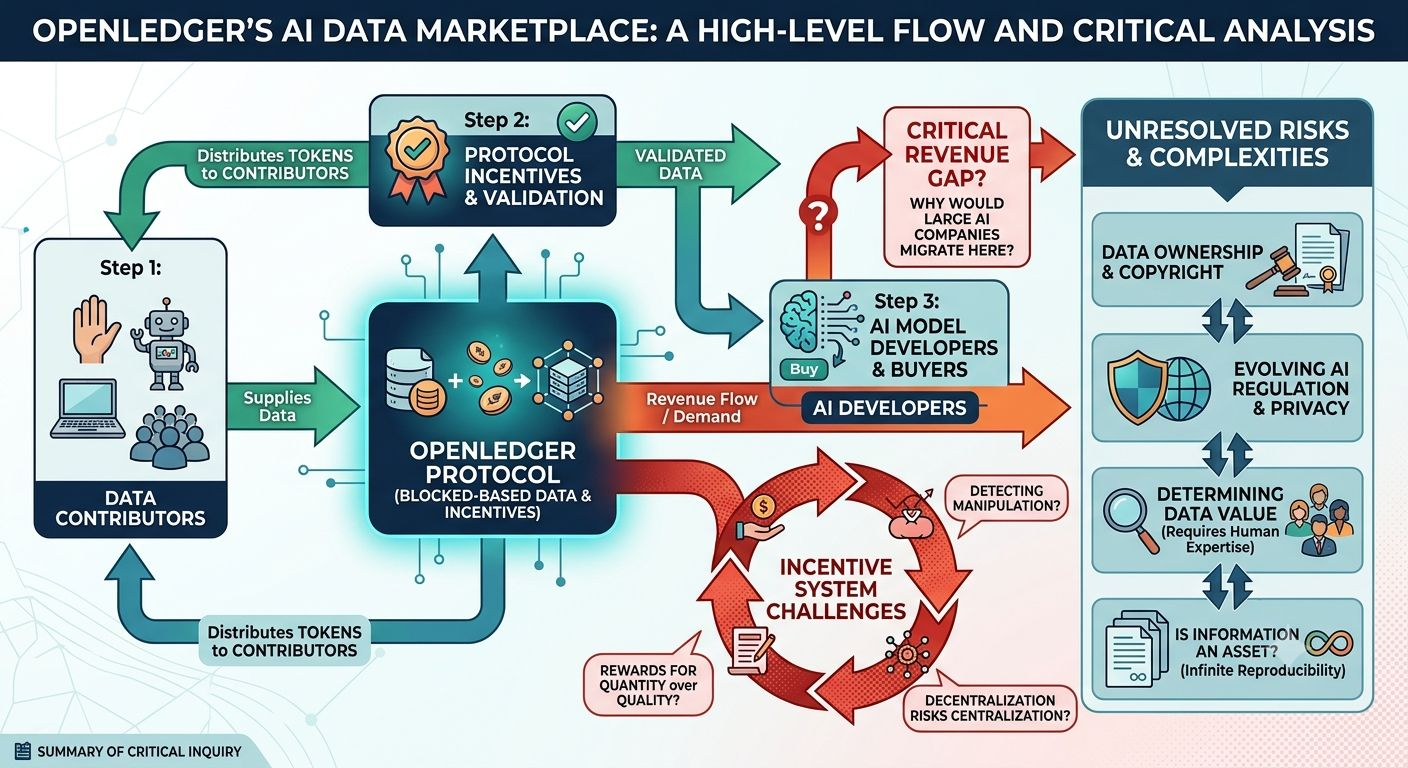
OpenLedger relies heavily on incentives.
Contributors provide information.
Validators verify information.
Developers consume information.
Tokens flow through the system.
It sounds tidy.
On paper, at least.
But incentive systems have a habit of producing unintended consequences.
Social media platforms rewarded engagement.
Users created outrage.
Search engines rewarded rankings.
Marketers created spam.
Advertising rewarded clicks.
Publishers created clickbait.
Human beings optimize for rewards.
Always.
Why should OpenLedger be different?
If contributors are rewarded for supplying data, some participants will inevitably focus on maximizing rewards rather than maximizing quality.
That's not a criticism of human nature.
That's human nature itself.
The network then needs mechanisms to detect manipulation.
Those mechanisms need oversight.
That oversight needs governance.
That governance needs authority.
And suddenly the supposedly decentralized system starts looking suspiciously centralized.
Because somebody has to make decisions.
Somebody has to determine what counts as valuable.
Somebody has to resolve disputes.
Somebody has to punish bad actors.
Crypto projects often speak about decentralization as if it eliminates authority.
In practice, it usually redistributes authority.
There's another issue that doesn't get discussed enough.
Demand.
Everyone talks about supply.
Almost nobody talks about buyers.
OpenLedger can attract contributors. It can attract validators. It can attract speculators.
But can it attract paying customers?
That's the question that matters.
Not social media followers.
Not community growth.
Not ecosystem announcements.
Revenue.
Real customers.
Real demand.
Because a marketplace without buyers isn't a marketplace.
It's a waiting room.
And this is where OpenLedger faces the same challenge confronting many blockchain projects connected to artificial intelligence.
The largest AI companies already possess enormous advantages.
They have proprietary data.
They have engineering teams.
They have compliance departments.
They have legal resources.
They have existing supplier relationships.
Why would they move critical components of their data pipeline into a tokenized ecosystem governed by external participants?
Maybe they will.
Maybe they won't.
But that's a much harder sales pitch than many investors seem willing to admit.
Then there's regulation.
The least exciting topic.
Which is precisely why it matters.
Data ownership laws are evolving.
AI regulation is expanding.
Privacy enforcement is increasing.
Copyright disputes are multiplying.
OpenLedger sits directly in the middle of all three.
That's not necessarily fatal.
But it does mean the project operates inside one of the most legally uncertain sectors in technology.
And legal uncertainty has a habit of becoming expensive.
Very expensive.
Particularly when real money starts flowing.
The catch, then, isn't hidden inside the technology.
The catch is hidden inside the assumptions.
The project assumes contributors can be accurately rewarded.
It assumes valuable data can be reliably identified.
It assumes buyers will consistently appear.
It assumes token incentives will improve behavior rather than distort it.
It assumes governance mechanisms will remain effective as the network grows.
Each assumption sounds reasonable in isolation.
Stack them together and the challenge becomes enormous.
Maybe OpenLedger succeeds.
Maybe it becomes a meaningful piece of AI infrastructure.
But after twenty years of watching technology cycles rise and fall, I've learned something simple.
Building technology is usually the easy part.
Building markets is harder.
Building trust is harder still.
And building a system that depends simultaneously on artificial intelligence, data ownership, token economics, regulatory compliance, contributor incentives, and marketplace demand is the sort of challenge that looks manageable in a white paper and considerably less comfortable when actual humans start interacting with it.
That's the part investors should probably spend more time thinking about.
