
Fundamental Analysis of Pixels (PIXEL)
1. Project Overview
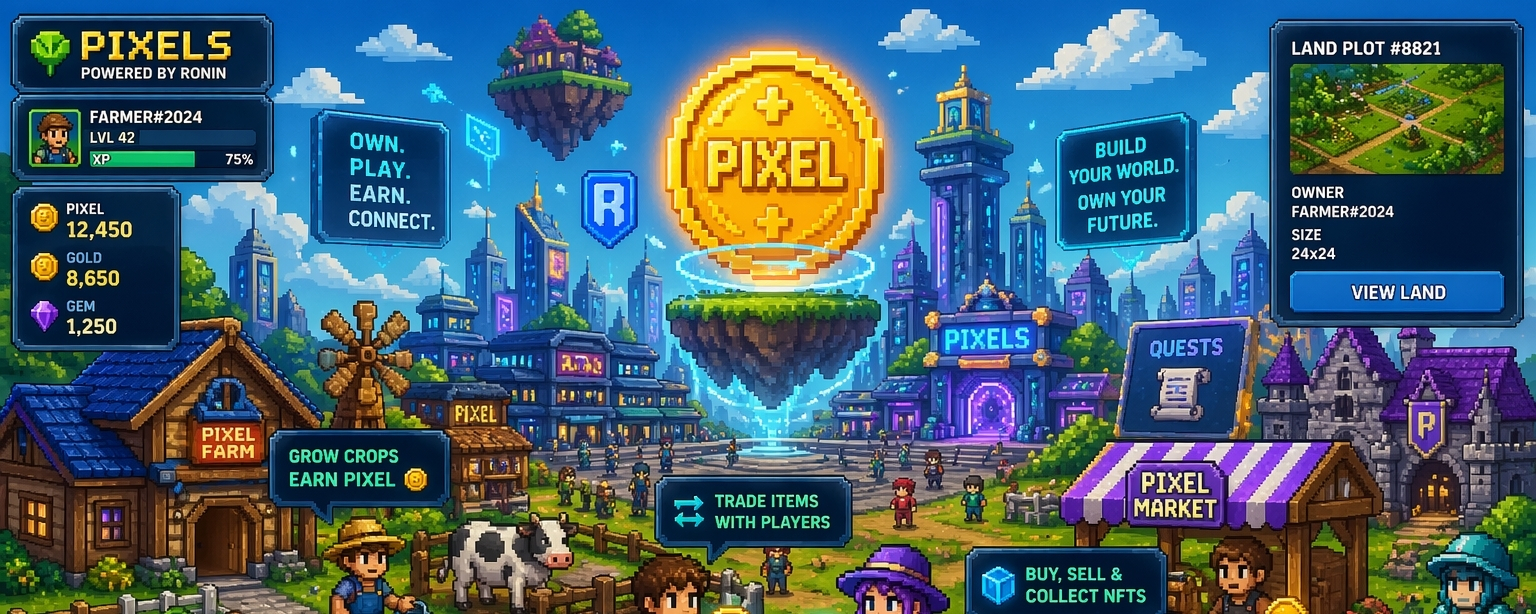
$PIXEL (@Pixels ) sits at the intersection of Web3 gaming, NFTs, and digital ownership. Unlike traditional cryptocurrencies that focus purely on payments or DeFi, Pixels is built around a play-to-earn (GameFi) ecosystem.
At its core, it is a social farming and exploration game running on the Ronin blockchain, where players can farm, craft, trade, and own digital assets. �
CoinMarketCap +1
The PIXEL token functions as:
In-game premium currency
Governance token
Medium for NFT minting and trading �
CoinMarketCap
This dual utility (game + token economy) is a key part of its value proposition.
2. Core Fundamentals
Utility & Tokenomics
PIXEL is not just speculative—it has clear in-ecosystem demand drivers:
Used for buying land, items, and upgrades
Required for high-tier crafting and NFTs
Enables VIP passes and gameplay boosts �
WEEX +1
This creates a closed-loop economy, where:
More players → more demand for assets → more demand for PIXEL
That’s a strong fundamental signal compared to purely narrative-driven tokens.
Technology Stack
Initially launched on Polygon, later migrated to Ronin for better gaming performance �
CoinDesk
Ronin is optimized for low fees + high throughput gaming transactions, similar to what powers major Web3 games
This migration shows:
Focus on scalability
Alignment with gaming-first infrastructure
Market Position
Pixels has achieved:
One of the largest player bases in Web3 gaming
High daily active users compared to most GameFi projects �
Flitpay.com
This is critical because:
In GameFi, user adoption = real value, not just hype
3. Key Developments
1. Migration to Ronin Network
This was a major strategic shift:
Reduced transaction costs
Improved gameplay performance
Positioned Pixels alongside top blockchain games
2. Explosive User Growth
Pixels became:
One of the most played decentralized apps (dApps) in its category �
WEEX
This indicates strong:
Product-market fit
Retention (rare in GameFi)
3. Token Launch via Binance Launchpool
PIXEL gained exposure through major exchange backing
Increased liquidity and accessibility
4. Transition to Hybrid Economy
Introduced off-chain coins for basic gameplay
Reserved PIXEL for premium actions
This reduces:
Token inflation pressure
Unnecessary on-chain congestion
4. Roadmap & Future Direction
While detailed official roadmap phases evolve, the project direction is clear from developments:
Short-Term Focus
Expanding game features (quests, crafting, NFTs)
Improving user onboarding (free-to-play model)
Scaling player base
Mid-Term Vision
Building a platform for user-generated games
Allowing developers to create experiences within Pixels �
Pixels
This shifts Pixels from:
Game → Gaming ecosystem
Long-Term Vision
Becoming a Web3 gaming hub
Integrating:
Digital ownership
Creator economy
Cross-game assets
If executed well, Pixels could resemble a decentralized version of platforms like Roblox—but on blockchain
5. Strengths (Bull Case)
Strong real utility (not just speculation)
Large and active player base
Backed by Ronin ecosystem
Clear monetization loop via NFTs and assets
Positioned in high-growth GameFi sector
6. Risks (Bear Case)
Heavy reliance on gaming popularity
GameFi historically suffers from user drop-off
Token price can be affected by:
Speculation spikes (seen in sudden rallies) �
MEXC
Competition from:
Other Web3 games
Traditional gaming (Web2)
7. Investment Perspective (Fundamental View)
Pixels is not a pure financial crypto asset—it behaves more like:
A gaming economy token tied to user engagement
This means:
If the game grows → token demand grows
If users leave → value weakens
So fundamentally, evaluating PIXEL = evaluating:
Player growth
Retention
Ecosystem expansion