
There’s a quiet kind of frustration many gamers feel but rarely talk about. Hours turn into days, days into months, and all that effort every mission completed, every item unlocked eventually fades into nothing. The game moves on, or you do, and what remains is just a memory. Pixels (PIXEL) steps into this emotional gap and asks a bold, almost uncomfortable question: What if your time didn’t have to disappear? What if every small action inside a game could carry meaning, ownership, and even value beyond the screen?
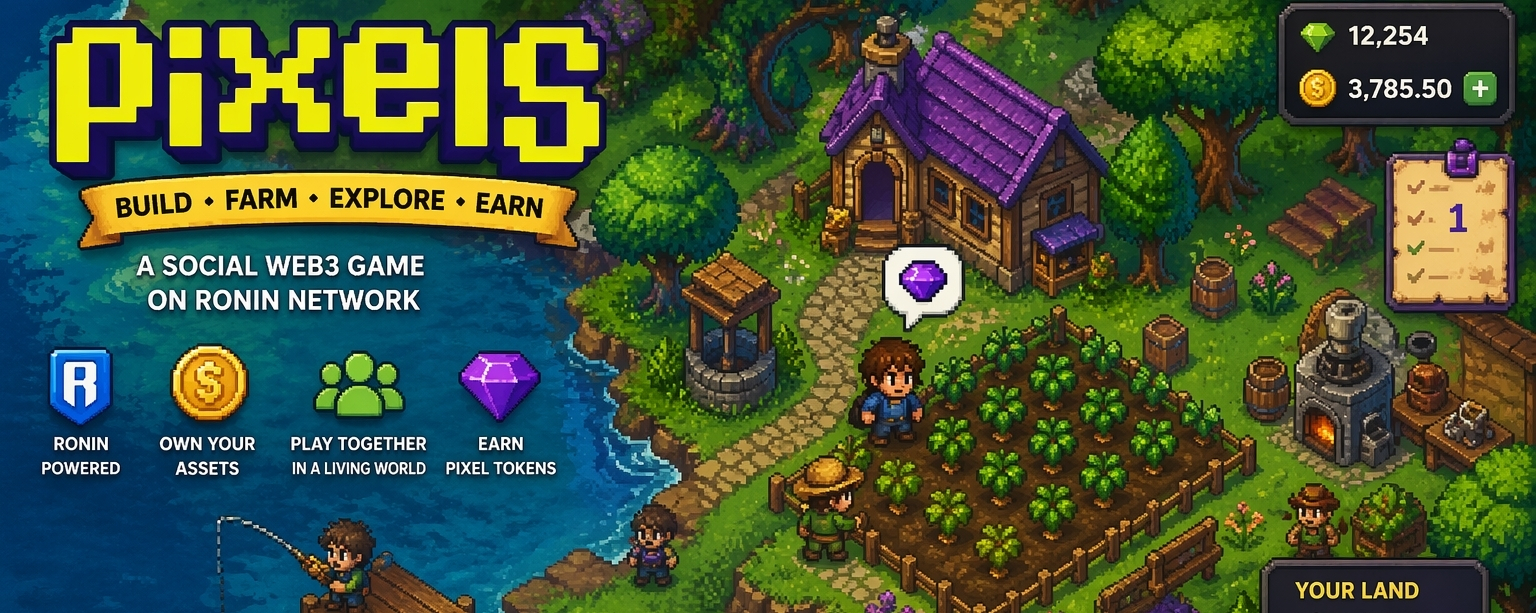
At first glance, Pixels doesn’t try to impress you with overwhelming graphics or fast-paced action. It feels simple, almost nostalgic a peaceful world where you farm, explore, gather resources, and craft items. But that simplicity is intentional. It lowers your guard. And slowly, almost without you realizing it, the game begins to change how you think about what you’re doing. This isn’t just about growing crops or completing tasks anymore it becomes about building something that feels like it belongs to you in a deeper way.
What makes Pixels emotionally powerful is the idea of ownership. In most games, no matter how much you achieve, nothing is truly yours. It all lives and dies within the system. But here, your land, your items, your progressthey aren’t just temporary data. They’re assets you control. That shift may sound technical, but emotionally, it’s profound. It means your effort isn’t just consumed—it’s preserved. It means the time you spend isn’t just passing—it’s accumulating into something tangible. And that subtle difference can completely transform how you feel every time you log in.
The gameplay itself wraps you in a rhythm that feels calm yet meaningful. You plant seeds, wait for them to grow, gather materials, craft tools, and slowly expand your capabilities. There’s an energy system that limits how much you can do, and instead of being frustrating, it gently reminds you that your time has weight. You start making choices—What matters most right now? Where should I invest my effort? And without even noticing, you begin treating your in-game decisions with the same care you might give to real-life priorities. That’s where Pixels quietly blurs the line between a game and a reflection of life itself.
Then comes the economy one of the most fascinating and emotionally complex parts of the experience. Pixels operates on two layers: a simple in-game currency that keeps everything moving smoothly, and a more powerful token that carries real-world value. This dual system creates a delicate balance between play and purpose. You’re free to enjoy the game casually, but if you choose to go deeper, there’s a path where your time, strategy, and consistency can lead to something more. It’s not about quick rewards or empty promises—it’s about creating a space where effort has the possibility of becoming value. And that possibility is what keeps people coming back.
Land ownership adds another emotional dimension. Owning a piece of the world isn’t just about status—it’s about presence. It’s about knowing that this small corner of the game exists because of you, grows because of you, and evolves with your decisions. Some players become farmers, others traders, others builders or community leaders. Slowly, the game stops feeling like a fixed system and starts feeling like a living society, shaped by the people inside it. And in that society, everyone has a role even if they don’t realize it at first.
But perhaps the most human part of Pixels is its social layer. It doesn’t push you into isolation; it invites connection. You see other players, interact with them, collaborate, share spaces, and build communities. Over time, familiar names start to feel like familiar faces. The world feels less like a game and more like a shared environment where stories are constantly unfolding. In a digital age where loneliness can exist even in crowded spaces, that sense of belonging carries real emotional weight.
Still, Pixels doesn’t pretend to be perfect—and that honesty is part of its authenticity. There are moments when the gameplay feels repetitive, when the pace slows down, when the rewards don’t match the effort you expected. And yes, like any system connected to real value, there are uncertainties. The economy can shift, demand can change, and outcomes are never guaranteed. But strangely, these imperfections make the experience feel more real, not less. Because just like in life, not everything is predictable—and not every effort leads to immediate results.
Looking ahead, Pixels feels less like a finished product and more like an evolving story. With each update, each new feature, and each adjustment to its systems, it continues to grow alongside its community. The long-term vision hints at something bigger than just a single game a digital world where players don’t just participate, but truly own, shape, and influence the environment around them. It’s an ambitious idea, and whether it fully succeeds or not, the journey itself is already changing how people think about gaming.
In the end, Pixels isn’t really about farming or crafting or even earning. It’s about something much more personal. It’s about the feeling that your time matters. That the hours you spend aren’t just disappearing into a void, but building somethingeven if it’s small, even if it’s digital. It speaks to a quiet desire many people carry: to create, to own, to belong, and to feel that what they do has meaning.
And maybe that’s why Pixels resonates so deeply. Not because it’s perfect. But because, in its own simple and thoughtful way, it reminds you that even in a virtual world… your effort doesn’t have to be invisible anymore.
