
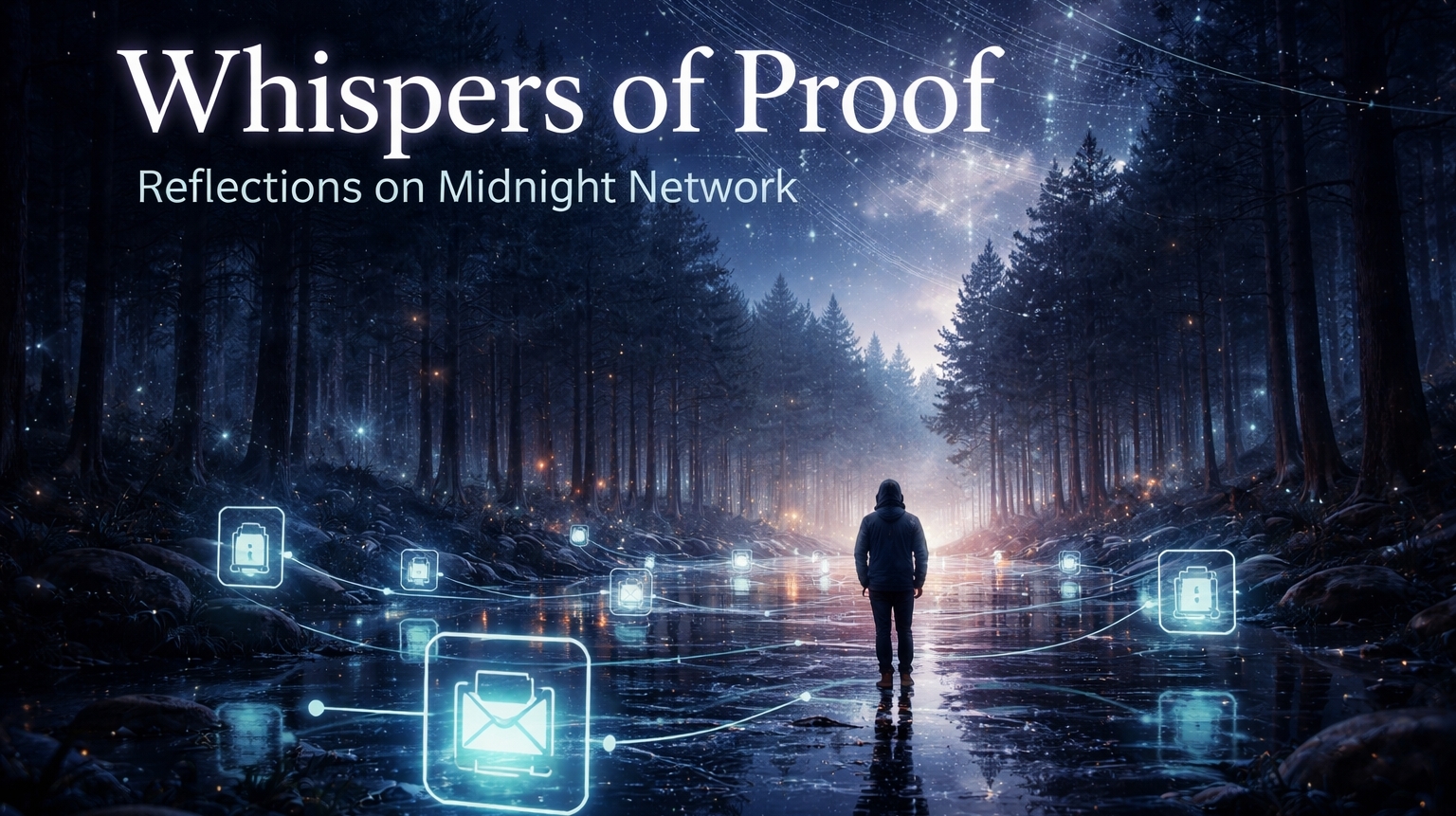
I’ve been carrying this thought quietly for a while, like it’s sitting in the corner of my mind, waiting to be noticed. Midnight Network keeps returning to me, not as a project or a system, but as a feeling. It’s a blockchain, yes, but it doesn’t behave like one I’ve known. It moves, verifies, and confirms, all without exposing itself, all without asking for attention. It’s almost alive in the way it exists quietly in the background.
Zero-knowledge proofs — I keep circling that phrase, trying to hold onto it, but it resists. They let something be true without showing why it’s true, and somehow that doesn’t make it lighter; it makes it heavier. You know something has happened. You know it matters. And yet the knowledge itself is hidden, and that contradiction is… unsettling. It feels like learning to trust a shadow: the shape is there, but you can’t touch it, and somehow that is enough.
I notice the small things first. A token moves. An identity is confirmed. They seem ordinary at first, but then they aren’t. Ownership doesn’t have to be visible. Proof doesn’t need applause. And suddenly, the way I think about trust and responsibility shifts. If verification can exist without exposure, what does that do to the way I measure certainty, or honesty, or even action itself? I don’t know. I just feel the question pulling me.
Sometimes I imagine it as standing at the edge of a dark forest. You can hear movement, see shadows, but you can’t quite tell what’s happening. You trust the patterns, the rhythm, the rules, even when you can’t see them. That’s how it feels — familiar, yet strange. The ordinary world suddenly seems layered, and my mind starts noticing things it didn’t before: the weight of privacy, the quiet power of unseen systems, the subtle influence of things that exist without being pointed at.
And it lingers. I think about people using it, moving data, making choices without exposing themselves. The ethical edges press gently but insistently. What responsibility do we carry when visibility is optional? When proof can exist without spectacle? When participation doesn’t require recognition? I don’t have answers. The questions themselves feel alive, stretching in quiet spaces I hadn’t noticed before.
There’s a subtle elegance in the way it works. It doesn’t demand notice, yet it’s precise, rigorous, dependable. It makes me think about human knowledge, about the things we claim to know and the things we leave unspoken. Some truths, maybe, are meant to exist quietly, without exhibition, and the more I sit with that, the more I notice how my mind shifts.
Time feels different here. Actions that normally feel immediate or transactional take on a latent weight. Cause and effect exist, but not in a chain I can follow with my eyes. I find myself slowing down, noticing, circling questions that don’t resolve. How do you act without showing? How do you prove without revealing? How do you know something is real if the proof is invisible? The more I try to pin it down, the more it slips, leaving only reflection, patience, and curiosity.
I don’t think I’ll ever fully grasp it. Maybe that’s the point. Maybe the value is in noticing, in feeling the subtle shift in how I think, how I measure trust, how I imagine responsibility. Midnight Network hums quietly in the background, moving, verifying, protecting, and I realize that maybe the reflection isn’t about understanding it completely. It’s about how it changes the way I notice, the way I linger, the way I feel the weight of proof even when it can’t be seen. And perhaps the thought is still unfolding, quietly, patiently, just like the network itself.