Labor is finally becoming liquid. For decades, we thought of a robot as a single, fixed tool designed for one specific task in a closed factory, but the shift we are witnessing this week suggests something far more profound. Today is March 5, 2026, and as robo consolidates around the $0.038 to $0.044 range following its massive Binance spot listing yesterday, the market is beginning to price in a future where a machine’s value isn't in its steel frame, but in its ability to download a new purpose. This is the essence of the Robot Crafter and the Skill Chip marketplace, a concept that essentially turns specialized physical labor into a modular software file.
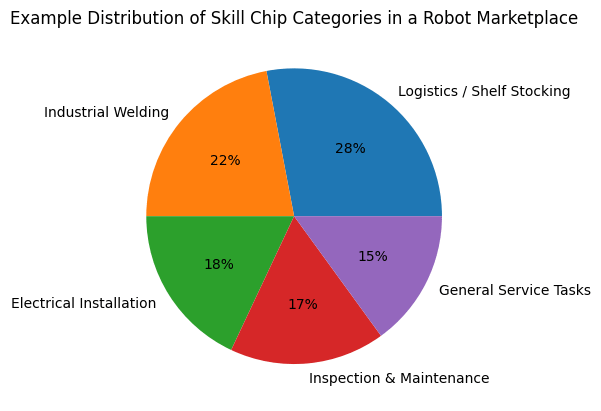
What exactly is a Skill Chip? If you are a developer, think of it as a containerized capability—a compact software file that adds a specific, verified function to a robot, much like an app on your smartphone . But hmmm... there is a massive difference here. In the mobile economy, an app controls pixels on a screen. In the Fabric Foundation ecosystem, a Skill Chip controls atoms in the physical world. A developer can build a "shelf-stocking" or "electrical wiring" skill once and publish it to the App Store. Because the underlying OM1 operating system is hardware-agnostic, that same skill can be deployed across humanoids from UBTech, bipeds from Fourier, or quadrupeds from AgiBot . Yes, the siloed era of robotics is effectively dead.
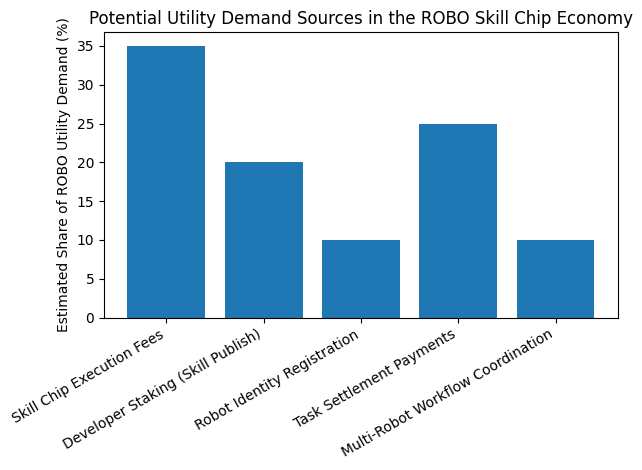
The economic loop here is what should fascinate any serious investor or trader. To publish a skill, a developer doesn't just upload code; they must stake a fixed amount of $ROBO tokens to enter the participant ecosystem . This isn't just a fee; it is a work bond that aligns the developer's incentives with the network’s safety and performance standards. When a robot operator needs their fleet to perform a new task, the machine accesses the Skill Chip and pays a fee per use. This is settled instantly and autonomously on-chain, creating a structural demand sink where $ROBO is the essential fuel for every new "thought" a machine has. No human middleman, no banking hours—just pure machine-to-machine settlement .
Looking at the real-time data from this morning, we see robo maintaining a market capitalization of approximately $99 million with a 24-hour trading volume hovering near $130 million . That volume-to-market-cap ratio is exceptional, signaling that the "Agentic GDP" narrative is moving from pure speculation into infrastructure validation. Why is this trending now? It is because the Q1 2026 roadmap has successfully deployed the initial robot identity and task settlement components . We are no longer waiting for a whitepaper to come to life; we are watching the first robot fleets operate with verifiable on-chain identities and autonomous wallets .
From my perspective as a trader who has seen many "AI" hype cycles fade, the Fabric Foundation's approach feels different because it solves the "winner-takes-all" risk. In a centralized world, a single corporation would own the intelligence and the hardware, essentially monopolizing physical labor. In this decentralized model, a developer in a small studio can create a world-class "welding" skill and compete on equal footing with a giant. The Skill Chip marketplace democratizes access to robotic capability. Hmmm... no, it doesn't just democratize it; it turns labor into a global, programmable commodity.
Philosophically, we must realize that we are transitioning from a world of "owning a machine" to a world of "orchestrating intent." The Robot Crafter platform is the marketplace where that intent is traded. As we look toward Q3 2026, when the roadmap specifies the extension to multi-robot workflows, the demand for these Skill Chips is likely to grow exponentially as machines begin to coordinate complex, multi-stage tasks . For those of us holding ROBO, the trust isn't in a CEO’s promise, but in the mathematical certainty of the Proof of Robotic Work mechanism that validates every single skill execution on the network . We are not just buying a token; we are buying the infrastructure of a new global financial system where machines are the primary participants. I've been in this space a long time, and hmmm... yes, this shift feels like the real deal. Stay focused on the utility, not just the noise.