
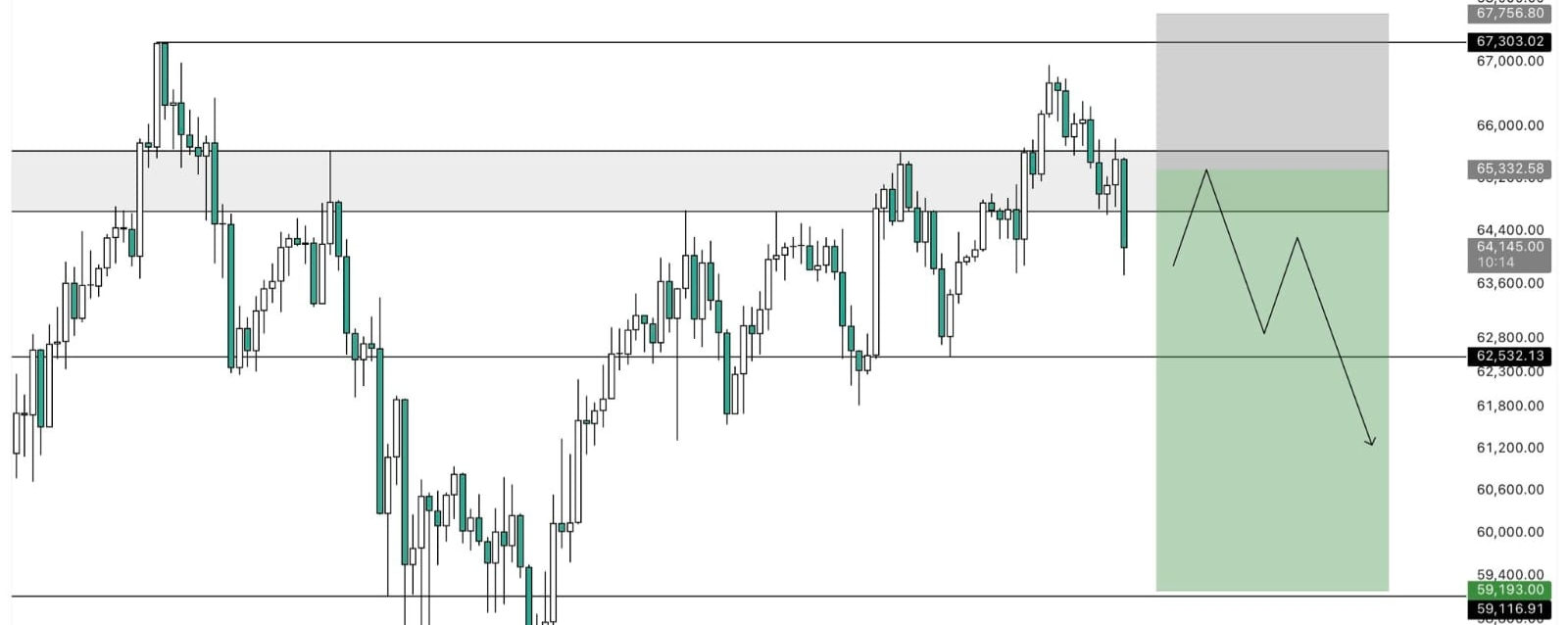

What stands out to me isn't that Bitcoin is trading around the $65K area. It's how much importance the market has attached to a relatively narrow range over the past few weeks. A lot of traders are focused on whether price can reclaim higher levels or break below support, but from a market perspective, that almost misses the more interesting point. The grey support zone has become a test of conviction rather than just another technical level. Holding it would have kept the possibility of breaking the higher time frame downtrend alive. Losing it doesn't automatically change the long-term story, but it does change the short-term balance between buyers and sellers. That changes the way I look at the next move because failed support often becomes resistance, and that shift tends to influence positioning more than headlines do.
The interesting part is how liquidity starts shaping expectations once a key level gives way. If price closes below roughly $64.7K on the four-hour chart and fails to reclaim that level on a retest, the market suddenly has a much clearer downside path. The $62K to $61K area becomes less of a random target and more of a place where liquidity is likely to concentrate. That's where incentives begin to matter. Short sellers see an attractive reward relative to their risk, while buyers who missed previous entries may start preparing for another opportunity. Neither side is guaranteed to be right. Markets rarely reward obvious setups forever. But when enough participants begin looking at the same liquidity pocket, it often becomes self-reinforcing. The real question isn't whether that level gets reached. It's whether demand there is strong enough to absorb selling without immediately breaking down again.
What I keep watching isn't just the price itself. I'm far more interested in how the market behaves if we actually revisit that lower zone. Does volume expand because new buyers are stepping in with conviction, or does liquidity disappear as participants become more cautious? Does the bounce happen because genuine demand returns, or simply because short sellers begin taking profits? Those are very different signals even if the chart initially looks the same. Trust in a market isn't measured by a single candle. It's measured by whether participants continue defending important levels after volatility increases. If buyers hesitate after multiple opportunities, that tells me something very different than a sharp rejection followed by sustained accumulation. Price is only one part of the picture. Behavior around price usually matters much more.
For now, my approach is patience rather than anticipation. If the breakdown is confirmed and the retest fails, the path toward the $62K to $61K liquidity zone becomes much easier to understand from a risk management perspective. If that confirmation never comes, forcing a bearish view simply because support looked weak would make little sense. The real test isn't whether Bitcoin briefly trades lower. It's whether the market still treats lower prices as opportunities worth defending, or whether conviction starts fading once support is lost. That's the question I'll keep watching, because it probably matters more than whether the next move is up or down.