

The global financial system is built on a simple promise. When a country produces more goods and services its currency should reflect that real economic growth. That connection has completely broken down. Across every major developed nation the total supply of money is growing at a rate that leaves actual economic output far behind.
❍ Canada Leads the G7 in Money Supply Growth
The disconnect between money creation and real economic expansion is most visible in North America.
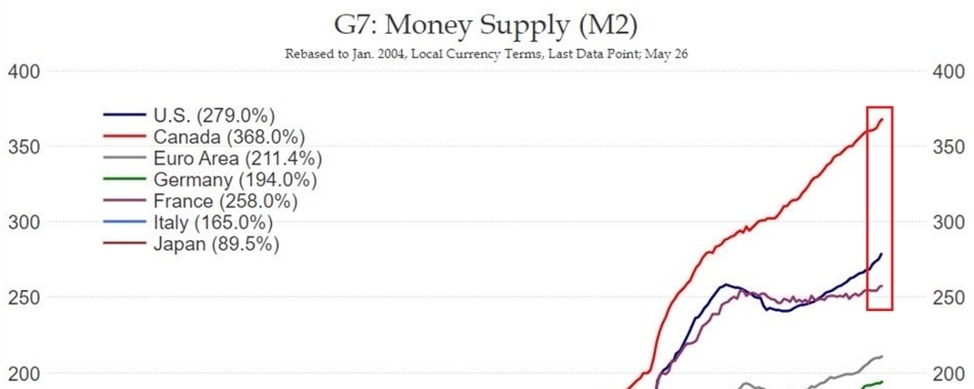
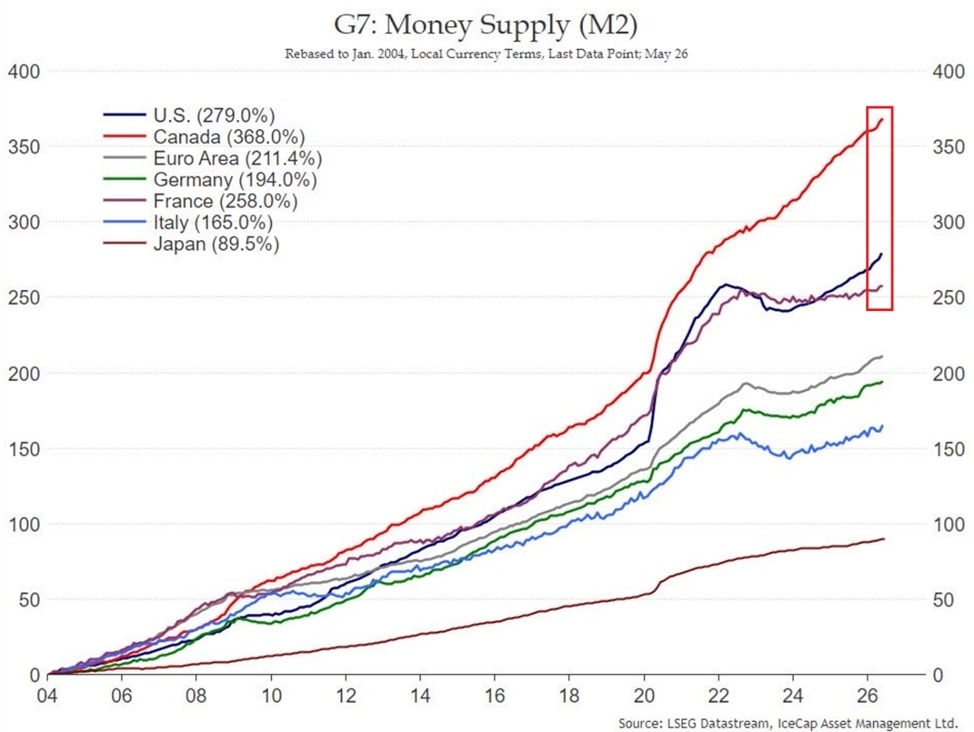
Canada holds the largest gap among all G7 economies. The M2 money supply in Canada has grown by 368 percent since January 2004.
Over that exact same timeframe the actual Canadian economy has only expanded by 159 percent. The growth in currency is more than double the growth in actual goods and services.
The United States follows a very similar path. US money supply has surged by 279 percent while nominal GDP has increased by 171 percent.
❍ Europe and Japan Feel the Structural Gap
This trend is not limited to North America. Central banks across Europe and Asia are pumping currency into circulation at speeds their local industries cannot match.
In France the M2 money supply has jumped by 258 percent while its economy grew by just 84 percent. The broader Euro Area shows a similar imbalance with 211 percent money growth against 102 percent economic expansion.
Japan records the slowest overall economic pace in the G7. Its economy expanded by just 25 percent since 2004 while its money supply climbed by 90 percent.
Every single major nation is relying on faster currency creation to keep its financial system afloat.
Some Random Thoughts 💬
When money supply outpaces economic growth by this magnitude the math eventually catches up to everyday people. Central banks print currency to solve short term debt crises and stimulate growth, but that excess liquidity loses its purchasing power over time.
This structural reality is the exact reason why alternative assets continue to gain traction. When fiat currencies are diluted faster than actual economic productivity, capital naturally migrates toward hard, scarce assets that governments cannot inflate away. Understanding this divergence is the first step to protecting your long term wealth from silent currency devaluation.