
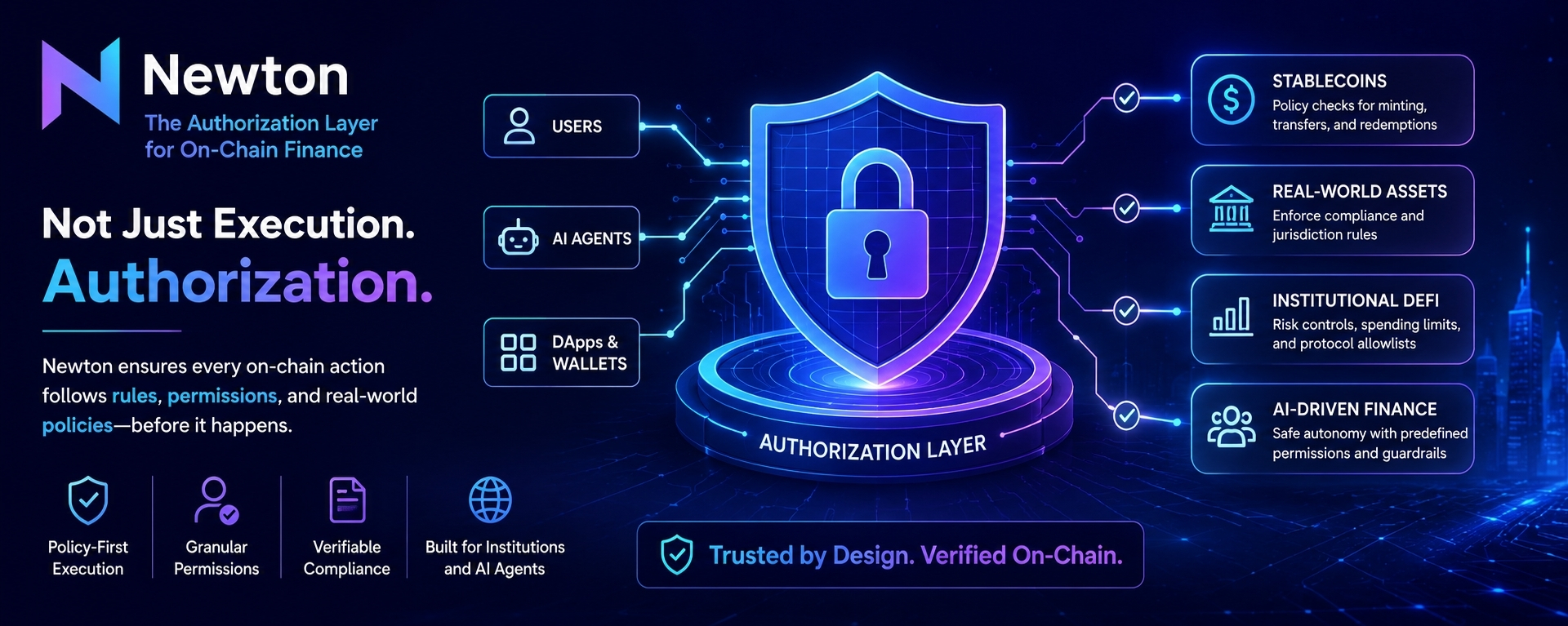

Newton caught my attention because it didn't keep chasing the same AI trading story that almost every new project was pushing. Instead of trying to build another agent that promises to outperform the market, Newton started asking a much more practical question: before AI is trusted to move money, who decides what it's actually allowed to do? That change says a lot about where the team believes on-chain finance is heading.
For a while, the conversation around AI in crypto was almost entirely about automation. The assumption was that smarter models would naturally lead to better trading, better portfolio management, and better returns. It sounded exciting, but excitement isn't enough when real assets are involved. The more people experimented with AI agents, the clearer it became that intelligence alone doesn't create trust.
That's where Newton started separating itself.
The project shifted its focus from simply helping AI execute transactions to building the rules that sit in front of every transaction. Instead of asking whether an agent can make a decision, Newton asks whether that decision follows the permissions already set by the user, a business, or an institution. That might not sound as flashy as automated trading, but it's a far bigger problem to solve.
Think about how people handle money in everyday life. Parents put spending limits on their children's cards. Businesses decide which employees can approve payments. Banks constantly check whether a transaction looks normal before allowing it to go through. Nobody sees those checks as an inconvenience because they're the reason people feel comfortable using the system in the first place.
Crypto has never really had that layer.
If a wallet signs a transaction, it usually goes through. The blockchain doesn't stop to ask whether the payment breaks a company policy, exceeds a spending limit, or sends funds somewhere that should never have been approved. That approach works for simple transfers, but it becomes much harder to defend when AI agents are making decisions on behalf of users or businesses.
Newton is trying to fill that missing piece.
Instead of treating authorization as an afterthought, it puts policies at the center of the transaction flow. Users can define what an AI agent, wallet, or application is allowed to do before anything happens on-chain. That changes the relationship between automation and trust. The AI doesn't just act freely; it operates inside clear boundaries that can be enforced.
I think that's a smarter direction than competing with every other AI trading platform. Markets change every day, strategies stop working, and models improve constantly. Rules, however, don't become less important. If anything, they become more valuable as more money and more institutions move on-chain.
This also makes Newton relevant beyond AI. Stablecoin issuers, tokenized asset platforms, payment providers, DAOs, and enterprise treasury teams all face the same challenge. They need automation, but they also need control. They want systems that can move quickly without removing the safeguards that make financial operations reliable.
That balance is difficult to achieve, and it's probably why Newton's recent direction feels more mature than simply promising smarter bots. The project seems to recognize that the future of on-chain finance won't be built by giving AI unlimited freedom. It will be built by making sure every action happens within rules that users can understand and trust.
One thing I appreciate is that Newton isn't trying to replace human judgment. It's trying to define it before execution begins. Once those policies are in place, automation becomes much less intimidating because people know exactly what their wallets, applications, or AI agents are allowed to do.
The crypto industry spends a lot of time talking about faster transactions, cheaper fees, and more powerful AI. Those improvements matter, but none of them solve the biggest question people still have: "Can I trust this system with my money?" Newton's answer isn't another prediction model or another trading strategy. It's an authorization layer that makes every transaction accountable before it happens.
That feels like a much stronger foundation than chasing short-lived narratives. AI will keep evolving, trading strategies will keep changing, but trust will always decide whether people are willing to use financial technology at scale. Newton seems to understand that, and that's exactly why its pivot feels less like changing direction and more like moving toward the problem that mattered all along.