

One thing I've noticed about @NewtonProtocol is that it made me pay attention to something I had been ignoring for a long time.
Whenever people talk about blockchain, the conversation usually goes in familiar directions. Faster transactions. Lower fees. Better scalability. More users. Bigger ecosystems.
Permissions almost never make the list.
To be honest, I didn't think much about them either.
I used to see the "Approve" button in my wallet as just another step before using a protocol. Click it, sign the transaction, and move on. It felt routine. I never stopped to ask what I was actually approving or how long that permission would stay active.
The deeper I went into Newton's architecture, the more I realized that this habit isn't unique to me. It's something most of us have picked up over the years.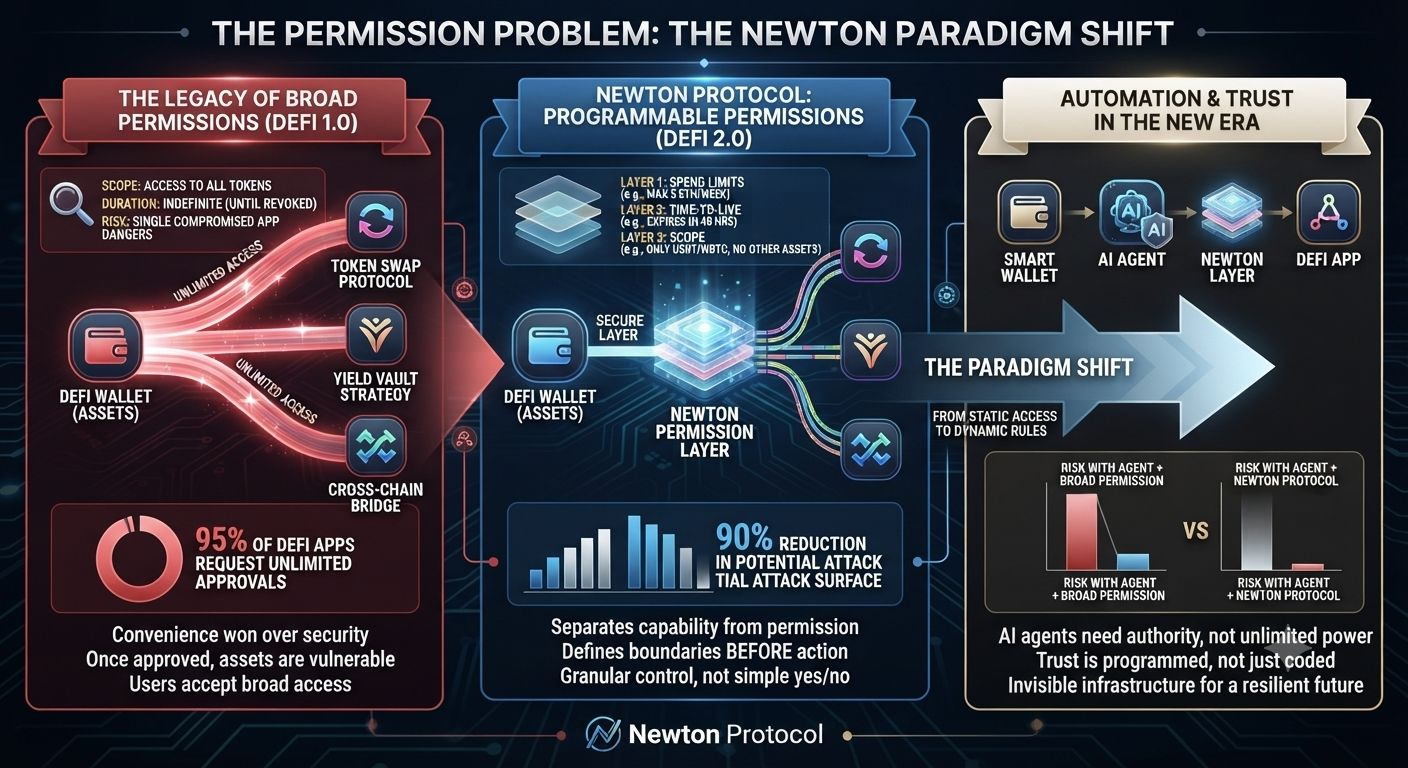
We've become comfortable giving applications broad access because that's simply how DeFi has worked.
That doesn't necessarily mean it's the best way.
The more I explored Newton, the more I felt like it wasn't trying to build another flashy feature. Instead, it was asking a question that the industry had quietly stopped asking.
What if permissions themselves needed an upgrade?
At first, that sounded like a small detail.
It turned out to be much bigger than I expected.
Think about how most approvals work today. You want to swap a token, deposit into a vault or use an automated strategy. The protocol asks for permission, you approve it, and in many cases that approval stays active long after you've finished what you wanted to do.
Most of the time, nothing bad happens.
But that isn't really the point.
The question is whether those permissions are broader than they actually need to be.
That thought stayed with me.
Outside of crypto, we rarely give unlimited access unless it's absolutely necessary. A company doesn't give every employee administrator privileges. A hotel gives you access to your room, not every room in the building. Even your streaming subscriptions let different people have different levels of access.
Somehow, Web3 ended up normalizing much wider permissions than many of us would probably accept elsewhere.
I don't think that happened because developers ignored security.
I think it happened because convenience won.
It's easier to ask for one broad approval than several smaller ones. It's faster. Users experience less friction.
For a while, that tradeoff probably made sense.
But DeFi today isn't what it was three or four years ago.
People are managing larger portfolios. Automated vaults execute strategies around the clock. Cross-chain transactions happen constantly. AI agents are beginning to make decisions without users manually confirming every step.
As the ecosystem becomes more capable, the consequences of broad permissions naturally become larger too.
That's where Newton started to make sense to me.
Instead of treating permissions as something static, it approaches them as something that can be programmed with rules.
That sounds technical, but the idea is actually pretty simple.
Imagine lending your car to someone.
You could hand over the keys and hope they only drive to the grocery store.
Or you could somehow limit the car so it can only be driven within a certain area, during certain hours and only for that specific trip.
The second option gives you much more confidence without removing convenience.
That's how I started thinking about Newton's permission model.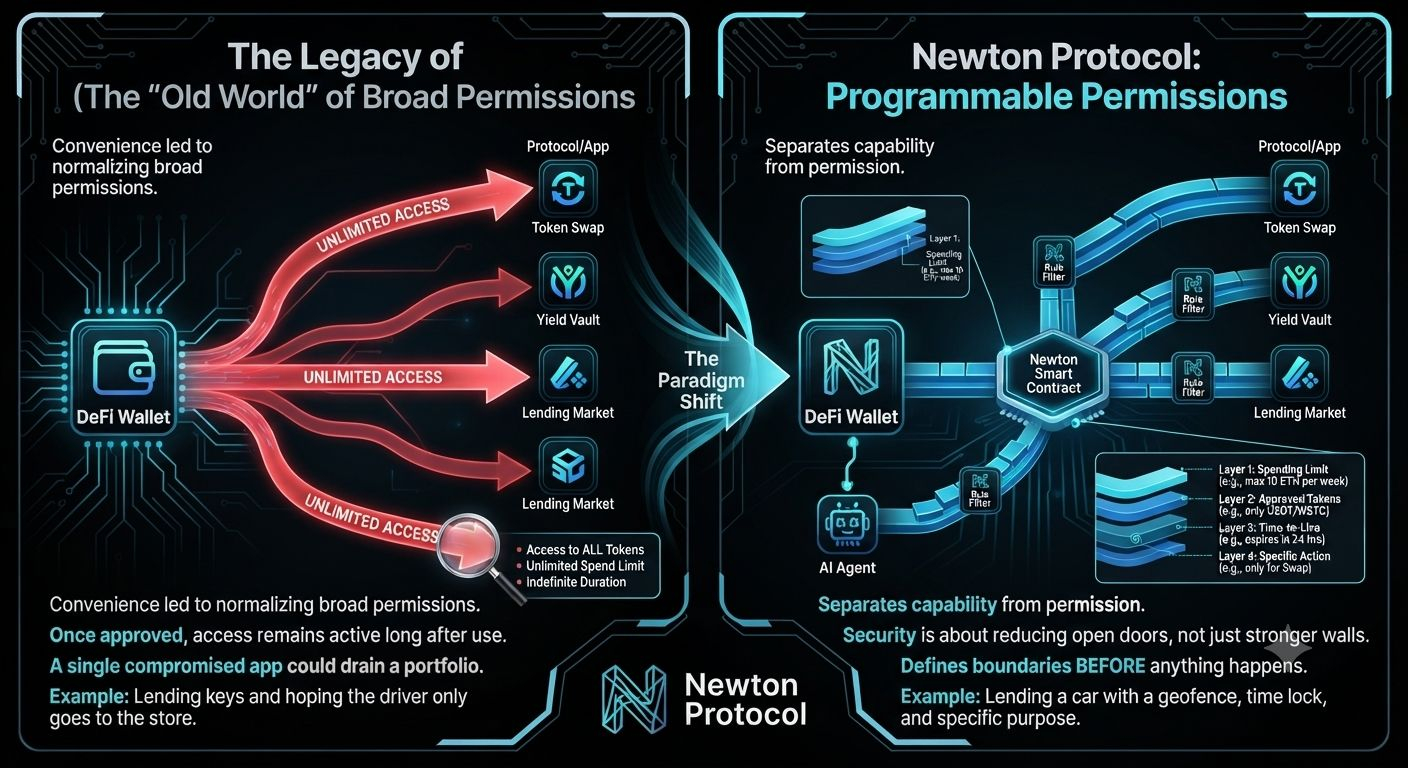
It's less about saying "yes" or "no."
It's about defining the boundaries before anything happens.
The more I thought about it, the more I realized that security isn't always about building stronger walls.
Sometimes it's about making sure fewer doors are left open in the first place.
That idea feels surprisingly relevant as automation becomes a bigger part of crypto.
Everyone seems excited about AI agents managing portfolios, moving liquidity, or executing complex strategies.
I think that's exciting too.
But I also kept asking myself another question.
How much authority should those agents actually have?
If an AI is acting on my behalf, I don't just want it to be smart.
I want it to be limited.
Not because I expect it to fail, but because good systems shouldn't rely on everything going perfectly forever.
That might be the biggest shift in how I now think about permissions.
For a long time, trust in crypto often meant trusting code.
Newton seems to push that idea one step further.
Trust shouldn't only come from believing the software works.
It should also come from knowing the software simply isn't allowed to do certain things.
There's an important difference between capability and permission.
A system might technically be capable of accessing assets.
That doesn't automatically mean it should have permission to do so.
Those two ideas have often been treated as the same thing.
Newton separates them much more clearly.
One thing I appreciate is that this approach doesn't ask users to become security experts.
Most people don't enjoy reading smart contract documentation before every transaction.
Honestly, I don't either.
The goal shouldn't be making users memorize more technical information.
The goal should be designing systems where users don't have to constantly wonder whether they've approved more access than intended.
That's a design improvement, not just a security improvement.
Of course, no protocol eliminates risk completely.
Anyone who says otherwise is probably oversimplifying reality.
Software can have bugs. Smart contracts can fail. Markets can behave unpredictably.
Those challenges aren't disappearing anytime soon.
But reducing unnecessary permissions feels like solving a problem that actually matters.
It doesn't guarantee safety.
It simply reduces opportunities for things to go wrong.
Sometimes that's exactly what good engineering looks like.
It's easy to get excited about headline features because they're visible.
Permission systems aren't exciting.
They're mostly invisible.
Ironically, those invisible parts often determine how resilient a protocol becomes over time.
After spending time learning about Newton, I came away thinking less about one protocol and more about the direction the entire industry is heading.
Web3 is becoming more automated every year.
Wallets are becoming smarter.
Applications are becoming more connected.
AI is beginning to participate in workflows that used to require constant human input.
If all of that continues, permission management stops being a background feature.
It becomes part of the foundation.
That's probably what stayed with me the most.
Newton didn't make me think that permissions are a solved problem.
It made me realize we've barely started talking about them.
Maybe that's because permissions aren't easy to market.
They don't produce impressive TPS numbers.
They don't create flashy demos.
Most users won't even notice when they're working well.
But that's often how good infrastructure works.
You rarely think about it until it's missing.
Whether Newton's approach becomes the standard is impossible to predict. What I do know is that it made me question an assumption I hadn't challenged before.
For years, we've accepted broad permissions as the cost of convenience. Maybe they were.Or maybe they were simply the best solution available at the time.
If protocols can now offer automation while giving users more precise control over what they're authorizing, that's a conversation worth paying attention to.
For me, that's the most interesting part of Newton. Not that it's trying to make DeFi faster. But that it's asking whether the way we've handled trust all along deserves another look.