
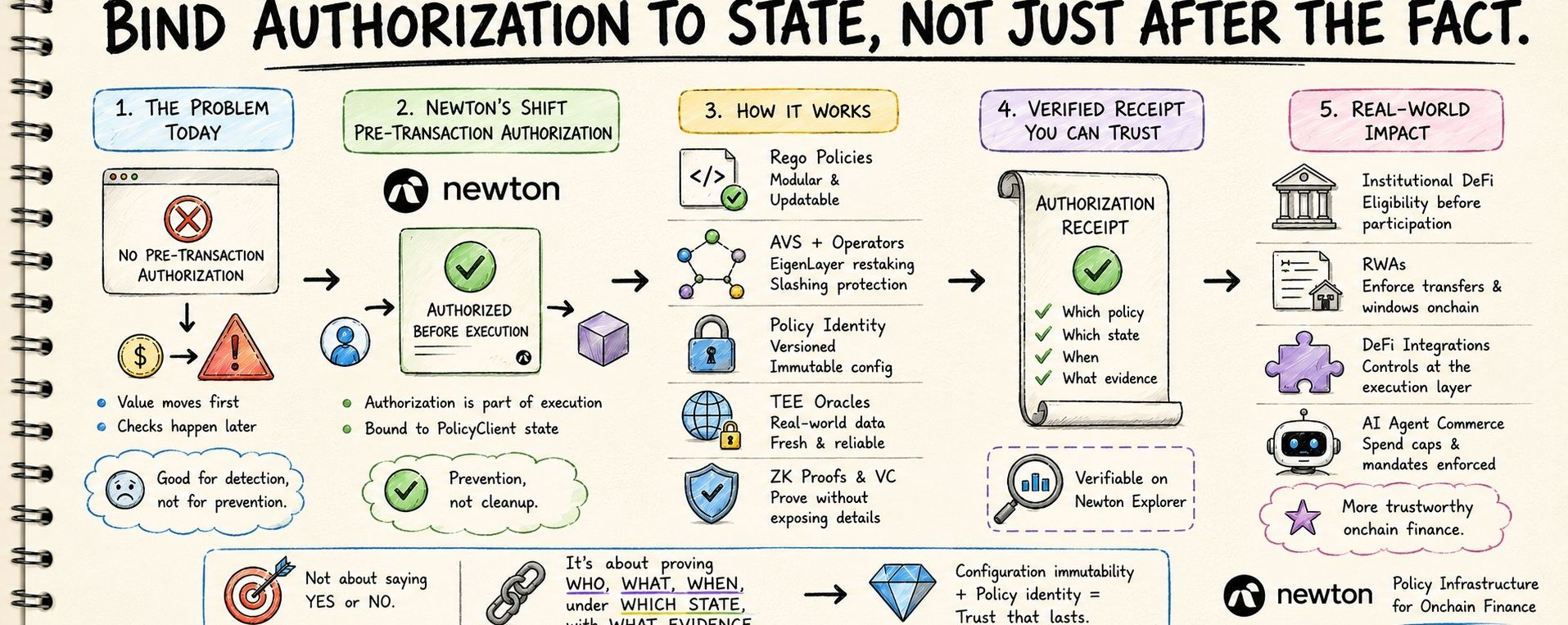

When more than $700 billion moves through onchain finance every month, the absence of pre-transaction authorization stops looking like a technical gap and starts looking like infrastructure debt. Stablecoins alone are already moving at a scale that forces the question: who decided this transaction was acceptable before the chain executed it? Right now, most systems answer after the fact. That works for detection. It does not work for prevention.
That distinction matters more than people admit. Reactive compliance can flag a transfer, freeze a wallet, or raise an alert after something happens. But once value has already moved, the control layer is playing cleanup. For institutions, that is not a minor weakness. It is the reason many of them still treat onchain markets as something to observe from the edge rather than participate in directly. If you cannot prove that a transaction was authorized under a valid policy at the moment it was submitted, then every later audit feels like a second-best substitute.
That is where Newton starts to look interesting. The core idea is not just “we monitor policy violations,” but “we bind authorization to state in a way that can be checked before settlement.” I think that is the real shift. Newton is trying to make authorization a first-class part of execution, not a logging layer sitting beside it. That changes the architecture. It also changes the trust model.
The phrase configuration immutability sounds dry until you realize what it is protecting against. In a policy system, the dangerous failure is not always a bad rule. Sometimes it is a good rule attached to the wrong configuration, or a valid policy evaluated against stale state. Policy identity matters for the same reason. If an authorization receipt can be verified later, but the policy client that created it has drifted, then the proof no longer says what people think it says. Binding authorization to PolicyClient state is Newton’s way of saying that policy is not just a string of logic. It is a live object with identity, version, and context.
That is why the Rego angle matters. Rego gives Newton modular, composable policy logic instead of hard-coded, one-off contract checks. In practice, that means an institution can express rules like investor eligibility, jurisdiction restrictions, counterparty screening, or position limits without redeploying the whole application every time policy changes. The policy can evolve without turning the smart contract into a maintenance problem. That is a big deal, because institutional compliance is never static. It moves with markets, regulators, and internal risk teams.
Newton’s AVS design is the other piece that makes the model feel more serious than a typical compliance layer. By running as an Actively Validated Service beside smart contracts, Newton is not asking one operator or one company to make the call. It uses a decentralized operator network secured through EigenLayer restaking, with economic bonding and slashing for dishonest evaluations. That matters because authorization only becomes credible when the evaluator has something real to lose. Without that, “policy enforcement” is just a fancy word for centralized discretion.
The architecture also looks more complete than many crypto compliance ideas because it is not pretending onchain rules can live in a vacuum. Newton’s TEE-based oracle layer pulls in offchain data so policy decisions can reflect real-world context. That could mean sanctions data, eligibility proofs, transfer windows, or other data points that need to exist outside the chain but still affect what should happen on it. The privacy layer is equally important. Zero-knowledge proofs and verifiable credentials let Newton validate conditions without exposing everything behind them. In other words, the system is not just asking, “Was this allowed?” It is asking, “Can we prove it was allowed without leaking the entire reason why?”
That last part is where the project feels more durable to me than the usual compliance narrative. The strongest version of Newton is not a surveillance tool. It is a receipt engine. Authorization receipts that can be verified on Newton Explorer turn compliance from a retrospective paperwork exercise into a live cryptographic trail. For institutional DeFi, that could mean an investor gets checked against eligibility rules before they enter a position. For RWAs, it could mean transfer restrictions and redemption windows are enforced as part of the asset’s actual behavior, not just written into legal docs no one reads. For Uniswap v4 hooks, it could mean institutional controls exist at the execution layer instead of being bolted on later. For AI agent commerce, it could mean spend caps and mandate enforcement are enforced before an agent spends outside its lane.
Still, I do not think the novelty here is just technical. The more interesting part is market positioning. Newton is trying to sit in a narrow but valuable gap between raw execution and regulated access. That is a better category than “compliance product,” because compliance products often sound like dashboards. Newton sounds like policy infrastructure. That is a more ambitious claim, and also a harder one to prove. The real test is whether developers actually adopt it as a default control layer, not just as a demo for institutional optics.
I also think the strongest skepticism is obvious. Policy systems are only as strong as their freshness, their data sources, and their operational discipline. A beautiful authorization architecture can still fail if the upstream policy state is stale, if the oracle inputs are delayed, or if the verification flow becomes too slow for real markets. Pre-transaction control is attractive, but it cannot become so heavy that it breaks the very use cases it is supposed to unlock. That tension is not a footnote. It is the product.
Magic Labs being behind Newton gives the project credibility in a very specific way. They already understand embedded wallets and developer distribution at scale, which matters because policy infrastructure is useless if it never gets integrated. But scale in wallets is not the same thing as scale in authorization. This is a new problem category. The company has the right kind of experience, but the market will still judge Newton on whether it makes onchain compliance feel native instead of external.
That is why I keep coming back to configuration immutability and policy identity. The phrase captures what most systems get wrong. Authorization is not only about deciding yes or no. It is about proving which policy decided, under what state, at what moment, and with what evidence attached. If Newton can keep that chain intact, it could become one of the few projects that actually changes how onchain finance is allowed to operate. Not louder. Just more trustworthy. $NEWT #Newt @NewtonProtocol
